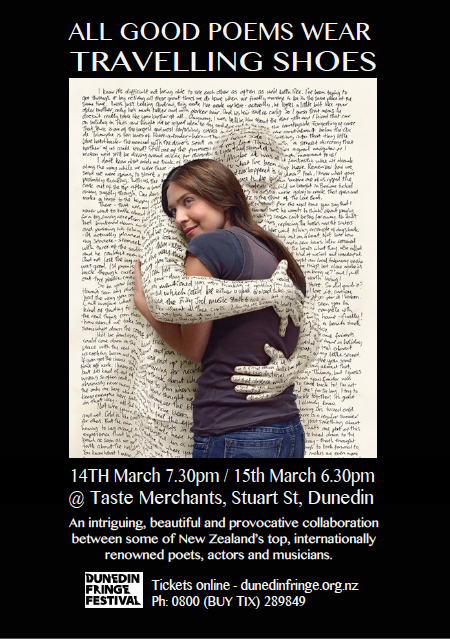
You are invited to the launch of Heartland, Michele Leggott’s new book

Poetry Shelf aims to celebrate the arrival of Michele Leggott’s new book with a review and an interview but meanwhile here are the details for her launch.


Heartland Ak City launch invitation

Brian Turner Wins Caselberg International Poetry Prize 2014

Brian+Turner+SST

Congratulations!

Brian Turner Wins Caselberg International Poetry Prize 2014

Otago poet Brian Turner has been awarded the $500 first prize for his poem ‘Mulching’, in the annual Caselberg Trust International Poetry Competition.

Second prize ($250) went to Dunedin-based writer Annelyse Gelman for her poem ‘Auden,’.

Poems by Mary Macpherson (Wellington), Lynley Edmeades (Dunedin) and Jessica le Bas (Nelson) were highly commended by this year’s competition judge, the distinguished poet Sue Wootton. Another entry from Brian Turner was also highly commended.

In her report, Ms Wootton said that each of the winning entries was ‘adeptly tuned, attentive to itself at every turn.  What is said is inseparable from how it’s said.’ Over 200 entries were received for this year’s Caselberg Trust International Poetry Competition, from writers working in several different countries. Entries are judged ‘blind’, with the judge being completely unaware of the author’s identity until after the final decisions have been made.

The prize-winning poems and the judge’s report will be published in the May issue of Landfall, and together with the highly commended entries, will be posted on the Caselberg Trust web-site next month. Awards will be presented at a function at the University Book Shop in Dunedin, in April.

Past winners of the Caselberg competition include Mary McCallum from Wellington, and Tim Upperton from Palmerston North (who won two years in succession). Previous judges have been poets Bernadette Hall, James Brown and Gregory O’Brien.

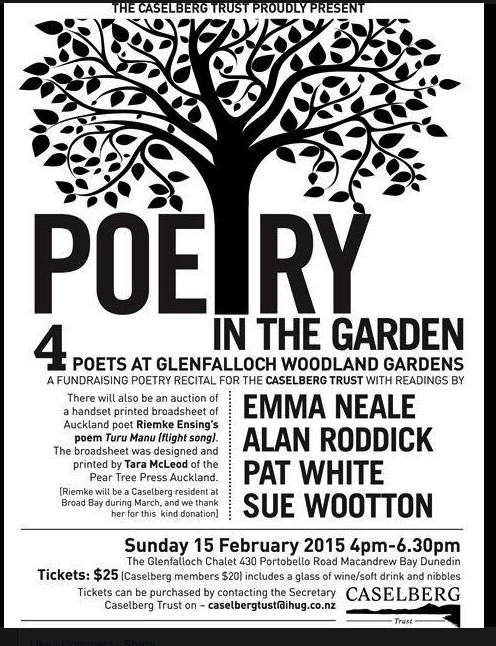
The Caselberg Trust was established seven years ago to buy and renovate the former home of writer John Caselberg and his wife, the painter Anna Caselberg. The Caselberg house is now a residence for writers and artists of all descriptions, and the Trust runs residencies, workshops, exhibitions, and innovative arts events for the wider Dunedin community.
Robert West

Secretary Caselberg Trust
PO Box 71 Portobello Dunedin

www.caselbergtrust.org
info@caselbergtrust.org

Alice Miller’s debut poetry collection liberates a way of reading that defies limits

IMG_8526    THE LIMITS_CONCEPTS_01


The Limits, Alice Miller (Auckland University Press, 2014)

Alice Miller, an award-winning author, has just published her debut poetry collection both in New Zealand (Auckland University Press) and in Britain (Shearsman, due May). Alice’s awards indicate the eclectic stretch of her writing: a Creative New Zealand Louis Johnson Bursary, the BNZ Katherine Mansfield Premier Award for Fiction, the Landfall Essay Prize and the Royal Society of New Zealand Manhire Prize. She was the Glenn Schaeffer Fellow at the Iowa Writers’ Workshop and graduated from the International Institute of Modern Letters at Victoria University with an MA with Distinction. Alice has also worked as an historian, studied music and taught creative writing. She held the recent Summer Residency at the Michael King Writer’s Centre in Auckland. She usually lives in Vienna where she is Associate Editor of The Vienna Review.

The Limits is a slender volume (37 poems) with widespread possibilities. The poems are quiet, spare and luminous. Each poem is like a marvellous vista—it is as though you keep returning to the same spot on a hill to contemplate a view because that view is in a glorious state of flux. Always on the move, sustaining, transcendental. This is what it is like to read an Alice Miller poem.

The poems sit in mist or silence or enigma, or puzzling and then rewarding fragments. This is not prosaic writing, the plain everyday lilt we find in much of our local poetry (nothing wrong with that!). If there is a story to be told, it is told in a poetic manner (but not ornate lines that strive for the Romantic or the Baroque). If there is a story to be told, it is told though the poetic art of concealment, of ellipsis: the white space on the page, the silent beat in the rhythm and the fertility of the gap. This shifts the manner of reading—no ambulatory beat here. Instead, as reader, you stall and you ponder, you concentrate and you backtrack. Most of all, and this is what I love about these poems, you drift in the poetic space, feeding both intellect and heart.

Alice also embraces the abstract. As you move through a poem, it is as though you are moving through the surreal, the unreal, the unearthy, a dreaminess that is one step back from the grit and grimy edge of the real, of everyday life with its bumps and hollows. Yet Alice does something extraordinary—she gives life to the philosophical, the dreamlike, the mist beyond limits and within limits. Enigmatic detail compounds. Things may be things and nothing more or they may shimmer and shine as metaphor or symbol.

The collection is divided into four parts: Skin, Steps, Earth, Body. It is fascinating to link these governing entities back to the title of the book; the way there are borders (inside/outside, corporeal/heavenly, containment/limitlessness), the way there is implicit movement and travel (the earth on its axis, the steps) and the way all roads lead back to what it is to be human (are there limits?).

Sometimes single lines leap out and then you leap with them:

‘Still the spaces keep growling for something.’

‘I may wander but my wonder’s still.’

‘You’ll always have life instead of art.

‘Tonight a scrunch of air between fingers/ what more do you expect?’

‘You are locked/ in the wing/ of history/ with blood still/ stuck in your veins.’

‘I look out, and the terms are still sloshing/ by our window, past cobwebs nestled/ in hedges like fog.’

‘I fashion some antlers/ to guard my brain.’


Alice’s poems are so beautifully crafted. ‘Apple’ is an earthquake poem and it is the strand of verbs that constitute a shudder and aching ripple through the poem (cracked, reaching, brush, crane, caress, wrench, rip, split, shudder, broke, tore). These verbs create a moving ripple effect through the poem that heightens the intensity and is matched by the shifting placement of lines upon the page. To me Alice’s poetic choices get to some kind of poetic essence (is this possible?) and then breaks out visually, semantically, emotionally to wider effect.

At times the syntax and vocabulary are fluent and reachable; at other times they seem deliciously out-of-kilter, quirky even. ‘In Season’ is a superb example of the latter. There are the trademark gaps, the points of ellipses, the dense accumulation of detail. It might be an unexpected verb choice: (‘Listen to waves mutter/ as sun butters the water’ or ‘A couple/ of boots stroke the road’). The overall effect, in my view, is a finely crafted stream-of-consciousness (yes, an oxymoron).

There are other ways to enter these poems. You can follow the deeply grooved tracks of love (poems are often addressed to a mysterious ‘you’ and the love felt is palpable). You can also follow in the steps of the historian and re-enter historical or mythical moments and figures (Troy, Caesar, Rome’s Senate, war, Brahms, Picasso).

Alice’s debut collection liberates a way of reading that defies limits, that poses limits and that makes dazzling connections. Each poem takes you to the top of the hill where you sit to behold the view, a view that shifts and settles, shifts and settles, in countless extraordinary ways.


See my interview with Alice here.

Alice Miller website

Auckland University Press page

Shearsman UK page

On Antarctica on New Zealand Book Council page

Alice Miller’s poetry duets — The Red Room page

Dylan Horrocks has no words in his mouth and makes poetry

IncompleteWorks_frontCover__43649.1386021015.220.220   IncompleteWorks_frontCover__43649.1386021015.220.220

I went to hear Dylan Horrocks in conversation with Sarah Laing at Auckland Central Library the other night (it was to celebrate the arrival of Dylan’s Incomplete Works (Victoria University Press). It was a great conversation!

I was most intrigued to hear Dylan make strong connections between comics and poetry (he said he wasn’t surprised as both his parents were poets). He then said there were a number of cartoonists using poetry as comics (or comics as poetry).

Dylan introduced one of his pages by suggesting we think of it as a poem with no words (‘there are no words in my mouth’). He also said he felt intimidated trying to write a poem with words when pictures usually bear 50% of the load (my word) in a cartoon (graphic novel). It sidetracked me into thinking about the way a poem set to music becomes something completely different as the poem’s internal music (so important to some poets) gets lost, drowned out, diluted. So if a cartoonist makes a poem does it too become something different because the poem’s internal images are now coloured by the sketching pen? Fascinating! And is it simply the notion that a picture is a thousand words kind of poetry (no words in my mouth) and you enter a an image by way of a bridge of silence?

One of Dylan’s favourite NZ cartoonists, Rachel Jones (or is it Fenton?) (Rae Joyce?), has written a poem in comic form which I am keen to read. A whole new world opens before me! Wonderful!

Then … just as I am about to type this post in black font which I have zero control over on WordPress I see Rachel Fenton (Rae Joyce) has posted about the occasion herself (and picked up on the poetry references). And oh I get sucked into a vortex of names and identities unsure of what’s going on here.

Unlike me, Rachel has rendered the event with brush and colour and wit. A comic strip. See it here.

Here is an example of her graphic poetry.

And another.

Best NZ Poems 2013 is now live and the list is a cracker!

Here is a list of the poets in the latest edition of Best NZ Poems edited by Jane Stafford and Mark Williams. Poetry Shelf has featured many of these poets to date and I can’t wait to work my way through the poems. This is a terrific line up — imagine it as a poetry reading!

Fleur Adcock Hinemoana Baker Amy Brown Sarah Broom Kate Camp Mary Jane Duffy Murray Edmond Johanna Emeney Cliff Fell Bernadette Hall Dinah Hawken Caoilinn Hughes Anna Jackson Anne Kennedy Michele Leggott Therese Lloyd Selina Tusitala Marsh John Newton Gregory O’Brien Rachel O’Neill Vincent O’Sullivan Elizabeth Smither Chris Tse Ian Wedde Ashleigh Young

Check out the 2013 page here

The giveaway copy of Gathering Evidence by Caoilinn Hughes

gathering_evidence_front__66501.1385936635.140.215   gathering_evidence_front__66501.1385936635.140.215   gathering_evidence_front__66501.1385936635.140.215

Sarah Jane Barnett’s name  was picked out of the hat and will receive a copy of Gathering Evidence by Caoilinn Hughes thanks to Victoria University Press.

My review here.

Caoilinn’s picks for April’s On the Shelf here.


On the Shelf: April’s picks by Albert Wendt, Caoilinn Hughes, Amy Brown, Zarah Butcher-McGunnigle

1. Albert Wendt

 Just finished reading Coconut Milk by Dan Taulapapa McMullin (University of Arizona Press).

A beguiling collection: the poems are open, innovative, humourous, and compassionate.

Also Afakasi Speaks by Grace Taylor (Ala Press, Hawaii, 2013).

Vigorous, honest, energetic poetry that wraps you up in its arms and carries you along into complex emotional depths and tensions.

Albert Wendt is one of most New Zealand’s most treasured writers, in both poetry and fiction.


2. Caoilinn Hughes

Bevel by William Letford (Carcanet Press, 2012)

The marketing of this book draws attention to the fact that young Scotsman Letford is a roofer by day. Although that might seem like a bit of a cute hook, the language, labour and sense of humour of being a roofer are central to the tone of Bevel: Letford is just that bit closer than the rest of us to the sky and, though he might be physically kept in his place by the hammers, nails and vernacular of the tradesman culture, he is imaginatively and creatively unobstructed, uplifting. What’s more, the novelty of a roofer-poet is topped by the novelty of the poems. The writing is so rivetingly different! The poems engage in witty repartee with one another and relate a refreshing, funny, honest, sometimes cheeky perspective. I love this book, and have read it a half-dozen times. I subject non-poetry enthusiast friends to recitations from it because he is a poet who, through sheer joy, novelty and humanity—and despite his use of Scottish phonetics throughout—translates. He’s worth checking out on YouTube too, as his performances do justice to the poems. This is my favourite:  http://www.youtube.com/watch?v=zyHWqdIEtb0


Graft by Helen Heath (Victoria University Press, 2013)

Graft is Helen Heath’s debut collection of poetry, and it was the first book of poetry to be shortlisted for the Royal Society of New Zealand’s science prize in 2013. It’s a bit like cronyism to rave about this book (as we happen to be in the same university and share a publisher!), but when I think of poetry books that I really enjoyed over the past couple of years, Graft is definitely up there. The prize nomination is a result of the book’s strong interest in science, as Heath’s parents were scientists and it informs her philosophies, but I recall the relationships portrayed most distinctly. The interactions between people; the meeting points between ideologies. What stands out in this book is the poet’s generosity: Heath lets the reader in, and rewards her—by no means a given in the genre. These poems are accessible, while being finely crafted and finished.

Caoilinn Hughes’ debut collection Gathering Evidence was recently published by Victoria University Press. My review here. You can see her at the Auckland Writer’s Festival on Saturday May 17th 2.30 pm – 3.20 pm in Matters Of Discovery.


3. Amy Brown

Ephemeral Waters, Kate Middleton (Giramondo, 2013)

Kate Middleton is a brilliantly talented young Australian poet, whose recent book (what I would call a contemporary epic poem) took her the length of the Colorado River. What I most enjoy about this book-length meditation, complete with its own tributaries and dams, is its brazen ambition and generosity of attention. In an essay about the writing of Ephemeral Waters, Middleton says, “At a distance, even after the task is done, my faith that the impressions could add up to the poem seems crazy . . . writing this poem has taught me to try impossible things. I wonder, should a long poem always develop with the suspicion that it is unpublishable? Did Ephemeral Waters teach me that I should only try impossible things?” I find this sentiment especially resonant and inspiring.


Phosphorescence of Thought, Peter O’Leary (Cultural Society, 2013)

I confess that Phosphorescence of Thought is still on my bedside table, having just arrived from the U.S. late last week. I wanted to mention it, though, because I have been looking forward to reading it even since Joan Fleming recommended it on this blog last year. As another contemporary epic poem, with enormous empathy for a specific physical environment, I think it will follow nicely from Ephemeral Waters. In a few months I’ll be visiting Chicago, where O’Leary lives, and am tempted to go to Des Plaines, which features in the poem.


Autobiography of a MargueriteZarah Butcher-McGunnigle (Hue & Cry Press, May 2014)

It may seem nepotistic to list here a book that I have edited, but in honesty it is the poetry that I have been most struck by so far this year. Zarah Butcher-McGunnigle’s Autobiography of a Marguerite (another book-length poem) is a unique and indelible reading experience. In its adventurous structure and raw openness, it is comparable to Anne Carson’s Decreation and Beauty of the Husband. If I hadn’t been lucky enough to spend the last few months reading Zarah’s debut, I would be eagerly anticipating its launch this May.

Amy Brown has a cluster of poems in the latest issue of Sport (42) that I love—richly detailed, poignant, evocative. I particularly love ‘Names.’


4. Zarah Butcher-McGunnigle

 Anamnesis, Lucy Ives (Slope Editions, 2009)

I’ve been coming back to this book-length poem since late 2012. The poem uses the repetition of imperatives “Write” and “Cross this out”, inviting the reader to participate in the process of writing the poem. The enactment of revision becomes the poem.


What you did was wrong

Cross this out

What you did was right

You can write again about the tiger that fed itself

A great mystery

The owl that stepped forward one step

Cross out “tiger,” write, “present”

It goes on the cover of another book

What are you so depressed about?

Cross this out


Poemland, Chelsey Minnis (Wave Books, 2009)

This is a book-length poem about writing poems, what a poem is, and what it means to be a poet. There are lots of similes, over-the-top metaphors and exclamation marks as the poem addresses the reader directly, seeming to be sincere and ironic at the same time.


This is supposed to be an independent thought…

But it is just a strained leash…

This is a poem!

You should be able to figure it out alright…

The first theme of it is “old fashioned drinking”…


Zarah Butcher-McGunnigle’s debut collection, Autobiography of a Marguerite, will be published by Hue & Cry Press. This book is being funded through a Pledge Me request. You can pledge here (ends 6th April 14 at 7pm).


Caoilinn Hughes’ Gathering Evidence: To read this book is to step out of an itinerary of expectation

caoilinn-hughesweb-2

gathering_evidence_front__66501.1385936635.140.215gathering_evidence_front__66501.1385936635.140.215

Caoilinn Hughes, Gathering Evidence, Victoria University Press, 2014


Victoria University Press recently launched Gathering Evidence, the debut collection of Caoilinn Hughes (it is also being published by Carcanet Press in the UK). It is a debut collection, but Caoilinn has a significant track record to date. She graduated from Queen’s University in Belfast with a BA and a MA, and after doing various things (including writing novels at the weekends and working for Google), she enrolled in a PhD at Victoria University. The poems, too, have a fine pedigree—some won the 2012 Patrick Kavanagh Award and others the 2013 Cúirt New Writing Prize. She then won the 2012 STA Travel Writing Prize and the 2013 Trócaire/Poetry Ireland Competition. The book itself comes with a terrific endorsement by Bill Manhire on the back.


Caoilinn’s collection draws upon the richness of the world—her poetic tentacles reaching out in all directions to take hold of snippets of information, dialogue, recollection, facts, insight. Her lexicon is vibrant, challenging, eclectic as she shifts from scientific jargon to Spanish to Italian to plain language to language that sings and shines. There is a density on the page in terms of both meaning and accumulating detail and phrases—and it is as though you are within a sumptuous painting on the cusp of the Baroque and of the Renaissance. Not that this writing belongs in another time, it is most definitely, most gloriously, of our times.


The collection, more than anything, delights in the scientific. Caoilinn exhibits a penchant for scientific thought (how to translate and inscribe within poetic form); the alchemical link, the chemical reaction, the physical dance, the scientific anecdote. At times she stands in the shoes of other scientists not only to explore science itself, but also to invent and reproduce miniature, historical narratives. In ‘Rational Dress,’ Marie Curie is seen as much in the light of her clothing as she is in view of her prize-winning discoveries:

She wore her dark blue wedding dress for years on end

in the shed laboratory – once medical dissecting room –

at l’École Supérieure, filling its pockets with painstaking findings.


[and a little later in the poem]


On this, society would insist. Pierre had to speak on her behalf

at the Royal Institution, as she sat, hands knotted in the encumbrance

of her skirt. So off the record was she that the Nobel Committee

needed reminding of her work. Was it physics, chemistry or both?


Such a focus upon attire, makes the poem even more poignant.


In ‘Pacific Rim,’ the poet has her ear to the earth’s tremors, and again she renders a scene vivid through her concatenation of phrasing and detail (this is a poet of fertility rather than economy). The final verse resonates in the aching juxtaposition of children, cathedrals and split earth:


Children lose their footing, crying: ‘Pop goes the ceiling’,

cathedrals spill their bricks of hymn upon their neighbours;

flags drop to their knees; gardens split like freshly baked loaves.

The thundering ground, fissuring walls, the sound of history’s footfalls.


So many poems stand out, but unlike many collections I read, every last line sent me back to the first (without exception), to read the poem again in order to absorb and relish the layers of sound and thought, revelation and curvature. Even pocket narratives, such as ‘Catechism,’ dazzle with each next detail, connection or trope:


My aunt cried ‘Up the Reds!’ between Hail Marys

and was sent to bed. It might have been half-deliberate


when she snagged the sacrament, launching Glory Bes

into the gluey hives and trenches of her head


What I loved about the book is the contoured reading experience—these poems take you from Bolivia to Peru to Ireland to New Zealand. They take you from the cusp of womanhood in the terrific ‘Dublin Can Be Heaven’ (the mother sneaking her daughters on an illicit train ride instead of school) to electric connections between time and love in two Roundelets. There is the inventive exploration of ‘The sound that precedes the writing of poems’ in ‘Is It A Kind Of Bell Toll.’ There is the reading of Waiting for Godot (it can’t be reduced to the gist!) with dressing gown, goosebumps and love:


You point to the window, where the curtain is parted like a sideways eyelid,

pretending to be asleep. Our neighbour is watching us: the meaning of life laid bare.

The gown has come undone and goosepimples are everywhere. I curtsey.


Caoilinn bucks the trend and offers no endnotes, copious or otherwise (and there are plenty of occasions to expand upon the context and scientific references), but these poems get to stand on their own feet and I rather like that.


To read this book is to step out of an itinerary of expectation and take flight within the imagination and intellect, the warmth and the gut feelings, the precision and the clarity, of a mind that roves in startling directions. It is a voyage you want to reserve and rebook. Wonderful!


Thanks to Victoria University Press, I have a copy of the book for someone who likes or comments on this post.

Twitter Poetry Night NZ is a way of happening, a mouth

This is from Ashleigh Young:

Twitter Poetry Night NZ

People read poems and other people listen to them

A way of happening, a mouth.

Poetry Night doesn’t happen that often, but sometimes it does happen. Winter is on the horizon, deadlines are clamouring, the wind wand sculpture on the waterfront keeps gyrating suggestively, the future keeps leering at us from its speeding vehicle. One thing to do under these circumstances is read some poems and listen to other people reading poems. A man with some opinions called Karl du Fresne recently quoted that famous line by Auden: ‘Poetry makes nothing happen’, but du Fresne didn’t quote the next lines, in which poetry:

flows on south
     From ranches of isolation and the busy griefs,
     Raw towns that we believe and die in; it survives,
     A way of happening, a mouth.

He forgot to mention that it flows, it survives. That it’s a way of happening. It’s a mouth, Karl, a mouth.

I think also that du Fresne forgot that in the wider context of the poem, ‘nothing’ is a value in itself (Auden wrote those lines in a poem, after all, and to eulogize Yeats). I think he (and everyone) should read this great essay about isolation, communion, and poetry, by A. F. Moritz. I like these lines from the essay very much:

When we turn isolation into solitude by being creative and seeking ways to make this the basis of social life, we are poets.

The next Poetry Night will be on Sunday 20 April at 8pm on Twitter. If you’d like to record a poem or listen in, see here. Please note that the request to join me in an effort to get celebrities to read poems still stands.

Let’s make nothing happen, together.

@PoetryNightNZ (@ashleigh_young)

Exciting News — A new Book Show for TV but it needs our help


I am delighted to post this news and media release. Graham Beattie and Carole Beu are such dedicated supporters of New Zealand books, literary events and authors.


We are very excited about a new book show on NZ television; and we need your help to make it happen!

Graham Beattie and Carole Beu are collaborating with us, local TV broadcaster, Face TV, to produce and screen THE BOOK SHOW later this year. It will be nationwide and available on Sky TV 83, as well as online.  The weekly programme will feature author interviews, reviews and great reads from both NZ contributors and visiting international book people; presented by Carole and Graham.

We’re making use of the ‘boosted’ crowd-funding website (www.boosted.org.nz)  to raise money to make it happen – and will launch our campaign at the beginning of May: online and at a special event at the Women’s Bookshop.

So, all through May, you can make a tax-deductable donation of any amount over $5 by going to the boosted website, which is run as part of the NZ Arts Foundation.
Watch this space for updates and go online to help out in May!

Deb Faith
PRODUCER| FACE TELEVISION phone + 64  (0) 9 376 5030 Ddi  +64 (0) 9 360 4613
mobile + 64 (0) 27 489 0213
mail address  PO BOX 78-034, GREY LYNN, AUCKLAND, NEW ZEALAND 1245
street address  28 SURREY CRESCENT, GREY LYNN, AUCKLAND, NEW ZEALAND 1021
email deb@facetv.co.nz

Bringing you the best in public service broadcasting Sky Channel 083