Giveaway copy of Marty Smith’s Horse with a Hat

Horse_with_Hat_front_cover__77059-1.1385936731.220.220

Thanks to Victoria University Press, Jack McKerchar will receive a copy of Marty Smith‘s terrific Horse with a Hat.

My review: https://nzpoetryshelf.com/2014/03/20/marty-smiths-horse-with-a-hat-you-get-grit-and-you-get-open-views/

Helen Rickerby’s Auckland launch of Cinema

1932310_10151901349171734_839030285_n

Tuesday, April 1 at 8:00pm

Thirsty Dog 469 Karangahape Road Auckland

Music by Callum Gentleman, open mic, Cinema will be launched by Anne Kennedy. Helen Rickerby will read some poems. Cinema, and the other Hoopla books (Bird Murder by Stefanie Lash and Heart Absolutely I Can by Michael Harlow) will be available for $25 (cash or cheque only).

1932310_10151901349171734_839030285_n

Lest We Forget Poetry Competition

Lest We Forget Poetry Competition

Lydia Whyte, 2013 winner of the 12 - 17 years category, reads her poem.

As part of the lead up to the First World War Centenary commemorations, the Lest We Forget Poetry Competition provides an opportunity to articulate responses to war, in poetry or prose.

Using an historical or a contemporary lens, you choose the focus and content, around this year’s theme: Duty and Adventure. Whether focusing on those who went off to fight or those who were left behind, you can express thoughts and feelings, thus adding your voice in a very real way, to our Anzac Day commemorations.

The competition is open to families, adults and school students. There are three age categories: 11 years and under, 12 – 17 years, and 18 years and over.

Six finalists will be invited to read their poems in the Hall of Memories during the ANZAC Day Commemorations on Friday 25 April, 2014. If a finalist would rather not read out their poem, they may assign a substitute to read on their behalf or the poetry competition host can read for them.

How to enter

To enter, you can email your poem to competitions@aucklandmuseum.com including your name, address, age, telephone number and the title of the poem. You can also send your poem along with the submission form to:

Lest We Forget Poetry Competition
Auckland Museum,
Private Bag 92018,
Victoria Street West,
Auckland 1142

Please ensure that your poem arrives no later than Thursday 17 April. Submissions will be read by a museum panel of judges, and finalists informed by telephone on Friday 18 April.

Zarah Butcher-McGunnigle’s debut poetry collection, Autobiography of a Marguerite, needs support

Image1
Hue & Cry Press is excited to announce the upcoming release of Zarah Butcher-McGunnigle’s debut poetry collection, Autobiography of a Marguerite.

Autobiography of a Marguerite is scheduled for publication at the end of May, but we need your help to get the book printed. PledgeMe is providing a platform for you to get your hands on some excellent paraphernalia, including signed copies of Autobiography of a Marguerite, so we can afford to give the book the treatment and send off it deserves.

Every little bit will count, so please spread the word on our behalf. See the Autobiography of a Marguerite PledgeMe page for more details and to pledge.

Autobiography of a Marguerite is an innovative autobiography about illness, family dysfunction, and identity, and how they can shape one another. The narrator struggles with the effects of her auto-immune illness, and struggles to separate herself from her troubled mother. The narrative that emerges from the connected prose poems is both revealing and mysterious. Fragmentation, non-linearity and the use of footnotes reflect the disruptive nature of illness and the nature of recalling memories and family patterns.

Zarah Butcher-McGunnigle’s work has appeared in a wide range of publications. Along with Hue & Cry these include Sport and Landfall, and her poems have been selected for Best New Zealand Poems in 2011 and 2012. She has a Masters in Creative Writing from the International Institute of Modern letters, where was awarded the Biggs Poetry Prize for her manuscript, the first rendition of Autobiography of a Marguerite.

JAAM deadline looming

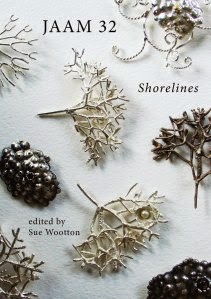
For this issue JAAM is shifting south, and are delighted that Dunedinite Sue Wootton is our guest editor for our 2014 issue. Sue is probably best known as a poet – she has published three collections of poetry, most recently By Birdlight (Steele Roberts, 2011), and has won awards for her poems. But she’s also an experienced prose writer. Her ebook of three short stories, The Happiest Music on Earth, was published in 2012 and her children’s book, Cloudcatcher, came out in 2010. Sue has twice been a runner up in the BNZ Katherine Mansfield short story awards, has been a finalist in the Sunday Star Times and Royal Society of New Zealand Manhire Prize short story competitions, and has won the Aoraki Literary Festival short story prize.

The theme for JAAM 32 is ‘shorelines’, and Sue welcomes submissions that consider this theme from any angle, loosely, or not at all.

JAAM publishes poetry, fiction, creative non-fiction, essays, photography and other artwork. Please don’t send simultaneous submissions, more than six poems or more than three prose submissions.

JAAM prefers emailed submissions. Send to jaammagazine@yahoo.co.nz, using ‘JAAM submission’ (or similar) in your subject line, so we know it’s not spam. Include your submission(s) in the body of your email. If you have particular formatting, you can also include your submissions in an attachment (.doc, .rtf, .pdf or any image file type is ok for images).

If you don’t have email, you can post submissions to:

JAAM
PO Box 25239
Wellington 6146
New Zealand

Make sure you include a stamped self-addressed envelope for reply.

The deadline for submissions is 31 March 2014, and JAAM 32 will be published in or around September 2014.

JAAM here

Owen Marshall’s The White Clock provides a frame for shimmering contemplation

otago065671   3378992_orig

Owen Marshall, The White Clock, Otago University Press, 2014

In Owen Marshall’s third poetry collection, The White Clock, poems provide a frame for contemplation—for reflecting back into the hills and dales of memory and for musing upon the physical and metaphysical currents of the world and of living. The adept fiction writer is at work here, with his trademark economy and grace, but so too is the roving mind of a philosopher. There is also the bird watcher (I should say life watcher) as Owen trains his figurative binoculars upon detail that renders his lines lucid and vital. Not all poems work for me, but those that do (the majority), dig and delve into the essence of humanness. There is humour (wry and infectious) and there is tenderness. As a whole the collection provides lovely contours of thought and feeling.

The title poem takes us in all directions—from the ‘multi-limbed Leonardo man’ to the idea that ‘Time writ this large is discomforting.’ This sway between the transient and the concrete, the hard to pin down and the readily held, is a terrific vein throughout the book. Thus ‘Freeze Frame’ observes the fleetingness of time. The opening line, ‘In the spool that is my life,’ makes a nice link to the way photographs also share ‘the stabbing sadness/ of glimpsed transience.’

Owen embraces playfulness. ‘Dog Winds’ does just that. He links a season to a wind and that season to a dog.

Winter wind is the starving bitch

heeding no one’s whistle, baring

cold, white teeth if faced, with ribs

of adversity and a muzzle-up howl.


Or he returns to the fable of the tortoise and the hare and resists favouring the tortoise that is ‘commensurately wise’ and endures ‘an eternity of slow vegetative mastication.’ Instead:

Better a mad March dance before

a lover, the sprint with wind in

your hair, the ultimate exhilaration

within the headlights’ glorious flare.


In ‘Watcher on the Shore,’ Owen (or narrating voice) confesses he prefers ‘Brueghel’s/ trivial and persistent cruelties’ to ‘transcendent, uplifting paintings.’ Is the last line then a cue for us to see the darker line of thought in the collection?

Like old Jacques I find more sustenance

in melancholy than any other humour.


Sometimes the humour, though, is laugh out loud. When the poet-narrator is about to talk about ‘narrative point of view/ and psychic distance’ he looks into the crowd and spots a woman asleep. Disconcerting, hilarious:

[  ] Golf balls could

have been dropped into her mouth

and there was nothing I could say

that would add to her contentment.


What I particularly love about this collection is the way the poet opens himself up for inspection—through what he observes, experiences and thinks. It imbues the poems with an acute truthfulness (which goes against the grain of poetic game play and irony). One black coat (now a little shabby) was purchased in Menton and conjures up past memories in ‘Habit.’ It is the last verse that shows Owen at his perceptive best:

[   ] We

are a fit, and I cannot bear its

replacement with any companion

less familiar with my life and form.


The White Clock, like the Graeme Sydney image on the cover, provides a frame for shimmering contemplation.


Otago University Press page

New Zealand Book Council page

Owen Marshall web page

Christchurch City Library interview

Random House author page

Emma Neale’s poetry reading was witty, warm, sharp and utterly musical

IMG_4503 IMG_4504

Last night Siobhan Harvey and I were the support acts for Emma Neale who is the current Literary Resident at The Pah Homestead in Auckland. There was an impressive audience made up of poetry fans, local poets, friends and family.

What a treat to hear our guest from Dunedin read. At question time, someone asked Emma to discuss the difference between writing poetry and fiction (she does both!). For her, poetry originates in a musical phrase, a musical fragment, the music of language (Interestingly she shows drafts of her novels to people for feedback but not drafts of her poems). When I sat back into the pleasure of her poems, it was my ears that pricked to attention — to a state of utter attentiveness. I have read the poems in The Truth Garden a number of times and admired their musicality, but to hear them in Emma’s voice adds extra musical zest. Words chime and words tremble. I particularly loved hearing ‘An Inward Sun,’ a poem written after Janet Frame. Emma gave us humour, intimacy, self revelation.

Two new poems particularly stuck me. The prose poem, ‘Stoic,’ that looped and curled on itself, drawing upon a mother-in-law along with the poet herself. It was witty, sharp, wry, pungent and densely packed with musical notes and observation. Then, in a completely different tone, but equally transporting, ‘PokPo’ used a  work of art as a starting point (a large white mouse). This poem was as much about mother and son, and maternal relations, as it was about art. There was poignancy and daring in its musical phrasing.

Interestingly Emma’s The Truth Garden was published as a result of The Kathleen Grattan Award — and Siobhan Harvey read from her manuscript that won the same award last year. Her reading of excerpts from the long narrative poem moved the audience profoundly (it will appear in book form later this year courtesy of Otago University Press!).

As for me I came away feeling I had put my foot in my mouth after responding to a question: Is there such a thing as women’s poems? Or some such wording. I spent seven years writing a doctorate where my central thesis/question was: Does it make a difference if the writer’s pen is held by a woman? This was explored in an Italian context (my Doctorate is in Italian). However, I read theory from all round the world as well as navigating Italy’s social, cultural, legal, political, historical and literary contexts. Such a question cannot be reduced to a black and white answer. There are smudges and blurs whichever way you look. But I strongly feel we haven’t yet told the story of women poets in New Zealand. And for all kinds of reasons I do think it makes a difference when the pen is held by a woman. Does this mean there is such a thing as men’s poetry and women’s poetry? I don’t know. Reviews of women’s poetry still denigrate it with a gender bias. You have to go back to Ursula Bethell and Eileen Duggan (and then further back still) and follow in the footsteps of our pioneering women writers to see how style, tropes and content (they can be in a symbiotic relationship) create writing that some people dismiss (particularly if it is domestic). Gosh the whole feminine-masculine  debate is a minefield. Ahh! Mmm. Ah well.

But tricky questions aside, it was terrific night. Just wonderful. So grateful thanks to The James Wallace Trust and The Pah Homestead crew.IMG_4500 IMG_4502

Poets’ Night Out – A Poet Laureate Celebration

Poets-Night-Out-NL

Poets’ Night Out
This not-to-be-missed event will be a celebration of the importance of poetry in our lives, and the role of the New Zealand Poet Laureate Award in bringing poetry alive and into our midst.
Poets’ Night Out also acknowledges the role played by Hawkes Bay in supporting poetry in New Zealand. Sir John Buck of Te Mata Estate Winery began the Poet Laureate Award in New Zealand in 1996 to mark the centenary of Te Mata as a wine producer.
The New Zealand Poet Laureate Award became the responsibility of the Government in 2007, and the role of administering this passed to the National Library of New Zealand. A Poet Laureate is appointed every two years, with the award recognising New Zealand poets of outstanding achievement. The current Poet Laureate is Vincent O’Sullivan.
Poets’ Night Out will be a memorable mix of fine poetry and musical talent that promises to be one of the best nights out for 2014.
Havelock North on Saturday 5 April, 7.30pm

Marty Smith’s Horse with a Hat– you get grit and you get open views

good one 7 cat

Marty Smith, Horse with a Hat, Victoria University Press, 2014

Marty Smith’s debut collection, Horse with a Hat, is a gorgeous book. The lush and evocative collages by Bendan O’Brien draw you in close, in a way that is both haunting and intimate. His cover collage replicates the way a poem can lead you to a wider picture (the ocean and its lure of voyage) and the catching detail (the pattern on a shell, the way a horse holds its head in anticipation). Heavenly!

The book itself is equally captivating. Horse with a Hat revels in poetry as a way of tracking a life, of harnessing an anecdote. The poems delve into relationships, previous generations, magical moments, pockets of history and, while they exude warmth and joy, Marty is unafraid of darker things, earthier things (violence, the threat of violence, grease and oil, bad tempers, men at war).

Marty was raised on a remote hill country farm between Pahiatua and the ocean so ‘bands of wild horses moving like wind patterns’ is as familiar to her as putting ‘the bloody thing [the lamb] out of its misery.’ Having learnt to ride, read and love horses from an early age, the animal is lovingly tended in the poems. Early on, the autobiographical and poetic motif is set when the father teaches the daughter how to ride bareback (‘Dad’s horses’). The emotional ripples—of a young girl trying to hold on tight with knees or keep up with the distant dot of her father—are poignant. So too is the poem’s lyrical beginning:

Dad’s horses

darken out the sun

I am at their knees looking up

at the lode star of the stirrup

and my four-storey father.

Horses are a nostalgic and potent link back to the author’s past, but they also connect the reader to the exhilarating movement of the poems (as though you are riding them bareback, wind in your hair so to speak). Poems are both reined in (diligently crafted) and set free (open to intuitive turns).

There is a sweet lyricism at work in these poems—from exquisite musical phrasing to biblical overtones to the pleasure of plain language in the service of narrative to gutsy dialogue. Here are some of my favourites:

‘I hide in the chook shed/ under a tin cold sky, thin bitter wind.’

‘It’s a demon—no it’s Dad, down in the dark/ sparks arcing off the grinder’

‘who flatten, who scatter’

‘I lived in the library. I was a child outside/ and I did not look up.’

‘He stays home with the slow slouch of cows’


There is terrific detail that adds vibrant life (yes, these poems are lived in!):

‘There are wasps all over the jam/ in the kitchen.’

‘the radio static fizzy, and raspberry biscuits.’

‘a heavy blur of rice’


And finally there are tropes that catch your eye:

‘My grandmother wore God like a glove/ to church’

‘the planes of light in the room’

‘bright flowers surprised to a standstill’


Marty’s collection takes you back to the child, to mother and father, and to country life, and in doing so you travel through sumptuous lines and layers. This is no rose-tinted memoir—you get grit and you get open views, you get life’s awkwardness and you get empathy. It is a fine debut.

Marty Smith teaches at Taradale High School, but she has also worked as a track-work rider in New Zealand and in England.

Horse_with_Hat_front_cover__77059.1385936731.220.220  Horse_with_Hat_front_cover__77059.1385936731.220.220  Horse_with_Hat_front_cover__77059.1385936731.220.220

Thanks to Victoria University Press, I have a copy of Horse and Hat for someone who likes or comments on this post.


Marty Smith’s website

Victoria University Press page

Blackmail Press multimedia performance and the stunning poem ‘Radar’

Marty Smith on Modern Lettuce

Alice Miller in interview—Poetry as a shift between the unconscious brain and the conscious

IMG_8526

Alice Miller has written poetry, plays, essays and fiction. She has worked as an historian for the Waitangi Tribunal, studied music, and graduated with an MFA from Iowa Writers’ Workshop and an MA with Distinction from the International Institute of Modern Letters at Victoria University. She has gained numerous awards—from The Royal Society of New Zealand Manhire Prize to a prize for the Landfall essay competition and the BNZ Katherine Mansfield Premier Award for Fiction.

Alice has been based in Vienna where she is the Associate Editor of The Vienna Review, but has spent the first part of 2014 at Auckland’s Michael King Writers’ Centre as its Summer Writer in Residence.

To celebrate the arrival of her stunning debut collection, The Limits, Alice kindly agreed to answer some questions for Poetry Shelf. The book was published by Auckland University Press in early March and will also be published by Shearman Press (UK)  this year. I will shortly review this book (Bill Manhire gives it a terrific endorsement on the back: ‘At the same time, her book takes us far beyond its title, letting us glimpse again and again – in finite space – what it limitless.’).

THE LIMITS_CONCEPTS_01    THE LIMITS_CONCEPTS_01

Did your childhood shape you as a poet? Did you write as a child? As a kid I wrote long, interminable stories. I think I filled an entire exercise book with a single story about a chestnut pony trying to get home. One chapter featured a hundred and three exclamation marks, all in succession. I still feel very sorry for my teacher.


When you started writing poems as a young adult, were there any poets in particular that you were drawn to (poems/poets as surrogate mentors)? Yes! When I first read Eliot – that disembodied voice, those great leaps, and the result being such an astounding whole – it may well’ve made me a poet. A large part of love is timing, and The Waste Land was my first real glimpse of what poetry could do.  It was so familiar and so foreign, like all the world was poured into this one voice.


Perhaps a large part of writing is timing! I love the way your poems abound in connections—narrative, musical, cerebral, material, enigmatic. What are key things for you when you write a poem? Thank you! I think of writing as basically a shift between the unconscious brain and the conscious. At first, the poem happens entirely in the unconscious; if you let the conscious brain in too early, it’ll try to explain the poem and kill it. But after some time away from the poem, the conscious brain has its part in editing, and re-editing, and re-editing –

After that, what I look for is a sense that a poem is working, that the machine o’ words has a functioning engine.  I know a poem is worth keeping if, when I return to it after revision over weeks or months, it’s still a mystery to me; it’s still alive on the page.


You were once a historian. Is a sense of history an important factor as you write? A way of exploring how and where you belong? Yes, absolutely. The Limits is haunted by a particular image, that of a city which carries all its pasts at once. I stole this idea from Freud. If we translate it to Wellington, say, we have the untouched bush, we have the first pa sites on the headland, and we have every building that’s been built ever since, as well as those buildings’ ruins – and all of it is able to exist simultaneously. Freud used this image as a metaphor for the mind, which holds all its memories at once.  We’re around on this planet for such a brief time, but poetry can, in a sense, cluster and compress space and time.


Name three NZ poetry books that you have loved. Because I’ve been overseas I’m behind on my local poetry – I’m about to catch up! – but I’ve heard great things about many recent collections.  And I loved Sam Sampson’s first book, and Lynn Jenner’s, and Bill Manhire’s Selected.


What poets have mattered to you over the past year? Some may have mattered as a reader and others may have been crucial in your development as a writer. Some poets of the last year (with the term ‘poet’ used rather loosely) would be Elizabeth Bishop for her precision and her use of abstraction, her embrace of specific geography alongside the unmappable; Chekhov for holding his sad and funny mirror to the world; Flaubert for his exquisite sentences; and Shakespeare and Yeats for, well, everything else.


The constant mantra to be a better writer is to write, write, write and read read read. You also need to live! What activities enrich your writing life? I do like to play football, or rather, at my level, to run about a football field accidentally kicking people’s ankles.


Your new collection is entitled The Limits. Is it important for you to break boundaries, respect boundaries or a bit of both? Or to see poetry as a way of navigating the limitless possibilities of the world, both real and imagined? Great question. For me, the limits also suggest limitlessness; would we still recognise beauty if we lived forever? Or was Stevens right when he wrote death is the mother of beauty? That there are limits means there’s something to reach beyond. I’ve always been terrified by time and death, and I see poetry – and art in general – as the only way to deal with time, to momentarily lose that terror.

You know those moments when you see a puddle on the pavement and it seems astonishing?  Are these the greatest moments of being alive?  We can’t live in a constant state of awe, so we spend a lot of time stretching to attain it.  Perhaps when I talk about a poem working, it’s actually reaching for awe.


I love that notion of writing as stretching—the way poetry has its feet in puddles (the ordinary) and its eyes on the distance (the awe-dinary?). Finally if you were to be trapped for hours (in a waiting room, on a mountain, inside on a rainy day) what poetry book would you read? Today I’m feeling a little anxious, so I’m going to say Whitman: ‘All goes onward and outward, nothing collapses, And to die is different from what any one supposed, and luckier.’

Thank you Alice!


Alice Miller website

Auckland University Press page

Shearsman UK page

On Antarctica on New Zealand Book Council page

Alice Miller’s poetry duets — The Red Room page