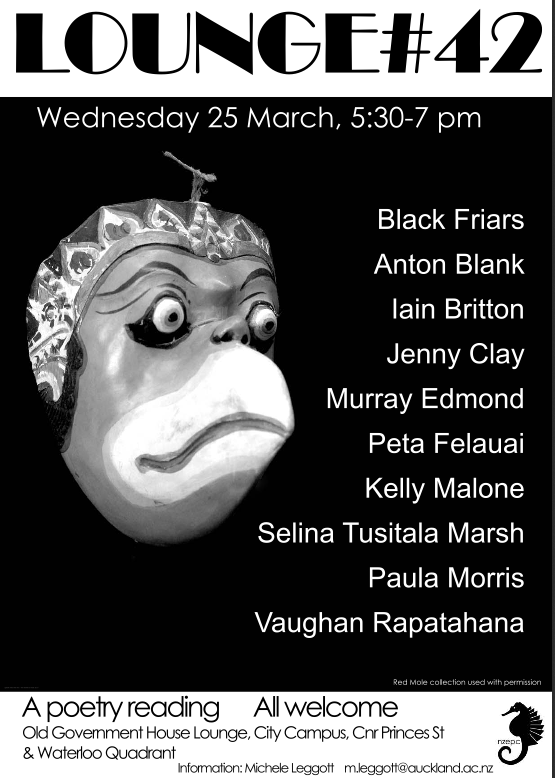
Lounge 42 at Old Government House: Line up includes Paula Morris and Selina Tusitala Marsh

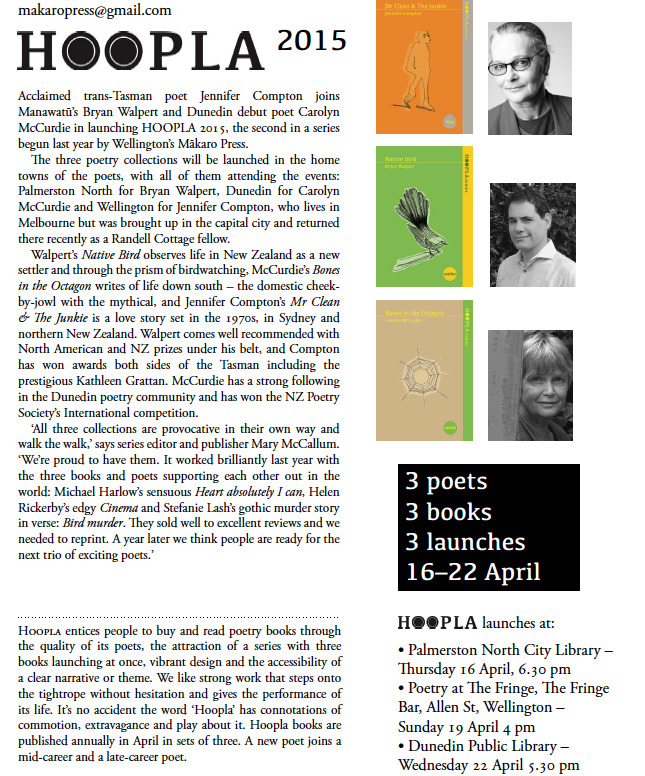
Screen shot 2015-03-11 at 8.57.32 AM

Free entry. Food and drinks for sale in the Buttery.

The LOUNGE readings are a continuing project of the New Zealand Electronic Poetry Centre (nzepc), Auckland University Press and Auckland University English, Drama and Writing Studies,  in association with the Staff Common Room Club at Old Government House.

LOUNGE READINGS #42-44: 25 March, 29 April, 27 May 2014

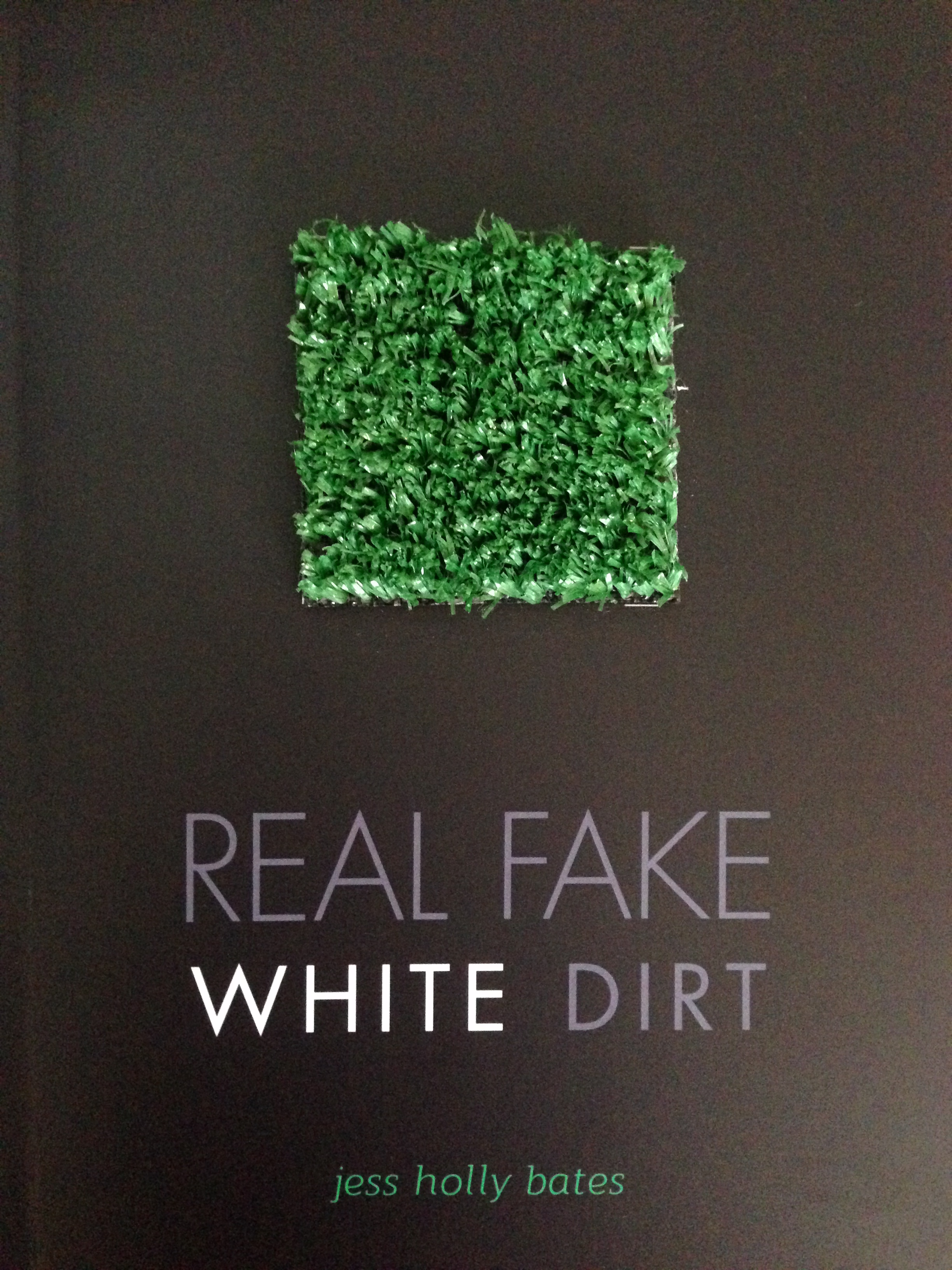
Jess Holly Bates’s Real Fake White Dirt — The poems overlap and interlace with a vibrant cutting bite

Jess Bates book cover   Jess_author_photo_lo-res

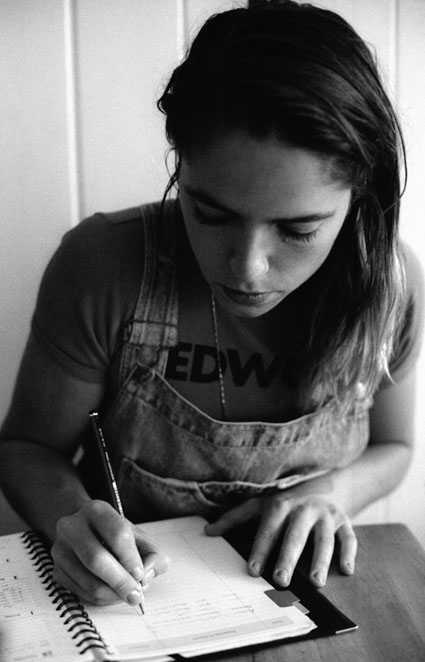
Jess Holly Bates is a Pākehā poet, particularly a spoken-word poet, and has studied English and Chemistry at The University of Auckland. Her Masters Thesis (she gained First Class Honours) is entitled ‘Revolting Others; Disgusted Bodies as a Function of Colonial Continuity in Aotearoa NZ and the Pacific.’ She did a Rising-Voices workshop which spurred her desire to write spoken word poetry. Her first piece, ‘P.I.P: Pakeha Identity Poetry’ was performed at the Rising Voices Slam in 2011. Since then she has performed in various places; most notably, REAL FAKE WHITE DIRT, which was performed at the Edinburgh Fringe Festival (with a four-star review).

Anahera Press (publisher is Kiri Piahana Wong)  published REAL FAKE WHITE DIRT in 2014 and it is a terrific debut. It is the first Pākehā poet that this press has published and I can see why Jessie was chosen. The poems overlap and interlace with a vibrant cutting bite. This is wide open, loud politics that navigates identity issues face on. Tough. Uncompromising. Edgy. I loved the urgent challenging punch of ideas but I also love the way the words on the page split and weave into poetry. There is glorious word play at work. On the page, phrases flit and float. You have to keep your eyes roving as this is not conventional poetic forms/form (although not exactly unconventional  as you can trace back examples of this for decades). I see it as poetry misbehaviour. There is enviable rhyme (taxes/ masses, bleached/ keen, schtict/ poetic). There is leapfrogging assonance and the aural allure of repetition. Repeated things gain flesh in shifting contexts. Sound enacts political punctual marks. Everything comes back to the white-hot core that this is poetry from the heart and that vital ideas percolate above the surface. Wonderful!

PS: It is a gorgeous production with a striking black cover and a fake patch of grass that in the manner of poetry could equally be something else.

Anahera press page here

Eleanor Catton’s Horoeka/ Lancewood Reading Grant kicks off with a fabulous essay by Amy Brown

‘The conditions, in the wake of this reading, are ideal for beginning to cultivate my own barren planet, to write my new poem, and for that I am very grateful.’      Amy Brown 2015


Eleanor Catton on the grant she has established and to date funded (contributions are welcome!):

‘I established the Horoeka / Lancewood Reading Grant to give New Zealand writers the means and opportunity not to write, but to read, and to share what they have read with their colleagues in the arts.

I hope that this endeavour will challenge our tendency to measure the value of art in the proof of artistic production and productivity, and that it will restore value to the crucial but in many ways unquantifiable activity of reading. Most of all, however, I hope that the grant will encourage free and curious discussion about books.

Each grant is worth NZD$2000, with half awarded at the beginning of the reading period, and half at the end, whereupon the recipient submits a short essay that discusses what they have read and what they thought about it. These essays are then published on this site along with a bibliography.’

For the rest of her statement see here.

The inaugural recipient of this timely project is Amy Brown whose debut poetry collection, The Odour of Sanctity, was published in 2013. She teaches at the University of Melbourne where she was awarded a PhD in Creative Writing.

‘Cultivating the Barren Planet’ by Amy Brown

  • ‘For the last year or so, I have been drawn to news items such as:

    The Country Fire Authority implores residents in rural areas to make Fire Plans so that when it becomes imperative to leave their homes the temptation to stay may be over-ruled by a rational list of instructions.

    Asylum seekers intercepted in Australian waters are being stripped of their personal effects — hearing aids, spectacles, prosthetic limbs and medication — on arrival at detention centres.

    Hundreds of Mars One applicants are hoping to participate in a small Dutch not-for-profit organisation’s plan to send four civilians on a one-way mission to Mars in 2026.

    These stories have struck me, I believe, because I’ve been interpreting them as extreme extensions of my own expatriate situation. In 2014, I applied for permanent residency in Australia, married an Australian, and so began legally relinquishing New Zealand as my home. My country of birth was not being consumed by fire tornadoes or bombed to pieces; I was not fleeing anything. Nor was I choosing to fly for seven months to a planet whose atmosphere could not support my life. However, these news stories gave me a new, oblique angle from which to question when and why I felt ‘at home’ in Australia, how that affected my connection to New Zealand, and, generally, what it means to belong to a place.’

You can read the rest of her essay here.

Current recipients include Craig Cliff, Alex Lodge, Rosabel Tan and Alex Mitcalf Wilson.

Gregory O’Brien: Geography and the Imagination: A conversation between two poets and two geographers

Calling all Wellington friends! Greg O’Brien is hosting a seminar next week entitled:

Geography and the Imagination: A conversation between two poets and two geographers

Date: Friday 20 March 2015
Time: 11.00am to 12.15pm
Venue: Stout Seminar Room, 12 Waiteata Road, Kelburn

All Welcome!

Ika2 from MIT: long may this journal continue

photo


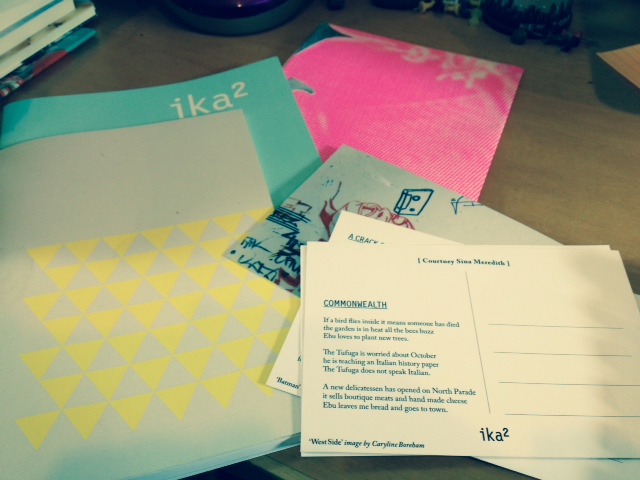
The second issue of Ika is out. This is a journal devoted to Literature and the Arts, is published by the Faculty of Creative Arts at Manukau Institute of Technology and is currently edited by Anne Kennedy.

This not your run-of-the-mill journal as it included a big book pasted inside a small book, a poster, a handful of postcards and a sticker. The postcards are terrific; they have a graffiti image sourced by Caryline Borerham and poems by Semira Davis, Courtney Sina Meredith, Alice Miller and Richard von Sturmer.

The look of the complete package is fresh. The line up of contributors on the literary front diverse and includes students at MIT and from Hawaii along with familiar poets. I am not sure what the submissions policy is but the guest poets include Emma Neale, Steven Toussaint, Helen Rickerby, Grace Taylor, Lee Posna, Daren Kamali, Jeffrey Paparoa Holma, David Eggleton, Michelle Elvy, Geoff Cochrane, Sue Fitchett, Johanna Emeney, Kirsti Whalen. That gives you an idea of the range of voices and styles.

A couple of personal favourites: I loved the curl and slide of Lee Posna’s ‘Island bay Blues,’ but two other poems really stood out for me. Steven Toussaint’s suite of ‘cradle’ poems are joy to read because the musical pitch is utterly rewarding. You follow the clash and link of vowels and consonants and fall upon tonal bridges, arcs and diversions. Wonderful. Emma Neale’s poem, ‘Pokpo,’ underlines how assured her writing has become. This poem reads in the ear so sweetly, yet it shocks and startles. It is risk taking not in terms of language that bends but in the degree of confession. And that confession is slipped in the cracks of the poem, subtly, surprisingly. It is a knock-out poem.

Long may this journal continue.


Subscription enquiries to: The Editor    ikajournal@gmail.com

Just fabulous! Gregory O’Brien on Peter Olds and Geoff Cochrane with Kim Hill

Poetry with Gregory O’Brien: Peter Olds and Geoff Cochrane

Originally aired on Saturday Morning, Saturday 7 March 2015

Painter, poet, curator and writer Gregory O’Brien discusses You Fit the Description: the Poetry of Peter Olds and a new collection by Geoff Cochrane, Wonky Optics.

Listen here

SUE Wootton Wins Caselberg Prize

First prize of $500 in the fifth annual Caselberg Trust International Poetry Prize for 2015 has been won by Dunedin poet Sue Wootton, for her poem ‘Luthier’. Second prize ($250) was awarded to Jessica le Bas, of Nelson, for ‘Four Photographs from a Window’.

Alexandra poet Michael Harlow, who judged the competition, said in his report that ‘Luthier’ was ‘a poem alive in its language’ and ‘a fine pleasure to read aloud’; and he described the second-prize-winning poem as ‘a poem of celebration, accurate to its truth-telling’.

Michael Harlow listed six further entries as highly-commended. The poets are Carolyn McCurdie (Dunedin), Jillian Sullivan (Omakau), Michael Morrissey (Auckland), Karen Zelas (Christchurch), and Pat White (Fairlie).

Around two hundred entries are received each year for the Caselberg Trust International Poetry Competition, from writers working in a number of different countries. Entries are judged ‘blind’, with the judge being completely unaware of the poets’ identities until after the final decisions have been made.

The prize-winning poems and the judge’s report will be published in the May issue of Landfall, and along with the highly commended poems, will be posted on the Caselberg Trust web-site after publication of the journal. Awards will be presented at a function at the University Bookshop Dunedin on Thursday 9 April.

  • 'YAY SUE!!!

SUE WOOTTON WINS CASELBERG PRIZE - press release

First prize of $500 in the fifth annual Caselberg Trust International Poetry Prize for 2015 has been won by Dunedin poet Sue Wootton, for her poem ‘Luthier’. Second prize ($250) was awarded to Jessica le Bas, of Nelson, for ‘Four Photographs from a Window’.

Alexandra poet Michael Harlow, who judged the competition, said in his report that ‘Luthier’ was ‘a poem alive in its language’ and ‘a fine pleasure to read aloud’; and he described the second-prize-winning poem as ‘a poem of celebration, accurate to its truth-telling’.

Mr Harlow listed six further entries as highly-commended. The poets are Carolyn McCurdie (Dunedin), Jillian Sullivan (Omakau), Michael Morrissey (Auckland), Karen Zelas (Christchurch), and Pat White (Fairlie).

Around two hundred entries are received each year for the Caselberg Trust International Poetry Competition, from writers working in a number of different countries. Entries are judged ‘blind’, with the judge being completely unaware of the poets’ identities until after the final decisions have been made.

The prize-winning poems and the judge’s report will be published in the May issue of Landfall, and along with the highly commended poems, will be posted on the Caselberg Trust web-site after publication of Landfall. Awards will be presented at a function at the University Bookshop Dunedin on Thursday 9 April.'

Poem Friday: Airini Beautrais’s ‘The thing is, Neil, you are all of us’ –It is a poem that haunts me, and in that haunting, I keep returning to the lines to reflect upon ‘why.’

2015-02-28 21.01.36


The thing is, Neil, you are all of us


You are the old rocker in skinny jeans

who is mumbling in the corner

you are the punk who fixes bicycles

at two o’clock in the morning.


You are the comic book girl in combat boots

whose breasts are drawn too large

you are the feminine librarian

who wants to go on a rampage.


You are the community gardener

with home-cut hair and knee holes

you are the bespectacled chicken rescuer

the guitar player and the police mole.


You are the tofu thief made to work

for the local Salvation Army.

They throw away about half of their clothes:

take as many as you can carry.


©Airini Beautrais Dear Neil Roberts  Victoria University Press 2014


Author Bio: Airini Beautrais lives in Whanganui with her partner and two sons. She is currently working on a PhD in creative writing through the IIML at Victoria University, on the subject of narrativity and verse form in contemporary long poems. Dear Neil Roberts is her third book.

Author note: ‘The thing is, Neil, you are all of us’ is one of the first parts of the book I wrote, back in 2011. I had known Neil Roberts’s story for some time and it had occurred to me it would be interesting to write a long poem about the incident. One of the things that struck me early on in my research, from reading various anarchist/ libertarian communist web entries, was the sense of ownership amongst these radical left communities for the story. It was as though each person who had re-told the story, while not endorsing Neil’s act, could identify with the way he must have felt. In this poem I drew on my own experience within the Wellington anarchist scene – although not every detail is ‘true’, the characters in this poem do approximate real people, myself included.

Within this poem the ghost of an accentual meter can be heard, and the metrical scheme, while loose, is something near the traditional 4, 3, 4, 3 ballad stanza. And it is off-rhymed, xaxa. Perhaps the ballad was lurking behind the scenes all along. It has been mentioned that Dear Neil Roberts is rhythmically close to prose. I think this is true (as it is for a wide range of contemporary free verse), but I also think that writing to a regular stanzaic shape can lead to some interesting effects. For instance, rhymes frequently occur at line-ends. And there are lines in the book that are straight iambic pentameter. It has to be remembered that poetry is a genre, and can be written in verse, prose, or any combination of the two. Writing Dear Neil Roberts as a poem allowed me to present, juxtapose and interpret information in a different manner, than if I had set out to write an extended essay or a work of New Zealand history.


Paula’s note: Not having read Airini’s note before I wrote this, I didn’t have the back history (which is fascinating!). The poem is placed near the end of her collection, Dear Neil Roberts, and traverses Neil’s story with a foot planted in the realm of invention and another within the scope of research. Forming some kind of arc across—or conversely a simmering stream below—these two choices, is the personal. Airini allows herself, her own history and predelictions, to enter the poems.

What struck me about this particular poem is its ability to move, to raise issues and to offer delight at the level of technique. The parade of chalk-and-cheese characters turns the narrative impulse over and positions you as reader squarely within the frame. The poem now addresses ‘you.’ Yes, you might be any one of these characters that, like Neil, might test boundaries or go to extremes, but there are other issues at work here too. We are all destined, in the main, to occupy the shadows of history (as did Neil) as opposed to being a key player. If there is a potential Neil at work in this parade, there is also the way in which the parade is at work in Neil. We occupy many roles, play many parts, with varying degrees of visibility and attachment. These possibilities move me, as they return me to the complicated, contradictory, and at times unfathomable make-up of what it means to be human.

If the poem flips your placement as reader, the final two lines flip your placement within the poem. Again the resonances are multiple.The cheap clothes. The bag to be filled. The societal waste. Yes we have roles but we always have needs. We are linked by common needs whatever complications are steering our lives: warmth, shelter, food.

You can read this poem as prose-like in its poetic intentions yet, as is so often the case with Airini’s poems, there is more at work here. For me, I was hooked by the aural chords that make different semantic connections. For example, I loved pursuing the ripple of ‘m’s’ (mumbling, morning, feminine, community, home, mole, army, many) and the way they are honey for the ear yet forge a buried story. This poem, as does the book, relishes the white space, the gaps, the ambiguity alongside the more prosaic intent of telling a story, bringing someone closer, circulating ideas. It is a poem that haunts me, and in that haunting, I keep returning to the lines to reflect upon ‘why.’ Marvelous.