

Wordsongs, St Peters Hall, Paekākāriki, 3rd March 2016
I go partly because there’s like a major poetry type gig in Paekākāriki and I’m a Paekākāriki poet and it feels a bit rude not to go. Imagine, I think, if there’s only six people there without me and they decide never to have anything poetry related in our village ever again. Yes, we call it a village and I needn’t have worried. Having scoffed down as much of a delicious fried-rice concoction as I possibly could in 94 seconds I arrive three minutes late and take the Very Last Seat. It’s an actual excited crowd, in carefully arranged tiers. They’ve turned St Peters Hall around so we face the direction of the sea and one long side of the hall with its cool house-shaped wooden-window shutter things. The huge red velvet curtain hangs over the stage to our left and the doors to the village main street to our right.
I love this hall but truthfully, I’m a bit wary of poetry set to music. It’s the puritanical killjoy in me which says, honey, you need to decide, music or poetry. Just get away with your weird, not very interesting bongo drumming interspersed with a man saying two words usually something like organic tomatoes in a quiet yet loud, yet well modulated, yet with working-class-solidarity voice and then pausing a full minute while making eye contact with every member of the audience before saying wet. But I know it’s kind of prudish of me and I need to open myself to new experiences so I am willing and here and listening.
Local poet, Dinah Hawken, who starts us off, makes me feel very comfortable. She reads her poetry sans music, the way it should be (sorry) and she starts with a good long poem about environmental catastrophe. The poem earns its length and I enjoy Hawken’s meditative delivery. She reads slowly and thoughtfully and the poem turns from lament to challenge to conversation. I feel like I’m hearing more and more poetry like this, laced with planet grief and helplessness and wonder. I’m glad it’s being written.
The main act is Bill Manhire with singer Hannah Griffen, pianist Norman Meehan and Hayden Chisholm on saxophone and clarinet. To begin with I think Chisholm is tuning up, his sax is breathy and rough and understated and there’s no clear strong notes but then I realise this is part of it all. He’s throat clearing and then the other clear notes come, but through the set I see this replication of human noises, and also the absorbing of other sounds and instruments. I hear reverb and the plucking of a guitar, slow growling, didgeridoo and the noise of traffic all through his instruments.
In this first song, an interpretation of Baxter’s High Country Weather, the piano and singing come in beside the brass and I’m startled by how much action, how much sound can be produced by just three people. Griffin’s voice is like some really good jazz club singer. I get that vibe through the night. I want to be sitting at a small lamped table having intimate conversations. She sings big, beautiful and clear, high and low. Next Bill, congenial and with charming anecdotes that thrill the poetry nerd in me, reads Rain by Hone Tuwhare and then the three musicians play it back to us. I get it now. I can listen to the poems read as poems, and listen to the music as music. No bongo drums. No organic tomatoes and soulful stares. It’s a relief. And when I hear Rain sung I’m struck by how lineation changes with the music, the words become split and lumped in different way. We can hear hidden rhymes and rhythms which may be a subtle backbone to verse on the page but in music are drawn out and played with. Cool.
Meehan tells us the set is pretty much the album Small holes in the silence, featuring versions of Manhire and other poets’ work as songs. We hear interpretations of Alistair Te Ariki Campbell, Manhire, David Mitchell, and my favourite piece, two poems by Eileen Duggan. I can’t actually hear the words as Griffin sings so perfectly in tune with the sax, so my liking this all the same proves how thoroughly mature I’ve become about the whole poetry and music mash up. What I love in this song is the way the sax more than ever takes the role of a voice; for a moment the sax and the singer are a duet and in a kind of heady triumph. After that the two seem to swap places; Griffin no longer singing words but sounds become another instrument and the saxophone becomes a human voice. It’s a meandering interesting work. I also love Manhire’s stories about and poem for Cornish poet Charles Causley. The evening ended with a spoken and then musical interpretation of Manhire’s rhyming list poem ‘1950s.’ The crowd loved it, they threw flowers, they cheered, they stomped. Well, they didn’t but I’m sure if they thought of it they would have. They applauded long and hard. I wander out into the Paekākāriki night. Now the traffic sounds like a saxophone. The crossing signals go off. A train, windows bright, rumbles past us on its way to Waikanae. I wave.
Maria McMillan
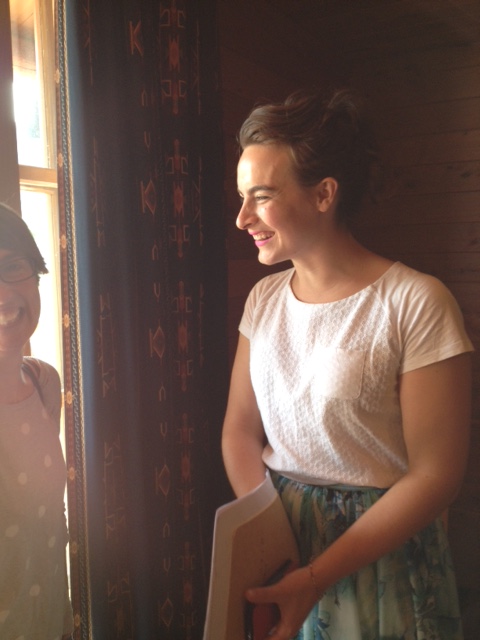
I got to introduce Amy Leigh Wicks at the Rupaehu Writers Festival, but I had barely sighted her poetry. What a discovery! Like most people in the audience, she blew my socks off. Amy is an American from New York City whose debut collection is Orange Juice and Rooftops. She is currently enrolled in the PhD programme at IIML and will write the critical component of her thesis on the poetry of James K Baxter.
Listening to her read as opposing to reading her for the first time on the page offers quite a different poetry experience. I cheekily asked if could take away the printouts so I could write about the poems. Usually I just depend upon my scrawlings but as chair I tempered my notebook entries. Amy is one of those poets who really knows how to bring a poem to life in the air (she has a background as a slam poet). And in fact won the slam competition at Ruapehu.
This is what linked the the words in the air to the words on the page: space, silence, pause, what is not said, mysterious bits, strangeness, poetic tilts.
What struck me on the page: these poems feed on questions, curiosity fizzes both above and below the surface. Alongside the the room to breathe, I rediscovered a clarity of voice, sometimes conversational, sometimes lyrical, always fluent. And then the effervescent detail that forms a little uplift in a line.
Here is an Amy Leigh Wicks poetry sampler:
from Honey Moon
The first time we climbed into bed
it seemed like there was no one
else in the world. Then we left New York
and by the time we reached California
we noticed an army of ghosts floating
like balloons above us each night
The word honeymoon is fractured in two because although you might think this poem is about bed, love, marriage and travelling, those ghosts bust it apart so you shift a little. Often I enjoy strange presences without analysing their status as tropes in a poem. The ghosts float like balloons above the bed. Beautiful. Strange. They don’t need to mean anything. Yet the balloon-ghosts (or ghost-balloons) keep tugging me back to the poem as though I want to make a story for them and give them a part to play beyond the unsettled sleep of a honeymoon couple. This poem, excuse the pun, haunts me. Read the full poem here.
from Learning to Swim
When ____________happened it made me feel …
This is the first rule. It’s like swimming, our new game –
The facts are false, the world inside is real.
Am I still in Vienna, floating from Klimt’s kiss to Schiele?
No.We are at our dining room table, I am learning how not to blame.
When ____________happened it made me feel …
Usually the repetitive lure of a villanelle is like free flowing honey, and the sweetness of repetition infuses fluency. But here the repetition is like a set of judder bars that shakes you out of easy coasting.
from First Night in Aotearoa
I was sitting at a stone table
there was a fire behind me
and a candle before me and
it was raining all around and the papers
on the table were soaking wet
with black ink bleeding through
A few poems are part of a sequence entitled ‘Kiwi Dairy’ and touch upon Amy’s experience of New Zealand (she is from New York). With this poem, again you get the white space, the shiny detail, the strangeness and the multiple questions. It is addictive listening/reading.
Keep an eye out for Amy’s poetry. You will find some poems on Turbine.
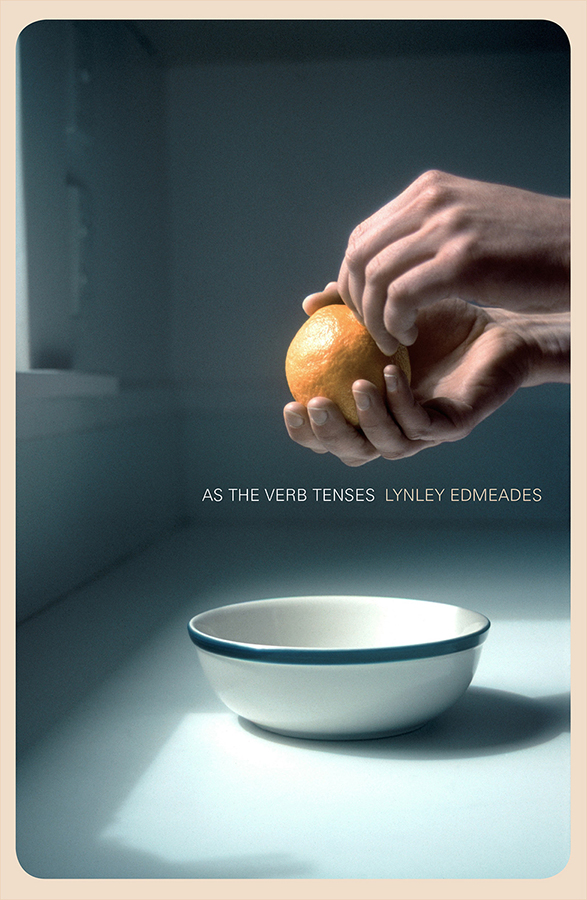
‘As the Verb Tenses is the work of a reflective and sensitive poetic talent: one run with gleaming wires of joy. In poems that gather together the vivid details of childhood memory, the surreal juxtapositions of life in the contemporary West, the wry observations of a temporary expatriate, the deeply lodged pain of historical and personal loss, Lynley Edmeades speaks to us in delicately spun lines that press out ironies, dissonances and profound formative experience.’
from Otago University Press. Launched tonight with Chris Price.
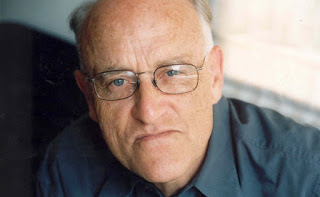
CK Stead, the current New Zealand Poet Laureate, will be officially honoured at the Poets’ Night Out, at the Havelock North Function Centre, 7.30pm on Saturday 2 April.
CK (Karl) Stead has invited award winning poets Gregory O’Brien, Chris Price and Paula Green to share this evening with him as guest readers. Local youth singers Project Prima Volta will also perform.
Poets’ Night Out is a wonderful opportunity for Hawkes’ Bay to be part of this special occasion honouring the Poet Laureate in Havelock North, the birthplace of the Poet Laureate programme.
Mr Stead will receive his hand carved tokotoko during a special ceremony at Matahiwi marae earlier in the day. Each Laureate receives their own tokotoko – a ceremonial carved walking stick –symbolising their authority and status. The National Library holds the matua, or parent tokotoko, to signify their guardianship of the New Zealand Poet Laureate Award. The tokotoko is a link to the Hawke’s Bay origins of the award, and is created by Haumoana artist, Jacob Scott.
The National Library assumed responsibility for the New Zealand Poet Laureate Award from Te Mata Estate Winery in 2007.
Tickets, $20, are available from Creative Hastings, Hastings Libraries, Napier Libraries and Beattie and Forbes or online at Eventfinder.
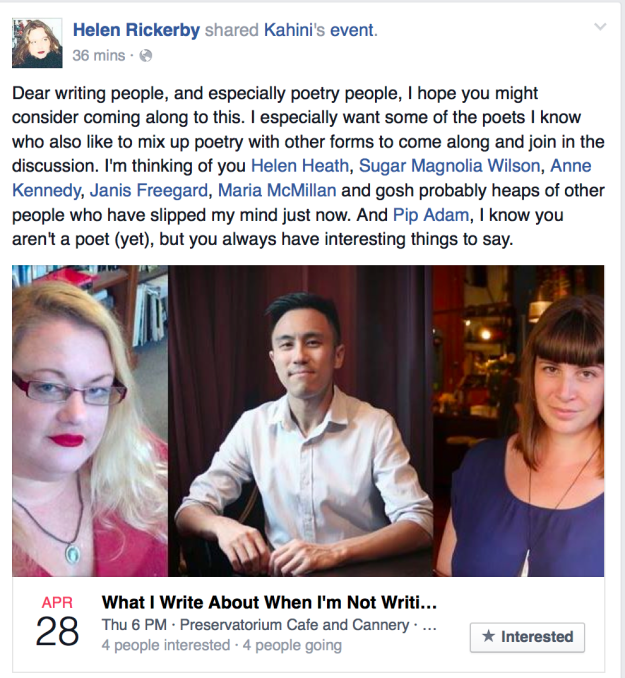
Preservatorium Cafe and Cannery 39 Webb Street Te Aro
We are getting absolutely constricted by the idea of writing as authenticity, i.e. autobiography…I’m clearly not a mad male psychiatrist or even Gil from the Monkey’s Mask, or an Egyptian Pharaoh, or the character in my next book who is an astrobiologist. I’m none of these people. I think that for me the most wonderful aspect of the imagination…is liberty and freedom. It’s not waving the flag of authenticity all the time. And for me, that is my authenticity, the power of my imagination.’
~Dorothy Porter
These days, poetry is generally seen as, by default, an autobiographical form, where we write lyric poems about what we’re feeling, or doing, or have observed. But sometimes we don’t want to write about ourselves. Poetry can be, and has been, broader than that, and can incorporate other forms such as fiction, creative non-fiction, journalism, biography, history and essay.
Join us for an evening of discussion and dinner with three poets, Helen Rickerby, Chris Tse and Stefanie Lash, who have experimented with using poetry for writing about things outside themselves–biography, fiction, film criticism, natural history. They’ll talk about their own work and the work of others that combines poetry with another non-autobiographical genre.
We will inevitably discuss what poetry brings to these other forms, the tensions and benefits of melding two genres, and the characteristics of poetry – just what is poetry anyway? And even when inhabiting another, are you still there anyway? Was Oscar Wilde right when he said: ‘Man is least himself when he talks in his own person. Give him a mask, and he will tell you the truth.’
SPEAKERS:
Helen Rickerby has published four collections of poetry, most recently Cinema, which took its inspiration from films and film-making. Her collection My Iron Spine, featured biographical poems about women, many of whom have been neglected by history. In 2014 she co-organised Truth or Beauty, a conference about biographical poetry. She is the managing editor of Seraph Press, and is co-managing editor of JAAM literary magazine. She’s currently working on her next collection (working title: How to Live), which attempts to grapple with the big philosophical issues, but will not attempt to answer them.
Chris Tse was born and raised in Lower Hutt. He studied film and English literature at Victoria University of Wellington, where he also completed an MA in Creative Writing at the International Institute of Modern Letters. Chris’ poetry, short fiction, and non-fiction have been recorded for radio and published in numerous journals, magazines, and anthologies both in New Zealand and overseas. He was one of three poets included in the joint collection AUP New Poets 4 and his first full-length poetry collection How to be Dead in a Year of Snakes, was published by Auckland University Press in September 2014.
Stefanie Lash is a poet and archivist who lives in Aro Valley, Wellington. Bird Murder was her first book, published in 2014, and she is working on her second, in which she discovers the entrance to the underworld in Fiordland.
Dinner will be prepared by the wonderful team at Preservatorium and include vegetarian and gluten free options. If you have any other dietary requirements please let Kirsten know at kirsten@kahini.org.
HOW TO GET TICKETS
Tickets are on a scale between $25-35 depending on income.
You can pay by credit card via Eventfinda or via internet banking by depositing $35 into our account:
Kahini Oceania
03-0732-0009609-000
Westpac Coastlands Parade
Any questions contact Kirsten – kirsten@kahini.org
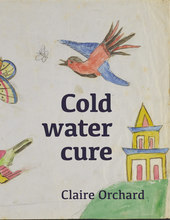
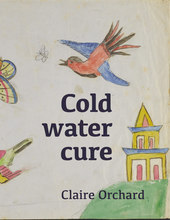
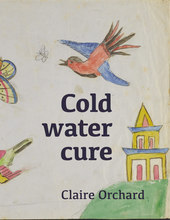
Cold water cure Claire Orchard Victoria University Press 2016
Lately I have been thinking about the bridges that occur between poem and reader. Some bridges are so surely established that the ensuing traffic is free flowing. Noisy. Exhilarating. On other occasions, the bridges falter and it is barely possible to cross.The poem remains at arm’s length. Reading can be viewed as a travel card of crossings, but it is also invigorated by countless sidetracks and multiple rest stops.
Claire Orchard’s debut collection, Cold water cure, affords rich crossings. It is a book in three parts with the long middle section, a fitting centrepiece. The first section resembles a picnic spread where everyone brings a plate and it all seems to fit together perfectly. These opening poems bring family close to the surface of reading in ways that move you. Move you to laugh out loud, to wry grins, to feel something. Claire prunes the dross, and peels a poem back to the bare bones of incident. Then she adds a little kick, a curve, a tilt and the bare bones gleam so we take notice. This is the joy of poetry. The way it enables renewed attention to old things.
So many favourites in this first section but here are a few:
Egg
What people often don’t realise, my grandfather said abruptly,
while we were sitting on a bench at the playground,
is that parenting involves taking
a lot of split-second decisions.
This poem is a grandparent anecdote involving an egg. I had no idea where the poem was taking me and it made me laugh out loud, grin wryly and feel something. All in one little poem basket.
Several of the poems suggest that Claire was once a primary-school teacher. Very rarely do I come across poems written from the point-of a-view of a teacher. It sparked a whole train of thought. I taught in primary schools in my twenties (Auckland, Wellington, London), yet I have never written poetry about these experiences as though they are low-status material or too far back in time. Janet Charman wrote some tough poems about being a high-school teacher. Johanna Aitchison has written hilarious poems about teaching English as a second language. Claire’s poems catch a knife-edge delight I recognised.
Here is the ending of, ‘Sharpening,’ one of the teacher poems:
I ask these questions without thinking,
tearing open a band-aid.
He’s six, the number of perfection.
There are a few found poems in the bunch. Found poems work best when the poet considers how best to serve them. Sometimes found poems don’t shift beyond road sign or stolen conversation and the connection is one of indifference. Not here. I especially love the one that kick starts the collection with a recycled quote from Ali Williams during the All Blacks 2011 World Cup Campaign.
Hang on
I think we’re getting ahead of ourselves here.
Last time we got ahead of ourselves,
we shot ourselves in the foot
then we did it again a few years before that –
shot our other foot.
We’re just trying to leave our feet on.
I loved the poem that riffs stream-of-conscious like when the poet spots a young man wearing the exact same T-shirt at the next table (‘Don’t let me be misunderstood’). Equally funny is ‘Poetry master class.’ This is based on sharing a copy of the poems with a late arrival at Bill Manhire’s event at the Embassy Theatre. Just hilarious with an ending that nails it. Here is an early stanza:
She referred to the presiding poet as Bill and,
before he’d begun to address himself to the first poem,
had taken a pen and scored briskly through three of its lines.
Yes there is humour in the opening banquet but there are ample reasons to savour rest stops. The end lines. The shift of the eye. The look of the poem. The sound of the poem. Tropes that renovate things. This from ‘Legendary creature’:
Your many-winged laundry rack
resembles a pale, anorexic albatross
doubled over
in the boot of the car
The middle section constitutes the bulk of the book and sets up bridges like Russian dolls, chiefly between Claire and Darwin. Unlike most poetry collections, Claire has placed her detailed notes at the start of the book. A travel guide, if you like, that signposts the link between poem and original source. Many of the poems juxtapose the words of Darwin or those connected to him with the words of Claire. The poems thus promote conversation between then and now, him and us, this idea and that idea. His experience and her experience. It is quite the thing for poets to step back in time at the moment. To take a historical figure and see what happens when you transplant yourself or your subject or both.
Such transplantation raises questions about how we represent the past. How the past infects us and vice versa. What I loved about the Darwin poems is the way his ideas percolate in the gaps but he is placed in a context of living. The poems are infused with life.
In ‘Voyages,’ Darwin’s voice sits on the left-hand side of the page, Claire on the other. I am itching to put Claire in quotation marks to stress her collision of selves. And then I think Darwin is equally unstable, and want to do the same for him. In the end, I leave them to float at will. A word from Darwin on the left prompts a personal anecdote, a musing, an image from Claire on the right. I keep looking at the page and reading the tiny stanzas and seeing them as two hand-prints. He and she. The connections are electric.
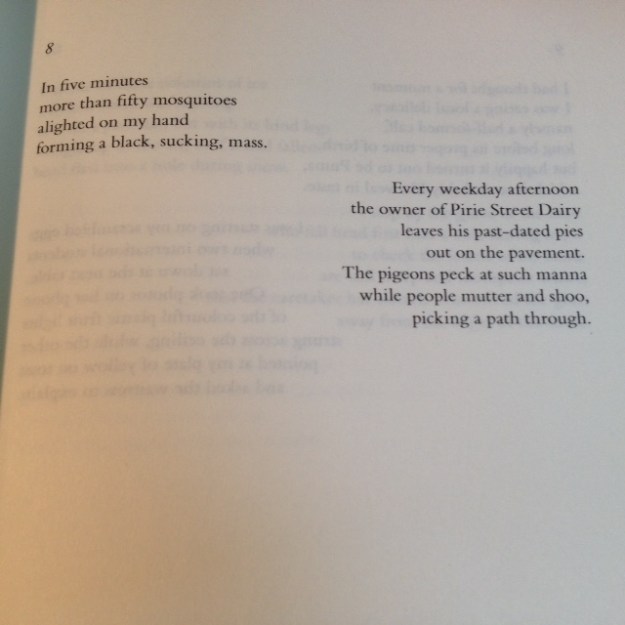
Another poem, ‘Near Lima,’ provides new entries into the Darwin section.
Somewhere I read that, day to day, most of us
rarely raise our eyes more than fifteen degrees
above the horizon.
This is what the Darwin poems do. They lift us beyond the horizon line of fact, beyond the borrowed phrase or lines to reflect on how ideas rub against wife, child, animals, watches, ornaments, fish, ceremonies, death. So innovative. So stimulating.
The final section faltered for me. These poems venture out into the wider world, untethered by theme or style, which felt liberating. I am fascinated that I didn’t make it across the bridge for some of them. I don’t see these poems as failures. I see this as a failure on my part as reader. Sometimes it is like wine affected by mood, circumstances, company or context. One day a vintage hits your palate. The next day it misses. As a persistent reader of New Zealand poetry this interests me. Reading poetry is also susceptible to mood, the weather, what you have just read or done. I haven’t yet got what these poems are doing. I am planning a return visit.
I heard Claire read from ‘Voyages’ at the Lauris Edmond Poetry Prize in Wellington recently. What a treat. It could have been a disaster trying to read these two voices into audible life (do they need to be discrete?), but it was a highlight for me. Hearing the voice of the poet aloud, heightened the effect of her deft hand. I shivered with connections that I hadn’t spotted on the page. Some kind of spooky yet wonderful ventriloquism was taking place.
This book is a gift. It makes you laugh out loud. It rejuvenates. It challenges. I adore it.
Victoria University press page.

Helen Rickerby has just posted a slide show from the Ruapehu Writers Festival. And this:
‘We’re still on a high from the fabulous experience that was the inaugural Ruapehu Writers Festival in Ohakune last weekend. We were pretty sure it would be a fun and worthwhile event, but it exceeded our expectations in every way. Several participants, including Elizabeth Knox and Paula Green, said it was the best festival they’ve ever been to!
From the opening event on Thursday, which was opened with a karakia by Hune Rapana of local iwi Ngati Rangi and was MCed by Johnny Greene, Head of English at Ruapehu College, we started to suspect we were in for something special. As those of you who were there will know, on Friday, as more and more people arrived, we enjoyed session after session of articulate and brilliant ideas and readings. By Friday afternoon, the room we used for most sessions had reached its capacity of 80–100, and the spill-over people were lounging in the hallway or sitting on the deck, listening through the open French doors. Also through open doors we could hear the bubbling of a stream across the road, and a couple of times a day the speakers needed to pause for a few moments while a train went past on the nearby Main Trunk Line.’
For the rest of the piece and the slide show see here.