IBBY is the International Board for Books for Young People and has very noteworthy aims. Chiefly IBBY believes it is the right of all children to hold a book and read regardless of their status (gender, economic, ability, ethnicity, disability and so on).
Around 500 delegates from over 60 countries attended the four-day event. I had no idea what it would be like but it was quite extraordinary.
The representations, whether keynote or parallel, were terrific. I drove back to the coast each night buzzing with ideas and a keenness to write and read new things. Good food, good conversations and exciting new connections.
Thank you Dr Libby Limbrick and Rosemary Tisdall, and your visionary team, both locally and from IBBY, for creating such an astonishing event. You both deserve a huge round of applause from our nation of readers. We are in your debt. Thank you. You are stars.
In his opening address, IBBY President, Wally De Doncker talked about the aims of the organisation in view of human rights and common goals. He said New Zealand had a fine record in terms of gender but there were areas of concern such as our immigration policies. Some delegates were refused entry into New Zealand for the Congress. This also happens with some writers invited to our literary festivals. What can we do about this?
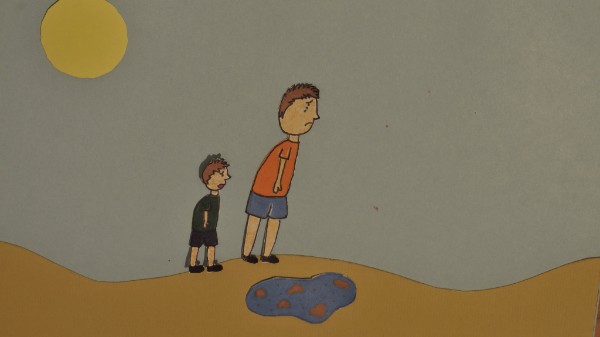
The graphics were sublime.
I didn’t get to everything but here are some selected highlights for me (one regret was I couldn’t see Leigh Hobbs, the Australian Children’s Laureate).
1 The key note session included Joy Cowley, Kate De Goldi and Witi Ihimaera and the combination was genius.
Joy Cowley talked about the way her country never appeared in her early reading. Children saw themselves in the School Journal but that was not a book. Three decades later, it had become a passion for Joy that children could see themselves in the books they read. I was delighted to hear Joy say that children’s literature is no longer an occupation for those who have failed at ‘real writing.’ I still see an unfortunate hierarchy here (we have no Children’s Laureate, children’s books get less reviewed, no Prime Minister’s Award, less time on the stage at festivals talking to adults for a start) but the Congress underlined the vitality of heart and thinking on an international scale. I particularly liked the way Joy challenged us: ‘to pause and remember a time in your childhood when you felt you could do anything — keep that inner child along with the learned adult. I first thought we aged like apples, grew ripe, wrinkled and fell off the tree, but I think we grow like onions adding layers.
Kate De Goldi asked if there is room for nuanced, contemplative writing for the middle reader – writing that is both meditative and intellectually playful. Kate talked about running her way into a new project with Gecko Press: an annual for children that will be out later this year. She interviewed her eleven-year-old self to find out what is needed. The annual is based on commission rather than submission with many adult writers (James Brown, Jenny Bornholdt) invited to produce work according to a governing idea. I like the way there is a desire to open different realities, different forms, adventures. I came away wondering what an eleven-year-old child in 2016 will stick to like glue.
Witi Ihimaera talked about the genesis of The Whale Rider and the importance of family. I didn’t make notes and wanted to push replay when he finished talking. It felt like he had soothed us into the comfort and necessity of storytelling and then pricked that state of comfort with provocative questions for a world ill at ease. Galvanising for those of us who write and read within a state of privilege.
2 A kapa-haka group from Mainfreight School in Auckland. Magnificent.
3 There is No Such Thing as a Children’s Book: Kate De Goldi with Leonard Marcus and Julia Eccleshare.
Marcus was a remedial reader but his break through moment was poetry. “Why don’t you write that poem for me and then read it to me?’ he was asked. Poetry was his way into reading! I am constantly harping on about the way poetry is a tool of liberation for children.
Kate juxtaposed two questions: ‘Is there usefulness?’ as opposed to ‘Is there play?’ In my view, poetry is first and foremost the playground for children writing and reading.
Julia juxtaposed ‘commentators’ talk’ as opposed to ‘writers talking.’ And this gold nugget: You don’t read, as a child reader, a children’s book for what adult critics say you are reading it for.’
Julia also asked if children’s authors are disrespected by adult authors. She suggested Philip Pullman gave children’s literature intellectual respectability and JK Rowling gave financial viability. And on the reading reward: ‘if you read Tom’s Midnight Garden, the whole of life is in there.’
Tellingly from Julia: In the past, children’s authors wrote the book they wanted to write with time and authorial autonomy but it is not like that now. She added, ‘it takes time to nurture authors and reach the classic book. Now the ink is hardly dry from the publisher’s pen and the book is out.’
Kate provocatively said she had found the YA form interesting and mysterious but now she loathes it.
Julia said the YA market has lost true commitment to the young reader. She said the central place from which you tell a story makes it different from adult books. You get a view of the world from a child’s eye.
Marcus could understand the teenage love of dystopian fiction because they have a sense of adults no longer able to control things in the world.
Julia is most gleeful about the book she picks up that sweeps her away (one in 10,000) and for Marcus, graphic novels.
4. Cultural Diversity in Children’s Literature: Nadia Wheatley, Gavin Bishop, Nahoko Uehashi.
This was a standout session for me but sadly the speaker before borrowed over 20 minutes of their time slot. It was fascinating hearing the stories behind some of Gavin Bishop’s stories and the way he provided books that are a kind of mirror. His show and tell was a direct response to his Māori ancestry and his Pākehā upbringing.
Nahoko was a revelation. She spoke briefly in English and then a translator read an English version of her presentation. Nahoko accompanied it with sign gestures. She began by saying she has only ever worn a kimono twice, loves Japanese food but also Korean BBQ and pasta. No one questions her Japanese identity. Here are some bits I gleaned from her talk that sent me in search of her books:
Outside Japan, I am an exotic minority – I wanted to write a book that could only be written by a Japanese writer.
I am swept along by a torrent or words – if readers find a trace of Japan it is because my unconscious is permeated with Japanese.
We are not left forever divided – one element that allows us to understand each other is story.
I am Japanese but can become a Celtic slave. I can live within a book penned by an English woman.
The ultimate proof we can all understand one another is we can all share stories.
No person is truly free from cultural limitations. We can reach out and grasp each other’s hand. Stories empower us to do this. Stories empower us, creatures of imagination, to become others.
Nadia was also a revelation. Like others I raced down to buy a copy of Flight but it had sold out. My copy is now on order!
5. Identity in YA Literature
With her IBBY Honour Book acknowledged at the festival, Mandy Hager was a standout for me: ‘Stories are a safe way to explore things.’ ‘Participants walk along with the protagonist.’ ‘You must do things you think you cannot do.’ I was disappointed not to see her book in the Penguin Random House stall.
6. Imagination in an Age of Reason: Julia Eccleshare with Kate De Goldi, Ursula Dubosarsky and Kathleen Paterson.
Julia suggested we need to keep imaginative literature alive and flourishing if we want to keep children readers. She asked the panelists to name a talismanic book for them (Kate, Harry the Dirty Dog and Katherine, The Secret Garden).
I loved Ursula’s claim that you need to keep somethings completely secret from the reader; things that give you the energy to write the book.
Kate: I can only set books in Christchurch.
Ursula: I don’t describe in my books.
Katherine: I have done very little describing of Terabithia. Children do their own describing.
Ursula: Children are quite happy with a state of unknowledge.
Katherine: Children tell you things about your book you didn’t know.
Kate: I have burglarised though disguised my family’s lives. I can do a male POV but never try to inhabit another ethnicity or culture.
Katherine: When I was first learning to write and I was an adult it was ‘write what you know’ but I didn’t know anything.
Katherine: Movie people couldn’t believe money wouldn’t buy a sequel to Bridge to Terabithia.
7 Verse and a Diverse World
I was in this session but came away with a long list of YA novels in verse I am itching to read. Chris Crowe from USA talked about the genesis of his verse novel, Death Coming Up the Hill, and it was riveting. He spoke about how a story he thought was really badly written was transformed by his love of the number 17, some mathematical equations and a sequence of haiku. He gave me a copy so I can speak further on this.
8 Marcus Zusak
Marcus stood on stage and told a long knotty snaky personal story on how The Book Thief came to life. Then read from a new novel,’Bridge of Clay,’ he has been working from. His storytelling started with the family anecdote of the alarm clock where his dad smashed Marcus’s beloved clock on the floor because the alarm went off in the middle of the night. Marcus was in the lounge hoping to watch Christmas cartoons (he was obsessed with them!).
After reading the new extract, Marcus returned to the image of the alarm clock: ‘As writers we are always digging things up. I am always back in the bedroom picking up the pieces of the alarm clock and realise it is still ticking.’ Wonderful.
9 The Hans Christian Anderson Awards Dinner at Shed 10
Every two years this award is given to a writer and to an illustrator.
This year: Cao Wenxuan (China) and Rotraut Susanne Berner (Germany)
Susanne sent an animation from Germany as she could not be there and Cao made a glorious speech in Chinese with an English translation beautifully inscribed on the screen. I had read and loved his book, Bronze and Sunflower, over summer,so it was very special to hear his speech.
Here is a sample of favourite bits:
I can’t sacrifice my life experience to make children happy.
Literature is another form of house building.
Certainly it should not be any empty house.
I no longer use clay, twigs or building blocks. Instead I use words.
On some occasions, I feel like a bird with its wings clipped of but at least I can go back to my house of words and have a rest.
Writing comforts our hearts which are consistently beating for freedom.




 NZ Poetry Shelf