Can’t help myself posting this, just as I am knee deep in Eileen Duggan letters poems writings!


Can’t help myself posting this, just as I am knee deep in Eileen Duggan letters poems writings!
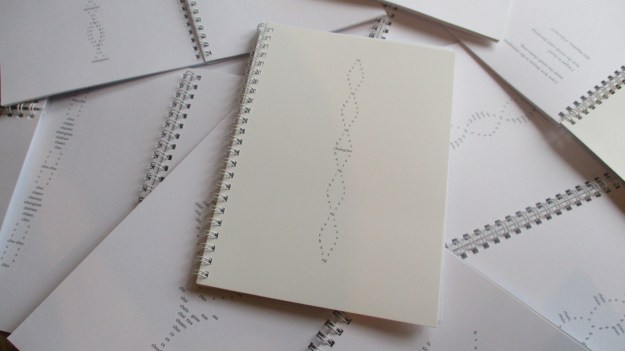
A spiral-bound notebook of visual poems, created in response to the word‘chaingrass’ from Bill Manhire’s poem ‘Falseweed’, has just been released in the UK by zimZalla.
zimZalla is a publishing project which makes literary objects. It is administrated by poet and publisher Tom Jenks and operates out of Manchester.
The poems were made by Catherine Vidler and the book designed by Tom Jenks.
The notebook is preceded by two other ‘chaingrass’ collections which Catherine has made and which have been published this year. A large collection of poems and patterns was published by Stale Objects dePress in Sydney in September, and a PDF chapbook of the poems together with an interview with Catherine, was recently featured in the journal Jazz Cigarette in the United States.
an interview and poem
stale objects
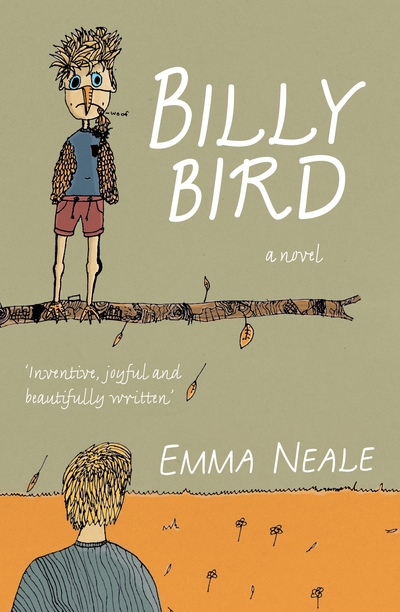
Billy Bird is such a terrific novel; it grips you tight with its poignant family tensions, its heartache boy at the centre, its sweetly crafted sentences. I loved it. I would be disappointed not see it on the forthcoming book-award fiction list as it has been one of my favourite reads of the year.
Hot off the press: Sarah Jane Barnett is the new Books Editor at Pantograph Punch – it is relaunching today! Great news. And a great interview to relaunch with!
Here is the start of an interview that explores the novel (among other things!). Full interview here.
Sarah Jane Barnett: First, a belated congratulations for the long listing your poetry collection Tender Machines at the 2016 Ockham Awards. It’s a beautiful collection. You’ve also recently launched a new novel Billy Bird, which – among many things – is about a family, a tragic event, and a young boy who takes on the persona of a bird. One of the reasons that I find your work so exciting is the way you write honestly and unabashedly about families. It took me a long time to feel comfortable writing about being a parent, possibly because the experience is as tough and brutal as it is joyous. It felt exposing, but in the end unavoidable. How, emotionally, did it feel to write Billy Bird?
Emma Neale: I understand the reluctance to write about parenthood, actually: a number of hesitations can turn people away from it as a subject. I’ve talked to writers who want their creative life to be a complete break from parenthood, as they find its contradictions, frustrations and sheer exhaustion too debilitating to revisit on the page; to writers who go in fear of the personal, full stop; or who agonise over what their own children will think of the work when they’re adults; or who fear that their work will be dismissed as ‘only’ domestic.
For me, the experience of parenthood has at times been so dividing, so challenging and shaking – potentially major early health issues for our children as babies; postnatal depression; pulling through that and wanting to be as present for the children as possible, but also to keep up some form of intellectual and creative life, and make a financial contribution (however small) to the family; that I found that even when I had carved out solitude for writing, there was so much teeming around in my head about family dynamics, and childhood development, that frequently these subjects jostled out others.
On the other hand, I’ve always been interested in how identity is shaped by our early family environments – and my own role as a mother was inevitably going to be ‘field research’! I also think, as time has gone on (one son is 14, one is nearly 7), I’ve been more able to see that each phase in their lives truly is a phase. Moments of crisis don’t have to signal permanent disaster. Some of the vulnerabilities and fears of early motherhood have just naturally dissipated as I’ve watched the children grow into confident, humorous, thoughtful, warm, wacky, creative adventurers.
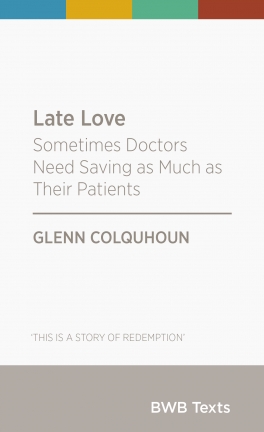
E-Tangata published an extract from Glenn’s new book. For the full extract go here.
In this extract from his new book Late Love: Sometimes Doctors Need Saving as Much as Their Patients, he writes about how his poetry has leaked into his medicine, and changed the way he practises.
The High Chaparral
For most of my career medicine has not been so friendly. I have struggled with doubt. I have always felt that at any point I might do the wrong thing. For a long time this meant that consultations were noisy with my own thoughts. Life was lived in two parts. In one I would go to work and be unsure and struggle with the waiting room and paper trails and fires popping up. In the other I would imagine. I would dream that I could fly. I would soar up over the world like a young seagull and look down and be amazed. Moments would open up like a ranch slider. Inside I found they were timeless. Poetry was good and medicine was bad. I joked that poetry was the first girl I ever loved, the one I always wanted but never felt confident enough to ask out, and that medicine was the girl I got pregnant behind the bike shed and thought I had to make an honest woman of.
A few years ago I began to compile a book based on the stories of a group of patients I saw over the course of one day in general practice. For a year I visited as many of them as I could and asked them about their lives leading up to that consultation. I saw them in their homes and among those things they cared about, then afterwards flew up into the sky like a seagull with an old piece of string and looked down. When I came to write about them I saw them with wet eyes — the sort of love that poetry demands of those who write it.
Copyright © 2016 Glenn Colquhoun
This is an extract from Glenn Colquhoun’s book Late Love: Sometimes Doctors Need Saving as Much as Their Patients, published by Bridget Williams Books.
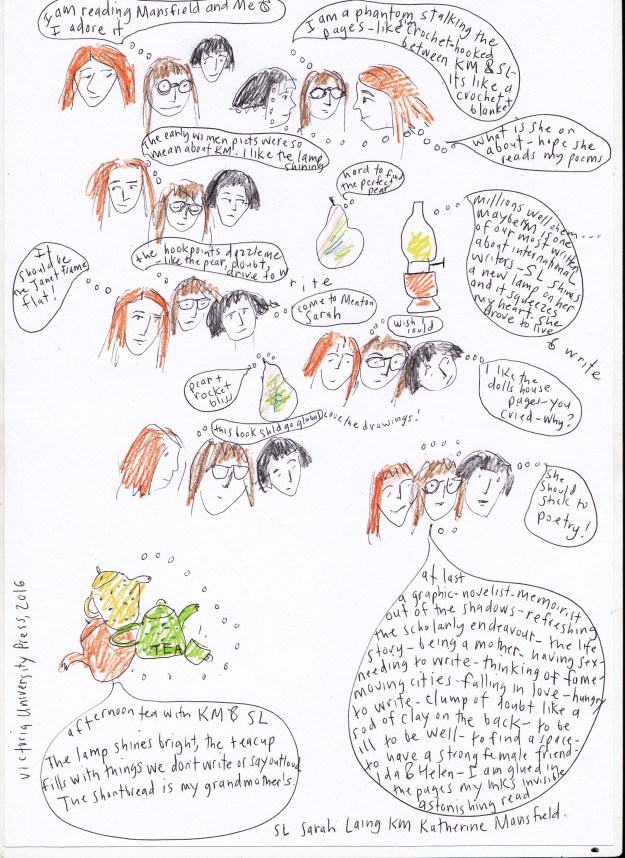
Sarah Laing’s Mansfield and Me is a breath of fresh air. I wanted to write about it for my book but also for the blog, in a different way, so decided, somewhat self-consciously to draw myself into my reading because I felt stitched into the book as I read. Maybe it’s because this is as much about two writers struggling with words, wanting to be noticed and slipping on self-doubt as it is about trying to live. I felt like a tracing paper sheet laid over the pages. What I want to shout out loud is that this wonderful refreshing view on life & writing & motherhood & Mansfield & Laing is turning over a new leaf for us. Mansfield and Woolf wanted to showcase a new way of writing – Sarah has picked up that torch. This is groundbreaking. It deserves an international audience.

Airini Beautrais has been named the winner of the 2016 Landfall Essay Competition for her essay ‘Umlaut’.
Competition judge David Eggleton said that her essay stood out as ‘written by someone unwilling to be boring, willing to take risks, and enough of a seasoned practitioner to carry it off with sustained verve’:
‘Umlaut’ is dextrous, exuberant and comical, if sardonic. It’s an account of the vexing business of unusual names and the thorny encounters they can provoke in this country with bureaucracy, with the insular-minded, with the proudly ignorant. It’s about the absurdities of modern life: how we negotiate otherness, how we negotiate our constantly revised colonial heritage on a daily basis. Sometimes verging on slapstick, nevertheless it’s a tour de force of a kind.
Airini Beautrais says she had thought that the umlaut in her children’s surname would make a good subject for a poem: ‘But the notes I put together seemed to lend themselves to an essay. As I wrote it and considered the issues around names, language and culture I found a lot of anger surfaced, but also a lot of humour. I was surprised how emotional this piece of writing became for me.’
Airini has published three books of poetry: Secret Heart (2006, winner of the NZSA Jessie Mackay award for best first book of poetry at the 2007 Montana New Zealand Book Awards), Western Line (2011) and Dear Neil Roberts (2014, longlisted for the 2016 Ockham New Zealand Book Awards). She holds a PhD in Creative Writing from the International Institute of Modern Letters and her poetry and short fiction has appeared in a range of print and online journals. In 2016 she was shortlisted for the Sarah Broom poetry prize. Airini lives in Whanganui with her partner and two children.
The Landfall Essay Competition is judged ‘blind’ by Landfall editor David Eggleton. The winner receives $3000 and a year’s subscription to Landfall. There were 51 essays submitted for the 2016 competition.
Michalia Arathimos came second, and third place went to Carolyn Cossey. The three essays will be published in Landfall 232 in November.
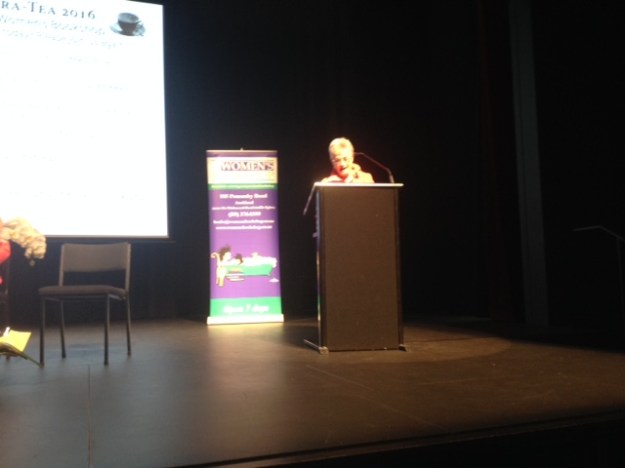
The Ladies’ Litera-Tea is an annual event organised by bookseller taonga, Carole Beu, and the Women’s Bookshop: eleven authors, a full auditorium and an excellent afternoon tea with delicious cakes and savouries. It usually lasts about five hours if you include the book signings. I always come away with a bag of new books, often unexpected choices.
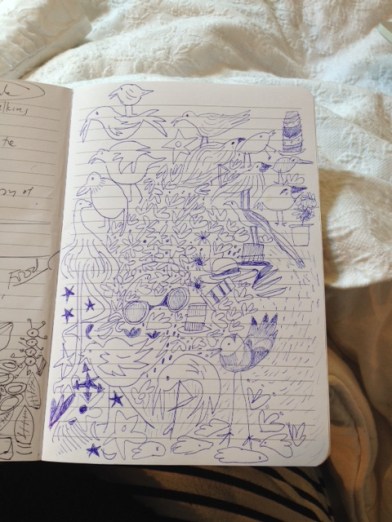
This year I felt like I was walking the fine line between voice and no-voice, with a fuzzy head and a sway that wasn’t to do with reading poems on stage. Luckily I was third up so delivered my poems and then sat back to listen. Usually I take notes to replay on my blog but all I seemed to do was doodle as a counterbeat to the feasts of words.
My head isn’t up to scholarly focus today so I am in bed blogging and reading.
Not sure why there were so many doodle birds. Birds were barely mentioned. Apart from Billy Bird. Or hats. Apart from the steampunks and their creative shed and steampunk hats.
First up was Catherine Chidgey talking with exquisite clarity about her new novel, The Wish Child. I loved the way she made something of obstacles and detours and can’t wait to read the book. Next up Helene Wong talking about: Being Chinese: A New Zealand Story. This is also on my must read list. It feels like essential reading particularly in view of the enduring racism Helene faces.
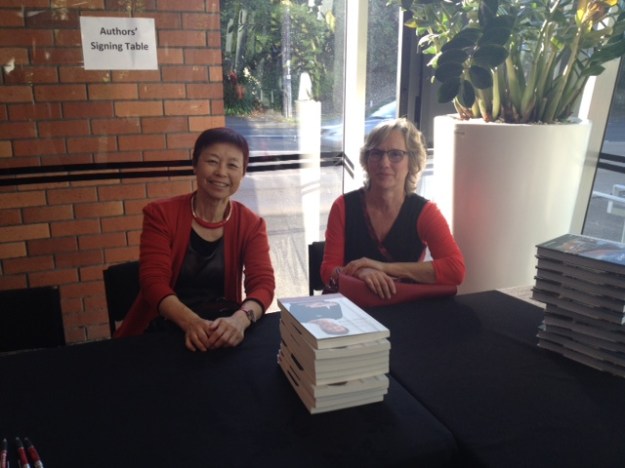
Helene Wong and Marilyn Jessen (Marilyn went on a road trip tracking creative spaces)
Helene recounted an anecdote that resonated (with a few details missing). She was at an undergraduate Chinese paper with a fairly indifferent bunch of students. The white middle-aged bloke started reading a poem in Cantonese. Helen was captivated by the undulating pitch and tones despite not understanding a word. She was struck by this ordinary white man’s pleasure in the Chinese language. His ‘gesture of respect astounded’ her. She almost ‘wept in gratitude’ that he showed so clearly Chinese culture is not to be ashamed of.
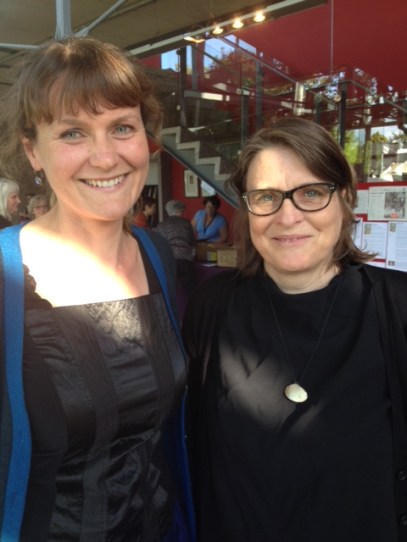
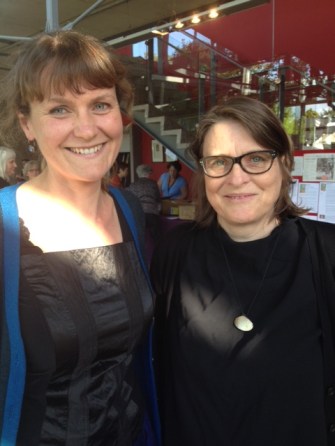
Emma Neale and Paula Green
There is no right formula for authors on stage – especially in view of what to say. I can go either way – just hearing the work or also hearing anecdotes and inroads into the writing experience can hit the spot. I loved the way Emma Neale talked about lexical exhaustion on completing a novel. She borrowed a quote from a musical composer who replayed his piece when asked to explain his work. Emma said she had decided to let the extracts do the talking. I agree with Emma on ‘the joyous creative anarchic energy’ of Billy, the central character of her new novel, Billy Bird. I have just finished this book and it is a top fiction read for 2016. So beautifully written, so moving, so funny, so gobsmackingly good.
The very lovely, very inspirational, Yael Shochat wrapped up the first half. She was celebrating the arrival of Ima Kitchen. I was hooked on the video of grandmothers in the kitchen in Israel making lunch. At half time, the queue for Ithe cookbook never stopped. Both cafe and book are terrific additions to Auckland’s eclectic food scene. We have had such a wide cultural culinary seasoning for decades and it adds so much to who we are as a city. When I arrived back from London in the 1980s my tastebuds were popping. Will be cooking out of this book tonight!
a f t e r n o o n t e a interlude was worthy of a n a f t e r n o o n t e a p o e m
sweet lamington and asparagus roll
the poem unfolds like spanikopita
spinachy peppery cream on the tongue
(thanks Yael, so delicious)
A long time fan of Kerrin P Sharpe’s poetry it was such a treat to hear her read for the first time. I adore the mother poems in her new book, Rabbit Rabbit – the audience did too as it was oohs and aahs and beautiful (just as I heard after the lyrical fiction of Emma Neale). I also loved the entry points gave into the book as it provided me with new discoveries.
Having recently (two posts back maybe!) gushed to you about Ashleigh Young’s witty debut collection of essays, Can You Tolerate This?, a highlight was hearing her read. She selected a section from ‘Big Red.’ I have quoted several times from this essay, so it felt like a favourite album was playing and I was word perfect. Wonderful!
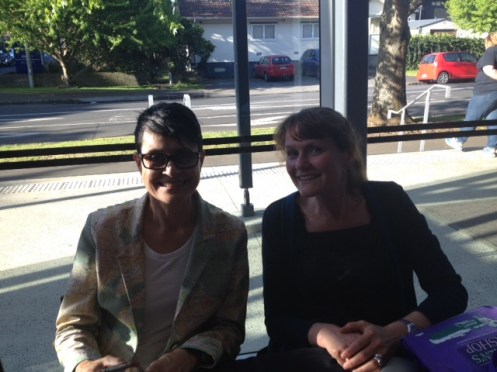
Emma Neale and Gina Cole (in the 6pm shadows!)
I was hooked on Gina Cole’s ancedotes, lucidity, warmth and story extracts all pivoting on the “L” word: lighthouses, law, literature. Her new book, Black Ice Matter, went in my shopping bag! I want to post about this soon!
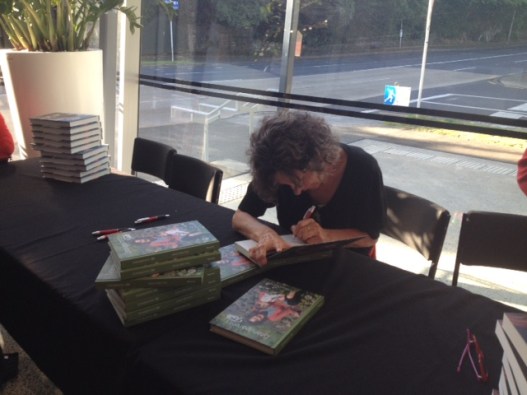
Janice Marriot’s book on Grandparents Talk also went in my shopping bag. It was good to meet a poet who has writtn some of my favourite poems in the Treasury!
Finally a dose of laughter. Urzila Carlson used her new book, Rolling with the Punchlines, to deliver a stand-up routine/reading/musing/confession that was pure gold. Like most of us she was anxious about following on from people so much wittier or funnier or more erudite. She says it best. She had been hearing all this writing that was ‘like warm honey in your mouth and too good to swallow.’ She then compared it to an effervescent something on the tongue [and then a riff on that]. ‘Holy shit,’ she says ‘What am I doing here? I should leave. I should say I’ve got to get a flight with Ashleigh.’ But then she had us in fits of laughter, tears streaming for twenty minutes, with a few piercing moments of inbreath and gasp at something sad or hard to talk about. Such a tonic.
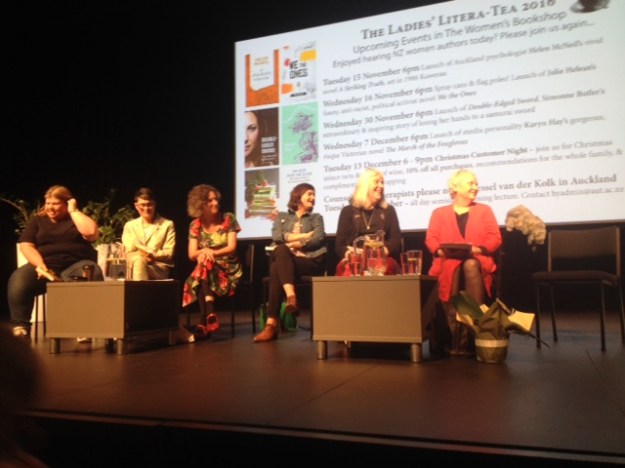
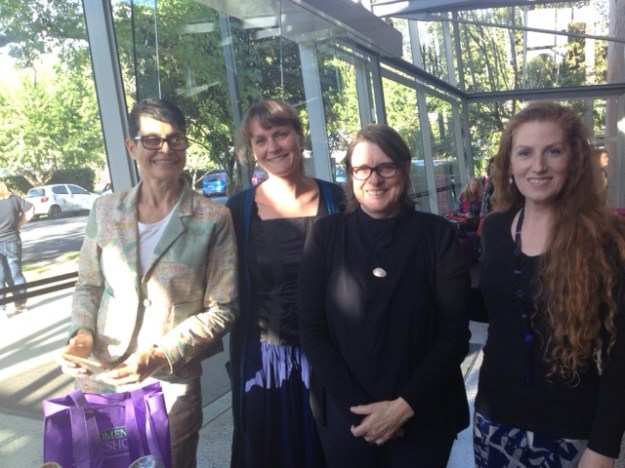
It was a rollercoaster occasion: warmth, ideas, humour, sad things, happy things, connections. I think I came home with six new books.
Thanks Carole and the Women’s Bookshop – it was a very happy audience.
 NZ Poetry Shelf