Poetry Shelf The Summer Season: Selina Tusitala Marsh picks Tusiata Avia


This is a photo of my house


It has pink bricks and a big tree. This is the driveway, you can lie on it in the summer, it keeps you warm if you are wet. This is the screen door, swallow. Front green door, hold your chest. The carpet is dark grey and hurts your knees, it doesn’t show any blood. Here are the walls, be careful of the small girl in the corner. Here is the door into the hall, be careful of that too. Here is the line where the carpet stops and the kitchen starts, that is a different country—if you are in the kitchen you are safe, if you are in the lounge on your knees you are not. Watch out for the corners. She isn’t going anywhere. There is the piano. There is the ghost. Here is the hall, it is very dark. Here is the bedroom. Here is the other bedroom, babies come from there. Here is the last bedroom, it is very cold, there is a trapdoor in the wardrobe, it goes down under the floor and you can hide if there is a flood or a tornado. There is the bath. The aunty punched the uncle in the face till he bled, they lived in the small room, the cold one, that was before I was born. Here is the lounge again, here is the phone: ringthepoliceringthepolice. Here is the couch, it is brown, watch out for the man, he is dangerous. Here is the beginning of the lino in the kitchen again, here is the woman. Watch out for the girl in the corner, she is always here. There is the woman, she just watches and then she forgets.

I am cutting a big hole in the roof. Look down through the roof, there is the top of the man, you can’t see his face, but see his arm, see it moving fast.

I am removing the outside wall of the bedroom. Look inside, there are the Spirits, that’s where they live.

Stand outside in the dark and watch the rays come out through the holes—those are the people’s feelings.


©Tusiata Avia,  Fale Aitu | Spirit House, Victoria University Press, 2016.


This is not a favorite poem.  It is not kind or gentle on the ears, eyes or heart.  But it is unforgettable.  Its quiet violence, the way it creates in-breaths of silent horror through concrete objects, the materiality of the powerful against the powerless in domestic spaces, the neutrality of nothing, imbalances me.  The manner of this poem reflects the nature of domestic violence – that all is seemingly known and visible, like a normal brick house on a normal street, and yet, inside the walls thrive secret spirits inhabiting the dark corners of our lives.  The voice in the poem remembers and pries open these walls, as one would do with a doll’s house.  She stands back and notices the pinprick light escaping through the openings she’s made.  This is how she begins to exorcise secret pain.  This is how memory might work.

Selina Tusitala Marsh


Selina Tusitala Marsh is Associate Professor of English and Pacific Literature at the University of Auckland. She is of Samoan, Tuvaluan, English, Scottish and French descent. Her first collection of poems, Fast Talking PI (Auckland University Press, 2009) won the 2010 NZSA Jessie Mackay Best First Book Award for Poetry. Selina was the Commonwealth Poet for 2016 and performed her poem, ‘Unity,’ for the Queen at Westminster Abbey. She was made Honorary Literary Fellow in the New Zealand Society of Authors’ annual Waitangi Day Honours, 2017.

Tusiata’s collection is longlisted for The Ockham New Zealand Book Awards.



Poetry Shelf The Summer Season: Poets pick poems – Airini Beautrais picks Gregory O’Brien


The clod of earth speaks


2004


I have come to Waitangi,

Said the leader of the opposition.

But I have always been here,

Said a clod of earth scooped from the ground.


We are for the leader of the opposition,

Sang the enclave of suits.

So am I,

Intoned the clod, mid-air.


2005


Although you didn’t recognise it at the time

I was your best idea


a thought bubble hovering just west

of your changeable complexion.


That, between the two of us, we might arrive at

some natural relation


between man and land, I was a hearing aid

that you might hear,


a handful of clay rubbed into your eyes

that you might see.


A year has passed, I am often asked

where the flying clod


finally came to rest. Up north

we have a saying:


the mud outlives

the man.


You never stood easily inside

your body – you needed


earth to steady you. That I offered.

Every gardener’s dream:


A good manuring. Time did not

stand still for me:


I was raised up, remembered

as ‘the high flying one’,


but also that most stationary of things,

the everything-returning earth.


©Gregory O’Brien Afternoon of an Evening Train Victoria University Press,  2005.


In 2004, Don Brash, then leader of the opposition, delivered a now infamous inflammatory speech at the Orewa Rotary club. Amongst other things he claimed that Māori were the recipients of unfair privilege, and described the Waitangi tribunal process as the ‘now entrenched Treaty grievance industry.’ The full text of Brash’s speech is available online.

The speech sent ripples of hurt throughout Aotearoa: amongst Māori, amongst non-Māori, amongst people working for reconciliation.

In 2004 I was 21, living in a flat with six staunchly political women and genderqueer people. Some of us were directly involved in working with treaty issues, particularly aiming to educate our wider communities about the history of the treaty and its importance in the contemporary world.

When Brash attended Waitangi Day celebrations in 2004, he was showered with mud and hit in the face with a clod of earth. It felt like the clod of earth was speaking for a lot of people. It was speaking for us.

Later, when Greg O’Brien’s poem ‘The clod of earth speaks’ appeared, I remember reading it and thinking ‘Yes.’

Responses to reading poems vary, even when poetry is one’s ‘thing.’ Sometimes I am quietly impressed. Other times I’m delighted by a poet’s technical skill. At times I’m ambivalent, at times I feel ‘that doesn’t work,’ and so on. The poems that have really stayed with me over the years have been the ones that reached me on an emotional level. Somehow these poems have said something I needed or wanted to hear; something that stops me in my tracks. ‘The clod of earth speaks’ is one of my favourite New Zealand poems for this reason. I remember being excited that O’Brien was willing to tackle this subject, one which might quickly be put in the ‘too hard’ basket by many writers. Few subjects in New Zealand have the potential to touch on so raw a nerve. For Pākehā poets it might be easy to say ‘That has nothing to do with me, I have no place writing about it, I’ll leave it for someone else.’ But it has everything to do with us. We live on this piece of earth.

I like the way this poem is divided into two sections, the first the symmetrical, call-and-response exchanges of Brash and the clod. I like the shift in tone in the second half, where the clod is given the last words, stating ‘I was your best idea . . . a hearing aid / that you might hear. . . .’ Ventriloquising through the clod, the poet asks a politician, but in fact all of us, to listen. The final line ‘the everything-returning earth’ is a call to humility: a reminder of our fallibility and mortality, and our responsibility to the land and to each other.

In the collection Afternoon of an Evening Train, this poem is included in a short section entitled ‘Two handfuls of earth’, alongside another political poem, ‘Dominion’. A number of other poems in the collection feature the story of Parihaka. There are strongly thematic concerns in the collection, various approaches to place being the most evident. ‘The clod of earth speaks’ marks an important moment in New Zealand history; Afternoon of an Evening Train is a significant waypoint in New Zealand poetry.

Airini Beautrais


Airini Beautrais is the author of three poetry collections. A fourth collection about the Whanganui river region is forthcoming later this year.


Poetry Shelf The Summer Season: Poets pick poems – Bill Manhire picks Louise Wallace

DSCN7357.jpg

Four Seasons on Poetry Shelf aims to widen the scope of voices, selections, opinions, poetry tastes, sidetracks, reading options in 2017 on the blog. Each season will be different.


First up, The Summer Season where, over the course of two weeks, New Zealand poets pick a favourite New Zealand poem and offer a few comments.

I have spent the past year reading, writing and researching my way through poetry by New Zealand women for my book. Sometimes a poem feels like a foreign country, a sea in which I haven’t the foggiest idea how to swim, and I feel like I am treading water, hopelessly. But sometimes, upon return, when the light catches the poem aslant (thanks Cilla McQueen!), I find myself swimming and it is heaven. Sometimes it’s just a matter of changing stroke, of navigating the tidal flow with different eyes. Different ears.

Reading outside your comfort zone, reading into the unfamiliar along with the much loved, is an absolute joy.

Yep, poetry is an absolute joy.


To launch the season, I am posting a poem Bill Manhire is very fond of:

‘Poi Girls’ by Louise Wallace (Since June, Victoria University Press, 2009).

Bill also suggested including a link to Louise’s excellent short note on the Best New Zealand Poems site. However Louise has granted permission to post both the poem and the comment. Thank you!

The Poi Girls

Kahu, Mere, and Faith
stand on the grass
by the corner.
They lean
on the fence and watch you
walk past –
spinning, twirling their poi.
Pou
Pou
Pou
The Poi Girls
say with their poi,
with each hard slap
of their poi.

On your way home
they’re in the same spot,
Kahu, Mere, and Faith.
Their older brothers and cousins
are fixing the car, out
on Mere’s lawn.
The boys stop as you
walk by.
They lean their hands
on the car’s sides and look out
from under the hood.
What
you
want?
The Poi Girls
say with their poi.

You’re walking
down the dip
but you have left
your shoes at school.
The yellow seeds
stick to your feet,
and when you get up
the other side, The Poi Girls
are looking
at you.
Om
Om
Om–mee
The Poi Girls
say with their poi.
Piss off,
you tell them,
leave me alone.
You don’t need
their crap as well.

You stuff Pak ‘n Save bags
into white plastic
and tie
them up with string.
You walk past the corner
twirling and spinning,
Hey
you!
Bumheads!
you say with your Pak ‘n Save poi.
The Poi Girls chase you
down the street
but you are too little and fast
for them,
especially for Faith, the fat one,
the one with the lighter skin.

One day in the cloakroom
It’s just you and Thomas
and he tells you
you have beautiful eyes –
green and brown,
just like his girlfriend, Jade’s.
The Poi Girls burst in, twirling.
You
kissed
Thomas!
The Poi Girls
say with their poi,
your cheeks
pounding flush.

Your sister tells you
to run through the mud
and you say you will
and that you don’t even care.
So you run
and halfway you sink
to your waist
and down the dirt road
come The Poi Girls, slowing
to a stop.
Ha!
You
egg
The Poi Girls
say with their poi
and leave
with your sister
in tow, twirling.

It’s sunny but cold
that morning, on the way
to school.
Mere’s front lawn
is filled with cars,
and there are people in suits
and old koros with sticks
and The Poi Girls stand
out the front.
Mere doesn’t
look at you today,
so Kahu and Faith
glare twice as hard for her.
The Poi Girls’ poi
hang still
from their hands
and today
say nothing at all.

©Louise Wallace Since June, Victoria University Press, 2009.


Louise comments:  ‘ “The Poi Girls” is one of those rare poems that came to me almost fully-formed in the middle of the night. I scribbled it down then and there, and I wish this happened more often! I grew up in Gisborne and the essence of this poem comes from there. The poem is about childhood, curiosity and the nature of difference, but contains a certain menace too. Through the sound of the poi and its repetition I hoped to convey the weight and seriousness that events so often have when you experience them as a child.’


Best NZ Poems

Listen to the poem here.

Poet honoured on Waitangi Day: Selina Tusitala Marsh, Honorary Literary

1456791150657

Acclaimed poet and scholar, Selina Tusitala-Marsh, has been made Honorary Literary Fellow in the New Zealand Society of Authors’ annual Waitangi Day Honours.
“As the country’s largest writers’ organisation, we believe it’s important to celebrate significant literary achievements, especially on the international stage,” said NZSA President, Kyle Mewburn. “Each year more and more kiwi writers are achieving exceptional things internationally. Last year was no exception.”
“As 2016’s Commonwealth Poet, this year’s NZSA Literary Fellow, Selina Tusitala-Marsh, was able to share her unique and powerful voice with the world. This included a memorable performance before the Queen at the Commonwealth Day of Observance in Westminster Abbey, which placed the diversity of our local poetry in the international spotlight,” Mewburn said.
“Fa’afetai tele lava for this lovely acknowledgment,” said Tusitala-Marsh. “The wondrous thing about a poem is that it’s an ‘ala’ – the proto-Polynesian word for ‘path’. As a ‘Tusitala’ my poems are paths between cultures and world views. In 2016 a poem found its way into Westminster Abbey connecting my Tuvalu grandfather with the Queen of England, Samoan philosophy with global ecology, and a New Zealand Fast Talking PI poet with the Commonwealth. How marvellous is that? Here’s to paving more poetic paths!”
First introduced in 2013, the NZSA’s Waitangi Day Honours celebrate success on the international stage.
“As the only writing awards bestowed by peers, they have become a highly regarded and prestigious honour,” Mewburn said.
Previous winners include Eleanor Catton, Paul Cleave and Philip Mann.

The gift shop


The gift shop


When Josephine leaves Ellis Island she is not yet sure what she takes away with her, and what she leaves behind in the glass cabinets, and she wonders if the gift shop sells little blue bottles of hope, gathered as carefully as saffron, to keep in a coat pocket and season the next day, and then the day when it is most needed.


© Paula Green New York Pocket Book Seraph Press, 2016.


Sarah Broom Poetry Prize – Entries now open

SARAH BROOM POETRY PRIZE

The Sarah Broom Poetry Prize is New Zealand’s most valuable poetry prize and aims to recognise and financially support new work from an emerging or established New Zealand poet through a $10,000 award.

The prize was established in 2013 in honour of the New Zealand poet Sarah Broom (1972-2013), the author of Tigers at Awhitu (2010) and Gleam (2013).

Entries open on 6 February and close on 2 March 2017

The Sarah Broom Poetry Prize is now in its fourth year, and we are pleased again to be working together with the Auckland Writers Festival to showcase and celebrate New Zealand poetry. The prize will be announced at the Auckland Writers Festival in May 2017. Shortlisted poets will be invited to read their poetry at a dedicated poetry event at the Festival, where the winner will be announced.

The judge for the 2017 prize is Carol Ann Duffy. Duffy is Britain’s Poet Laureate and is the first woman in the role’s 400 year history. She is one of the most significant names in contemporary poetry and the author of books for children, plays and many celebrated poetry collections including Mean Time (1993), which won the Whitbread Poetry Award and the Forward Poetry Prize, The World’s Wife (1999), Love Poems (2010) and The Bees (2011). She has been awarded numerous awards and prizes for her work including the T.S Eliot Poetry Prize.


For more information about the prize and Sarah Broom see here.

For more information about the Auckland Writers Festival, which will be held from 16 – 21 May 2017, visit here.


HOW TO ENTER

The prize is awarded on the basis of an original collection of poems by a New Zealand resident or citizen. Entries will be accepted from from 6 February 2017 until 2 March 2017.

Poets are required to submit six to eight poems, of which at least five must be unpublished. The recipient of the prize will be announced in May 2017 at the Auckland Writers Festival. Shortlisted poets will be invited to attend a dedicated event and read from their work.

Entries should be emailed to poetryprize@sarahbroom.co.nz Any queries should be emailed to enquiries@sarahbroom.co.nz


CONDITIONS OF ENTRY

1. Poets are required to submit six to eight poems of which at least five must be unpublished. 2. There is no maximum or minimum length – formatting and font size is your choice.
3. Entrants must be New Zealand permanent residents or citizens.
4. Only one entry per person will be accepted.

5. Entries must be the author’s original work. Any use of quotation must be acknowledged by attribution to its source.

6. Entries must be submitted as one electronic file per entrant, as an email attachment in Word or PDF format. No identifying details should be present in this poetry portfolio.

7. Your entry should also include a covering email with a brief personal statement, an indication of how you would use the award money, and contact details. These covering details are not provided to the judge.

8. The judge will assess the merits of submissions, and the Sarah Broom Poetry Trust reserves the right not to award a prize.

9. The prize recipient will be announced at the Auckland Writers Festival in May 2017 and in other appropriate publications.

10. No correspondence with the judge will be entered into.

11. The name and photograph of the prize recipient may be used by the Sarah Broom Poetry Trust for publicity purposes.

Josephine waits in a queue

Josephine waits in a queue


Josephine wears her Time Out Guide as a hat and then uses it as a fan

and then wears it as a hat again because she is caught in a queue

that is endless interminable bending about in the biting heat

with the buskers upstaging the Statue of Liberty and the Statue of Liberty


out there in the harbour like a pale welcome sign in the murky light.

Someone stands on a ladder dressed as the statue and doesn’t blink

or twitch, the classical green folds look like stone and next the bronze figures

stuck on the pier that might twitch or blink or be there for an eternity


one knee-deep in water with fingers outstretched missing the rescue

always not-quite saved the man stretching fingers down from the plinth

a boat and there’s an accordion frozen in time hands to mouth the bronze

tinged with liberty green a tableau of hope intense melancholy


that trips the woman up. For a moment Josephine thinks she’s an immigrant

taking off her shoes and belt and surrendering her bags, and then after three

hours and without warning she is moved into the fast lane as though she

is exactly what America wants.


©Paula Green New York Pocket Book Seraph Press, 2016


Liz Breslin, placed third in Charles Causley International Poetry Competition Winners 2016

Screen Shot 2017-02-01 at 7.17.09 PM.png

The Winners:

1st: ‘The Load’ by Jack Thacker (Bristol) – £2000 and a week at Cyprus Well

2nd: ‘The Year You Turned Into A Fish’ by Joanne Key (Cheshire) – £250

3rd: ‘Walk A Mile/ Stepping Out’ by Liz Breslin (Hawea Flat, NZ) – £100


As a child in the UK, Liz Breslin memorised Charles Causley’s poems, sitting in the bath. She now lives in Hawea Flat, New Zealand and writes poems, plays, stories, articles, and a fortnightly column for the Otago Daily Times. She also edits, parents, partners, skis badly, gardens sporadically, coordinates a school student volunteer programme, drinks too much coffee and loves getting her feet wet.

Liz’s first collection of poems, Alzheimer’s and a Spoon, will be published by Otago University Press in 2017. She is comfy on the page and the stage, was second runner up in the 2014 New Zealand Poetry Slam in Wellington and did an audience-response poem at the 2016 TEDx Queenstown. Liz took part in the ‘52’ project in 2014, where she discovered new voices and fantastic practices. Her poems can be found in Landfall, Café Reader, Takahē and other places in NZ, overseas and online, as well as brewing in the bath. Poems give her hope, connection and stoke. http://www.lizbreslin.com


Full details here.

Comments from Liz here.

You can find some of her poems here and they are good!

Exciting to see Liz has a collection out with Otago University Press this year.

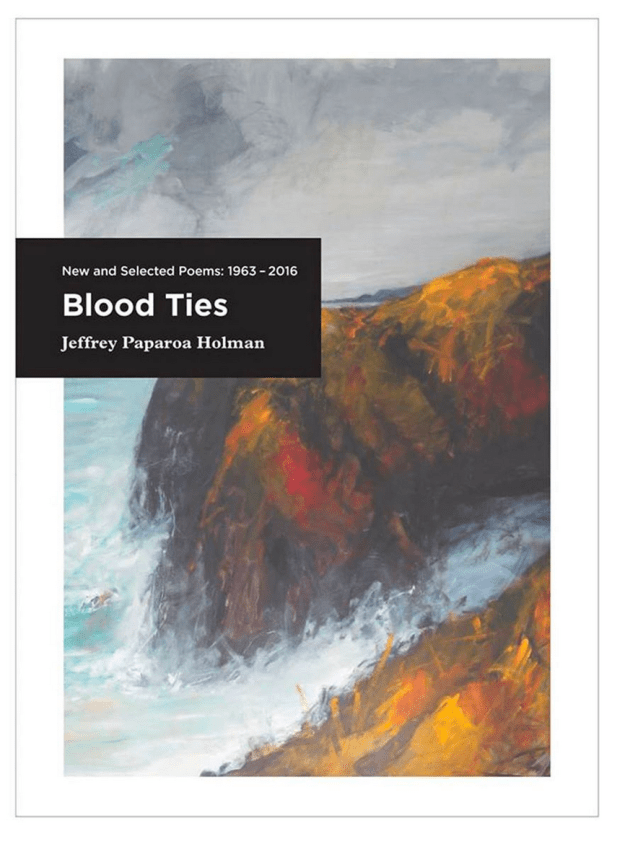
A Selected Poems from Jeffrey Paparoa Holman is out this month

BLOOD TIES: New and Selected Poems 1963-2016.
Jeffrey Paparoa Holman, Canterbury University Press,
978-1-927145-88-3, $25.00, due February 2017.

‘Blood Ties is a journey through a lifetime that is a parable of settlement, one man’s response to the challenge of living responsibly and with sensitivity to the question of where we are and what we must be. There are strong ancestors throughout, but, at the same time and very distinctively, the urgent sound of this river of poetry is all this fine poet’s own.’
Patrick Evans


Screen Shot 2017-02-01 at 7.10.52 PM.png

Poetry Live relaunches with Anne Kennedy and MW Sellwood

Screen Shot 2017-02-01 at 7.06.14 PM.png


Come one, come all, to our opening night of the year!

GUEST POET: ANNE KENNEDY
Anne Kennedy is a poet, novelist and screenwriter. Her awards include the NZ Post Book Award for Poetry for Sing-song and the Montana New Zealand Book Award for Poetry for The Darling North. Her novel, The Last Days of the National Costume, was shortlisted for the NZ Post Book Award for Fiction in 2014. In 2016 Anne was Writer in Residence at IIML, Victoria University of Wellington. She teaches fiction and screenwriting at Manukau Institute of Technology.

GUEST MUSICIAN: MW SELLWOOD
MW Sellwood is an up-and-coming Auckland blues artist from the city’s thriving underground music scene. Equally at home performing tunes on stage or a street corner, his groovy electric guitar riffs and playful vocals combine for a fresh take on Blues music in the new millennium!

POETRY OPEN MIC

KOHA ENTRY

MC: KIRI