2017 National Poetry Day calendar launched

20525413_1487630067987925_3566487927227859305_n.jpg


2017 CALENDAR OF EVENTS IS LAUNCHED!

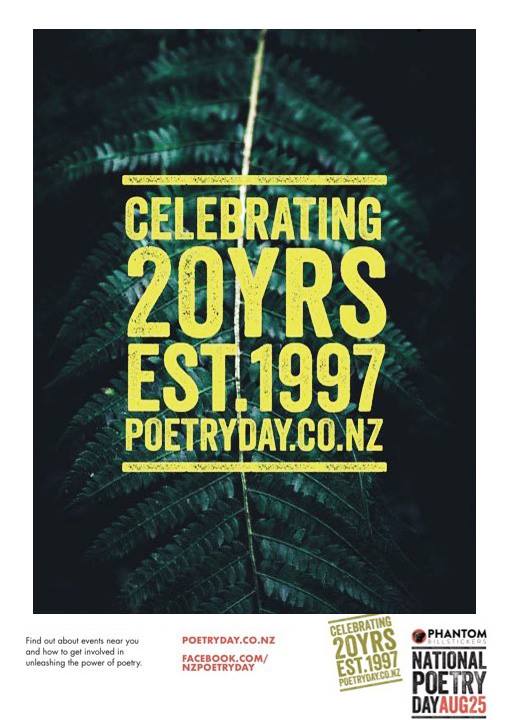
To celebrate its 20th anniversary, Phantom Billstickers National Poetry Day offers its most ambitious and wide-ranging programme of events yet.

This year’s packed programme features more than 100 dynamic and accessible events, workshops and competitions, featuring acclaimed poets, new voices, young writers, and poetry enthusiasts. From Slam Poetry to sonnets, from stages to pavements, poetry will be created and enjoyed in a myriad of venues around the country: cafes, bars, schools, university campuses, community centres, retirement villages, marae, libraries and theatres – as well as on buses, trains and ferries.

For full information about all events, including places, venues, times, tickets and more, go to the Phantom Billstickers National Poetry Day 2017 Calendar of Events.

Poetry Shelf Winter Season: Liz Breslin off-piste


The way things are


When they’re going to give you medals they send you a letter.

When you go to get them you’ll be treading on old ground, though you won’t know it by your feet.

When you stand and salute you must keep your fingers straight, you must remember the promises you made. When they give you the medals it is symbolic, the freedom, the keys.

When I Skyped my Ma she said there are different things that the medal boxes say. Your babcia was in the Home Army and then there was a national medal, now, I’ve forgotten what it was and then that little booklet with the President’s stamp but they were different and the national armed military action medal and the cross of the Warsaw Uprising and krzyzem is cross but the grammar is different, it means with the cross, they’ve got different endings and we found two separate cross pins in a little plastic bag so we put them in the empty box and I showed them to people

when they came after she died because that’s what you do and I forgot to say, with the photos, match the booklet to the medals, because that’s how you do it, that’s the only way, I wouldn’t know otherwise, she never told me either. I wonder if it’s the key that’s missing, I don’t have an actual memory of seeing it. It clearly isn’t an actual key that opens an actual door because there’s clearly no such thing in an actual city. She could’ve had a lot of free bus rides with that card.

When my babcia did that interview, that once, she said and now that people are celebrating this Uprising, I think to myself was it really worth it, to pay such a price? And what for? What for? For we didn’t gain anything substantial, anything real.


©Liz Breslin


Author note: This poem was a departure for me because I usually obsess over line endings and over having less words doing more, whereas here I’ve tried to capture language as faithfully and actually and unravelled-ly as I could. It’s also new for me to allow myself prosey line endings. It used to bother me that I wasn’t quite sure what was flash fiction and what was prose and what a poem and now I’ve decided it’s whatever. It’s the way the words settle true.

Liz Breslin doesn’t know the difference between rhyme and reason but she can write her way out of a paper bag. Her first poem collection, Alzheimer’s and a spoon, is out now, thanks to Otago University Press. She also writes plays, short stories and a fortnightly column – Thinking Allowed – for the Otago Daily Times. Liz is comfy on the page and the stage, came third in the 2016 Charles Causley International Poetry Competition and was second runner up in the 2014 NZ Poetry Slam. Her website is here.


From Paula: For Poetry Shelf’s Winter Season, I invited 12 poets to pick one of their own poems that marks a shift in direction, that is outside the usual tracks of their poetry, that moves out of character, that nudges comfort zones of writing. It might be subject matter, style, form, approach, tone, effect, motivation, borrowings, revelation, invention, experimentation, exclusions, inclusions, melody …. anything!



Poetry Shelf Winter Series: Jack Ross off-piste


Never give up

when you

get home after an undisclosed

absence abroad (say seven days)

to find your life in

chaos wife in hospital note

in red ink left on

the coffee table explanations given

gratis by your father who

can’t hear the doorbell nor

is he aware of any

of the names of any

of the main protagonists it’s

a rainy night and nothing

for it but to drive

to the hospital (wherever that

might be) and fight for

parking in the truncated parking

zone – crowded out by their

new building – make your way

to the curtained alcove hone

in on the source of

disturbance see her hear her

voice breathe deeply understand the

cat’s hysterical reaction but transcend

it hug her tell her

about the presents you’ve brought

back for her leave her

behind eventually having been seen

(not moved) by the doctors

then go home

to sleep


Jack Ross


Author note: This poem, ‘Never give up,’ seems to fit best into your category of ‘poems off-piste.’ It’s a pure transcript of experience, written at a time in which all the poetry I came out with seemed to demand elaborate amounts of scaffolding to make any sense at all.

Alistair Paterson printed it in Poetry NZ in 2012, and it’s also available online on a website linked to one of my fiction projects, The Annotated Tree Worship (forthcoming later this year). He queried the use of the word ‘hone’ – as in to ‘hone in’ on something – suggesting ‘home in’ instead. I kept on hearing ‘hone’ in my head, though, and so stuck to the immediacy of my first impression.

I feel that there’s a lesson there somewhere, though I’m not quite sure what it is: keep on cutting back on the undergrowth and be faithful to the actuality of experience, I suppose.


Jack Ross is the managing editor of Poetry New Zealand, and works as a senior lecturer in Creative Writing at Massey University’s Auckland Campus. His latest book, The Annotated Tree Worship, is due out from Paper Table Novellas in late 2017. He blogs here.


From Paula: For Poetry Shelf’s Winter Season, I invited 12 poets to pick one of their own poems that marks a shift in direction, that is outside the usual tracks of their poetry, that moves out of character, that nudges comfort zones of writing. It might be subject matter, style, form, approach, tone, effect, motivation, borrowings, revelation, invention, experimentation, exclusions, inclusions, melody …. anything!


Johanna Emeney reviews Jenny Powell’s memoir at Landfall online

Full review here


The Case of the Missing Body, while also on the subject of living with pain/disability, is an entirely different book to The Walking Stick Tree. It contains scientific writing, poetry and, predominantly, prose, to tell the story of a woman regaining the capacity to connect with herself physically.

Powell uses the pseudonymous Lily in the prologue of the book to introduce us to the central character (who will be ‘I’ throughout the book). From childhood, Lily has had a proprioceptive deficit and joint hypermobility syndrome, which, combined, and not properly identified or treated in her youth, have caused her considerable pain and distress. Now in mid-life she is anxious, lacking in confidence and, admirably, desirous of change: she joins a gym and employs a personal trainer.


Hera Lindsay Bird’s interview with Cordite’s Jonno Révanche

For the complete interview see here.

Jonno Revanche: One of the things that stands out from your poetry collection is not just how funny it is, but it’s a very precise kind of humour, one that allows for introspection, sentimentality and emotional involvement. For example, in ‘mirror traps’ you declare it’s ‘love that plummets you down the elevator shaft.’ Sort of blunt, but still honest and witty in its own way. Do you find it hard to accommodate all these things? If so, do you feel like it took a lot of practice to get there?

Hera Lindsey Bird: This is a hard question to answer because it’s so second nature to me now, and I don’t mean to sound like I’m dashing off poems while laughing in a stolen Cadillac, but that particular hybrid of humour with a base of emotional honesty or engagement is almost all I care about in writing these days. There was a period when I first started, and I was writing a lot of controlled, aesthetically rigid poems but I quickly became bored of that, and when I get bored I get reckless, and when I get reckless I send a lot of joke poems about oral sex to my masters supervisor. But most of the work was admitting to myself what kind of writing I truly had the energy and enthusiasm for, and giving myself permission to write that way. My favourite writers in every genre always straddle the line between comedy and emotional engagement, George Saunders, Chelsey Minnis, Mark Leidner, Frank O’Hara, Lorrie Moore. It was just a matter of admitting that to myself, and then hot-wiring Cadillacs became a lot easier. I never write well when I’m sombre. Even my greatest personal tragedies I like to turn into a joke, which might be a personal failing but I don’t think has been a poetic one at least.

Poetry Shelf Winter Season: Chris Price off-piste


Six Thinkers


Six thinkers


Anne thinks that Brian should stop pestering her to marry him.

Brian thinks if only Anne would only stop worrying about how they were

going to live.

Catherine thinks that Dean would be a far better choice for her daughter.

Dean thinks that Erica is the hottest thing since Elvis Costello.

Erica thinks that accountancy students may be the most boring people on

earth.

Frank thinks that Catherine should just leave Anne alone to make up her

own mind.


Brian thinks it looks like rain as he hesitates on the porch.

Catherine isn’t sure, but she offers Brian an umbrella.

Dean sees that drip Brian leaving Anne’s place as he pulls into the next-door

 driveway in his Ford Capri.

Erica has been ready for ages but she still goes to the mirror to check her

make-up when she hears the car.

Frank thinks That boy’s got his head screwed on the right way, Erica’s a real

 doll, if I were his age . . .

Anne thanks God (in whom she no longer believes) that Brian’s gone at last,

and wonders what her father is looking at through the kitchen window.


Catherine says Would you like to join us for a barbeque, Dean?

Dean leans over the fence and says No thanks Mrs Franklin, I’ve got some

serious studying to do.

Erica says Yes, he’s got exams next week.

Frank says Gotta get your priorities straight eh Dean?

Anne says Well, maybe after exams, then?

Brian says nothing, he’s halfway to Forrest Hill, grateful that the rain’s held

off, whistling, not a clue in the world what a no-hoper he is.


Dean passes that git Brian on his way home and pretends not to see him so

he won’t have to offer him a lift.

Erica wonders whether Dean really is the man for her, when accountants

 are so uncool, even if he does have a Ford Capri and a flat on his own

with a view of the Harbour Bridge.

Frank lingers at the window, which affords him a good view of Erica’s

 cleavage as she stands at the fence talking to his wife.

Anne finally twigs to the reason for the amount of time her dad spends at the

kitchen window.

Brian gets home and puts on a cup of tea for his mum, who is asleep over

the racing pages, radio cantering on in the background.

Catherine wonders why her daughter doesn’t get out more, meet a few

boys like Dean.


Erica thinks Dean just wants to get into her pants, he’s like any other boy,

in the end.

Frank thinks he wouldn’t mind getting into that girl’s pants, if he were a

 younger man . . .

Anne thinks I know what you’re thinking you dirty old bastard.

Brian thinks I wonder what’s for dinner?

Catherine thinks that young women today just don’t know how easy

they’ve got it.

Dean thinks about slipping his hand down Erica’s jeans as he slides into

the bath with Elvis Costello up loud on the stereo.


Frank starts guiltily as his daughter clatters the knives and forks onto the

tray with unnecessary force.

Anne decides she’s never going to get married, at least not until she’s finished

her degree and got a few year’s work behind her.

Brian sets the table, and puts the steaming cup quietly down where his

mother can’t knock it over when she wakes.

Catherine comes inside and says, Well, time to light the barbeque, eh Frank?

Dean flings some Brut about his steaming person, wraps a towel round his

waist, strolls into the lounge and flicks through his address book.

Erica walks in her parent’s front door and sits thoughtfully by the

telephone in the hall.


Anne begins buttering the bread, but her mind is elsewhere, and she butters

the teatowel thoroughly before she realizes.

Brian finds some fish fingers and frozen peas in the freezer and thinks

that’ll do us as his mum’s snore begins to ruffle the pages of the paper,

 ever so slightly.

Catherine wonders if her daughter might be pregnant, she’s been so vague

lately, and now this thing with the teatowel.

Dean finds Glenda’s phone number and begins to dial.

Erica decides it’s time to begin again.

Frank begins to build up a nice wee blaze.


©Chris Price, from Husk (Auckland University Press, 2002)


‘Six Thinkers’ was a response to an exercise Bill Manhire set the IIML’s MA workshop of 1998. The exercise was simply to write a poem in the form of a list (although Bill did hand out a couple of example poems along with that instruction, one a recipe poem by Gary Snyder, the other an Allen Ginsberg poem that used anaphora – every line began with the word ‘Because’).

My initial idea was simple: I would write down the first six letters of the alphabet, in order, a bit like a multi-choice test, and use each letter to begin a new line. The next step was to assign a name to each initial, so I found myself with a cast of characters whom I needed to set in motion.

The added constraint was that I applied the rotating end-word pattern of the sestina to those six names at the beginning of each line, which gave me a template for a story in six six-line stanzas plus a three-line tailpiece that also had to (once again, drawing on the sestina) use all six names. I may have had the formal pattern in place, but the poem itself came to me very early one morning, and I got out of bed to write it down. I’ve never repeated the mongrel sestina form, nor have I produced another study of multiple characters like this one. It’s the first and last time that I’ve tricked myself into writing a story in poem form.


Chris Price‘s latest book is Beside Herself (AUP,2016). She convenes the Poetry and Creative Non-fiction MA Workshop at the International Institute of Modern Letters. ‘Six Thinkers’ appeared in her first book, Husk (AUP, 2002).


From Paula: For Poetry Shelf’s Winter Season, I invited 12 poets to pick one of their own poems that marks a shift in direction, that is outside the usual tracks of their poetry, that moves out of character, that nudges comfort zones of writing. It might be subject matter, style, form, approach, tone, effect, motivation, borrowings, revelation, invention, experimentation, exclusions, inclusions, melody …. anything!


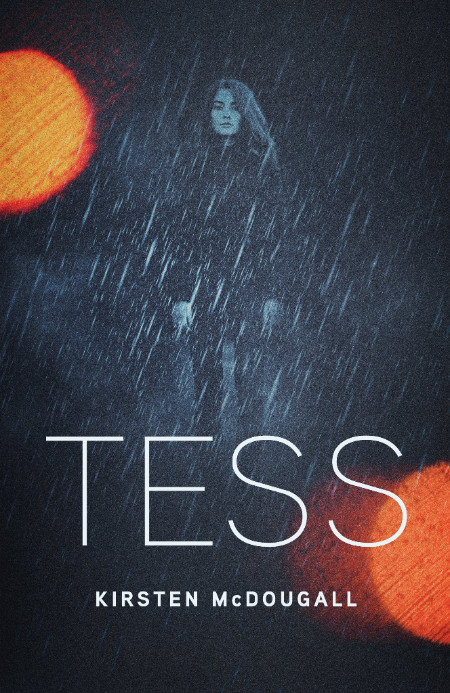
VUP launches Kirsten McDougall’s Tess

18451de5-c3e8-40b2-a2f9-26cf36a57aed.jpg


You are warmly invited to the launch of

Tess
by Kirsten McDougall

on Tuesday 15 August, 5.30pm–7.00pm
at Meow, 9 Edward St, Te Aro

Cash bar
Books will be for sale courtesy of Unity Books
$25, p/b

About Tess

Poetry Shelf Winter Season: Anne Kennedy off-piste


Die die, live live
1.

A puff of air
like a lover’s
sweet speech
bubble, blue
as sky. A brown
horizon turning
fast into tomorrow
and tomorrow, etc.
Mud and leather
and a man
who runs like rubber
drawn from itself
over mud
born from
its muddy
mother field.
A kick-off
and the howl of
a moon’s dog.
They kick
the tender thing and kick and kick the tender thing
and wail and sing.
Five-nil to them.
Fuck. And fuck
the conversion
too. More
points for them.
The ball sings.
The wind
sings a hymn
down the Saint
Patrick’s Day
parade-length
of field
and the wind
blows the ball
where it shouldn’t
go. You have to
hope these idiots
grasp softness
the idea of it
its air and
innocence.
Twelve-nil to
the other side.
Conversion? No.
A rose blooms.
The fullback
there he goes
into a scrum. He’s
in the scrum
for his girlfriend
the girl he loves.
A torn ear a red rose the love-song of the fullback
a big man a
fucking giant
look at him
run. A lot of blood.
He runs for the
invisible woman.
He’s a moving tree
a flowering
tree. The Aussie
should be sin-binned.
Oh. He is.
Penalty. Twelve-
three. Tenderness
and the terrible
wind-sound
necessary for
play. They kick the tender thing and kick and kick
the tender thing
and wail and sing.
A man jumps
to his feet
throwing the hand
of his girl into
the sky. He flails
and beseeches.
Go go go go go!
It’s her envoi.
A guttural
call Moss has
never heard before
coming from
here and here
a beating on
the edge of seagull
i.e. clarinet.
There’s a rolling
maul, players
scragging faces
with sprigs. The referee
runs and blood
runs like tears.
Penalty. Twelve-six.
Go man boot
the groaning
air cradle it
as your child.
Don’t fucking
drop it idiot.
A moan goes up.
It rests in
the bodied
stadium staying
there, living on
among the people
as damage.
They kick the tender thing and kick and kick the tender thing
and wail and sing.
Rain starts. Good
for the home team
(used to it).
The visitors gnash
their teeth. Mud
sprays men
into fossils
memento mori.
They’re covered
in the game
head to foot.
Outrageous penalty
fifteen-six. Fuck.
A scrum in mud
and more rain.
The field is
ankle-glass
sometimes shattered as a dance once seen moved in water
a splish and trail
like scarves.
Half time
(FW).

2.

The land shaved
of trees made
useful by
its nakedness
and water. Men
stand as if cattle
mirrored at
a trough. A whistle
like a cast
in a roving
eye roving
over the field.
The men swarm
towards the ball
flicking earth
and sky.
The Centre’s
butchering
down the field
as a lion hunts
prey in the late
afternoon.
As a boy he
loved animals.
Off-side. Fuck.
Blood and
sweat and blood
and the crack
of bones. They kick the tender thing and kick and kick
the tender thing
and wail and sing
and wail and sing.
A man is carried
off by St John’s
Ambulance. Ah well
Fifteen-eleven
but missed the
conversion the
egg. Another
kick-off and
before long
a line-out whatever
that is. A player
hurling himself
into infinity
running and falling
and not caring
his body everything
and nothing
hovering
on the brink of
his death, death
of a small
nation. He is
a carcass
or palace. He’s carried off by St John’s Ambulance.
But there’s a penalty.
Fifteen-fourteen.
They kick
the tender thing
and kick and kick
the tender thing
and wail and sing.
Howl and a face
coated in the season
and the game
is a season
imperative
compulsory
gone again and
a girl who walks into a woman. And rain drums length
of rain
drumming.
It’s late
and the sun dips
below the cap
of cloud touching
the heads of
the crowd limning
a moment blue.
They kick
the tender thing
and kick and kick
the tender thing
and wail and sing.
On the field
blood squelches
underfoot.
Twenty-fourteen.
Paul weeps
on her shoulder.
They’ve lost.
If they’d won
there’d be
just the same
weeping like a
well a stream
or cataract. She holds his bones under her hands
his back
where wings
might once
have been.
A good man
full of tenderness
giant i.e. a lot of
tenderness.
The small mercy
of no conversion.
A minute to go.
A man runs
down the field
like a doctor
in a field hospital.
A try to us!
Forty seconds
to go. The
half-back
lines up the
wet egg
of the universe
and after some
deliberation kicks
the tender thing.
And wails.
And sings.
Converted.
The sun sinks
The whistle blows.
They won!
(i.e. We won
apparently)
Paul and his mates
leap to their feet.
Hell we won.
They leap one
by one. Fintan
leaps to his feet.
Look even
Forest is leaping
to his feet. Moss
carried away with
the win and
Paul weeping
and giants leaping
and without thinking
she stands.
She looks down
at the long body
her old favourite.
And glances up
at the great giant
there beside her
a head taller
(no matter, he will
soon go away now
the game is over
and there is just
Finnegans Wake
to read or whatever
tall tale it was).
Light from
the tall lamp casts the giant shadow of the girl over Paul.
He is bathed
in a quick new
coolness, as
dusk falls suddenly
in the Tropics
and feels it
and stares up
at the girl and
backs and backs
(the love song
of the full-back).

© Anne Kennedy from The Time of the Giants (Auckland University Press, 2005)


Author note: Writing poetry at all was a jumping of the tracks for me, and although my prose was ‘poetic’ and my poems prosey, the change still felt enormous, like doing something other than writing. (I still think of it as not really writing, more arranging.) Boiled down, the change to poetry for me was to do with noticing the cool juxtaposition between freedom of language (a poetry reader is more likely to make leaps with you), and the restraint of form that is always there on the page in front of you.

The poem here (which I call my ‘rugby poem’) is from a verse novel, The Time of the Giants. It represents for me a few realizations. The first is the power of line breaks. They are marvellous things! Always have been, but with this poem I began to regard them anew, not just aurally, but visually – as a means to isolate words like stones in a Japanese garden.

With Giants I also realized I wanted to use a quite honed three-act structure to tell the story. In this poem, I knowingly brought together the whole cast at the end of Act III.

But why use this form to tell this part of the story? (I ask myself.) Because it’s fast, and the narrative is on full-throttle at this point; and because I wanted it to be high-energy like a pre-match haka, and a bit funny, and the line-breaks are ludicrous. (When you think about too much, all line breaks are ludicrous.)


Anne Kennedy‘s last book was the novel, The Last Days of the National Costume. Among other awards she has won the NZ Post Book Award for Poetry and the Montana Book Award for Poetry. In 2016 she was writer in residence at the IIML. Anne teaches creative writing at Manukau Institute of Technology.


From Paula: For Poetry Shelf’s Winter Season, I invited 12 poets to pick one of their own poems that marks a shift in direction, that is outside the usual tracks of their poetry, that moves out of character, that nudges comfort zones of writing. It might be subject matter, style, form, approach, tone, effect, motivation, borrowings, revelation, invention, experimentation, exclusions, inclusions, melody …. anything!


Kay McKenzie Cooke shares photos and comments on Dunedin’s farewell to poet, John Dickson


20293994_10211363283370214_8533850798113312235_n.jpg  20292864_10211363282450191_926639157787563302_n.jpg

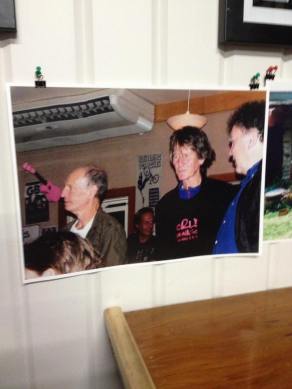
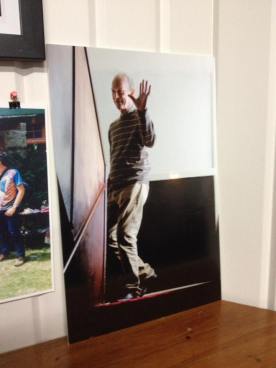
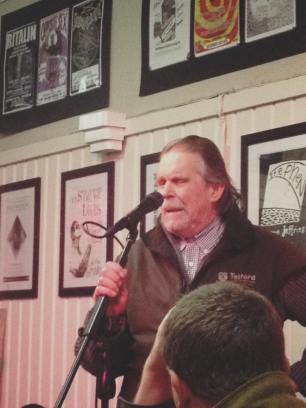
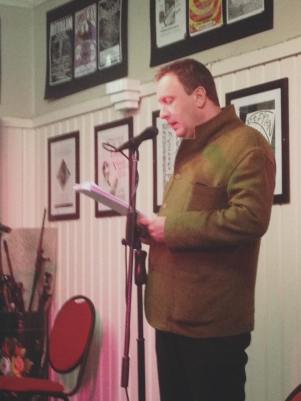
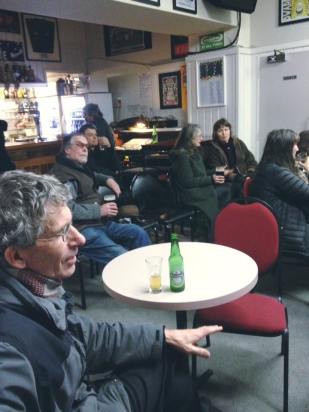
At times last night’s memorial poetry reading for John Dickson felt like friends gathered in a room together, having a quiet drink and reminiscing about their friend Dixie.
Fitting somehow that it was held in the Crown Hotel. Is it because the beloved Crown is such a Dunedin venue – non-pretentious, down-home, verging on grungy, established, under-stated, historical, storied – as if all the people who have frequented, hosted, performed, chatted and imbibed there have left behind some invisible imprint of themselves?
At other times the night took on the air of a formal poetry reading befitting and honouring a much-revered poet.


20292969_10211363282330188_4281611238851633488_n.jpg  20375938_10211363282010180_7491810256740697715_n.jpg

Poet Richard Reeve opened proceedings by reading poems from John’s last book, Mister Hamilton.


20292838_10211363281050156_2961189889695682918_n-1.jpg


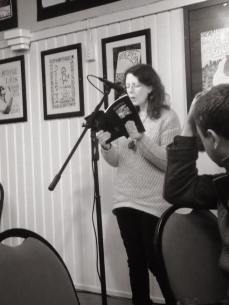
Jenny Powell read John’s famous Miles Davis poem; her delivery a tour de force and much appreciated by John Dickson aficionados present.
I read some of my own poems – poems about Dunedin and its streets and poets; poems which I hoped would reflect in some small way a poet I admired.

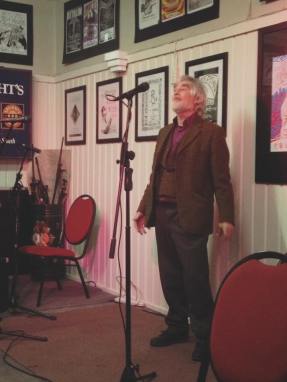
David Eggleton read two of his own poems, introducing his reading by saying he first met John thirty years ago and remembers, among other things, his gift as an entertaining raconteur of circular stories.
Richard spoke about how he got to know John in 1996 when he was a student and recalls their complex discussions about poetry, admitting that probably neither understood what the other was talking about. He also mentioned the value he placed on John and

Jenny’s friendship, and their visits to his Warrington home (which John dubbed as ‘bucolic’).
Richard also mentioned that in the 1980’s, John and Cilla McQueen ran poetry readings in Dunedin, which were attended by poets such as Hone Tuwhare and Bill Manhire.
John’s gift of friendship was mentioned many times – so much so that it became a feature of the night.

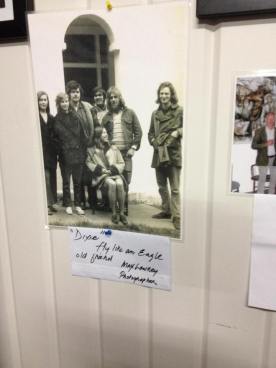
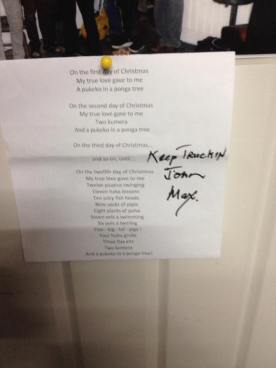
Max Lowery spoke about his friendship with John over many years and his regard for him both as a person (a friend, a flat-mate) and a poet. Towards the end of the evening, a quiet and reflective mood filled the room as Max talked about the photos of John that he had put up on the wall, and shared the memories that they evoked.

Alastair Reid also spoke of his close friendship with John, allowing someone like me, who didn’t know John well, insight into his individual take on life, his love of life, his curiosity about life and his love of learning, right to the end.

Alastair Galbraith also spoke about John’s dry humour, his laconic, unpretentious way of always just being himself. In particular, he spoke about John’s reading of his poetry. How amazingly deliberate and almost mesmerising it was. He recalled memories of recording

John reading his poetry and had the cds available for anyone wanting to buy them.
Richard read an excerpt from a twenty-eight page (yes, that’s right; twenty-eight page!) poem John had sent him as a response to a (much shorter) email Richard had sent him when the Irish poet Seamus Heaney died, thus treating those of us there to part of this poem’s dazzling, sweeping trains of thought.

Flatmates, poetry-reading mates, fellow poets, friends … all recalled John’s sense of humour and uniqueness.

Over and over, John Dickson’s warmth, regard, his gift of inclusion, of friendship, his intelligence and extraordinary complexity and depth as a poet, came through what people said and read.

Dixie will be greatly missed.

Kay Cooke, July 2017


20476088_10211363281890177_7940763199827956824_n.jpg  20294445_10211363281410165_5550758669763182706_n.jpg

20293078_10211363280570144_7161329800315891825_n.jpg20375909_10211363280410140_6383964667389936102_n.jpg

Winter Poetry Season: Hannah Mettner off-piste


My children are abducted by 17th-century French courtesans

In the rose garden near the big house
where somebody famous was either
born, or not, all the ladies spread their
pinks out in the sun. Pretty young ladies
with expensive, dewy faces who want
my children for their photogenic walls.
They look as though they’re picnicking
with their floral bubbles and their green
men but their stiletto fingers give them
away. And my children were just feeding
ducks, but where have they gone?! Quick
say the birds Find them Find them, gobbling
their trails of bread. The ladies strengthen
in the light and their prickles rise and my
nose is so full of their French scent that
I start to sneeze. The ladies wilt a little in
revulsion. Their corals and blushes and rouges
are falling brown, then grey; old ladies with
shallow bones and prickles blunted with
age. And where are your children they
want to know and I want to know too.
I’ve looked everywhere. There’s a low
graze of desperation in my throat, which
stings as I call their names. I uproot one
of the ladies and use her to beat back a
path through the others, until they look
almost young again in the freshness
of their bruises. When I get back to the
pond most of the spinsters have frosted
in the ground. The children are there
wearing new fur coats. One is putting logs
on a fire, while the other pulls dinner
from the snow.

©Hannah Mettner, from Fully clothed and so forgetful (Victoria University Press, 2017)


Author note: This is the poem that helped me realise that there was a way to integrate the emotional authenticity that I want my poems to convey (in this case the fear of ‘losing my children’) with something less literal. For me, this meant that rather than merely ‘stating facts’ in a pleasant or interesting way with line breaks, I was able to tease out multiple concepts and feelings simultaneously in an environment less concretely related to the real world. So, this poem deals with my fear of losing my children after the breakup of my relationship with their father, but holds with that the fear of a potential ‘stepmother’, and the fear of them doing fine without me, but because none of this takes place in a recognisable world (rosebushes don’t usually turn into young women), I felt freer to say all that.


Hannah Mettner is a Wellington writer originally from Gisborne. She runs the online poetry journal Sweet Mammalian with Sugar Magnolia Wilson and Morgan Bach. Her first book, Fully clothed and so forgetful, came out earlier this year.


From Paula: For Poetry Shelf’s Winter Season, I invited 12 poets to pick one of their own poems that marks a shift in direction, that is outside the usual tracks of their poetry, that moves out of character, that nudges comfort zones of writing. It might be subject matter, style, form, approach, tone, effect, motivation, borrowings, revelation, invention, experimentation, exclusions, inclusions, melody …. anything!