Eileen Myles to judge Sarah Broom Poetry Prize: entries now open

Exciting news! Will be in the queue for this festival session that’s for sure.



Sarah-prize2.png

SARAH BROOM POETRY PRIZE

The Sarah Broom Poetry Prize is one of New Zealand’s most valuable poetry prizes and aims to recognise and financially support new work from an emerging or established New Zealand poet. In 2018, the prize is an award of $5,000.

The prize was established in 2013 in honour of the New Zealand poet Sarah Broom (1972-2013), the author of Tigers at Awhitu (2010) and Gleam (2013).

Entries open on 19 February and close on 11 March 2018

Now in its fifth year, we are pleased to again showcase and celebrate New Zealand poetry during Auckland Writers Festival week in May 2018. Shortlisted poets will read from their work at a dedicated poetry event hosted by the Sarah Broom Poetry Trust where the winner will be announced.
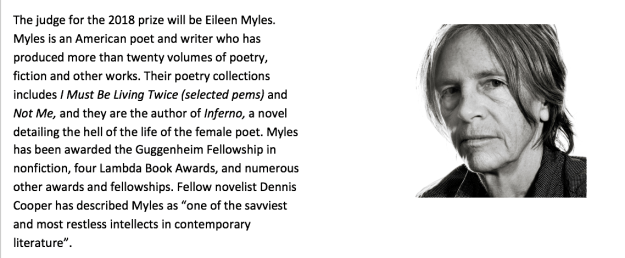


Screen Shot 2018-02-20 at 9.49.46 PM.png


For more information about the prize and Sarah Broom visit http://www.sarahbroom.co.nz

For more information about the Auckland Writers Festival, which will be held from 15 – 20 May 2018, visit here

HOW TO ENTER

The prize is awarded on the basis of an original collection of poems by a New Zealand resident or citizen. Entries will be accepted from from 19 February 2018 until 11 March 2018.

Poets are required to submit six to eight poems, of which at least five must be unpublished. The recipient of the prize will be announced in May 2018 during Auckland Writers Festival week. Shortlisted poets will be invited to attend a dedicated event and read from their work.

Entries should be emailed to poetryprize@sarahbroom.co.nz

Any queries should be emailed to enquiries@sarahbroom.co.nz

CONDITIONS OF ENTRY

  1. Poets are required to submit six to eight poems of which at least five must be unpublished.
  2. There is no maximum or minimum length – formatting and font size is your choice.
  3. Entrants must be New Zealand permanent residents or citizens.
  4. Only one entry per person will be accepted.
  5. Entries must be the author’s original work. Any use of quotation must be acknowledged by attribution to its source.
  6. Entries must be submitted as one electronic file per entrant, as an email attachment in Word or PDF format. No identifying details should be present in this poetry portfolio.
  7. Your entry should also include a covering email with a brief personal statement, an indication of how you would use the award money, and contact details. These covering details are not provided to the judge.
  8. The judge will assess the merits of submissions, and the Sarah Broom Poetry Trust reserves the right not to award a prize.
  9. The prize recipient will be announced during Auckland Writers Festival week in May 2018 and in other appropriate publications.
  10. It is expected that entrants would be able to travel to Auckland, if shortlisted, for the Sarah Broom Poetry Prize event which will likely be on either Saturday 19 May or Sunday 20 May 2018. Times and details will be announced on the website http://www.sarahbroom.co.nz
  11. No correspondence with the judge will be entered into.
  12. The name and photograph of the prize recipient may be used by the Sarah Broom Poetry Trust for publicity purposes.
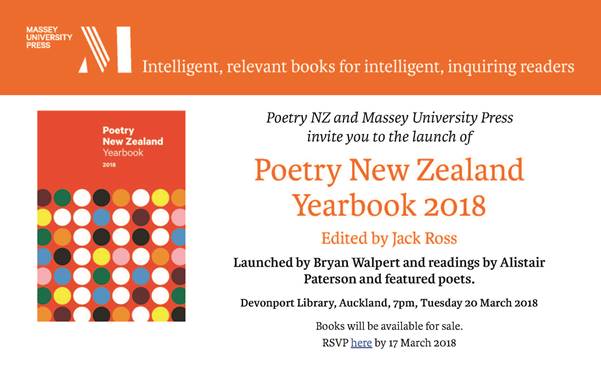
Time to nominate writers for PM Literary Awards

Kia ora koutou

Don’t miss your opportunity to nominate your pick of our finest writers for the 2018 Prime Minister’s Awards for Literary Achievement.

Every year New Zealanders are invited to nominate writers who have made a notable contribution to New Zealand literature in the categories of non-fiction, poetry or fiction. $60,000 is awarded in each genre.

New Zealand writers are also able to nominate themselves for the awards.

The nominations (submitted by email to pmawards@creativenz.govt.nz ) are assessed by an expert literary panel and recommendations forwarded to the Arts Council of Creative New Zealand for approval, with the awards presented in a formal ceremony.

In 2017, Witi Ihimaera received the award for Fiction, Paula Green for Poetry and Peter Simpson for Non-Fiction.

See the full list of winners

Nominations close on Friday, 6 April at 5pm.

Nominate a writer now

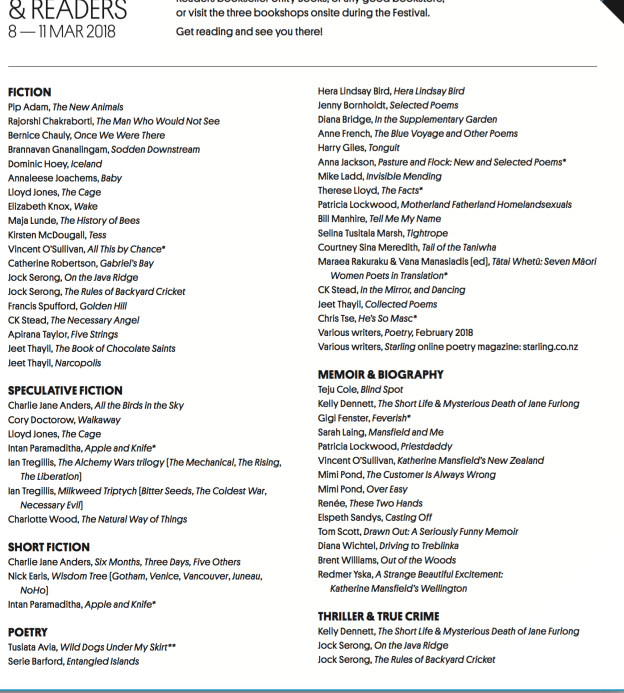
Nice one! Much poetry to be had at Wellington’s Writers & Readers

Screen Shot 2018-02-01 at 11.48.13 AM.png


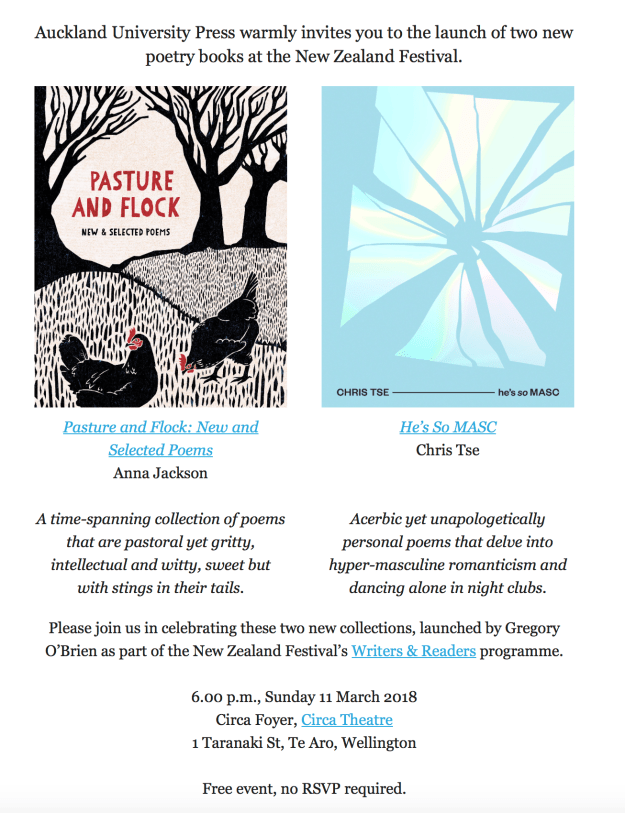
Go here for the programme. I am delighted to be reading at and chairing Selina Tusitala Marsh’s Call Me Royal event at the National Library as well as chairing Bill Manhire and Mike Ladd in conversation. I will be on the bus to Poetry at the Prison event, dashing to hear The Starling Poets, celebrating the launch of new books by Chris Tse and Anna Jackson and the new Seraph Press translation book, and hearing a cluster of poetry from offshore. Way more poetry here than last time – and a decent local presence! Always a treat to catch Hera Lindsay Bird read. And of course Tusiata Avia is a must. Check out the poetry reading list above to get in the mood.

Joan Fleming surveys NZ’s small presses for Cordite


Image courtesy of Limbo Agency.


Full piece here

There is a preconception that small presses, existing as they do outside the mainstream, publish poetry that is wilder, stranger, more political, and more ethnically diverse. Poetry that the university publishers have turned away, or whose genius such presses have failed to recognise. Poetry that bucks the mannered, nostalgic style that monopolizes the prizes and the media. Poetry that takes risks. No safety, no submission.

Certain small presses do, indeed, follow this brief. Anahera Press, for example, publishes Māori and Pasifika writers. Their books ‘give voice to … the intersections and spaces between cultures’ or champion writers who are ‘walking between worlds.’ A press that publishes culturally self-aware poetry, by Tangata Whenua and ethnically diverse poets, is much-needed in an environment that is still overwhelmingly white. In 2015, 91% of poetry books published in New Zealand were authored by Pakeha / Europeans; a dispiriting figure, when you consider that Pakeha make up only 74% of the population. Have a look at Janis Freegard’s ‘sad little pie chart.‘

Of course, Māori and Pasifika writers still publish within the mainstream, and are even fed into the dreaded mouths of university presses via the creative writing industrial complex. Tusiata Avia, for example, came up under the ‘straightening‘ tutelage of Bill Manhire’s International Institute of Modern Letters, so-named by the Vegas cowboy billionaire who funded its establishment. In 2016, she published her awards-shortlisted startling third collection, Fale Aitu | Spirit House, with Victoria University Press.

Still a few places in Kāpiti Writers’ Retreat

The 2018 Kāpiti Writers’ Retreat

Immerse yourself in writing and conversation this summer. There’s something for everyone–whether you’re new to writing, an established writer, or somewhere in-between.

Dates: 23-25 February 2018
Location: El Rancho, Kāpiti Coast, New Zealand
Registration:  Register securely online or contact kirsten@kahini.org with any questions or for additional information.

Join us for the Kāpiti Writers’ Retreat and renew and recharge your writing and your life. The Kāpiti Writers’ Retreat is an immersive, two-day gathering for writers, happening on the Kāpiti Coast. The retreat includes intensive morning workshops, lively afternoon discussions and space to write, relax and engage with topics critical to your work. Read about last year’s event here.

Kahini is delighted to host six established New Zealand writers–Airini Beautrais, Anahera Gildea, Pip Adam, Rajorshi Chakraborti, Queenie Rikihana-Hyland and Victor Rodger–at the 2018 Kāpiti Writers’ Retreat. Each writer will teach morning workshops: in fiction, poetry, memoir writing and mixed genre. In the afternoons they will lead discussions on topics pertinent to craft and literature in Aotearoa. (Read descriptions of the workshops, afternoon discussions and teachers below.)Talking

All writers are welcome, at whatever stage you are in your writing life. You’ll find community, encouragement, and a safe place in which to take artistic risks. Please contact Kirsten at kirsten@kahini.org for more information. Register for the Kāpiti Writers’ Retreat!


programme

Friday, 23 February
5:30 pm: Welcome
7 pm: Barbecue
8:30 pm: Freewrite with Helen Lehndorf (optional)

Saturday, 24 February
7 am: Gentle morning yoga with Helen Lehndorf (optional)
8 am: Breakfast
9 am–12:30 pm: Morning workshop (morning tea break included)
12:30 pm–1:30 pm: Lunch
2 pm–3 pm: Afternoon sessions: Moving at the Speed of Creativity & The Sum and its Parts
3 pm–4 pm: Afternoon sessions: Audio Storytelling & The Litmus Test
4 pm–5 pm: Workshop check-in
5:30 pm: Dinner
8 pm–9 pm: Open mike readings (optional)

Sunday, 25 February
7 am: Gentle morning yoga with Helen Lehndorf (optional)
8 am: Breakfast
9 am–12:30 pm: Morning workshop (morning tea break included)
12:30 pm–1:30 pm: Lunch
2 pm–3 pm: Afternoon sessions: The Poem Sequence & How Do We Tell Our Stories 
3 pm: Closing

Full details here