
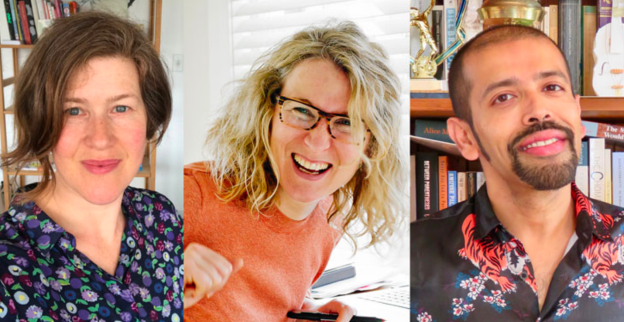
If you’re interested at all in the inner life of the writer, come along to Karori library on February the 28th between 6 – 7:30 p.m. and listen to three of Wellington finest writers — Sarah Laing, Rajorshi Chakraborti and Leah McFall — discuss their celebrated written works, inspirations and writing process.
Food and drink will be provided, and Marsden Books will be selling books on the night.
Leah McFall is an award-winning columnist for Sunday magazine and published her first collection, Karori Confidential, last year.
Rajorshi Chakraborti is an Indian-born novelist and short story writer whose latest novel, The Man Who Would Not See, takes place largely in Wellington and Karori.
Sarah Laing is a cartoonist, novelist and short story writer. Her most recent book, Mansfield and Me, is a graphic memoir about Karori’s most famous writer.
Need more information? Contact Karori library on 476-8413
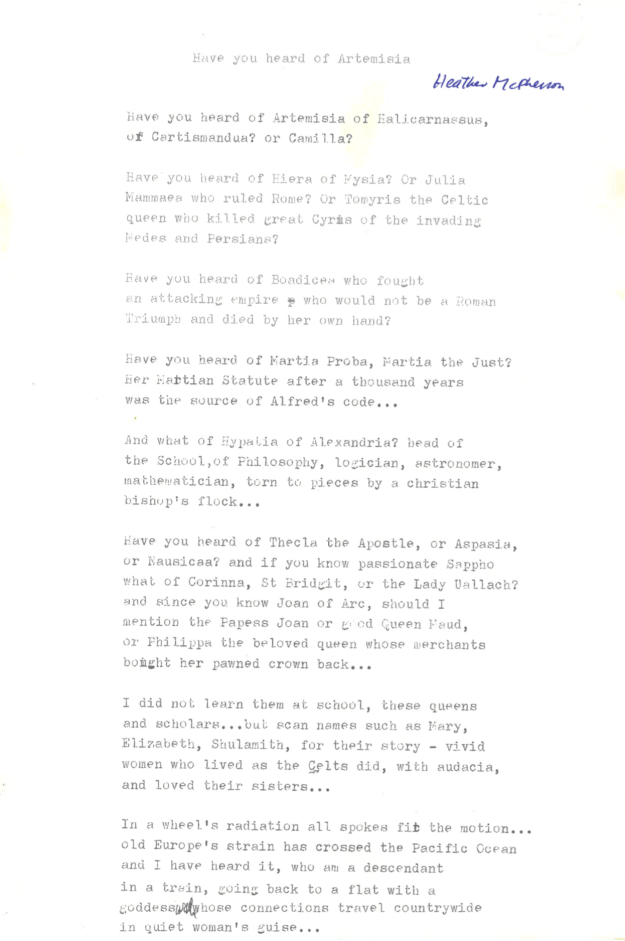
Have you heard of Artemisia?
Have you heard of Artemisia of Halicarnassus,
or Cartismandua? or Camilla?
Have you heard of Hiera of Mysia? Or Julia
Mammaea who ruled Rome? Or Tomyris the Celtic
queen who killed great Cyrus of the invading
Medes and Persians?
Have you heard of Boadicea who fought
an attacking empire – who would not be a Roman
Triumph and died by her own hand?
Have you heard of Martia Proba, Martia the Just?
Her Martian Statue after a thousand years
was the source of Alfred’s code . . .
And what of Hypatia of Alexandria? head of
the School of Philosophy, logician, astronomer,
mathematician, torn to pieces by a Christian
bishop’s flock . . .
Have you heard of Thecla the Apostle, or Aspasia,
or Nausicaa? and if you know passionate Sappho
what of Corinna, St. Bridget, or the Lady Uallach?
and since you know Joan of Arc, should I
mention the Papess Joan or good Queen Maud,
or Philippa the beloved queen whose merchants
bought her pawned crown back . . .
I did not learn them at school, these queens
and scholars . . . but scan names such as Mary,
Elizabeth, Shulamith, for their story – vivid
women who lived as the Celts did, with audacia,
and loved their sisters . . .
In a wheel’s radiation all spokes fit the motion . . .
old Europe’s strain has crossed the Pacific Ocean
and I have heard it, who am a descendant
in a train, going back to a flat with a goddess
wall, who connections travel countrywide
in quiet woman’s guise . . .
dedicated to Elizabeth Gould Davis and Max Jacob
Heather McPherson, from A Figurehead: A Face (Spiral, 1982)
Have you heard of Heather McPherson?
Emma Neale asked me this question when I was searching for lesbian and queer poets for my PhD research. I hadn’t which is hard to imagine now.
‘Have you heard of Artemisia?’ was painted on the outside wall of the Women’s Gallery on Harris Street, Wellington in 1981.
As I typed the poem it became apparent that Microsoft Word had not heard of Cartismandua, or Hiera of Mysia or Tomyris. Neither had I. My middle name is Bridget. A name I share with many women in my family. Every year in my Catholic primary school in Ireland we weaved St. Bridget (most commonly spelt Brigid) crosses on her saint’s day, the first of February. Nobody mentioned Darlughdach, Bridget’s apparent female lover and soulmate. Catholic forums online call this a conspiracy theory.
Heather was the first out lesbian to publish a poetry collection in New Zealand.
I’m not a “gold star lesbian” (watch Hinemoana Baker explain the term here). It took me a long time to own my feminism. The Guerilla Girls came to my university in Cork sometime in 2007 (or 2008 or 2009 . . . ) and when they asked the crowd, “How many people here tonight call themselves a feminist?”, I did not raise my hand. I didn’t think then that it mattered that men always won the Oscar for best director, or that women feature in the Met predominately as nudes not as artists. I believe my religious upbringing ensured that the patriarchal domination of society remained unquestioned within me for far too long. I did not learn to question at school.
There are ten question marks in this poem. I encourage you to ask yourself ten questions today. And to ask ten people, “Have you heard of Heather McPherson?”
Emer Lyons is an Irish writer who has had poetry and fiction published in journals such as Turbine, London Grip, The New Zealand Poetry Society Anthology, Southword, The Spinoff and Queen Mob’s Tea House. She has appeared on shortlists for the Fish Poetry Competition, the Bridport Poetry Prize, the takahé short story competition, The Collinson’s short story prize and her chapbook Throwing Shapes was long-listed for the Munster Literature Fool For Poetry competition in 2017. Last year she was the recipient of the inaugural University of Otago City of Literature scholarship and is a creative/critical PhD candidate in contemporary queer poetry.
Heather McPherson (1942–2017) was a poet, editor, teacher and feminist activist. In 1974 she founded Christchurch Women Artists Group and Spiral, a woman’s art and literary journal. She published five collections of poetry, with her poems appearing in numerous journals and anthologies. Figurehead: A Face (Spiral, 1982) was the first poetry collection by an out lesbian in New Zealand. Janet Charman selected the poems for McPherson’s posthumous collection, This Joyous, Chaotic Place: Garden Poems (Spiral, 2018).

Packs
We try to breath as long as technology
and medicine can stretch it
and don’t know why we are wretched with anxiety
Every dawn in Samoa the neighbourhood packs of dogs
cracked open our sleep: barking howling yelping screeching
Theirs was the desperation of hunger and ill-treatment
I needed to quench the undeniable accusation in their howling
Now back in our safe Ponsonby bedroom the spring dawn sprawls
across our bed and refuses to leave but it will be swallowed up
eventually by the morning and our need to walk out
into the embracing routines of our tidy lives
The packs will continue to stalk us with their slow howling
No set plan or final intention
Just let go – just let it go all of it
even the accusing packs
It will not come again
©Albert Wendt (August-Sept, 2017) (November 2018)
Albert Wendt has published many novels, collections of poetry and short stories, and edited numerous anthologies. In 2018, along with four others, he was recognised as a New Zealand Icon at a medallion ceremony for his significant contribution to the Arts.
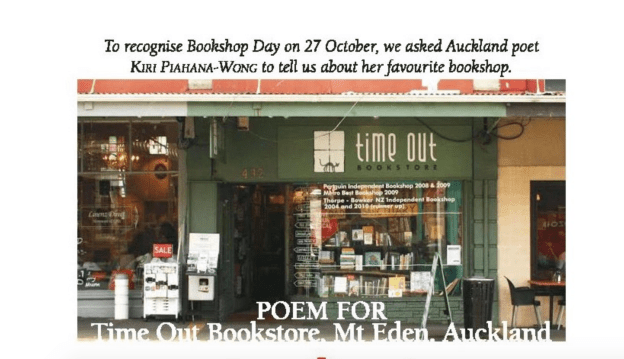
Kiri’s poem, ‘A Poem for Time Out Bookstore’, originally appeared in NZ Author to celebrate NZ Bookshop Day.
You can now read it online. It is so good! I completely identify with it.
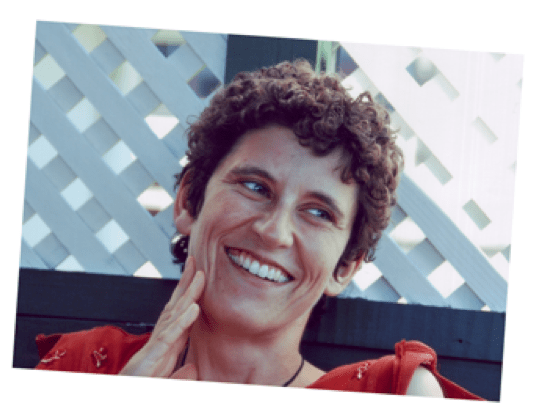
SARAH BROOM POETRY PRIZE
The Sarah Broom Poetry Prize is one of New Zealand’s most valuable poetry prizes and aims to recognise and financially support new work from an emerging or established New Zealand poet. In 2019, the prize is an award of $10,000. Poets are required to submit six to eight poems (at least five unpublished).
The prize was established in 2013 in honour of the New Zealand poet Sarah Broom (1972-2013), the author of Tigers at Awhitu (2010) and Gleam (2013).
Now in its sixth year, the award will be showcased in a special public session at the Auckland Writers Festival in May 2019 where shortlisted poets will read from their work and the winner will be announced. The full Festival programme will be publicly launched on 13 March and will be available in print and online here
Competition entries open on 21 January and close on 28 February 2019
For entries/queries email poetryprize@sarahbroom.co.nz For more information about the prize and Sarah Broom visit here
2019 Judge: Anne Michaels
Award-winning poet, novelist and essay writer Anne Michaels is Toronto’s current Poet Laureate. Her multiple awards and shortlistings include the Commonwealth Poetry Prize for the Americas, the Orange Prize, the Governor-General’s Award and the Griffin Poetry Prize. Her latest poetry collection All We Saw was published in late 2017.
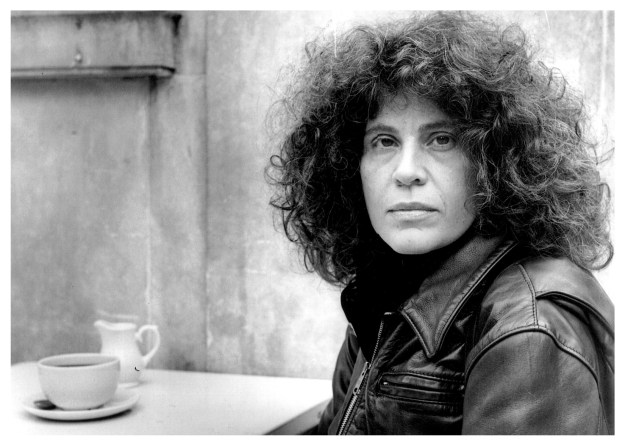
A lifted stone
Much is hidden from us. Behind the smooth, painted and plastered lining of the walls of my living-room, where I sit and write, less than a metre away from me, creatures are stirring, and have their secret life. Sometimes I hear the dry scuttle of a mouse, but other, smaller creatures – woodlice, whitetail spiders, click beetles, ants – these creatures are silent, and seldom reveal themselves. Occasionally I notice a daddy-long-legs swaying slightly in the corner of the ceiling, or, in the early hours, as I trudge to the bathroom, a solitary chocolate-coloured cockroach spreadeagled on the wall, stunned by the light. The borer chews a hole in the skirting board, with only a little brown dust to show for its industry. I imagine it deep in the wood, nestled like a rabbit in its burrow, its scrap of life ticking.
When I was a child I was obsessed with these hidden lives. I would carefully remove the pale, pupating huhu grubs that lay buried in rotting stumps like pharaohs in their tombs, and keep them in jars of damp sawdust until they emerged as winged beetles, still white and frail-looking, their long antennae testing the air. I would turn over planks of wood to see what lived under them, brown beetles, black, shiny, soft-bellied spiders with white egg-sacs, grey hump-backed slugs, orange slimy flatworms. On the windswept beach where my family camped each summer, I would crouch on the reef at low tide, the sea a distant, uneven roar, like traffic, and I would lift the weed-encrusted stones in the rockpools to expose the creatures that teemed underneath. Glassy shrimp, almost invisible, would dart backwards. Brown cockabullies would flash past the cautiously retreating hermit crabs. Anemones would wave their thin arms among the inert kina and cushion starfish. It seemed very strange to me that all these creatures coexisted under the stone, as in a darkened house, in a kind of dormancy, until I lifted the roof and the light fell upon them.
Now, as I turn on the tap to fill the kettle, I hear a gurgling in the plumbing, and I remember the water-supply at the street has been turned off for some hours as contractors are digging a trench for the installation of fibre-optic cable. The cable – really many cables bundled together, each insulated in bright blue sheathing – lies along the grass berm, but soon it will be buried and I will never see it again. Beneath the ground it will ferry data between my computer and the world beyond. The water is back on, and in a sort of convulsion it bursts from the tap, orange with rust, and flecked with clots of green-black algae. And this has always been there, the flakes of rust and the algae, inside the pipe that leads to the tap – if I look closely, I can see a rind of green algae at the spout, surviving despite the chlorine-treated water that rushes through it every day. It has been there the whole time, the outside of the tap is gleaming chrome but this belies what it is like inside, where no light shines, where rust collects and algae grows.
My eldest child, an adult now, writes poems. His poems are sometimes enigmatic, they evoke a feeling, a mood, but I don’t always understand them. I want to, perhaps out of a desire to understand him. It’s as if the poems might reveal to me something about him that is hidden, as if they are a stone that might be lifted. But it’s no good me asking what they mean. He just shrugs and grins. We both know the strangeness of poetry, the impossibility of paraphrase, it’s what makes us come back, to read the same short poem again. There it is, the poem, on the white page with nowhere to hide, yet concealing some of itself. And this is true of all the poems I love most. I memorise these poems, even as they withhold their meanings, to take them into myself. They feel a part of me, just as my liver and kidneys and heart are parts of me, hidden inside my body, working in ways I don’t understand to help me live.
Tim Upperton
(excerpt from a longer work that will be published in a collection of essays, Strong Words, by Otago University Press)
Tim’s second poetry collection, The Night We Ate The Baby, was an Ockham New Zealand Book Awards finalist in 2016. He won the Caselberg International Poetry Competition in 2012 and again in 2013. His poems have been published widely here and overseas, and are anthologised in The Best of Best New Zealand Poems (2011), Villanelles (2012), Essential New Zealand Poems (2014), Obsession: Sestinas in the Twenty-First Century (2014), and Bonsai (2018).
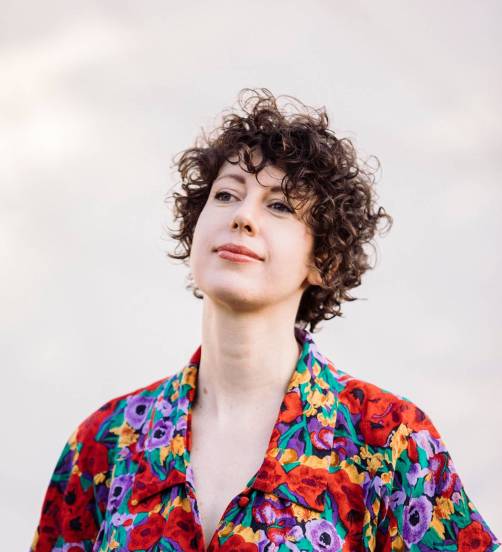
Joan Fleming is the author of two books of poetry, The Same as Yes and Failed Love Poems (both with Victoria University Press), and her third book is forthcoming with Cordite Press in 2019. She has recently completed a PhD in ethnopoetics at Monash University, a project which arose out of deep family ties and ongoing relationships with Warlpiri families in Central Australia. Her honours include the Biggs Poetry Prize, a Creative New Zealand writing fellowship, an Australian Postgraduate Award, the Verge Prize for Poetry, and the Harri Jones Memorial Prize from the Hunter Writers Centre.
 NZ Poetry Shelf