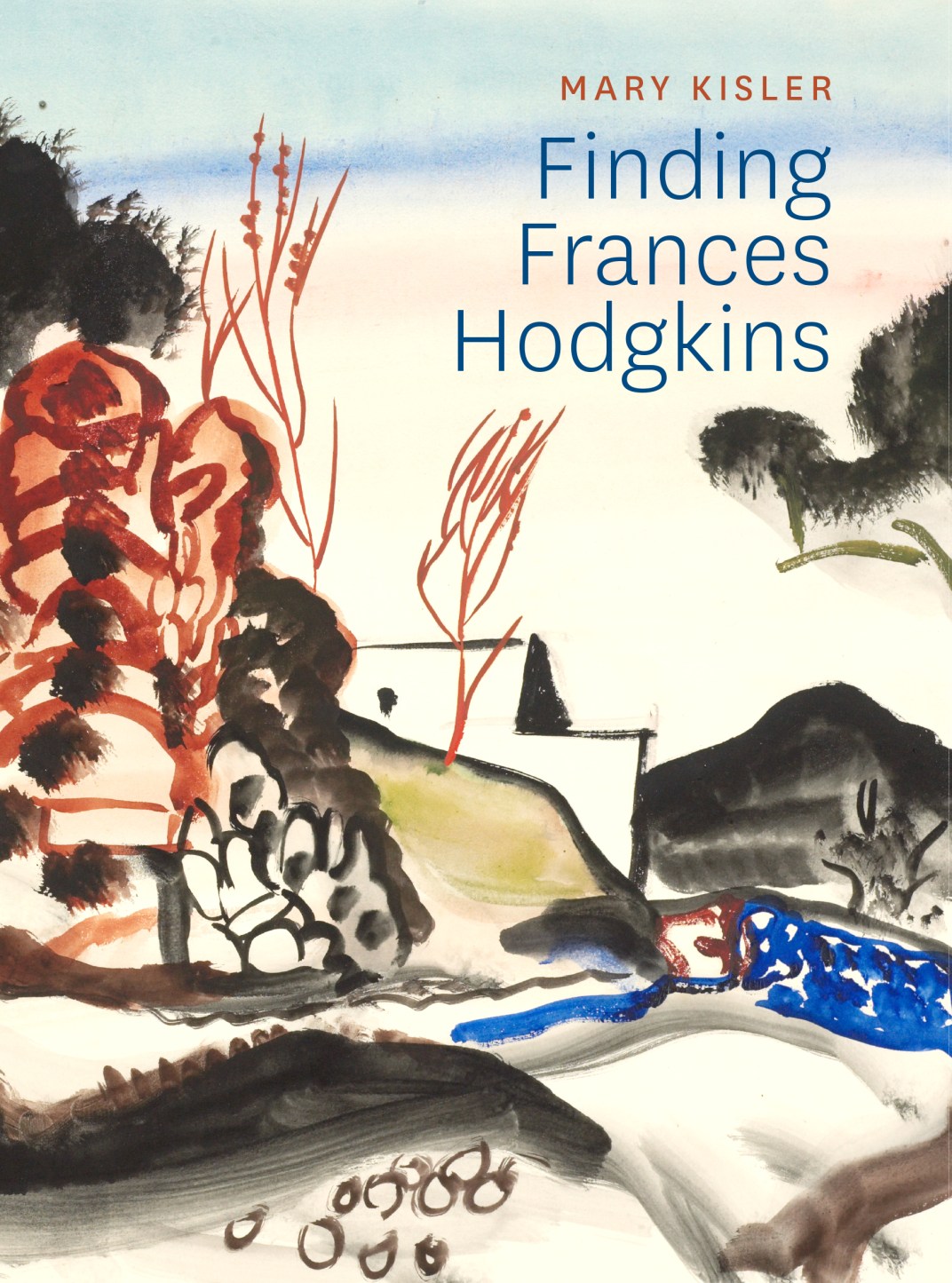
Mary Kisler Finding Frances Hodgkins Massey University Press, 2019
At First Glance
At first glance you are a bird in flight
wings flapping and paper flailing
feet above the cobbled bridge
ready to land on a blank page
as happy as the lark,
Dorothy behind with strings let loose.
At first glance you carry a pigeon on your head
a thousand pictures and a thousand words
colours to cry for and lines to settle on
the tools of art tucked tight beneath your arm
in the blackest of winters and the blackest of springs,
Dorothy behind with her feet on the ground.
At first glance you are a moth to the flame
wings beating and cloth shivering
feet above the water
ready to land on windmills and cabbages
the cloud effects magnificent,
Dorothy behind with an eye on the light.
Paula Green
from Making Lists for Frances Hodgkins Auckland University Press, 2007
One summer I was invited to write something for a Frances Hodgkins exhibition – I lay on my bed surrounded by catalogues of her work and pitched deep into her paintings. It was a curious experience, because the more I looked, the more I became entangled in her artwork and the more her artwork became entangled in me: my back story, my obsessions, my predispositions, my failings. I ended up writing a poetry collection that I named Making Lists for Frances Hodgkins.
All these years later I am lounging back after finishing Wild Honey and find myself entangled in Frances’s paintings again; but this time it is a little more intricate – thicket like – because I am entering the artwork by way of Mary Kisler’s terrific new book Finding Frances Hodgkins. The book is beautifully produced by Massey University Press, with a generous serving of Frances’s paintings and drawings, and photographs from the archives and from Mary’s travels. Mary is the Senior Curator, Mackelvie Collection, International Art at Auckland Art Gallery Toi o Tāmaki.
In 2013 Mary was updating an unpublished catalogue raisonné of the works of Frances, and it proved a challenging task solving the unnamed titles and places. Keen to track the changes in style and subject matter in the work of such a nomadic artist, Mary decided to trace Frances’s travels through Italy, France, Spain, Morocco and Britain. Armed with the artist’s work on her iPad and her letters, Mary journeyed through Europe. The final result is a little treasure; a book that stitches you as reader to Mary as traveller/memoirist and to Frances as artist. It is a concertina booklet; Frances’s paintings folds onto Mary’s vivid descriptions, musings and anecdotes which fold onto Frances’s anecdotes which fold onto Mary’s photographs which fold onto your own experiences which fold back onto the paintings themselves. Unfold the whole sequence and your breathtaking absorption of a painting is rich and surprising.
Mary immerses you in the world of Frances – her daily routines, the physical scenes, the painter’s observations – the writing culled from letters, the lexicon of paint and from standing in places where Frances once stood/painted. A particular painting, Hill Landscape (1936), with its juxtaposed motifs and borrowed elements, is described as ‘a memoir, so pleasing and much richer than a postcard or a photograph that captures only a single place in a single moment’. Herein lies the joy of the book – the way Mary’s engaging travels have produced a book that offers postcards and photographs yet is so much more. It is travel guide, art guide and twinned memoir that draws you close to place, both past and present. As much as it illuminates the workings of an artist does it illuminate the workings and preoccupations of a scholar. Everything seems to bound off and rebound against each other. I love that.
Take Frances on truth and how she is perceived:
I wish the papers wouldn’t make me out a sort of freak artist. I am really a very sober minded thoughtful sort of person with nothing slapdash or offhand about my work. Every stroke I put down comes from real conviction & is a sincere aspect of truth – if not the whole truth. If I can only live long enough the world will have to acknowledge me – I am horribly stubborn & I haven’t lived these long years of privation & hard work for nothing.’
By 1929 Frances is pleased to be in the news and exhibiting alongside Len Lyre and emerging modernists Henry Moore, Ben and Winifred Nicholson and Paul Nash. In a letter to her brother Bert she writes:
It is about time they realise I exist and am doing something a little more significant than the usual ruck of artists who come to Europe – even it is unpopular now people will in time grow used to the strangeness of my technique, a “handwriting” unfamiliar to them and therefore ‘eave a brick at its ‘ead!
To view the paint stroke as a form of handwriting is genius – with its subjective gestures and colour palette. Her autobiographical script was affected by the art of others, as Mary often points out, but Frances was always forging her own visual voice. It affects me as spectator at the level of both feelings and ideas. I am reminded of Robin Hyde’s pull to flee New Zealand and her ache to write. Frances was also pulled to Europe (and Africa) but in her ‘ache to paint’ she navigated what she felt and witnessed in front of her. She would stick to her own painting impetus but she would also wipe her canvases clean when her galleries saw ‘flaws’ and demanded new work. ( Interestingly I have lived with an artist for over 30 years and have never witnessed such gallery demands). She was both alone and not alone – alone in the moment of putting brush on canvas but often touring with friends or teaching students to earn money.
Behind any painting (or poem or movie etc) is the narrative and context of its making. Sometimes traces are glimpsed in what is disclosed or hinted at but often it is impenetrable. Frances’s life-long struggle to survive for example. This was a matter of finances, of crippling contracts with galleries and of maintaining her own ‘painting voice’ regardless of the ‘isms’ she rubbed against and the scant recognition back home. Mary highlights this independence: ‘Other English modernists were constantly battling over the right “ism” to follow, but Hodgkins kept her head down and followed her own path, sometimes weaving certain surrealist elements into a partially abstracted tapestry of motifs.’
I am drawn to the way Frances produced a strong bond between place and objects. Sometimes place took the form of an armchair, at other times a Mediterranean vista. The objects were often dreamlike and mnemonic, often a potent symbol. In this sense her paintings become poems – rich in visual chords that activate multiple engagements. This is what attracted me when I was lying on my bed with her catalogues. Mary comments on ‘Self Portrait: Still Life’:
(..) we know what she physically looked like, but encompassed in her self-portrait are aspects of everything that was important to her: objects she loved and which held particular symbolism for her, her favourite scarves reflecting her love of pattern and design, and her ability to construct a work rather than simply paint what was in front of her. It states clearly: judge me by what I do and what I believe, not by how I look.
Finding Frances Hodgkins is a book to linger over, savouring sumptuous detail, along with joyful discoveries and sidetracks. It is kaleidoscopic in its reach, it enhances viewings of Frances’s paintings and the real/imagined woman painting. I love this book because it resists straitjacketing the artist within specific theories in order to explicate her work. The way we write about art, the way we ‘find’ art cannot fit into a single reductive box. We can critique within the critical climate of our time but we can also choose independent paths (whilst brushing up and absorbing traces of contemporary thinking, styles, tastes). Mary has followed in the path of Frances but she has made that path her own.
Of course no one really ‘finds’ Frances Hodgkins, because she will never fit comfortably into a single box. But what I hope to have done on this journey is cast some light on how important place became in her search for modernity, and her individuality as an artist, respecting the work of others but always taking her own path. (Mary Kisler)
This is a book I will treasure for a long time.
Massey University Press author page
Mary Kisler in conversation with Kim Hill on RNZ Saturday morning
Evening
Between the skeletal tree and the blue grape, my ears ring.
Between the black roof and the soft drape, my skin yellows.
Between the support of the loggia and the altar table, my voice holds back.
From the pink hill to the fallen leaf, and upon black sand, my limbs burn.
From the little windows to the muddy goblet, I make out the women dying.
From the white wall to the sensual fruit, my hands seek slim comforts.
Between the streamy clouds and the blue jar, I rest upon crisp sheets.
Between the blood shadows and the chalky highlights, my stomach empties.
Between the eye of the house and your eye, I am in limbo.
Paula Green from Making Lists for Frances Hodgkins