Poetry Shelf on Poetry Day: essa may ranapiri’s ‘it’s 2019 and things like this are still happening’

it’s 2019 and things like this are still happening

pull the rock wall down in large chunks
the calendar didn’t make
that which hangs over the whenua
just disappear did it?
this nation state of
white-is-right
of slash-and-burn of
divide-and-conquer

New fucking Zealand
in all its truest colours

five years of struggle
or is it two-hundred-and-fifty-five years
without end without end without
a single word from the mouth of power
that can be trusted

(Jacinda I hope you didn’t think you could escape the poem unscathed)

fighting against a company that keeps a name of an honest job
to mask the fact they’re colonisers chasing a profit motive
scaffolding a claim out of iwi-consultation
gone gold-panning for the first race traitor they can find

on this land?!

where the sky has come down to hide our whereabouts
in the fog
Ranginui weeps at the sight
we have always belonged
in the āke ake ake! that pushes solidarity through the mist
we are connected to so much more than a margin

the pigs have some nerve to suggest
we’re trespassing here

and the drums

and the drums
are going and they’re standing crisp in blue uniform
all ordered to be here
just doing their jobs
what is the labour value of guarding a paddock
what is the bonus you get from terrifying our tamariki?

and the drums are going
and we’re singing
mana motuhake
we’re standing arms locked together
in the spirit of Parihaka
the pole of a flag to hold onto
our independence
in the disappointment it’s still happening here
on the land
we are kaitiaki
and we will not let you exchange Her mauri for a paycheque
in 2019 and every year after that
until you fucking stop
until you understand
where we stand is where we will always
stand
on the whenua that we are
and are one with


essa may ranapiri


essa may ranapiri is a river full of run-off and a mountain that is money-gated, tangata takatāpui trapped in a colonised world. Their first book ransack is out from VUP now., please buy it they’re so poor. They write these poems to honour their tūpuna, they will write until they’re dead.


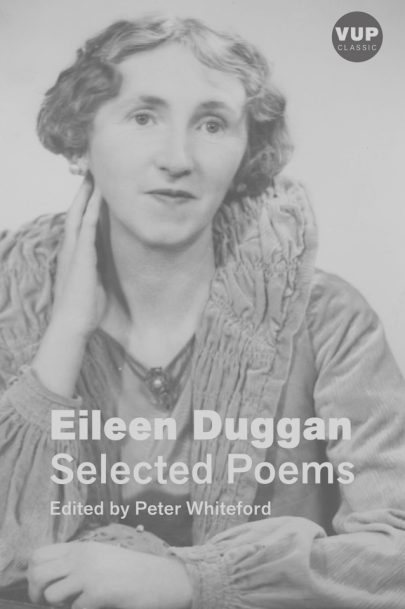
Poetry Shelf audio spot: Paula Green reads four Eileen Duggan poems

Screen Shot 2019-08-22 at 7.50.26 AM.png


I read Eileen Duggan’s:

‘When in Still Air’, ‘The Solitary’, ‘The Song of the Kingfisher’ and ‘The Tides Run up the Wairau’

from Selected Poems, Victoria University Press, 1994 -reprinted this year in VUP’s Classic Series


Victoria University Press has recently reissued Eileen Duggan’s (Selected Poems edited by Peter Whiteford. Eileen was one of my three foundation stones in Wild Honey: Reading NZ Women’s Poetry (Massey University Press, 2019) and this was a go-to book for me, along with the extensive reading I did in the archives. I am delighted to see it back in print. Eileen also has boxes of unpublished writing – poems, letters, essays – lovingly stored at Catholic Archdiocese of Wellington Archives.


Here is an extract from my Duggan chapter:

It hurt Duggan deeply that her primary aim to write New Zealand, rather than her ancestral home of Ireland, was undervalued if not overlooked. In an undated letter to Alexander, she wrote: ‘I think Jessie and I were not of the past. New Zealand was our dream; it still is mine. Whatever they take from us we had the joy of the work and of the ideal and we knew the countryside — which, not the cities, is the real New Zealand.’[i] When a critic claimed that no real New Zealand poem existed, Duggan was cut to the bone: ‘My depression was generic as well as personal. I remembered that some of us had worn our bodies out and lived on the crust-line for the ideal of a national poetry.’[ii]

One of Duggan’s most anthologised poems, ‘The Tides Run Up the Wairau’, exemplifies her need for poems to be simple, musical and layered. Heart is entwined with the river of her birth; the poem represents the ebb of salt and snow, the river origins that stick with her in the Wellington streets.

The tides run up the Wairau
That fights against their flow.
My heart and it together
Are running salt and snow.

The poem, though, is also a veiled confession where love, like the childhood attachment to river and paddock, is hinted at. The lines are open to interpretation, but Duggan’s rebuttal of love as a young woman came to mind as I read.

[i] Duggan letter to W. F. Alexander, undated, ATL MS-Papers-0423-6.

[ii] Ibid.


Eileen Duggan (1894–1972), of Irish ancestry, was born in Marlborough and grew up in Tuamarina, near Blenheim. Duggan graduated from Victoria University of Wellington with an MA First Class Honours in History in 1918. She briely taught as a secondary-school teacher, and as an assistant lecturer, before devoting herself to writing full-time. She wrote essays, reviews, articles, a weekly column for the New Zealand Tablet (from 1927) and published five collections of poetry. Three collections were published in the United States and Britain to international acclaim. She left a substantial body of unpublished material, which Peter Whiteford drew upon for Eileen Duggan: Selected Poems (Victoria University Press, 1994). Duggan was awarded an OBE in 1937 and was made an Honorary Fellow of the Royal Society of Literature in 1943. She lived most of her adult life with her sister, in Wellington.


Poetry Shelf classic poem: Jordan Hamel picks Ria Masae’s ‘Jack Didn’t Build Here’


Jack Didn’t Build Here


This is the house that Dad built.

Foundation laid with stories

from sitting under the ulu tree

to learnings from palagi scholarship:

for wife, for offspring, for aiga.

Sunday School teachings echo in his mother-tongue

dotted with Oxford Dictionary words.


This is the house that Lange built.

Southside Prime Minister. The only home

in the hood with a pool. He invited the locals

– his Mangere locals – over to swim

and understood the pressures of fa’alavelave,

cos he brown on the inside like that.


This is the house that Mum built.

Chandelier hangs over the heads of churchy

poker players, cheating and laughing on

the woven fala. Celebration trestle tables

laden with islands of sapasui, oka,

fa’alifu taro, palusami, and umu pork

surrounding a pavlova cheesecake.


This is the house that Key built.

Double-glazed windows within a security code gate.

His pool stretches across his Parnell palace

where riff raff are never invited to take a dip,

instead he swims regular laps to drown the reality

of midnight figures huddled inside torn sleeping bags

outside glaring high-fashion mannequin stores.


This is the house that I built.

Now in State House central. Wallpaper designed with parents’ language

smudged into Samoglish. One post carved from

the ancient va’a of bloodline ocean wayfarers.

Other post, a mighty kauri etched with Hans fairytales,

and Chinese script I feel but I can’t translate.


What house will Jacinda build?

Will her house accommodate the next generation?

Will it enable my daughters to build their own homes

of tangata whenua foundations and fa’a Samoa roofs

in this palagified City of Sales?


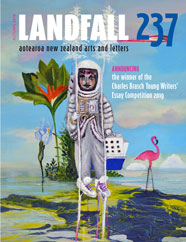
Ria Masae, originally appeared in Landfall


poem appeared in latest Landfall 237


Note from Jordan:

I was lucky enough to see Ria Masae perform poetry last year and I’ve been a fanboy ever since.  I fell in with love this poem when I read it in Landfall instantly because of how it delineates the relationship between the personal and political. While those with power have the ability to create structures and systems that shield them from one or the other, the two spheres of experience are inherently and inevitably reciprocal.

Ria shows us the house as a place of learning, eating, sharing, a place to nurture Whanaungatanga. But she also shows us the house as something unattainable, surrounded by barriers and surveillance, somewhere that can spread fear, otherness or indifference. We spend our whole lives as house guests: we consciously and subconsciously pick and choose experiences and lessons as we build our own, deciding who to invite in, how we speak inside, what wallpaper to put up. Ria has built a house that is a sum of her, her knowledge, her language, her whakapapa, her space within a nation, where the treatment of its guests fluctuates with the whims of those sitting at the head of the table. Ria ends with a question:

What house will Jacinda build? Will it enable my daughters to build their own houses/of tangata whenua foundations and fa’a Samoa roofs/in the palangified City of Sales?

This ending resonates in a time where Aotearoa is asking more of it’s leaders, asking how they will allow rangatiratanga to flourish, how they will create a sustainable future and undo the harms of colonialism and capitalism, how they will celebrate and protect the unique experiences and histories of all its guests, how they will rectify their positions of power and privilege with the whenua they stand on. Ria will have an answer to her question sooner or later. In the meantime, I’m getting a grappling hook, a balaclava, a bottle of whisky and going for a midnight skinny dip in John Key’s forbidden pool, who’s coming with me?


Jordan Hamel is a Pōneke-based poet and performer. He was raised in Timaru on a diet of Catholicism and masculine emotional repression. He is the current New Zealand Poetry Slam champion and has words published or forthcoming in Takahē, Poetry NZ, Mimicry, Sweet Mammalian, Glass Poetry, Queen Mob’s Teahouse and elsewhere.

Ria Masae is a writer, poet and a spoken word artist. Her work has appeared in various writing outlets such as, Landfall, Circulo de Poesia / Circle of Poets (Mexico), and Best NZ Poems 2017. She is a member of the South Auckland Poets’ Collective.

This year Ria was accepted for the 2019 New Zealand Society of Authors Mentorship Programme in which she is working on new material for her sole poetry collection. She is also compiling poetry to be published by Auckland University Press, alongside two other emerging poets in a book series, New Poets #6. This is due to be released next year.
 

otago708667.jpg

Landfall page

Poetry Shelf review: Kirsten Warner’s Mitochondrial Eve


mitochondrialeve_webcover.png


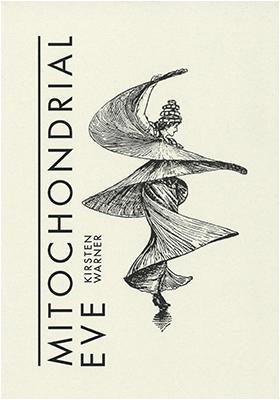
Kirsten Warner, Mitochondrial Eve, Compound Press, 2018


Kirsten’s Warner is a writer, poet, journalist and musician and former chair of the Auckland Society of Authors. She graduated with an MA in Creative Writing with Distinction from AUT and won the Landfall essay competition in 2008. She performs as a musician with partner Bernie Griffen in the folk-blues band Bernie Griffen and The Thin Men. Makāro Press published her debut novel The Sound of Breaking Glass in 2018. Her poetry has appeared in a number of journals and  anthologies. Her debut chapbook Mitochondrial Eve also came out in 2018. This slender collection is the kind of book you can spend ages with. I read it on the plane to Wellington and once I got to the end of the book I returned to the beginning and read it again. Goodness knows what the passengers either side of me thought. They wouldn’t have known I was poetry rich with a stack of books waiting to be read in my bag.

The six poem titles resemble a narrative framing device: beginning with heartbreak, then moving through dailiness and despair, to a degree of release:


The Location of Heartbreak

Plant a Red Hibiscus

Channel Surfing

S. O. S.

In a Nutshell

Off the Leash


Each poem is exquisitely layered as things are held at arm’s length, obstacles loom, the real world intrudes bright and harmonic, words are lithe on the line. Here is the first stanza of the first poem that pulls you into threat and challenge through the rhythm of walking with its pauses and asides:


I surface dismantled

heart-sore here in the area of the left breast,

certain the most meaningful part of life

is lived while dreaming

and that to awake is to fail to fall

into an abyss of light.


from ‘The Location of Heartbreak’


The heart-threatened core (of the poem, of self), unsettling and hard to reach, is like an insistent pulse that keeps me reading:


I step over cracks so I won’t marry a Jack

resist walking out into traffic

we don’t have a bath and I’d have to find blades

and it’s an end I want not intensification

someone to find me before I drift away.


The second poem, ‘Plant a Red Hibiscus’, returns to the rhythm of ‘feet on the pavement’, but changes pace as the speaker takes charge of a bulldozer. Always the incandescent  core, like a burning wound, enigmatic, exposing; the poet never still. Here is the musing speaker at the bulldozer’s helm; I am holding my breath as I read:


Things that also might be worth living for are

small dark orphan babies who need arms to hold them

I would sit for hours.

Gathering fallen leaves,

we are all compost exchanging molecules and air.

Plant a red hibiscus.


Spread good dark soil, pick up dry leaves, hold a baby.


I don’t make assumptions about the speaker in the six poems. She might be the ‘Egyptian Goddess stalking the town!’ She might be part poet, part invention, part delight in different voices. The poem ‘In a Nutshell’ samples role hopping from Eve with mitochondrial disorder (misbehaving cells that can’t burn food and convert oxygen to energy) to Katherine Mansfield in her German pension, Suzie Wong getting STDs, Carmen Miranda breaking into song, Mata Hari watching time flying over rooftops, until the final glorious, puzzling stanza that hooks the stitches of everyday into the whip and pain of existence:


When I eat nuts

I am Nut

the whole shebang

born of ululation

moisture and fire crackers.

I have no consort

he’s outside

drinking

fagging

shooting up

hocking my starry dress

trying to get back up me.

I bear down

without drugs

swallow the night

virgin again

every morning

to make school lunches

and hold up the sky.


This hallucinogenic, rollercoaster, gut punch of book runs through me like fire. I love it.


Kirsten Warner WordPress page

Selina Tusitala Marsh celebrates her Poet Laureateship tenure with a poem and a power point


Dear Selina

You have given us so much  as Poet Laureate – you have sparked poetry and poets all over Aotearoa and beyond its shores – you have shared poems, your own experience and opened up what poetry can do. Poetry matters to so many more people because of you. Thank you three times thank you. I look forward to reading your new books, hearing you perform again and talking poetry. Meanwhile enjoy your time as Poet in Residence at the Queensland Poetry Festival – you deserve this time with a much clearer calendar! I embrace you dear friend, dear poet.

Aroha nui

Paula


Poetry Shelf noticeboard: Hinemoana Baker’s sole NZ performance

Screen Shot 2019-08-20 at 8.39.26 AM.png

Go here for tickets and details


Hinemoana Baker – Live @ Aratoi
Waiata mō Te Wairarapa

An acclaimed performer of text and song, poems and prosody, a writer, sound artist and storyteller, Hinemoana Baker joins us for one night only.

Her only show in New Zealand in 2019, a multilingual selection from her back-catalogue and from her upcoming collection, Funkhaus.

For the last four years, Hinemoana has been living, working and performing in Berlin, where she was Creative New Zealand Berlin Writer in Residence 2016.

She hails from Ngāti Raukawa, Ngāti Toa Rangatira, Te Āti Awa and Ngāi Tahu on her Dad’s side, and from England & Germany on her late Mum’s side.

Doors open 6.30 with a cash bar.
Door sales: $30 on the night.

Aratoi thanks Grafia Productions and Masterton District Council for their support.

Photo credit: Robert Cross