
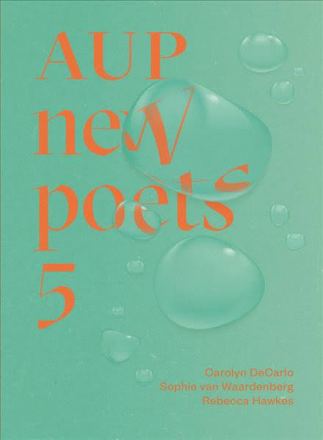
AUP New Poets 5: Carolyn DeCarlo, Sophie van Waardenberg, Rebecca Hawkes, edited by Anna Jackson, Auckland University Press
Auckland University Press’s New Poets collections began in 1999 and, after an eight-year hiatus, has relaunched the series. Anna Jackson, who appeared in the debut issue, has edited volume 5 and written the foreword. The series serves as welcome launchpad for emerging poets and has, for example, included the work of Chris Tse, Sarah Quigley, Sonja Yelich, Erin Scudder and Reihana Robinson in previous volumes.
The recent launch at Unity Books (Wellington) was packed with an attentive audience – the reading highlighted three distinctive voices linked by poetic charisma: Carolyn DeCarlo, Sophie van Waardenberg and Rebecca Hawkes.
Carolyn DeCarlo, originally from USA, has read at various literary events including Welington’s LitCrawl, and runs the literary reading series Food Court. Her writing delivers mesmerising physicality, detail that illuminates the present tense, a moment that might be hyperreal in ways that startle or soothe or move you.
The opening poem ‘Spy Valley’ is a sumptuous rendition of a scene to the point it glows with heat and crackling light: it’s sensual, surprising, moreish. Every word is pitch perfect and every word adds to a building physicality that clings to you as you read.
(…) Their calls cleave the
valley like lightning, crackling in the air,
striking the dirt beneath your toes,
and when the drops of rain hit your face
thick as bread you’re unafraid,
you open wide, you spread your arms
and soak your skin in sanguine heat,
its spongy hug lulling you to sleep.
Carolyn offers textured poetry – almost as though you can brush your fingers over the surface of a poem and feel grains of feeling, its physicality, its movement. The poems often bridge the hyperreal and an everyday real, relishing the slow occupation of a moment, a place, a state of being. In ‘Fields of Glass’ the speaker stands musing on a glass hill – there is a building (sometimes sad and green, sometimes uncomfortable) driving the movement of the poem, the thoughts of the muser. Everything is slightly mysterious, anchorless, as though each stanza is a shortcut to censored feeling, reserved circumstances. Again the reading effect is addictive.
Another time, we danced
on the floor. Do you remember that?
Our socks bunched up
around our ankles
then our ankles around our knees
and so on.
I am eating tomatoes and crying,
if you sit beside me
I will let you carry the juice,
I am carrying the rain.
Much thought has been given to the order of the poems – water and rain ripple through, along with birds, trees, piquant colour. In the middle the speaker is anchored in the land, their body made visible, and anxiety appears like little body fractures, the physicality of the writing potent. This from ‘The Year I Let My Heart Go Asunder’:
I am crouched down on the bank of Wellington Harbour
and I am huge as the hills.
I am squatting with my bottom on Khandallah,
my feet in the harbour and the water barely splashing my ankles.
I love Carolyn’s selection of poems (Winter Swimmers) so much: it’s beautifully crafted, aurally satisfying, surprising in turn and revelation. There are a number of poems named ‘Winter Swimmers’; like a swelling and shifting contemplation that keeps changing hue and effect, yet never losing sight of the water, the swim stroke, the breath necessary for living, for writing, for reading. This selection is like a pair of lungs inside me, expanding and dilating, expanding and dilating. Glorious.
At the time of publication Sophie van Waardenberg was working at the Open Book in Ponsonby. She has completed a BA at the University of Auckland and is now undertaking an MFA in poetry at Syracuse University, New York State. Her poetry has appeared in a number of journals.
Sophie’s selection of poems – does a potato have a heart? – navigates learning the world in all its brittleness and wonder, especially through the glints and sharp edges of love.
In ‘Unhatched egg/two girls at easter’, a precious bird’s egg is discovered, wrapped and held close to the girl’s belly. The egg’s potential life is in razor contrast to the felled trees, the scarred landscape, but then life delivers the little blow with the cracked egg, the cracked future.
in the morning we two bury the fresh-cut shell by the river
where her parents had their honeymoon
and at hot noon with downy arms we swim there
under trees our failure has grown for us so quickly.
Love is a constant infusion, whether of a particular person close or at a distant. In ‘schön’ a woman (a beloved one) appears in a lyrical list poem like a chant; the love portrait builds sweetness and good feeling, along with topple and enigma:
my girl becomes a calendar and I curl up inside her
my girl becomes a tongue twister and I curl up inside her
my girl lets the spring in through her hands
she puts her hands over my ears and I remember how it feels
it is nice and nice and nice
One poem – ‘all the friendship bracelet makers have retreated’ – hooked me with its evocation of yearning and ache: of missing someone, missing home, of negotiating elsewhere and of being apart. The writing is confessional, yet prismatic in its different slants. Dislocation tempers location, location tempers mascara-smudged cheeks. The middle stanza is the exquisite heart of confession, the simile potent in meaning:
I want to be far away but I want to be home.
breath by breath I want these things.
let me show you how little I want to know:
make a fist and let no air in.
I want to make the world as tight around me
as I make my single duvet cover in winter.
On the adjacent page, ‘to keep all the bees out’ signals love’s potential pain and potential joy. The poem, with intricate and surprising detail, layers what ‘we’ do. Sophie is refreshing the scope and dimensions of confessional poetry; not everything is visible, not everything is stable, not everything is knowable. The hills they climb together ‘are eaten by their own edges’. Such a striking image of mist and uncertainty heightens the final stanza:
and the right ventricle of the human heart
does not have doors heavy enough
to keep all the bees out, and their stings
Sophie’s selection of poetry haunts me; it is an atlas of love, experience and feeling, with pronouns shifting to accommodate you and you and we and I, and poems that keep drawing you back. It feels fresh and original, and I love it.
Rebecca Hawkes grew up on a high-country farm near Methven. She graduated in media studies and then completed an MA in creative non-fiction at Victoria University.
As the title suggests Softcore coldsores is an audible kaleidoscopic rendition of life: startling, a sonic explosion in your ear, acutely visual, utterly satisfying. The poems move from milking cows to trying to go vegetarian, sexual fumblings, all manner of hungers and yearnings. ‘Gremlin in sundress’ is an intense and captivating blast of sound that catches an intensity of living and craving for life. I have heard Rebecca read live several times and it is an addictive experience – the sonic rewards find new traction in the air / ear. Here is the middle bit of the free-flowing, page-long ‘Gremlin in sundress’:
gimme something pretty but with brains
I can crack open gimme salt’n’pepper
tentacle dredged from the abyss and deep
fried gimme hot cephalopod gimme yer cold
shoulder gimme drunkenness gimme the vomitorium
next door to the buffet gimme mortal clay
with tingle and baby fat to live in
gimme glory gimme eternity gimme your likings
There are many paths through Rebecca’s poetry but every reading path is an intricate interplay of the visual and the aural. I keep rereading a poem to savour the music and and the visual impact. Maybe it makes a difference that Rebecca is a painter with a richly-hued palette and eye for massed and sensual detail. She takes me to the edge of vertigo at times, even squeamishness, in both her art and her poetry. Reading her poetry becomes a whole body experience (as it so often is) and I find myself unable to move onto the next thing, the next book, the next chore, the next outing. Perhaps at the core is the notion want: I am thinking of its varied meanings as Rebecca’s poetry pivots upon desire and upon lack.
With her high-country childhood it is not surprising the back blocks feature in some poems. The magnificent and utterly surprising ‘Dairy queen’ begins in the milking shed with an image of a shedhand:
you’re the other shedhand on the early morning shift
and you work shirtless
under your heavy rubber apron
which I appreciate from behind –
muscles moving under your tan
perspiring glossy as a cold can of golden pash
unfortunately the overall effect is ruined
by your bleach-blonde dreadlocks Grinch fingers
dyed greenish by weeks of cowpat splashback
Lust makes way for private musings on love and sadness, on loving people for their sadness and equally resenting a desire to be loved despite internal sadness. I am out of the cowshed into the secret moment, the little confession on the power of trust and tenderness: ‘all summer / I’ve been skittish and gentle like a puppy / saying hello by resting my whole mouth around your hand but not biting’. This sweet piquant moment is like a eyecatching flash before we return to the cowshed, the sexual pulls, and an image of the speaker in a water trough, bathed in barley seed and molasses.
I am also entranced (held in the grip of) by ‘Add penetrant to preferred broadleaf herbicide & devastate the wildflowers’. The poem brings the rabbit-infested, lupin-covered Mackenzie Country into sight by interweaving opposing views, both opinion and what you frame in your camera lens. Driving through the beauty in this poem is to drive through the Mackenzie basin with reactivated eyes:
as the lupins bloom out the summer in their splendid blushing colonies
both the planters of lupins & their weedkiller neighbours insists
that nature should take its course
but they can’t agree on what nature means:
conserving shrivelled unpalatable tussock or letting slip
the lupine war on the landscape
Rebecca’s poetry has such potency the poems stick to your skin and you carry them all day, reflecting back on the twisty turns, the compounding rhythms that act as both torrent and ripple, the bits that make little bites which get you thinking and feeling. For a small cluster of poems to do this is astonishing.
A welcome return, AUP New Poets 5 delivers three poets who fit together beautifully. Their writing is complex, unafraid of feeling, physical, invigorated and invigorating. Yet each poet offers a distinctive voice that is highly addictive; it is like getting to swim in three very different locations with three very different impacts on your body as you move. I can’t wait for the next volume (it’s in the pipeline) and I can’t wait for debut collections from these three fresh voices.
J & K Rolling Poetry Reading
When: Friday !st November 7pm
Where: Humboldt Room, Camp Glenorchy, in the town of Glenorchy, located at the headwaters of Lake Wakatipu.
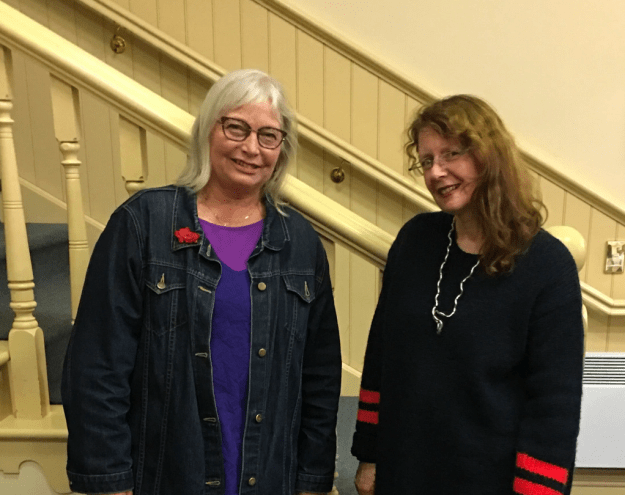
Five years ago, poets Jenny Powell and Kay McKenzie Cooke formed a poetry reading duo dubbing it ’J&K Rolling’ and have visited numerous small rural areas.
J&K Rolling are dedicated to taking poetry to the hinterlands and southern outposts. The rewards are priceless. Local poetry hitherto unknown or heard, tends to come to the surface and there’s always a participatory helpful and interesting discussion held about poetry and writing in Aotearoa in general. Twice now, local poetry groups have been formed after our visit. Glenorchy already has a keen group of book enthusiasts and writers and their own very small library operating every Friday.
To read more about our readings etc. take a look at the J&K Rolling page
Mr Anderson, you heartbreaker you
Oh Hans Christian Andersen, you tormentor
of children, creator of nightmares
The Little Mermaid always did me in
with her big love and her
enormous silence and giving up
her fishy tail for two legs
maybe to part them for
her sweet prince, but
relegated to the friend-zone
each shard of glass she stepped on
pricked a tiny hole into my
squishy little heart
And, really, if she’d just held on to her tongue
she could have sung him to her
reeled him in, drunk him down
One prince, on the rocks, coming up
*
And at the same time as the prince married the princess and the Little Mermaid turned into not even sea foam, but air, Andersen wrote to his friend Edvard Collin, who was also about to marry: ‘I languish for you as for a pretty Calabrian wench … my sentiments for you are those of a woman.’ Collin later wrote in his memoir, ‘I found myself unable to respond to this love, and this caused the author much suffering.’ Gosh, I can barely move for the shards of broken hearts beneath my feet.
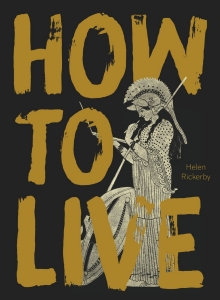
Helen Rickerby, How to Live, Auckland University Press, 2019
Helen Rickerby is the author of four collections of poetry, most recently How to Live (Auckland University Press, 2019). She likes questions even more than answers. Since 2004 she has single-handedly run boutique publishing company Seraph Press, an increasingly important publisher of New Zealand literature, focusing on poetry. Helen lives in a cliff-top tower in Aro Valley, and works as an editor.
You are warmly invited to the launch of
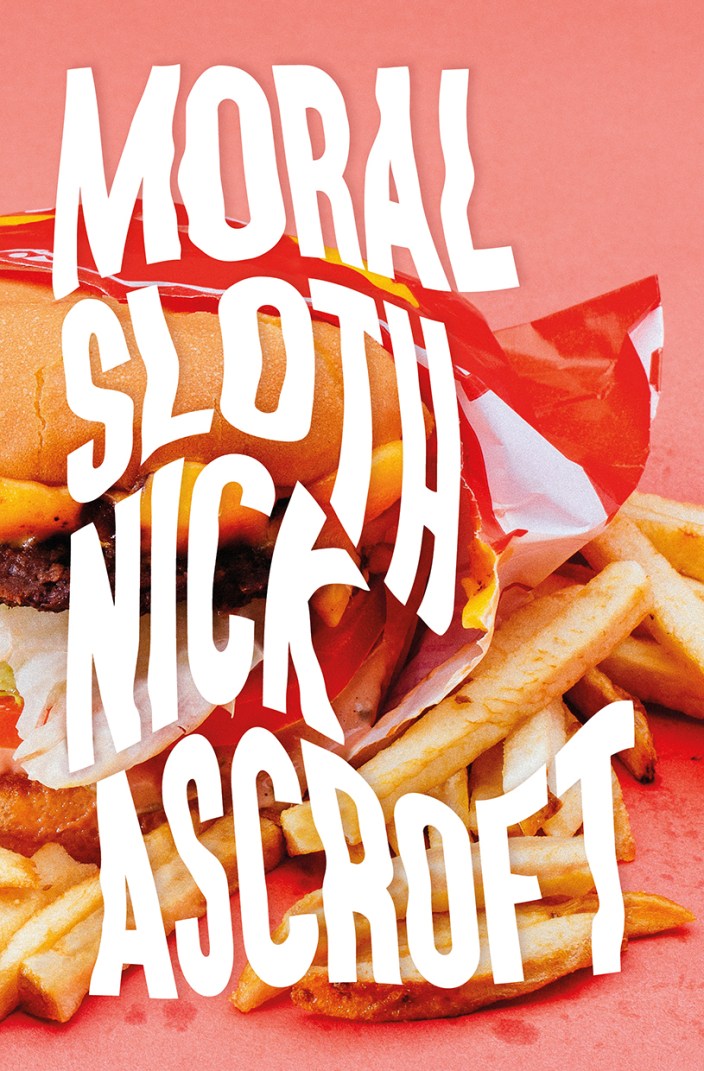
Moral Sloth
a new collection of poetry by Nick Ascroft
to be launched by Ashleigh Young
Tuesday 12 November, 5.30pm–7pm
Hudson Bar, Chews Lane, Wellington.
All welcome!
$25

Unity Books, Wellington, 6 pm
Mary Macpherson, Unity Books and The Cuba Press warmly invite you to the launch of Social Media, a playful and provocative debut collection from an established Wellington poet and photographer that drills into our social and media selves using elements from short stories, art projects and films.
With readings by The Meow Gurrrls.
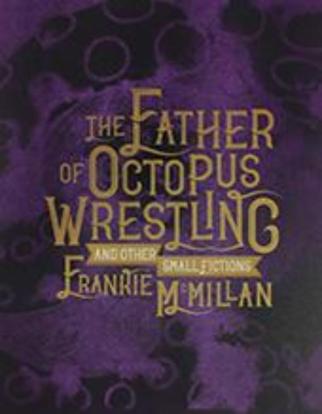
The Father of Octopus Wrestling and other small fictions, Frankie McMillan, Canterbury University Press
Canterbury University Press page
What a gorgeously produced book! A purple marbled cover with gold lettering and dark marbled section dividers inside. The book was designed and printed at Ilam Press, Ilam School and published by Canterbury University Press. I do hope more books emerge from this genius partnership.
Not far into reading I began to muse on the idea of original writing because the book is so invigoratingly original – I am fascinated by the origins of these short fictions that are shaped by an aeronautic imagination and (perhaps) specks of real experience. The realness is luminous – the sharp compounding detail does its work beautifully – yet each fiction offers tilts and kinks and little spikes of strangeness.
The opening piece, ‘Seven starts to the man who loved trees’, is like a test pot of beginnings that overlap with scene and foreboding to the point of fluidity and connection. The book’s dark swirly cover with its murky possibilities seems a perfect match because this fiction, like all the fictions we read here, arrives in tantalising pieces. We will never get the full story but we do get sensual and emotional impact. I love that.
The water-presence in the first section is a thematic link. There is a father who gets put in an aquarium, a sister who holds tight to her sinister secret by a river, there’s too much plastic in the ocean, an Amsterdam canal. There are multiple movements ( I am thinking of the movement of water that is both predictable and unpredictable). Movement is a way of going forwards; elsewhere someone is moving through Ireland’s eerie rock-clad Burren.
Frankie’s writing flows like honey and is so sweetly crafted with its shifting rhythms. In ‘The honking of ducks’ the first long sentence is like a breath held (a secret held) and we all come up gasping for air:
The thing to do with a secret is to swallow it, and just as you’re not bothered by thoughts of a plum’s progress through your intestinal tract, neither will you think of your sister running hand in hand with a strange man to the river bank and when your sister goes missing you will have to borrow words to explain why you never told and when the police say who put those words into your mouth you will think only of the loveliness of weeping willows, the sshhh sweep of fronds over the sandy bank, all the fun you will have when your sister sets up house under water and you have to swim through the clefts in rocks holding your breath against the squeeze.
The collection is a reading banquet: I am feasting on scenes, situations, relationships, human challenges, desires, loves, losses.
Situations – In ‘How we occupy ourselves’, after parental bickering, the family home gets physically split in half, and the father lives by the river and the mother lives on the flat, and the grandmother makes roly poly pudding and says ‘how lucky we are, all of us alive with roofs over our heads and telling each other stories’.
Situations – In ‘A good match’ a husband wants to know if his shirt looks good with his green jeans (third one tested). The wife looks at the clothes strewn on the bed after he has gone out and stares and muses: ‘Wonder again about what goes best, this or that, blue with green, him with me or her.’ I get a whole whoosh of feeling when I read the this final sentence.
Frankie’s short fictions (you could also say prose poems) have poetry’s ability to screen most of the detail but with a few deft strokes and admissions reach a poignant kernel of human experience.
Situations: In ‘Reading the signs’ a miniature but dynamic biography of a hospitalised father emerges. To his visiting offspring he admits regret over a chimp he had raised like a human child in a zoo. The visitor sees him at the window as they leave:
I waved, knowing that it was probably the last time I’d be seeing him but wanting the wave to convey all the love I had inside me, all the things I was wanting to do and all the things I was wanting to say but couldn’t.
Ah such a whoosh of feeling as I read these lines. The way a story, a situation, a scene twists your heart until it hurts.
Here I am breaking my rules and telling you the endings. The beginnings are equally good. Here is the the start to ‘Salt’, a piece that pivots on salt and a woman who is forbidden to eat it on the hospital ward:
Sometimes you can ask for something as small as salt only to be refused, the rules won’t allow it. Then salt becomes a big thing in your mind and all you can think of is salt; how it’s responsible for the salinity of the ocean, and then you imagine all the seas in the world, all the whales, then all the camel trains across deserts to bring salt to people like the big woman in the bed opposite. It puts it all into perspective when the nurse says, sorry no salt allowed on this ward.
You forgot to add salt is also good for mistakes.
And here is another favourite beginning (‘Jesus and the ostriches’): ‘Soon after Roland began sleeping in the caravan I saw Jesus.’
The Father of Octopus Wrestling offers many satisfactions. Yes it is a book in pieces but it is also a book of echoes, hinges, connections. Fathers are every which way you look, along with birds, Jesus, fish, mothers. The strangenesses will jolt you – like when you think you saw a wild cat but it’s the bending tree – and the human experience will make your skin prickle. Within the surprising anecdotes (think bizarre surreal unexpected) wisdom takes seed. This is a book that maps human existence, past present future, and I am all the better for having read it. I recommend you do too! I just love it to bits if you will forgive the pun.
The mothers of the mothers of the mothers
She tells the child that if all the great grandmothers were
to climb out of the ground to drift though the cemetery,
it wouldn’t be long before they came across each other,
laughing to see each other’s old faces and say they were to
hold hands, the long line of them would reach the other
island, but they couldn’t complain that their feet were in
the cold salty ocean, in fact the mothers of the mothers of
the mothers were used to much worse, some having only a
potato to eat at night or soldiers burning down their whares
and others having to wear corsets of whale bones that go all
the way to their knees but the child says that’s going too far
and she likes the part best where the mothers of the mothers
of the mothers wonder about the little girl who rides to
school in a car that does not eat hay but only drinks lakes
and lakes of petrol.
Nodding is Soft
I can only tell you. What I saw.
And all I can. Say is that you.
Wouldn’t have wanted. To see it
yourself no. Sir it was not.
For public. Consumption it was
very hard and very. Bad probably
the hardest and. Baddest thing
to see but yes. I saw. It I saw
it hard and it was. Bad but even
when I. Saw it I didn’t say. Wow
that is the hardest. Thing I’ve ever
seen I just. Said when. Are we
leaving and you. Said well we
can leave when. You’ve finished
looking at the. Thing you’re looking
at. And so I turned. Away but
already I. Knew it was. Not
worth telling you. About this
most hardest and. Baddest thing
it is not. Soft not like your. Nodding
is soft. But why are. You nodding
don’t you know. That this is. The
hardest and baddest. Thing. No you.
Don’t understand it is. The worst.
I can only. Tell you what.
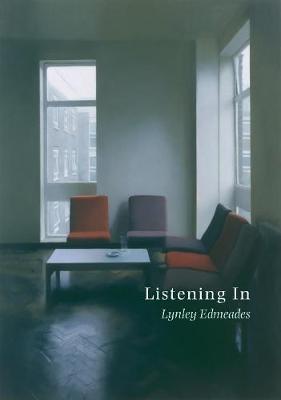
Lynley Edmeades, Listening In, Otago University Press, 2019
Lynley Edmeades completed an MA at the Seamus Heaney Centre for Poetry at Queen’s University in Belfast, Northern Ireland, in 2012. Her first collection of poetry, As the Verb Tenses (Otago University Press, 2016) was longlisted for the Ockham NZ Book Awards for Poetry, and shortlisted for the UNESCO Bridges of Struga Best First Book Award. She has a PhD in avant-garde poetics and teaches literature and creative writing at the University of Otago.
Otago University Press page
Lynley in conversation with Lynn Freeman (it’s terrific) Standing Room Only

 NZ Poetry Shelf