Poetry Shelf interview with Kate Camp

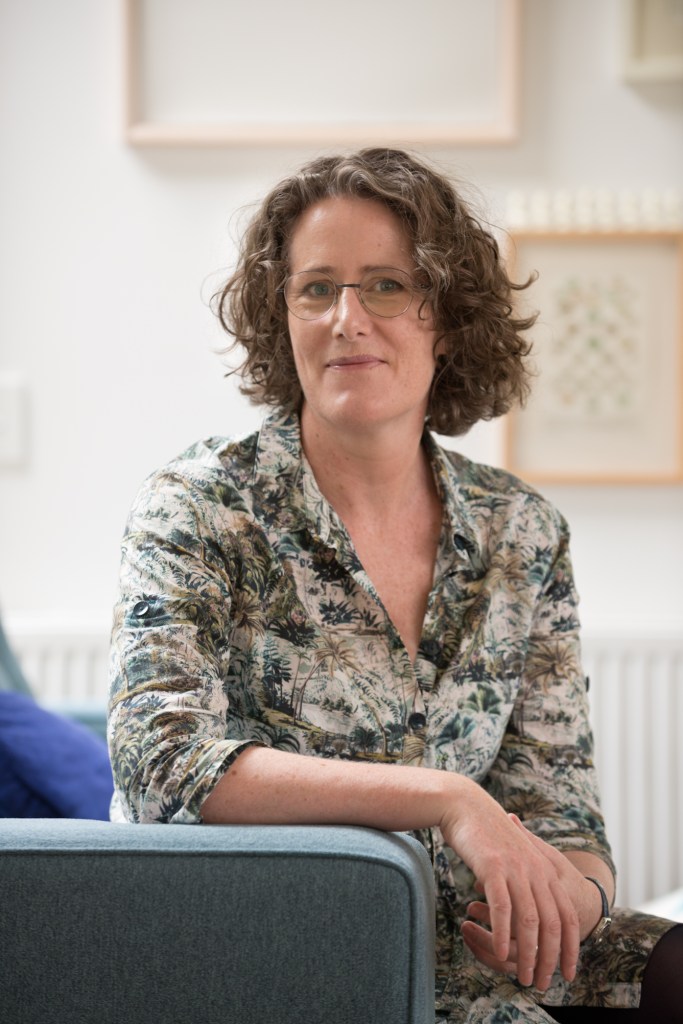
Photo credit: Grant Maiden

‘And I think it is this sense of connection, in all Kate’s poems, which sent me scrambling for a word like spiritual. Because what I feel when I read Kate’s work is that the great mysteries of the world, the omnipresent magnificence, the unexplainable and the truly awesome, rest in being human among humans. Take your ley lines and chakras and give me the oesophagus and the eyeball, the memory of a dusty school hall, that night, that party, remember the small blasts of happiness, our bloody painful hearts.’

Maria McMillan, launch speech for Kate Camp’s How to Be Happy Though Human

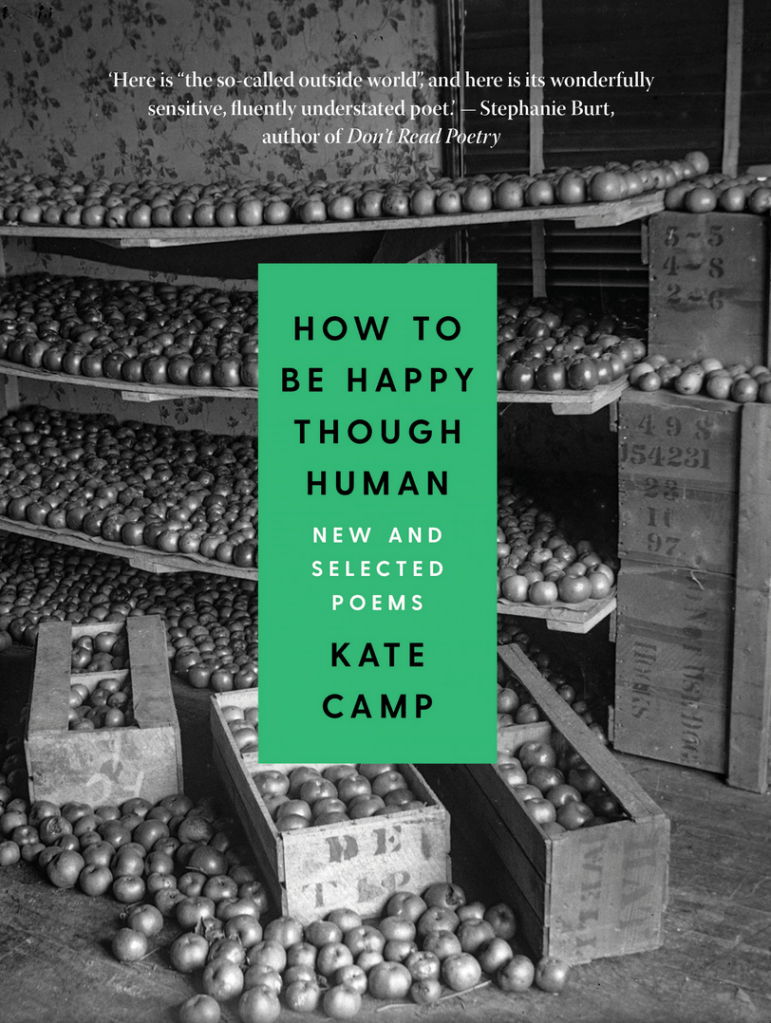
Poet, essayist and literary commentator, Kate Camp has published six previous poetry collections. Her debut collection, Unfamiliar Legends of the Stars, won the NZSA Jessie Mackay Award for Best First Book of Poetry at the 1999 Montana NZ Book Awards. Her fourth, The Mirror of Simple Annihilated Souls, won the 2011 NZ Post Book Awards Best Book of Poetry. Her poems have appeared in magazines and journals in New Zealand and internationally. For a number of years she has discussed classic literature – Kate’s Klassics – on with Kim Hill’s Saturday spot on Radio NZ.

To mark Victoria University Press’s publication of Kate’s How to Be Happy Though Human, Kate answered a few questions for Poetry Shelf.

So many things can go wrong

inside a human life, it’s almost comical.

You find yourself in a house,

in a night, with everyone you love

breathing in and out somewhere

and if you thought about it properly

you’d just throw up in terror.


from ‘Panic button’


Paula: Have you always been an avid reader and writer?

Kate: Family legend is that I came home from my first day of school and told my mother I could read. She said, oh ok read this. I replied, well I don’t know any words yet.

I didn’t learn to read particularly early, but once I did I quickly became obsessive about it, all the usual reading under the covers, walking down the street with a book on my way to school, re-reading books over and over again.

Paula: Can you name a few poets that have caught your attention across the decades?

Kate: Lauris Edmond is a key one for me among New Zealand poets. I’m reading Fleur Adcock’s selected poems at the moment and remembering what an important influence she was for me early on. And Jenny Bornholdt, her work and mine are so different, and yet I always feel such an affinity with her poems.

In more recent years / decades I’ve got into a lot of poetry in translation. Czesław Miłosz is one I come back to again and again, and Wisława Szymborska. Like Bornholdt, Mary Oliver is a poet I feel is very different from me, but I love her.

Paula: You acknowledge your writing group. How important is it to be part of this as a poet?

Kate: My whole career I’ve had a writing group. When I first started writing seriously I was on the creative writing course at Victoria in 1995, so I was in a weekly workshop. After that finished, around half the course members formed a group together and we met for years. Then in 2003 I joined my current group and it’s been going that whole time.

They are my first readers, my best readers, my greatest motivators. We follow the “Iowa workshop” style where we read our poem aloud, the others talk about it, and the poet just listens and says nothing. It’s such a brilliant, powerful way to understand how a poem is landing.

A liquorice cable

wires hand to mouth.


Proud magpies

raced the dawn home.


Asphalt remains lively

weeks after its laying.


from ‘Unfamiliar Legends of the Stars’

Paula: Your debut collection Unfamiliar Legend of the Stars came out in 1998. Were you writing poetry much before this?

Kate: I’d always written poems in a notebook but never really shown them to anyone or thought I’d do anything with them. I knew about the creative writing course at Victoria, I was a student there studying English and I knew that Emily Perkins, who was the older sister of a school friend, had done the course and become a published author.

I thought, I’ll apply for the course three times, if I don’t get in I’ll just give up on it. I got in the first time I applied and it was really only then that I started writing with any focus or seriousness.

Paula: That first book really caught my attention – it felt fresh and rendered the world alive with possibilities. Can you remember what motivated you as a poet then, what mattered when you shaped a poem?

Kate: I think what motivated me then was a sense that I saw the world in a certain way and I wanted to share that way of seeing with others. And I guess I felt the power of poetry, and I wanted to wield that power myself.

What mattered to me then was to write a poem that was clever, surprising, and made you feel something.

Having said that, when I’m actually writing a poem I try not to think at all. About anything. I find that gets in the way. The Canadian poet Christian Bok said “take care of the sound and the sense will take care of itself.” That’s how I’ve always written, just going with what comes up and trying not to switch my thinking brain on until I’ve finished the draft, and it’s time to edit.
Violin was out the back of my flat when I was nineteen.

I would put the speakers in the garden

and play ‘Be Mine Tonight’ again and again

running inside to rewind the tape.

He’s shocked to find I am middle aged.

I’m not shocked. Inside me are Russian dolls

of the women and girls I’ve been before

each more beautiful and unhappy than the current.


from ‘One train may hide another’

Paula: Your new collection How to Be Happy Though Human (you have a deft hand with titles!) is a gathering of new and selected poems. I like the way you have placed the new poems first and then we move through your books from the debut to the most recent. Often the new poems go at the end. I love this choice! Any comments?

Kate: I read a lot of selected poems and I tend to read them backwards, in chunks, so that I’m reading the poet’s most recent poems first. Otherwise with a poet like Milosz you’re starting in the 1940s and the poems can feel really dated. But if you start with the new ones, by the time you get back there you’re kind of in the zone.

That doesn’t really apply to my selected though as my career hasn’t been that long, at least not by Milosz standards! I just wanted to start with new poems because, you know, new poems are always the ones you love the most. The best poem is the next one.

And I go back to Saturday

we dance with other people

other people’s children,

create community with physics.


Memory is a kind of  mourning.

We take each other’s hands

as if they were made for that

and we form a circle.


from ‘How to be happy though human’
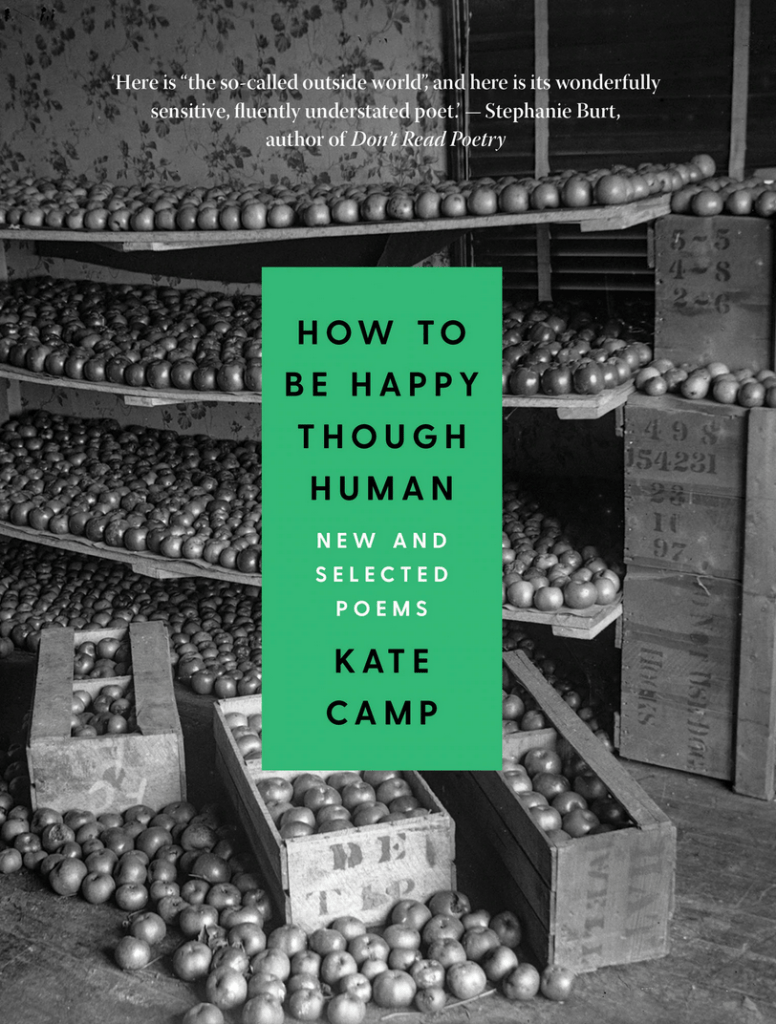
 

Paula: Your new book offers perfect routes through the rewards of your poetry. The physical world is refreshed, relationships between things and people are made visible, there are surprising connections, and always a glorious poetic fluency. Did you encounter any poetry stumbling blocks or epiphanies across the decades?

Kate: There was a fairly big gap between Beauty Sleep and The Mirror of Simple Annihilated Souls. I was having a crap time in my personal life, and I felt really stuck creatively. I was scared to write about my failures, my despair, my loneliness, my fucked up life. And I was scared to write about “the human condition” like a Milosz or a Mary Oliver, I felt – who am I  to write about the meaning of life? On both fronts my ego and my vulnerability was in the way.

But then I realised, the artists I most admired were writing poems and songs of utter devastation and heartbreak and disaster. And I didn’t think they were losers, I thought they were magnificent.

And I realised that I was never going to be anything other than a middle class New Zealand woman who grew up on Timbacryl adverts and 70s singer songwriters, and that I had just as much right as the next poet to plumb the depths of the human psyche.

I think that book marked a “fuck it” point for me where I decided just to write the poems that are in me, however depressing, distasteful or megalomaniacal they may be.

I take the last few turns in darkness

steep, short of breath

these legs have been mine all my life.

Hot hands. Small nights within my lungs.


We are fortunate to live in a world.

We are fortunate to live in a world

where some person, some man

is painting railings on the zig zag


and when he finished

he could have raised his eyes

and seen, beyond the black-tree hills

some ragged and fast-moving clouds.


from ‘Walking up the zig zag’

Paula: I just adore the new poems housed under the title ‘How to Be Happy Though Human’. Now and then I post a poem that has really haunted me in a new collection – and this whole section haunts me. The poems stick to me – I think the title is a key. These poems are intimate and revelatory, physical and movement-rich. Again the surprising juxtapositions: hanging out the washing, Watergate, your mother. Scenes become luminous. Family matters. There is a poetic heartbeat. Would you see any changes in the poetry process?

Kate: Almost all of these poems have been written since I came back from the Menton fellowship, where I was writing prose – a collection of memoir essays. I can definitely see the influence of that. These poems are looser, more prosy in style, and in many cases are straightforwardly autobiographical. They’re also long. Pulling together this book made me realise that my poems have got very long lately!

Paula: Do you have doubt tagging along? Is there a particular poem that was hard to write?

Kate: Most poems I try to write either don’t happen at all, or turn out to be not that good and get abandoned. But every poem I write that turns out good, I write in one go, in an hour or so. I will revise it later but usually not a huge amount. That’s just my process, it’s kind of scattershot but when it’s working, it’s easy, so I don’t really find any poem hard to write. I just throw away a lot of attempted poems.  

My main doubt is whether I will ever write a good poem again. The first sensation when I write something I like is relief.

Tom Waits records the sound of frying chicken

that’s how he achieves his pops and crackles

Our old unit had a crooked arm,

it was a trunk of wood with woven speakers.


As I child I worried about forgetting:

the hexagonal handle, a creamy honey cell,

that flaw in the lino resembling Donald Duck

while the others of its kind looked like grey bells.


sometimes life would seem too big, even then

an empty Sunday when you drifted as a ghost.

I saw Bonnie and Clyde on such a day,

as I recall, in black and white


from ‘Snow White’s coffin’

Paula: What poem really works or matters to you?

Kate: The poem “Snow White’s Coffin” is an important poem for me. It covers a lot of abiding interests for me – found facts, childhood memories, what makes life meaningful when you’re an atheist. It draws on something I thought on a lot when I was living in Berlin, the tension between intellect as the most human thing of all and the intellect as dehumanising. There’s also a tone of anger and despair in it which is quite primal – the word “howling” is in it, which is not a word anyone puts in a poem lightly.

In my last few books, the title poem is a poem that is really important to me – one that functions as a kind of tuning fork for the whole collection.

Paula: Do you have any tips for emerging poets?

Kate: Read poetry by other people. If you don’t like reading poetry, you’re not a poet, you’re just a bit of a dick.

Paula: What else do you love to do apart from writing?

Kate: Conversations and laughing are my favourite things. I love to sing with my choir. I love to watch Netflix. I love to dance. I love to drink to excess, rarely but with gusto. I love doing escape rooms with my nephew. I love looking out the window while drinking tea and listing to podcasts about American politics.

Victoria University Press author page
Poetry Shelf Monday Poem: Alison Glenny’s ‘Notes on The Nocturne Tradition’


Notes on The Nocturne Tradition

By the end of the decade the song is said to have lost most of its charm. This did not diminish the vogue for delicate compositions, likened to albums of fragrant leaves or to finger bowls in which reveries drifted among the reflections.

A preference for ornament over direction led to a confusion of jewellery boxes. The greatest treasures mingled with trinkets of lesser value, or were lost against the velvet lining.

The expressed aim of the cantilena was to drown the world in night.

The enigmatic nature of beauty is said to have inspired his phrasing of the portamento. At its most lucid moments a slight staccato, almost a stammer, conveyed the vague sensation of a serenade.

The belief that the action of the wrist was a form of respiration gave rise to experiments with breathlessness. Audiences likened the experience to diving into a deep lake, or being smothered in song.

Each charmed moment coaxed a new loop of melody from the shadows. Also her hair, which he compared to a curtain made of silk and embroidered with tiny stars.

Although the modulations were described as ‘tormenting’, this did not diminish the rapture that greeted the appearance of the sub-clause.

She compared the delicate figurations in the left hand to an attempt to conceive of a vaporous machine. Also a pattering of raindrops, or the sound of a bird tapping its beak against a shell.

By wandering into less dominant keys, he hoped to reveal a gender that slipped through minor modulations like water, and had no name.

Likened to a failure of the symbolic code due to an exhaustion of available resources. For example, the disappearance of the object, or the composer burying himself in a large white handkerchief.

Alison Glenny

Alison Glenny’s Antarctic-themed collection of prose poems and fragments, The Farewell Tourist, was published by Otago University Press in 2018. She lives on the Kāpiti Coast.

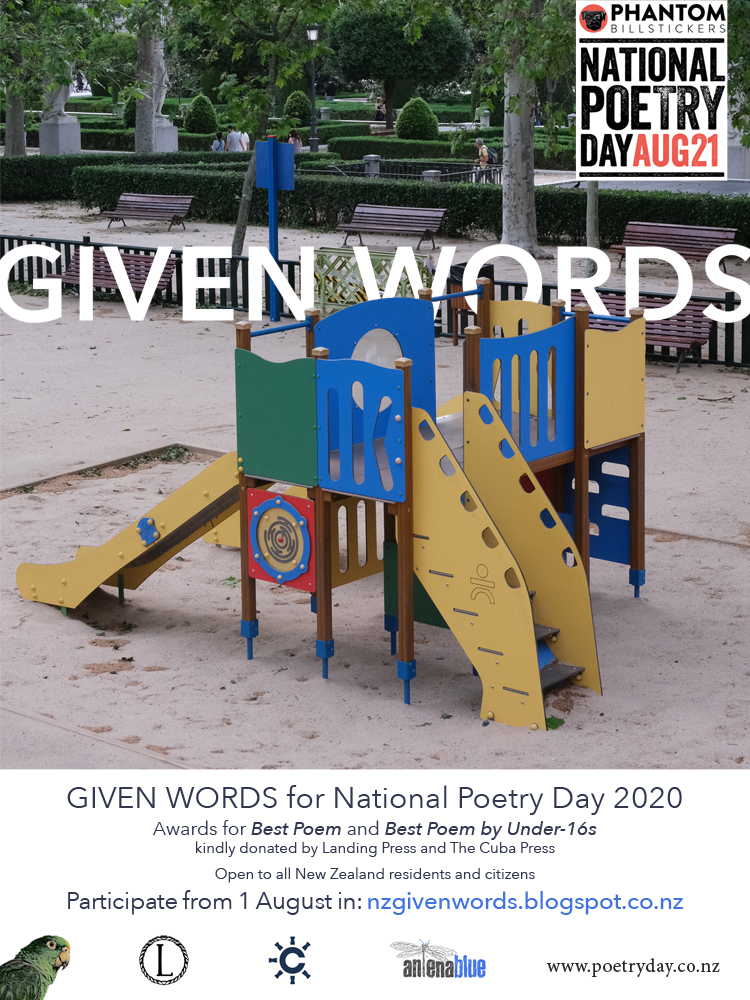
Poetry Shelf noticeboard: Given Poems for National Poetry Day 2020 – the winners

GIVEN WORDS thanks everyone who sent their poem with the five words chosen from Las Moscas (‘Flies’) by the Spanish poet Antonio Machado. They received 144 poems and have made a selection from these to publish here on Given Words. The winning poems have been selected by the poets Mikaela Nyman, Jordan Jace and Charles Olsen. (You can read about them here.)

You can read the judges’ comments here.

GIVEN WORDS is delighted to announce the winning poets. The winner of Best Poem is Stuart Airey for his poem I am a Blue Whale Heart, and the winner of the Under-16 category is Sarah-Kate Simons for her poem Attic. They will receive books courtesy of Landing Press and The Cuba Press respectively as well as being translated into Spanish and published on Palabras Prestadas. More details of the book prizes can be found here. Congratulations from Given Words, Landing Press and The Cuba Press.


Below are the winning poems. You can read the judges’ selection of the rest of the poems from adults here and from under-16s here. All the entries had to contain the words: letter, childhood, fly (the animal), greedy and dream.

I Am a Blue Whale Heart

In this current re-make of me I am becoming the heart of a blue whale
I dreamt myself an angel but this wasn’t enough
He was wondrous but stuck
like a fly in amber

You can hear a whale heartbeat from 2 miles away
which is the distance I want to be from unleavened nurse smiles
and the choice of ensure or tube

No tampering with the drip lines
Friends I am un-distending
I wonder as my zipper finds free air
whether Eve had to eat the whole apple

I liked my angel
counting calories and grams together
his feather vane minutiae

A whale heart aorta is as big as a dinner plate
Why does food have such gravity?

My angel’s face was an open letter
to each whispered treatment
our greedy midnight exercises

A whale heart – blue – is as heavy as a Lion (adult, male)
which is exactly what you need
for beautiful dying

I wish I could take my angel’s place
sleeve my childhood into the wall

When a whale dives deep its heartbeat slows
slows in the black to 2 beats per minute
just 2 beats left to still to marble


Stuart Airey, Hamilton

Attic

all the days of childhood collected in sepia
photographs in the crevices of
the boards watching the greedy dust
descend to settle on their faces

age has curled up their edges into love hearts
like the shape she used to replace the dots on
her i’s; tiny lopsided hearts that flood the pages
of the stack of letters resting in the bottom of
the rickety suitcase, its faded travel stickers

peeling off and flaking away like the nails on fingers
pressed to an anxious mouth and these funny little
dreams of things swirl up like moths from the piles
of outgrown clothing and fill the air with their wing powder
turning the musty scent of forgotten things into a phantom

of lily of the valley; the lid of the harpsichord crammed against
the broken dollhouse is propped open on a sewing box
and in the murk of memories there’s a song tiptoeing up the keys
— or is it just the bluebottle fly scratching its wings
against the windowpane and whining to be set free


Sarah-Kate Simons, age 15, Canterbury

Stuart Airey lives in Hamilton with his wonderful wife and has three children who have mostly left home. He writes poetry as therapy or possibly for more perplexing reasons. He has been a Sarah Broom finalist and was shortlisted for the Julia Darling Memorial Prize. Stuart has been published in the Molotov Cocktail Journal with a short story and third place in the Shadow Poetry Award. These successes have managed to pay for several cups of coffee. He has dabbled in multi-media performance poetry and dreams of being a jazz pianist. His poem entry for given words is an honest attempt to enter the thoughts of those suffering from anorexia as well as being more widely read.

Sarah-Kate Simons is a 15 year old home-schooled girl from rural Canterbury. Her day job consists of schoolwork and volunteering at her local wildlife park, where she gets to walk the llamas. She loves to go on biking and tramping holidays with her family, and tries her hand at all sorts of arts and crafts. She is also the proud owner of a very naughty puppy named Missy.
Sarah-Kate eats, breathes and sleeps writing in all its forms—poetry, flash fiction, short stories and novels. She can often be caught talking to thin air as she tries to figure out time travel for her latest novel or peeking into nooks and crannies in search of her next poem.

Poetry Shelf noticeboard: Boosted campaign for Food Court Bookshop

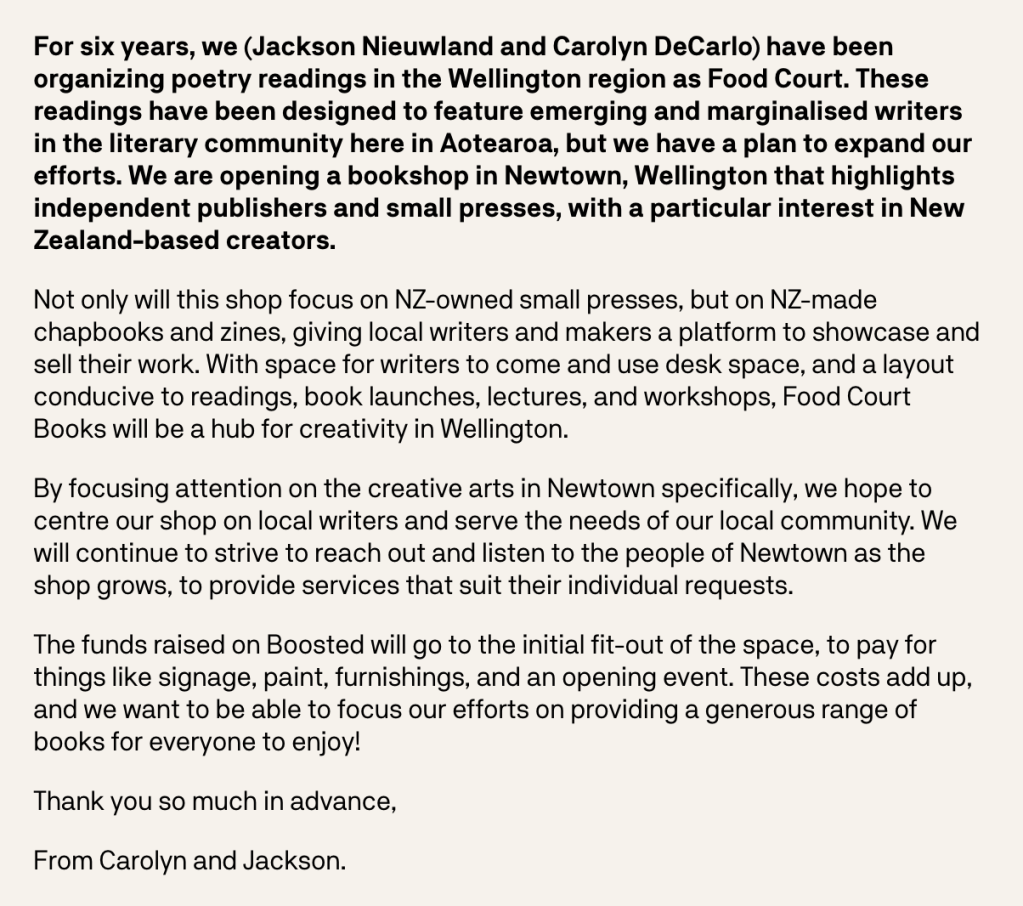
We (Carolyn DeCarlo & Jackson Nieuwland) are opening a bookshop in Wellington that will feature exclusively books by independent publishers and small presses. This is an expansion of our project Food Court, a reading/zine series that we’ve been running for the past six years. Poetry will obviously be a big focus for us at the bookshop!

Go here to contribute

A Poetry Shelf gathering: AUP NEW Poets 7 read and talk poetry

AUP New Poets 7: Rhys Feeney, Ria Masae, Claudia Jardine, ed. Anna Jackson

Auckland University Press, 2020

Anna Jackson, editor of AUP New Poets 7, suggests the collection ‘presents three poets whose work is alert to contemporary anxieties, writing at a time when poetry is taking on an increasingly urgent as well as consolatory role role as it is shared on social media, read to friends and followers, and returned to again in print form’.

I agree. Poetry is an open house for us at the moment, a meeting ground, a comfort, a gift, an embrace. But poetry also holds fast to its ability to challenge, to provoke, to unsettle. In the past months I have read the spikiest of poems and have still found poetry solace.

It feels really important to maintain our poetry hubs – to listen to poets as well spend time with the book in hand. So many new books have missed launches. I haven’t been to a poetry reading since the Wellington Writers and Readers Festival. This is partly why I am compelled to create Friday gatherings so we can connect with poets across Aotearoa.

I am the lucky one. Each of these poets emailed me their readings and I felt I was at an intimate private preview. Just me and the poems, and the heart-moving discussions on poetry, poems and the book itself.

I will review this anthology at a later date, but in the meantime, settle back in a comfy spot and take a listen, and the support the poetry world and buy a copy! I love this gathering so much I am walking on air, boosted out of covid flatness into glorious activity.

Thank you so much Ria, Rhys and Claudia for the mahi, the poetry love. Thank you.

The Poets

Ria Masae talks poetry and the book:

Ria reads poems:

Claudia Jardine reads and talks poetry:

Rhys Feeney reads two poems and talks about the book:

The Poets

Rhys Feeney is a high school teacher, volunteer peer support worker and fledgeling doomsday prepper who lives in Te Whanganui-a-Tara. He writes with terrible grammar about things he is scared of. His work can be found in Starling, Sponge, Salty x Foodcourt, and forthcoming in The Spinoff. You can buy his debut chapbook ‘soyboy’ as part of AUP New Poets 7.

Claudia Jardine (she/her) is a poet and musician based in Te Whanganui-a-Tara. Her most recent publication is AUP New Poets 7 which also contains collections by Ria Masae and Rhys Feeney. In recent months she has completed an MA thesis on intertextuality in Anna Komnene’s Alexiad, and now she is learning to groom dogs. Jardine’s writing can be found in Sport 47, Starling, The Spinoff, Stasis and Landfall 237.

Ria Masae is of Samoan descent, born and raised in Tāmaki Makaurau. She is a writer, poet, and spoken word artist whose work has appeared in various literary publications, as well as a handful of theatre productions. Her family includes an exasperating, but adorable dog who looks like a cow and neighs like a horse. Since her acceptance into the AUP New Poets 7 anthology, Ria has been working on a poetry collection for her first sole anthology.

Auckland University page

Poetry Shelf noticeboard: Warm congratulations to the winner of The National Schools Poetry Award

I am so delighted to see that E Wen Wong from Burnside High School in Christchurch has won the National Schools Poetry Award. I have had poetry communications with E Wen since she first began writing poetry as a child, so this is a very good news indeed. Warm congratulations E Wen – may your days continue to shine with poems and poetry.

You can read E Wen’s poem Catalyst in the Monday poem spot.

Aotearoa’s poets of the future feature in National Schools Poetry Awards


E Wen Wong, a Year 13 student from Burnside High School in Christchurch, has won the 2020 International Institute of Modern Letters (IIML) National Schools Poetry Award.

Her poem titled ‘The house that Saturn built,’ was described by judge Airini Beautrais, as “powerful and beautiful”, “full of surprising language and with a strong sense of place and the interaction between the human built environment and the natural environment”.

E Wen Wong receives a prize of $500 and her school library receives a book grant of $500. She also receives a package of literary prizes provided by Read NZ Te Pou Muramura, Victoria University Press, Sport, Landfall and the New Zealand Society of Authors. As part of the prize, Wong will attend an online poetry masterclass with Airini Beautrais, along with nine other poets shortlisted for their entries.

Director of the IIML at Te Herenga Waka—Victoria University of Wellington Professor Damien Wilkins, says, “Over the years this competition has featured many writers who have gone on to publish widely and have careers in the arts. We view it as one way of encouraging young writers and their teachers to see imaginative writing as legitimate, valued, and important.”

E Wen Wong says, “Receiving this award was unexpected, yet exciting and uplifting. ‘The house that Saturn built’ gave me a platform to channel my passion for the environment in a way that was distinctly positioned in Aotearoa. It allowed me to comment on climate change from a new perspective—to communicate what science cannot.”

There were more than 250 entries this year from senior high school students, with a wide range of styles and subjects represented, including personal events, politics, history, humour, and current events such as the COVID-19 pandemic. Ms Beautrais notes, “I’m impressed at anyone being able to write a poem (or anything at all) during the months of lockdown and accompanying stress. There are poems that give vent to big and terrifying feelings, and poems that take a comical slant.”

Nine students were finalists: Campbell Wilson, Abraham Hix, and Marijke Hinton (all from St Andrew’s College, Christchurch); Arwyn Cranston (Wakatipu High School, Queenstown), Isabella Lane (Rangitoto College, Auckland), Xavier Hayward (Marist College, Auckland), Allegra Wilson (Diocesan School for Girls, Auckland), Robin Kunwar (Burnside High, Christchurch), and Victoria Sun (Epsom Girls’ Grammar, Auckland). Each will receive prizes from Read NZ Te Pou Muramura and Sport, as well as $100 cash.

This was also the first year the Award was able to receive entries in te reo Māori. While there were fewer such entries than the IIML had hoped, Māori language judge Anahera Gildea (Ngāti Tokorehe) was excited about the potential of te reo Māori poetry.

The 2020 National Schools Poetry Award is organised by the IIML with the support of Creative New Zealand and advertising agency Ogilvy (formerly Ogilvy & Mather), with sponsorship and promotional support from Wonderlab.

The winning poem, the complete judges’ report and all the shortlisted poems are available on the National Schools Poetry Award website.

Poetry Shelf poets on poems: Rachel Lockwood on essa may ranapiri’s ‘she cut her face shaving’

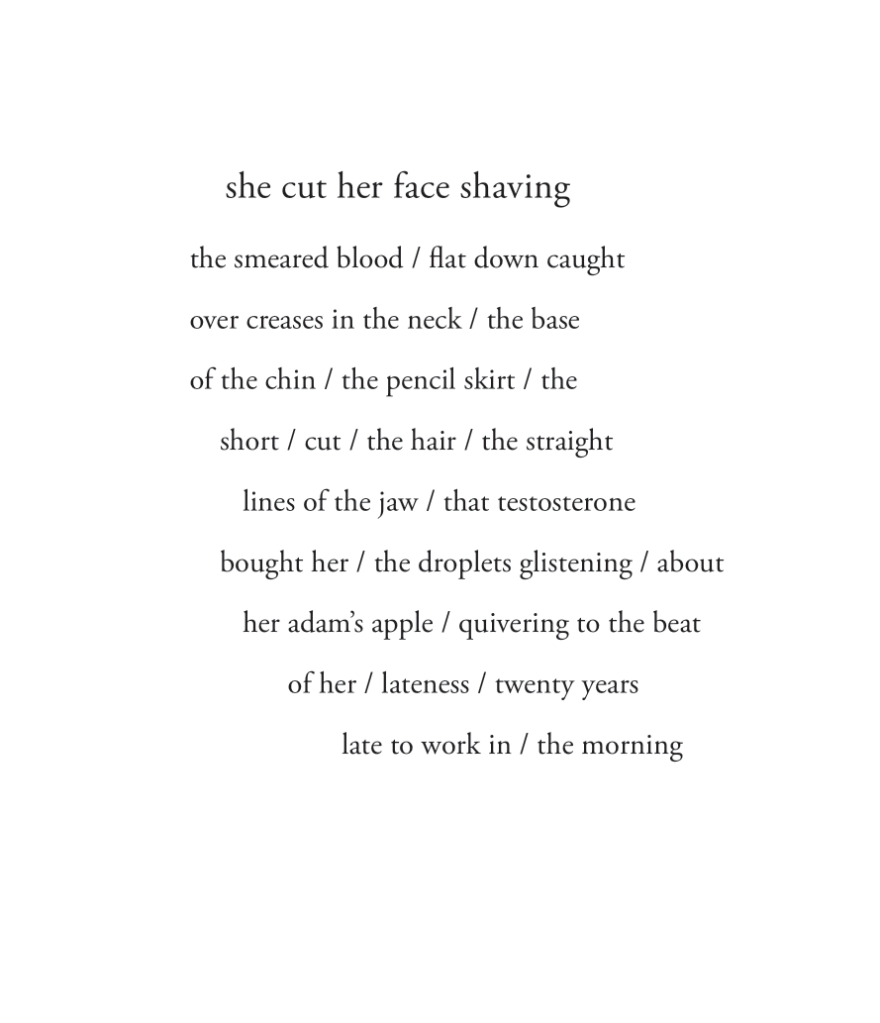
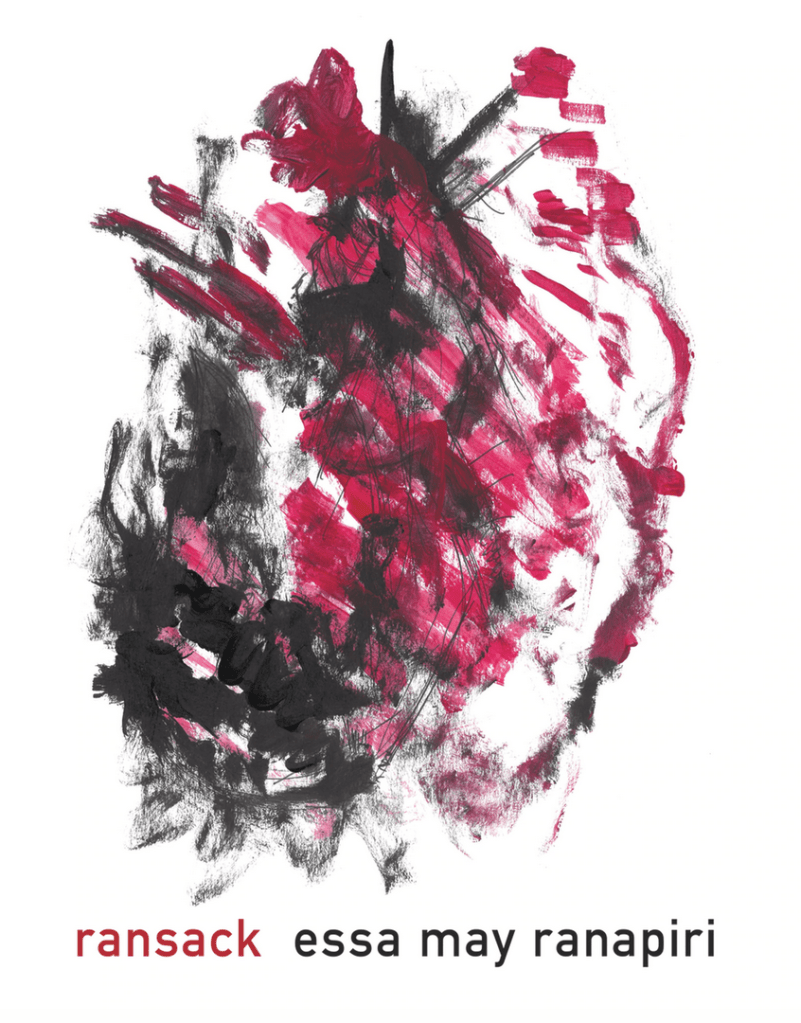
                             ‘She Cut Her Face Shaving’ essa may ranapiri

(from ransack, Victoria University Press, 2019)

essa may ranapiri’s work frequently explores the uncomfortable boundaries that exist in binary gender, and uses form and technique to push readers away from conventional approaches to both gender and poetry.  Everything in their piece ‘she cut her face shaving’ works to push the reader towards a new space, from the vocabulary and imagery to the way the lines are arranged on the page.

The arrangement of the work on the page exemplifies the subtle ways that ranapiri affects the reader. Rather than proceeding straight down the page, ‘she cut her face shaving’ begins to drift right from the second line. The final shape evokes images that reflect those in the poem – the drip of blood, the curve of a neck- but also reflect a preoccupation with resisting convention.  Throughout their collection ransack, words drift and explode across the page in varying arrangements. The visual aspect connects to the subject matter, which centres on ranapiri’s identity as a takatapui and non-binary individual. This poem is a microcosm of an effect found throughout this work- the reader’s eye is physically drawn away from conventional pattern, into a new space and shape that ranapiri has created.

Form and content collide again in the fifth line. Ending this line with the word testosterone is a confirmation of a non-cis experience that is only hinted at the beginning of the poem. Positioned at half-way, this line offers an opportunity to the reader to consider the first section in a new light, and prepares them for the impact of the second section. The deliberate use of pronoun  immediately afterwards reinforces this transitionary moment. The pronoun use is sparing throughout this work, but rich with meaning, drawing connection between ownership and the body. The title itself gives context to the poem, ‘her chin’ positions the reader as an outsider in this situation. Garments and body parts that could be ascribed ownership are not, instead they become ‘the pencil skirt’, ‘the hair’, ‘the jaw’. Ownership appears again in this vital fifth line- ‘that testosterone/ bought her’. After this moment, both the Adam’s apple and the ‘lateness’ become hers again. The pronouns here own this experience, and are unafraid to do so. 

The slash is a dominant feature of this poem, and serves multiple purposes. One that immediately pushes itself forward is the echo, again,  of the ink on the page and the action of the work. Lines that are not broken up by the slash are broken up instead by the line break. Nothing goes on for longer than four words. These short, sharp lines, remind the reader of the pattern of shaving, the short strokes, and in one particularly poignant use – the ‘/cut/’ of hair seems at once to reference the ‘cut’ of the title. Additionally, it breaks the flow of the reader. There appears to be no particular rhythm to the slashes or line breaks, simply a disruption. The disruption to the face by the cut, perhaps, or the disruption to the presumed reader represented by a non-binary figure.

Another strong use of the slash is the way it abstracts the body. Every part of the body, down to the clothes being worn, have their own line. Here the body is represented not as a whole, but as separate pieces. The reader is invited to consider the way we read these pieces as masculine or feminine within the context of the poem and its title. The limited pronoun use works in conjunction with this, separating the pieces not only from each other, but also from a singular ownership of this body. Once this space between body and self is established, ranapiri jams the masculine and feminine together, setting the reader off balance. Gender has remained ambiguous before this moment, and could be intentionally misread to provide a more cis-normative view. ranapiri quashes this in the seventh line, bringing that all important ‘her adam’s apple’ into play. Immediately the subject of the poem comes into view, shedding new light on to the readers experience, and preparing us for the final two lines.

What all of these techniques have in common are the spaces both literal and figurative in the story. ranapiri seems to be again referencing the final part of their work. What is missed out, what we are ‘late’ to, preoccupies this poem, haunting every line and every sparing word. ranapiri creates in this work a space where identity can be celebrated and mourned in the same breath, the past and present as well as hopes for the future tumbled up together.

Rachel Lockwood

Rachel Lockwood is Hawke’s Bay born and bred but now living in Wellington and studying a BA at VUW. She was a 2019 National Schools Poetry Award finalist, and has previously been published in Starling.

You can hear Rachel read her poem in Starling 10 here

essa may ranapiri (Ngāti Raukawa/Tainui/Ngāti Takatāpui/Clan Gunn/Highgate) is a person or some shit / or whatever / they wrote a book of poems called ransack / it’s still in th world / the only time they use they/them pronouns for themselves is in these bios / isn’t that funny / thx goes out to their ancestors / who are as big as everything / just wow / just everything / they will write until they’re dead

Monday Poem: You can read essa’s poem ‘when i was born i didn’t say anything’ here

Poetry Shelf podcast: Erena Shingade interviews Murray Edmond

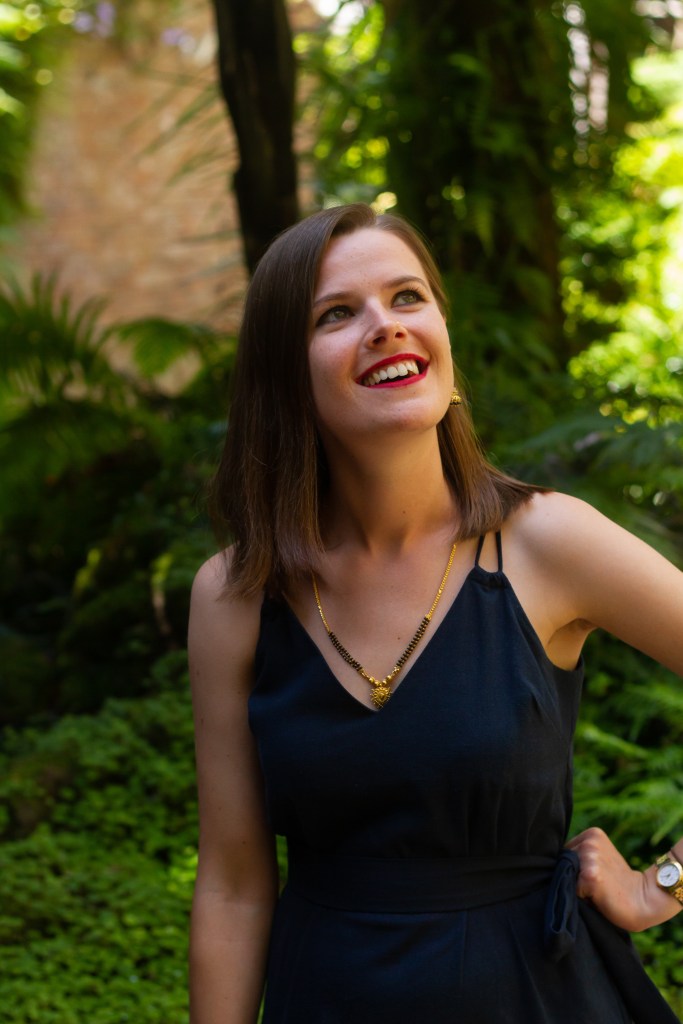
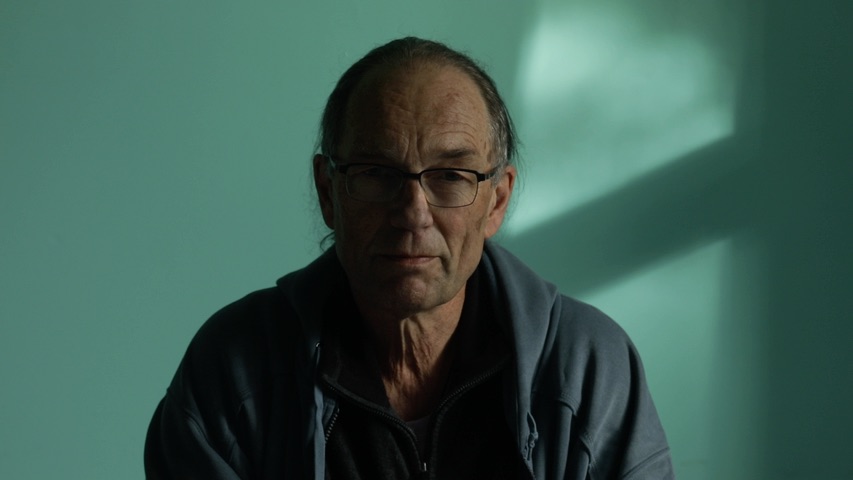
Photos credits: Bala Murali Shingade and Joanna Forsberg

Erena Shingade in conversation with Murray Edmond — the podcast-style interview is about 1 hour long and takes Murray’s unpublished memoir as the base from which to cover some big-picture questions about him and his creative practice.

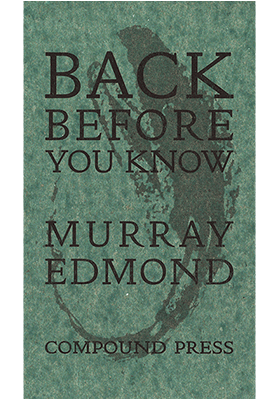
Murray Edmond: Born Kirikiriroa 1949, lives in Glen Eden, Auckland. Poet (14 books, Shaggy Magpie Songs, 2015, Back Before You Know, 2019); critic (Then It Was Now Again: Selected Critical Writing, 2014); fiction-writer (Strait Men and Other Tales, 2015); editor, Ka Mate Ka Ora; dramaturge for Indian Ink Theatre. Forthcoming: from Indian Ink, Paradise or the Impermanence of Ice Cream, Q Theatre, October 2020. Ka Mate Ka Ora #18, October 2020. Time to Make a Song and Dance: Cultural Revolt in Auckland in the 1960s, from Atuanui Press in 2021.

Erena Shingade writes poetry and essays from Tāmaki Makaurau. Her most recent long form project contemplates neoliberal workplace psychology and the promise of spiritual salvation offered through self-help literature. Previously she completed an MA thesis on the Zen Buddhist poetry of Richard von Sturmer, whose practice confronts language at the moment of perception. Erena’s writing can be found on platforms such as The Spinoff, Art + Australia, Landfall, Mimicry, Blackmail Press, Atlanta Review, Ka Mate Ka Ora, and the New Zealand Electronic Poetry Centre. During the day she works as a publicist for Allen & Unwin book publishers.

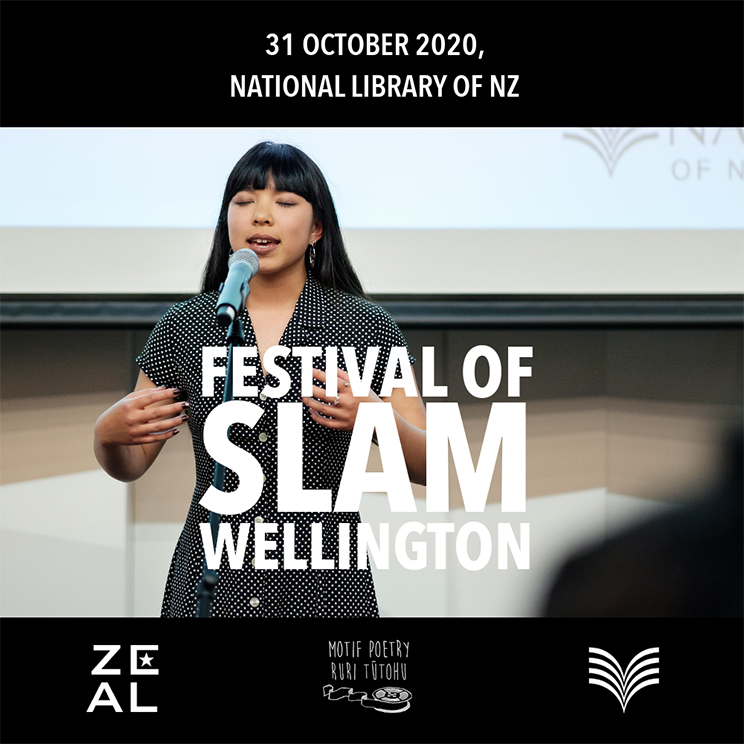
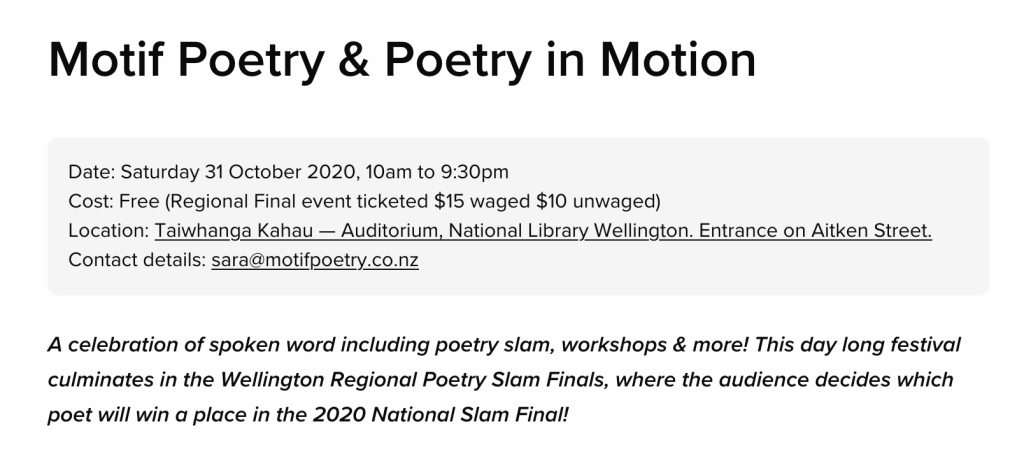
Poetry Shelf noticeboard: Wellington Festival of Slam

Poetry alive and kicking in the capital

Sold out events, packed open mics and searing hot verse screams out that poetry is alive and kicking in the capital.

The winners will get the chance to compete for the title of New Zealand Slam Champ!

Be quick, this event always sells out!

Come prepared for a CASH ONLY bar.

Part of the Festival of Slam Wellington. A handful of spoken word and poetry groups in Wellington have banded together to create a day of poetry facilitation, workshops and events.

More details at Motif Poetry website

The National Library is fully wheelchair accessible. Download an accessibility map for the venue.

Check before you come

Due to COVID-19 some of our events can be cancelled or postponed at very short notice. Please check the website for updated information about individual events before you come.

For more general information about National Library services and exhibitions have look at our COVID-19 page.