Poetry Shelf noticeboard: MUP virtual launch of High Wire by Lloyd Jones and Euan Macleod.


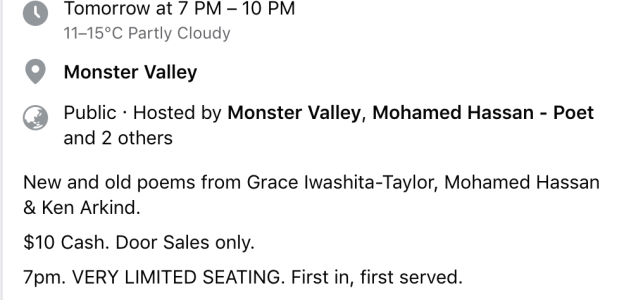
Screen Shot 2020-05-13 at 11.44.21 AM


From Massey University Press:

We are very excited to bring you the virtual launch of High Wire by Lloyd Jones and Euan Macleod.

Tune in here at 6.30pm tomorrow, Wednesday 13 May, to watch the proceedings. A big thanks to Paula Green from New Zealand Poetry Shelf for helping us to celebrate this exquisite new book.


Poetry Shelf connections: two poems from Eliana Gray


Regent’s Canal


We push a trolley

Into the canal

Just to watch it sink

Slowly, then all at once

Like they talk about love:

Swallowed, completely

Clear toxic liquid

Opaque


Both the nature of desires

And love, yes, love is viscous

Festooned with trash

Bumping up by the locks

In the waterway

Single use plastics

Brushing hands with

Twist ties, bloated crusts and


Isn’t it interesting?

How we’ll steal something

Just to break its purpose

Hoarding mentality

But sideways, emotional


The thrill of a sharpened crayon

The compulsion for bluntness

For rubbing, hard

On a perfect ending


Are we trying to make ourselves soft?

Trying to fit

The world to our curvature?

Action’s nothing more than a

Mechanism of coping


And what does that say about Romance, hmmm?


Supermarket nightwork:

Pigeons looking fat and sensuous

Moonlit tension

Pilfered fizz and roses

Stolen, from a discarded bench

In Victoria Park


Push me dangerously

Close to the water

Make me believe

You’ll tip me in


We’ll laugh a little too

Tight, too high, too fast

Like, of course we know

You don’t mean to hurt me

But the back wheel

Has always been faulty

(as stolen trolleys tend to be)

Seems like it’s locking

Skidding, sideways, again


What if it flies out of your hands?

What if it just . . .  keeps skidding

And my feet, stuck under

Crossed legs, my scarf, my

Jacket too bulky for sudden moves


What if I try to jump

And it just . . . .  tips?

Crack my head against the metal

Concrete, what if the wheels

Are already over the edge?

My centre of gravity not heavy enough


What if it teeters, expectantly

On the edge of the canal

And you’ve finally decided

To reach your hand to steady

But your balance is off and

You push


How long would you stand?

Watching. My head, my

Hands, beneath the water

Viscous fill my lungs

Swallow me like the trolley


All I want is to be absolutely perfect forever


I want to live like an ornamental apple

Protected from consumption

Slick plastic blush red perfect

Looking so delicious

Resting, in a crystal bowl


Beautiful and

An irresponsible use of plastic

Something that could be art but isn’t

And not in the sense that ‘everything is art’

Because it isn’t


A perfectly useless representation

of something so cliche

It feels almost overwhelming


A stand in for temptation

with no intention or ability

To be so desirous


No perfumed smell

no golden hanging from the garden

no pollination no rotting no flies


Is it still stasis

if you’ve reached your final destination?

And how long exactly

Is a sense of finality satisfying?


Anticipation and anxiety are a Venn diagram

with approximately one circle

The only way to soothe them

is to complete the task


I want to live like an ornamental apple

Slick red plastic constant state of blush perfect

The promise of forever

A lifetime sabbatical

Researching absolutely nothing


Eliana Gray


Eliana Gray is a poet from Ōtepoti, Aotearoa. They like queer subtext in teen comedies and not much else. They have had words in: SPORT, Mimicry, Minarets, Mayhem and others. Their debut collection, Eager to Break, was published by Girls On Key Press (2019) and in 2020 they will be both a writer in residence at Villa Sarkia, Finland and Artist in Residence at St Hilda’s Collegiate, Ōtepoti.


Poetry Shelf congratulates the Ockham NZ Book Award winners – and showcases the poetry

d590ea43-fe25-4bb4-a1b5-a785e5cb0b66.jpg


Warm congratulations to all winners! This is a year where well-deserving and much-loved books have taken the winning spots – each book is worthy of a place on our book shelves.

I look at this list (and indeed the shortlists) and it reminds me that NZ literature is in good heart. These are heart books. These are books born from love and labour, by both inspired and inspiring authors and publishers.

The Award’s poetry section  was a drawcard for me. I loved each shortlisted finalist so much, but I leapt for joy at the kitchen table to see Jane Arthur win Best First Book and Helen Rickerby win Best Book.

Yes, some extraordinary books did not make the longlists let alone the shortlists – but this is time to celebrate our winners.

I toast you all with bubbles and bouquets and can’t wait to see what you write next.

Right now we need to support our NZ book communities, so I strongly advocate putting an Ockham winner in our pile, the next time we visit our local booksellers.

In these strange Covid times my email box has has never been so full of poems – we’re making sour dough and we’re writing poetry, and it has been such a connecting comfort.

Long may we cherish poetry in Aotearoa.


My toast to the Poetry Winners:


screen-shot-2020-02-11-at-8.45.03-am.png


Craven, Jane Arthur, Victoria University Press, 2019 Best First Poetry Book


I have a broth at a simmer on the stove.

Salty water like I’ve scooped up some ocean

and am cooking it in my home. Here,

gulp it back like a whale sieving plankton.

Anything can be a weapon if you

swallow hard enough:

nail scissors, a butter knife, dental floss,

a kindergarten guillotine, hot soup,

waves, whales.

from ‘Circles of Lassitude’


Jane Arthur’s debut collection Craven inhabits moments until they shine – brilliantly, surprisingly, refractingly, bitingly. Present-tense poetry is somewhat addictive. With her free floating pronouns (I, you, we) poetry becomes a way of being, of inhabiting the moment, as you either reader or poet, from shifting points of view.

It is not surprising it has won Best First Book at 2020 the Ockham New Zealand Book Awards.

The collection title references lack of courage, but it is as though Jane’s debut collection steps across a line into poetic forms of grit. This is a book of unabashed feeling; of showing the underseam, the awkward stitching, the rips and tears. Of daring to expose. The poems are always travelling and I delight in every surprising step. You move from taxidermy to piano lessons to heart checks and heart beats, but there is always a core of exposed self. And that moves me. You shift from a thing such as a plastic rose to Brad Pitt to parental quarrels. One poem speaks from the point of view of a ship’s figurehead, another from that of Constance. There is anxiety – there are dilemmas and epiphanies. The poetic movement is honeyed, fluid, divinely crafted – no matter where the subject travels, no matter the anxious veins, the tough knots.

An early poem, ‘Idiots’, is like an ode to life, to ways of being. I keep crossing between the title and the poem, the spare arrival of words punctuated by ample white space, elongated silent beats that fill with the links between brokenness, strength and pressing on.


Idiots

I’ve known people who decided

to carry their brokenness like strength

idiots

I’m a tree

I mean I’m tall, I sway

I don’t say, treat me gently

No¾I say, cool cool cool cool

I say, that really sucks but I guess I’ll survive it

or, that wind’s really strong

but so are my roots, so are my thighs

my branches my lungs my leaves my capacity to wait things out

I can get up in the morning

I do things


I heard Jane read for the first time at the Sarah Broom Poetry Prize session at the Auckland Writers Festival in 2018. Her reading blew my socks off, just as her poems had delighted American judge, Eileen Myles, and it was with great pleasure I announced her as the winner. Eileen described Jane’s poetry: ‘poetry’s a connection to everything which I felt in all these [shortlisted] poets but in this final winning one the most. There’s an unperturbed confident “real” here.’ In her report, Eileen wrote:

The poet shocked me. I was thrust into their work right away and it evoked the very situation of the poem and the cold suddenness of the clinical encounter, the matter of fact weirdness of being female though so many in the world are us. And still we are a ‘peculiarity’ here and this poet manages to instantly say that in poetry. They more than caught me. I like exactly how they do this – shifting from body to macro, celestial, clinical, and maybe even speaking a little out of an official history. She seems to me a poet of scale and embodiment. Her moves are clean and well-choreographed & delivers each poem’s end & abruptly and deeply I think. There’s a from the hip authority that inhabits each and all of these poems.

I am revisiting these words in view of Craven’s multiple poetry thrills. So often we talk about the way a poem steps off from the ordinary and blasts your heart and senses, if not your mind, with such a gust of freshness everything becomes out of the ordinary. This is what happens with Craven. A sense of verve and outspokenness is both intoxicating and necessary:


I’m entertaining the idea of never being silent again,

of walking into a room and shouting, You Fuckers Better Toe the Line

like a prophylactic.

from ‘Sit Down’


A sense of brittleness, vulnerability and self-testing is equally present:

I’ve been preoccupied with what others think again.

I’ve been trying not to let people down.

Nights are not long enough.

Lately there’s been more sun than I would’ve expected.

I keep the weather report open in its own tab and check it often.


From ‘Situation’

The movement between edge and smooth sailing, between light and dark, puzzle and resolution, and all shades within any dichotomy you might spot – enhances the reading experience. This is a book to treasure – its complexities and its economies, its confession and its reserve. It never fails to surprise. I am delighted Jane read as part of my Poetry Shelf Live session at Wellington’s Writers Festival in March. It was a divine reading.


Victoria University Press page

Poetry Shelf Monday poem: ‘Situation’ by Jane Arthur

Poetry Shelf audio spot: Jane Arthur reads ‘Snowglobe’

Poetry Shelf: Conversation with Sarah Broom Prize finalist, Jane Arthur


Rickerby_How_to_Live__14837.1564361874.jpg


How to Live, Helen Rickerby, Auckland University Press, 2019 Best Poetry Book


Helen reads ‘How to live through this’


When that philosopher said life must be lived forwards

but can only be understood backwards

he was not thinking of me

I have lived all kinds of lives

from ‘A pillow book’

Helen Rickerby’s latest poetry collection How to Live is a joy to read. She brings her title question to the lives of women, in shifting forms and across diverse lengths, with both wit and acumen. Like many contemporary poets she is cracking open poetic forms – widening what a poem can do – as though taking a cue from art and its ability both to make art from anything and in any way imaginable.

Reading this book invigorates me. Two longer poems are particularly magnetic: ‘Notes on the unsilent woman’ and ‘George Eliot: a life’. Both function as fascination assemblages. They allow the reader to absorb lyrical phrases, humour, biography, autobiography, insistent questions. Biography is enlivened by such an approach, as is poetry.


6.   It seems to me that poetry usually begins with the self

and works its way outwards; and the essay, perhaps, starts

outwards and works its way in towards the self.

from ‘Notes on the unsilent woman’


Thinking of the silent woman I am reminded of Aristotle’s crown of silence that he placed upon she. I then move across centuries to Leilani Tamu’s poem ‘Mouths Wide Shut’ where she sits on a bus with her mouth taped shut silent. The skin-spiking poem (and the protest) considers silence in the face of racism. Even now, even after the women’s movements of the 1970s and the explosion of feminism and feminisms over ensuing decades, men still talk over women, still dismiss the women speaking (take women in power for example, or a young woman at the UN challenging climate-change inertia).

What Helen does is remind us is that silence is like snow – it is multi-hued and deserves multiple names and nuances: ‘Silence isn’t always not speaking. Silence is sometimes / an erasure.’

Ah the stab in my skin when I read these lines. In ‘Notes on the unsilent woman’ Helen draws me in close, closer and then even closer to Hipparchia of Maroneia (c 350 – c 280 BC).

5.    But I do have something to say. I want to say that she

lived. I want to say that she lived, and she spoke and she

was not silent.


Helen gathers 58 distinctive points in this poem to shatter the silence. Sometimes we arrive at a list of women who have been both audible and visible in history, but who may have equally  been misheard, misread and dampened down. At other times the poet steps into view so we are aware of her writing presence as she records and edits and makes audible. In one breath the poet is philosopher: ‘Silence might not be speaking. It might be / listening. It can be hard to tell the difference.’ In another breath she apologies for taking so long to bring Hipparchia into the picture.

Elsewhere there is an ancient warning: ‘”If a woman speaks out of turn her teeth will be / smashed with a burnt brick.” Sumerian law, c. 2400 BC.’

A single line resonates with possibilities and the ‘we’ is a fertile gape/gap/breathing space: a collective of women, the poet and her friends, the women from the past, the poet and I: ‘There are things we didn’t think we could tell.’ Yes there are things we didn’t think we could tell but then, but then, we changed the pattern and the how was as important as the what.

Another single line again resonates with possibilities for me; it could be personal, it could equally be found poetry: ‘I would like to be able to say that  it was patriarchy that stopped me talking on social media, but it wasn’t, not / directly.’

I read ‘Notes on the unsilent woman’ as a poem. I read this as an essay. I am tempted to carry on with my own set of bullet points as though Helen has issued an open invitation for the ‘we’ to speak. Me. You. They. She quotes Susan Sontag: ‘The most potent elements in a work of art are, often, its silences.’


The other poem I dearly love, ‘George Eliot: a life’, is also long form. Like the previous poem this appears as a sequence of numbered sections that are in turn numbered in smaller pieces. It is like I am reading a poem and then an essay and then a set of footnotes. An assemblage of fascinations. Biography as fascination allows room for anything to arrive, in which gaps are curious hooks, reflective breathing spaces and in which the personal is as compelling as the archives. Helen names her poem ‘A deconstructed biography’ and I am reminded of  fine-dining plates that offer deconstructed classics. You get a platter of tastes that your tongue then collates on the tongue.

To taste ‘George Eliot: a life’ in pieces is to allow room for reading taste buds to pop and salivate and move. This is the kind of poem you linger over because the morsels are as piquant as the breathing spaces. It delivers a prismatic portrait of George Eliot but it also refreshes how we assemble a biography and how we shape a poem. Helen brings her acerbic wit into play.


10.7.1.  But the fact is, and I don’t want to give you spoilers, that for such an

extraordinary woman she sure did create some disappointing female

characters. Even the heroines don’t strike out – they give up, they stop,

they enclose themselves in family, they stand behind, they cease, they  die.

They found nothing.

10.7.2.   Did she think she was too exceptional to be used as a model for her

characters? Did she think that while she was good enough to be involved

in intellectual life, and she could probably even be trusted to vote, the same

could not be said for her inferior sisters?


A number of smaller poems sit alongside the two longer ones including the moving ‘How to live though this’, a poem that reacts to an unstated ‘this’. ‘This’ could be anything but for me the poem reads like a morning mantra that you might whisper in the thick of tough times or alongside illness or the possibility of death.

‘How to live’ is a question equally open to interpretation as it ripples through the poems; and it makes poetry a significant part of the myriad answers. I haven’t read a book quite like this and I love that. The writing is lucid, uplifting, provocative, revealing, acidic, groundbreaking. The subject matter offers breadth and depth, illuminations, little anchors, liberations, shadows. I am all the better for having read this book. I just love it.


I slept my way into silence

through the afternoon, after days

of too many words and not enough words

to make the map she needs

to find her way from here

I wake, too late, with a headache

and she, in the garden wakes up shivering

from ‘Navigating by the stars’


Auckland University Press author page

Helen‘s ‘Mr Anderson, you heartbreaker you’

Helen on Standing Room Only


Poetry Shelf connections: Hana Pera Aoake reads ‘My heart swings like poi’


IMG_5934.jpeg


This is an audio recording of Hana Pera Aoake reading a poem they wrote called, ‘My heart swings like poi’, which they wrote for Te Rito o te Harakeke, which was a journal they co-edited with essa may ranapiri, Sinead Overbyne and Michelle Rahurahu Scott for Ihumaatao.

They have been very busy with the first issue of Tupuranga which has just launched.


Hana Pera Aoake (Ngaati Raukawa, Ngaati Mahuta, Tainui/Waikato) is an INFP, Gemini heartthrob living on Kai Tahu land in Te wai pounamu. They are a writer, editor and artist in a stupid amount of debt (Liv, Laff, Luv), having completed an MFA in Fine Arts (first class) in 2018 from Massey University. They are a current participant in the Independent study program at the Maumaus des escola artes via a screen and an editor at both Tupuranga journal and Kei te pai press.


Poetry Shelf connections: 2 poems by Joan Fleming


Meditation on relative suffering

            5 April, Madrid


Many terrible things in life happen quietly and without spectacle.

The times I am penned inside my own skin are a one that feels like a seven

and it makes me loud.


I pull down a book and find a strand of hair that cannot be mine.

I stroke it the wrong way to make it squeak

like an animal.


Now the windows are open and I smell a fire I want to be next to.


They say that after great pain, you find you can speak well,

but I have been speaking badly and feel about it all

as helpless as childhood.


Everything is flowering and the wild boars run in the street,

expecting someone.


Via Negativa

1 April, Madrid


In the day book, several nothings have made a space as slow as the city.

I toe the bottle to the table’s far side, this stops me reaching for it.

Mornings are good, don’t you find? And evenings sometimes terrible.


We ought to be flooded with green, turned out onto a slope

held down with roots and crowns, zesty with rot, the seasons

breaking into food, the air mad with bees and matter.


Instead, there are streaks on the glass

only where the left-side body was responsible.

We meet in bed, stroke each other’s skin as if we possessed it.


Joan Fleming


Joan Fleming is the author of two collections of poetry, The Same as Yes and Failed Love Poems, both from Victoria University Press, and the chapbook Two Dreams in Which Things Are Taken (Duets). Her new collection Dirt is forthcoming with Cordite Books. She holds a PhD in ethnopoetics from Monash University, Melbourne, and is the New Zealand/Aotearoa Commissioning Editor for Cordite Poetry Review. She currently lives in Madrid, and in 2020 she will travel to Honduras for the Our Little Roses Poetry Teaching Fellowship.


Poetry Shelf Monday Poem: two poems from Shari Kocher


from Gathering in the Underworld


Monday 13 April (Prompted by Sharon Olds’ ‘Making Love in Winter’, using the nouns: skin, blooms, transom, ovaries, questions; the verbs: is, flying, touch, burns, casts; and the adjectives: loose, dark, motionless – last noun is the title of the response poem)


Questions


At birth, the bird flew high and white

and motionless, the eye of the storm not yet

arrived but drawing nearer, the bird

loose in its orb of stillness branching

its wings in the hospital hallway between

the lights going out and the generator

roughly clanking the lights back on, in that

moment of cyclonic noise subsiding, the veil

your mother reached down to touch

between the legs they had raised in stirrups

slid warm, unbroken, and when

she, frightened, drew you to her, only a

makeshift curtain pulled partially

around the trolley on which they had

parked her, alone and shaved, one among

many, young, untaught, she felt

before she saw, like glistening gladwrap,

the bag you came in, and she held you in it,

horrified, in awe, believing in that moment before

the light flooded you with ultraviolet,

that you were gone from her, or dead, or worse,

a creature from another universe, which was

partly true and partly all she could feel through

in that overrun, clamorous place, but then you

reached your curled fist palm-upwards,

and kicked to break that sticky breach of trust

and rushed her skin, which bloomed

beneath you, and in that transom,

your tiny ovaries quickened like stardust

and she saw in your unblinking eyes

not the surprise of the unseen bird

like a torn sail above her, but something pass

wingshadowed through your widened

pupils, and she pitied the mewl you made

and brought herself to love you.


Monday 20 April: Prompt: What repels me? Working from a list of things you dislike intensely – the question of beauty propelled by repulsion inevitably confronts the abject.


Have you got your Action plan ready?

Mould on the windows, all the cooking books

smoked in grease and arsenic. Spores

on Jamie Oliver. Dust so thick it lives

to garnish spaghetti spliced with stink

bugs suppurating the porous ground.

Where once a kind of onion grew, indelible

Rorschach blots bubble through the possum wee

cooking pot, whole towns drowned in porridge

or was it asparagus, for lack of a word?

Maggots at work among the tulips,

like actors planting light bulbs under

centrelink office desks flashing on and off

up-side-down. Nothing weird

about the underworld in Australia.

Give me a worm with a moustache any day,

or a shrieking bat drunk on Tequila.

Ah, do not go gently, my foul

friend, the good old days when vampires

chilled out with retro cooking shows

and grinned friskily at the rule

against garlic in Hades. Renovations

the Addams family could be proud of.

No queues at Sgninnub in Hades, the

sausage sizzle still available with all

the extras, don’t ask questions,

blinking strictly prohibited though

you can shake whatever comes to hand.

Handles, however, are in short supply.

Tomato sauce, sulphur and sinew completely

out of stock. When registering for real estate

in Hades, have your password ready

and your myVogID portal set up

to activate your deathrate with the

myVogAp to track your whereabouts.

All viral carriers welcome, we want you to

socially include yourselves before we press

Incinerate. No, Ruby Princess, you stay

exactly where you are, you beautiful

infernal dream boat, all your working

slaves captured on camera in their glorious

two-by-two styrofoam cells, no Styx©

necessary, no coin discharged. Here’s a

plastic bag, easy enough, just hyper-

ventilate: we’ll take care of everything

at the Swiss hotel or at the marble gate.


Shari Kocher


Dr. Shari Kocher is a poet, creative writer, therapist and independent scholar whose work has been featured in literary journals in Australia and elsewhere spanning twenty-five years. These include Australian Poetry Journal, Best Australian Poems 2013 & 2016, Blue Dog, Cordite, Going Down Swinging, Meanjin, Plumwood Mountain Journal, Southerly, Overland, and Westerly, among others. She is the author of The Non-Sequitur of Snow (Puncher & Wattmann 2015) which was Highly Commended in the 2015 Anne Elder Awards (Australia). Recent awards include The Peter Steele Poetry Prize (2020), The Venie Holmgren Environmental Poetry Award (2018), The University of Canberra Health Poetry Prize (2016) and second, third and shortlisted placements in the prestigious Newcastle Poetry Prize (2017, 2015, 2020). Her forthcoming books Foxstruck and Other Collisions (Puncher & Wattmann 2020) and Sonqoqui: a verse novel in translation (El Taller Blanco Ediciones) are due out soon. Kocher holds MA and Doctorate degrees from Melbourne University, where she sometimes works as a sessional teaching associate and postgraduate supervisor in the School of Culture and Communications.


Paula: Shari Kocher and Joan Fleming have occasionally followed daily poetry prompts as part of a Madrid writers’ group that was doing ‘a poem a day’ for Poetry Month. It inspired me to gather together some local poetry prompts that I will post on Wednesday May 13th.


Poetry Shelf connections: my Level 3 Mother’s Day poem


Little thistles


The bad thoughts will arrive

little thistles that cling

But I move them on

Yes, I am digging a hole

in the garden

for little thistles

with that stormy wind whining


And I am worrying about Level 3

and the people who are hungry

and the people who are sick

and still I can’t sleep


Tomorrow is Mother’s Day

and I’m making a daisy chain

of mother daughter memories


The time we read books together

or saw the Giant’s Causeway

or ate New York bagels

The times we hugged and

the times we will hug

again soon


Today I am lifting

my head above

the Covid clouds like a little

periscope a stretching

swan’s neck


to see how the world

will be


Paula Green


Originally published in the Herald‘s Canvas magazine (9.5.20). The last line was left off by mistake which made the future even more uncertain. You get a little jolt at the end of the poem in the paper version and that is quite cool! I am very grateful the paper has published a suite of my lockdown poems over the past four weeks.

Today, I sending Jacinda a virtual bouquet of flowers, because I am so proud and inspired by the way she is reshaping the way nations can be led.


IMG_5561


Poetry Shelf connections: Michelle Elvy’s ‘Kia ora’


Kia ora

for my mother


I remember the brooch you always wore

I remember it most of all

tiny fragments, blue dust

glinting on your breast

my hand reaching to touch


I recall the call of the song sparrow

I recall it most vividly of all

the squeech-squeech-trill

moving through sunlight

stopping on our sill


I can see the maple in our yard

I can see it best of all

its smooth  grey skin

planted in thin slanting soil

a young towering thing


Or was it a pendant?

A warbler? A white oak?

My memories, round

and flawed, you

across oceans and continents


It’s autumn in Dunedin

sunrise, cool and misty

glowing

the brooch            the pendant

the sparrow          the warbler

the maple              the oak


Michelle Elvy


Michelle Elvy is a writer, editor and manuscript assessor. She grew up in the Chesapeake Bay region of the US and now makes her home in Dunedin. She edits at Flash Frontier: An Adventure in Short Fiction and Best Small Fictions, and she chairs National Flash Fiction Day. Recent anthology projects include Bonsai: Best small stories from Aotearoa New Zealand (CUP 2018) and Ko Aotearoa Tātou | We Are New Zealand (OUP 2020). Michelle’s poetry, fiction, travel writing, creative nonfiction and reviews have been widely published. Her book, the everrumble (Ad Hoc Fiction 2019), is a small novel in small forms. michelleelvy.com


Poetry Shelf connections: two poems from Nicola Easthope


Unessential kiss


I thought we’d meet in Island Bay

on a park bench facing the sea.

Well, you two on it, in your safe bubble

with us three standing, two metres away.


There’d be coffee poured from the flask

steaming against the strait’s new ice

and muffins with feijoa’s soap-sweet grit.

We’d inhale the aroma, lift our masks.


In lock down, I can’t mistakenly slip

on the mussel-kelp-anemone rock

and the soft creased surface of your cheeks

cannot be surprised by my bursting lips.


Numb and Absurd have morning

love children

and there is small relief.


Boris has gone to hospital.

Donald is lost, will lose.

Scotland’s chief medical officer,


Catherine and our Health Minister, David

have apologised for breaking

their own rules. The Queen, Elizabeth


calls for stoicism and self-discipline.

The iwi from Uawa are dancing

on the checkpoint line, in rainbow chiffon


wings, totally winning.

Craig from Solly’s lorries says all loos

are closed on his route from Mataura


to Ashburton but he makes it in time

yet the journo presses him – just take us

through this – what did this feel like?


I am looking in the mirror at the small

purulent pimple on my chin

wondering why on earth at my age?


I am thinking of people with nothing

in the fridge and no safe haven.

I am loading the dishwasher too unlovingly


and chip the willow-green bowl my mother

made at a pottery nightclass way back

when all we ever caught off each other


were colds, mumps, chickenpox, headlice

and it was wickedly easy

to make ourselves burp, or cry.


Nicola Easthope


Nicola Easthope (Pākehā, tangata Tiriti) is a teacher, poet and cheerleader for teen activism, from the Kāpiti Coast. Her two collections are leaving my arms free to fly around you (Steele Roberts, 2011) and Working the tang (The Cuba Press, 2018), and individual poems have been published in Aotearoa, Australia, Scotland and the U.S. She was a guest of the Queensland Poetry Festival in 2012, the Tasmanian Poetry Festival in 2018, and a couple of very cool LitCrawl seasons in Pōneke. You can find more of her work on gannet ink


Poetry Shelf connections: Lynn Davidson reads ‘For My Parents’

LynnD_June_2017_016_13Jun17_Web-2.jpg


Lynn Davidson is a New Zealand writer living in Edinburgh. Her latest poetry collection Islander is published by Shearsman Books in the UK and Victoria University Press in New Zealand. She had a Hawthornden Fellowship in 2013 and a Bothy Project Residency at Inshriach Bothy in the Cairngorms in 2016. Lynn has a doctorate in creative writing, teaches creative writing, and is a member of 12, an Edinburgh-based feminist poetry collective.  Website