Category Archives: Uncategorized

Poetry Shelf Occasional Reviews: Jordan Hamel’s ‘Everyone is Everyone Except You’

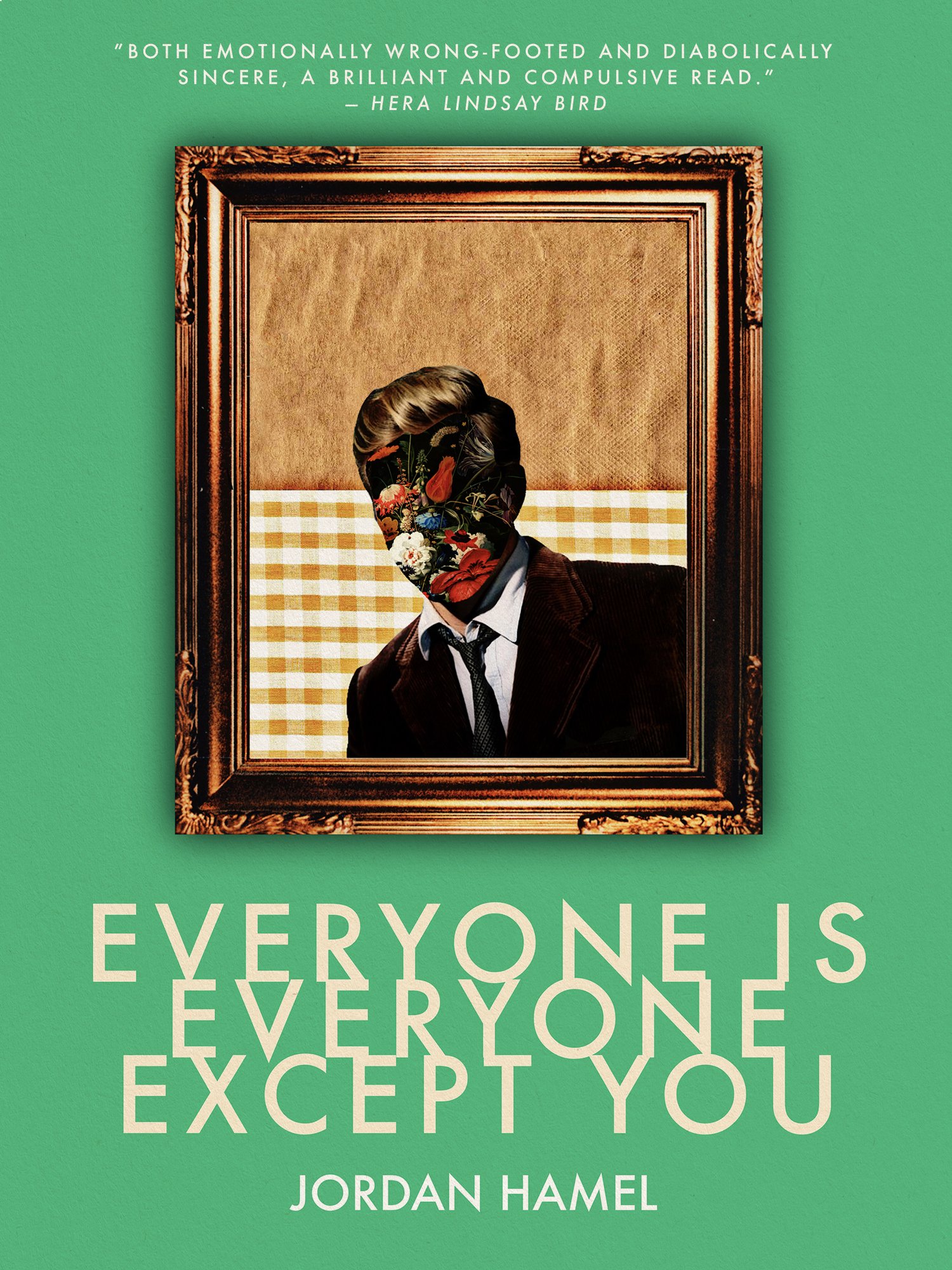
Everyone is Everyone Except You, Jordan Hamel, Dead Bird Books, 2022

In this city you can be whoever you want
and I’m still so much myself it’s disgusting

nothing else fits, nothing is comfortable,
I just want comfort, I want, I want

poorly-aged fish-out-of-water celebrity voyeurism
to remind me living can be so, um, uncomplicated

there’s nothing left for me here except reality
sleep demons waving performance plans

mandatory psychometric pub quizzes
where every answer is a ghost you’ve buried


Jordan Hamel, from ‘The Simple Life’


Three poets whose writing I admire immensely – Hera Lindsay Bird, Tracey Slaughter and Tayi Tibble – endorse Jordan Hamel’s debut poetry collection on the back of the book. That is enough to make it essential reading. I read their comments once I finish the book and have mused upon its effects. I begin by pirouetting on ‘everybody’ and ‘someone’, pulled between the wide-reaching ALL and the particular ME. The poems deliver ‘I’ and ‘you’, and I am fascinated by the movement these pronouns/entities/gaps generate. You could say there’s a swing bridge between them, an interface, a hammock, and however you visualise the link, it is a link with traffic. And out of that glorious energised traffic, you find poetry.

Jordan’s deft ear and eye, his ability to craft words and lines, underline myriad ways to read and travel in a poem. Writing (reading) becomes a route beneath your own skin, a way of stretching writing to embrace the universal and the personal. This is writing of comfort and discomfort, of need and want. It is vulnerable and it is direct.

Rebecca Hawkes writes very different subject matter, but I absorb a similar verve and vitality, an ability to reveal spikes and judder bars, and to conceal. Jordan’s speaking voice is one of self scrutiny, self doubt, even perhaps self erasure. And then the whole process turns upside down, and the poetry is the act and art of self preservation, self testing, self nourishment. This affects me deeply as reader (and as secret writer).

The self deprecation is scattered thought out:

and the last old man          I’ll ever disappoint      is me

where I grew up      men don’t get sick     they rust
like grizzled house cats      under the ute      they crawl
with a quiet    they’ve always carried            they don’t die
just become another blunt saw    you never throw away


from ‘The worst thing that will ever happen to you
hasn’t happened yet’

The final poem ends on blank space, on pause, reset, refill, silence, breath intake. It is over to us how we respond, engage. We now inhabit “you”, which also becomes a way of reflecting upon “I”, whichever “I” that is, whether anybody everybody somebody. These lines form the final musical notes of a haunting book that is such a rich and open reading experience.

                   the perfect poem is just                                     blank space


the perfect you is just


from ‘Human resource’         

Dead Bird page

Jordan Hamel website

Wellington City Libraries video interview

Jordan Hamel (he/him/his) is a Pōneke-based writer, poet and performer. He was the 2018 New Zealand Poetry Slam champion and represented NZ at the World Poetry Slam Champs in 2019. He is the co-editor of Stasis Journal and co-editor of a forthcoming climate change poetry anthology from Auckland University Press. He is a 2021 Michael King Writer-in-Residence and recently placed third in the 2021 Sargeson Prize judged by Patricia Grace. He has recently had words published in The Spinoff, The Pantograph Punch, Newsroom, NZ Poetry Shelf, Landfall, Turbine | Kapohau and elsewhere.

Poetry Shelf Occasional Poems: Hebe Kearney’s ‘monarch wings’

monarch wings

risingholme park
ten years before the
/ earth cracked open /

the pine trees were filled with sleeping butterflies

looking up
sails of their orange wings
closed to triangle points
nestled in the needles
childhood haze / gold in memory

and then one night suddenly
/ frost /

looking down
the next day
orange confetti / green grass
disembodied wings
fluttered from death

we gathered their softness / into a basket

went to the dairy on the way home
and when man behind counter saw
eyes went wide / heard him thinking:
butterfly murderers
and i just didn’t know how to
/ explain /

Hebe Kearney

Hebe Kearney (they/them) is a poet who lives in Tāmaki Makaurau. Their work has appeared in publications including: Mantissa Poetry Review, Mayhem, Starling, samfiftyfour, Tarot, takahē, and Poetry New Zealand Yearbooks. You can find them at @he__be on Instagram.

Poetry Shelf Occasional Poems: Jenny Powell’s ‘The Girl and the Poet Read Tea Leaves in Paris-Gore’

The Girl and the Poet Read Tea Leaves in Paris-Gore

Spilt tea settles between Formica
flicks of colour, flecks of leaves
turn on a red table.

In front of them a collusion of fate,
a collision of cups in a clumsy act,
the leaves of a script set out before them.

Butter sizzled and browned on a black griddle,
hoisted flags of wet washing hung
in a damp wait, a forgotten cigarette smoking
in the ashtray, the teapot cosy
in crocheted stripes.
On the red Formica table,
pikelets dripped the thin juice of melted syrup
down her fingers, onto her dress.

They change their table, order a new
pot of tea and a plate of hot pancakes.
The syrup melts thin and juicy, drips

down her fingers onto her dress. He gives
her a serviette to soak up the mess.
She folds it in half for her own plot.

Jenny Powell


Poetry Shelf Occasional Poems: essa may ranapiri’s ‘Three Siblings on the End of The World as They Know It’

Three Siblings on the End of The World as They Know It

for Lyssa, Ruby & Michelle

Taane

to kick the night
into something
new

it feels good
for light to break in

Taawhirimaatea

someone makes a joke about
the great divorce
the wind doesn’t
find it very funny
doesn’t even crack a smile

they close their eyes and start to blow

Whiro

prefers the dark
and the warmth one day they will be
strong enough to
parent trap the
earth and the sky
back together

essa may ranapiri

essa may ranapiri (Ngaati Raukawa, Te Arawa, Ngaati Pukeko, Clan Gunn) is a person who lives on Ngaati Wairere whenua. Author of ransack and ECHIDNA. PhD student looking at how poetry by taangata takataapui engages with computer technology. Co-editor of Kupu Toi Takataapui | Takataapui Literary Journal with Michelle Rahurahu. They have a great love for language, LAND BACK and hot chips. Thanks as always goes to their ancestors, who are everything. They will write until they’re dead.

Poetry Shelf: Emma Neale’s launch speech for Michael Harlow

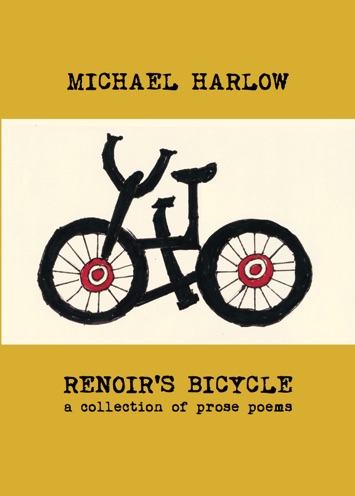
Renoir’s Bicycle, Michael Harlow, Cold Hub Press, 2022

Launch Notes

In the past, I’ve edited a couple of Michael Harlow’s poetry titles, but I’ve loved arriving to his new book like a house guest, rather than as one of the electricians or scaffolders tinkering during the final stages of its construction.

Renoir’s Bicycle is a mysterious, atmospheric, idiosyncratic, compelling collection. It seems to me that it’s often a celebration and delicate understanding of the private, interior life; the foundations of identity; the inner-scape of secrets, wishes, dreams, whimsy, reveries, desires, the unspoken, or the unrealised: all the hidden things that can either drive us — or block us; even make us deeply, psychologically unwell, if they’re unacknowledged.

I wanted to use Michael’s line ‘the imagination never lies’ as a mantra, for a while, after reading the collection; and also found myself writing down other phrases to pin to the corkboard in my study: ‘the rondeaux of astonishments’, say, or ‘rondels of light’; or ‘call it love, a lush wilderness in the mind’. Phrases that themselves seem like sun landing on a gem or a silver hook: phrases I wish I could wear, somehow: as earrings or lockets.

Several of the poems ring with authentic, detailed memory and leave a feeling of nostalgia, even when the life in the poem isn’t your own; some trace fleeting states of mind; others work through the comical switches and non-sequiturs of dream language.

They might outline the strange rituals and comforts humans invent for themselves to cope with the dark, with loss, and death:

She took a clean, white bone from her apron pocket,
rubbing it over the warts on both my hands.
     Then she said a prayer in Italian reciting it
backwards. And then she kissed the white bone,
crossing herself three times, and buried it in the earth;
where I could hear Father singing his heart out.
And my Sister too.

from ‘A song in the dark’

On the other hand, these short pieces might evoke a certain disposition, or lean on our responses, the way music does. By this I mean that despite the fact that the front cover of th book calls these prose poems, the music of their syntax, the emotions that the rhythms, hesitations, refrains, and prosody convey, seem to be as much a part of the meaning as any nuggety little quotable, extractable bit of, say, ‘advice’ or ‘belief’. The feeling of spell and flow, sound and song are powerful in Michael’s work.

I’ve talked about the interior life of the mind, and things that might feel a bit nebulous and vague, like music and mood — yet these pieces also call on tangible forms like the fable, or riddle, the tragi-comic skit; or the love song. Several struck me as strange, compressed and compelling psychological or crime case notes. (‘Round the bend’ and  ‘In the mood’, to name just two). All of them, in some way, even the skits or riddles, document and diagnose what it’s like to carry a self through all the puzzles and buffetings of time, and alongside other people with all their own quirks, attractions, and neuroses.

The collection is given a sense of weave or pattern in its repetitions of light, dark, music, birdsong and other motifs; and by lines that echo each other from poem to poem here (and even from earlier poems from Michael’s other collections). I came to think of those repetitions as perhaps like characteristic gestures by which we might recognise a loved one: the drawn out syllables in their way of sighing; the way they hold their elbows when they slide in their socks across the kitchen floor; that favourite, Fanta-coloured hat. Michael’s refrains are the fingerprints, the laughter lines, by which we know him.

I have at least ten particular favourites in the collection —  but perhaps the top top favourite is the poem ‘Unspeakable’— which is also a perfect and sorrowful micro story, as a character looks back on his life, and struggles with how to articulate his origins, his history, the losses that have, in a sense, brought him to where and who he is now. Poets might be more obsessed with language than the average punter, and the poem could be an analogy for the poet’s role, but in its suggestions of loss of faith, desecration of a trove of myth, separation from personal and cultural heritage, I think what it addresses is far broader and deeper.

I’m reproducing it here, with permission from Michael and his publisher, Roger Hickin of Cold Hub Press:

Unspeakable

Trying to write of the unspeakable.
In the white-washed room with
the broken statues of his ancestors.
At the oval table, the lamplight
drawing a circle. Inside it the cast
shadow of his hand and the stub
of a pencil. Trying to say something
that would take him back to the time
when he had no name in the streets
to call his own. And then he wrote
‘Every word is a crossroads.’

Michael’s work often makes me think about the lies we harbour. Reading it alongside Martin Shaw’s Courting the Wild Twin, Michael’s poetry also seems to be about the shadow selves we try to fling out the window, or run from, but end up having to live and reckon with in some way; the chimaera versions of reality we piece together as young children when we’re only told a portion of the truth going on for the adults in our lives, or when they push down too punitively on the wild in us; how after childhood we can both carry gleams of Eden at the back of our minds and yet be damaged by our parents’ own hidden wounds; how we can both mirror and yet distort those wounds at the same time. And yet, even all of this is paraphrase and abstraction from me, really. What the reader often comes across in Michael’s work are small, dramatic re-enactments of scenes that quietly suggest, rather than announce, this kind of psychic tunnelling. They’re scenes composed with a kind of melodic, sonorous touch, which means somehow we can lift and carry even the most tragic stories without smashing into stone fragments ourselves.

Cold Hub Press page

Emma Neale is the author of six novels,  six collections of poetry, and a collection of short stories. Her novel, Billy Bird (2016) was short-listed for the Acorn Prize at the Ockham New Zealand Book Awards and long-listed for the Dublin International Literary Award. Emma has received a number of literary fellowships, residencies and awards, including the Lauris Edmond Memorial Award for a Distinguished Contribution to New Zealand Poetry 2020. Her first collection of short stories,  The Pink Jumpsuit (Quentin Wilson Publishing, 2021) was long-listed for the Acorn Prize at the Ockham New Zealand Book Awards. The mother of two sons, Emma lives in Ōtepoti/Dunedin, where she works as a freelance editor.

Michael Harlow is one of New Zealand’s leading poets. He has published twelve books of poetry, including Cassandra’s Daughter (2005, 2006), The Tram Conductor’s Blue Cap (a finalist in the 2010 New Zealand Book Awards), Sweeping the Courtyard, Selected Poems (2014), Heart Absolutely I Can (2014), Nothing For It But To Sing (2016, winner of the Otago University Press Kathleen Grattan Award) and The Moon in a Bowl of Water (2019). Take a Risk, Trust Your Language, Make a Poem (1986) won the PEN/NZ award for Best First Book of Prose. Residencies he has held include the Katherine Mansfield Memorial Fellowship and the Robert Burns Fellowship. In 2014 he was awarded the Lauris Edmond Memorial Prize for Distinguished Contribution to New Zealand Poetry, and in 2018 he received the Prime Minister’s Award for Literary Achievement in Poetry.

Poetry Shelf Occasional Poems: Jack Ross’s ‘Time’

Time

No time but the present. That’s not quite it, is it? No time like the present is the usual phrase. Do it now, in other words – don’t put it off. But, as H. G. Wells’s Time Traveller explains so clearly in the story, there’s no such thing as an instantaneous object: it must have duration, as well as height, length and breadth, in order to be perceived (let alone possessed) by us. Now is a moment which is over so quickly that it’s only perceptible in the rearview mirror, as a part of the long spool of experience unwinding behind us. So all we really have is the past – that is to say, the memory of what is already done and dusted. But do we have that, even? It’s no longer with us, so I’d have to say no – all we have, then, is that quavering moment, poised on “Time’s toppling wave,” in W. H. Auden’s phrase. But since we can’t perceive it till it’s over, you could argue that all we have is anticipation: the prospect of what the next moment will bring. You’d think that might make us a bit less greedy: less determined to collect the leavings of all these moments, past and to come, and more prepared to enjoy them to the uttermost. We’re only conscious for a small part of the time allotted to us: there’ll never be any more of it, so let’s dance. 

Jack Ross


Jack Ross is the author of eight works of fiction and six books of poems, most recently The Oceanic Feeling (2021). He was managing editor of Poetry New Zealand from 2014-2020, and has edited numerous other books, anthologies, and literary journals. He blogs here

Poetry Shelf Occasional Poems: Hannah Mettner’s ‘Love poem as women’s work’

Love poem as women’s work

There are so many tiny hitches, being a woman. I wake up and think, god, I have to wash my hair. And you know how that goes—I block the plughole again. Again, I check my breasts for lumps with conditioner running down my back. Amazing how I am destined always to find what I’m looking for. My horoscope app tells me I can be a world unto myself and I find that I already am.

Stopping in for two-for-one Tuesdays at the video store after doing the grocery shopping. Checking out something black-and-white and something for the kids, because we couldn’t afford the new release rack. What did we do before we binge-watched television? Everything was analogue then, the evenings ticking neatly to their closure. Just getting the children to bed seemed to take all night.

A blackbird flies into the window and lies twitching on the ground outside for several minutes as we watch from behind the glass. Next day it happens again, I sigh and take up the shovel. I try to forget that we live in a country of fitfully dozing volcanoes. Any of them could wake, any minute, and destroy us all. My nails are always catching on something as I stride out into the fault.

Sometimes I find myself looking at my children, nearly taller than me now, and thinking, I will be survived by them. Sometimes I find myself looking at the man I made them with and thinking, will we survive the raising of them.

Hannah Mettner

Hannah Mettner is a Wellington-based poet from Tūranganui-a-Kiwa. Her first collection, Fully Clothed and so Forgetful (VUP 2017), was longlisted for the 2018 Ockham New Zealand Book Awards, and won the Jessie Mackay Award for best first book of poetry. With Sugar Magnolia Wilson and Morgan Bach, she is one of the founding editors of Sweet Mammalian. A new collection is forthcoming from THWUP in 2023.

Poetry Shelf Occasional Poems: Elizabeth Smither’s ‘The Etruscans’

The Etruscans  

In the British Museum
I love the Etruscans best.
I thought I would be simpatico with others

more genteel, less roughly hewed
as if from sandstone, not marble
deep thinkers, at it for years

by frozen water or under chandeliers
but these rough-hewn who loved
the present moment and pleasure

are the best this afternoon
when the darkness comes at three
the hour I imagine they dance.

Elizabeth Smither

Elizabeth Smither’s new collection, ‘My American Chair’ will be published in October/November by AUP and MadHat (USA).

Poetry Shelf occasional Poems: weekend diary and Janet Newman’s ‘Goodbye Kukutauaki Road’

The rain is dampening down the day before it has even started, but I plan on reading books in bed, making fish tacos for dinner, eating cheese scones and writing some more poems for children. I posted Claire McLintock’s cancer thoughts from Canvas on social media and felt so many connections. YES to living each day fully. It may be sleep or dream or reading or writing. But the choices I make – I know some of you might think I am crazy busy but I’m not – mean I live in a state of unbelievable happiness, calm and strength. It is like a miracle, and that I love words helps no end.

Claire and her husband are selling fundraising TShirts for Sweet Louise with Workshop.

This morning I was thinking about how important conversations and connections are when you are cut off from ‘normal’ life. I can’t imagine getting on a plane for a long time, or laughing in a crowded cafe. Or even going to festivals and launching books. But I can imagine connections and conversations through the exquisite reach of blogging. Even doing my own secret writing!

With these words drifting in my head, I read Janet Newman’s email. She writes:

Reading Robert Sullivan’s Rākaihautū there [on reawakened Poetry Shelf] and Anna Jackson’s response made me think of a poem I wrote after another poem from Tūnui / Comet. My poem reflects on the loss of productive farmland to lifestyle blocks, an old issue that is finally starting to seep into national and political consciousness. I thought you might like to read it. 

I loved reading Janet’s poem – and I love how conversations and connections keep rippling out from Robert’s poetry, from the poem that relaunched Poetry Shelf, and from Anna’s. Poetry has the power to forge links with who, where and how we are in the world, the way we connect with and care for the land, the way we connect with and care for our own wellbeing. It is wonder and it is joy.

Goodbye Kukutauaki Road

“… there’s only a certain percentage of elite soils in this area, or even around the country. And once those are gone, they’re gone forever. You can never get them back.”

––Pukekohe farmer Stan Clark


my old friend.
I know how far you travel.
            Back to my no-gear,
pedal-brake bike tyres
catching in dull gravel,
school bus
turning in smoky dust, Dad milking Jerseys
in a walk-through shed: six sheds, six houses
and a sheep farm at your end.
Back to war veterans clutching
marbles in your land ballot.
Back to Te Rauparaha’s boundary:
Kukutauaki Stream near Paekākāriki,
a snare for catching kākāriki.
           Out west, sunsets
over Waitārere Beach. East, rainbows
over the Tararua Range, colourful
as your jam-packed letterboxes jostling with wheelie bins 
for shoulder space.
Yet why do I see your bitumen shine
as loss my friend, your slick curves
as enclosure?
           You’re smooth
as a black cow and our vehicles slide down
your spine all the way to Wellington,
coast nose-to-tail through the gully. Return
to pūkeko stalking lifestyle blocks, kererū
ghosting rural retreats.
           I wave as my car swings past
your long, blue sign. Bye, bye
no exit Kukutauaki Road.


Janet Newman

(after ‘Hello Great North Road’ by Robert Sullivan)


Janet Newman is a poet and scholar. Her debut poetry collection is Unseasoned Campaigner (OUP 2021), the manuscript of which was shortlised for the 2019 Kathleen Grattan Poetry Award. Her poems have been anthologised in Manifesto Aotearoa (OUP 2017) and No Other Place To Stand (AUP 2022). Raised on a Horowhenua dairy farm she now farms beef cattle. She holds a PhD in English from Massey University for her thesis Imagining Ecologies: Traditions of Ecopoetry in Aotearoa New Zealand (2019).

Poetry Shelf Occasional Poems: Cadence Chung’s ‘mount st.’

mount st.

I am trying to love it, all of it, including the stomachaches and the scars that pucker on my legs. They say the world is poisoned but I feel like I just have to give it a go first, sample the arsenic-yellow paintbrush just to see if it might stain something bright. “That’ll be us,” my friend says when we pass a group of kids, picnic-lunched, sun-dizzy, at the local graveyard. I can’t tell which part he means: the picnic or the being-six-foot-deep-in-a-grave. He is an actor, not a poet, and doesn’t take kindly to being immortalised in a poem. His art is all glitter and stage lights and sweat. The moment all the sweeter for not being preserved. Verse erodes on the human tongue, and a tongue is nothing but a slab of meat ‒ which is to say, it will rot. But I just can’t help it. I want to taxidermy this crude human heart just so somebody down the line remembers how it felt. Oh, how it felt: too much, too much, always bursting with clotty red blood. There’s nothing in a graveyard that you can’t find somewhere in the gristle of a human. And nothing clawing in my mind that can’t be stopped by the sight of a wild sparrow-chewed blackberry, a window glowing golden at night, two friends trying on a silly hat. I keep them like sweets under my tongue, and when, as all flesh does, it rots ‒ there’ll be sugar spilling out into the grass.

Cadence Chung

Cadence Chung is a poet, student, and musician currently studying at the New Zealand School of Music. Her original musical In Blind Faith premiered at BATS Theatre in August 2022, and her debut poetry book anomalia was published by We Are Babies Press in April 2022. Her poetry takes inspiration from Tumblr text posts, antique stores, and dead poets.