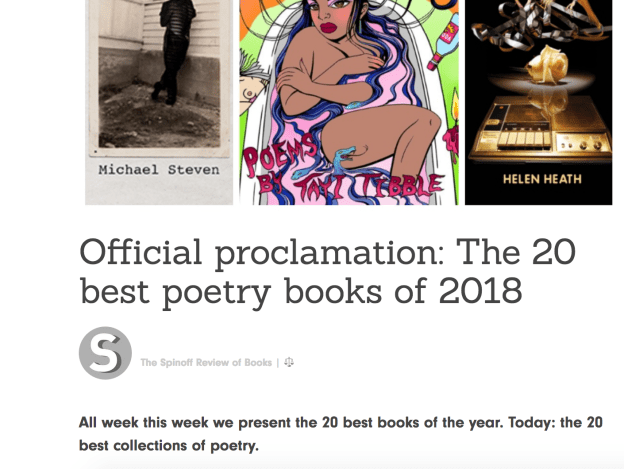
List of excellent poetry books from 2018 chosen by Steve Braunias, Bill Manhire, Courtney Smith and me. Such a good year for poetry not all best books can fit.
Yeah to all the poetry presses in NZ who take risks and keep publishing poetry. Thank you! And the bookshops that put poetry on their shelves. And the festivals that slot in poets. And the readers who keep loving local poetry books. Thank you!
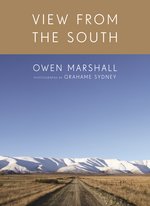
My father had a piece of kauri gum with
an insect entombed within its amber glow.
A slender fly, buckled in futile agony
as the resin gradually engulfed it and set
fast. He kept it on his desk, a talisman
from a Wekaweka boyhood and an oddity
no doubt. Hundreds of years may well have
passed since this incidental tragedy within
the cloistered Northland bush, yet thin, black
lines of the body are preserved within the
jewelled translucence that caused its death.
Owen Marshall, novelist, short story writer, poet and anthologist, has published over thirty books. Awards include the Deutz Medal for fiction, the New Zealand Literary Fund Scholarship in Letters, fellowships at Otago and Canterbury universities and the Katherine Mansfield Memorial Fellowship in France. He is an Officer of the New Zealand Order of Merit for services to literature, a Companion of the New Zealand Order of Merit, and has received the Prime Minister’s Literary Award. He is an adjunct professor at the University of Canterbury.
I really like this idea – I wonder if we could do the same here?
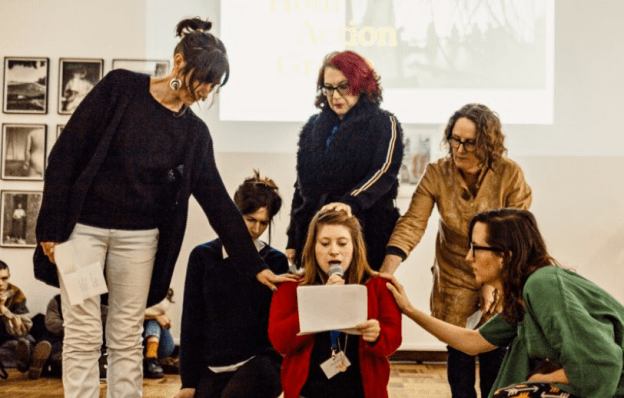
’12 is a collective of women writers using a shared Google document to post monthly poems in response to one another’s writing. The collective originally formed at the request of Sophia Hao, curator at Cooper Gallery in Dundee, in order to create work echoing the collaborative Feministo Postal Art Event of 1975-77. For that project, women made art at home and posted it to one another, generating home-based art collections and a tight-knit community of women artists.
The poets in the collective so enjoyed writing in a safe and easily accessible space, with a simple constraint and support garnered from working alongside and in response to one another’s creativity, that they decided to continue. One poet writes a lead poem each month and the others each post a response. The writers in the original collective were Tessa Berring, Anne Laure Coxam, Lynn Davidson, Georgi Gill, Marjorie Lotfi Gill, Jane Goldman, Rachel McCrum, Jane McKie, Theresa Muñoz, Alice Tarbuck, Karen Veitch and JL Williams. Since then, Rachel McCrum and Karen Veitch exchanged places with Em Strang and Lila Matsumoto.’
Jennifer Comptom is a poet and playwright who also writes prose. Her most recent poetry collection, Mr Clean & The Junkie, was published by Mākaro Press in 2015 and was longlisted for the Ockham NZ Book Awards. She lives in Melbourne.
1. Anna Smaill’s long interview with Bill Manhire. The advantages of slow-paced email interviews are evident as Anna and Bill explore the personal, ventriloquism, creative writing programmes, reading poetry, writing poetry, weirdness, holding back, trauma, God, mystery, parents, memory, drinking jugs of beer with Hone Tuwhare through the night. Life and poetry still maintain the requisite cloudy patches, private life and inner life are signposted but not made specific. This is a cracking interview – it refreshes my engagements with Bill’s poems, and writing and reading poetry in general.
2. Oscar Upperton’s poem ‘Yellow House’ because it has bright detail in the present tense and I am in the scene reading on a glorious loop.
The stream crosses the bridge. Pūkeko flicker
from blue to white, bikes rust into each other.
We rust at table.
(and the fact this poem is followed by ‘Explaining yellow house’ where Pip Adam gets a mention)
3. Sarah Barnett’s long poem essay ‘One last thing before I go’. Wow. This piece of writing is one of my treasures of the year because it goes deep into tough dark experience. It is measured and probing and hits you in the gut. Yet the fact of it on the page in front of me, so crafted and exposed, is uplifting.
4. Jane Arthur’s poem ‘I’m home a lot’ because it’s strange and real and unsettling.
This one sounds loudest against the front windows
and this one across the roof, nearly lifting it,
in an angry violent way. not like a bird taking off.
And even the birds here are massive and prehistoric.
Silence is rare. It’s eerie when it happens. Our dreams are mute.
5. Morgan Bach’s poem ‘carousel’ because when you read this your breathing changes and you enter a glorious mysterious complicated experience in the present tense.
but now having swallowed full moons,
coupled with mirrors of reticence, I find
life is not an experiment like that
and soon the body gives up its hunt
how soon the body becomes a cliff
how soon the body becomes a full stop
6. Discovering new-to-me poet Nikki-Lee Birdsey – she has a collection out with VUP next year and is currently an IIML PhD candidate. Her first-person storytelling in the form of a poem gripped me from the first lines.
7. essa may ranapiri’s selections because I find myself picturing them performing the poems and then I take supreme delight in the detail on the page.
8. Lynley Edmeades’s “We’ve All Got to Be Somewhere’ because it left a wry grin on my face. Poetry can do that.
9. Emma Neale’s ‘Unlove’ because this poem sings so beautifully.
My friend whose mind has frozen
sends me small gifts she says to keep her sane —
a cornflower-blue watch;
a box carved of light with a green latch;
a pink soapstone egg she says will one day hatch
a small, exquisite monster, its teeth sharp as love.
10. Rata Gordon’s poem ‘Mango’ because the writing is spare but it makes you feel so many different things.
The Writing Life: Twelve New Zealand Authors edited by Deborah Shephard
Massey University Press, 2018
Albert Wendt reads ‘Used-by Date’
Twelve authors talk to biographer and historian, Deborah Shephard, about writing and living. It is a captivating new book. Deborah has done an excellent job drawing out stories and raising issues; from what it means to write alongside domestic and money-earning demands to coping with both success and failure. She is familiar with the authors’ books and the context of the times in which they were written. The interviews often feel like a warm and stimulating conversation rather than a pre-prepared interview. John McDermott took stunning photographs to accompany the text.
Joy Cowley’s interview is essential reading. I didn’t realise how tough things were for her in her first marriage and how writing became increasingly important. The depth and range of her revelations moved me. I have been a big fan of Joy’s writing for decades. Along with Margaret Mahy she has also shown me that writers can be generous beyond the writing desk – in the way they listen and back younger or emerging writers (from the child to the adult). Joy was motivated to write New Zealand children’s books because it was really hard to find local examples.
Writing was something I just did. Wanting to be a writer, well, that’s like wanting to be a breather. I just lived stories.
Joy said she used to think people were like apples that fell from trees when they withered and dried but that she now thinks of people as onions – beautifully layered. This is an apt description for the interviews, for the writing life.
Deborah undertakes the interviews on the author’s turf, often over several days, and that makes a difference. We discover that Fiona Kidman has images of her writing mentors on the wall: Robyn Hyde, Katherine Mansfield, Margurite Duras. When they talk about Fiona’s mother and her knowledge of china, there is some Royal Doulton with pansies on the wall . That this is the china that featured as decorative end pieces in Fiona’s poetry collection This Change in the Light adds layers for me. I feel present in Fiona’s kitchen and I am reminded of her terrific poems about her mother.
My way of communicating with the world from when I was a very solitary child was through the written word.
Fiona’s interview covers family, friendship and feuds, love and terrible loss, along with the origins of her novels, the way she brings them to life and the way her writing process has changed over time. Her novels catch me immeasurably with their humaneness, their warmth and empathy; and the meticulous attention paid to details (think dialogue, setting, signs of the time). I have just read her latest, This Mortal Boy, and I recommend it highly.
In her interview Fiona returns to the 1970s, a time when women were reassessing their roles, finding their voice, standing together and speaking out. I was fascinated to read the back story to her debut novel, A Breed of Women – the way an early unpublished novel, ‘Club Litany’, was shelved because ‘it wasn’t a book I was quite ready to live with’. That novel formed the basis of A Breed of Women – the novel that affected so many women at the time. Fiona talks about entering ‘some new hall of knowledge’ and the women who gave her both the confidence to write and the tools to explore feminist issues.
I was particularly drawn to Fiona’s struggle to find a way to put Māori in her novels – Fiona grew up close to Māori communities and married a man with both Māori and Pākehā ancestry and has a daughter with Māori and Pākehā ancestry.
Again I am riveted by the conversation; the way it takes me back to Fiona’s writing and the way I reconsider what it was like to write in a particular time in a particular place.
Owen Marshall’s interview begins with Deborah reading his poem, ‘Missing person file – Jane Ella’, aloud. The poem features his mother and his slender memories of her; she had died when he was young. She is also there because Marshall had adopted her maiden name as his writing surname. His father remarried and had six more children to add to the initial three. Owen wanted to stay at secondary school beyond 5th form so was allowed to if he paid for it and contributed a small sum towards the household. Fascinating – the commitment to learn when many of his friends were reluctant. Like his father he savoured books and academic learning along with outdoor activities.
I loved the way Owen described the relationship between experience and invention in a novel or short story:
Much of that is my own experience, but burnished and reformed by the process that is fiction writing.
And that Owen prefers the novel to autobiography when he is asked about his short memoir:
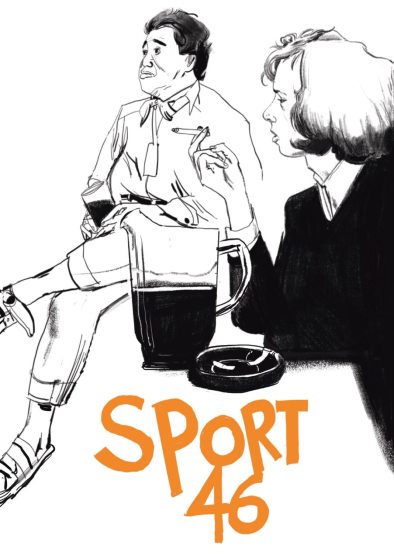
The memoir is based on two short pieces I did for Sport magazine and takes my life only to the beginning of the nineties when I left full-time teaching and became a professional writer. I did enjoy revisiting an earlier time and earlier self, but the experience hasn’t given me a desire to write my autobiography. I prefer to be seen through the prism of my work.
Albert Wendt, like Joy Cowley, has gifted us literature across diverse genres and has offered extraordinary support towards other writers, both emerging and established. In the interview he keeps some things private out of respect to the living but he draws us close to his lineage, to parents and grandparents, to the way writing both takes flight and becomes grounded. In a talk to students at his old school, New Plymouth Boys’ High he said:
Our lives are made up of great joy and love and also great pain and suffering and change. At times we feel like giving up. But this is the only life we have so we have to try and survive it, and enjoy it. Live it with integrity and honesty and to the best of your gifts.
I want to pin this to my wall. Like many of the authors I have read so far, the writing life is a life of both challenge and joy. It is also a life of reading, and in most cases from an early age. Albert is no exception. He read the Bible and then the School Journal before hiding himself away in the secondary -school library. Then his sixth-form English teacher gave handouts of The Waste Land.
I’d never heard of The Waste Land but when he began reading, shit, it was like listening to music and the way my grandmother chanted. We studied the whole poem for the next two weeks and my attention was held right from the beginning.
Albert talks about the way he has always been political; and of his willingness to write about and challenge racism. He talks about the way politics infused Sons for the Return Home. I remember reading this book the year after I had left school – and thinking, as it settled inside me, this is what writing can do. Albert said:
When I write it’s mainly for myself. I’m writing a book that I would like to read. It has to mean something to me and if it has some impact on the public then good, but that is not my aim. At the time I wrote Sons for the Return Home I had become politicised, and I still am, but I was interested in exploring colonisation, what it does to people, both the colonised and the coloniser.
I am also fascinated by the process of writing and the way it differs from writer to writer. Albert speaks of writing poems:
I deliberately set out to make them feel effortless, but to achieve that sometimes I had to rewrite and rewrite, or leave it for a few days and then go back to it. With my new collection From Mānoa to a Ponsonby Garden I decided to write a set of poems fourteen lines long each, and centre each one on this garden and this house and Reina, our cat, me, and any other creature that entered the garden, and see what happened. I was doing what I do with my paintings, deliberately limiting the colours, and the bloody poems began to take off. And instead of having short lines I decided to have fourteen fairly lengthy lines and make them appear just casual, and closer to prose.
I love this book. I love the way it returns me to writing I am familiar with and lives that I am not. It reminds me that the writing process is addictive, sustaining and for many a necessary joy. It is not a criticism – because I found the interviews I have read immensely satisfying – but at the end of each one I wanted to enter the room and carry on the conversation myself.
I shall read the other interviewed authors over summer: Marilyn Duckworth, Tessa Duder, Marilyn Duckworth, Chris Else, Patricia Grace, David Hill, Witi Ihimaera, Vincent O’Sullivan and Philip Temple.
Jo Thorpe was born in Wellington in 1948. She grew up in Gisborne, and graduated from Auckland University before settling in Wellington. Jo is the author of two previous poetry collections: Len & Other Poems (Steele Roberts Aotearoa, 2003, written in part as a response to the work of Len Lye and Roger Horrocks’ biography of the visionary kinetic artist); in/let Steele Roberts, 2010.
Jo has a masters in creative writing from the International Institute of Modern Letters, Victoria University. She taught Dance History at the NZ School of Dance in Wellington (2003-15), danced with the Crows Feet Dance Collective (2002-15) and has written dance criticism for a variety of publications.
Jo has three daughters, five grandchildren and now lives in Turanganui-a-Kiwa/Gisborne.
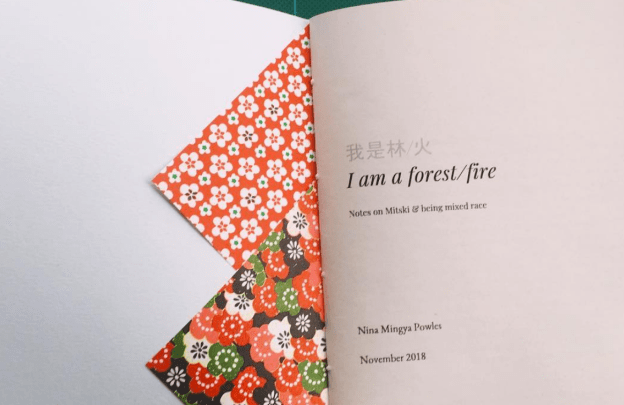
Nina Mingya Powles has produced a terrific new zine: I am a forest/fire – notes on Mitski & being mixed race.
Nina listens to Mitski, the Japanese/American songwriter, at her desk in Shanghai.
I noticed a swelling in my chest and in my stomach like something about to burst. I noticed how her voice lingers on every word. Something sweet / a peach tree.
Both Mitski and Nina are using the forward dash in lyrics/ poetry and prose as ‘A breath, a pause, a sharp shift.’ The forward dash is like the space on a line that allows room for pause, for new furnishings. There is much space in the zine. I like that.
Nina traces herself – her poetic lineage ‘made up of multiple languages and art forms, containing several oceans’.
She pulls herself into view. She doesn’t want to speak of herself in fractions with the pieces getting smaller and smaller as white people do ( I am a quarter Scottish, I might say).
I think of my own writing and how sometimes making a poem means making something exist outside of my own brain, my own skin. The poem contains parts of me and I still contain parts of it, but it’s also separate from myself, distinct, new.
I agree. We carry bits of things that we have read inside ourselves, the things that stick and prod and soothe. The things that change us forever.
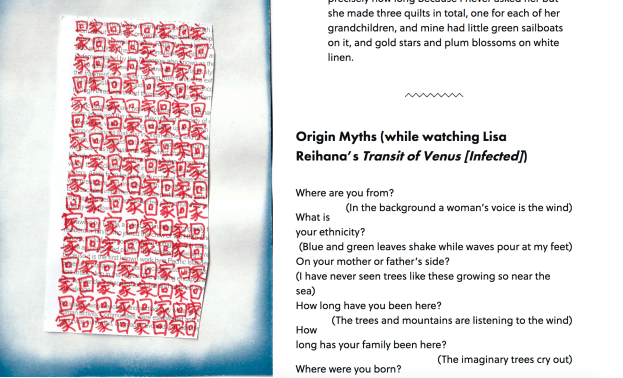
Nina’s zine is like an album of pieces (the images, the Chinese characters, the hand scrawlings).
What do I know but pieces? All at once. Half sun, half moon. Half tooth, half bird. A blue lantern, a jade heart, a peach-pink melamine bowl.
The zine is beautiful. It is beautiful in the way it slows right down to a state of meditation, of facing the inner space, the diverse fragments:
The shadowy space in me shimmers like glitter.
Where there is a forest there is growth. Where there is fire there is heat. This gorgeous zine with its sharp edges is the growth and burn of the shadowy space. It heats up inside you as you read.
And
this is writing that illuminates. The subject matter is tough – that insistent consideration of who you are. Outside a storm is close. I can see it in the dark clouds coming in from the coast and the way the manuka keep bending back. All I can think about is this zine. I cannot recommend it highly enough.
The shadowy space in me shimmers like glitter. I feel its burn and glow. It is a kowhai forest in a southern-hemisphere summer. It is bloodlines, it is threads, it is pieces of cotton hanging up to dry under a coconut palm, sheets of white and pink and blue.




 NZ Poetry Shelf