

Packs
We try to breath as long as technology
and medicine can stretch it
and don’t know why we are wretched with anxiety
Every dawn in Samoa the neighbourhood packs of dogs
cracked open our sleep: barking howling yelping screeching
Theirs was the desperation of hunger and ill-treatment
I needed to quench the undeniable accusation in their howling
Now back in our safe Ponsonby bedroom the spring dawn sprawls
across our bed and refuses to leave but it will be swallowed up
eventually by the morning and our need to walk out
into the embracing routines of our tidy lives
The packs will continue to stalk us with their slow howling
No set plan or final intention
Just let go – just let it go all of it
even the accusing packs
It will not come again
©Albert Wendt (August-Sept, 2017) (November 2018)
Albert Wendt has published many novels, collections of poetry and short stories, and edited numerous anthologies. In 2018, along with four others, he was recognised as a New Zealand Icon at a medallion ceremony for his significant contribution to the Arts.
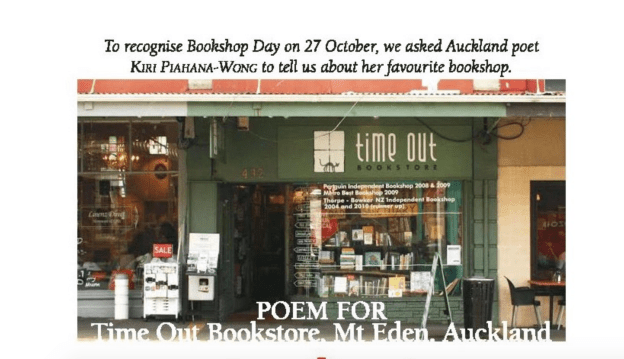
Kiri’s poem, ‘A Poem for Time Out Bookstore’, originally appeared in NZ Author to celebrate NZ Bookshop Day.
You can now read it online. It is so good! I completely identify with it.
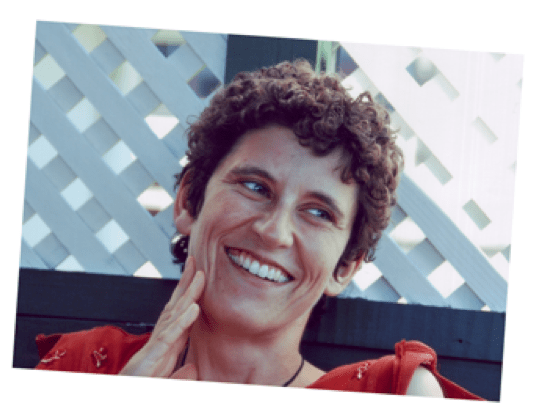
SARAH BROOM POETRY PRIZE
The Sarah Broom Poetry Prize is one of New Zealand’s most valuable poetry prizes and aims to recognise and financially support new work from an emerging or established New Zealand poet. In 2019, the prize is an award of $10,000. Poets are required to submit six to eight poems (at least five unpublished).
The prize was established in 2013 in honour of the New Zealand poet Sarah Broom (1972-2013), the author of Tigers at Awhitu (2010) and Gleam (2013).
Now in its sixth year, the award will be showcased in a special public session at the Auckland Writers Festival in May 2019 where shortlisted poets will read from their work and the winner will be announced. The full Festival programme will be publicly launched on 13 March and will be available in print and online here
Competition entries open on 21 January and close on 28 February 2019
For entries/queries email poetryprize@sarahbroom.co.nz For more information about the prize and Sarah Broom visit here
2019 Judge: Anne Michaels
Award-winning poet, novelist and essay writer Anne Michaels is Toronto’s current Poet Laureate. Her multiple awards and shortlistings include the Commonwealth Poetry Prize for the Americas, the Orange Prize, the Governor-General’s Award and the Griffin Poetry Prize. Her latest poetry collection All We Saw was published in late 2017.

A lifted stone
Much is hidden from us. Behind the smooth, painted and plastered lining of the walls of my living-room, where I sit and write, less than a metre away from me, creatures are stirring, and have their secret life. Sometimes I hear the dry scuttle of a mouse, but other, smaller creatures – woodlice, whitetail spiders, click beetles, ants – these creatures are silent, and seldom reveal themselves. Occasionally I notice a daddy-long-legs swaying slightly in the corner of the ceiling, or, in the early hours, as I trudge to the bathroom, a solitary chocolate-coloured cockroach spreadeagled on the wall, stunned by the light. The borer chews a hole in the skirting board, with only a little brown dust to show for its industry. I imagine it deep in the wood, nestled like a rabbit in its burrow, its scrap of life ticking.
When I was a child I was obsessed with these hidden lives. I would carefully remove the pale, pupating huhu grubs that lay buried in rotting stumps like pharaohs in their tombs, and keep them in jars of damp sawdust until they emerged as winged beetles, still white and frail-looking, their long antennae testing the air. I would turn over planks of wood to see what lived under them, brown beetles, black, shiny, soft-bellied spiders with white egg-sacs, grey hump-backed slugs, orange slimy flatworms. On the windswept beach where my family camped each summer, I would crouch on the reef at low tide, the sea a distant, uneven roar, like traffic, and I would lift the weed-encrusted stones in the rockpools to expose the creatures that teemed underneath. Glassy shrimp, almost invisible, would dart backwards. Brown cockabullies would flash past the cautiously retreating hermit crabs. Anemones would wave their thin arms among the inert kina and cushion starfish. It seemed very strange to me that all these creatures coexisted under the stone, as in a darkened house, in a kind of dormancy, until I lifted the roof and the light fell upon them.
Now, as I turn on the tap to fill the kettle, I hear a gurgling in the plumbing, and I remember the water-supply at the street has been turned off for some hours as contractors are digging a trench for the installation of fibre-optic cable. The cable – really many cables bundled together, each insulated in bright blue sheathing – lies along the grass berm, but soon it will be buried and I will never see it again. Beneath the ground it will ferry data between my computer and the world beyond. The water is back on, and in a sort of convulsion it bursts from the tap, orange with rust, and flecked with clots of green-black algae. And this has always been there, the flakes of rust and the algae, inside the pipe that leads to the tap – if I look closely, I can see a rind of green algae at the spout, surviving despite the chlorine-treated water that rushes through it every day. It has been there the whole time, the outside of the tap is gleaming chrome but this belies what it is like inside, where no light shines, where rust collects and algae grows.
My eldest child, an adult now, writes poems. His poems are sometimes enigmatic, they evoke a feeling, a mood, but I don’t always understand them. I want to, perhaps out of a desire to understand him. It’s as if the poems might reveal to me something about him that is hidden, as if they are a stone that might be lifted. But it’s no good me asking what they mean. He just shrugs and grins. We both know the strangeness of poetry, the impossibility of paraphrase, it’s what makes us come back, to read the same short poem again. There it is, the poem, on the white page with nowhere to hide, yet concealing some of itself. And this is true of all the poems I love most. I memorise these poems, even as they withhold their meanings, to take them into myself. They feel a part of me, just as my liver and kidneys and heart are parts of me, hidden inside my body, working in ways I don’t understand to help me live.
Tim Upperton
(excerpt from a longer work that will be published in a collection of essays, Strong Words, by Otago University Press)
Tim’s second poetry collection, The Night We Ate The Baby, was an Ockham New Zealand Book Awards finalist in 2016. He won the Caselberg International Poetry Competition in 2012 and again in 2013. His poems have been published widely here and overseas, and are anthologised in The Best of Best New Zealand Poems (2011), Villanelles (2012), Essential New Zealand Poems (2014), Obsession: Sestinas in the Twenty-First Century (2014), and Bonsai (2018).
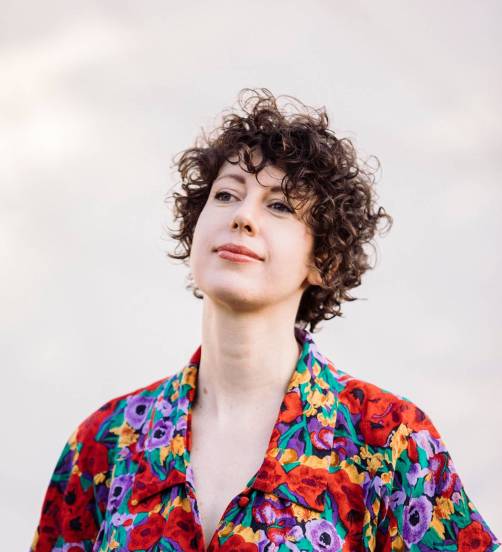
Joan Fleming is the author of two books of poetry, The Same as Yes and Failed Love Poems (both with Victoria University Press), and her third book is forthcoming with Cordite Press in 2019. She has recently completed a PhD in ethnopoetics at Monash University, a project which arose out of deep family ties and ongoing relationships with Warlpiri families in Central Australia. Her honours include the Biggs Poetry Prize, a Creative New Zealand writing fellowship, an Australian Postgraduate Award, the Verge Prize for Poetry, and the Harri Jones Memorial Prize from the Hunter Writers Centre.
Grieving, 1972
for Jim
You — bugger
you — arsehole
you — stinking shithouse
Dying
without me
Leaving
me stranded
Having
to keep on
Living
without you
Knowing
I’ll never
See you
again
You bastard —
You bloody bastard you —
© J. C. Sturm, Dedications, Steele Roberts, 1996
I was in Opunake for a couple of nights camping in January, and as we passed Taranaki maunga on the way there, I remembered it was the tūrangawaewae of poet and fiction writer, Jacqueline (J.C.) Sturm.
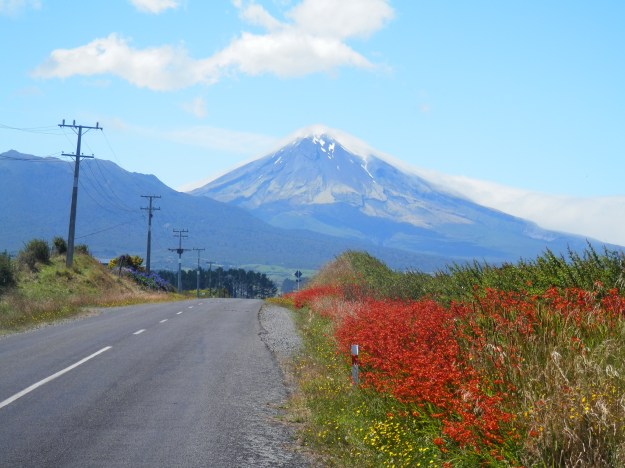
It’s something of a regret that we never crossed paths, despite both living on the Kāpiti Coast in the same early 2000s. I would have liked to thank her for this unforgettable poem, for the permission she gives herself – and, unwittingly, any poet who’s ever been silenced – to directly accuse, to swear, to rage and ache (I imagine from a west coast clifftop, face into the southerly wind whipping up volcanic blacksand)… in this case, at her loved, lionized, rogue husband, for dying without her.
There are so many layers here – her mantle of anger in the first, brilliant, versatile stanza, to the intimate, broken heart of the poem, and back to the cursing, in an emphatic finale. Such a satisfying poem.
‘Grieving, 1972’ has a companion in ‘And again, 1989’ – here, Sturm returns to the subject of her grief, but now the pain has significantly lessened, maybe almost gone. May it be so.
In celebration of the life and work of Jacqueline Sturm, let’s seek out copies of Dedications and Postscripts again; open their pages to the fresh air.
Nicola Easthope, 20 February 2019
And again, 1989
for Jim
It is all so different now.
I cannot swear
With such conviction
Nor do I thirst
So savagely for blood,
Anybody’s blood,
Or recompense
At anyone’s expense.
The trail is too old
Too cold
To follow as I used to
Taking directions from friends
And the not so friendly
(You were seen there
Doing that with them
The day before the day — )
Searching, combing
The landscape of my mind
Over and over again,
Desperate to find
The reason for your going
Or just to hear,
Still lingering
On the listening wind,
An echo of your voice.
Nor do I dream any more
Of finding that small
Very ordinary house
And those nervous strangers
Showing me where
You lay down
The last time.
It is all so different
Except, of course
You are there
And I am still here
Waiting,
And only God knows
(I do not ask to be told)
When, in his good time
This too will be different.
© J. C. Sturm, Dedications, Steele Roberts, 1996
J. C. Sturm (Jacqueline Cecilia) (1927–2009), of Taranaki iwi, Parihaka and Whakatōhea descent, was born in Opunake and is thought to be the first Māori woman to graduate with an MA from a New Zealand university (First Class Hons, Philosophy, Victoria University of Wellington). She initially wrote short fiction, and her work was the first by a Māori to appear in an anthology. Her debut poetry collection, Dedications (Steele Roberts, 1996), received an Honour Award at the 1997 Montana New Zealand Book Awards and she published further collections of poetry and short stories. Her poetry appeared in a number of anthologies and journals. Her collection, Postscripts (Steele Roberts, 2000), includes images by her son John Baxter. She received an honorary doctorate from Victoria University of Wellington, worked as a librarian, was married to James K Baxter and had two children.
Poems published with kind permission from the estate of J. C. Sturm.
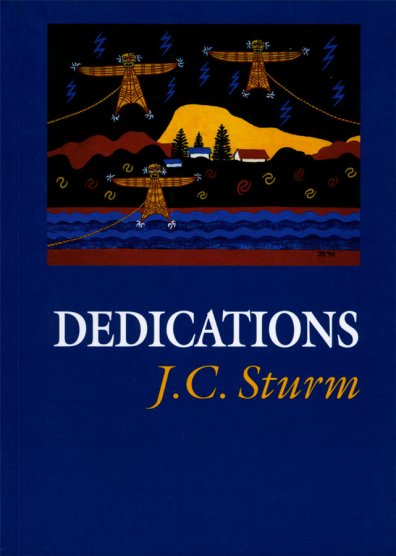
cover by John Baxter
Te Ara page on J. C. Sturm by Paul Millar
NZ Book Council page
Creative New Zealand is inviting nominations for writers who have made an outstanding contribution to New Zealand literature in the categories of non-fiction, poetry or fiction. Writers can also nominate themselves. $60,000 is awarded in each genre.
Those nominated must be New Zealand citizens or residents.
This year Creative New Zealand has improved the process for nomination and selection to give greater transparency and accuracy of information. Nominators must now include a statement of up to 500 words about why they are nominating a writer.
The nominations are assessed by an external panel of literary experts who then forward their recommendations to the Arts Council of Creative New Zealand for approval.
The awards are presented by the Prime Minister in a formal ceremony later in the year.
In 2018 poet, publisher and librettist Michael Harlow received the award for Poetry, critic, curator and poet Wystan Curnow for Non-Fiction, and dramatist and fiction writer Renée for Fiction.
As Renée says, “Shine a light e hoa, nominate a writer for this amazing award.”
See the full list of previous winners
Nominations close on Friday, 26 April at 5pm.
For media enquiries, please contact:
Kimberley Brady
Senior Communications and Advocacy Adviser
Ph: 04 473 9738
kimberley.brady@creativenz.govt.nz


 NZ Poetry Shelf