
our place, January 2020
In 2020 Poetry Shelf will host a monthly, theme-based festival of poems.
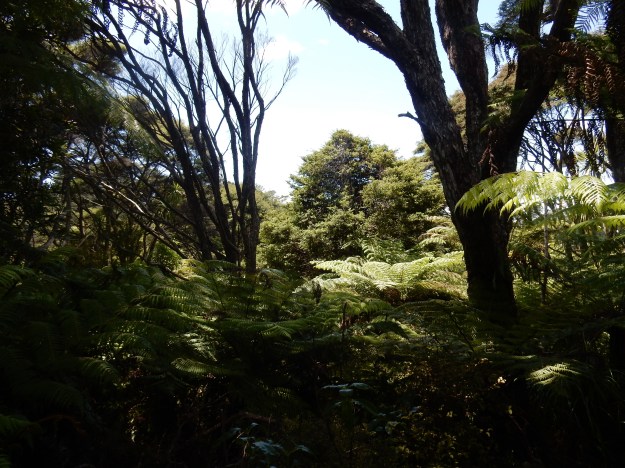
First up: trees. I chose trees because I live in a clearing in the midst of protected regenerating bush. It is a place of beauty and calm, no matter the wild West Coast weather. We look out onto the tail end of the Waitātakere Ranges knowing we work together as guardians of this land.
I chose trees because like so many other people the need to care for trees is strong – to see the fire-ravaged scenes in Australia is heartbreaking.
I love coming across trees in poems – I love the way they put down roots and anchor a poem in anecdote, life pulse, secrets, the sensual feast of bush and forests, political layers.
I could plot my life through the books I have read and loved, but I could also plot my life through my attachment to trees.
Let me Put in a Word for Trees
Let me put in a word for breathing.
Let me put in a word for trees.
Let me put in a word for breathing.
Dinah Hawken
from Water, Leaves, Stones (Victoria University Press, 1995)
After a long hard decade, Miranda asks for a poem about feijoas
Small hard green breasts budding on a young tree
that doesn’t want them, can’t think how to dance
if it has to put up with these;
yet over summer the fruits swell and plump:
frog barrel bodies without the jump or croak
limes in thick velvet opera coats
love grenades to throw like flirt bombs
for your crush to catch and softly clutch
before they release their sweet seductions
and when the congregation and the choir
in the Tongan church next door exalt in hymns
while their brass band soars and sforzandos in,
a fresh feijoa crop tumbles to the grass
as if the tree’s just flung down its bugle mutes
in a mid-life, high-kick, survival hallelujah.
Emma Neale
Heavy lifting
Once, I climbed a tree
too tall for climbing
and threw my voice out
into the world. I screamed.
I hollered. I snapped
innocent branches. I took the view
as a vivid but painful truth gifted
to me, but did not think to lay down
my own sight in recompense.
All I wanted was someone to say
they could hear me, but the tree said
that in order to be heard I must
first let silence do the heavy lifting
and clear my mind of any
questions and anxieties
such as contemplating whether
I am the favourite son. If I am not,
I am open to being a favourite uncle
or an ex-lover whose hands still cover
the former half’s eyes. I’ll probably never
have children of my own to disappoint
so I’ll settle for being famous instead
with my mouth forced open on TV like
a Venus fly-trap lip-synching for its life.
The first and the last of everything
are always connected by
the dotted line of choice.
If there is an order to such things,
then surely I should resist it.
Chris Tse
from He’s so MASC (Auckland University Press, 2018)
Reverse Ovid
Woman running across a field
with a baby in her arms . . .
She was once the last pine tree on Mars.
Bill Manhire
My mother as a tree
I like to think my mother may have been a tree
like Fred’s, the oak whose Elizabethan
damask skirts each year spring-clean
the hillside opposite, in front of the house
where Fred was born. Her royal foliage
clothes a peasant’s weathered fingers,
the same unfussed embrace.
Fred never sees her now,
he’s in a rest-home up the coast
and doesn’t get out much
and so, in lieu, she fosters me
from unconditional dawn
to dusk and through the night,
her feet in earth, her head
in air, water in the veins, and what
transpires between us is the breath
of life. In the morning birds
fly out of her hair, in the evening
they are her singing brain
that sings to me. My mother as a tree:
my house, my spouse, my dress
and nakedness, my birth, my death,
before and afterwards. I like
to think my tears may be her
watershed, not just for me.
Chris Price
from Beside Herself (Auckland University Press, 2016)
Objects 4
It’s the close of another year.
Stunned, I walk through the Gardens
feel them draw the numbness out of me.
This is another ‘I do this, I do that’ poem
I learnt in New York from O’Hara.
This is a New York poem set in a garden
styled in colonial civics on an island
that is not Manhattan.
I hurry to the hydrangea garden,
their shaded, moon-coloured faces
so much like my own. As a child I was posed
next to hydrangeas because the ones
next to an unremembered house
were particularly blue—
to match my eyes, presumably.
There are no hydrangeas in New York City.
I rush past the Australia garden but I stop
dead at the old aloes, their heavy leaves
so whale-like, gently swaying flukes
thick and fleshy, closing up the sky.
Some kids have carved their
initials and hearts in the smooth rind,
a hundred years against this forgotten afternoon.
I bend to the ground and sit as if to guard them
in the darkening sun.
The spread of rot constellates out of the kids’ marks
as if to say
look at the consequences,
look at me dying.
Nikki-Lee Birdsey
from Night As Day (Victoria University Press, 2019)
I Buried the Blood and Planted a Tree
Love is the thing that comes
when we suck on a teat and are fed.
Love is the food we can eat.
The food we can’t eat we give
to the ground
to the next day.
We pat the earth
like it is our own abdomen.
If I could have drunk a hot enough tea
to boil it out
I might have.
If I could have stood
on a big red button
and jumped once
to tell it to exit
like the highest note on the piano.
It was a sound I couldn’t feed.
I gave it to tomorrow.
I buried the blood and planted a tree
so she, unable to be fed, could feed.
Maeve Hughes
The sepia sky is not one for forgetting. Even fragmented, looking up at it from beneath a canopy. The flash of light through leaves more twitch than twinkle. Therapists and yoga teachers say It’s important to let yourself to be held by mother earth, to let yourself be. I used to feel relief in the arms of a tree, but now I feel unease. Is it my own chest trembling or the trees? Oxygen spinning from the leaves, boughs holding birds who were once such a chorus they almost drove Cook’s crew back to sea. Invisible roots bearing the weight of me, through the deep dark, where trees talk in voices I am too brief to hear.
Simone Kaho
Trees
Place is bottled lightning in a shop,
or in a chandelier’s glass tear-drop,
or in a glow-worm’s low watt grot,
or in street neon’s glottal stop —
wow-eh? wow-eh? wow-eh?
Place is the moulded face of a hill,
or lichen like beard on a window sill,
or the bare spaces that shadows fill,
or ancestors growing old and ill,
or descendants at the reading of a will,
who frown and examine their fingernails
before plunging off down the paper trails
of diary and letter and overdue bill.
Place is the home of family trees —
family trees to wrap round plots of soil,
tree roots to shrivel into umbilical cords,
tree branches to spill bones and skulls;
but even trees are just a spidery scrawl
against the shelf-life of a mountain wall.
Place is a brood perched on power-poles:
bellbirds with shadows of gargoyles,
korimako who clutch the power of one,
like an egg, to trill their familiar song.
Place is grandsons who sprawl
in the family tree with laughter;
place is the tree windfall,
gathered up in the lap of a daughter.
David Eggleton
from Rhyming Planet (Steele Roberts, 2001)
13
Te Mahuta Ngahere
the father of the forest
a livid monster among saplings.
A swollen aneurism grips his bole.
Below bearded epiphytes
a suppurating canker swarms with wasps.
Derisively lyrical
the tuis in his crazy, dreadlocked crown
pretend to be bulldozers.
Ian Wedde
from ‘Letter to Peter McLeavey – after Basho’, from Three Regrets and a Hymn to Beauty (Auckland University Press, 2005)
Last night I sat outside and looked at the moon. Up there, like it has been since the dawn of time.
Same one the cavemen looked at.
Sickle phase.
I know, scientifically, about the forces that hold it in place.
And suddenly I felt I knew too much.
The grass had been cut, while flowering.
The flowers were still there, they’d either sunk below the blades or reflowered.
I noticed grass flowers look like kowhai post-flowering. When the stamens hang long and white after the flower has fallen away.
The night was still. Cones on the street let me know men would come the next day in matching orange tunics and I should not park there.
The moon was still there.
The stillness and the quiet was misleading.
Everything had a perfect and terrible design that didn’t need me to know it.
I know the trees above the mangroves are called macrocarpas, some bird calls sweetly from the macrocarpa as the sun sets every evening. Orange, purple and pink from the verandah of my flat.
I don’t ever want to know that bird’s name.
Simone Kaho
Song from the fallen tree which served as a twelve year old’s altar to the wild gods
i am a hundred years more girleen since before you were a seed
i fell to mouldering in this darkleaf cathedral where you come
to bury the bones of brief chittering things and burn candles
in roothollows ah you young girleen life all aflickering past short
roots unplanted
i am all your church and ever the altar at which you girleen kneel
i all goldenarched around by sunbeam and sapling green
with my many rings i share with you rootlessness and in winter
you brush away my cloak of snow humming your warmblood
girleen beatsong to soften my ache of frost
while you ask knowing of what time is to the forest and you sing
up your low girleen voice to the horned and feathered kind which
do not walk the rustling hymn of season same as we all
then twice up here you come bringing anothergirl girleen
you open your arms to the sky saying this is your heart and
home yes this the forest that sings you by name and girleen
it is true we the trees know you but you never learned from us
the songs called shyness and slowly and the next time girleen you
bring your brighthaired friend you kiss her in the pricklebelly
shadow of the holly
where i feel you like a seed unhusked shiversway as she
branchsnap slams whipslap runs so when again you dewyoung
girleen come to me you come alone
ungrowing girleen and withering back your shoots as you
bitterbrittle freeze your sapling blood into something thinner
than lancewood leaf
which cracks you through to the heartwood solvent veinsap
dizzily diluting girleen you can barely make your mountainwalk
up to me
until for two snowmelts you do not return but even once your
starved arterial taproot has begun sucking in again greedy sunlight
and sugar to colour your suppling girleen bark back alive
you have disremembered every prayersong taught you by we the
trees and i rot in the forest you called your heart and girleen
you do not visit
Rebecca Hawkes
The Gum-Tree
Sitting on the warm steps with you
our legs and backs supported by timber
looking down to the still trunk of the gum-tree
we are neither inside ourselves
as in the dark wing of a house
nor outside ourselves, like sentries
at the iron gates – we are living
on the entire contour of our skins,
on the threshold, willing to settle
or leap into anywhere.
Here’s to this tree we are standing in.
Here’s to its blue-green shelter,
its soft bark,
the handy horizontal branch
we have our feet on
and the one supporting our shoulders.
Dinah Hawken
from Water, Leaves, Stones (Victoria University Press, 1995)
Nikki-Lee Birdsey was born in Piha. She holds an MFA from the University of Iowa Writers’ Workshop and a BA from New York University. She has been published widely in the US, UK, Canada, and New Zealand, and she is currently a PhD candidate at the International Institute of Modern Letters. Her first book Night as Day was published by VUP in 2019.
David Eggleton’s most recent poetry publication, Edgeland and other poems, was published by Otago University Press in 2018. He is the New Zealand Poet Laureate 2019 – 2021.
Dinah Hawken was born in Hawera in 1943 and now lives in Paekakariki. Her eighth collection of poetry, There is no harbour, was published by Victoria University Press in 2019.
Rebecca Hawkes is an erstwhile painter-poet and accidental corporate-ladder-ascender. Her chapbook Softcore coldsores was launched in AUP New Poets 5 in 2019 and she performs with the poetry troupe Show Ponies. She wrote this tree poem in her previous occupation as a teen and hopes it will survive repotting after all these years.
Maeve Hughes lives in a tall house in Wellington. She has studied Fine Arts and Creative Writing. Her first publication Horsepower won the 2018 Story Inc Prize for poetry and was launched in October last year.
Simone Kaho is a New Zealand / Tongan poet and a graduate of the International Institute of Modern Letters. She published her debut poetry collection, Lucky Punch, in 2016. Simone is noted for her poetry performance and writes for E-Tangata.co.nz.
Bill Manhire’s new book of poems will be published later this year. It might well be called Wow because he is so surprised by it.
Emma Neale is the author of 6 novels and 6 collections of poetry. She is the current editor of Landfall.
Chris Price is the author of three books of poetry and the hybrid ‘biographical dictionary’ Brief Lives. She convenes the poetry and creative nonfiction MA workshop at the International Institute of Modern Letters in Wellington. In May 2019 she and her guitarist partner Robbie Duncan will be among the guests at Featherston Booktown.
Chris Tse is the author of How to be Dead in a Year of Snakes and HE’S SO MASC. He is a regular contributor to Capital Magazine’s Re-Verse column and a book reviewer on Radio New Zealand. Chris is currently co-editing an anthology of LGBTQIA+ Aotearoa New Zealand writers.
Ian Wedde’s Selected Poems were published in 2017 – Te Mahuta Ngahere can be found there and we hope will survive in the bush. Wedde’s historical novel, The Reed Warbler, will be published by Victoria University Press in May, and a collection of essays 2014-2019 is in development.



 NZ Poetry Shelf