Kim Meredith (Samoan, Tokelauan, and Portuguese descent). Her poetry and short stories are founded on reclaiming space for the Pasifika female narrative and have been published in Aotearoa, Hawaii and Mexico. She has collaborated extensively with partner Kingsley Spargo performing to audiences in New Zealand and China. She is co-producing an upcoming album on spoken word and soundscapes ‘Swimming Toward the Sun’ due for release later this year.
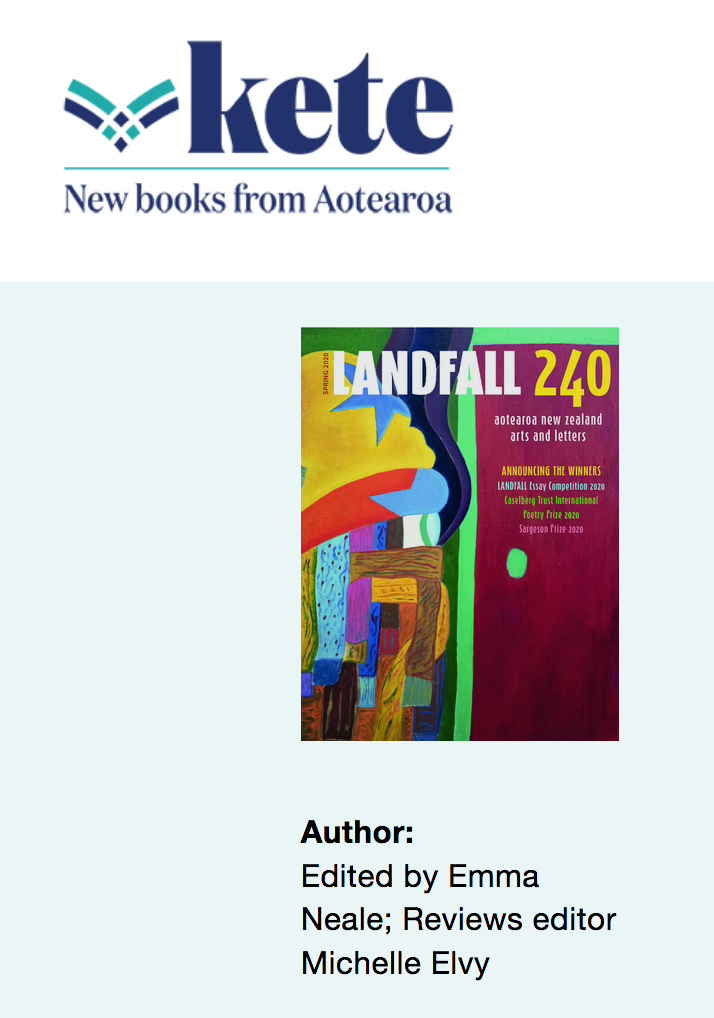
Landfall 238 edited by Emma Neale (Otago University Press)
I am finding literary journals very satisfying at the moment. They suit my need to read in short bursts throughout the day. Landfall 238 came out last year but the gold nuggets keep me returning. Is our reading behaviour changing during lockdown? I read incredibly slowly. I read the same poem more than once over the course of a week.
Helen Llendorf’s magnificent ‘Johanna Tells Me to Make a Wish’ is a case in point. It is slow and contemplative, conversational and luminous with physical detail. She starts with chickens, she stays with chickens, she intrudes upon herself with long parentheses. It feels like a poem of now in that way slows right down to absorb what is close to home.
Landfall 238 also includes results from the Kathleen Grattan Award for Poetry 2019, with judge’s report by Jenny Bornholdt; results and winning essays from the Landfall Essay Competition 2019, with judge’s report by Emma Neale; results from the Caselberg Trust International Poetry Prize 2019, with judge’s report by Dinah Hawken.
Tobias Buck and Nina Mingya Powles’s winning essays are terrific. Two essays that in different ways, both moving and exquisitely written, show distinctive ways of feeling at home in one’s skin and navigating prejudice. Both have strong personal themes at the core but both stretch wider into other fascinations. Would love to read all the placed essays!
I also want to applaud Landfall on its ongoing commitment to reviewing local books, both in the physical book and in Landfall Review Online. Review pages whether in print or on our screens seem like an increasingly endangered species. Landfall continues to invite an eclectic group of reviewers to review a diverse range of books.
To celebrate this gold-nugget issue – I have invited a handful of poets to read one of their poems in the issue.
Make a cup of tea or a short black this morning, or pour a glass of wine this evening, and nestle into this sublime poetry gathering. I just love the contoured effects on me as I listen. I have got to hear poets I have loved for ages but also new voices that I am eager to hear and read more from.
Welcome to the Landfall 238 audio gathering!
Louise Wallace
Louise Wallace reads ‘Tired Mothers’
Louise Wallace is the author of three collections of poetry published by Victoria University Press, most recently Bad Things. She is the founder and editor of Starling, and is looking forward to resuming a PhD in Creative Writing. Her days in lockdown are filled with visits to the park, bubbles, playdough, drawing, and reading the same handful of books over and over with her young son who she loves very much.
Cerys Fletcher
Cerys reads ‘Bus Lament’
Cerys Fletcher (she/her) is in her first year at Te Herenga Waka, splitting her time between Te Whanganui-a-Tara and her home city, Ōtautahi. When possible, she frequents open mics and handmakes poetry zines. She was a finalist in the 2018 National Schools Poetry Awards and the winner of the Environment Canterbury Poems on Buses competition in 2019. She has been published in Landfall and A Fine Line. She does NOT like men who hit on you while you’re making their coffee. She is online & probably wants to talk to you (instagram: @cerys_is_tired. email: cerysfabulousfletcher@gmail.com).
Rachel O’Neill
Rachel reads ‘The place of the travelling face’
Rachel O’Neill is a writer, filmmaker and artist based in Te Whanganui-a-Tara, Aotearoa. Their debut book One Human in Height (Hue & Cry Press) was published in 2013. They were awarded a 2018 SEED Grant (NZWG/NZFC) to develop a feature film and held a 2019 Emerging Writers Residency at the Michael King Writers Centre. Recent poems appear in Sport 49, Haunts by Salty and Food Court, and Ōrongohau | Best New Zealand Poems 2019.
Peter Le Baige
Peter reads ‘what she knows’
Peter Le Baige has been writing and performing poetry since the first session of the legendary ‘Poetry Live’ weekly poetry readings in Auckland in 1981. He has published two collections of his very early work, ‘Breakers’ 1979, and ‘Street hung with daylit moon’, 1983, and whilst living abroad for 23 years, mostly in Asia and China in particular, has continued to write. He has been previously published in Landfall and was one of the cast for the ‘Pyschopomp’ poetry theatre piece at Auckland’s Fringe Festival in 2019.
Jenny Powell
Jenny reads ‘Not All Colours Are Beautiful’
Jenny Powell is a Dunedin poet. Her latest collection of poems is South D Poet Lorikeet (Cold Hub Press, 2017). She is currently working on a new collection based on New Zealand artist, Rita Angus.
Annie Villiers
Annie Villiers reads ‘Bloody Awful’
Annie Villiers is a writer and poet who works in Dunedin and lives in Central Otago. She has published three books; two in collaboration with artist John Z Robinson and a novel. She is currently working on a travel memoir and a poetry collection.
Iona Winter
Iona reads ‘Portal to the stars’
Iona Winter writes in hybrid forms exploring the landscapes between oral and written words. Her work is created to be performed, and has been widely published and anthologised. She is the author of two collections then the wind came (2018) and Te Hau Kāika (2019). Iona is of Waitaha, Kāi Tahu and Pākehā descent, and lives on the East Otago Coast.
Stacey Teague
Stacey reads ‘Kurangaituku’
Stacey Teague, Ngāti Maniapoto/Ngāpuhi, is a writer from Tamaki Makaurau currently living in Te Whanganui-a-Tara. She is the poetry editor for Scum Mag, has her Masters in Creative Writing from the International Institute of Modern Letters, and has three chapbooks: Takahē (Scrambler Books, 2015), not a casual solitude (Ghost City Press, 2017) and hoki mai (If A Leaf Falls Press, 2020). Tweets @staceteague
Mark Broatch
Mark Broatch reads ‘Already’
Mark Broatch is a writer, reviewer and the author of four books.
He is a former deputy editor at the NZ Listener and is a fiction judge
for this year’s Ockham NZ Book Awards. His poetry has been published
in Landfall and the Poetry NZ Yearbook.
Susanna Gendall
Susanna reads ‘Spring’
Susanna Gendall’s poetry and short fiction have appeared in JAAM, Takahē, Sport, Geometry, Landfall, Ambit and The Spinoff. Her debut collection, The Disinvent Movement, will be published next year (VUP).
Murray Edmond lives in Glen Eden, West Auckland. His latest book, Back Before You Know, includes two narrative poems, ‘The Ballad of Jonas Bones’ and ‘ The Fancier Pigeon’ (Compound Press, 2019).
Mere Taito is a Rotuman Islander poet and flash fiction writer living in Hamilton with her partner Neil and nephew Lapuke. She is the author of the illustrated chapbook of poetry titled, The Light and Dark in Our Stuff.
Before we moved into Level 4 lockdown, I decided I would phone a NZ bookshop each week and get them to recommend a book and I would pick one to get sent out to me.
I didn’t get very far as bookshops had to close! But the day before lockdown I phoned Time Out Bookstore in Mt Eden and spoke to Kiran Dass. I so appreciated Kiran talking when the shop was packed with people stocking up on books.
I have saved the parcel until today because I wanted to hear that my big children’s poetry anthology I have been working on is ok. And it is! So I am very happy. And now I have my treat!
The books seem entirely perfect to be reading now.
In the middle of night recently I heard Rebecca Priestly in conversation with Kim Hill on RNZ National about her new book, Fifteen Million Years in Antarctica (VUP), and it was breathtaking. It was a podcast of their session at the VERB Wellington Writer’s Festival. I can’t wait to read this book. I can’t seem to find a link to the podcast – will add if I do!
Kiran recommended Olivia Laing’s The Lonely City (Allen & Unwin). Very excited about this book.
Like many bookshops, Time Out will start doing online orders from next week when we move into Level 3.
This is a time to go gently on ourselves, for some it is a time to read, and for some it is not, and that is ok.
Some of us are in positions to support small businesses again, and I plan to resume my support of independent NZ bookshops.
Tusiata Avia is a poet, performer and writer. She has published three books of poetry, a chapbook, three children’s books and is included in over 100 anthologies, journals and online publications. Tusiata has held a number of writers’ residencies and awards, including the CNZ Fulbright Pacific Writer’s Fellowship at University of Hawai’i and the Janet Frame Literary Trust Award. Known for her dynamic performance style, she wrote and then performed Wild Dogs Under My Skirt as a one-woman show (2002-2009). In 2016 it became a multi award-winning play for 6 women, directed by Anapela Polata’ivao. In January 2020 Wild Dogs Under My Skirt made its American debut, Off-Broadway.
in memory of Gerry Melling, poet and architect 1947-2012
I shall explain herein the arrangement and symmetry
of private buildings from the position of the heavens in respect of the earth,
the inclination of the zodiac and from the sun’s course
just the cold left now like a smooth glove on the top of my hand
though the joint between my fingers is still warm
an object under the eye will appear very different from the same object in an open space
think of the shell as part of the architectural setting, a shallow canopy
over the Madonna who, with her child, has been gathering raspberries
the injury which nature would effect is evaded by means of art
take, for example, the more tensile forms of tiny fish that dart,
a little more weighted with their body mass,
more straightforwardly down, slewing side to side like footballers
shaping new subtleties of line to distract the eye
it is the part of a skilful (wo)man to consider the nature of the place,
the purpose of the building and the beauty of it
think of the falcon and the falconer,
of words in circular and ovoid shapes like the seventy-one
cervical vertebrae that held up the neck of the plesiosaur
think of Beethoven’s Quartet No. 15 in A minor
think of the Sky Box overlooking the West Bank in Wellington
think of Gerry and Geoff and Celeste and all the other beautiful people
Bernadette Hall
italicised text taken from the writings of the Roman architect, Vitruvius 80-15BC
Bernadette says: Here is my lockdown poem. Some of the lines have been floating around for a while. I’ve long wanted to write something for Gerry. How good that this week Geoff Cochrane and Celeste should join him. I’ve no idea who Celeste is. She appears in one of Geoff’s poems. She sounds beautiful. All I can say is, here’s to love and friendship, they are timeless. And thank you to all who are working to keep us all safe.
Although April is rather a challenging month for its release, I’m very proud to be publishing this novel.
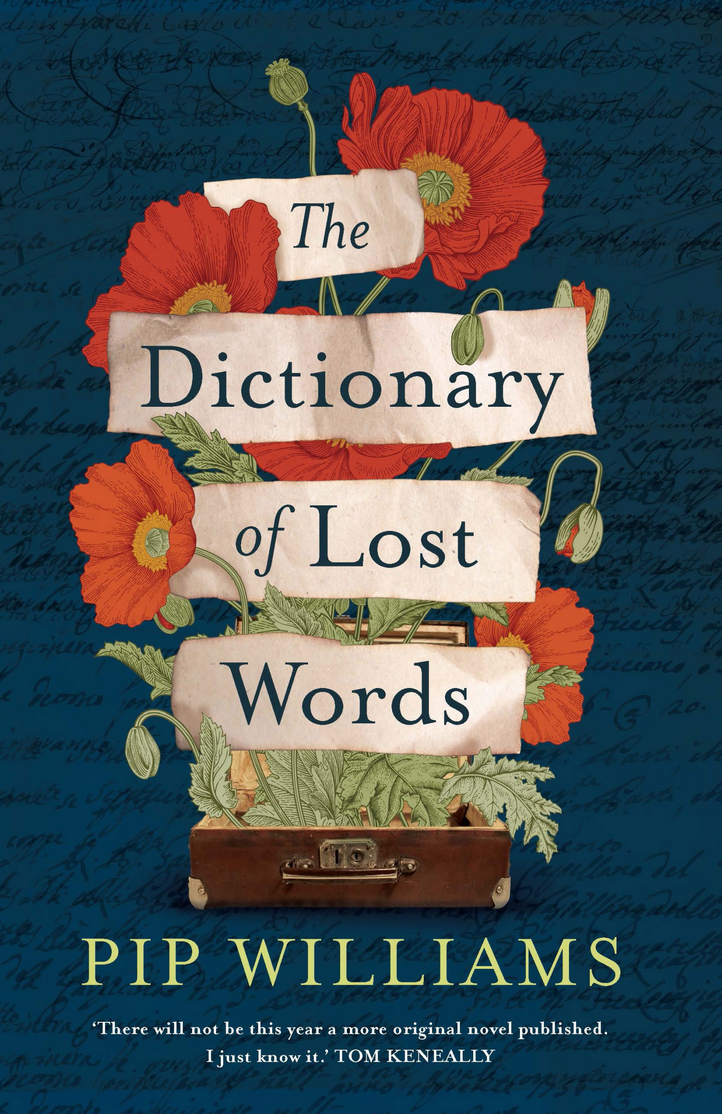
It is a Tardis of a book, for within its covers are various intriguing stories, a modern novella with an unusual love-hate triangle, a visit to the afterlife, biographical details of Edith Wharton, including the revelation of a secret love affair and indeed walk-on parts for Edith and a number of her circle, a tour through the gardens Edith wrote about and visited in Italy and created in America and France, plus snippets from Wharton’s own novels, poetry and memoir, and a whole lot more besides – all of which is integrated into a wonderfully upbeat and enthralling novel.
Philippa is indeed a literary Dr Who, taking us through time and space. We watch the young Edith in a rowing boat, waiting for a marriage proposal that never comes, we visit the Mount, the mansion she went on to build in Massachusetts, we drive with her, Henry James and a dashing rogue through the snowy countryside, we travel to modern-day Hyères in the south of France, and we are flies on the wall of a seedy hotel room in London.
When I used to picture Edith Wharton, I’d think of an amalgam of Gillian Anderson playing Lily Bart in the film of The House of Mirth, the wonderfully pompous characters that people Wharton’s novels and often deliver the acerbic and hilarious one-liners that would give Jane Austen a run for her money, and the photographs of Wharton that generally capture very grand settings and clothes but so often a rather wistful expression that has always made me wonder what the real woman was like. Thanks to The Night of All Souls, I now reckon I know her rather well. She’s come alive again in this novel and is someone I’m very reluctant to say goodbye to.
In fact, everyone who worked on this novel expressed reluctance at having to pass it on – we all wanted to stay in these multiple worlds, getting to know this fascinating woman. You can sample a chapter here
and look out for the Penguin Facebook page for Philippa’s launch speech and her daughter reading an extract.
You can access a copy through numerous online channels
Marsden Books in Karori was going to launch The Night of All Souls, so a big shout-out to them. As soon as bookshops open again, you can of course also purchase physical copies, and I urge you to do so as it is well worth making the acquaintance of Edith Wharton.
Very happy the Herald will be posting a poem of mine for awhile. I am not sure if they are poems. They need a new word. Lockdown writings. Maybe it is a nocturnal diary. They arrive in the middle of the night and spin in my head during the day and then hit paper. Karyn Hay talked about writing in her contribution to the comfort reading list I posted on Friday 17th April. I so identified with it. There is no model at work here. There are different urgencies and stasis, multiple ways of connecting. But I do feel an urgent need to write before the sun comes up. Some of us are writing and some of us aren’t, some of us are reading and some of us aren’t, some of us are baking bread and some of us aren’t, and I think the last thing we need is pressure to do anything that does not aid our well being.
My poem has lost all the spacing between sections and I don’t care. I do care that after almost giving up hope the cress and the spinach have poked through the earth. And peas. And something else, the rain washed my writing away. Now I wait for other little miracles as I do what I can.