Category Archives: Poetry

July On the Shelf: Picks by Vincent O’Sullivan, Sue Wootton, Ros Ali, Sam Sampson

Vincent O’Sullivan: I can’t imagine moving further from the kind of poetry we tend to write in New Zealand, and the kind we probably mostly read ( allowing for the crass generalisation that of course implies!), than to what I’ve been so delighted by over the past couple of months in Ilan Stavans’ huge anthology, The FSG Book of Twentieth Century Latin American Poetry (Farrar Straus and Giroux, 2011). The Introduction is smart in the best sense, informative and challenging. Then seven hundred pages of poets from a dozen countries. There are the poets one can’t help but have come across, the marvellous so un-English figures like Neruda and Paz and Vallejo, but then so many others I didn’t know, and was bowled by – the Brazilian Carlos Drummond de Andrede, say, whose ‘The Elephant’ is probably the best animal poem I have read. A book to open at random, where you’re hardly ever likely not to be snared.

Of poets closer to home, I’ve especially admired Caoilinn Hughes’ Gathering Evidence (Victoria University Press, 2014). We don’t have many writers so at ease with either the long line’s six or seven stresses, or with so sustaining narrative as poetry ( I mean narrative with the same qualities as good narrative in prose, and then more as well.) And this, with the taut, vivid phrasing of fine lyric. A book you come out of, feeling the horizon is that touch further than you thought.

Vincent O’Sullivan is the current New Zealand Poet Laureate. Victoria University Press released a collection of his short stories, The Families, earlier this year. You can see my review of it here.


Sue Wootton: A collection I’ve been re-reading with great pleasure recently is The Overhaul by Scottish poet Kathleen Jamie (Picador, 2012), winner of the 2012 COSTA Poetry Prize and shortlisted for the 2012 TS Eliot Prize.  It’s a book that gives you sharper eyesight, better hearing, that makes your body into compass and barometer.  Jamie’s voice in these poems is clear and concise, managing to appear almost matter-of-fact while also being elegant and lyrical. She gives equal weight to everything she scrutinises – to spider, roe deer, stag, osprey, hawk, swift, blackbird, weather-beaten clinker, bluebells, roses. A collection that seems to me be part rapture, part lament, it’s full of questions, like this from The Spider: “Who tore the night?/ Who caused this rupture?/ You, staring in horror/ – had you never considered/how the world sustains?”

My Poetry Book of the Winter this year is The 20th Century in Poetry, edited by Michael Hulse and Simon Rae (Pegasus, 2013). This rich anthology opens in 1900 with Thomas Hardy and ends in 2000 with Jeffrey Harrison. In between it takes in a broad sweep of English language poets from a variety of countries. New Zealanders include Vincent O’Sullivan, Elizabeth Smither, A.R.D. Fairburn, Bill Manhire, James K Baxter and Katherine Mansfield. With almost 800 pages of poems, it’s a joy to open at random. Just now I picked it up to write about it and it fell open at Gwen Harwood. I read ‘Prize-Giving’ and closed the book. I picked it up again:  Tony Harrison (‘The Mother of the Muses’).  The third time, it gave me ‘The Steeple-Jack’ by Marianne Moore. You can’t really go wrong.

Sue Wootton is a Dunedin poet. Her latest venture is Out of Shape, a letterpress collaboration with Caren Florance of Ampersand Duck (Canberra). The exhibition of framed poems from this unbound book is on until July 4th at The Fix cafe in Frederick Street, Dunedin.  See website for details.

Ros Ali: It’s too hard to choose favourite books of poetry. Like trying to rank best friends. So I’ll cheat a little and tell you about two books I’ve dipped into the most over the last few months, to help inspire my students to enter ‘imaginary gardens with real toads in them.’

Essential Poems from the Staying Alive Trilogy, edited by Neil Astley (Bloodaxe Books, 2012) is a ‘portable travel companion’ housing numbers of my favourite poems from the popular UK Staying Alive, Being Alive and Being Human anthologies

Take Naomi Shihab Nye’s, “Kindness”, for example. I give this poem to all my students at the beginning of the year, hoping they, too, will look to it in difficult times and find:

… it is only kindness that makes sense anymore,

only kindness that ties your shoes

and sends you out into the day to mail letters and purchase bread,

only kindness that raises its head

from the crowd of the world to say

it is I you have been looking for,

and then goes with you everywhere

like a shadow or a friend.


Another small and important book, an essential reader in the classroom, is Why Poetry Matters by Jay Parini (Yale University Press, 2008).

Here, we are eased backwards and forwards in ‘conversation with the traditions,’ as Parini discusses the craft and experience of poets from Ancient Greece to modernist America. Of most significance, perhaps, for young people finding their identity in the world and on the page, Parini deals with poetic voice, which he perceives as ‘offer[ing] an antidote to the bludgeoning loud voices of mass culture … thus staking a claim for what used to be called the individual soul.’

Parini observes that poetry’s power and transcendence are internal. Poetry ‘doesn’t usually send masses into the streets to protest a war or petition for economic justice. It works in quieter ways, shaping the interior space of readers, adding a range of subtlety to their thoughts, complicating the world for them.’

I love that Parini gently nudges us to conclude that yes, poetry matters. It matters profoundly. Poetry allows, among other things, insight into the ‘substance of our lives…to see ourselves freshly and keenly.’

Ros Ali teaches English and runs a Writing Programme at St Cuthbert’s College. She also works with  Jo Emeney in the  Young Writers’ Programme, of the Michael King Writers Centre, offering writing workshops  for senior secondary students. Recently Ros and Jo ran series of student workshops  for New Kiwi Voices, sponsored by the Albert-Eden Local Board.


Sam Sampson:

Stunning debut of the repairing of a life, Leigh Davis (Otago University Press, 2010)

‘The only joy of poetry is the trance of language. All the rest is sentiment’

(Leigh Davis, Sunday Star Times, July 25, 2010)

The late Leigh Davis wrote this book after a major operation to remove a brain tumour. It charts not just the resurrection of language, but also the metamorphosis of language. Emerging from the chaos of trauma, the book takes us on a journey, the mapping of a new voice…the re-emergence of an old voice…the distillation of a polyphonic voice. Visually the introductory notebook pages ( Simple / Broken / Beautiful) preserve (collect, if you will) a sense of origins, contexts, which the new composition will never quite obscure.

As a composition it is authentic in its format of fourteen-line semi-autobiographical utterances. The body will die, but the language is an embodied presence. To progress we must surrender to such a presence and be comforted by incoherence. Delivered in almost meditative flashbacks we feel the bumps and joins (of Davis’s favourite texts) trace the surface of the poem, and feel where one piece of language meets another – where texture and temperature change.

The proem, or ars poetica that begins the book is both elusive and revelatory: I want to reflect what I live with, to extract representation’s / subtle body in even the most intimate moments.

By the Bias of Sound Selected Poems: 1974 – 1994, Gustaf Sobin (Talisman House, 1995)

When I first encountered Gustaf Sobin on the Shearsman Press website, I was so moved by his clarity of vision that I used a fragment as an epigraph for my first book (wanting to say / wanting to / hear/ what it is that / I wanted to say), and when he died in 2005, dedicated a poem to him in my new book. Sobin was an expatriate American poet who spent most of his adult life in France, moving to a small hillside village in Provence, near the home of Rene´Char, whom he admired greatly. His syntax is to break the line, the word, and embody language, such that it is never inert. Nouns become verbs, the inanimate becomes animate with each unit of breath. As Heidegger’s investigation into ‘Being’ (Dasein), Sobin’s poetry attempts to strip away artifice and provide a musical scaffolding for the thought-speech continuum. One of my all time favourite poems is Sobin’s ars poetica: ‘The Earth As Air: An Ars Poetica’.

An Elemental Thing, Eliot Weinberger (New Directions, 2007)

Reading Weinberger was like turning a multifarious kaleidoscope that throws up new angles with each viewing. Thirty-five prose fragments / essays (including the Preface) where the only rule is that the information is verifiable. It reminded me of my early studies in ethnomusicology and the discoveries of ethnomusicologist William P. Malm’s – Music Cultures of the Pacific. The Near East and Asia – I returned to as an attentive explorer. As with Malm’s investigations, Weinberger’s poetic essays both narrate and articulate liminality inside and outside the frame of reference. Where does the text / key take us? Is the music even dictated by a key? As a form, does the prose element restrain the voice or accelerate the vision?

Century Swept Brutal, Zach Savich (Black Ocean, 2013) and The Self Unstable, Elisa Gabbert (Black Ocean, 2013)

I’ve just received two volumes from the small U.S. press Black Ocean.

The first by Zach Savich stakes out a fractured quality of mind; unsettling, and responsive, it is at once being consciousof its own consciousness.

He writes: …Beauty being cause / not effect; not perceived / perceived with / Century-swept brutal, the new flags / dry on wires.

He sings: Asters in the sill / hat brim thin. / Willow’s the only green for a time. / I place in a small envelope. / I gauge the season by what is in my hands…

Elisa Gabbert’s prose blocks, build a frame for the self, the body framed, the language re-framed. An alphabetically arranged index at the end of the book throws the reader toward a referable lexicon of subject matter: If information has replaced the story, what will replay information?

From ‘Enjoyment Of Adversity: Love & Sex’:

Girls want to be beautiful. Boys want to be powerful. In other words, everyone wants to be powerful. The appeal of Houdini and lingerie is the same: The more straps you wear, the nakeder you look. The only natural responses to vulnerability are love and violence.

Sam Sampson‘s latest poetry collection, Halcyon Ghosts, was recently published by Auckland University Press. I will post an interview with Sam this week and review his collection shortly.


Carla Harryman and Barrett Watten in Auckland 14 July 2014

Carla Harryman and Barrett Watten in Auckland 14 July 2014

You are warmly invited to attend talks and readings by distinguished North American poets Carla Harryman and Barrett Watten on Monday 14 July at the University of Auckland and the Central City Library. All events are free and public.

Carla Harryman, ‘The Obituary of the Many, a talk on Gail Scott’s The Obituary.’

Arts 1 (14a Symonds St), Level 5 Common Room, University of Auckland, 10am-12 noon.

Barrett Watten, ‘Regions of Practice: On the Advantages of Negativity.’

Arts 1 (14a Symonds St), Level 5 Common Room, University of Auckland, 2- 4pm.

Carla Harryman and Barrett Watten  Poetry Reading at Auckland Central City Library, 5.30-7pm.

44-46 Lorne St, CBD. Poster: http://www.nzepc.auckland.ac.nz/features/harryman-watten/Harryman-Watten-reading-poster.pdf

Carla Harryman is a poet, essayist, novelist, and playwright. She has published thirteen single-authored works, including Adorno’s Noise (Essay Press, 2008), Open Box (Belladonna, 2007), Baby (2005), and Gardener of Stars (2001) and has received numerous grants and awards including from the Foundation for Contemporary Art, Opera America, the American Embassy in Romania, and the Fund for Poetry. A frequent collaborator, she is co-contributor to the multi-authored experiment in autobiography The Grand Piano, a project that focuses on the emergence of Language Writing, art, politics, and culture of the San Francisco Bay Area between 1975-1980. The Wide Road, a multi-genre collaboration with poet Lyn Hejinian was released in 2011 from Belladonna Press. Her poets’ theater and interdisciplinary performance works have been performed nationally and internationally, while her writing has been translated into a number of European languages. Her work is widely anthologized including in The Kenning Anthology of Poets Theater, Great American Prose Poems, The Norton Anthology of Postmodern Poetry, Biting the Error: Writers Explore Narrative and in international collections such as La Lengua Radical, Action Poétique: Etats-Unis Nouveaux Poétique, and Out of Everywhere: linguistically innovative poetry by women in North America and the UK.

 Barrett Watten is a language-centered poet, critic, editor, and publisher. His collected early poems, Frame: 1971–1990, appeared from Sun & Moon in 1997; Bad History, a nonnarrative prose poem “including history,” from Atelos in 1998; and Progress/Under Erasure, in a combined edition, from Green Integer in 2004. He edited This, one of the central publications of the Language school of poetry (1971-82), and co-edited Poetics Journal with Lyn Hejinian, featuring writing on poetics by poets and academics. He collaborated on two multi-authored projects: Leningrad: American Writers in the Soviet Union (1991) and The Grand Piano: An Experiment in Collective Autobiography (2006–10). With Carrie Noland, he coedited Diasporic Avant-Gardes: Experimental Poetics and Cultural Displacement (Palgrave, 2009); Wesleyan University Press is in the process of publishing a combined print/digital Guide to Poetics Journal and Poetics Journal Digital Archive in 2013-14.

For further information please contact Michele Leggott (m.leggott@auckland.ac.nz) or visit Carla Harryman and Barrett Watten in New Zealand at http://www.nzepc.auckland.ac.nz/features/harryman-watten/

Gregory O’Brien has a gig on Best American Poetry website– first up Bill Manhire

Gregory O’Brien has a gig coming up on the Best Amercian Poetry website.

12 weeks of New Zealand Poetry!

First up one of my favourite Bill Manhire poems.

Follow my two links for details.

Creative Writing discussion on National Radio

Great discussion on National Radio this morning on Creative Writing with Robert Sullivan, Eleanor Catton and Daren Kamali as guests. All connected to the Manukau Institute of technology programme.

Listen here

Māori poets celebrate Matariki

kiripiahana_160x170  apirana_taylor   robertsullivan_160x151

An exciting group of Māori poets – several of the country’s leading poets and some emerging writers – will come together to celebrate Matariki with readings and korero at a free event on Saturday June 28.

Māori Poets Celebrate Matariki features Ben Brown from Lyttelton, Apirana Taylor from Kapiti, with Auckland’s own Robert Sullivan, and social historian, novelist and poet, Kelly Ana Morey, from Mangawhai. It also features writer Te Awhina Arahanga, publisher and poet Kiri Piahana-Wong, and an emerging young poet Amber Esau.

This is a rare opportunity to hear some of the leading Māori poets in Aotearoa today, together with the next generation of talented young writers. It is a free event, part of the 2014 Matariki Festival, supported by Auckland Council and the Michael King Writers’ Centre.

Where:  Depot Artspace, 28 Clarence St, Devonport, Auckland
When:   Saturday, June 28, 2014, 4 pm
Free

Poem Friday: Cliff Fell’s ‘Once’ absorbs the pitch and shfts of Dante

188257_258223857536748_215928848432916_1103068_3434173_n


Once

Once when I was living in Florence

cycling home in the early hours

I heard an owl high in the campanile

and took a wrong turn down a wooden ramp,

an excavation in the Piazza Signoria—

and found myself in the city beneath the city

cycling between small ancient houses,

through alleys vaulted by the world of light

and the paving stones I knew.

They say we go into the ground

to know where Death will take us,

but I had entered this other world

in lively wonder— for I was in love with poetry

and the spectral light it casts over

the past and present and perhaps even the future,

though it is hard to say for sure what light

poems will cast over the time that is yet to come

or even that they will survive.

I only knew and cared that I was alive

in the catacombs and tumble

of a lost city, and that what I thought an alley

was really a thoroughfare leading to the river

between small shop fronts

such as you might find today

in cities like Herat or the Byculla backstreets

of Bombay— Mumbai as we must say.

Now I had to dismount to push the bike

and it seemed I had been heading

somewhere beneath the Uffizzi

for I had come to the waterside, though still

on a stratum below this world—

I could hear cars moving above me

on the via Lungarno,

the swish of their tyres on the cobble street,

close to the corner of Pontevecchio

and the nook where Dante once waited, alone and forlorn,

hoping to catch a glimpse of Beatrice,

as the pall-bearers carried her away.

Nothing ever happens twice,

and yet as I stood in the dank and must

of that underworld scene,

in what was once the Etruscan city,

I felt those old stones tensing up,

as though they could sense the poet in the shadows

waiting for the cortege to pass him once more,

and then to pass again.


Cliff Fell lives near Motueka. His latest publication is the illustrated poem, The Good Husbandwoman’s Alphabet, which is available in good bookshops or through messaging him on his Facebook page.

Cliff’s note: I can’t remember now exactly why or how I came to write ‘Once’,  but I think it must have been after a trawl through old notebooks and finding an entry from my Florence diary, where I lived in 1983 and ’84. I know it all sounds imagined, but in fact it’s based on a real event. I really did take a wrong turn on a bicycle down an archaeological excavation ramp in the Piazza della Signoria and find myself in the Etruscan city. Perhaps I didn’t get as far as the river, though. And there was an owl, too – but that was in the Piazza San Carmine, where I lived in my little car, an Allegro, through the autumn of 1983.

Paula’s note: Reading this poem I was taken right into the throbbing heart of Firenze with the shining detail of place, but I was also taken into the heart of Dante’s Inferno. It as though the narrating voice has absorbed the pitch and shifts of Dante as he (whichever) journeys deep into the underworld. This air of another poem accentuates the way Cliff’s poem is rich in strata. It is a physical journey located in time and place, but the poem also layers other travels. The old poet standing in the shadows awaiting his Beatrice is companion to the new poet on his bicycle (new world, contemporary time, young, alive). There is the way the movement into wrong turns and unexpected places yields mnemonic connections, and the way this physical and cerebral movement can be likened to the process of writing. The writing trope fits the poet perfectly (and I am also reminded of the freewheeling link between cycling and writing a poem). The way when you write a poem you stumble, take wrong turns, enter dark and light, emerge from dark and light, notice that things are not always as they initially seem. Each line of Cliff’s poem is handled with a deft touch, and each line takes you into the translucent sheen and surprise of the world with one stroke and into the lyrical beauty of Dante with another.

Zarah Butcher McGunnigle’s Autobiography of a Marguerite– out of illness, lacework poems, kinetic poems

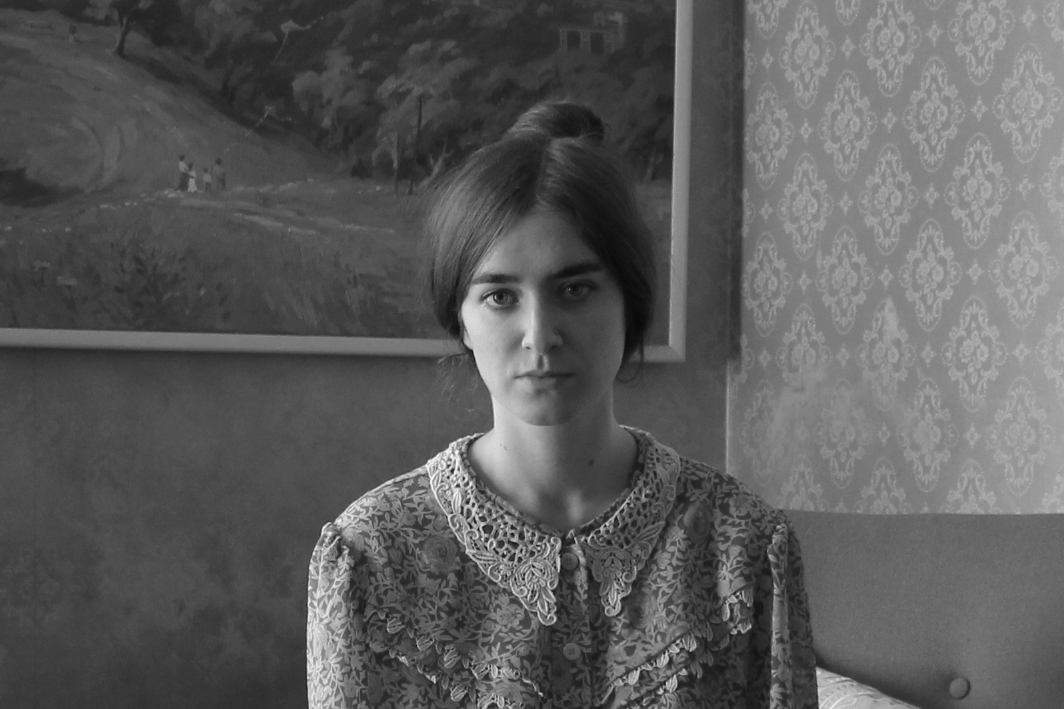
ZarahButcher-McGunnigle_1

Photo courtesy of Hue & Cry Press

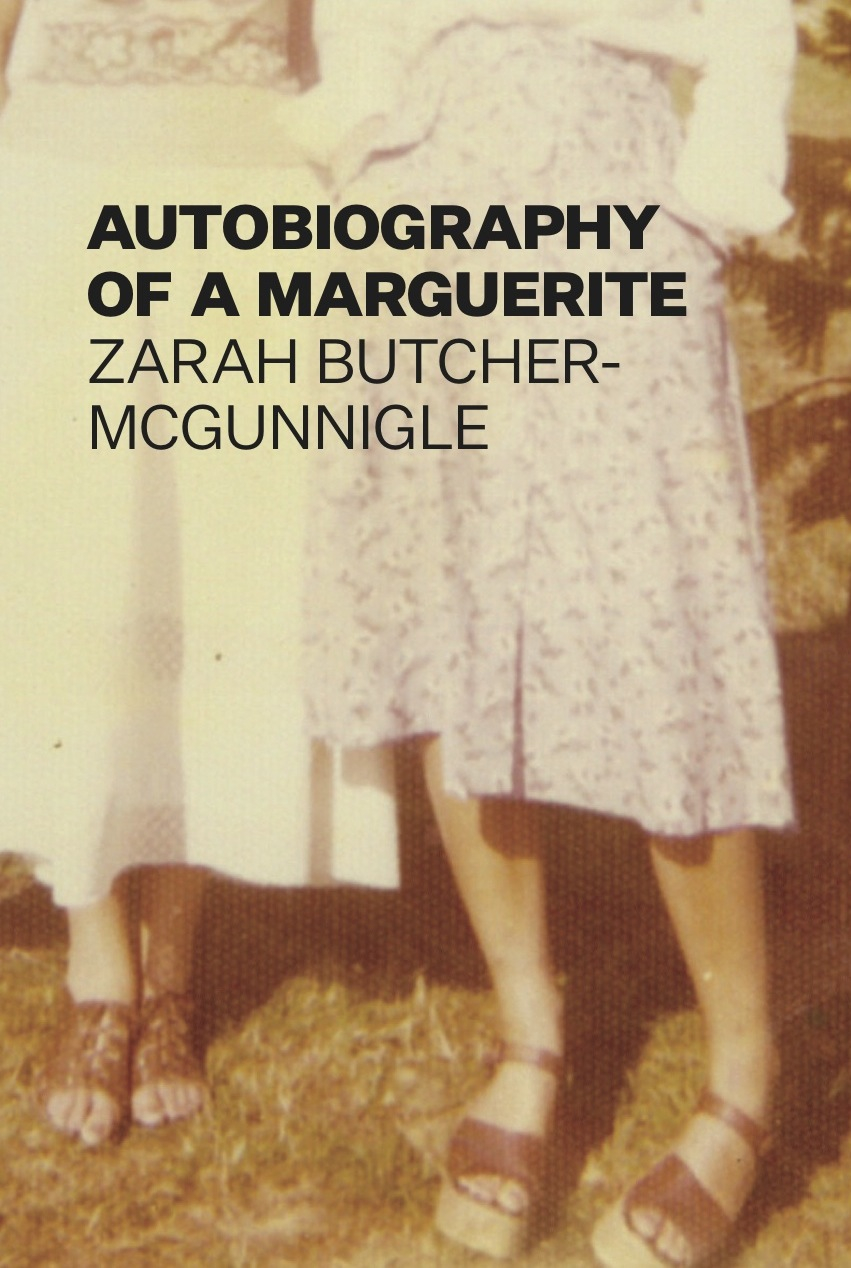
Zarah Butcher-McGunnigle’s debut collection, Autobiography of a Marguerite (Hue & Cry Press, 2014) sent me in search of a new terms to describe the effect it had upon me. This book-length poem is poetry in pieces—poems that piece together an experience of illness, family relations and the need to write. Yet as much as there are threads and mood and revelation, this is lacework poetry. You see enough to experience the whole, and more importantly, to acquire new ways of reading and writing poems.

The book is in three parts and each part works a little differently in terms of writing choices. The first part consists of prose-like poems. The poems in the second part are given more breathing space, but they are interrupted, wonderfully so, by footnotes (and not conventional footnotes, I might add). In the final part, there is a return to poetic prose, or prose-like poetry, that is offset by photographs that take you back to mother and daughter (amongst other things).

It is a book of illness, anonymous illness, as the details of diagnosis are only ever hinted at. This is poetry of the gap, of the hinted at, and of silence. Names are left off the line. Questions are laid down as statements (no question marks) as though answers are elusive (as indeed they so often are in illness). The silence and the gap suggest that illness is unfathomable at times, hard to tell, exhausting to tell—so much better to divert and filter so it becomes poetic lacework. In the second part, sentences are truncated and left hanging on the line as though the poet is breathless, weary of the full story. To me it is also akin to memory—the way it is spasmodic, episodic, shard-like. If this is lacework, it is a lacework of beginnings. And then life—lifegoes on, uncomfortably, differently with the arrival of illness, as the narrator moves in and out of family and school routines, friendships, her writing.

Each section is full of poetic rewards, but I was particularly taken with the middle section where footnotes interrupt and introduce a different way of reading. Astonishing. These footnotes are taken from books by Marguerite Duras and Marguerite Yourcenar. You physically move your head in and out, up and down—crossing an unexpected bridge between Zarah’s line and the line of a Marguerite (you never know which one). That movement across the bridge is glorious—it produces a tremble and ripple of connections and meaning. This poetry is unlike anything I have seen. I am calling it kinetic poetry. There is the movement across the little footbridges, but there is also the way each discrete line vibrates. Like a little earth tremor. And in these little vibrations, there are miniature collisions between this line and that. Side stepping. Side dancing. Side tracking.

There is so much to love about this book. A thousand movements to take you elsewhere and then return you to the moment, to the page. There is the watch that is often looked at but is not on the wrist—as though illness is a state of not-time, unreal-time, faked-time, thwarted time, longed-for time. Or there is the way the delicious word play takes me to Gertrude Stein  (‘poured system’ then ‘Poor system’; ‘weekend’ then ‘weak end of’). It comes back to the way a word stretches to accommodate the nuances and implications of a body ill at ease. Or the way the mother, a Marguerite, flickers and trembles like the narrating I (‘Her mother used to say I don’t know what I’d do without you’ and its footnote ‘You’re right, this is not normal weather for this time of year’). Where does she begin and where does she move to next? Her illness, her illness. Her discomfort, her discomfort. The way words puff out with the need to get things right (‘the filling is not always filling,’ ‘is progress slower than you expected or slower than you hoped’). And the way in illness, and in the memory and physical deposits of illness, writing is vital. An essential anchor. A lifeline.

So much more to write and think which means it is a book of returns.

I just loved this book. Thanks to Hue & Cry Press I have a copy of this book for someone who likes or comments on this post.


Rachel O’Neill has  an illuminating interview with Zarah here.

Zarah’s Hue & Cry author page here .


AutobiographyofaMarguerite_cover  AutobiographyofaMarguerite_cover   AutobiographyofaMarguerite_cover

Poem Friday: Rata Gordon’s ‘Thumb in a House’ meaning and narrative spin on tiptoe surprisingly

IMG_1694 - Copy

Photo credit: Amber McLennan


Thumb in a House

pinching flakes for gold

fish two piglets nose

my palm pink cheeks in

the light of a hut

bamboo poles and sheets

with pansies and holes


blue rope swing a stick

to sit on dust up

my nose when a car

speeds past a red streak

in our dog’s fur where

the neighbor shot her


polar bears live in

the toilet’s white ice

rabbits as big as

your thumb in a house

boat floating in the

hall the cat ate my

mouse and a fantail


swam through the window

to say our granddad

has gone somewhere else

but warm pajamas

by the fire a sip

of rain before bed


Rata Gordon is a seventh generation New Zealander who lives in Grey Lynn. Her life at the moment involves writing, drawing, dancing, and planting trees. Rata’s poems have appeared in LandfallDeep South and JAAM (forthcoming).

Rata’s note: This poem is built from memories of my childhood home in Waimauku, West Auckland. I wrote it while I was in Begnas tal, a wee village in Nepal. I noticed that the physical distance from home made some things float to the surface that I hadn’t thought about for years.

It was an exercise piece for Whitireia’s Online Creative Writing Diploma and was my first attempt at a syllabic poem. I enjoyed the way that the syllabic constraints broke up and stitched together my memories in strange ways. It seemed like a good match for swift and bewildered childhood perception.

Paula’s note: The title of this poem hooked me. Incongruous. Puzzling. The accumulation of detail is the second hook. Sensual. Vibrant. Strange. Earthy. I love the way the lack of punctuation amplifies the momentum of the poem—both the ambiguity and the surprise. This is the gold nugget in this poem. The way each line break holds you back and then in delivering you smashes your expectation. Glorious. For example, follow this thread: ‘the cat ate my/ mouse and a fantail/ swam through the window.’ Constant little dance flurries in your head as the meaning and narrative spin on tiptoe surprisingly. There is also a elastic stretch between home and elsewhere (‘warm pajamas’ and ‘hut/bamboo poles’). You stall and you pirouette as you read, but there is a honeyed fluency. Just wonderful!

Lovely to hear Zarah and Rachel read in Auckland last night

IMG_4609  IMG_4608

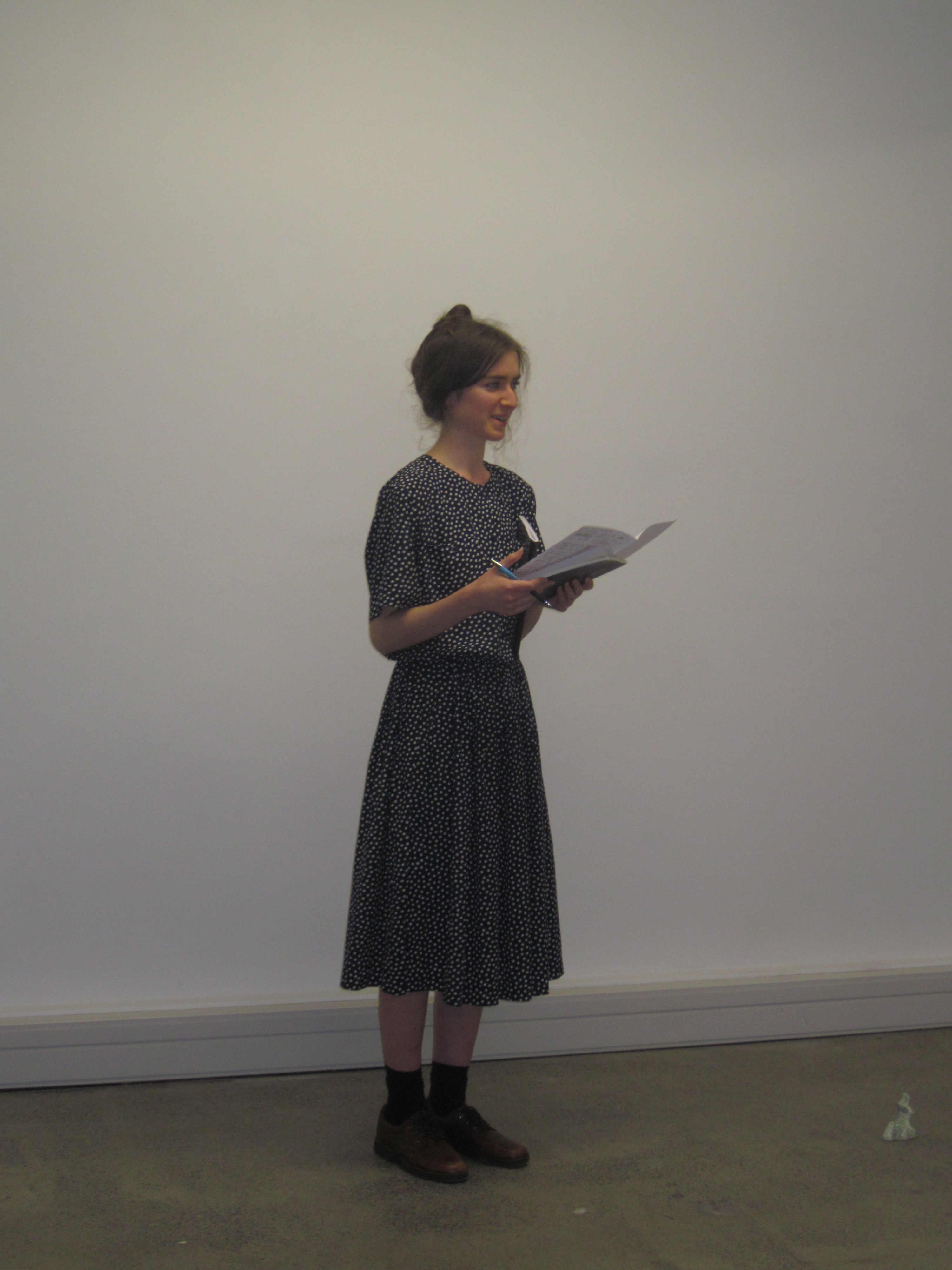
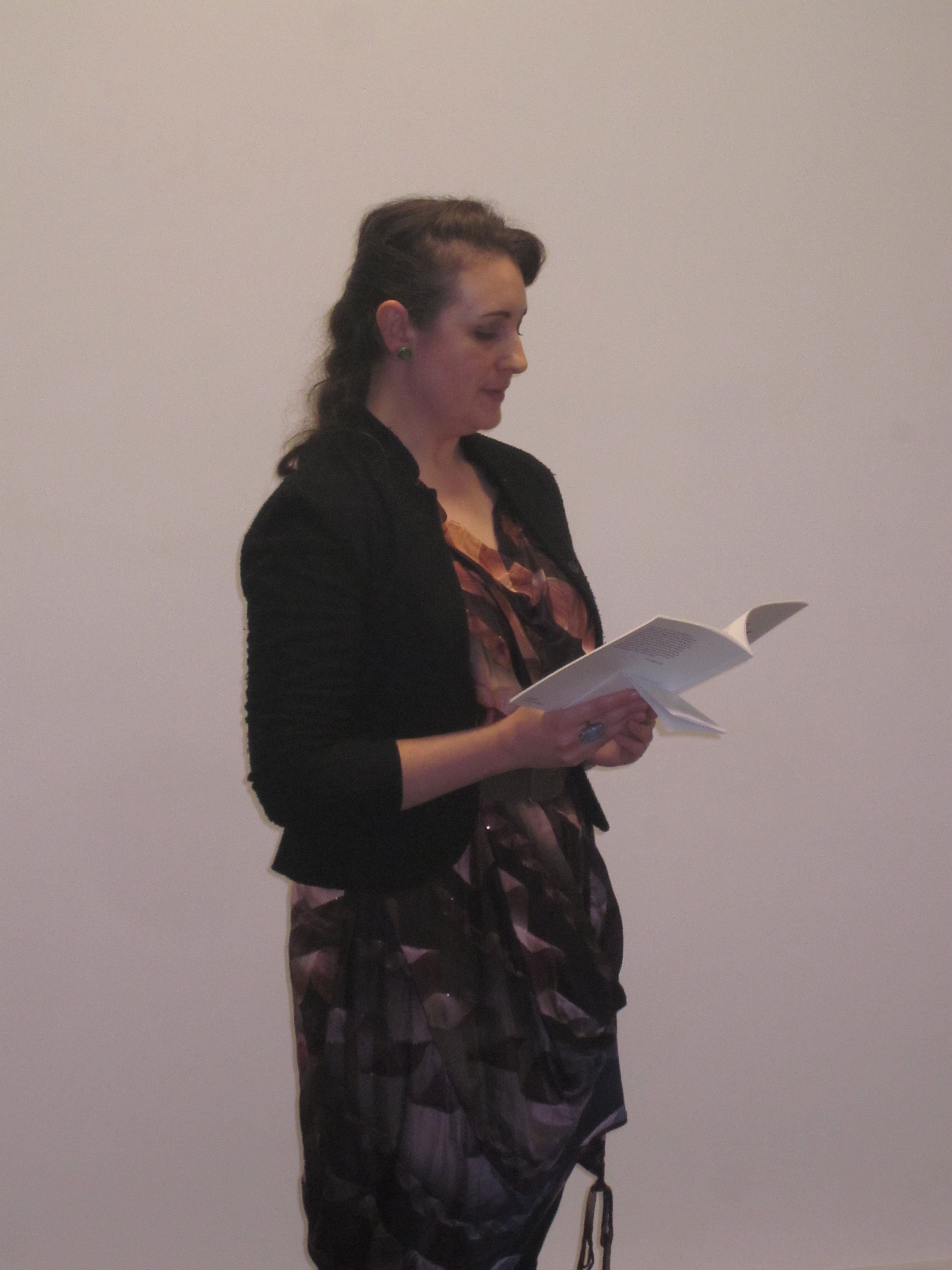
Zarah Butcher-McGunnigle and Rachel O’Neill read from their debut collections in Auckland last night. What a stellar job Hue & Cry Press is doing (Publisher Chloe Lane and editors Amy Brown and Lawrence Pratchett). These collections offer much for the reader both on the page and in the air—I will post a review of Zarah’s Autobiography of a Marguerite early next week. My review of Rachel’s One Human in Height is  here.

Yes! Autobiography of a Marguerite is astonishing. Delighted to be launching it tonight

And Rachel O’Neill’s terrific One Human in Height. Hue & Cry are forging a great stable of poetry

Thursday  6pm 12 June 2014
RM GALLERY, 1st Floor, 307 K Road, Auckland, Entrance on Samoa House Lane

AutobiographyofaMarguerite_cover   AutobiographyofaMarguerite_cover