The journal is here


I, Clodia and Other Portraits Anna Jackson, Auckland University Press, 2015
Anna Jackson has published five collections of poetry including Thicket (Auckland University Press, 2011) which was a finalist in the New Zealand Post Book Awards. She currently teaches English Literature at Victoria University.
Anna Jackson’s new collection contains two sequences that step up from everything she has previously written to a lightness that is fierce, a spareness that is complex. Poems become voice, voice becomes reaction to/against, reaction become autobiography, autobiography becomes invention. The pleasure that the poetry generates is multiple; from the exquisite loop of sound to the ideas that pierce, to the stories that accumulate, to the silent patches that are not in fact silent.
The first sequence, ‘I, Clodia,’ signals a return to Catullus, but now his muse, his beloved (Lesbia, Clodia), speaks. There has been a wide line in recent times of re-visioning, resiting, reclaiming, re-presenting women from the shadows of history; women who were spoken on behalf of, who were seemingly passive, are given voice. Anna’s version prompts thinking in myriad directions. The poems are laid across an underlay Catullus carpet. I followed Anna’s directive and read his poems in the order proscribed so that I might absorb the intriguing underlay as I read. In the end, it felt like Anna had given flesh to the bare bones of Catullus’s Lesbia (Clodia). Invented because Anna was working with the protruding bones of a skeletal figure, yet this sequence also gains fire and contextual zest through diligent research. The poems come to life within the context of the times hinted at — the events, relations, circumstances. The degree of research for such a slender sequence could have rendered the historical (the facts, the near-facts) cumbersome, but instead history becomes the lily pads of the poems. Drawing the eye close, moving ever so slightly on the drift of water, encouraging the mind to make little leaps.
What of the voice? No whimsical, petal-of-a-voice here. This is where the layers utterly captivate me. Draw me into a woman brought to sparking life, and all the issues and ideas that emanate. Clodia addresses his charges (‘but to counter them one by one in order’) and declares her love (‘Oh, I loved you, and being loved by me did/ you not take more than you could ever give me?’). She throws his questions back at him (‘Whom shall I love now?’ ‘Whom shall I permit to visit?’ ‘It seems we are occupied with the same questions’). She is fierce (‘You had better be leaving’) and in his moment of speechlessness, she replenishes her own stanzas (‘I’ll fill my/ stanzas up while you can be silent for once’).
We come hard up against the authority of the male poet on the page. His authorship legible, enduring. She, however, ephemeral. Catullus writes: ‘but a woman’s words to her eager lover/ should be written on running water, on the wind.’ Clodia counters (by way of Anna): ‘I can just see you/ scuttling about on the shore, peering/ suspiciously at the ocean and calling it/ a fickle thing’. Ha! He is desperate to read her, yet would not want her words set in concrete, with script and ink that lasts. In this sequence, Clodia exists beyond the contrary longings of Catullus; she exists beyond him in the wider world of political relations and within the intimate moments of her own reckoning.
Anna appeared with Daniel Mendelsohn at the Auckland Writers Festival this year in a standout session on translation. Anna suggested that she was ‘not translating words but ideas,’ and that she wanted to see ‘how far she could push her translated versions, her subversions.’ She had the advantage of translating ‘imaginary texts, non-existent poems.’ So for her, traversing the hiatus between Latin and a second language posed different challenges. The conventional translator faces the untransportable word, gendered endings, punning options, difficult rhymes, different rhythms, inappropriate cliches, time honoured truisms and cultural trapdoors. The list is endless. Anna, though, was traversing a different gap as she worked with English translations and sought to translate the hints, the shadows, the contradictions, the silences. She was after a way to give poetic flesh to longing, loss, love, not-love, circumstance, conflict and so on. Anna has stepped into the skin of a long-lost other and gifted us a mesmerising mouthpiece. The deftness of what is revealed and what is kept back renders the white space poignant, illuminating, fertile.
You need to go for a long walk or eat a bowl of soup before you move into the second sequence, ‘The pretty photographer.’ Now Anna steps into contemporary shoes in order to re-present portraits. The Diane Arbus quote at the start is the perfect entry point (‘A photograph is a secret about a secret’) because the poems are like miniature mise en abymes. You fall into elusive, intangible selves, the dry dust of story, as the autobiographical self is laid like a transparency over the invented or borrowed self. If these are photographs, at times it is like entering the photo negative, where things are dreamlike, with the melancholy of the dark room adhering, the upset of the negative image clinging. The past is caught in splices of looking, looking through and then looking through again (‘I’m going to look right through you/ furiously stapling my feelings together’). It is as much about the photographer as it is the subject.
So many standout poems that linger (‘ Diane, unexploded’ ‘Afraid of falls?’ ‘The photographer in the library’ ‘The photographer’s hallway’ the whole thing really!). So many lines and phrases in the collection as a whole to pin to the wall. Here are some that struck a chord:
‘silent and tethered’
‘a look of such lovely lamentation’
‘the sight of women’s arms/ lifting and rising in and out of the water/ black like black eels in a swarm/ curling and calling/ one to another’
‘She picks out her coldest onion,/ her tears tight on her face.’
‘We were always walking towards the day we’d be parted.’
‘The truth is, I have feelings for you/ in every substance – including/ a cathedral of sea.’
‘I had a dream I was a ghost/ and only one man could see me …’
‘I’ll return/ to the person I was drawing/ and the dawning of the night’.
My copy of I,Clodia is battered and worn as I have carried it out and about with me for months. Sometimes I think the right book finds the right reader, not because you will necessarily get what the poet is trying to do and say, but because that book strikes a deep internal chord — the chord of humanity, the exquisite chord of a solo violin partita, the chord of that which is missing and that which is missed, the chord of women emerging from the shade. This is a poetry collection that matters.
Auckland University page
New Zealand Book Council page
Anna Jackson’s poem, ‘Afraid of falls?’ on Poetry Shelf.
Anna Jackson’s interview on Poetry Shelf

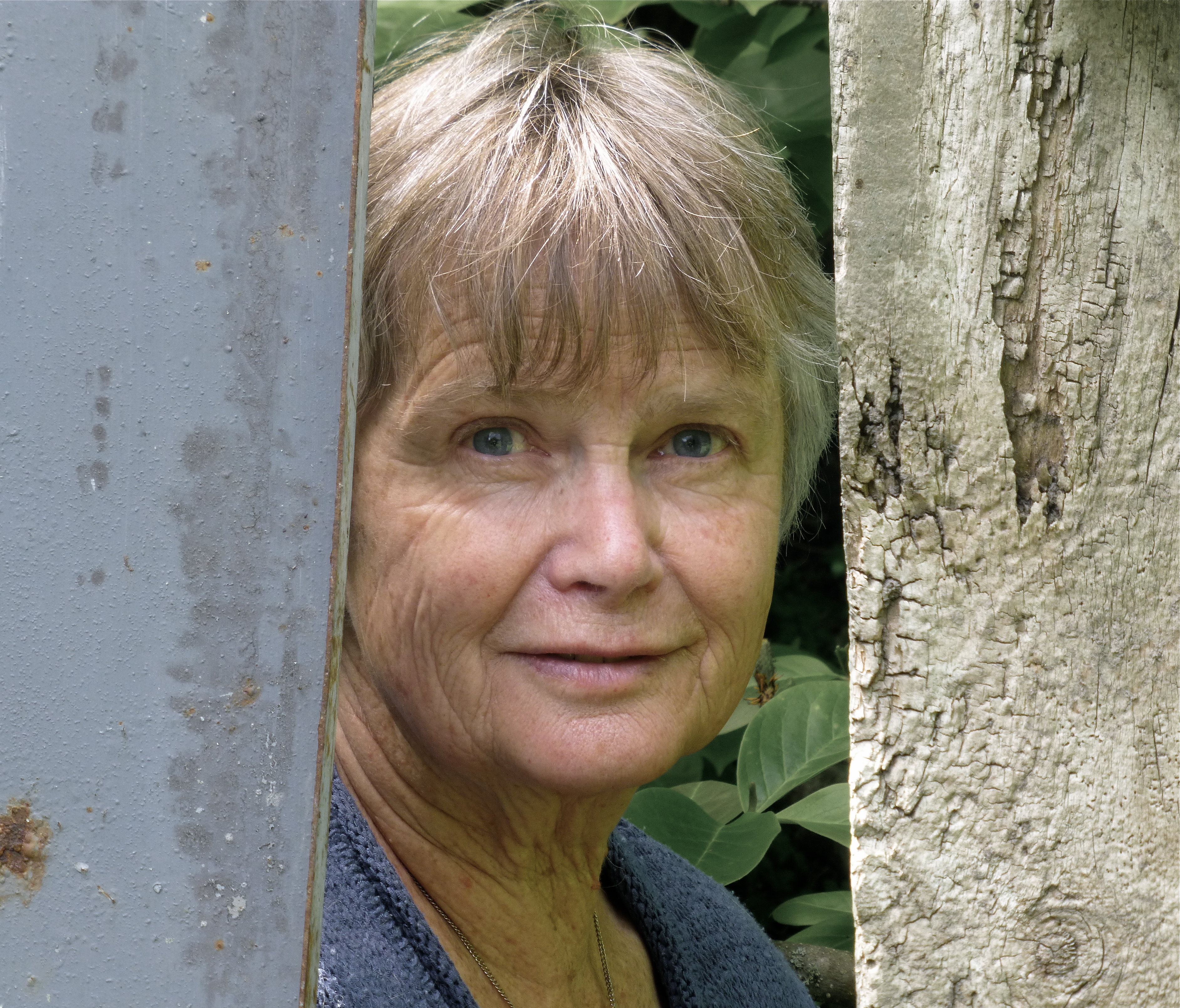
Bones in the Octagon by Carolyn McCurdie, Mākaro Press, 2015 (part of The Hoopla Series 2015, see below for other two titles)
Launch notes – Emma Neale
I’ve spoken in public before about first coming across Carolyn’s fantasy novel for children, The Unquiet, in manuscript form at Longacre Press. I felt then a sense of breathless disbelief that something so sharp and lucidly poetic, was just sitting there, looking like any other mild-mannered typescript in the unsolicited submissions pile. It should have been thrust into the air gleaming like the sword from the stone in myth. Hyperbole, you might think, but the novel went on to be named in the Storylines Trust list of ‘Notable Books of 2007’, and I still stand by my description of it as a novel that seems Frameian in its use of gentle abstraction, natural imagery, and its empathy for the child’s eye view. Carolyn’s use of imagery there lay potent clues for what she also does in her poetry.
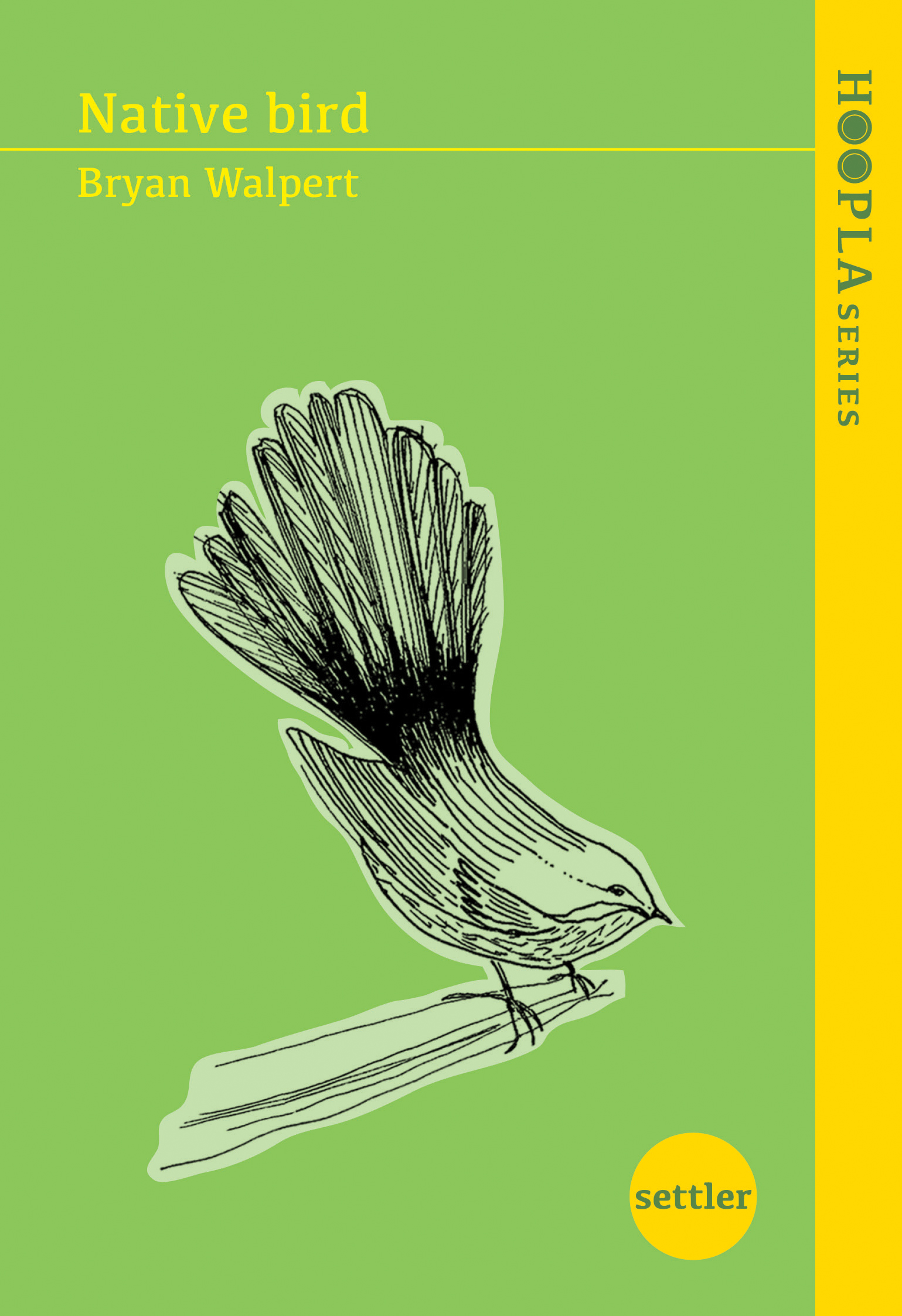
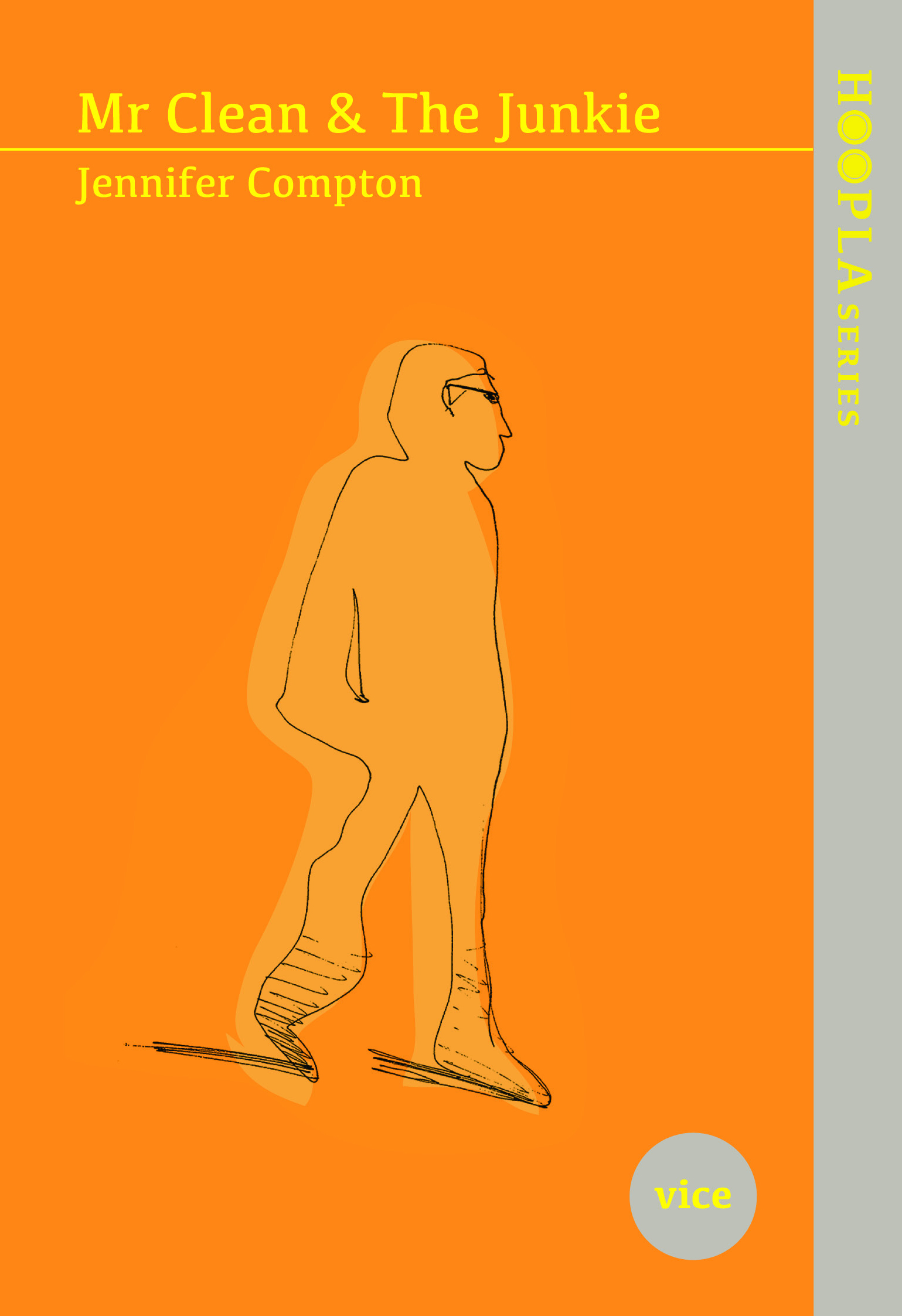
Mākaro Press have done a gorgeous job of producing this first collection of her poems —her first poems, but her third book. (There is also an ebook of short stories called Albatross, published by Rosa Mira books.) I love the feel of the whole Hoopla series as tactile objects — the fact you can slip them into your bag or capacious coat pocket like a Swiss army knife — bristling with tools for the mind — and the fact that it comes with two free bookmarks — (i.e. the side flaps) — or wings, symbolically ready for launch.
When I first started reading Bones in the Octagon, very early on I wanted to pluck out the phrase ‘shy iridescence’ to characterise Carolyn’s poems. But increasingly that came to seem lazy, insipid, because while the poems might have a kind of chromatic shimmer of mood and topic, the dart and race of illumination, the voice is anything but reticent. It is often, I think, steely. There is an inner resilience here; a voice that holds its strong, pure note even when face to face with everything from physical drought to domestic violence, psychological abuse, suppression, bereavement, political corruption, dislocation, and deep dread. Resurgent, the voice always lifts. And throughout, even when confronting darkness, it somehow still hums with wonder.
Carolyn’s poems can reach back to the first footprints and hungers of human civilisation, feeling out for connection to our earliest selves; they can hone in on the present, with condemnations of political expediency and brutality; they can have the dreamlike urgency of premonition; the shiver of fable lodged deep as inherited instincts, bred in the bone. Some, like ‘Making up the spare beds for the Brothers Grimm’, contain a sense of threat and corrupted relationships that go right down to the roots of a primal terror — there are traces here of abuse, damage, disillusion. Yet the touch is so light and the poetic control impeccable.
Often the voice in the book seems to speak in the firm but whispered imperatives of a mentor, parent, even a spirit guide. (Here is just a small sample: don’t cross, cross now, go through, walk with me, pack no bags, don’t look back, stand by her, watch out, shush, look there, please leave, come in, measure, wait…and again wait…. and wait.) There’s the sense of a markswoman with her arrow pulled back, tense, taut, not even quivering — then thwish — the poem is released.
Carolyn’s range is wide: she draws on world myth, local human and zoological history, the urban present, the transcendent imagination of childhood, a feeling of secular prayer and benediction. ‘Verbal Thai Chi’ is another way to describe the atmosphere of her work. She catches the heady lift of music ‘the intoxication of song’ as she calls it; she has a long view, of gradations of deep time — yet she is also vividly alert to the smallest shift in interaction between people right now, in the living minute. (I’ll just say here, watch out for the eyebrows.)
Her language, in its crisp repetitions, might imitate a bird in flight; her use of line break and white space can capture the way a ‘silence is vibrant’ […] ‘As when you enter a room/and conversation stops’ ; the careful accretion of information builds like a web of narrative, every strand or line holding the whole design in place. There can be gentle, plangent word play which shows the way the subconscious can both pun and express loss, can show the past so indelibly written on the mind’s memory maps.
Throughout the book, there is an awareness of the atavistic, of someone listening in closely to the primitive within us, but with something like a physician’s training and carefulness. It made me think of the title of a Les Murray collection, Translations from the Natural World, but where Murray’s work sprawls and layers, Carolyn seems to have a porous sensitivity that she still manages to whittle down to a fine wire of narrative; to forge the line till it strikes a clear, ringing note.
I could say so much more about Carolyn’s work, but I want to close by saying that as in her poem ‘Hut’, her work has corners that shelter tenderness, and offer us refuge. To use her own lines to sum up the strongest qualities in her work, and to make a ‘virtual’ toast to Carolyn here: “Fire, music, you. Another sip.”
Become road
When the car stops we are beginning already to become road.
A little taken apart and buried, the way birds, leaves
become road. Become road beneath
the burying of cars. All become driven over,
all become under. Even weather is taken
a little apart and buried. That we have been hit tonight
is relief; we no longer need to wonder when. Pain becomes
a story we will tell you years from now.
Sound becomes the dream you’ll nurse us from.
For now we are a passenger belted in
to the happening, looking back
at our tame furred moon. On our way home
the night had been too pleasant: rows and rows
of blue glass jars like the BFG’s jars
of dreams: the night was too pleasant
for what we had done. As we cycled uphill
the person we once were was cycling downhill
and each exhalation pushed us further apart.
Before we got hit we saw the shadows of trees
become road. Then the trees. A woman walking
a dachshund through the trees become road.
We saw the dog’s eyes glinting in the road.
The shine of his leash, caught in the road.
We heard voices in the trees become road, and the sound
of someone’s phone ringing in the trees become road.
As traffic clears, the road softens and takes us
deep in its arms, which though hard, accommodate
everyone. Early morning, as the road begins
its upward surge we hear footsteps nearing
from somewhere inside the road, as if
we have been recognised.
© Ashleigh Young
Note from Paula: This was one of the poems that Ashleigh read out at the Auckland Writers Festival in the session for the Sarah Broom Poetry Award. Ashleigh was a finalist in the award along with Alice Miller (I was her stand in) and Diana Bridge (winner). This poem really struck a chord with me, clung to me like a poetry limpet as I left the room. Curiously, as I listened, it was a little hallucinogenic — time slowed down, the world stretched out to a state of dissolve and all that mattered was the elongated moment of the poem. Everything inside the poem seemed bright, shining, crystal clear yet simultaneously unreal, mysterious, out of reach. Disconcerting. Strange and estranging. The words so perfectly catching the momentum of anecdote yet lilting sideways, looping back like a Zen master as everything becomes road and time laps back upon itself (‘As we cycled uphill/ the person we once were were was cycling downhill’). Really, that state I had to snap out of as I sat on stage in front of the packed audience is the state embedded in the poem — when catastrophe strikes. The world stretches like chewing gum to become so real it is unreal. This is what poetry can do; it can take those unfathomable, unspeakable moments and cast them within a poetic frame that recasts you. You get to see and feel and shift a bit. Thank you Asheigh Young, thank you.
Sarah Broom Poetry Award judge’s comments (Vona Groarke) on Ashleigh here.

Over the past two years, Vincent O’Sullivan, current New Zealand Poet Laureate, has posted on the Laureate blog the work of poets he admires enormously. This has been a great way to dip and delve into New Zealand poetry. Rhian won the NZ Post Book Award for Poetry in 2011 with her debut collection (I was one of the judges) in year that was particularly strong in poetry. Fingers crossed these terrific new poems signal a new collection in the pipeline.
He writes:
When Rhian Gallagher returned from almost two decades out of the country, and won the NZ Post Award in 2011, it seemed to me that there was a perceptible addition to what went on in our poetry. Here was a freshly attentive linguistic edge, a direct sensual intensity, a focus and gutsiness in writing of memory and regret, that seemed just that bit different from what any other writer here was doing. One reviewer called her poems ‘assiduously polished’, another picked up on ‘the visceral strength of her language’. What I admired then I find there again to admire in these unpublished poems. I’m glad my almost last laureate blog becomes the forum to display them.
– Vincent O’Sullivan
You can see the selected poems here.

This is a terrific letter — open, honest, generous, thoughtful and it is the mark of the kind of writer Laurence is, the kind of woman she is. I was at her session, and yes, I felt uncomfortable at the point she got heckled. For the audience, for the other panelists and for Laurence herself. To be honest, I was sitting in the front row, and because I could almost reach out and touch the speakers, at times I almost started joining in! Truely, I had to stop myself and say, no I am NOT on this panel! That is a measure of the vitality of the conversation. Yes, there might be ways to improve as chair (I always feel this no matter what I do!) but this session sparked all kinds of thoughts in my head. All credit to the chair. I was also utterly impressed with Laurence’s level of engagement with the work. When someone takes time out to read your books and to think about your books it is incredibly moving (not all chairs do this!).
I think there are many ways to be a chair. We are all different as this glorious festival demonstrated. You had the nerves and infectious enthusiasm, that utter passion for poetry from John Campbell, and the ensuing poetry conversation with Carol Ann Duffy. A special occasion indeed. You had the measured way of Jim Mora that welcomed the general reader as much as the writer when he spoke with Tim Winton. Equally special. You had the sparkling reach of Noelle McCarthy in conversation with Helen Macdonald. Gold! All different, all producing different kinds of vital conversations. These are all professional talkers so does it make a difference when the chair is a writer?
I like the fact Laurence asks for help here. Perhaps the festivals could build a short list of experienced chairs willing to briefly mentor (answer the questions of) fledgling chairs. In a reply to my festival post Laurence poses some of the questions she might ask.
What about the heckler? I agree with the points below wholeheartedly, but I have been guilty of this to the point I ended up on the front page of the Sunday Star Times and was hounded by reporters. At the now infamous session that Kim Hill chaired where she was rude to the international panelists, and talked at length without allowing them to speak, I yelled at her from the back “We have come here to hear three fabulous writers speak, not three fabulous writers under attack.’ Etched in brain. The audience stood and clapped in unison. I felt like I was going to faint. You had to be in the room to understand what happened. Perhaps I am responsible for this new species of festival hecklers. I am the hugest fan of Kim’s radio show, her interviews are the best but I felt a line was being crossed. I guess Kim has never forgiven me. I was rude. Alice Sebold hugged me. There is always a price when you speak out publicly, even as a heckler.
It all comes back to that word that Eleanor Catton floats: kindness. We need kindness. We need critical debate. But we don’t need to knock the stuffing out of people. Read the article I posted before this one on reviewing books.
If I could, I would reach and give Laurence a hug. Thanks heavens someone did. I admire your courage enormously.
Paula Green
Hi Paula
You raised the issue of chairing in your blog and I’d like to reply. At the weekend I chaired a session ‘Art of the Novel’. Despite having been a writer on upwards of 50 panels, it was my first time as a chair for a group of novelists and the combination of my inexperience, nerves, and over-enthusiasm (and probably over-thinking) proved to be a a disaster. Twenty minutes into the session an audience member started heckling me. I couldn’t hear what he was saying but it was soon communicated that I was talking too much and interrupting.
As the Auckland festival becomes larger I can see problems concerning chairing increasing. Audience members clearly have little tolerance for poor chairs so dissatisfaction will increase.
There are some fantastic, skilled chairs out there (Fiona Farrell, Paula Green, Kate de Goldi, Jolisa Gracewood, Emily Perkins to name a few I have had the pleasure of meeting) and I was wondering if there might be value in including a back-stage, 40 minute chairing session at the start or end of each festival day for people like me who have not chaired a panel, or for people who feel a little rusty. I know we are sent notes on chairing (which I re-read, believe me) but it would have been fantastic for my nerves if I had been able to ask an experienced chair a couple of questions concerning problems I had. For example: reading the panelists works raised some complex ideas that I wished to discuss. How could I have communicated those questions, maintaining the complexity of the idea without the question becoming confused, and needing additional clarification or follow-up questions that interrupted the writer? I am sure, that with your experience, you would have ideas on how to tackle those problems.
So, would any of you be prepared to offer help in this way?
I don’t think heckling is the answer to shaking up a poor session. I think it creates a flee or fight response in the chair, makes the audience apprehensive (is it a one-off heckle, is the audience member nuts and will continue heckling, what impression is this making on the panelists), and the panelists uncomfortable (because they are usually nice, sympathetic people).
After my panel – when I had already got the message – a woman came up to me, grabbed my arm and snapped, “learn to button your lips.” It was a shit remark, coming at the end of a bad session, and surplus to requirements. Thank God for the kindness of Stephanie Johnson, Jill Rawnsley and Charlotte Henry.
Laurence Fearnley
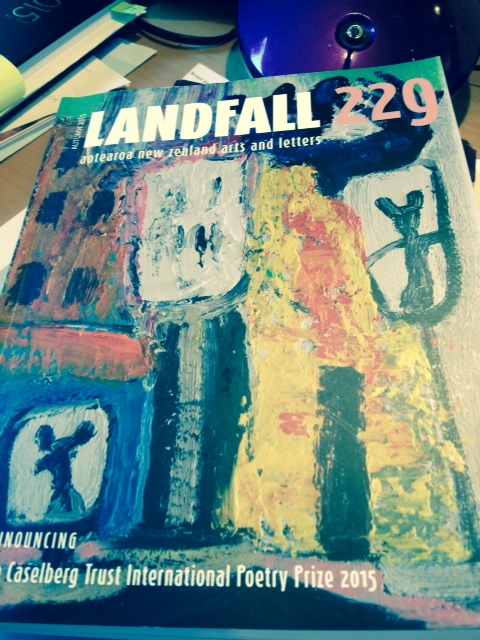
Shortly after Sport arrives in my box, I get a bright new issue of Landfall. My little list below maps my ‘loves’ so far — like little ‘like’ ‘share’ ‘favourite’ or ‘retweet’ buttons. Editors might compile a journal with an arc of contours (aural, thematic, emotional pitch, genre, experimentation, quietness and so on) as I have always done with an anthology so you move through shifting readerly experiences from start to finish. However, I never read a journal like this. It’s dip and delve.
1. Straight to the review section to books I have missed, and books I have reviewed. Ha! I Have missed (all meanings intended) reading Ian Wedde’s The Grass Catcher: A digression about home (Victoria University Press). Martin Edmond’s scintillating review meditates on the implications of writing the past alongside his critique of Ian’s illuminations of his own. ‘Home’ was a key notion that came under scrutiny within my doctoral thesis and within the context of Italian women writing novels in the twentieth century. It still fascinates me. This review has sent me scuttling to buy the book. In particular: ‘This is not one of those writer’s memoirs that says: here is how I became the resplendent creature I am today. It is too multi-faceted, too in love with the world, you might say, to serve such a purpose.’
2. Rata Gordon’s poem ‘Tinkering’ is like an electric train on electric tracks. You get to the end and you want to travel that route again. Wow!
3. Discovering Michael Harlow picked Sue Wootton’s poem, ‘Luthier,’ as the winning entry in The Caselberg Trust International Poetry Prize (2015). This poem is sumptuous in detail and that detail evokes mood, music, character, place in a transcendental kind of way. I would love to hear this poem read aloud to hear the poet lift and connect and pause, the hit of certain words on the line (flitch, slink, Sitka, bedrock). Sue demonstrates the way a poem can take a small moment/thought/action/thing and then open out intimately for the reader. A word that comes to mind and that is so overused when speaking poetry is luminous. But this poem is utterly and breathtakingly luminous.
4. Discovering Christina Conrad still writes poems.
5. Short poems can be very very good. So much happens in the white space that holds them This is the case with Louise Wallace’s ‘Mirage/Arizona.’
6. Tina Makeriti’s essay, ‘This Compulsion in Us.’ Strikes a chord because I am fascinated by museums too; enthralled by the things that stick to the objects that only you can see or hear or feel. Loved Tina’s exploration of a museum’s paradox, in that it preserves treasures yet ‘also captures and immobilises things that make sense only in motion, that should breathe and transform.’
7. Runner-up in The Caselberg Trust International Poetry Prize (2015), the opening lines in Jessica le Bas’s ‘Four Photographs from a Window’ : ‘The first is a shot in the dark/ buttoned up and black suited’
8. An Elizabeth Smither short story that underlines what an exquisite hand she has when it comes to fiction (‘The Trees’).
9. The way Sue Reidy’s poem, ‘The primitive,’ became etched on my skin.
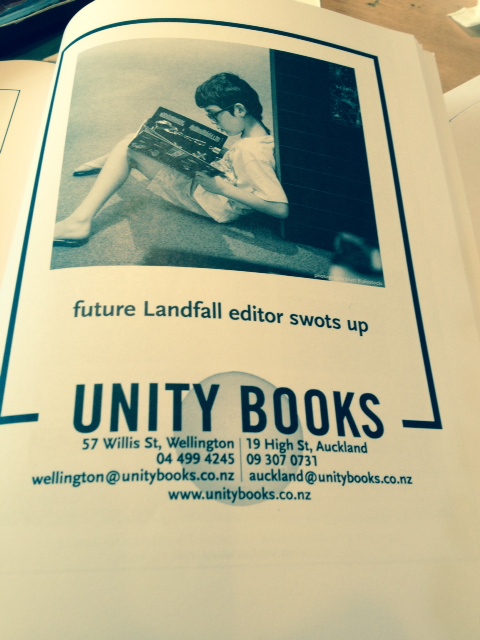
10. Lots more delights but I have to mention the Unity-Books, standout ad. A child reading a book, thank you!
Sometimes a literary journal is just the ticket for rainy-day blues, diversion, or the need to put a finger on a literary pulse. Ha! The notion of a literary pulse is where debate ensues. Each finger will be sensitive to different nuances, different implications. I strongly believe that national anthologies that claim to represent a wide group ( New Zealand, for example) must be challenged if gender, ethnicity, age or geographic-location biases fuel significant blind spots. For decades, women were the blind spot in anthologies and journals, and now, at times it seems there is token representation of work by Māori, Pasifika and Asian authors. Literary journals, however, are often the bloodline of a place, a niche, a literary disposition, and nearly always reveal the predilections of the editor. Sport comes out of Wellington, and it is to a great degree of Wellington (not in subject matter, but in terms of authors selected). It is a celebration of the writing by both established and emerging writers that have some connection with the city, often through Victoria University or its Press. I have no problem with this. I most definitely have no problem with this when the work included catches my attention and sends me in directions both familiar and unfamiliar.
The latest issue worked a treat for my rainy-day blues.
Seven essays are sprinkled through the selection of poetry and fiction, and if this is a new feature, it is a feature I applaud in this climate of idea-sharing in creative and stimulating forms. Long may it continue.
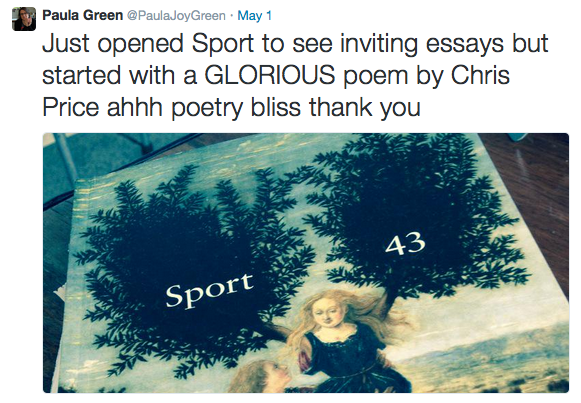
When I first picked up the book, I went straight to Chris Price (out of longing for a new collection perhaps) and immediately did a tweet review. Tucked away at the back of the book, it felt like the best had been saved for last with the playful, audacious flick and flash of words that catch your ear and send you flying to a nursery rhyme or Murphy’s Law or cheeky wit or the subtle twist and let’s-be-serious of the last word, ‘unspoken.’
This time I went to an unfamiliar name first, ‘Ruth Upperton,’ and what a discovery. Think I must have yearning for the comfort and absolute pleasure of poetic musicality (why I like the poems of Michele Leggott and Bill Manhire so much). Ruth has appeared in other journals, has just finished a law degree and lives in Palmerston North. Her five poems are different, the one from the other, but are linked by gorgeous rhyming (off, aslant, sliding), infectious repetitions, aural chords, sumptuous words. There is poetry out of sentences and there is poetry out of curiosity. You shift between comfort and strangeness.
from ‘The lonely crow’
Nothing sadder than a lonely river.
Nothing darker than a single crow.
Shiver at the strong’s surrender.
Play a tune on your June piano.
James Brown’s terrific poem, ‘Mercy,’ made me hungry for a new James Brown collection.
Anna Jackson’s three cooking-show poems suggest she is just getting better and better ( I am working my way through Catallus so I can review her new collection soon). I love the way the ingredients (excuse the pun) in these poems shift and flicker from one poem to the next, and in their new baking dishes taste a little different. The sort of poems that evoke a steady engagement at the level of sound and narrative.
Sarah Jane Barnett’s sequence of poems, Addis Ababa,’ caught me by surprise. They take me to an elsewhere, the elsewhere of displacement, of otherness, of immigrants. The poems step up from everything Sarah has previously written, and then take another step into risk, empathy, inquiry, experience. What a combination.
Rachel Bush’s ‘Long and short,’ is a poem that moved me with its exquisite detail and revelation, a family story (true or false) that catches in the throat. The poetic glue: the baked bread.
So many things accumulate. They weigh us
off balance. We struggle to stay upright,
we lurch and are precarious. Our feet are flat
and sudden. It was easier when we had
a mum and dad. Easily we could blame them
when we were less than we desired.
Still most essays and fiction to read, but started here: Damien Wilkinson’s lecture/essay navigates a subset of the ‘ought’ and ‘ought not’ of narrative: the way it ought/ ought not represent some kind of personal change (character based). Fascinating following the thread of argument. Is this a requisite ingredient in poetry? That poems ought to navigate some kind of change? I raise this because, and I am shifting tack a little here, I am fond of poems that exhibit some kind of movement (and movement may be zen-like and hold change within its sameness and vice-versa). Poetic movement need not be on a grand, spectacular scale. It might be miniature shivers in the poem, sweet little movements that you catch out of the corner of your eye, or a flicker in your ear, or a faint tremble of your heart, or the tug of an idea that is itching to confound, challenge and pull you elsewhere. That is what I felt when I read, ‘She cannot work,’ Ashleigh Young’s foray into fiction. It is what I felt reading this issue of Sport, a catalogue of movements that displaced my state of fatigue.
Sport: miniature shivers in the writing, sweet little movements that you catch out of the corner of your eye, or a flicker in your ear, or a faint tremble of your heart, or the tug of an idea that is itching to confound, challenge and pull you elsewhere.

 NZ Poetry Shelf