Category Archives: NZ poetry event

A Little Poetry Shelf Diary: A weekend at Matahiwi Marae to launch our new Poet Laureate, CK Stead


IMG_3281.JPG


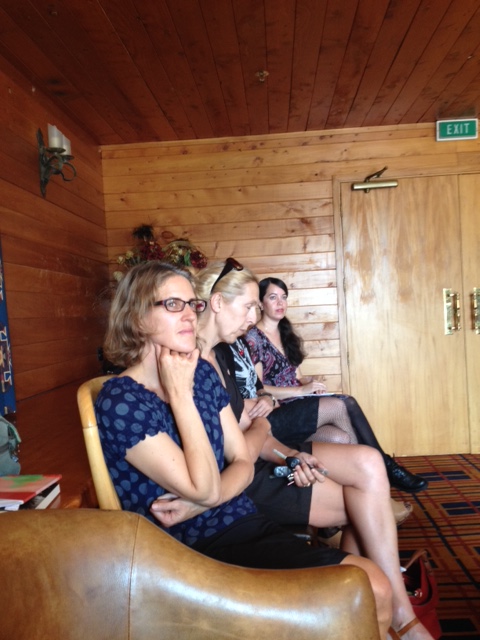
This weekend friends, family and poets gathered to join CK Stead celebrate his Poet Laureateship and the presentation of the tokotoko. It was a marvelous occasion that will stand in my memory for a long time. The weekend featured two key events. The formal and informal proceedings at Matahiwi Marae on the Saturday morning and a Poets’ Night Out in the evening.

With exemplary dedication to New Zealand poetry, Te Mata Estate’s Peter Buck and poet Bill Manhire established the award twenty years ago. In 2007, The National Library took over the administration, although the Buck family still remain involved, and donates a stipend of wine to the Laureates. Unlike most of the visitors, I got called onto the marae on the Friday evening with Chris Szekely and Peter Ireland from the National Library, and a number of their colleagues, including Oliver Stead and his son Isaac. Peter was the driving force behind detail of the weekend, and Ian Wedde’s moving tribute to him at The Circle of Laureates hit the mark. Thoughtful, attentive, committed to making a celebration fit for a Laureate. His back-up team are pretty special too (Joan, Cellia Joe, Lynette, Jason and Oliver).

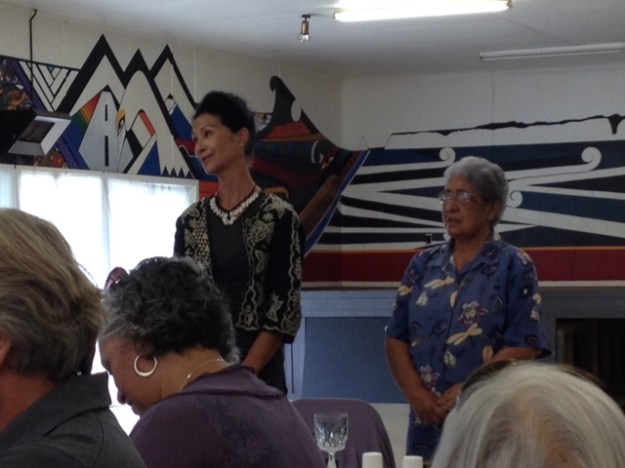
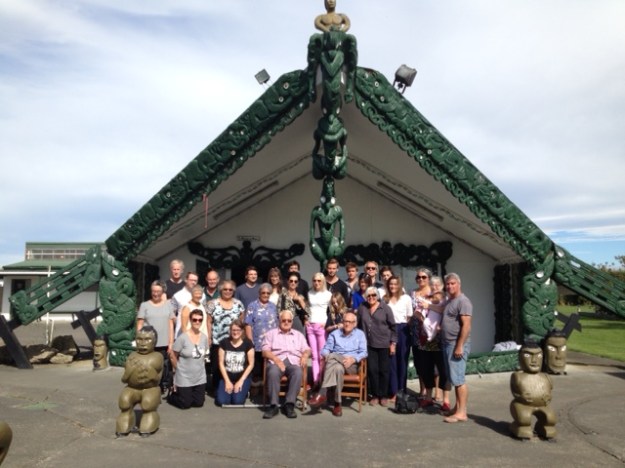
Kaumatua Tom Mulligan and other members of the marae welcomed us with much aroha.

Joan, Cellia, Jason and I practiced some waiata back in the whare nui. CJ on ukulele.We crack up when CJ says all her family knows she can’t sing and she just fakes it. We are all fooled and I wonder what I can’t do but could fake and get away with.

On Friday night we hived off to Havelock North (one poet, five librarians) for dinner at Maine where the food was divine. We fell greedily into the comfort of the best hot chips ever and with that salty comfort digging deep into our bones were ready for whatever the weekend delivered. One plate of salmon with the best Niçoise salad and I was ready for a weekend of poetry and celebration.


Saturday morning

I got up early to walk in the near rain and saw a black cat stock still on a fence post eyeballing my lack of sleep. Not budging an inch until a car came down the gravel road and sent the cat sliding down like a snake into the golden corn. I had no idea what it meant. But it glowed with options.


CK Stead was called onto the marae with his whanau (around 20), poets Gregory O’Brien and Chris Price, her partner Robbie Duncan, and other guests. To have such family support felt very special. He is poetry but he is most definitely family. His daughter had travelled from London with her children.

After the formal speeches and the waiata exchanges, the tokotoko was presented to Karl by a kuia. She had such presence. Jacob Scott, who carves the tokotoko for each Poet Laureate said he had wanted to make a tokotoko for a gentleman and a scholar that could be used on a daily basis if needed. He had gained inspiration from Karl’s poem, ‘Scoria.’

Karl responded with a speech that mixed graciousness, humbleness, love. He said he was not only honoured by the role but honoured by the marae: ‘by being here, by your presence, by your aroha.’

Before he read a few poems, Karl talked about place, about the importance of one’s childhood occupation of place, and the way that place becomes one of return. He grew up with three maunga facing him whichever way he turned. He also underlined the primacy of poetry for him since his teenage days and the way he has ‘always come back to poems.’ With much humbleness, he added,’that’s why it is extraordinary at this late stage in my career as a writer to be honoured as Poet Laureate.’

Karl paused in his korero and then said; ‘I am getting advice from the tokotoko. We have to get used to one another.’

At that we all paused.

I am delighted that the Poet-Laureate role honours our elders, our writing taonga. It felt good to be part of the protocol. The talking. The listening. The exchange.


MC-ed by Marty Smith, the informal part of the morning was like a miniature poetry reading. As his invited poets, Chris, Gregory and I read a couple of poems and Chris sang a Bill Manhire song with her partner Robbie. What made this section special were the performances from local secondary students. One student used the analogy of a bird to explore the Poet Laureate’s original function to write poems on dictated subjects. She was keen to let a Laureate fly free! A student played a solo violin piece, one sang a Māori version of ‘Hallelujah,’ while another wrapped up the morning with Van Morrison’s ‘Moondance.’ Wonderful! I pictured us all dancing slow motion with the wind in our hair. Instead the wind whipped the music sheet up and away.

It was a morning of korero, waiata, music and poetry and it felt good to inhale both words and song. Nourishing. We moved to the whare kai where a tremendous lunch of fresh local produce matched the hubbub of conversation. You don’t get to experience many days like this in your lifetime. Such warmth, and connections.


Saturday night

Marty Smith was the MC extraordinaire in a poetry reading of two halves. It’s ages since I have heard Chris and Greg read, but to hear them read in this context was something special with poems handpicked for the Laureate occasion. Greg read a terrific poem now showcased in the selection of Best NZ Poems from 2015, while Chris confirmed that her new book is her best to date (we have an interview in the pipeline!). Three young opera singers from Project Prima Volta wowed us with two arias. The room befitted the occasion: white cloths on tables, astonishing flower/plant arrangements, platters of food, Te Mata wine. Karl started and ended the night and showed very clearly why he is Laureate. He read across his range and his last set gave me goosebumps. The clarity of voice, the poetic strata, the acute detail that makes you want to pick up your pen and write.


Sunday morning

Breakfast and poroporoaki for everyone on the marae. The goodbyes. At breakfast Karl and I talked about the weekend and how we both spent chunks of the night wide awake as though we had to rehearse the next day and analyse the day before. I probably had about two or three hours sleep a night and it seemed like a state of wakefulness that kept me on high alert. What had happened, what was about to happen. I had brought seven books to match most moods (everyone laughed at my big bag of duvet and books) but I only got to read snatches of The Lie Tree. The gap between YA fantasy and the marae was unbridgeable. I got up early and walked my way into wakefulness before Emma Scott, Jacob’s sister, took me out to the river mouth and then coffee at her brother’s house. To see the meeting waters, where river meets ocean, to soak up the gleam of sun on waves and estuary, felt like a poem on the surface of the world. We talked and we looked. Emma is a stone mason. We talked about poetry and we talked about stone. We talked about what holds things together. It matters that we hold up our treasured poets. Give them a place to stand and speak.

There was much korero after breakfast, and song. Chris and Robbie sang a mesmerising Bob Dylan number, almost lullabying me into necessary slumber.

Peter Ireland, running on empty after little sleep, spoke with characteristic thought and thanked everyone personally. It felt like a garland of words to wear out into the world of planes and trains and motorways. Or for me, a place of solitude and bush.

Jacob said it beautifully. He said that the Poet Laureate was significant for the marae. That it spread the hapu’s power and influence. That this is now Karl’s place as well. The undercurrent is that poetry matters. Jacob said it is significant ‘that the Poet Laureate can articulate the thoughts and expressions of who we are. Of what we can do. Of what we have got. And what we could do.’ Like a bird.

We all felt in debt to Tom Mulligan and his drawing together of this poetry clan. With much aroha and generosity of place, stories and a willing ear.

Our heads are full of days we cannot remember, but for many of us, this weekend will not be one of them.

Thank you. Especially Karl, The National Library and Matahiwi Marae.


The performances.


A quick trip into Havelock North to drink the best coffee and eat the best lemon tart in a cafe on the brink of closing for the day. Peter was a very good guide.


The writers, friends and family ate at Pipi Cafe, a cafe renowned for its love of poetry and its excellent pizzas in Havelock North.

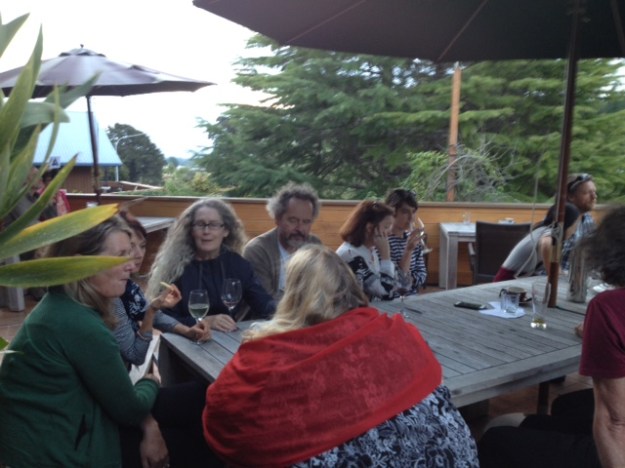
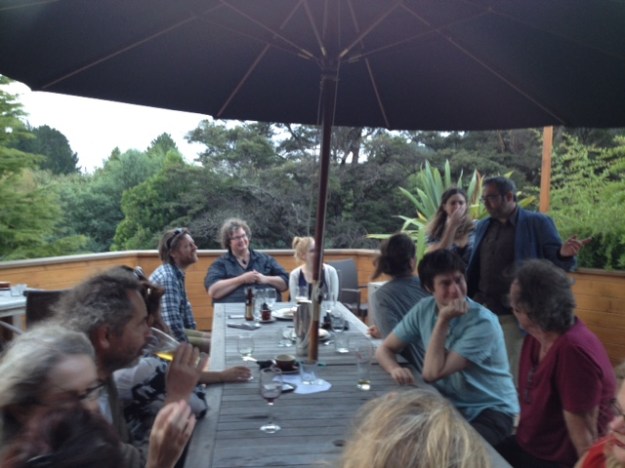
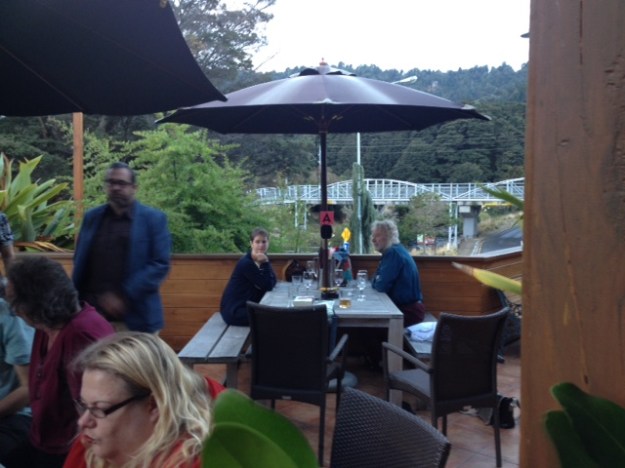
Poets’ Night Out


IMG_3258

IMG_3276

The last morning.
A very special Poetry Book Launch: Rachel Bush


And some mornings seagulls fly
three or four over this house to say
something about grief and weather.

–from ‘Watch’, by Rachel Bush


Victoria University Press warmly invites you to a celebration of Rachel Bush and the launch of her new collection Thought Horses.

On Tuesday 19 April, 5.30pm–7.30pm at Vic Books, Kelburn.

This event will include readings of Rachel’s poems by Bill Manhire, Chris Price, Jo Randerson, Louise Wallace, Dinah Hawken, Louise Wrightson and Glenn Colquhoun.

Thought Horses will be available for purchase, $25, p/b.
Refreshments will be served.

Book Launch: Bill Nelson

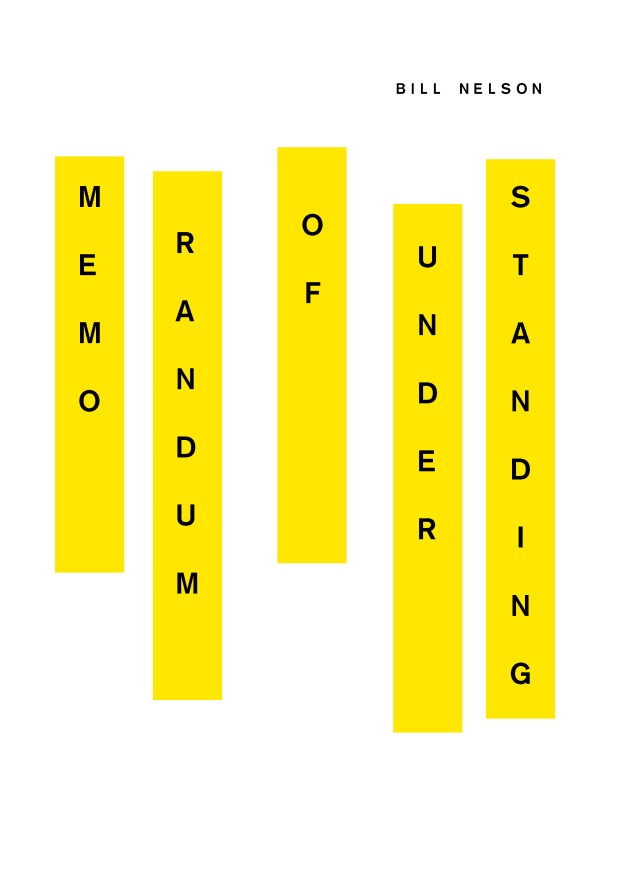
Victoria University Press warmly invite you to the launch of
Memorandum of Understanding
by Bill Nelson

on 6pm–7.30pm, Thursday 14 April,
at The Guest Room, Southern Cross Garden Bar
39 Abel Smith St, Te Aro

Memorandum of Understanding will be launched by Kate Camp.
Copies of the book will be for sale courtesy of Vic Books. p/b $25.


Memorandum front cover.jpg

Maria McMillan on Wordsongs


Wordsongs, St Peters Hall, Paekākāriki, 3rd March 2016


I go partly because there’s like a major poetry type gig in Paekākāriki and I’m a Paekākāriki poet and it feels a bit rude not to go. Imagine, I think, if there’s only six people there without me and they decide never to have anything poetry related in our village ever again. Yes, we call it a village and I needn’t have worried. Having scoffed down as much of a delicious fried-rice concoction as I possibly could in 94 seconds  I arrive three minutes late and take the Very Last Seat. It’s an actual excited crowd, in carefully arranged tiers. They’ve turned St Peters Hall around so we face the direction of the sea and one long side of the hall with its cool house-shaped wooden-window shutter things. The huge red velvet curtain hangs over the stage to our left and the doors to the village main street to our right.

I love this hall but truthfully, I’m a bit wary of poetry set to music. It’s the puritanical killjoy in me which says, honey, you need to decide, music or poetry. Just get away with your weird, not very interesting bongo drumming interspersed with a man saying two words usually something like organic tomatoes in  a quiet yet loud, yet well modulated, yet with working-class-solidarity voice and then pausing a full minute while making eye contact with every member of the audience before saying wet. But I know it’s kind of prudish of me and I need to open myself to new experiences so I am willing and here and listening.

Local poet, Dinah Hawken, who starts us off, makes me feel very comfortable. She reads her poetry sans music, the way it should be (sorry) and she starts with a good long poem about environmental catastrophe. The poem earns its length and I enjoy Hawken’s meditative delivery. She reads slowly and thoughtfully and the poem turns from lament to challenge to conversation. I feel like I’m hearing more and more poetry like this, laced with planet grief and helplessness and wonder. I’m glad it’s being written.

The main act is  Bill Manhire with singer Hannah Griffen, pianist Norman Meehan and Hayden Chisholm on saxophone and clarinet. To begin with I think Chisholm is tuning up, his sax is breathy and rough and understated and there’s no clear strong notes but then I realise this is part of it all. He’s throat clearing and then the other clear notes come, but through the set I see this replication of human noises, and also the absorbing of other sounds and instruments. I hear reverb and the plucking of a guitar, slow growling, didgeridoo and the noise of traffic all through his instruments.

In this first song, an interpretation of Baxter’s High Country Weather, the piano and singing come in beside the brass and I’m startled by how much action, how much sound can be produced by just three people. Griffin’s voice is like some really good jazz club singer. I get that vibe through the night. I want to be sitting at a small lamped table having intimate conversations. She sings big, beautiful and clear, high and low.  Next Bill, congenial and with charming anecdotes that thrill the poetry nerd in me, reads Rain by Hone Tuwhare and then the three musicians play it back to us. I get it now. I can listen to the poems read as poems, and listen to the music as music. No bongo drums. No organic tomatoes and soulful stares. It’s a relief. And when I hear Rain sung I’m struck by how lineation changes with the music, the words become split and lumped in different way. We can hear hidden rhymes and rhythms which may be a subtle backbone to verse on the page but in music are drawn out and played with. Cool.

Meehan tells us the set is pretty much the album Small holes in the silence, featuring versions of  Manhire and other poets’ work as songs. We hear interpretations of Alistair Te Ariki Campbell, Manhire, David Mitchell, and my favourite piece, two poems by Eileen Duggan. I can’t actually hear the words as Griffin sings so perfectly in tune with the sax, so my liking this all the same proves how thoroughly mature I’ve become about the whole poetry and music mash up. What I love in this song is the way the sax more than ever takes the role of a voice; for a moment the sax and the singer are a duet and in a kind of heady triumph. After that the two seem to swap places; Griffin no longer singing words but sounds become another instrument and the saxophone becomes a human voice. It’s a meandering interesting work. I also love Manhire’s stories about and poem for Cornish poet Charles Causley. The evening ended with a spoken and then musical interpretation of Manhire’s rhyming list poem ‘1950s.’ The crowd loved it, they threw flowers, they cheered, they stomped. Well, they didn’t but I’m sure if they thought of it they would have. They applauded long and hard. I wander out into the Paekākāriki night. Now the traffic sounds like a saxophone. The crossing signals go off. A train, windows bright, rumbles past us on its way to Waikanae. I wave.

Maria McMillan


I agree! ‘Inaugural Ruapehu Writers Festival wildly successful’

IMG_3168

Helen Rickerby has just posted a slide show from the Ruapehu Writers Festival. And this:

‘We’re still on a high from the fabulous experience that was the inaugural Ruapehu Writers Festival in Ohakune last weekend. We were pretty sure it would be a fun and worthwhile event, but it exceeded our expectations in every way. Several participants, including Elizabeth Knox and Paula Green, said it was the best festival they’ve ever been to!

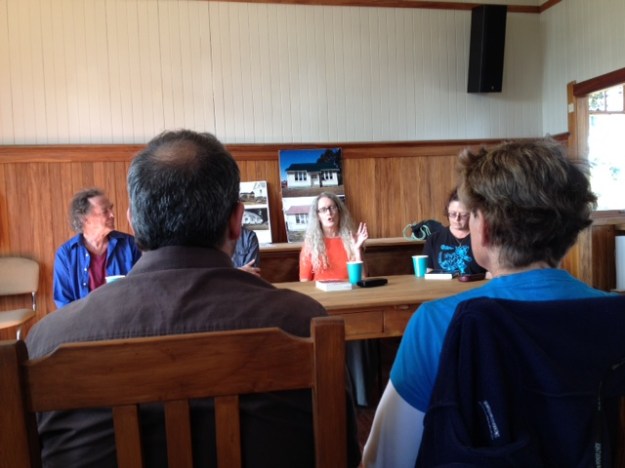
From the opening event on Thursday, which was opened with a karakia by Hune Rapana of local iwi Ngati Rangi and was MCed by Johnny Greene, Head of English at Ruapehu College, we started to suspect we were in for something special. As those of you who were there will know, on Friday, as more and more people arrived, we enjoyed session after session of articulate and brilliant ideas and readings. By Friday afternoon, the room we used for most sessions had reached its capacity of 80–100, and the spill-over people were lounging in the hallway or sitting on the deck, listening through the open French doors. Also through open doors we could hear the bubbling of a stream across the road, and a couple of times a day the speakers needed to pause for a few moments while a train went past on the nearby Main Trunk Line.’

For the rest of the piece and the slide show see here.

Dinah Hawken to open WORDSONGS

I seem to have been a roving poetry reporter these past few weeks but time to shut the hatches and stay at home. This event will be good – I judge this on my experience of hearing Hannah sing Bill at the AWF a few years ago. Transcendental experience.

I urge you to check this poetry event out and would love a wee response from a poetry patron to post on the blog.


Screen Shot 2016-03-23 at 10.12.24 AM.png


Screen Shot 2016-03-22 at 6.28.24 PM.png


Tickets $20 from Eventfinder or Darcey’s Fruit Shop.  Limited door sales at $25.

QUERIES: Gilbert Haisman.  Tel 04 904 8428 or 022 0122 103. Email: thewordshop@paradise.net.nz

Why I loved the Ruapehu Writers Festival


‘Memoir is a place to illuminate, not seek revenge.’ Elizabeth Knox

‘The Villa is a book of 100 tiny pieces. That’s how my brain was. Everything had fallen to pieces. I was writing in a state of shock.’ Fiona Farrell

‘I am a product of socialism and feminism.’ Fiona Farrell

‘We are not just a who or a what we are also a here.’ Martin Edmond

‘Archives are as questionable as memory.’ Martin Edmond

‘Poems have tended to ambush me every few decades.’ Fiona Kidman


[ I   k e e p   r e m e m b e r i n g

t h i n g s  a n d    a d d i n g     b i t s]


Yesterday there was a flurry of writers on social media suggesting the Ruapehu Writers Festival was the best festival ever. I have loved the richness and discoveries of so many other festivals, along with the family warmth of Going West. Yet this festival was special. The best ever.

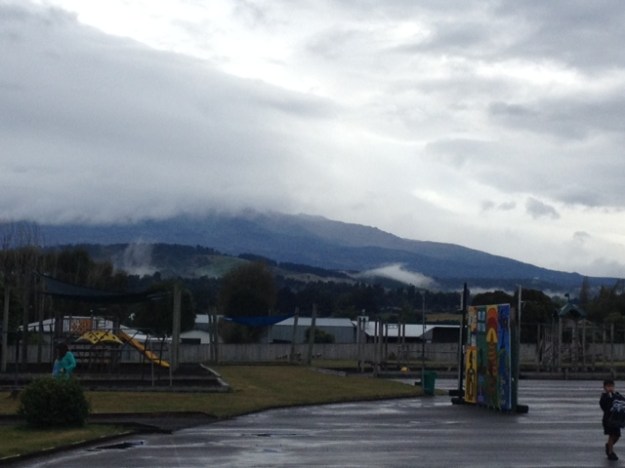
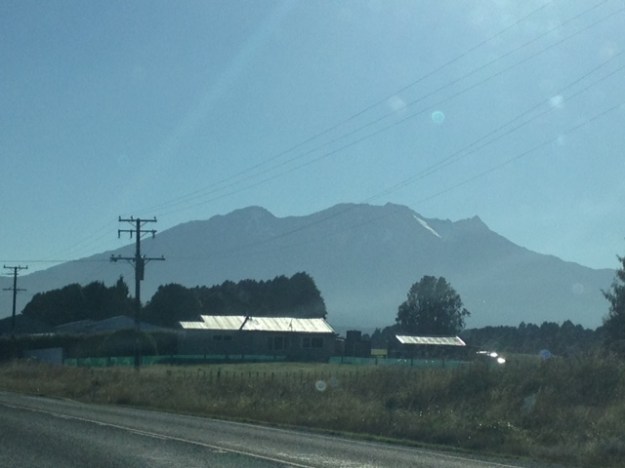
The setting: The mountain to the north loomed large out of clouds, and on some days into bright blue sky. The mountain stream babbled past like a soothing mountain soundtrack. The trains punctuated sessions and we all stopped and listened to the comforting sound of travel.

The writers: The writers came from far and wide (Martin Edmond, Fiona Farrell). Bigger publishers were represented (Penguin Random House, Auckland University Press, Victoria University Press) and so too were the boutique Presses (Seraph Press, Anahera Press, Mākaro Press, Cat & Spaghetti Press, Hue & Cry – to name a few).


The sessions: Not a single dud. Just smorgasbord of highlights. I do want to pick out a couple of presentations that struck a chord with me.

Merrilyn George shared Ohakune stories with Martin Edmond. Wow! I wish the whole country could have squeezed in to hear the way the local matters. Has mattered, does matter and will matter. It was Martin’s session too, but he let Merrilyn take centre stage with his little anecdotal prompts.

The fluency of my good friend Sue Orr when she got talking about place as character.

Three writers musing on the Desert Road: Fiona Kidman, Ingrid Horrocks and Fergus Barrowman (standing in for Nigel Cox). The conversation just flowed and the extracts were riveting. I have tracked down Ingrid’s essay, ‘A Small Town Event,’ in Sport 43. The sample stuck with me so I need to read the whole thing.

Elizabeth Knox‘s festival lecture, ‘On Doubt, Doubtingly,’  explored the implications and means of building memoir. Particularly in view of multiple selves, and the multiple reception and behaviour of selves. Elizabeth showed the way ideas can move, stimulate and challenge. Deliciously complicated and moving.

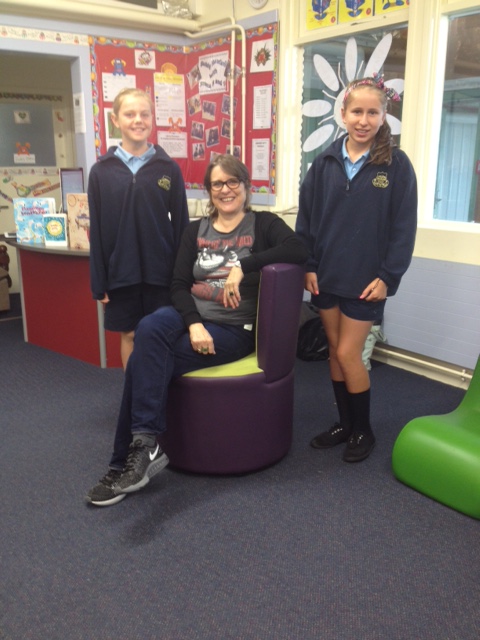
The children who came to my poetry session. Some as a result of my visit to Ohakune Primary School on the Thursday. I had an outstanding time there. This is a school where the teachers have already sown the fertile seeds of poetry. PS Jenny and Laughton Patrick did a great job getting the whole room singing!

Three writers talk on structure: Pip Adams, Emily Perkins and Fiona Farrell. This session got on National Radio because Fiona let her guard down and moved most of us to tears. I thought I was going to start sobbing out loud. Listening to Fiona read from The Villa at the End of the Empire — a book shortlisted in the nonfiction section of the Ockham NZ Book Awards — was extraordinary. Yet the session was this and was more than this. It embraced two other terrific readings and generated a conversation on structure that made me want to get writing.

Six writers read from Extraordinary Elsewhere: Essays on Place from Aotearoa New Zealand (forthcoming VUP). Ashleigh Young‘s detail kept ringing in my ear, along with the moving circularity of Harry Rickett‘s essay and the philosophical nuggets of Martin Edmond (which I tweeted throughout the session).

I was quite taken with the response of Tim Corballis and Thom Conroy (chair) in my session on POV. I just loved the way Tim proposed the leaf on the boy’s shoe acted as a transcendental point of view. Ha! Thom was an excellent chair.

The final session of poets was a perfect way to end. I discovered the poetry of Hannah Mettner and will go hunting for it in issues of Turbine. I loved hearing Fiona Kidman read from her new book (out next week) and Vana Manasiadis from her old. Magnolia Wilson was also a new find off the page (I had loved her foldout poems). A local poet and ex-librarian, Helen Reynolds read her poems in the quietest of quiet voices. We stretched forward, further and further into her reading. It felt like I was bending forward into the end/ear of the festival.


The atmosphere: Warm, intimate, stimulating, generous. The festival had the family flavour of Going West but in a mountain setting. At four thirty each day we spilled into the bar for a glass of wine and platters of gratis nibbles before the final sessions. We shared conversation and that conversation was infused with a common love of books. And an infectious engagement with ideas.

The chance(ish) encounters: Hearing Amy Leigh Wicks read poetry for the first time and having lunch with her. I am itching to write about her poems on the blog. Sitting under the cool of a tree and talking women’s poetry with Sarah Jane Barnett (she was there as reader, as were other writers!). Eating breakfast with the very lovely Fiona Kidman and talking about women’s poetry in the seventies. Meeting a man who lived next to Eileen Duggan but not getting to follow that revelation up (ah! rue!). Drinking coffee with Fiona Farrell and talking about how something in the air or on the page prompted us to let our guard down. Just a tad. Meeting old friends.

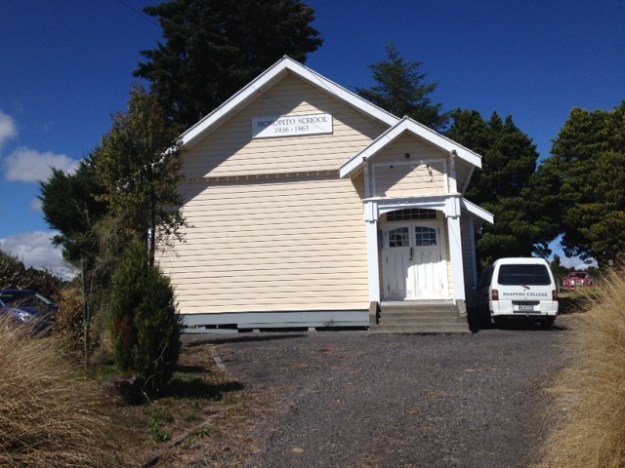
The special features: A band of writers cycled back from Horopito Hall with James Brown after hearing a session on cycling and poetry (ok Ashleigh Young where can I read a version of your lost-things poem?). A local kaumatua guided at least forty readers and writers up to a waterfall and back (around two hours). Stacy Gregg led some fans on a horse trek.

The audiences: Most sessions were full to the brim.

The chairs: I especially loved Fergus Barrowman (he did zillions with just the right degree of input), Nick Ascroft (he was hilarious) and Thom Conroy (astute listener!).

The organisers: Anna Jackson, Helen Rickerby and Simon Edmonds built a festival out of nothing yet when I reflect upon this daring, I realise it was out of something. The festival grew out of the hard labour and inventive thinking of these three. It also grew out of the good will these three can harness: from the locals, the venue, the schools, the publishers and the out-of-town readers and writers. It might sound corny but it also grew out of the physical location and its beauty. The festival always bore this mind.

It was really good to hear Anna and Helen read and share ideas. I loved too the way they sat in the front row in every shared and listened so intently. I could see the joy of the occasion on their faces. You don’t usually see festival organisers with freedom to sit in the front row and listen. Yet another sign of what made this occasion special.

Place matters.

I think if I were to ask all writers and readers to join me in a huge pakipaki for Anna, Helen and Simon we would drown out the mountain stream and the passing train. Just for a moment. We are in debt to you. Thank you.


Excuse my phone photos!

IMG_3156IMG_3157IMG_3137IMG_3140IMG_3142IMG_3145IMG_3146IMG_3151IMG_3152IMG_3154IMG_3161IMG_3162IMG_3164IMG_3166IMG_3168IMG_3169IMG_3170IMG_3171IMG_3173IMG_3174IMG_3175IMG_3176IMG_3177IMG_3178


Great news: New partnership powers up National Poetry Day

Screen Shot 2016-03-22 at 8.15.24 AM

National Poetry Day always demonstrates the wide reach of poetry in New Zealand. All manner of events and poets tumble into vision and hearing. Phantom Billstickers is a tireless promoter of NZ poetry. This partnership has to be good. Bravo NZ Book Awards Trust for this grand idea!


This terrific news is just out:

In its 19th year, National Poetry Day — the biggest nationwide poetry event of the year —will be boosted by the partnership between the New Zealand Book Awards Trust and Phantom Billstickers, with a sponsorship agreement announced today.

The highly popular and eclectic National Poetry Day will now be known as Phantom Billstickers National Poetry Day and will continue to bring poetry to the people, with over 80 events held nationwide, involving everyone from seasoned award winners to aspiring poets facing the microphone for the first time. Phantom Billstickers National Poetry Day will be held on Friday August 26 this year and continue the day’s legacy of taking poetry to the people from Kerikeri to Southland, across the streets of small towns and major cities.

“It’s an opportunity to hear more poetry. There’s the possibility to take it back to the regions that built us,” says Jim Wilson, owner of Phantom, “We’ve been putting the New Zealand voice out there for some time. Now with this exciting partnership that voice will become louder.”

Phantom Billstickers National Poetry Day is about discovery, diversity, community and pushing boundaries. Poetry enthusiasts generate events such as slams, poetry-music jams, poetry art exhibitions, performance poetry, poetry and dance, poetry street chalking, bookshop and library readings, open mic events and poetry writing competitions.

Nicola Legat, chair of the New Zealand Book Awards Trust says “We have long admired Phantom’s commitment to putting poems on posters and in cafes via their Café Reader. They are a natural partner given that Phantom’s business is taking messages to the streets and that’s what the New Zealand Book Awards Trust aspires to do with poetry.”


Phantom Billstickers   http://0800phantom.co.nz/   is a street poster company which since 1982 has consistently helped Kiwis express themselves. Recognising and supporting home grown talent has always sat comfortably alongside its commercial campaign work. Phantom actively promotes New Zealand music, art, poetry and culture around the country and across the world, putting poetry on posters and a literary mix of work into cafes via its quarterly magazine the Phantom Billstickers Café Reader. Phantom makes New Zealand’s streets livelier by taking the creative arts into public spaces.

The New Zealand Book Awards Trust   www.nzbookawards.nz  was established as a charitable trust in 2014 to govern and manage the country’s two major literary awards and National Poetry Day, and to ensure their longevity and credibility. New sponsorship agreements have now been secured for all three properties with Ockham supporting the Book Awards, Hell Pizza backing the Children’s and Young Adult awards via its support of the Reading Challenge and Children’s Choice programmes and Phantom National Poetry Day. Additional funders include The Acorn Foundation, Book Tokens Ltd, Creative NZ, Copyright Licensing Ltd NZ , the Fernyhough Education Foundation, Nielsen and Wellington City Council, supporting specific aspects of the properties.


A Circle of Laureates, a galaxy of poetry

This event prompted me to hunt for cheap fares to Wellington because it seemed like a rare and special poetry occasion. And it was! A sold-out event!

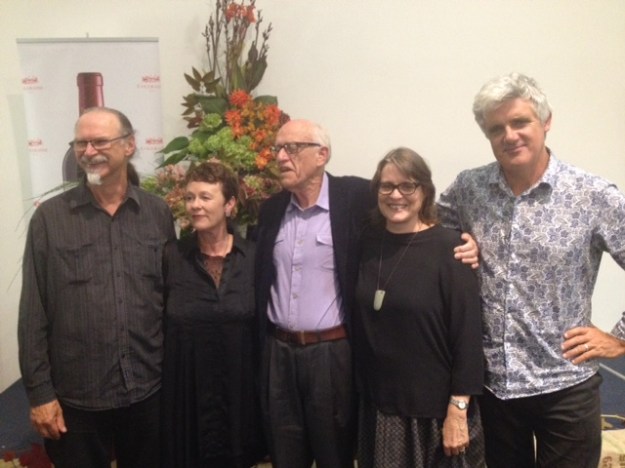
The National Library, as current administrator of the NZ Poet Laureate awards, hosted the evening as part of Wellington Writers Week.  John Buck from Te Mata Wines instigated the Laureateship in 1997, with Bill Manhire taking the debut spot. John was there with wine to share. He still retains an involvement.

Fergus Barrowman from VUP was the MC. He made the important point that the award is ‘an activist portfolio not just an honour.’ The earliest debut publication by a Laureate was in 1964 while the most recent debut was 1988.  Three generations of poets! Cilla McQueen and Michele Leggott calculated over 700 years of life/poetry experience across the ten laureates to date.

Bill Manhire (1997) spoke about what the Laureateship meant to him and the two ways it expanded his sense of what he might do as a poet, as a public figure. Firstly he began to write poems with some kind of public dimension. Secondly he explored the way the role centred on the promotion of poetry. He wanted to ‘talk it up.’ Both are options we can be thankful for. Bill’s poems that stand on a public stage are poems that embrace the knots and crests of humanity. I talked about the way ‘Hotel Emergencies’ does this on Summer Noelle in January.

Bill read ‘Erebus Voices’ and I sat there thinking this is a poem that belongs in the world and can be heard again. And again. And then again. Because it both moves and matters. Bill shows so adeptly the way poems can shift us to laughter, to wry grins at the surprise of it all, but also lead to far more unfathomable movements of the heart.

‘I am here beside my brother, terror./ I am the place of human error.’

I especially loved the way he started with the poem of a fellow poet. He ‘talked her poem up,’ and I fell in love with it all over again: Rachel Bush’s ‘The Strong Mothers.’


Hone Tuwhare was represented by his son Rob. We listened to Hone read ‘No Ordinary Sun,’ we listened to Rob read Hone and then Rob picked up his guitar and sang a Graham Brazier version of one of the poems. A version of friendship. Quiet, haunting, utterly melodic. This was love. Hairs standing on your arm on end from start to finish in the Tuwhare bracket.

‘Oh tree/ in the shadowless mountains/ the white plains and/ the drab sea floor/ your end is at last written.’


Elizabeth Smither read a cross section of poems that delighted the audience. But one as-yet-unpublished poem in particular stuck to me. Kate Camp, her mum and I – all went ‘wow.’ I adored the story of Elizabeth seeing her mother move through her house, the windows bright, unaware of the daughter driving by. By the time I got to congratulate her, dear Elizabeth had already signed her copy for Kate. How lovely! Like a bouquet of flowers. Elizabeth emailed the poem so I can read and write about it for my book.

‘It was all those unseen moments we do not see/ the best of a mother/ competent and gracious in her solitude’


Brian Turner with his delicious wit said: ‘I’ve been called a political animal many times and it’s not always a compliment!’ And that is what makes his poems so enduring. The way he hits the right pitch of land and sky but with a deep love that is unafraid to match beauty with issues. He read a cluster of short poems where every word sang. Gee whizz this was good. Here are few lines I loved without the line breaks (sorry):

‘and the shadows are mauve birthmarks on the hills’

‘If the sky knew half of what we were doing down here it would be inconsolable and we would have nothing but rain’

‘where a river sings, a river always sang’

See what I mean!


Jenny Bornholdt

Jenny rued the way Wellington Writers Week has dropped ‘readers’ from the title. She said she would reclaim readers, in the perfect setting (the library), with a longish poem: ‘A long way from home.’ This was a highlight for me. The poem is all about illness and reading; the ability to read and a time when it flees. Here are some sample lines:

‘How as a child, books were the lens// through which I eyed the muddy track to adulthood’

‘For six weeks now I’ve been outside weather/ and of reading. Outside of myself.’

‘I have tried to read but nothing/ sticks. That anchor of my life has been raised and// I’m all at sea.’


Michele Leggott, like Bill, brings poetry to a a public arena through her tireless promotion and expansive love. Michele read an extract from a long work (‘The Fasciclies’) that bridges Taranaki and Lyttelton, the 1860s and the 1970s, and the connections between two women.

My notebook is full of Persian-like doodles of birds and shapes interspersed with notes but, as I listened to Michele, my pen stalled. I felt like I could hear Robin Hyde with her luminous detail and observations in the seams. For this was luminous writing. There is a bridge between reader and poem. Sometimes you cross it. Sometimes it seems impassable. I just wanted to cross the bridge and read the whole poem.

You can find the whole piece here.


Cilla McQueen read ‘Ripples’ a long poem that showcases her strengths as a writer. It is in her latest collection, The Radio Room (2010). Another highlight. Other poets make an appearance, Joanna and Hone. Moving. Uplifting in a way.

‘After the funeral service you leaned down towards me out of a cloud;/  “Kia mau!” you shouted into my mind.’

Cilla McQueen’s memoir is due next week from Otago University Press.


Ian Wedde also has a childhood memoir out, The Grass Catcher, which is on my must-read list. Ian’s poetry produces my ideal poetry trifecta of relations: music, ideas, heart. Oh! And singing its way through, a sense of story. He read from ‘The Life Guard.’ Ha! It’s all here. Listen to the start:

‘You have to start somewhere/ in those morose times,/ / a clearing in the forest say,/ filled with golden shafts of sunlight// and skirmishes’


Vincent O’Sullivan has a new book out from VUP, which I am about to review for a newspaper, so perfect to hear him read his poetic contours. He has the ability to refresh anything. To tilt tropes, to enhance the music of a line, to poke you with an idea, to make you feel. Once again I got caught up in the moment of listening and didn’t catch lines in my notebook.


Ck Stead is the current Poet Laureate. He began with a poem about Allen Curnow, who he felt would have been Laureate if he had lived within the Laureate time span. Karl had struggled over whether to read a top-hit kind of poem or read new things. I know that feeling and first thought I would only ever read a poem once in public when first published. That soon fell by the wayside.

It was a moment of audience empathy as Karl confessed he thought he would read it, then wouldn’t, then finally after hearing Bill, decided he would. And we were glad, indeed, as he read an elegy for his mother. Utterly moving.

Poetry is such a love for Karl. He made this clear when I was filming his ‘thank you’ speech for the Sarah Broom Poetry Award. And hearing him read on this occasion, lifted the poems off the pages where I have loved them, to a new life in the air/ear.

from ‘Elegy’ but without that scattered layout that makes much of white space (sorry):

‘She’s there somewhere/ the ferryman/ assures me.// He tells me/ she was reluctant to go/ but silent – // stood in the prow/ no tears/ and never looked back.’

Karl filled the room with the warmth of poetry. Music. Heart. Ideas. A perfect end.


The tokotoko table, with all the talking sticks carved especially for each poet, was like a quilt with stories. I wished someone had held up the mother tokotoko for all to see and told that story. And indeed held up each tokotoko, for each tokotoko has its own.

Karl will get his at the Matahiwi ceremony in April. I am honoured to be part of this occasion along with Gregory O’Brien and Chris Price.


A Circle of Laureates was a magnificent occasion. I bumped into Elizabeth Knox the next day and we were both enthusing about how good it was. Peter Ireland from the National Library had put in all the hard work! Kindly acknowledged on the night by Ian. Every poet held my attention. There is a big age range here, but to me, it is a way of honouring our poetry elders.

As a poet, I write with one foot in the past and one foot in the future.I want to know who I’m writing out of. This is my tradition. This is my innovation. This circle.

It reminded me of Selina Tusitala Marsh’s’s poem ‘A Circle of Stones in her debut collection where she honours the women she writes from, towards and beside.

Thank you to everyone who made this event possible. It was worth my spur-of-the-moment cheap flight, my accidental data blow out, my misbooking home that meant a new booking, the chance to hear the Lauris-Edmond finalists, and losing myself in Jessie Mackay in The Alexander Turnbull Library.  Thirty-six hours of poetry. Heaven.

Thanks! Ten Poets Laureate to celebrate!