Category Archives: NZ poetry book

Poetry Shelf interviews Bill Manhire – I get great pleasure from a poem when at some point it pushes me sideways from myself

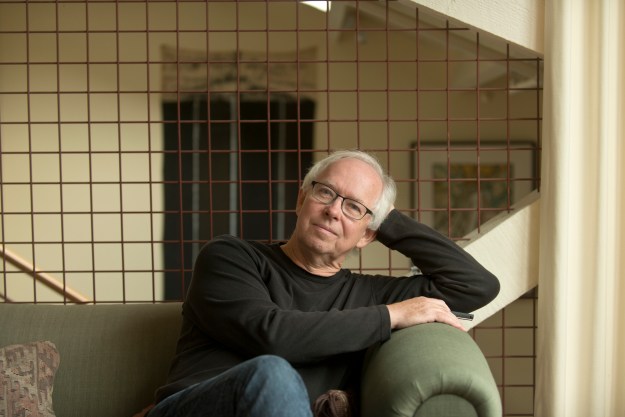
bill_manhire035-2.JPG

Photo Credit: Grant Maiden


‘Did you all survive?

On that first day of school, I mostly remember

being terrified: the dark interior, the children in rows

at their separate desks, and I was now to be one of them.

In a field by the school, there were bales of hay.

I remember inkwells.

That was perhaps a harder day.’


from ‘The Question Poem’


Somet_Things_to_Place_in_a_Coffin__40224.1482273596.220.220.jpg  Somet_Things_to_Place_in_a_Coffin__40224.1482273596.220.220.jpg   Somet_Things_to_Place_in_a_Coffin__40224.1482273596.220.220.jpg

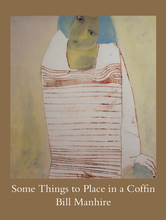
Some Things to Place in a Coffin Bill Manhire (Victoria University Press, 2017)


Bill Manhire’s new collection of poetry offers the reader a sumptuous reading experience: there is coolness, heat, air, movement, suspension.  There are some poetry books that maintain a cavernous distance as I read, but I just click with Bill’s poems. My review of Bill’s book of riddles, Tell me My Name, is here.

Bill  lives in Wellington, and is an emeritus professor at Victoria University. His first book of poems, The Elaboration, with drawings by Ralph Hotere, appeared in 1972.


PG: What challenges you most when you write a poem?

BM: Getting properly underway.  I’m quite good at finding phrases that nag away at me, and I keep them in my head or on paper – but finding my way forward from them can be a problem, or even knowing if I can find my way forward.  I seem to know how long a poem is going to be, roughly what its shape will be and so on, but things often collapse about two thirds of the way through. I suspect there are quite a few poems over the years where it looks like I’ve landed on my feet near the end but I’ve actually broken my ankle.


PG: What delights you most?

BM: Knowing that a poem is actually there, but that it needs some work to be fully itself.  Doing that last little bit of work – so different from whatever inspiration is supposed to be – is strangely exhilarating.


PG: Your new collection, as with Lifted and Victims of Lightning, refreshes what poetry can do: how it can soothe and challenge and prompt wonder. Initially the Zen-like movement of the poems struck me (or you could track an oxymoron effect): silence yields music, stillness leads to activity, simplicity yields knots, economy yields richness. Such movement prolongs contemplation. Have you ever thought of your poetry in this way?

BM: I don’t think I think very deeply or coherently about poetry, especially my own. I don’t have any aims when I write, even with a commissioned poem like ‘Known unto God’. But I get great pleasure from a poem when at some point it pushes me sideways from myself, pushes me out of habitual assumptions, changes the pace of my inner life. I like it when a poem starts off quietly and then starts resonating – a sort of ripple effect – and I certainly like it when a poem looks innocent and amiable then suddenly gets dangerous and agitating. Tonal shifts – code-switching, logopoeia – seem to be key to individual poems, too; and maybe even more, inside a book, to the way poems keep each other company.


The window waits for light.

The path to the river waits

for twigs and stones ands feet.

The day hopes to be successful,

a prose day really, nothing untoward

and so it, too, waits. Also the car waits.

from ‘Waiting’


PG: There are several ‘waiting’ poems and it seems to me this book has benefited from a different relationship with time (a little like your Menton sojourn did for Lifted). Away from your hectic university life, has your time with poetry changed to the degree you are able to wait with a poem differently?

BM: It’s not in the least relevant, but I think Waiting for Godot is the great poem of the 20th century.

I don’t think this is what what you’re getting at either, but we all start out in the world full of appetite and desire and with a strong sense only of the immediate moment. And then I suppose there’s that troubling, invigorating phase later that mixes memory and desire, to borrow the start of Eliot’s The Waste Land.  Your past and future are fighting it out in the present. And then if you last the distance there’s a lot more past and much more of this thing called memory, which as someone said is pretty much the imagination in reverse. I think I’m in this last time zone. I’ve even prefaced the collection with a little poem about memory.


PG: I found the ‘waiting’ poignant because it felt both philosophical and political.

BM: That’s a generous way of putting it. I suspect it’s more that I’m very much a fatalist. This probably has something to do, someone once told me, with being the child of an alcoholic – you’re totally under the circumstances. The great human beings are the ones who change the circumstances, or have a shot at doing so. But my feeling is that most of the time most of us are under the circumstances, and so how you behave is what measures your worth as a human being.


They dug me up in Caterpillar Valley

and brought me home –

well, all of the visible bits of me.

Now people arrive at dawn and sing.

And I have a new word: skateboarding.

from ‘Known unto God’


PG: The collection seems open to anything (Chairman Mao’s impersonator, surveillance notes, the school bus, the trenches, a Sunday School mural, a body blown to bits, war, Ralph Hotere’s coffin). Do you have no-go areas as a poet?

BM: I’m pretty protective about my personal life.  No one could accuse me of oversharing. If you were to try and turn the first-person I in my poems into someone called Bill Manhire, it would all be pretty baffling. Sometimes it’s someone else altogether, sometimes someone with some of my features, sometimes (but rarely) the full myself. As Emily Dickinson says, ‘When I state myself, as the representative of the verse, it does not mean me, but a supposed person.’

Of course the life is there in certain poems, but displaced or approached obliquely.  ‘The Question Poem’ deals with the aftermath of an event like the Christchurch earthquake, but the speaker in the poem, trying to deflect the very direct questions about catastrophe, reaches back to memories of his first day at school – and I guess that’s essentially my own first day at school.  Likewise, ‘The Schoolbus’ is fairly true to a particular patch of my childhood.

But I’m never a completely missing person. I’m there in every poem in some form or other, even if it’s just via a small tonal inflection or a tiny hesitation.


How Memory Works


Come over here

we say to the days that disappear.

No, over here.


PG: You are the master of the miniature poem—I liken your examples to a drop of wine that dances on the tongue. What attracts you to this form? What holds your attention in a small poem?

BM: I think I’m drawn to the short poem for visual rather than auditory reasons.  There’s nothing more wonderful than a few words, just two or three lines, sitting in the middle of a white page. The words and letters start to grow out into the space around them  – which I guess is what you also want the reader’s imagination to do. In some ways the words look vulnerable, but to me they’re powerful.

I like putting little poems on Twitter, and that’s partly because I miss the days when I could type out a handwritten poem and see it as it as itself without my protective care.  You need to find ways of making poems remote, independent – there they are on the screen, out in the world. But there’s something undermining about the way Twitter clutters the screen, so it’s not the same.


Soon enough the enemy will come,

limping out of a place that will not heal.

And soon enough it will be gone,

this world that you once woke into.

from ‘The Enemy’


PG: Initially I view your poetry as steered by a mind drifting, stalling, looping. I was watching the surprising lines of a gull at the beach this morning, the way it arced and stretched, hovered with such grace, landed with light feet. I was fascinated by the beauty and the unpredictability and began to compare it to the way your poems move. Which led me to the way politics also feed the poems. There are subtle entries and there are toothpicks: ‘That is why China waits,/ and America waits.’ ‘You cannot reach the beautiful world.’ In this world under threat, is it now more important that political views are visible, whether overt or subtle?

BM: There are poems in the new book with a political dimension, and maybe there are more of them than there used to be. It’s highly satisfying to make a local-body politician say, ‘I do not think that I am rubbish’!  And sometimes a political element’s there but a little oblique. ‘Poem in an Orchard’, for example, is about rendition. I don’t set out to write politically.  I’m not into palpable design. But I’m a citizen who votes and signs petitions and tries to pay attention. And I’m a human being, so I can do gasping and outrage and anxiety and distress – and sometimes hopefulness – in poetry just as others can.  I think the US invasion of Iraq intensified some of those things for me, and that’s probably evident in some of the poems written since then.

I’ve always felt slightly ashamed that I let the Listener mildly censor a poem I wrote years ago called ‘Wellington’.  It was a piece against Muldoon, and included the lines ‘the boys from Muldoon Real Estate / are breaking someone’s arm’. They wanted to change it to ‘Beehive Real Estate’, and I weakly said yes.  Was it better for the doctored poem to appear in the Listener than not? I don’t know. I restored the true reading when the poem appeared in a book. But I don’t imagine either version would have hastened Muldoon’s downfall.  Labour’s Grant Robertson once told me  that there was briefly a Dunedin band called ‘Muldoon Real Estate’, which is nice. Probably one of those stories that’s too good to check.


PG: The poem, ‘Falseweed’ was originally published as a little pamphlet by Egg Box Publishing in Norwich. It has a different feel to your other poems. The words are scattered like seeds on the expanse of white page. There is linguistic inventiveness that boosts both music and image, particularly in compound words:

leafcandle  pencilheart  wintertwig  scribblegrass  anchorwhite  tongue-true.

What are the origins of this poem? Did it feel like you were shifting your musical key in terms of the words on the line?

BM: Yes. there’s some sort of musical shift – in some ways back to poems like ‘The Seasons/If I Will Sing There’ or ‘Wulf’.  Your seeds image is a good one, as the poem is pseudo-botanical. I started noticing, a bit obsessively, just how many poets in the UK and North America were using the vernacular names of plants in their poems: poets like Jen Hadfield, Alice Oswald, Robert Hass.  It’s maybe connected to Robert Macfarlane’s Landmarks project recovering regional and dialect landscape terms. For a pakeha New Zealander like me it’s possible to feel envious of these language troves. About a year ago the English poet Sasha Dugdale tweeted: ‘Path on Seaford Head through restharrow, agrimony, moon carrot & selfheal.’ Now there’s a lyrical outing!

Anyway, I thought I would try to make a poem that teased that whole fashion – seed-packet poetry, I’ve heard it called – along with my own language inadequacies, by inventing my own weeds and grasses. But then as I wrote I found myself producing a poem very much about writer’s block and a kind of world-weariness.


Now darkness brings out

the little paperclip

plus a clump or two

of scribblegrass –

*

If we had seeds
we would scatter them

scatter them –

*

oh pencilheart –

oh smudge-of-lead.


PG: Is there one poem in particular that really works for you in this collection?

BM: I’d have to say ‘Known unto God’ – in part because of publisher generosity with formatting. I like the way it’s been able to sit like a small chapbook inside the larger book.  Each speaker in the poem gets their own page – so that that thing I was talking about earlier in terms of small poems, the mix of vulnerability and powerful presence, is made visible. The fact that the sequence effectively opens with a double-sided black page sets up the elegaic mood, too. The whole thing looks right.


PG: Which poem took you by surprise?

BM: Again, ‘Known unto God’.  I want to say I didn’t know I had it in me, but of course I didn’t have it in me – it was always out there in the world. My work was to catch it, edit it hard, and get the choreography right.


Victoria University Press page

Susanna Andrews shares her review on Radio NZ National

Bill describes his writing day for The Listener

‘This Reading Life: Bill Manhire’ for NZ Festival

On reading Bill Manhire’s Tell Me My Name

Tell_Me_My_Name_front__47436.1482273132.1280.1280.jpg


The road goes by the house

the wind sings in the tree

we sing the travelling worlds

we sing quietly

(we sing quietly)


from ‘1’


I have never learned to meditate but running on the beach is a way of being completely in the moment, of absorbing sky, sea and sand, with everything else on hold. I find the same thing happens when I do cryptic crosswords—whether as a bedtime ritual or in a waiting-room—the head clatter dissolves. I have, courtesy of Bill Manhire’s Tell Me My Name, discovered a new floating aid: the riddle poem.

Bill’s book is a collection of riddle poems with alluring photographs by Peter Peryer and a CD where the riddle poem becomes song, courtesy of Hannah Griffin’s voice and Norman Meehan’s music.


I’m made of where you’re going

I’m made of north and south

I’m made of possibility

I’m made of somewhere else


from ‘4’


Upon first reading, I meet the poems with the riddleness waiting in the rhyme, the echoes, the porousness, the enigma, the sweetly crafted melody.  I let song wait and then the poems start to sing themselves because they are music rich. There is such openness, as though you enter a vast field that might be corn or might be sunflowers, that generates both movement and stillness.

Upon second reading, I pay attention to the riddles and drift in and out of an atlas, a memory, a shadow. Now I have my floating aid. I am not sure what things are or the answer to the riddles, and that is the unexpected joy of it (like the rhythm of running or cryptic clues where there is a Ha! at arrival which is good but not as good as the travel). One day I will look at the end page and discover the names of things, but it will puncture the delight of currently never knowing (in many cases). Perhaps I have found a bridge, an ocean, an echo, a family tree, a watermelon, a muddy puddle, ice, the dark, longitude and latitude. I am thinking this is the perfect book to take on a long haul flight, to have in my bag for steamy queues, but I don’t want to lose it. The riddle poem as flotation aid is like a strip razor sharpening your mind, a shot of vitamins that restores equilibrium.

And now the CD. I keep playing it over and over to fall into the honey gravel lift and dip of Hannah’s voice or the textured music, the delicious pared-back feel so that each note— whether violin, piano, whistles or voice—resonates.

Victoria University Press has produced a beautiful hard-cover book. It is going in my carry-on bag.


I’m always at the cinema

I’m always at the beach

I’m waiting in that secret place

that lovers try to reach


from ‘5’


Victoria University page

Interview with Kathryn Ryan on RNZ National

Poetry Shelf interviews Sue Wootton: ‘interweaving and texture in a poem is an effect I love’

Sue_Wootton-092012-300dpi.jpg

The Yield, Sue Wootton, Otago University Press, 2017

Sue Wootton’s latest collection of poetry is a sumptuous read, a read that sparks in new directions while clearly in debt to everything she has written to date. The cover is so very inviting. I have been a fan of Sue’s poetry for a long time and was delighted she agreed to share thoughts on poetry and the new book.

Sue Wootton lives in Dunedin, where she is the selecting editor for the Otago Daily Times Weekend Poem column and co-editor of the Health Humanities blog Corpus: Conversations about Medicine and Life. She is a PhD candidate at the University of Otago, researching connections between creative practice, literature, and medicine. Sue’s debut novel, Strip (Mākaro Press, 2016), was longlisted for the fiction prize of the 2017 Ockham NZ Book Awards. The Yield (Otago University Press, 2017) is her fifth collection of poetry. Sue’s website. Find Corpus here.


The+Yield.jpg  The+Yield.jpg


and you wonder if unspooling is, will ever be, your forte,

a question you will never answer since it never ends,

this casting your line on gale or water

from ‘Unspooling’


PG: Let’s begin with the world of books. What books affected when you were young and what books have affected you as an adult poet?

SW: My mother used to take us to the Whanganui library every Saturday morning to collect an armful of books for the week, and we were lucky in having a family friend who used to give books—lovely hardback illustrated books—for birthday and Christmas presents. I still have the one I received from her on my sixth birthday: Candy and the Rocking Horse by Gwyneth Mamlok. Oh Candy, how I loved your red hat, your bright pink tights, your long boots, and the way you and your dog Peppermint did everything together, just the two of you! Other beloved books included Hubert’s Hair-Raising Adventure by Bill Peat, Patrick by Quentin Blake and Horton Hatches the Egg by Dr Seuss. A little later I fell big time for Roald Dahl with Charlie and the Chocolate Factory. Ian Serraillier’s The Silver Sword made a huge impression on me, and there was a novel set in the crypt of Winchester cathedral about which I remember nothing except the sinister feelings it evoked and the grip it had on me. By then I was hooked on books that stirred my imagination, especially by describing other possible worlds. I chewed through the Narnia series and Lord of the Rings, and in my teens went through a major science fiction phase, devouring books by authors like Ursula K. Le Guin and Isaac Asimov. Poetry hit me as a force in my final year of secondary school, when we were given poems by Dylan Thomas. We studied King Lear that year, and I remember being well and truly woken up when I heard Richard Burton bring those words to life. And I discovered e e cummings around the same time, and was amazed to see what can happen when syntax and word are unpacked and put back together askew, strange, and suddenly with so much more verve than “ordinary” language.

As an adult, I would credit Harmonium by Wallace Stevens for jolting me forward in terms of realising what the ‘blue guitar’ of poetry can do: “Things as they are / are changed upon the blue guitar”; they become “A tune beyond us, yet ourselves”.  There have been many other influences, too many to list in full, but probably my most thumbed volumes are by Emily Dickinson, W. B. Yeats, W. H. Auden, Czeslaw Milosz, Louise Glück and Elizabeth Bishop.


PG: Your latest collection is a sumptuous feast of sound and image amongst other things. Several poems feature knitting and I decided that knitting is a perfect analogy for the way your poems interlace the aural and the visual to produce sensual patterns. Your poems have enviable texture and that texture engages both mind and heart. What matters most when you write a poem?

SW:  Thanks, interweaving and texture in a poem is an effect I love, so I’m pleased if you find it in some of my work. I can get very absorbed in the pattern-making. I like the way Glen Maxwell describes words and phrases as being capable of giving up at least four types of meaning: solar (the daytime, dictionary denotation), lunar (dream and shadow-sense), musical, and visual. Some words are particularly richly endowed with these extra layers, so they can act as portals to interlacing patterns inlaid within the poem. It’s the intertwining, the entanglement, that matters most, because it’s only through connection and relationship that we can experience life. Or, as Emily Dickinson much more succinctly wrote: “The mind lives on the heart / like any parasite”.


PG: As I read, the poetry of David Eggleton and Michele Leggott came to mind.  They both write out of their own skin in ways that are quite unlike the local trend to write conversational poetry. I could see a similar idiosyncratic pulse driving your poems as though you were pushing your boundaries, resisting models, playing and challenging what you could do as a poet. I am wrong to think this?

SW:  I suppose this is something to do with my sense that writing poems is an embodied process. How could a poet not write out of their own skin? It’s a matter of probing language for a response, and following what happens. And then paying attention to how that feels. Is it good on the tongue, does it sing in the ear, does it resonate in the heart and mind? Does it intrigue? Has it got heft and mass, or is it a ghostly drifter? Is it slow or swift? Is it eager or melancholy? Quiet or noisy? I can only start shaping the poem properly once I have a sense of these things.


Measure my wild. Down to my last leaf,

my furled, my desiccated. This deciduousness,

this bloom. Calculate my xylem levels,

my spore count, fungal, scarlet

in a bluebell glade. Whoosh,

where the foliage closes on a great cat.

Test me: how many tigers in my jungle,

how many lions at roam? Map my rivers,

deltas, estuaries. Mollusc, whelk, worm.

from ‘Wild’


PG: I am really struck by the heightened musical effects in these poems. You have always had an attentive ear to the way poems sound but this collection almost feels baroque in the leapfrogging alliteration, assonance and sweet chords. Was this deliberate or an unconscious progression?

SW: I’m not overly conscious of working the musicality of poems as I’m writing them, but undoubtedly I do love sound and lyrical effects in language and this seems to naturally surface in my work. Sometimes I consciously decide to use a poetic form as a template to get started on something, because it can be helpful to have an incubating frame. Whatever words I’ve got, I’ll push them around within the frame until something starts to happen. That something is a gut feeling that the gears have meshed, and things are underway. It’s about then that the poem starts to generate its own peculiar hum. I’ll find myself wanting to shape or enhance that fundamental pulse, and that seems to involve going deaf to the outside world in order to listen to the language itself, word speaking to word, image to image, sound to sound. But it’s an instinctive thing mostly—although there is also a constant back and forth between being immersed in the poem and zooming out to ‘hear’ and ‘see’ it more dispassionately.


PG: Some of the poems (‘The needlework, the polishing,’ ‘Pray,’ ‘Priest in a coffee shop,’ ‘Graveyard poem,’ ‘Poem to my nearest galaxy’) engage with the spirituality either through a church building or prayer. Do you see poetry as a vessel to explore the divine? I am also thinking of the way the landscape frames beauty and you as poet tender your version of that (‘Central,’ ‘Hawea,’ ‘A day trip to the peninsula’).

SW: I am not religious in the sense of believing in a god or gods or in cleaving to any institutionalised religious belief or practice. I resent being told what to think and I am allergic to dogma (she says dogmatically). “I like an empty church”, as I say in ‘The needlework, the polishing’. But I do think life is marvellous, in the sense that it’s a marvel, and I think that remembering to marvel at life is hugely important, and in this way I definitely consider myself to have a religious sensibility. Paying attention to nature and landscape, that’s one way to transcend the petty personal and recall the awe-fulness of being alive. In the human world, I do like buildings like churches or mosques or some art galleries and museums that have been designed to facilitate attention, reflection and reverence. Sacred spaces, if you like. And yes, some poetry can also open such a space: architectural, composed, a place of formal dignity.


PG: That’s a lovely way to think of the poetic space. To take notions of the landscape further, place does resonate strongly in the collection, particularly the allure of Central. What local poets offer sustenance when it comes to the poetry of place?

SW: I find myself thinking of poets of waterscape, actually, rather than landscape – poets like Bob Orr (especially his poem ‘The Names of Rivers’), Rhian Gallagher’s poems about creeks and rivers and salt marshes, Cilla McQueen’s poems that quietly celebrate Otago harbour and lakes, Brian Turner’s odes to rivers, and Hone Tuwhare’s Tangaroa poems.


Some words dwell in the bone, as yet

unassembled.

from ‘Lingua incognita’


The bones that lie around Black Lake are lichen spotted.

They do not gleam. They are not white.

Not the idea of bone, but bone itself, scattered, split.

from ‘Black Lake’


PG: Are there places in particular that are deep in your bones (to borrow your recurring motif) and call to be written?

SW: Going back to the water poems above, and to quote Bob Orr, there’s a creek near Whanganui that ‘runs through my life’. We used to visit it when I was a small child, and although I’ve never been there as an adult, I keep finding echoes of it elsewhere, as when I was walking along the Omarama stream in North Otago just last week. The Otago peninsula, and several beaches north and south of Dunedin are in me too. And I like the repetition of walking my Dunedin neighbourhood, how (as Charles Brasch wrote) “I walk my streets into recognition”. But it’s the water-places in my life that really haunt me and keep calling to be written.


PG: There are traces of the personal in the poems—deaths, a family picnic, illness, a declaration to live life to the utmost, friendship—but I would suggest you hide in the crevices. I am also fascinated by the way the personal does not necessarily mean self confession or family anecdote. What is your relationship with the personal when you write poetry?

SW: I hope that’s so, that the writer is hiding in the crevices and the poems are standing in  the foreground. That seems the right way round to me. I feel that my task when I write a poem is to construct an artefact out of language. The results are always much more interesting if I can get my personal self out of the way of my writing self. My personal self has the usual limited preoccupations, whereas my writing self has much wider vision. I think this is because my writing self tends to be always in conversation with dead and living writers, and they often have interesting things to say, and that make me stretch my own pen beyond mere anecdote or autobiography. There’s a lot more out there to write about, things much more intriguing, more puzzling, more important. And along the way, poets are allowed to make things up. Indeed, this is a very liberating approach. For example, the picnic poem you mention describes a completely imaginary picnic. Then again, many poems in The Yield do have personal resonance, but being poems they have all been through that ‘blue guitar’, and become changed. Not false, mind. Never untrue!


PG: I was utterly delighted and moved to see you dedicated a poem to me. Thank you! In my debut book, Cookhouse, I dedicated poems to women who played a role in my writing origins. I called them my ‘afternoon-tea poems,’ because I imagined my poem stood in for this beloved ritual. Which poets, significant in your writing origins, would you invite to afternoon tea?

SW:  This would need a long table and I hope it wouldn’t end in a bun fight, but let’s see: Emily Dickinson, Emily Bronte, Elizabeth Bishop, Louise Glück, Carol Anne Duffy, Adrienne Rich, Amy Clampitt, Kathleen Jamie, and a few blokes: James K Baxter, Gerard Manley Hopkins, Bob Dylan, Leonard Cohen, Hone Tuwhare and William Shakespeare.


PG: So many poems in the collection stand out for me (and indeed there are a praiseworthy number of award-winning poems here). I especially love ‘Calling,’ ‘Wild,’ ‘Lunch poem for Larry,’  ‘Admission,’ ‘Picnic,’ ‘Unspooling,’ ‘Strange monster,’ ‘A treatise on the benefits of moonbathing,’ ‘The crop,’ ‘Daffodils.’ Oh a much longer list than this – I deliberately left off most of the award winners. Do you have a favourite because of its origins? Or the way it formed itself on the page?

SW:  Maybe ‘Strange monster’ because it was a surprise to me in every way—it was one that seemed to generate its own heartbeat from the get-go; it just galloped away. And ‘The crop’, for the opposite reason, because it cavilled and bitched and moaned about being written, and took years to find its final shape.


Let parasols be wrecked in soonest storm and let them drop.

Tree be tree and branch be branch. Lean, lean, into the spaces between.

from ‘Wintersight’

Chris Price shares a New Zealand poem on World Poetry Day 2017

 Screen Shot 2017-03-22 at 5.10.32 PM.png
Great choice!
Published on Mar 20, 2017

Victoria International Institute of Modern Letters senior lecturer and New Zealand poet Chris Price shares one of her favourite New Zealand poems for World Poetry Day 2017, written by Sonia Yelich and published in Clung (Auckland University Press, 2004).

Bravo! Poetry at the Auckland Writers Festival is an eclectic mix

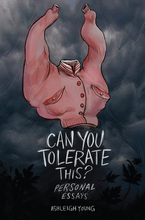
can_you_tolerate_this__31811-1464841060-220-220

You will also get a chance to hear  Ashleigh Young with her fabulous essays!

AWF programme here.


Lots of these events are free entry so get there early if you want a seat. Such an innovative inclusion of poets and clear demonstration that NZ poetry is in very good shape. So many excellent books out in the past year  and only so much room to showcase them here. That surely is testimony to the dedication of local publishers and local poets. Sure there are voices I am sad not to be hearing – but this is a poetry feast! Congratulations Anne O’Brien and team.


Tuesday 16th May, 7 until 8.30pm Go see who wind the poetry section of the Ockham NZ Book Awards

Friday 19th, 2.30pm. Catch Courtney Sina Meredith in Pacific Tales.

Friday 19th, 4pm. Poets Hera Lindsay Bird and Anne Kennedy joined three other writers at Auckland War Memorial Museum to seek inspiration for a piece of writing. Hear what they came up with.

Friday 19th, 5pm. Hear the book-award winners.

Hear Carol Ann Duffy with John Sampson on 19th at 6pm or do the World’s Wife on Saturday 20th 7pm until 9.30pm.


Friday 19th 6.30 until 8pm. Walk on High looks like a poetry smorgasbord:

Walk on High is an intimate meandering journey, featuring a sampler of Festival talent on a word trail along High Street in the CBD. From 6.30pm to 8pm choose from four fifteen-minute events, repeated four times across the ninety minutes, individually crafted and each as delectable as the next. Formats take in games, Insta-essays, music, spoken word and theatre. Over 20 writers and performers take part, including: Jess Holly Bates, Anthony Byrt, Teju Cole, Glenn Colquhoun, Jonothan Cullinane, Mei-Lin Hansen, Ali Ikram, Simone Kaho, Sarah Laing, Last Tapes Theatre Company, Michelle Leggott, Lana Lopesi, Selina Tusitala Marsh, Doug Poole, Randa, Rosabel Tan, Apirana Taylor, Tourettes, Steven Toussaint, Ian Wedde, Rewa Worley and Sonja Yelich. A full schedule and event descriptions will be posted to our website early April so check it out and start planning your Walk on High: writersfestival.co.nz/walk-on-high


Check out the Old Guard New Guard with Bill Manhire and Hera Lindsay Bird 4.30 Saturday 2oth.


There is an electric group on offer at the Spoken Word Showcase Saturday 21st 7.30 until 9.30pm:

Five of the brightest spoken word artists take to the stage in an unprecedented showcase of talent from Tamaki Makaurau, including Marina Alefosio (Rising Voices, South Auckland Poets Collective), Mohamed Hassan (New Zealand Poetry Slam and Revival Sessions), Tim Heath (Poetry Idol finalist), Jennifer Rockwell (Word the Front Line) and Rewa Worley (Rising Voices). Former Poetry Idol winner and judge Zane Scarborough hosts an evening of signature pieces, improv, and a little crowd participation with international guests Paul Beatty (The Sellout), Ivan Coyote (Tomboy Survival Guide) and Rupi Kaur (Milk and Honey) punctuating the evening with performances. A special night not to be missed.


You can hear Apirana Taylor on Sunday 21st at noon.

Bill Manhire joins in Questions of Time (with the fabulous Frances Hardinge). Sunday 21st 10.30.


Ian Wedde is in Family Dynamics with his new Selected Poems. Sunday 21st at noon.

Simone Kaho and Rupui Kaur are in Those Were the Days. Sunday 21st at 3pm.


Check out the winner of the Sarah Broome Poetry Award on Sunday 21st at 4.30pm.


Fiona Kidman is the 2017 Honoured New Zealand  Writer. Sunday 21st 6pm until 7pm.


Ian Wedde is launching his Selected Poems  on Friday 19th 3.30pm until 5pm.

Plus Ian Wedde is doing this intriguing workshop you can be part of:

The poetic Bob Dylan won the 2016 Nobel Prize in Literature, and rap, poetry slams, and online publications have expanded the definitions of and audiences for poetry. In some countries – in Palestine, for example, with Mahmoud Darwish – the form has long been a vital aspect of public discourse. Bring your work to this session with Ian Wedde, for a practical investigation of the porous borders of poetry.

Limited to a maximum of 40 participants.


Finally you can see Pop Poetry in the Square each evening:

Festival week sees a corner of Aotea Square come alive each night with text projections. Every evening a
combination of curated and live writing will emanate from the mysterious Pop Poetry hut, inspired by the theme ‘Love Letters’.

A sparkling collection of intrepid writers join the fun, with one a night writing live but anonymously and only revealing themselves as they sign off… expect poems, letters, lyrics and other treats.
Pop is an annual series of public art projects made for and by Aucklanders, supported by Auckland Council and the Waitemata- Local Board. Its mission is to create unexpected experiences in Auckland’s neighbourhoods; creating surprise, making fun and forming communities. Pop Poetry is in its second year of activating urban sites around the city though large-format, typographic projections by night. Pop Poetry is designed by Alt Group.

Pop Poetry will take place each evening from 6:00pm – 9:00pm, from Tuesday 16 May until Sunday May 21.


Poetry Shelf interviews Hannah Mettner: ‘I want to be emotionally moved by a poem, and nothing less’


FullSizeRender.jpg


We believe in the steps.

We tell our children and then our

grandchildren about the cool

pond at the top where sun-

carp clean our feet and where

we can sleep. The steps are one of

the beautiful mysteries of

life, like how did we get here,

fully clothed and so forgetful?


from ‘Higher ground’


Hannah Mettner is a Wellington-based poet from Gisborne. Her poems have appeared widely in literary journals, including Sport, Turbine and Cordite. She is co-editor with Morgan Bach and Sugar Magnolia Wilson of Sweet Mammalian, an online poetry journal launched in 2014.

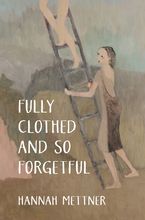
I first heard Hannah read at the Ruapehu Writers Festival last year and I was immediately hooked. To celebrate the arrival of her debut poetry collection,  Fully clothed and so forgetful (Victoria University Press), Hannah agreed to do this interview. As you will see from my comments in the interview, this collection has struck a chord with me on a number of levels. I absolutely adore it.


The book is launched tonight: 16 March 2017 from 6.00 pm – 7.30 pm

The Guest Room, Southern Cross, 39 Abel Smith St, Wellington


PG: You include two quotations at the start of the book—one by Eileen Myles and one by Adrienne Rich—that underline your status as reader, while the book itself is infused with your reading life.  Can you name three non-poetry books that have sparked you any time from zero until now? And three poetry books, from any point in your reading timeline, that have also affected you?

HM: Ah yes, I mean, it wasn’t meant as any kind of political statement, choosing two gay poets to front the book, although it definitely can be, I just love their writing, and those particular poems. And then those parts of those poems stuck out as handy things to highlight at the outset of the book. As to my reading, well, I’ve always liked reading, and I wonder if it’s partly a control thing: I find people quite hard work, they’re so fascinating and unpredictable and needy, with a book you can just shut it when you get to satiety, and come back to it when you’re ready. Then I studied English Lit at uni, and I work at the Turnbull Library now, so books are very thoroughly part of my comfort zone, and I get a bit panicked if I don’t have one nearby, to serve as a social safety blanket. I remember being completely transported by a Margaret Mahy book The Door in the Air and Other Stories, as a young person. Strange little vignettes into other possible lives: very like one of the stories in that book about a girl who meets a wizard with a house full of different windows depicting different worlds. Obviously all of Mahy’s books are fantastic, and that magical realism has definitely been a thing that has kept my interest over the years, both as a reader and a writer, she’s so good at combining the very mundane with the extraordinary. Another book I’ve come back to again and again (a big deal when you’re a bit blind and reading is a pleasure/pain situation like it is for me) is Jeanette Winterson’s Written on the Body, which is scorchingly personal and profound. Those two books are really my sun and moon, there are heaps of other books I’ve read and loved, but nothing quite like those. Poetry books are perhaps too numerable to mention? Though I distinctly remember that James Brown’s first book Go Round Power Please was the book that got me reading and eventually writing poetry. I checked it out from the public library in Gisborne not long after having my first baby, and discovered that poetry was a great way to ‘get more bang from my buck’ when I was too tired and busy to make much headway with novels. Those poems are so humble and personable, and so varied, so I could read a couple, then turn them over in my head until I could get to the next couple (which is a great way to read poetry in my opinion).


Fully_Clothed_and_So_Forgetful__32303.1486956777.220.220.jpg   Fully_Clothed_and_So_Forgetful__32303.1486956777.220.220.jpg   Fully_Clothed_and_So_Forgetful__32303.1486956777.220.220.jpg


PG: Your debut collection, Fully Clothed and So Forgetful, gave me goose bumps as I read and took me beyond words to that state where you stand somewhere wild and beautiful and just stall beyond language to absorb the world. My initial reaction is simply to tell the reader to read your book. But then I start accumulating a list of what I think your poetry is doing: the poems are inventive, unpredictable, melodic, on the move, strange, love-soaked. What key things matter when you write a poem?

HM: Thank you! That is a lovely thing to have someone say about my writing, and quite strange because these poems have become so familiar to me now that I’ve almost become disenchanted by them: you know, the feeling of old outfits you’ve worn too many times and are giving way at the knees or something. The key thing that matters to me in a poem (whether one I’m writing or reading) is that it gets me in the gut. I get very frustrated by poetry that feels empty, or emotionally disengaged or distant, or is teasing the reader or holding them at arm’s length. I just find it boring, I mean, I know that different poems and poets have all sorts of intellectual fare to offer, but I want to be emotionally moved by a poem, and nothing less.


PG: I feel the same way. Your book generated strong emotional engagement for me, which is why it mattered so much. I am particularly excited by the way you create poetic movement. Is this something organic and unconscious or deliberate and cultivated?

HM: I guess it must be unconscious, because it’s not something I’ve gone in thinking about or worked at. Maybe it’s because I’m a chronic fidgeter? Or maybe because lots of my poems come to me when I’m walking. Or maybe it’s because I have a terrible attention span?


PG: The first poem, ‘Higher ground,’ is memorable, resonant and fablesque. I fill to the brim with it and don’t want to undercut the way I absorb its magical effects—the poetic side lanes and underpasses and overbridges—by explaining what I think it is doing. But I would say, as a tiny hinge into the poem, it reminds me how we can so easily become immune to what we see and hear. How do you feel about talking about the poetry you write?

HM: Ah yes, well this poem is an example of one that came to me while walking! In Wellington, as you know, there are lots of hills, and my old house was up one of them, and then up ninety steps. This made walking home from school with my kids kind of a drag, and so this poem, with its promise of glories to come, is really just an exaggeration of the daily bribery of walking home from school up what is basically a mountain. We totally become immune to life, it’s kind of tragic eh? One of the things that was promised to me when I had kids was that “they’d make me see the world with fresh eyes” and more parental romanticisations like that, and I really don’t know if that’s been true or not. But I do spend a lot of time trying to look at things like that anyway. I used to think I was going to be an artist, so maybe it comes from that? Experiencing the world, then deconstructing it in order to be able to reconstruct it on the page?


PG: I loved the oblique appearance of Gertrude Stein and her Tender Buttons in your ‘Gender buttons.’ While your poetry does not replicate the anarchic and playful syntax of a Stein poem, your phrasing is deliciously agile and surprising (‘I wake to you nuzzling into my bed/
complaining of the quick-sand carpet in the hallway’). Do you feel Stein influenced your language in any way or your inventive links between object-self-word-love?

HM: Well actually I’m not a huge Stein fan, I find her poetry difficult to engage with, and I suspect she was kind of a horrible person. In fact, this poem came about because I told the person I was in love with at the time that I thought she looked like Stein (who she also hated), and then I felt so bad that I wrote a love poem by way of apology. But I am interested in Stein’s idea of ‘Cubist writing’, which I guess in my poems isn’t even close to the exaggerated effect she achieves, but I like the idea of multiple things going on, multiple ways to access a work, multiple planes of understanding, gaps in meaning which the mind auto-fills. And I like the idea of language constructing a world, rather than merely referencing it, you know, then I can say each of my lil poems is its own world, like one of the windows in the wizard’s house. I would love it if that’s how they were read, like objects to be picked up and transported by, either a snow-globe or a portkey.


PG: Another reason the collection affected me so much is that is deeply yet originally personal. I felt like making a caption to go over my desk: poetry is personal. Your poems demonstrate that you can dig deep into personal experience and self-scrutiny in ways that are inventive and quiet. There are some big things faced: a teenage pregnancy and not meeting expectations to marry a man.  So many of the poems, with strong personal origins, are effervescent with possibilities. I am thinking of ‘In the Forest of the night,’ inspired by William Blake’s ‘The Tyger,’ but hovers like a miniature, fully-formed autobiography (the fearful child, the maternal embrace, the maternal anxiety, the supressed feelings, the broken relationship). Did you have lines you would not cross in order to protect those close to you?

HM: Well yes, poetry is personal. Very personal. I do hope no one reads these and recognises (a part of) themself, and is upset. The relationship poems are unnamed for this exact reason, but the family ones are probably more problematic. Funnily enough the ones about my parents are pretty tidily summed up by saying they’re about miscommunication (or lack of communication), and I hope they’re grown-up enough to understand that everyone sees things differently, and that this is my version of events, so to speak. The kid-ones are the most worrying, as I don’t want them to be like some shameful or burdensome photo brought out at a 21st party. But there aren’t many of them, and I’ve tested them out on Lucia and Jethro, who seem ok with them. We talked about this a lot in Hera’s TMI course last year: what is too personal, what sorts of things make you a ‘bad person’ for disclosing about someone else in a poem, etc etc. I try to think ‘how would I feel if someone said this about me?’ and bear that in mind, and there are lots of excruciatingly personal disclosures about myself in here, so maybe that balances it out? But also, that responsibility can be a bit crippling and sometimes you think ‘well fuck it’ and just write.


PG: I love the way you place a personal revelation within intriguing and inventive contexts and layer it like an artichoke so that is exquisitely simple yet flavoursome on the tongue. I am thinking of ‘Trip with Mum,’ where you go to Disneyland and take rides with your aging mother—real or imagined—and have difficult conversations until you spin away from probing questions to a far-off planet: ‘I’d try shouting things like, What do you know about pain?! and I’m afraid! and finally, I love you! as I grew smaller and smaller and she grew older and older and everything just kept spinning.’ Is the autobiographical thread a significant part of how you write?

HM: Well I guess so, erm. I don’t know if that’s just narcissistic and unimaginative or what, but I guess I just don’t want to speak for anyone else, or tread on any toes, and other people are better qualified than me to tell their own stories. But also it’s a by-product of the way I think and experience the world: by relating information and experience directly to my personal history and developing self. I remember our MA class having a near-fight early in the year when Chris presented us with a reading which basically posited that people assume poetry is autobiographical, and that the narrator is the writer. We, mostly, railed against this on principle, wanting perhaps to protect our right to mystery, but I think we all secretly knew that the ‘I’ is the I. I’ve been emboldened by the opening poem in Hera’s book, which gives the reader permission to read it as a book about her (and the title), and Greg’s book which is openly autobiographical while looking outward at people and events to hang his history on in the complicated and beautiful way that true life does.


PG: Are you after some kind of autobiographical truth when you write, however elusive that might be? I am wondering if this is why the book has so intricately hooked me.

HM: Autobiographical truth? I guess so, in the sense that I’m prone to self-reflection. I’m quite a socially anxious person, and a major introvert, and one of those people who analyse social interactions excessively as they’re happening and potentially going on for days afterward just in the normal course of things. Looking at your actions in the world so closely is perhaps not healthy, but it is interesting, especially the way different people work in given situations and relations.


PG: Feminism is such a complicated, multifaceted, highly contested set of ideas and practices. It always has been and is especially so today. I think your collection is in debt to a feminist engagement with the world that is mobile and probing. Do you think it makes a difference to your poetry that you are a woman? Does feminism matter?

HM: Of course I’m a feminist, though I tend to think in essence feminism is very simple, actually, which is not to say women and womanhood aren’t complicated and gloriously multi-faceted, or that femininity as an identity within feminism (particular for lesbian, bi and trans women) isn’t highly contested. And yes, for sure feminism matters, and I think it needs to keep on mattering, more loudly and insistently than it has to date, for quite a while yet. I think it’s (perhaps too) clear that it matters to my writing that I’m a woman, it matters that I’m a feminist women, that I’m a mother, that I’m a teenage pregnancy statistic, that I’m bisexual, that I grew up in a working-class Christian family etc etc. Those large facts, plus all the more messy detail of just living—that’s my subject matter. I think every writer’s personal history matters to them in their writing to some extent, whether as information or bias, but not all writers are keen to share that information, or maybe they don’t think it’s interesting enough? But the feminist in me wants it to be enough! I want women to write their stories and for them to be enough! I get the sense that it’s sometimes considered not tasteful to be a bit political in poetry, that poetry should be a respite from the real world, but I want to read more poetry about the intricacies of other people’s lives.


PG: Are you a solitude poet (you keep poems to yourself) or a community poet (you exchange poems with friends for feedback)? Have you had any poetry mentors?

HM: I’m definitely not a solitary poet! If I was, I don’t think I’d get anything done. I’ve been lucky enough to be part of multiple communities of writers at different times: first my Masters class, then “poetry club” as we fondly call it, and Hera’s TMI school last year. All of those places have been so wonderful for being peopled with other humans who want to think and read and write, and I’m so grateful and in love with and in awe of all those humans! My longest-standing ‘community’ are definitely Sugar Magnolia Wilson and Morgan Bach, who are also my co-editors for Sweet Mammalian. Magnolia’s poems are like crystals, each with special powers, which you can pick up and feel humming through your skin, and which leave you altered and fumbling about on the astral plane. Morgan has this incredible gift for knitting centuries’ worth of narrative weight and detail into small and exacting visions which seep into your subconscious and trick you into thinking they’re your own memories. Those two, phoar, I’m so goddamn lucky to know them, to read their things when they’re vulnerable and new, and to have them do the same for me!


I’ve never had an official ‘mentor’, but do you think Anna would be too embarrassed if I claimed her? I think a significant portion of young writers in New Zealand, particularly women, wouldn’t be writing the way that they are if it wasn’t for her. Her writing is so smart, with such a dry sense of humour and openness to silliness too, such a unique voice, such clever observations, but they’re also unashamedly ‘womanly’ poems: they’re about friends and family, they’re domestic and comfortable and they still give you such feels. SO good!


Sometimes in your sleep I hear you roar

and it echoes in the back of my jaw, child,

in the forest of the night.


from ‘In the forest of the night’


Victoria University Press page

Radio NZ  National: Harry Ricketts reviews the book with Kathryn Ryan


Vivienne Plumb and Glenn Otto Launch is tonight – the book is glorious

17190457_10154416660243424_3707795828733151756_n.jpg

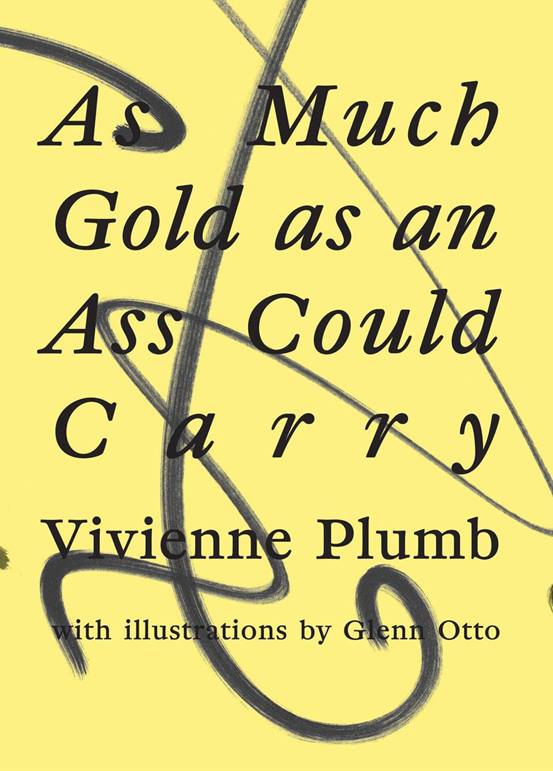
The launch of AS MUCH GOLD AS AN ASS COULD CARRY, by Vivienne Plumb with illustrations by Glenn Otto.

Friday 10 March, 6pm at split/fountain, 3C/23 Dundonald Street, Eden Terrace, Auckland.

Published by Split/Fountain

Split/Fountain page

Jeffrey Paparoa Holman’s New and Selected Poems book launch

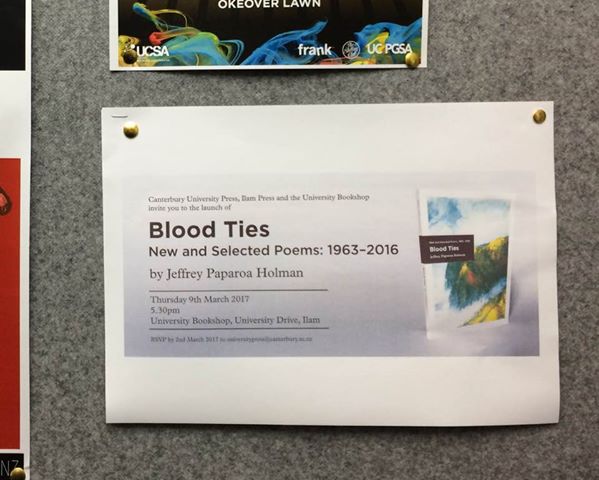
The book is near! Launch on
9 March at University Book Shop in Christchurch, 5.30pm.


16996085_10210832515702929_4970705068367885116_n.jpg