Category Archives: NZ poetry book

Better off Read: Pip Adam talks with Nina Powles


nina-powles.jpg

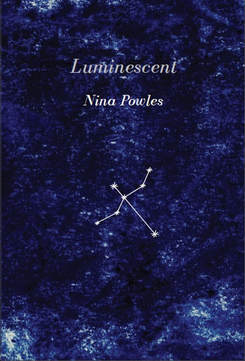
Episode 51: Pip Adam talks to Nina Powles about her new work LUMINESCENT

Listen here.

‘In this episode I spoke with one of my favourite Wellington poets Nina Powles. I first spent time with Nina around Helen Rickerby’s table where a group of us were hand-binding copies of her first collection Girls of the Drift.

Nina is an outstanding poet, non-fiction writer and zinemaker. She is half Malaysian-Chinese, half Pākehā. Nina has an MA in creative writing from Victoria University of Wellington and won the 2015 Biggs Family Prize for Poetry for the first draft of Luminescent. She is the author of the chapbook Girls of the Drift (Seraph Press, 2014) and several poetry zines.

Nina’s new work Luminescent is an extraordinary work.’


Paula: I love this collection so much. Here is my review.


luminescent-cover-low-res.jpg

Michele Leggott’s glorious new poetry collection: a launch speech and some poems


IMG_1043.jpeg  GetFileAttachment-1.jpg


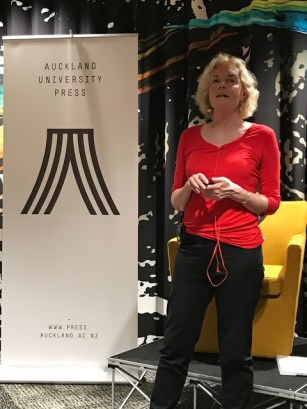
2017 seems to be the year of enviable launch speeches. Gregory O’Brien did a cracking job launching James Brown’s new book; Greg had taken the poems up to Palmerston North to read before writing his speech.

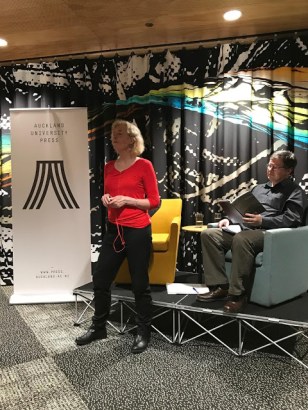
Jack Ross has launched Michele Leggott’s Vanishing Points (Auckland University Press) with similar incandescent word flare. I have read the book twice so far and he is right on point: this is one special poetry collection.


The Speech

Well, needless to say, I felt very flattered when Michele Leggott asked me to launch her latest book of poems, Vanishing Points. Flattered and somewhat terrified. It’s true that I’ve been reading and collecting her work for well over 20 years, and I’ve been teaching it at Massey University for almost a decade now, but I still felt quite a weight of responsibility pressing down on my shoulders!

One thing that Michele’s poetry is not, is simple. It’s hard to take anything in it precisely at face value: what seems like (and is) a beautiful lyrical phrase may be a borrowing from an unsung local poet – a tangle of Latin names can be a reference to an obsolete star-chart with pinpricks for the various constellations.

The first time I reviewed one of her books, as far as I can see, in 1999, I ended by saying “the reading has only begun.” At the time, I suspect I was just looking for a good line to finish on, but there was a truth there I didn’t yet suspect. Certainly, I’ve been reading in that book, and all her others, ever since.

But how should we read this particular book? “Read! Just keep reading. Understanding comes of itself,” was the answer German poet Paul Celan gave to critics who called his work obscure or difficult. With that in mind, I’ve chosen two touchstones from the volume I’m sure you’re all holding in your hands, or (if not) are planning to purchase presently.

The first is a phrase from the American poet Emily Dickinson, referred to in the notes at the back of the book: “If ever you need to say something … tell it slant.” [123] The second is a quote from the great, blind Argentinian writer Jorge Luis Borges: “I made a decision. I said to myself: since I have lost the beloved world of appearances, I must create something else.” [35]

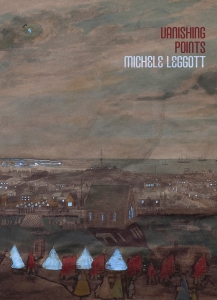
With these two phrases in mind, I’d like you to look at the cover of Michele’s book. It’s a painting of the just-landed Imperial troops, camped near New Plymouth in August 1860. The wonderful thing about it is the way the light of the campfires shines through the painting: little holes cut in the canvas designed to give the illusion of life and movement.

“War feels to me an oblique place,” wrote the reclusive New England poet Emily Dickinson to Thomas Wentworth Higginson in February 1863, at one of the darkest points of the American Civil War. Higginson, a militant Abolitionist, was the Colonel of the 1st South Carolina Volunteers, the first officially authorized black regiment in American history. He was, in short, a very important and admirable man in his own right. Perhaps it’s unfair of posterity to have largely forgotten him except as the recipient of these letters from one of America’s greatest poets.

New Zealand’s Land Wars of the 1860s may have been on a much smaller scale, but they were just as terrifying and devastating for the people of Taranaki – both Māori and Pakeha – in the early 1860s. In her sequence “The Fascicles,” Michele transforms a real distant relative into a poet in the Dickinson tradition. Just as Emily Dickinson left nearly 1800 poems behind her when she died in 1886, many collected in tidy sewn-up booklets or fascicles, so Dorcas (or Dorrie) Carrell “in Lyttelton, daughter of a soldier, wife of a gardener” [75] provides a pretext for “imagining a nineteenth-century woman writing on the outskirts of empire as bitter racial conflict erupts around her.” [123]

There’s an amazing corollary to this attempt to “Tell all the truth but tell it slant” (in Dickinson’s words). Having repurposed one of her family as a war poet, Michele was fortunate enough to discover the traces of a real poet, Emily Harris, the daughter of the Edwin Harris who painted the picture of Taranaki at war on the wall over there, whose collected works so far consist of copious letters and diaries, but also two very interesting poems. “Emily and her Sisters,” the seventh of the sequences collected here, tells certain aspects of that story.

It’s nothing but the strictest truth to say, then (as Michele does at the back of the book), that one should:

walk away from the painting when it is lit up and see how light falls into the world on this side of the picture surface. Is this what the artist meant by his cut-outs? Is this the meaning of every magic lantern slide? [124]

I despair of doing justice to the richness of this new collection of Michele’s – to my mind, her most daring and ambitious work since the NZ Book Award-winning DIA in 1994. There are eight sequences here, with a strong collective focus on the life and love-giving activities which go on alongside what Shakespeare calls in Othello “the big wars”: children, family, eating, painting, swimming. One of my favourites among them is the final sequence, “Figures in the Distance,” which offers a series of insights into the world of Michele’s guide-dog Olive – take a bow, Olive – amongst other family members, many of whom, I’m glad to see, have been able to come along here tonight.

This is a radiant, complex, yet very approachable book. It is, in its own way, I’m quite convinced, a masterpiece. We have a great poet among us. You’d be quite crazy to leave here tonight without a copy of Vanishing Points.

Jack Ross


[Jack and Michele then had a discussion on how the book came into being. I am going to do an interview with Michele so Poetry Shelf readers can also get different entry points into the collection.]


1503612399072.jpg


The poems:


from ‘Figures in the Distance’


18

In he comes, bouncing and sweaty, to borrow a towel and go swimming at Duders. Voice out front, key in the lock, just passing through. A voice on the phone from an airport far away, saying early morning is the time to go and see the ruins outside the city when there’s no one else around. One heading for the beach each morning with a thermos of coffee and that same ragged towel. Breakfast. The other drinking something from a coconut on a beach in Mexico. One in this city, one in that city, two brothers crossing the sea. Camper vans gather down at the bay. Two people sit with their feet in the waves, looking out to sea and drinking wine from glasses they fill from the bottle hung off the side of their aluminium deckchairs. The house at the corner has been flying a tricolore since the Paris attacks. The house next to it is flying a flag that says Happy New Year. Here’s a man walking up the street dripping wet and asking if he can stick his nose into the buzzing magnolia flowers at the gate.


29

I saw the Maori Jesus walking on Wellington Harbour but his pool in the shadow of the museum was drained for repairs and the words were no longer lapped in fishscale light. I saw John Baxter in the pool ecstatic in arcs of water he was splashing over his father’s words on the day the writers’ walk opened. I heard the mihi that was sending Wellington Harbour over the father’s words. I heard the camera catch water light and send it to the eyes of beholders who were a great crowd on the waterfront that day. We took the train as far as Woburn, crossed the platform and came back along the side of the harbour. We took the ferry to Day’s Bay and back riding on the top deck and talking about other excursions. We had a dance at the mardi gras and kept walking along the waterfront to Roseneath. When we turned back there was the young woman walking towards us with bags full of produce from the market. Look, holes, she said.


30

We know what the dog of tears will do next, he who has been trailing the woman standing on the balcony looking up at the sky. She is the woman who wept, he is the dog who licked away her tears. They have gone on like this for some time, the only woman who can see and the dog who is now more human than he wants to be. His nails scratch the wooden floor. His belly is as empty as everyone else’s but he does not mind. He is walking towards the woman on the balcony. When he reaches her she will bring her eyes down to look at the ruined city and become blind. Everyone else will have their eyes back. She will have the dog of tears. The dog will bark holes in the last page of the book and lead her through one of them. There they are, the dog of tears and the woman who wept. His nails click on the rough stones. She who can no longer see begins to tell a story. They pass the street of crocodiles, the pool of tears, the hill of forty days and the hill of forty nights. They pass the little seahorse in its salty pool. They pass a white rose, a black swan, a blue biddy. The dog kills another hen and they roast it over a small fire. They can hear the sea, its fronding on smooth sand, its talking against rocks, its clapotis bouncing off stone walls. What might we not do with the hot bones dripping fat, she says. Two birds rise into the air on wings the colour of ash. Did you hear that she asks the dog licking away the salt on her cheeks.


32

The boy in his green turban the girl in her purple tunic dancing around each other under the old clock on the waterfront. Voices float in the morning air. One says, I had always imagined Paradise as a kind of library. The other replies, It is a bowl that one fills and fills.


©Michele Leggott, Vanishing Points Auckland University Press 2017


Auckland University Press page

Jack Ross’s blog The Imaginary Museum – his extended launch coverage


Poetry Shelf Spring Season’s poetry fans: Peter Ireland picks Bill Manhire


Kevin


I don’t know where the dead go, Kevin.

The one far place I know

is inside the heavy radio. If I listen late at night,

there’s that dark, celestial glow,

heaviness of the cave, the hive.


Music. Someone warms his hands at the fire,

breaking off the arms of chairs,

breaking the brute bodies of beds, burning his comfort

surely to keep alive. Soon he can hardly see,

and so, quietly, he listens: then someone lifts him

and it’s some terrible breakfast show.


There are mothers and fathers, Kevin, whom we barely know.

They lift us. Eventually we all shall go

into the dark furniture of the radio.


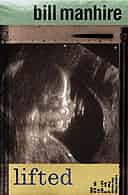
©Bill Manhire from Lifted (Wellington: Victoria University Press, )


Note from Peter:

Between the earth and sky of my 1960s Ashburton was the radio; a New Zealand-made Ultimate complete with earth and aerial wires. I remain in the dark about what you were to do with the earth, but the aerial provided passable reception when attached to the wire wove base of my bed.

The Ultimate was a budget model, suffering in comparison with those radios with a short-wave function that I coveted, but I should have known better than to paint it white in a moment of teenage idleness.

In a house without books and lacking the wit to utilise the local library the radio was my source of stories, together with those told by my father and relations.   I went to bed early most nights to listen to the serialisation of books like Nevil Shute’s A Town like Alice, or Alistair Mclean’s Ice Station Zebra and South by Java Head and was transported.

How could one not feel addressed by Kevin?

In this wondrous poem, Bill makes some stabbing observations in that last ravishing verse, about mothers and fathers we barely know, lifting us, and dark furniture of the radio as ultimate destination. Whether the mothers and fathers are truly those we don’t know, or those we did and couldn’t know, I am more saddened than heartened at the thought. As destination I wouldn’t book to go there, but I do keep returning to Bill’s poem and the transcendent possibilities of its ‘celestial glow.’


Peter Ireland works at the National Library in Wellington where, among other things, he looks after the Poet Laureate. And still listens to the radio.

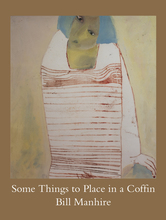
Bill Manhire, inaugural New Zealand Poet Laureate, has published award-winning poetry, edited anthologies, written short story collections and founded IIML. Lifted won the Poetry Category in the 2006 Montana New Zealand Book awards.  This year he released a new collection of poems, Some Things to Place in  a Coffin, and in collaboration with musician Norman Meehan, published Tell Me My Name, a book of poem riddles (or riddle poems) set to music.


somet_things_to_place_in_a_coffin__40224-1482273596-220-2202.jpg   tell_me_my_name_front__47436-1482273132-1280-1280.jpg    lifted.jpg


Poetry Shelf Spring Season’s poetry fans: Ros Ali picks Elizabeth Smither


Spring bulbs

Plant them carelessly. The earth straightens them.
Already they have divided and multiply.
They stand straight up like pencils

among last year’s survivors, also thicker
for a year’s disregard, a feeble weeding
an intention to reform as a gardener

knowing nothing will change: the philosophy
is too broad, too many variants
the huge tree, the little viola

one shivering, the other sending shivering down
on a white head near the ground, sheltering
its tremulousness a little, in its shadow.

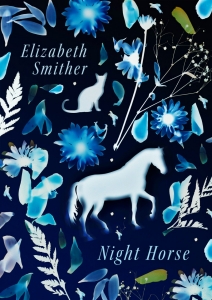
©Elizabeth Smither, Night Horse (Auckland: Auckland University Press, 2017).


1497223465774.jpg


Note from Ros: Delving into Elizabeth Smither’s special new collection, Night Horse, when it was released in June, the poem ‘Spring bulbs’ was an arresting reminder of the fresh green shoots of random bulbs surprising my winter garden, and the all too familiar failure to reform. Significantly, the poem deftly and tenderly shifts its focus, into a deeper contemplation of the vulnerability, beauty and power of the natural world.

Rosalind Ali is a teacher of English and Writing, and Director of Libraries at St Cuthbert’s College in Epsom. She is a member of the Michael King Writers’ Centre Trust and co-facilitates the Michael King Young Writers’ Programme with poet and teacher, Johanna Emeney.


Elizabeth Smither has written five novels, five collections of short stories and seventeen poetry collections, the most recent of which was The Blue Coat (2013).  She has twice won the major award for New Zealand poetry and was the 2001–2003 Te Mata Poet Laureate. In 2004 she was awarded an honorary DLitt from the University of Auckland for her contribution to literature and was made a Member of the New Zealand Order of Merit. She was given the Prime Minister’s Award for Literary Achievement in 2008. In 2016 she won the Sarah Broom Poetry Prize, New Zealand’s most valuable poetry award, judged by Paul Muldoon, and those poems are included in Night Horse.


Poetry Shelf Spring Season’s poetry fan: Marion Castree picks Louise Wrightson

Wood

(for Dave Russell)


I have lived on this quarter-acre

of clay longer than the trees.


The tī kōuka are the exception

and they are crumbling inside

their long reptilian trunks.


The elderly kowhai still

conjure up their gold nuggets

but the wood is moody; it sulks

and smolders in the fireplace.


It’s the wood from the big gum

that warms and entertains us;

every night is Guy Fawkes,

all flare, crackle and spicy scent.


Twelve cubic metres of Mac

keep us warm in winter;

there are stashes under the trees

among the pop-up seedlings.


The red eye of the fire

transforms us; we soften

under its gaze, swap news,

try to make sense of things.


Our house started as a cottage

that was sawn in half.


The four rooms were trundled

across paddocks, two at a time,

and dumped here on a slope.


The floors were tawa boards,

the walls were lined with scrim

and newspapers from 1886.


I won’t get started on the renos

but one of our many builders

came from Bucharest.


Dave thought he was a con

because his apron was so new

it creaked and his tools

were sharp and oiled (like him).


He muttered pisses of vood,

bluddy selly pisses of vood

because the houses in Romania

are made of brick or concrete.


He didn’t show for work

one day: he just rang and said

vood is too much feedle.


It can be—but when we ripped

up the cork tiles in the kitchen

and found the floor was matai

a friend said wistfully;

I’ve always wanted

to be that sort of person.


I’ve lived here forty years—

Forty years and not yet found 

a cure for being human—

James Keir Baxter wrote that;

he lived next door for a while.


This table I write on is rimu;

it hosts a kauri salad bowl,

steak knives with olive handles

and ironwood salad servers.


At a very posh party I saw

a woman help herself to some

decorative, coloured wood

shavings in a bowl and scatter

them over her chicken salad.


I watched, mesmerized,

while she chewed them up.


I should have told her the truth

but she had eaten them

by the time I remembered—

Better a cruel truth than a

comfortable delusion—

Edward Abbey said that;

I wish he’d lived next door.


Anyway, here is the thing;

when I am fed into the flames

(inside a plain plywood box)

please think of trees and vood;

they mean the world to me—


Breathe out and in.

Keep warm.


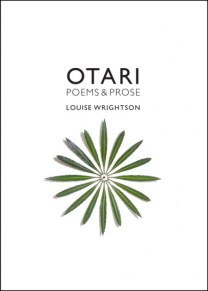
©Louise Wrightson Otari Poems & Prose Otari Press, 2014


cv_otari.jpg


Note from Marion: This poem is for Dave Russell and also a love poem to wood and all that it can mean to us in our world, particularly in our home patch. The wood in all it’s manifestations is a pleasure to behold.

I have allowed this poem to idealise home for me. Home of course requires give and take from its people but the presence of wood offers so much unconditionally. This is a magnificent poem, perfect in form and also in parts, very funny.

Marion Castree is a Wellington bookseller, NZ book buyer and staff manger at Unity Books.

Louise Wrightson has an MA with Distinction in Creative Writing from the IIML (The International Institute of Modern Letters) Victoria University, Wellington. She lives and writes near Otari-Wilton’s Bush, a 100-hectare reserve of regenerating forest. Her work has appeared in numerous anthologies and journals.


Louise Wrightson has an MA with Distinction in Creative Writing from the IIML (The International Institute of Modern Letters) Victoria University, Wellington. She lives and writes near Otari-Wilton’s Bush, a 100-hectare reserve of regenerating forest. Her work has appeared in numerous anthologies and journals.

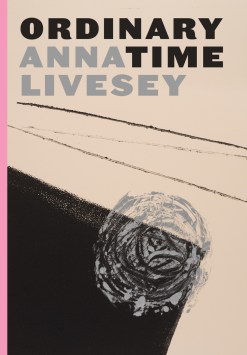
Poetry Shelf interviews Anna Livesey – ‘Every time I have published a book I have felt a part of myself caught in amber’


Ordinary_Time__59860.1501624161

Ordinary Time Victoria University Press, 2017


‘I want a little quiet, a piece of the day

where the baby and I soak in our own silent language.’


from ‘Speech and Comprehension’


Anna Livesey has published two previous poetry collections, Good Luck (2003) and The Moonmen (2010). She graduated with an MA in Creative Writing from Victoria University and was the Schaeffer fellow at Iowa Writers’ Workshop in 2003.  Her new collection, Ordinary Time has just been published by Victoria University Press. With these new poems, personal experience is paramount because this book, with its roots and wings in the miracles and challenges of parenting, is an intimate exposure. Lines are agile, things pulse, gaps pollinate, and the glorious, challenging, curvatures of motherhood are brought searingly close.


 The interview


Paula:


‘Having not been out for days I have very little to add—

save that the house is sweet and clean, the baby safe and fed.’


from ‘Synthetic Thinking’


Before I enter your new collection of poems, I stall on the title: Ordinary Time. Poets have often used ordinary things as a gateway to the less ordinary, as a way of refreshing little patches of the world about us, whether experience, sensation or physical object. Yet the title goes deeper for me, particularly having read the word ‘parenthood’ in Jenny Bornholdt’s quote on the back cover. It feels like you are boldly staking the domestic space and the mothering role as a necessary and fertile springboard for writing. How does the title resonate for you?

Anna: One of the things I think about a lot (for whatever use it is), is our moral responsibility to the world we live in – who we should care about, who we should care for. What events – horrors and wonders –  should we allow to get under our daily carapace and work on us? Especially in this world where the news of disaster is never far away. There’s that phrase about extreme weather events: “the new normal”. Hurricane Irma – the new normal. Degradation of democracy in the States, Spain, parts of Latin America where it was once thought it be bedded in – the new normal. The end of Francis Fukuyama’s “the end of history” – the new normal.

The book starts with Peter Singer, a moral philosopher who basically says – “we are all equally valuable so we are wrong to value ourselves, our families, our tribe above those who are ‘other’…”.  And I believe that, but I also believe it is an impossible and inhuman doctrine. To me this is the puzzle at the heart of this book and the title. My beautiful, blessed, mundane life of glorious domesticity and early motherhood with my children, husband, friends and family and warm dry house with full cupboards exists in the same reality as Syria. Where children as beautiful and as beloved as mine are dying. Both of these realities are “ordinary”.

To survive and function and care for those who are most immediately our responsibility we need (or at least I need) to take refuge in the shared human mendacity of closing up our carapace and giving an emotional shrug. And in fact I think this is not really the “new” normal, but just normal – the Hobbesian description of the human condition – “solitary, poor, nasty, brutish and short” – continues to hold true. (And as I type this I think – and what is the point of poetry in all this anyway?)

And then on the other hand – the title poem talks about the late winter time when the magnolias all around Auckland are covered in their magical flowers. They look like aliens or supermodels, all lanky grace and outrageous decoration. Then the flowers fade and the “green leaves of ordinary time” appear and the magnolias just look like normal trees for another year. So yes, the title is also a nod to the magic and mania of those first early weeks with a new baby, and how they refine and change one, as a parent and inevitably as a writer.


‘(…) Across the road two magnolias, one pink, one white. In the days

since we came home I’ve watched their stark flower-spiked branches

soften and go pastoral—the green leaves of ordinary time climbing out

of the wood.’


from ‘Ordinary Time’


Paula: That nagging doubt about the value of writing poetry is a tough one. What difference does it make to the Syrian crisis, the ordinary families there that love their babies, eat, sleep, celebrate and mourn? Perhaps one response is that in translating your experience you contribute to a global poetry conversation that opens windows on how we live with our different hungers, failures, connections, kindnesses.


‘I am a person in love with nostalgia

and this unfits me for every moment of living but the one just past.’


from ‘I Am a Person in Love with Nostalgia’


You record the early weeks of motherhood and the poems undulate through fatigue and joy, routine and insistent questions. I love the way you pull things from the past into the patterns of the present. I particularly love ‘I Am a Person in Love with Nostalgia.’ It feels like there is nostalgia for former selves, but you also make a precious baby moment glow that might be a future nostalgic memory hub. What kind of returns does poetry represent for you?


Anna: The returns of poetry. Let me first be contrary and take returns in the sense of “what you get back”. In my previous book, The Moonmen, there is a poem called “Bonsense”. Bonsense means “good sense” – ‘bon’ as in the French “bonne”, for good (and indeed the Scots “Bonnie” – beautiful, cheerful – which is my daughter’s name). The poem is about the returns of poetry, and of art, the non-essential, in general. It is addressed to a dear poet friend who had a job caring for a very very small library in a small town in Montana, and ends:


“From the chest of your books

you enjoin belief

in outposts of minature sense or nonsense,

or going further, antonym, bonsense—

the elaborate folly of the heart and brain,

built curlicued, baroque.


What bonsense is this, a tiny horse, a tiny library?

The great iced cake of relationships,

the ornamental pony of compassion,

the perennial shout (SHOUT) of shared exclamation.”


The central idea here is that compassion and art spring from the same core impulse. Imagination/transportation/identification/recognition/the marvellous… these are human characteristics and lead to our greatest baroqueries – the welfare state, poetry, breeding horses too tiny for any purpose but to be admired. I don’t feel that poetry needs to “do” or “contribute to a conversation”. I think the return of poetry is merely for it to be.

And the returns in the sense of nostalgia. Every time I have published a book I have felt a part of myself caught in amber. And through my three books the amount of “me” that is there like an insect in the settled gum is greater than before. And in this book, as you observe, “me” has expanded out and encompasses my babies. As I am writing this to you, it is day one of Bonnie being fully weaned. Yesterday she had her last ever feed and five years of being pregnant, breastfeeding or both came to an end for me. So to have that moment at the early cusp of our relationship captured and kept in a way that I love, that moves me back into that moment perfectly, is infinitely precious. A memory outside myself. That is the personal return of poetry.


Paula: I loved that. For me, it is exactly why poems that venture into the domestic or the personal are utterly productive for reader and writer.


‘When my mother died she had spent

a long time in darkness.


When my grandmother died she had spent

a medium time in darkness.


When my daughter was born she had spent

a short time in darkness.’


from ‘Quotation’


That phrase ‘caught in amber’ really resonates, and that poems can be an intimate way of catching a present moment to savour the future. Is there a poem in the collection that particularly resonates with you? I found myself haunted and, as that word rightly implies, returning to ‘Quotation’. I was entranced by the generations of women and by the distinctive dark and light.

Anna: That’s like asking if I have a favourite child! I’m pleased you asked about “Quotation”. It’s a funny little poem – the opening lines include a quotation from William Calos Williams, of course — “Danse Russe”. In that poem, Williams is talking of himself, dancing naked, singing (go and read the poem now…! Such an image it is), waving his shirt around his head. His poem ends “Who shall say I am not/ the happy genius of my household?”.  My grandma was a brave woman (a WREN, among the first five WRENS to be choosen to go on a troop transport as decoders), but also a modest, genteel, English/Irish Catholic of her time. And so the image of her secretly dancing naked, admiring herself as Williams does, is part of the joy of that poem for me. And then there is the word “genius”. In my poem, as in Danse Russe, it means, essentially, “the soul of a place” – the genius loci, the ancient Roman concept that all places have a soul. So my poem is saying… who shall say that this modest woman, looking like a snuggly grandmother to me, her little grand-daughter, was not in fact a wild dancing creature, the secret, gleeful soul of the old farmhouse.

And then I just miss her so. And the farmhouse that had every aspect of a fairytale farm – my Grandpa made all the bread, there were hens and herbs and a sheepdog, a shy white cat, treasures from India (war service), a dressing table with mirrors that folded out and could be made to reflect themselves into infinity. Winegums in the pantry for story time. Easter in the garden. Woollen blankets. Grandpa’s blue farming overalls. Sunday roast – “from our own sheep”. I want every single part of it back, including and especially them.

(I should note here my family have a terrible weakness for writing books. My mother was a published historian with several books to her credit. My Grandpa wrote several local histories of the Wairarapa and a five volume self-published autobiography (Yes. Five volumes. And very interesting they are, at least to me). My grandma trained as a speech teacher in her 60s and then wrote plays which her students performed in the garden at Perrymead. She also wrote short stories for us, her grandchildren, and several of them were read on radio. So I am not just missing the rural idyll and the unstinting love of Grandparents, but also missing a formative place, where books and language and storytelling and performance were part of everyday life.)

In this poem, and in ‘Privacy’, and several other poems in the book, I was thinking about a passage from Simone de Beauvoir’s memoir of her mother’s death, A Very Easy Death. In the book she is looking for keepsakes for her mother’s friends, after her mother has died. She writes: “Everyone knows the power of things: life is solidified in them, more immediately present than in any one of its instants.” (C.f. Williams: “no ideas but in things”). So that’s the desire behind taking their house and putting it in my house — I want to “quote” their life in my life through their things.

The poem ends with another quotation, from Yeats, “John Kinsella’s Lament for Mrs Mary Moore”. Again, if you don’t know the poem, go and read it. It’s a song of grief for a witty, wise, sexy old woman (I have always loved this poem and it continues to appeal as I grow a little older myself and hope to be appreciated in the round, (even and despite my flaws), as John Kinsella appreciates Mrs Mary Moore). The repeated refrain is “What shall I do for pretty girls/ now my old bawd is dead?”. Mrs Mary Moore is, literally, a bawd. And so again this is a naughty joke on my part. My grandmother was a witty, wise, sexy older woman. She absolutely die to see that written down! But I love having that thought about her.


Paula:

‘is this how my mother felt

this fear, this,

bewilderment?

I want to mother better than I was mothered.

I can say this because she is dead.’


from ‘Bay Leaves’


I like the idea of a poem as keepsake. A way of preserving familial relations in the manner of a photograph album, a daily journal or a shoebox of mementos.

The collection offers myriad rewards for the reader. It is a bit like peeling back layers of living to expose the challenges along with the miracles or joys. I am drawn to the way the world rubs into the private life: the child washed up on the beach makes the mother hold her child that much closer. Perhaps the poems that struck deepest faced the mother, the mother no longer here, the mother who prompted the poet to look at her own mothering. Were these difficult poems to write?

Anna: No they weren’t. The difficulty was in the long years of decline. My mother was a writer, so writing feels like a very real way to honour her. Making art felt like salvaging something.


Paula: Do you think, in this move to the overtly personal, other things such as musicality, changed a little too?

Anna: I deliberately wanted some of these poems to be clumsy. Awkward subjects deserve an awkward sound. That’s not something I would have been comfortable with in my earlier work.


Paula: Were you tempted to include endnotes as some poets do? I can go either way. Endnotes open up poems in ways I don’t necessarily anticipate, adding avenues of delight, but conversely might limit my own freedom to explore and delve within the myriad possibilities of a poem.

Anna: My first book, Good Luck, had endnotes.  There was a lot of found poetry and I wanted to reference where it had come from.  With this book I thought about end notes, very briefly. And then I thought: who has the time??? And also I didn’t want to explain the poems – either they do their own work or they don’t.


Paula: Did you read any books while writing this that affect how and what you were writing?

Anna: Czeslaw Milsolz’s Roadside Dog – a little book of prose poems, limpid, narrative, engaged, straightforward, complicated, personal and full of the world. The best bits of Ordinary Time are really just a crib of Roadside Dog. Raymond Carver – again, the direct voice of his poetry. The beautiful poem, “The Haircut”, of his referenced in “Because I’m a Human”. Kate Atkinson’s Life After Life is the book that “Reading Books About the War” lifts off from. Tove Jannsen, the Moomintrolls – moments of recognition in literature affect me profoundly, especially when they are parent/child, and Tove Jannsen does these so beautifully. I am always reading Janet Frame’s poetry, and hoping for a little of her perfectly awkward insight to rub off. And then also the manuscript of my dear friend Lauren Levin. Her work is quoted in the last poem in the book. She has just had a truly wonderful book published – The Braid. If you care about poetry and about women and about the world and about justice and about beauty you should order it. And Heather Tone’s Likenesses. There are several poems for Heather in The Moonmen, and she and her luminous, curious, outsider-mind writing are a constant inspiration to me – how to live, how to write.


Victoria University Press page


Poetry Shelf Spring Season’s poetry fans: Nicola Strawbridge picks Dinah Hawken


Screen Shot 2017-10-14 at 1.31.02 PM.png


Screen Shot 2017-10-14 at 1.32.00 PM.png

©Dinah Hawken Small Stories of Devotion Victoria University Press, 1991


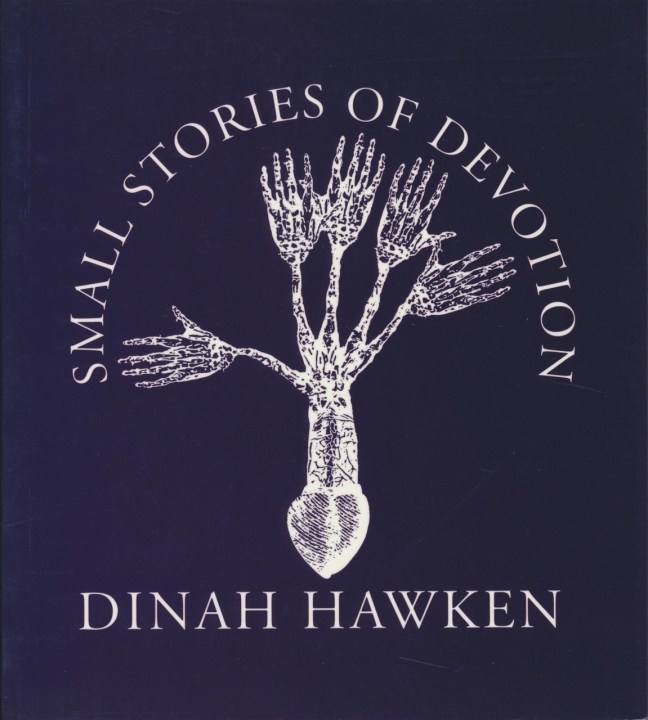
Small_Stories_of_Devotion__14354.1401159901.jpg

Note from Nicola:

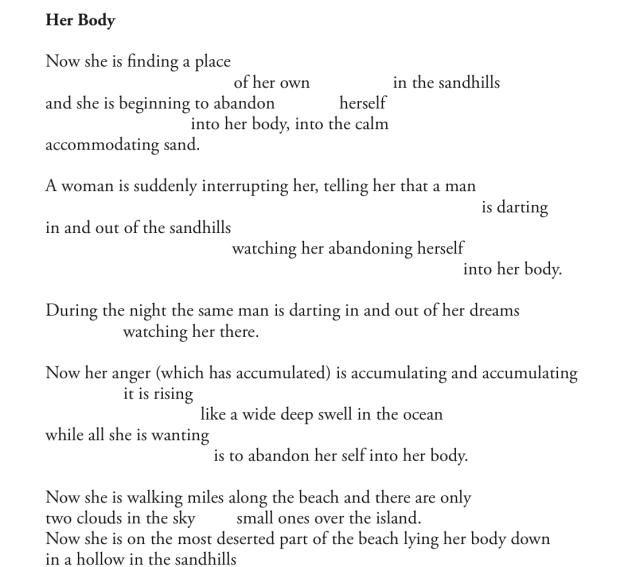
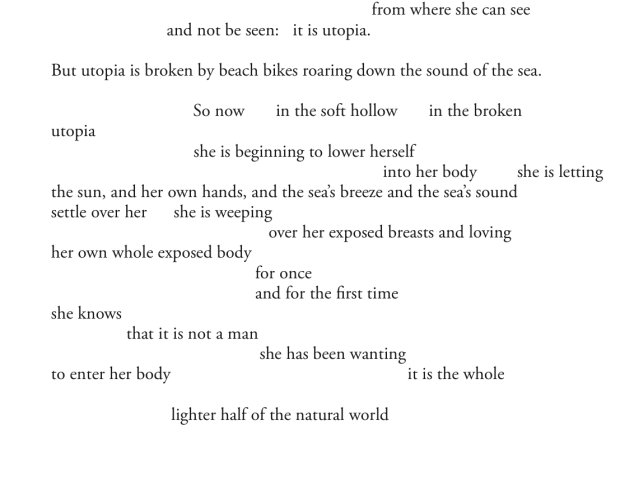
Dinah Hawkin’s Small Stories of Devotion was the first collection of contemporary NZ poems that had a big impact on me as a young woman. The collection was published the year I went flatting for the first time.  My flatmate had a copy, and I was attracted to this beautiful small blue book and it’s pocket-sized format. I hadn’t been exposed to much contemporary poetry, and it was a revelation to find work that spoke to me so directly. ‘Her Body’ is all tangled up with that time in my life where I was emerging and coming into myself as an adult. A time when I was encountering lots of new ideas about how to live, how to be in myself and in my body. This poem in particular spoke to those themes, as well as being a gateway into the world of NZ poetry. Now I read it and appreciate a layer of memory folded into its mix including a fondness for that younger woman and her questioning self. I love the poem’s rhythm, the place of the poem playing itself out, that long beach, those sandhills, the island and its two clouds. It surges and retreats, echoing the waves and the words lapping up the beach and across the page.

I enjoyed its anger (“accumulating & accumulating”), its passion and release.  I was spending a lot of time myself walking on beaches while having big existential conversations with my new friends about the world we wanted to live in, and about our sexuality and gender politics in particular. ‘Her Body’ encapsulated that exploration and the feminism that was so often at the heart of our conversations. I was she, the powerful sensual voice of the poem, the woman abandoning herself into her body. And alongside all that, entwined, the natural world, informing everything, settling on everything. A potent combination and one I’ve continued to enjoy in Dinah’s work.


Nicola Strawbridge is Programme Director of the Going West Books & Writers Festival.

Dinah Hawken is a poet who lives in Paekakariki on the Kapiti Coast. Her seventh collection of poems, Ocean and Stone, was published by Victoria University Press in 2015.


Poetry Shelf Spring Season’s poetry fans: Paul Diamond picks Gregory O’Brien


Ode to the Sarjeant Gallery


Likened, on occasion, to a boom-box on a grassy shelf,

Sarjeant Gallery, I think of you mostly


as a tin

in which the finest bread

is baked, with your airy dome


and ample intelligence, your south-facing wall

on which the paintings of Joanna Paul


and Edith Collier sing to the river birds,

and are sung back to.


A steadying influence,

above which clouds like

thought balloons moor a while


and around which gather

the moonlit streets of Whanganui.

On your lawn this morning I watched


a film crew being washed down-river, an empty shoebox

blowing towards Moutoa Gardens – but all I could hear


was a distant burbling of the mayor

and his accountants

marooned in the small towns


of their suits, nose-deep in their yellowing pages,

in whose minds


the Whanganui River would be diverted

so it comes out

at Patea, and by whose good judgement


Pak ‘N Save would be enlarged

to enclose the whole town,


and the marble wrestlers in the Sarjeant foyer, this goes

without saying, would be replaced with


jelly. In the council chambers, a hundred years

of Whanganui River fog would seem


to have obscured the mayoral judgement,

the mist outside

clearing to reveal, on the forecourt,


a bullroarer and baby’s rattle – emblems of the town’s

leadership – and towering above it all,


our observatory

of earthbound constellations,

your patient dome, looking down on


the dust-gatherers and nay-sayers, the elected

and the naturally selected. It all comes down,


like the Whanganui River,

to this. And every city

has its limits.


©Gregory O’Brien  NZ Listener April 2-8 2005 Vol 198 No 3386


Note from Paul:

I’m writing a book about Charles Mackay, a former mayor of Whanganui, who was a driving force behind the building of the glorious Sarjeant Art Gallery in Whanganui. In 1920, Mackay shot D’Arcy Cresswell, who threatened to expose the mayor’s homosexuality unless he resigned. Subsequently, the mayor’s name and title were erased from the Sarjeant Gallery foundation stone (but restored in 1985). Spending time at the Sarjeant Gallery and getting to know its staff and collections has been one of the highlights of my research visits to Whanganui. Greg O’Brien’s poem came out of an unhappier, divisive time in the life of the city and the gallery. More than a decade on, fundraising for the gallery redevelopment plan is well underway, and there’s greater awareness of the significance of the Sarjeant building and its collections for the nation, as well as Whanganui. I like to think Charles Mackay would be proud.


Paul Diamond (Ngäti Hauä, Te Rarawa and Ngäpuhi) was appointed as the inaugural Curator, Mäori at the Alexander Turnbull Library in 2011. He worked as an accountant for seven years, before switching to journalism in 1997. He is the author of two books (A Fire in Your Belly, and Makereti: taking Mäori to the World) and has also worked as an oral historian and broadcaster. In 2017 he was awarded the Creative New Zealand Berlin Writer’s Residency, to work on his book about former Whanganui mayor Charles Mackay, who was shot in Berlin in 1929.


Gregory O’Brien is a poet, essayist and writer, currently finishing a non-fiction book, Always song in the water–New Zealand art, letters and the environment. ‘Ode to the Sarjeant Gallery’ was written at a time when the Sarjeant was getting a very bad rap from the local council under mayor Michael Laws. It appeared in the Listener and hasn’t surfaced again until now.

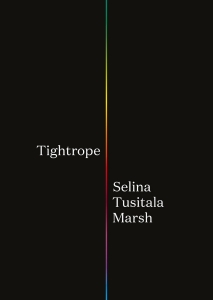
Poetry Shelf Spring Season’s poetry fans: Gina Cole picks Selina Tusitala Marsh

In Creative Writing Class

the pākehā man
calls the kailoma Fijian woman
the Māori woman
and the ‘afakasi Samoan woman
privileged
because they have the experience
of being doubly oppressed
at a time when they qualify
for certain scholarships
when their demographic
is fashionable and interesting
their life experiences
make their writing more convincing
their stories are rich and deep
hot chocolatey and steamy
his are staid, North Shore-ish
lukewarmish gumboot tea

the los atrevido
wait for him to finish
his first world problems
in their global village
their serpent tongues aim
for the space above his collar
they fire simultaneously
no one even hears him holler

©Selina Tusitala Marsh from Tightrope (Auckland: Auckland University Press, 2017)


1502933415430.jpg


Note from Gina: I love this poem because I have attended many creative writing classes. I am also a kailoma Fijian woman, and I have been in a creative writing class with Selina. In most writing classes that I have attended, I have been one of a minority of Māori and Pasifika writers in the class. I love how the title reads as a play on each word in all their different meanings, especially “class”. I love the last stanza and the description of the women as “los atrevido”. I had to look up what that meant. I found that it translates as – the daring, the badass, the bold. I love that daring in the poem, and that Selina is the new daring, badass, bold Poet Laureate for Aotearoa.

Gina Cole is of Fijian, Scottish and Welsh descent. She lives in Auckland. She writes fiction and poetry. She is a Barrister specialising in Family Law and has a Master of Creative Writing from Auckland University. In 2016, Huia Publishers published Gina’s debut book of short stories Black Ice Matter. Black Ice Matter won the 2017 Hubert Church Prize for Best First Book Fiction at the Ockham New Zealand Book Awards.

Selina Tusitala Marsh is of Samoan, Tuvaluan, English and French descent. She was the First Pacific Islander to graduate with a PhD in English at the University of Auckland where she currently is an Associate Professor. Her first collection, Fast Talkin’ PI, won the Jessie Mackay Award for Best First Book of Poetry in 2010. As Commonwealth Poet (2016) she composed and performed a poem for the Queen at Westminster Abbey. She is New Zealand’s current Poet Laureate.