Category Archives: NZ poetry book

Monday Poem: Maraea Rakuraku’s ‘When does it start?’


When does it start?


It’s not waving a flag, holding a banner, knowing what postcolonial theory

means and when to use it, memorising quotes and lining them up like

soldiers that are sent out in waves of attacks,


It’s not being polite, remaining open, listening fairly, vigilantly assessing

your motivation, re-writing your carefully worded response, marvelling

how the person who has cornered you on-line, at a party, work do or

rugby game is not hearing how every word they are saying is offensive and

they may as well be slicing through your heart, with the intent-sity of a

scythe clearing long grass,


It isn’t realising dressing up racist rhetoric in flash language is still just

racist rhetoric in flash language and sniffing that out in the first, I’m not

racist … but,


It isn’t recognising white privilege and entitlement, functioning under white

privilege and entitlement, loving under white privilege and entitlement,


It doesn’t start with the huge fucking disappointment when a brown

brotha is worse than the worst redneck you’ve encountered in your life,


It doesn’t start by standing up for your iwi, people, culture, colleague,

son, daughter, lover, missus, Koro, Nan, cuzzie, animals, Papatūānuku, or

even yourself,

Mō āhea tīmata ai? ka tīmata āwhea?


Ehara i te whakakakapa i te haki, i te pupuri ki te kara, i te mōhio ki

te ariā pōhi koroniara me te wā e tika ana kia whakamahia, i te tuhi i

ngā whakataukī ki te rae ka whakarārangi ai anō nei he hōia e tukuna

putupututia ana ki te whawhai,


Ehara i te mānawanawa, i te noho areare, i te tōkeke o te whakarongo,

i te mātai i ākinga ōu, i te whatatika i tō whakahoki kua āta tuhia, i te

whakamīharo ki te tangata nāna koe i whakaiti i te ipurangi, i te pāti, i

te kaupapa ā-mahi, i te kēmu whutupōro rānei me tana kore i rongo ki te

hākiki o ia kupu āna, me e haehae ana i te ngākau, he rite tōna kaha ki te

kotinga o te haira e whakawātea ana i te pātītī roa,


Ehara i te kitenga o te kōrero kaikiri kua whakareia ki te kupu whakaniko,

me te mōhio tonu iho he kōrero kaikiri tonu kua whakareia ki te kupu

whakaniko, ehara au i te kaikiri … heoi anō,


Ehara i te whakamārama i te huanga me te āheinga kiritea, e mahi ana i

raro i te huanga me te āheinga kiritea, e aroha ana i raro i te huanga me te

āheinga kiritea,


Kāore e tīmata i te mutunga kē mai o te matekiri i te mea he kino noa ake

te tūngāne kiriparauri i te kakī whero tino kino rawa atu kua tūpono i

roto i ō rā,


Kāore e tīmata i tō tū tautoko i tō iwi, i ō tāngata, i tō ahurea, i tō

kaimahi, i tō tama, i tō kōtiro, i tō whaiāipo, i tō wahine, i tō koro, i tō

kuia, i tō whanaunga, i ō mōkai, i a Papatūānuku, i a koe anō hoki,

It starts,

with that first step from the margins into the glare of light

and

opening

your

mouth,

that started

when the idea of you was born and took seed

that started

when the idea of you was born and took seed

that started

when the idea of you was born

that started

with the idea of you.

Ka tīmata,

i te tapuwae tuatahi i te paenga ki te kōnakonako o te tūrama

me te

hāmama

o tōu

waha,

i tīmata tērā

i te tinakutanga me te tupu o te whakaaro ki a koe

i tīmata

i te tinakutanga me te tupu o te whakaaro ki a koe

i tīmata

i te tinakutanga o te whakaaro ki a koe

i tīmata

i te whakaaro ki a koe.


©Maraea Rakuraku  Translated by Jamie Cowell, Tātai Whetū: Seven Māori Poets in Translation, Seraph Press, 2018.


Maraea Rakuraku is an award-winning playwright, poet, short story writer, critic, reviewer and broadcaster who lives in Wellington and the Bay of Plenty. She creates work that investigates, examines, calls out and celebrates Te Ao Māori and our navigation of 21st century Aotearoa New Zealand.

Her thoughtful, fierce intellectualism, and grounding in her Tūhoe and Ngāti Kahungunu identity, is matched only by her heart and commitment to giving voice.

With Vana  Manasiadis, Maraea is the co-editor of and contributor to Tātai Whetū: Seven Māori Poets in Translation, which has just been published by Seraph Press.

In 2018 she started a PhD in Creative Writing at the International Institute of Modern Letters, Wellington.

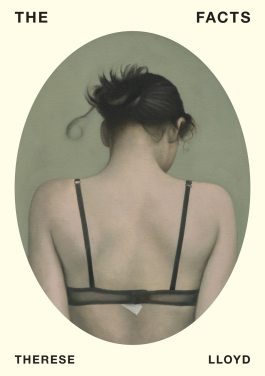
Poetry Shelf review: Therese Lloyd’s The Facts

The_Facts_low_res__11927.1513281444.jpg


Therese Lloyd  The Facts Victoria University Press 2018


For three months I tried

to make sense of something.

I applied various methods:

logic, illogic, meditation, physical exertion,

starvation, gluttony. Other things too

that are not necessarily the opposite of one another,

writing and reading for example.

But the absurdity of the thing

made all attempt at fact-finding evaporate;

a sort of invisible ink streamed from my pen

the more data I wrote down: facts are things driven,

as Anne Carson says, into a darkening landscape where other people

converse logically.

from ‘The Facts’


Therese Lloyd’s new collection resides in a captivating interplay of chords. You could say that any poetry book delivers chords whether aural, visual or thematic, and in the light of ideas and feelings. This book does it to a stunning degree. Once you start hunting for them – whether in harmony or not, between poems or within a single example – the rewards are myriad.

Hera Lindsay Bird endorses the book on the back cover: ‘The Facts is mesmerisingly beautiful, and shocking in its intensity. This is already one of my favourite New Zealand books. It won’t make you feel better.’

I didn’t read the back until I had read the poems as I like to start a book with a clean reading slate (if that is possible).  I am thinking of the way reading this book sets up an arc between comfort and discomfort; we are the interlopers into what Therese chooses to let us see.

We enter a collection in debt to a doctoral thesis (IIML), and I am curious about the ideas picked up in the academic component.

This might be the first cluster of chords: shifts between ideas and feelings provoked by the writings of poet Anne Carson and the experience of a broken marriage and a toxic love affair.  This might be an impetus to navigate relations with art, in itself forging a chord with Anne.

I am absorbing the chords as though they flicker between light and dark – and the poem resembles a cinematic space with the external world, and its pressing demands, blacked out so it is just you and the poem. This what flicks for me:

love notlove

truth lies

Carson LLoyd

facts notfacts

pain joy

mother daughter

daughter husband

daughter lover

presence absence

beginning end

end beginning

beauty beauty

deep breath shallow breath

here there

intimacy distance

heart mind

sweet sour

slow stalling

debris order

miracle incidental

share notshare

exposure kept hidden

where you live where you don’t live

mixed clarity

see see

poet poem

poem story


At the core of the book the title poem, the standout-lift-you-off-your-feet poem, achieves the blinding intensity that Hera speaks of: raw, surprising, probing, accumulative, fearless, cutting, detail rich, lucid, testing. On either side the poems offer more subtle chords. Yet any element in my list for ‘The Facts’ might drive a poem. I particularly love the surprising turns of ‘Mr Anne Carson’.

Therese’s collection takes you deep into personal experience that gets hooked up in the poetry of another, in matted ideas and the need to write as a form of survival. It makes you feel as much as it makes you think. It is a riveting read.


I moved all the holiday reading

to the spare room

to keep the literature and the art books

pure

I say squarely in the middle

of the fluffed-up sunroom sofa, I am

careful

not to disturb the cushions

cushion—a curious word

its function of support

is ancillary to its attractiveness

and that’s why cushions have covers

in colourful fabric—I become

an ornament

another word I like

because everything here is decoration

everything here is placed

The story of the things here is not new


from ‘Mr Anne Carson’


Victoria University Press page


Poetry Shelf interviews Chris Tse


Chris Tse - October 2017 - 01x - Photo by Rebecca McMillan.jpg


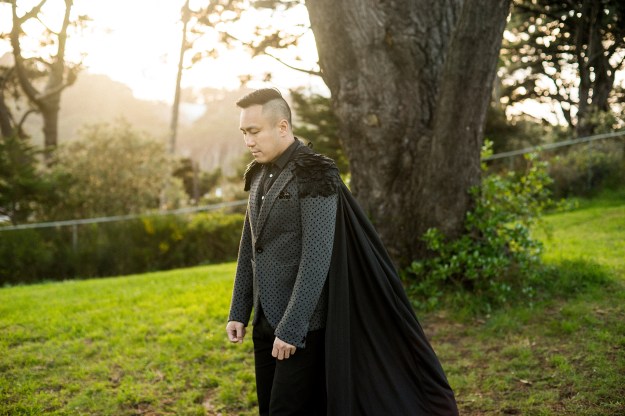
Chris Tse is a poet, actor and musician whose poetry first appeared in AUP Poets 4. His award-winning debut collection, How to be Dead in a Year of Snakes, responds to a moment in history – a 1905 murder – not so much by narrating that history but by installing a chorus of voices. I loved the book as you will see here.

I consumed Chris Tse’s new poetry collection, He’s so MASC, in one sitting, because I was caught in its grip. The knottiness belies the grace and fluidity of writing, but the tangle of self – the laying on the line and the holding in reserve – haunted me. It feels utterly exposing, playful, inventive and daring. It is warm, vulnerable, strong. I began to fear a review might appear heavy-footed alongside its lithe connections; like a delicately balanced house of cards, a review might miss the point and topple it over. Instead I have opted for an unfolding email conversation.

Chris made a deeply personal speech at his launch, acknowledging heartfelt gratitude to his friends and family. His tears, in hoping his friends and family were proud of him, moved me to tears. He told us that, for the first time in his poetry, ‘the speaker is one hundred percent me’.  This is the book that matters. Chris also hoped the book might find its way into the hands of people who might ‘see themselves in it’.


      1517533295117.jpg   1517533295117.jpg

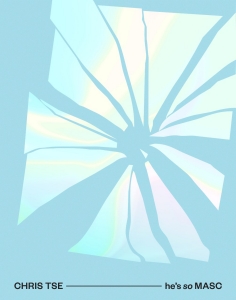
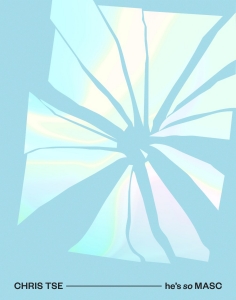
Chris Tse, He’s So MASC, Auckland University Press, 2018


Paula: Are you hesitant to answer questions about this book? I am hesitant to ask them! In the first poem we meet wolves. The wolf is also there in the last poem and makes a number of appearances in between, with teeth and claws and transformations. They can never settle to a single trope or behaviour or ache. I don’t want to explain the wolf. I just want to say they were a subterranean sharpness that clawed me. I can’t stop talking about the wolf. They are plot device, semantic undercurrent, emotional barometer, love infected, unreliable protagonist, hidden key. Ah, there is that glorious knottiness. Can you say anything about the wolf?


The wolves are closing in

on the ballroom while the band members

look out and brace themselves

for the conflict to come. Shit just got real.

They pick up their instruments

and clear their throats.

from ‘Intro’


Chris: For me, a big part of getting this book ready for publication was figuring out how I’m going to talk about it. With Snakes, it was like there was a safe following distance between me as author and the book as a literary/historical object. With this book, I don’t feel the safety of that distance given its themes and content, and honestly that’s a little terrifying. I work in communications and part of my job is to train our staff in how to deal with the media and select committees. We drill them on all the possible questions they could be asked and the best ways to answer them so that nothing throws them. I’ve been feeling I need to do that for myself for this book just to make me feel less anxious about it!

I like to think of each of the poems in this book being a single wolf roaming the terrain of my personal history. The first wolf poem I wrote for the book was ‘Lupine’, but it began life as a poem about my brother and I. Eventually, as the poem begin to take shape, it was clear that my brother had nothing to do with what I was trying to say in the poem. From there on, the image of the wolf and its association with transformation and masculinity felt like a good fit for what I wanted to explore, and so wolves began to pop up in other poems. I love how you’ve described the wolves as an ’emotional barometer’ – that’s a really apt description of what I wanted them to do in the book. They seem to have a habit of popping up in poems where I’m feeling uncertain, heartbroken, or angry.


Paula: I think the diverse self exposures is one reason why this book has affected me so much – and the sway between distance and intimacy. Things are at a distance and things keep disappearing. Presence is handlocked with vanishings, and not just the speaker in the poem. That flitting in and out of view intensifies the emotional impact for me, the unspoken. I am wondering too if distance is also coupled with masquerades and masks?


I can almost run my fingers through

the sun-streaked strands of those days


when I was nothing but a silhouette

disappearing into fog—just a sketch.


I could step into a crowd and never

resurface. No one would suspect anything.


from ‘Belated backstory’


Chris: The masquerades and masks are definitely there for distance. I’ve been performing my entire life – in public and private – so it was essential that this book, as unflinchingly open and true to my experiences as it is, also acknowledged the masks I’ve worn to protect, to give myself confidence, and to play. Those masks have been an important tool of survival and a way to make sense of the mess that sometimes builds up in my head. It’s also in part a response to having a somewhat public life now and the expectations that some people have of me as a Chinese New Zealand writer, especially given how few there are of us. I’ve talked at length in the past about being piegeon-holed, so I won’t go into all of that again, but sometimes I do feel like I’m performing the part of a Chinese New Zealand writer to appease others and meet a certain need. I can’t and won’t ever deny that side of me, but this book was a chance to draw from the intersectionalities of who I am.


Paula: Yes! The Chinese New Zealand part surfaces here and there – I was thinking like little teeth marks teeth to carry on the Wolf presence:


I’ll go to my next grave                     wondering

whether I pushed them hard enough to never settle

for being the token Asian in a crowd scene or

the Asian acquaintance in an ethnically diverse television series

from ‘Punctum’

I like the way intersectionalities of self are so important. The ‘coming out as a poet’ poems feel high risk when masks and arm’s lengths are dropped or reduced. I found these poems witty and raw and touching a chord. Yet there is also the nerve-ending intersections with coming out sexually. The one standing in for the other.


There’s no such thing as the perfect time or the best way to tell loved

ones about your poetry inclinations. You need to muster up every

ounce of courage in your being and just say it: I am a poet. You could

say ‘I write poetry’, but there’s something non-committal about

that phrasing, like you only dabble now and then and would prefer

not to attach labels to your preferences. Prepare yourself for a full

spectrum of emotional reactions, from ‘You’re still the same person

to me’ to ‘I can’t be friends with a poet’.

from ‘I was a self-loathing poet’


Paula: Is this an example of letting the poetry do the talking?


Chris: Absolutely. And not just letting it talk, but also letting it have the last laugh, so to speak. It was important to me that a poem like that (which dealt with something that I don’t exactly fondly look back upon!) had a healthy dose of humour in it to soften some of the emotional barbs for me as a writer. It’s not that I’m trying to run from the memory of that moment in my life or downplaying its significance. Rather, I see it as a way to embrace it for what it is while still being able to continuously learn from it and move forward.

Those intersectionalities of the self are important, and possibly even more so for readers who are trying to find someone they can identify with. On the flip side, those intersectionalities can be so easily carved up and used as labels to make someone or something appear more palatable or accessible. Even I’ve been guilty of this: as this book was coming together I would joke with my friends that this was “the gay book”, but it could just as easily have been “the break-up book” or “the pop music book”.


Paula: Sometimes poetry books should come with playlists at the back! This was what I was listening to at the time.

Is there a poem that particularly resonates with you – where everything has fallen into place and it just works or it matters in other ways? For me it is ‘Release’. I gasped when I read this. Maybe it is feeling that is both intense and restrained. I love this poem. Then again I like the surprise and momentum of ‘The saddest song’. I also adored ‘Wolf Spirit —Fade’, the last poem, but readers have to discover this poem for themselves.


Chris: Well, being the mix tape/playlist geek that I am, I’ve made two playlists for this book: Side A and Side B! They feature songs and artists that inspired the poems or feature in the poems themselves.


I can fit the saddest song in the world in my carry-on.

I can fit the saddest song in the world in my right-side brain.

But I can’t fit it in my lungs or hold on to it with confidence

when underwater.               And I can’t fit the saddest song

on one side of a 90-minute cassette tape without

an uncomfortable interlude cutting into its breath.

from ‘The saddest song in the world’


‘The saddest song in the world’ is the poem that resonates the most for me – I consider it the heart and soul of the book. Writing ‘Release’ was a very confronting experience. I read that poem now and I feel so vulnerable, but it was important to me that it had a place in the collection. Every time I had to revise what was in or out, I fought for it to be in, even though it feels like a ‘selfish’ inclusion because of its personal significance, so I’m glad it resonated with you as a reader! I’ve never performed it and I don’t know if I ever could. ‘Punctum’ and ‘Performance—Part 2’ were the last two poems written for the collection, after my publisher had already seen a final-ish version of the manuscript. They were both based on two separate lines that I’d been holding on to for a long time but just didn’t want to play with any of the other poems. When those two poems were finished it felt like I’d clocked a video game – those two lines were the things I needed to complete my quest!


Paula: One of the great attractions in the collection is movement. There are vital points (themes, events, revelations, states of being) that shine out, that repeat and overlap, a bit like a constellation. But it is the movement between that creates the knottiness I first mentioned, and I am not thinking of an ugly mess of a knot, just intricacies and complications.

What attracts you in the the poetry of others. Did you read any books that got under your skin while you were writing this?


Chris: I can’t pinpoint what attracts me to a particular poet or type of poetry – keeping an open mind is essential – but lately I have been drawn to poets and books that aren’t afraid to be sassy, funny or messy.

Unsurprisingly, I read a lot of poetry by gay male poets while writing this book: D.A. Powell, Richard Siken, Stephen S Mills, Ocean Vuong, Saeed Jones, Danez Smith, Andrew McMillan and Mark Doty, to name but a few. D.A. Powell was one of the first contemporary gay poets that I remember reading while I was an undergraduate and being absolutely shaken by his syntax and the emotional intensity of his writing.

Reading Hera Lindsay Bird’s first book was a revelation – a real YES! moment that in its own little way gave me the confidence to carry on with the types of poems I wanted to write for the book. Maggie Nelson’s The Argonauts and Bluets have also had a profound effect on me recently. Her work is often described variously as memoir, essay or genre hybrid. It’s all drawn from her personal experiences, which are then filtered through many layers of what interests and excites her. That, to me, is poetry. The way she’s able to draw in so many threads to weave a net of support over a single narrative is fascinating to experience as a reader.


Paula: Finally, I love the title. It feels like a little challenge. You are opening the space of masculinity – stretching poems wide open to its possibilities. As our conversation so clearly shows your book challenges us as much as it challenges you. I am really intrigued how certain books, such as this one, matter so much to me – often it is because they anchor themselves in human experience in distinctive ways. This seems like a scary, tricky question but what do you love about your book?


Chris: That is a scary question! It’s apt that you’ve mentioned the title because that is what I would pick. For the longest time – even before Snakes was published – I thought I knew what the title of this book would be. But somewhere along the way it became clear that my working title wasn’t going to cut it, and this book needed something spikier with loads more character. HE’S SO MASC instantly felt right – it’s cheeky, it’s a little irreverent and there’s a pop music connection (Cyndi Lauper’s She’s So Unusual). And I love what Greg Simpson, the cover designer, has done with it too – the dash drawing my name into the title, the italicised ‘so’. In a way the title is a challenge – the word ‘MASC’ is so loaded in gay culture and I wanted to turn that on its head. It’s my way of pushing back on everything I’ve ever been told that made me feel like I wasn’t enough or didn’t fit in.


Auckland University page

Chris Tse website

Friday poem at the SpinOff


A 2017 poem toast to you – from Mere Taito’s splendid debut


Feed

the sea
gate-crashes your lunch
through an opening
in the bus shelter wall

it salts your chips
makes you squeeze
the tomato sauce out of your words
onto the battered fish

the butcher’s paper
grabs the name of your crush
and coats it with the hot oil
before the wind blows it
through the door of the Metrolink bus
E.R.I.C

(sigh…)
deliriously happy
you mouth feed the seagulls


©Mere Taito, The Light and dark in Our Stuff (2017)


Mere introduces herself at the start of her debut poetry book – a book that I like very much indeed.

‘The island of Rotuma is my ancestral-mapiga (grandmother) home. It looks like a whale on Google Earth. Fiji is my I-grew-up here-home and New Zealand, my right-now home. I moved to New Zealand in 2007 because my father ‘talked up’ this country – he said it was a great country to live in. Except for winter, I have no reason to believe otherwise.’

The book is a book of two halves; five dark poems and five light poems. I have read it twice, sitting on the beach at the end of my run, finding the shift from dark to  light sparking even sharper in a dramatic setting. Mere offers music, challenges, an attentive eye and heart, and it feels like a little guidebook to living. On this particular occasion, in this particular way. Wonderful.

So with this poem, and permission from Mere, a warm seasonal, poetry toast to you all!

xx

Seraph Press interviews Nina Powles

Luminescent is one of my favourite poetry reads in 2017. Check out this new interview with Helen Rickerby.


Screen Shot 2017-12-13 at 9.04.29 AM.png


Reuben Todd’s The Poet Creep replays an unstable world, a flickering heart, an excavating mind


Reuben.JPG


Reuben Todd, The Poet Creep, self published, 2017


I could eat you

with my bare feet.


Reuben Todd graduated from the Hagley Writers Institute and acknowledges the tutelage of Kerrin P. Sharpe and mentorship of Bernadette hall at the front of his new poetry collection, The Poet Creep. He works in multiple fields: writer, comic, director, actor and produces Christchurch’s live weekend sketch show, Skitch.

The poetry collection crept up on me slowly, and then picked up speed, like a wild wind gusting through my poetry-focused mind. Six distinctive sequences grasp the white space of the page and, using that as a key element, play with language to a point of  alluring freshness. Words hug the line,  dart above and below, congregate in prose-like flashes, are crossed out, repeat, splinter, break apart. The effect might induce poetry vertigo but instead I am pulled along a current of reading that replays an unstable world, a flickering heart, an excavating mind.

At times it feels like I have entered the realm of dystopian poetry where surreal channels bust the borders between the real, the longed for and the imagined.

‘IS?TANBUL’ is a surprising page turner – fidgety restless poetry – that responds to an unstable, immaterial world. Words repeat, letters float and drift or overlap (impossible to replicate on my staid blog).  In this sample note the ‘h’ and ‘f’ of ‘ashfelt are jammed tight as though intensifying the tension between heart and ruin:


earthworks

earthworks

earthworks

ashfelt

earthworks

trees


Sometimes a single line floats like a guest lyric:


Snow is falling like fat wet kisses


Blank pages reinforce the primacy of white space, the fresh start, the need to pause, the silent beat, the tacit sidestep, the unsayable, if not the unthinkable.


A sequence of B/W images, ‘UNCOUPLED V GNETTE’,  with ‘i’ missing, like a motif of self erasure, like a hiccup or pause, a bridge to the white space, pulls me to concrete details. Close-up images of architectural features form the book’s core. Interpreting this choice – the intricate, hard and designed surfaces of built things  – I feel the physical core absorbs the knotted movements, the virtual scenarios, the upended semantics, the tilted ground we stand on.

The final sequences, if not all the sequences, present autobiography that refracts and reflects stutters and sings. Then again, every word might be a downright lie. This is not important. The need to break and link, overlap and disintegrate, produces poetry that fires both heart and mind. Language is always on the move, and it is an exhilarating experience following it. I loved this collection.

Buda

calls

across

the

water

,


but

Pest

cannot

hear

.


Pest

calls

across

the

water

,

but

Buda

cannot

hear

.


from ‘Where we part.’


Reuben Todd web page

In conversation with Selina Tusitala Marsh


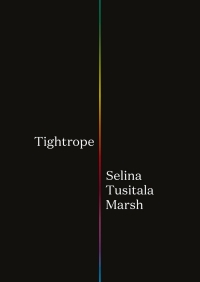
1497493006148-1.jpg  1497493006148-1.jpg


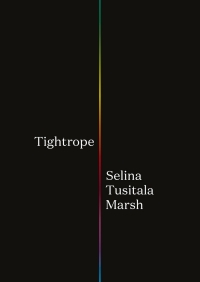
Tightrope, Selina Tusitala Marsh , Auckland University Press, 2017.


Let’s talk about unity

here in London’s Westminster Abbey


did you know there’s a London in Kiritimati?

Republic of Kiritibati, Pacific Sea.


We’re connected by currents of humanity

alliances, allegiances, histories


from ‘Unity’


To celebrate Selina’s new poetry collection, Tightrope, and her appointment as our current New Zealand Poet Laureate we email-conversed over several weeks. Selina is of Samoan, Tuvaluan, English and French descent. Her debut collection, Fast Talking PI, won the Jessie Mackay Award for Best First Book of Poetry. She was the first Pacific Islander to graduate with a PhD in English from the University of Auckland. Last year as Commonwealth Poet she performed ‘Unity’ for the Queen at Westminster Abbey.

I leapt for joy when I found out our new Laureate was Selina. Firstly because I am in awe of what she writes and she is a good friend. Her latest book catches you from first to last page on so many levels. Secondly I follow behind her at schools and I can see how she has utterly inspired teachers and students, whatever the level. This is poetry gold. Thirdly I leapt for joy because that now makes it 5 women poets  out of the 11. Did it matter to me that a woman was picked -yes it most certainly did. Selina has talked about the way she wants to have 1000 hands touch the tokotoko – how she wants to bring the poetry of brown faces to the spotlight. When I look about and see how whitewashed we are in so many ways – what gets published, what gets reviewed (check out the latest list of best poetry books 2017 in The Listener), what gets put stage centre at festivals, journal content etc – I leapt for joy that we have Selina. Hone Tuwhare and Sam Hunt are the two poets that are so beloved by our nation. I predict Selina is our third. I am currently writing a book on NZ women’s poetry and while my aim is to showcase the poetry that so often gets eclipsed by theory and dogma and bias, I also, at times, talk about the woman holding the pen. She has existed in the shadows. She has been maligned and misunderstood and devalued. I want to give women poets presence where it seems apt because their stories have so seldom been told. So while I think the poem is the first most paramount thing, I also think it is important to navigate the difficulties and triumphs women have faced as poets over the past century in New Zealand; how their poetry has been denigrated and erased due to gender or race. To have Selina given this golden opportunity to write further into our sightlines is heartwarming.

Paula Green 10 October 2017 on Facebook


Our conversation


Paula: I have spent a stormy Sunday morning lying in bed reading your new poetry collection, Tightrope, from cover to cover, and now I want to read it again slowly as an email conversation unfolds between us. The reading experience moved shook soothed challenged diverted me with the ooh and aah of recognition pain delight. In other words, the poems take you so many places in so many ways. I love it!


Gran’s jasmine

delicate pink


heavy and sweet

clings to the bone


from ‘Kiwitea Street in the ’80s’


The cover is striking with the tightrope moving from top to bottom rather than stretched taut across a horizontal line. I had held up my piece of red wool at your book launch, but it is only now, I am wondering why it holds a vertical line. It as though the rope stretches from the sky (heavens) to the earth (grounding), or from earth to sky. It is like an upturn, an overturn, and is infinitely resonant in its red to green glow. Why this placement?


Selina:  Instinctively insightful as always Paula.  In part, it references the living conditions of what I think of as the first poem of this land – the poetic parting of Papatuanuku, Earth mama and Ranginui, Sky dad, and the struggles of living before, during and after their separation. What does it mean to live in between such aroha, such passion, such angst?  Sometimes, like this morning, it means submitting to Tawhirimatea’s restlessness in the driving wind; other times, it means tuning into a mist-like longing in the light after-rain.  I’m often in between.  As a middle child I’m used to it and have finely honed skills of negotiation. Inbetweeners possess tightropish qualities:  a tender balance between joy and pain; the toe inching forward of a line that demands feeling before seeing.  That’s why the line is raised (much to Michele Leggott’s joy, who proclaimed at the Devonport Library launch recently that it was one of few books which she could hold up to an audience and know it was rightside up!)  Because I feel my lines.  Because that’s what brings me out of the abyss.  It’s also what gives depth to the abyss.

Unity is an underlying theme in the collection, as well as being the title of the poem for the Queen.  Unity is what’s needed in ‘the struggle’, however you define it in your life at that point (evoking the brothers’ struggle against the darkness imposed on them by their parents).  Unity is what my poetry seeks to create.  Unity of the multitudinous stories that constitute our memory, which in turn, form our history, ‘the remembered tightrope’, to quote Albert Wendt. The morphing colours of that beautiful vertical rainbow line (thanks Katrina Duncan and Spencer Levine) evokes the many hues of our lives that refuse to be forgotten.


Al,

I’ve taken a black vivid marker

pressed it against your page

and letter by space by word by phrase

inked across your lines

streaking pouliuli pathways

wending in and out of the Void


from ‘The Blacking Out of Pouliuli (1977)’


Paula You climb reverse-wise through Albert’s quote, so to speak, in your three sections: from the abyss to the tightrope to the trick. It seems the poetry pollinates the inbetween space between forgetting and remembering. He places this in view of history, but is it also personal?

‘We are what we remember, the self is a trick of memory … history is the remembered tightrope that stretches across the abyss of all that we have forgotten.’ Maualaivao Albert Wendt

Selina:  History is deeply personal, after all, it’s ‘written by the winners’, as I first saw in my undergraduate years graffettied under Grafton Bridge as my bus was heading out to Avondale (and later attributed to Churchill).  I’m reading a delicate collection of poems titled ‘Luminescent’ by Nina Powles at the moment (PG: my review here). 5 chapbooks are stacked in a fold out box (Seraph Press does a beautiful job) and each of them speaks back to women figures – some famous (I especially like the poem ‘If Katherine Mansfield were my best friend’) and some lesser known (to me), like ‘The Glowing Space Between the Stars’ responding to the award-winning New Zealand cosmologist Beatrice Tinsley (1941-1981), who ended up at Yale University teaching on galaxy evolution.  Where was her history in school?  Nina’s personal, poetic connection with five (early) New Zealand women is helping to build this history.

I think that’s why I so love Al’s line ‘the self is a trick of memory’, because that’s the personal self (‘Queens I Have Met’, a way to memorise moments), the communal self (‘The Dogs of Talimatau’ – how did all those dogs really die?) and the national self  (from the New York poems, see for example ‘Inward Hill, New York’ – what happened to the indigenous people of Manahatta? – to Oceania’s ‘Atoll Haiku Chain’ – Tahiti’s stories fan the flames of its history of colonisation, nuclear testing, and protest.  That inbetween space between forgetting and remembering though, is probably most potent in the abyss of death, but ‘Essential Olis for the Dying’, the poem written for my beloved colleague and ‘shooting black star’ Teresia Teaiwa (1968-2017), to whom this collection is dedicated, appears in the ‘Tightrope’ section.   That’s because, to quote Al again, ‘we are what we remember’, and we choose to capture moments of relationship that are ephemeral by nature, that’s the act of tightrope walking.

We choose, inch by inch, what we will feel beneath our toes, how we will balance ourselves in the air and keep our centre of gravity so that we can keep moving forward.  Certain moments, particular memories, we will throw across the abyss of time in order to reach back while moving forward.  Other things will recede into the background – we think we’ll never forget, but then we do.  We lose shades of it, pieces of it, and even though the loss stays, even that, the depth of it, the pain of it begins to diminish over time.  Maybe it’s meant to.


Take this cardamon

to ease you into the next plane

not the one taking you back to Santa Cruz

or Honolulu or Suva

but the next plane.


from ‘Essential Oils for the Dying’


Paula: I also love Nina’s collection and the way she is casting light on these five diverse women. That you dedicate your collection to Teresia Teaiwa resonates deeply, on an individual level, but also because you are part of a weave of women writing, speaking, sharing. You don’t write out of a vacuum.

I was particularly moved by, ‘Apostles’ and the way it challenges on so many levels. Alice Walker lays down the first challenge:


Alice Walker said

before placing a red

cushion in the middle of the road

that poetry is revolutionary.


You recount events that speak to such a claim. I am musing on way you highlight the example you accidentally found when googling lime; a brown skin woman mob tortured for sorcery. Not famous; one woman suffering. Do you think poetry can make a difference?


A brown woman is sitting

her back to us

bare on a corrugated

iron dock

noose round her neck

wrists bound

machete bites

mar her back

one gash so deep

its creviced meat

blackens

in the smoking air.


from ‘Apostles’


Selina: ‘Apostles’ is my answer to that question, which is answered by a question back to Alice Walker, poet, writer and activist extraordinaire: ‘Alice, how can a poem possibly revolutionise?’  Then Kepari Lenara, the name of the young woman murdered by mob, appears and fades over the following lines. These visually echoing whispers evoke the power of orality at the heart of poetry.  Poems are meant to sit on the tongue, be spoken and sung, flung into someone’s ears.

One of my favourite lines of all time is by poet and lyricist Rangitunoa Black: ‘A fire burns on the tip of my tongue, I should cry to put it out.’ That’s the power of poetry, that it matters, that it creates fire and movement out into the world.  It’s why the Poet Laureate Matua Tokotoko (parent tokotoko) is so gorgeously poetic. The parents have three detachable sections to them (to enable easy travel!).  It comprises of a mama section (which has a hand written poem by Hone Tuwhare in its belly) and a papa section (which has a grooved tip).  When you rub them together – ahi!  Smoke! Isn’t that what poetry is about?  It’s why I’d love love love to have a flint embedded in my own tokotoko so in performance, I can strike it and create that spark.  A living metaphor.  A heightened engagement with the audience.  An interactive poetry.  That’s the difference poetry can make.   And poetry has made a tangible difference in my life.  Poetry enabled me to articulate my turangawaewae (standing place) at university as nothing else could. Poetry can make a difference.  That’s why I take it out to schools, community halls, corporate boardrooms.  For the difference it can make.


Paula:  And you take it to your sons in ‘Warrior Poetry’. It is like a letter coming from the gut, saying this is what I do, but it also feels like an energised song-chant-poem for teenagers, especially boys, who skirt books and poetry.

Putting together a poetry collection, boys

is like the NLR nines

Eden Park, 45,000 packed

you’ve got 90 pages of lines

to work the eclectic crowd

into some kinda synthesis – some kinda wonderful


from ‘Warrior Poetry’


Poetry does many things in your collection – even act as a little spot of revenge! Ah! the revenge poem.

Selina: Poetry for all occasions right?  You see, often in a difficult, embarrassing, confronting, uncomfortable situations, my first reaction is to smile (my kickboxing trainer used to call me the ‘Smiling Assassin’).  It’s only later when the brilliant retorts, the intellectual one-liners, the sardonic replies, come to the tongue. Or I should write, the pen.  And poems can carry the weight of my anger or angst; they can take the push-pull of my righteousness and ambivalence (at the same time); they can turn a moment of indecision about what just happened or shock at someone’s rudeness or felt gut-disempowerment and re-story it ways that return power to me.  Call it ‘the revenge poem’ or call it ‘the re-storying painful or uncomfortable events poem’, whatever you call it, its at all of our fingertips!


My moana blue Mena

My Plantation House shawl

My paua orb

My Niu Ziland drawl

My siva Samoa hands

My blood red lips

My va philosophising

My poetic brown hips


from ‘Pussy Cat’


Paula: Five poets were Te Mata Estate Poets Laureate, with Bill Manhire (1996) and Hone Tuwhare (1997), the first two. In 2007 the National Library took over the administration and appointment process and selected Michele Leggett as the first New Zealand Poet Laureate. You are the sixth Laureate appointed by the National Library with the change in title.

Looking back across the Laureate blogs and tenures, each Laureate seems to shape the role to fit him or herself, just as the tokotoko is carved by Hauamoana artist, Jacob Scott, to fit the individual. I love the idea that you will shape the role to fit – what matters to you as Poet Laureate?


Selina: In 2 weeks I leave for Samoa where I’m judging the Pan-Pacific Tusitala Short Story competition, giving the keynote for the Pacific Arts Association, running two writing workshops, and performing on opening night.  While this was arranged well before becoming Poet Laureate, I am taking the Matua Tokotoko with me and ‘they’ (the parents) will feature.  Usually behind lock and key in a glass case at the National Library in Wellington, I have instinctively known, as a person from the Pacific, the taonga, the national treasure, that I have in my possession.

Polynesians know the mana such taonga possess.  Material objects become taonga as they are passed on and down; as they pick up the stories, histories, and genealogies of those who possess them.  I will have reached my goal of a 1000 pairs of hands touching the Matua Tokotoko in Samoa (I’m currently at 977) since the Award was announced on August 25th.  Everywhere I go people are enthralled with the story of its making – but it’s not really common knowledge.  That’s what I want to do, at least among the diverse communities I engage with.  Most are not aware of what the Poet Laureate is, nor what the tokotoko represents.  Each Laureate has helped increase awareness in their own circles, in their own way.  That’s what I’m doing now.

After visiting Hawkes Bay and finally having a korero with carver Jacob Scott from Matahiwi Marae, we’re really excited about bringing my tokotoko into the world.  This trip to Samoa will also enable my Samoan treasures to be included in its making.  One idea was that I source (that means ‘cut’) some wood from my grandfather’s house in Elise Foe, the original ‘Tusitala’, to include in the carving.  Then when I visit Vailima, Robert Louis Stevenson’s plantation house, I do the same there (with permission from the owners) and source material from the other ‘Tusitala’ to somehow incorporate.  I’d like to bring home a stone from the river my mother used to bathe and play in. I’d like to include some other historical objects.   As poets are wont to do, I will wait for synchronous moments to come – I know these material stories will make themselves known to me.

This is part of a journey and Mike Hurst, along with his film-mate Andrew Chung, and Tim Page are the guerilla film / photo crew capturing formative moments in order to make a lovely documentary – more on that later!

I guess this is a round-about way of also addressing the question: ‘What does it mean to be a Pasifika Poet Laureate?’  It means doing this stuff.  Taking the Laureate-ship along in my Pacific-infused life (we are, after all, in the middle of the Pacific), not just in incidental ways, but in deliberate, epistemologically-informed ways that centre Pacific worldviews, at least, as far as I see and experience them in my life as a Pasifika poet-scholar.

So, as the Poet Laureate, people matter to me, stories matter to me, especially when those stories have existed on the margins of mainstream consumption.  Creativity and freedom matters to me, honoring my own unique poetic voice, and continuing to grow it matters to me.  I have two years to work on these things that matter to me: to continue taking poetry ‘to the people’ and to continue growing poems!


We are about to step

on stage at Aotea Centre

in front of a sold-out

crowd of two thousand

I ask

How would you like to walk on –

before me or after me?

You say

Let’s just do this

and take my hand.

We stroll on

side by side

to a standing ovation

your hands become doves


from ‘Alice Walker’ in ‘Queens I Have Met’


Auckland University Press page

Poet Laureate blog

NZ Book Council page

Watch Selina perform ‘Unity’ at Westminster Abbey here

Gina Cole picks ‘In Creative Writing Class’

‘The Dogs of Talimatau’ at The SpinOff

Selina picks Tusiata Avia’s ‘This is a photo of my house’


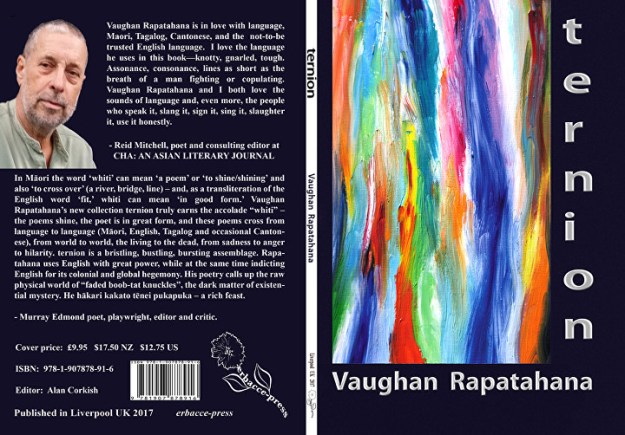
Vaughan Rapatahana’s Ternion: I love this generous embrace


4632673381_720x502.jpg


Ternion Vaughan Rapatahana (Liverpool: erbacce-press, 2017)


Vaughan Rapatahana travels and lives in three distinctive places:  Aotearoa, the Philipines and Hong Kong. His poetry reflects an impulse to travel because the linguistic movement, whether aural or visual, is paramount. Words dart, dash, stretch, stutter, link, break down, break apart. There is vertical uplift and downward slants. Such linguistic playfulness is not simply a matter of exercising the dimensions and possibilities of language; each poem travels with a movement of heart and mind.


There is the hiccup of letters and words in ‘my father’s death’, a poem that faces the hard-to-say in fits and starts. Physical detail anchors the experience:


only

the young oldest son

there to witness

his shrivelled size,

the estranged demise

-astray the slim single bed


The diverse subject matter embraces the movement of a global traveller, with several languages sharpening the line, hooking place and experience, opinion and identity. He rails against the weakness of English (‘railing against’). He rages against blinkered if not blind identity views: ‘why/ are  we/ mis interpreted/ all the time?’ (‘I carry a rage’).

The detail is pungent and thick on the line – especially when place is at the poem’s core:


hong kong, you old bastard;

your flabbergasted lips

basting the back alleys

in jisms of sputum,

disabling sophomore solons

garbled in yellow

under colourless sun.


from ‘hong kong town, 2015’


What I love about Vaughan’s poetry are the multiple jigs: the way death brushes against life, humour touches against sharp-as-axe political edges, confession corrupts reticence. Poetry is a way of cooking up a brew that resists boundaries, rules, decorum, models. I especially like the scene at the fence where poetry is the topic pf conversation:


‘Smells good,

you cookin’ up another one

of those bloody poems of your’s mate?;

offered my gap-toothed neighbour,

through the interrupted picket fence.


‘reckon,’ I said, stirring up

a bit of everything on the page,

so to speak.


from ‘boil up’


The neighbour hopes the poem hasn’t got any of ‘those clever-dick tricks’ when he wants ‘plenty of/ good old carrot & onion words’. I love this poem. On the one hand, Vaughan is responding to the age-old incomprehension at what a poet does, but it also gets right down to the guts of how he brews a poem. There are clever, tricky acrobatics on and off the line that signal intellectual engagements with the world, but there is also a Hone-Tuwhare-like cheek and an absorption of an everyday physical world. We might get ‘cacophonous condiments’ along with ‘a little watercress    on the side’ and a good stir of Te Reo.

Murray Edmond claims the collection as ‘a rich feast’ on the back cover and I agree. The poems spark in myriad directions that touch mind and heart, and I can think of few local examples that are so linguistically and creatively fluid.


Postscript: Vaughan’s must-read poem for Tusiata Avia and Fale Aitu / Spirit House resonated so deeply I felt like crying. A poem like this underlines the way we write within poetry communities, not in estranging isolation, but in arm-to-arm states of poetry and human connection. I love that. I love this generous embrace.


manuia Tusiata, manuia

this is the best body of poetry


I’ve hugged for years.


from ‘fa’afetai Tusiata’


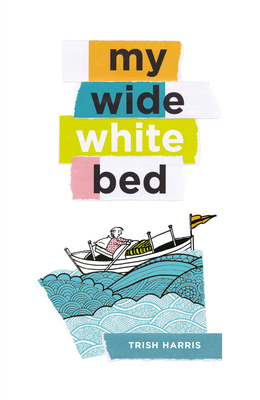
Trish Harris’s My Wide White Bed is an astonishing uplift


large_my-wide-white-bed-front-cover.jpg

The Wide White Bed Trish Harris  Landing Press 2017


Trish Harris spent eight weeks in the Orthopaedic Ward at Hutt Hospital as people – visitors and patients – came and went about her. Someone brought her a journal and that became both her private room and the subsequent resource for My Wide White Bed.

The poetry is airy, with acute observations, luminous things, and an awareness of community experience rather than a single perspective. It is immensely readable; I gobbled it in a flash, loving the sweetly crafted lines, the wit and the reflection.

The sequence comprises untitled poems that begin with the idea of a ship:


The hospital sails

like a tall ship

down the crease of the valley.

I am stabilised

mid-mast

laid out on a wide white bed

head facing east.


The book struck such a cord with me because it took me right back into the thick of hospital stays where intimacy thresholds dissolve, discomfort displaces comfort and walls and windows are unsteady.

This is not a bitter grim read but an essential read in the light of the current state of hospital care. The politics are subtle and various:


They arrive

as elderly women with

broken bones

strained muscles.

Back home

they are the strong ones

caring for senile husbands

sick sisters

dying mothers.

They come to this place

of illness

for a rest.


Trish pulls us into the lives of others as much as she exposes her own story, and that is what elevates the reading experience. Names are changed but the dialogue, the situations and the revelations sound out as vital human truths. This is poetry of connection, of empathetic relations in tough circumstances. Single lines glow:


Merle is doing crosswords.

That’s why she buys the newspaper.

At home her husband grows daisies and dementia.


The book should be in the drawers beside every hospital bed, and in the gift shop, because the book, like the boat with the wind in its sails, is an astonishing uplift. Plus I recommend placing a journal and pen in bedside drawers, so patients can open up their own privates rooms to write or doodle windows and doors and secret sails.


Then again pick up this book for a wet Sunday and savour the rewards. I love it.


All night long I ease

the white blanket over shoulder

across belly and over hip

dreaming of transformation.


In the morning the nurse says

You look like a cocoon.


I smile. The covers bulge

with antennae buds and

the scratching of wings.


©Trish Harris The Wide White Bed

Trish Harris has a BA of Applied Arts (Creative Writing) from Whitireia New Zealand. She has worked with words – editing, writing, creating and tutoring – for over thirty years. In 2016, Escalator Press publisher her memoir, The Walking Stick Tree. Her poetry has appeared in various journals.