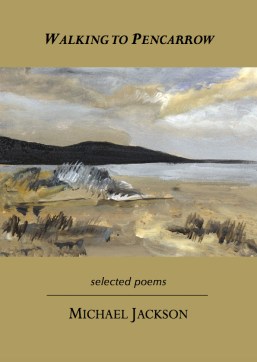
Walking to Pencarrow Michael Jackson, Cold Hub Press 2016
Cold Hub Press has recently released, Walking to Pencarrow, a selection of Michael Jackson’s poems. The poems are drawn from eight collections dating from Latitudes of Exile in 1976 to Midwinter at Walden Pond in 2016. Michael has written thirty-five books, eight of which are poetry. He has received a Commonwealth Poetry Prize and a New Zealand Book Award for Poetry. Vincent O’Sullivan writes on the blurb: ‘Jackson’s vocation as a world-class anthropologist, and his spending so much of his life away from his own country, are shaping forces on his oeuvre.’ Martin Edmond writes: ‘One of our most astute, humane, idiosyncratic and perdurable writers.’ The collection gathers together luminous pieces of the world–with family, fidgety notions of home, anchored home, slithers of beauty, people and anecdotes to act as both an interior and poetic compass. The poems both augment and transcend what is real. Reading your way through the arc of living and writing, poetry becomes an absorbing form of solace as well as an impetus to write. A spotlight on Michael is long overdue as this magnificent selection underlines.
To celebrate the book, and the poems within, I have been granted permission to post Michael’s excellent preface and two poems that I particularly like. Both poems were originally published in Midwinter at Walden Pond.

Author’s Preface
As an adolescent, I was in revolt against the bourgeois tendency to paper over the harsh realities of social inequality, capital punishment, and colonial violence in order to create a fools’ paradise of domestic comforts and hackneyed phrases. The poems that poured out of me were filled with the angst and ambivalence of youth, its romantic infatuations, its embrace of lost causes, its wild oscillations between home and the world. Jim Baxter gave me good advice, critiquing one of my early poems about un-requited love. “Write about the body straight, and you find you are writing about the soul without knowing it … It’s the facts that count: her black or blonde or yellow hair, whatever treasure she is able to give you. The footloose sand and the seabirds and the crabs have a right to control the poem, not the I-centre or the her-centre; they can tell us more about love than we can tell them; they do in a sense control Fairburn’s greatest poem, The Cave.”1 Clearly I had to learn how to yield completely to the things that captured my attention, allowing them to speak to and through me. I also had to learn that poetry is far more than an exercise in breathtaking imagery and verbal legerdemain; it had to do justice to life; it had to measure up to something beyond itself; it had to be a kind of witnessing. My first breakthrough was ‘Blind Man’ which appeared in a student magazine when I was 19.2 Its focus was a Westland schoolteacher who had lost his sight in a car wreck, and subsequently moved to Auckland with his wife and two small children to study for an arts degree at Auckland University. Terry rented a house near the Blind Institute and I spent my Saturdays helping him with his English 1 coursework. The second poem was inspired by Arthur Koestler’s Reflections on Hanging, and appeared in Landfall in 1959.3
Nevertheless, it was only after I left New Zealand in 1963 and immersed myself in various forms of welfare work among Aboriginals in Victoria, Australia, among the homeless in London, and among war-torn communities in the Congolese hinterland, that I began to find my own voice and painstakingly piece together the collection of poems I published in 1976 as Latitudes of Exile. The earliest of these poems date from my return to New Zealand from Africa when I took a job relief teaching in the Wairarapa and began editing poems I’d drafted but never finished during my travels. To these ‘Congo poems’ was added new work based on experiences in Sierra Leone where I did fieldwork between 1969 and 1972; other poems reflected my everyday life in the Manawatu where my daughter Heidi (born in Sierra Leone) spent her early childhood and I taught anthropology at Massey University.
In hindsight, the poems in Latitudes were born of a quandary that troubled my thirties but undoubtedly had its origins in the experience of growing up in a small backwater Taranaki town in which I felt a complete stranger. A yearning for the freedom of new horizons (the ‘latitudes’ of exile) pulled me in one direction, while the longing to have and hold a place I could call home pulled me in another. A similar struggle informed the poems in my second collection (Wall) where I describe, not without irony, the experience of breaking up a concrete path only to find myself building, with the broken pieces, a wall between myself and my neighbor. What had happened to my desire to break down walls and embark on new journeys to the ends of the earth? Wall not only bears the impress of the Manawatu, Wairarapa, and East Cape ––regions of social and spiritual anchorage for me––but excursions abroad to Australia, Sierra Leone, and Europe throughout the ’70s.
In 1982–83, I took two years’ leave from academe, deter-mined to turn my hand to fiction. Two-thirds the way through my Katherine Mansfield fellowship year in Menton, France, my wife Pauline fell gravely ill. We traveled to England for medical advice before returning precipitously to New Zealand where Pauline died in September 1983. In the wake of Pauline’s death, our daughter Heidi found it difficult to settle back into school, and I felt an urgent need for “fresh woods and pastures new”. When friends at the Australian National University offered me a temporary teaching position, I sold our house in Palmerston North, sent the furniture for auction, and moved to Canberra where I completed Going On––a kind of logbook of the year before Pauline’s death and the six months after. Some of these poems were written in Menton; others in England, New Zealand and Australia. Though pervaded by a sense of desolation and loss, the best of them celebrate that deepened sense of life that sometimes arises un-bidden in the face of catastrophe. A return trip to Sierra Leone, a sojourn in Sweden, Heidi settled in school, and the miracle of my falling love again reinforced this sense of rebirth and inspired several of the new poems I published in Duty Free (1989).
Though I revisited New Zealand every year and hoped to keep the home fires burning, the gradual attenuation of old relationships was the inevitable price I paid for living abroad. After several years of unemployment in Australia, I accepted a job offer at Indiana University (Bloomington) in 1989 and throughout the 1990s made a succession of life-changing ethnographic field trips to Central Australia and Cape York Peninsula, accompanied by my second wife Francine Lorimer. But my years away from academe had radically changed my priorities as a writer, and most of the work I published between 1988 and 1998 interleaved poetry, creative nonfiction, and fiction. The titles of my books suggest a preoccupation with questions of personal identity and belonging. Rainshadow (1988) explores the conspiracy of silence that may sometimes follow a family tragedy no one knows how to work through or explain. Pieces of Music (1994) questions the notion of a coherent self, or a single seamless life story. At Home in the World (1995) is a sustained meditation on the meaning of home among nomadic or displaced persons, while Antipodes (1996) ponders issues “of inequity and division between North and South as well as personal quandaries and contradictions arising from a life divided between two hemispheres.” Although I called my memoir, The Accidental Anthropologist, I could just as well have called it ‘The Unsettled Expatriate’, for while I had come to call several countries ‘home’, including Sierra Leone, Denmark and Australia, the close friendships I had formed, the roots I had put down, the landscapes I had come to love, were not of a piece. At the same time, I was beginning to discover that my homeland was not altogether accepting of its native sons and daughters who, in search of employment, adventure or love, wind up living elsewhere. Though our hearts may remain wedded to natal landscapes and seascapes and though we return annually like godwits to rebuild our nests, we are no longer regarded as bona fide kiwis. Martin Edmond, with whose work I have always felt a deep affinity, wrote a review of my book, Road Markings: An Anthropologist in the Antipodes (2012) that begins by invoking James Joyce’s poignant line––“A nation exacts a penance from those who dared to leave her payable on their return.”4 For whatever reason––age, prolonged absence, or mediocre talent––publishing in New Zealand became increasingly difficult; one editor even describing me as “effectively dead”. Despite diligent efforts to publicize my books in radio and magazine interviews, my profile faded and I became a footnote to local literary history. Yet I see a fascinating progression from Dead Reckoning (2006) and Being of Two Minds (2011), where the poet seems torn “between seemingly irreconcilable affections, identifications, and places of personal anchorage”, to a poetic voice that no longer construes selfhood in either-or terms, but accepts and celebrates its multiplicity and instability. In passing beyond the pale of a purely regional identity, or seeking to define or defend this identity against all others, I seem to have followed the Cynics’ example of living according to nature (kata phusis) rather than conforming to any particular social law or custom (nomos.) Even as a child, I was aware of an antinomian streak in me, but it has taken me a lifetime to be able to say, as Diogenes did when asked the name of his home-town, it is both nowhere and everywhere. I like to think that this notion of cosmopolites provides one answer to the self-serving parochialism and blind fundamentalism that are the curses of our times. But few writers are ever fortunate enough to publish internationally, and in pursuing my ambition to remain a New Zealand writer, I am grateful for the unstinting support of Vincent O’Sullivan over many years and, more recently, the generosity of Roger Hickin at Cold Hub Press.
––––––––––––––––––––––––––––––––––––––––––––––––––––––––––––––––––
1 Letter from James K. Baxter to Michael Jackson, dated 22 November 1960.
2 ‘Blind Man.’ Outline, 1959: 13. 3 ‘To be hanged by the neck.’ Landfall 13(4): 323.
4 James Joyce, ‘Notes by the author’, in Exiles (New York: Viking, 1951).
Seamus Heaney 1939-2013
I dig deep for words
worthy of what you gave
delving into the peat and loam
of your own upbringing,
a country boy as you were
who in the end became
a countryman, versed
in the particular tools of your trade
honing language
to cut a swathe
through unbearable experience,
scything a space where we all could breathe,
a wedge of silage in the side of a hill
held down by tires on a black
tarpaulin, the ritual
of tying the harvest bow.
I cannot bear the thought
of you reduced to bone
smashed in a mortar,
shelved or scattered
across the plow,
though know the earth or sea
will gravely welcome you,
an ally at a time we spend
our time naming and numbering
our enemies,
walling ourselves in, wanting no contact,
and the only poetry
garish doggerel slashed on brick
in the small hours by a kid too young
to carry a gun.
I am ill at the idea
that you are gone, who wrote
about your wife with
unparalleled love, who sat
at a table so solidly, so filled
with confidence that
inspiration would always come,
unbidden in the gorse-
scented wind or brine-soaked
oyster-catching sea,
an unexpected gift, a good turn,
a phrase for something
we did not quite believe.
The stacked lumber
of your seventy-four years
and our repining
is now pared down to a single
knot-holed plank of grief.
In a cobbled yard
we build your bier,
as plain and unpretentious
as celebrity allows,
acknowledging the simple fact
that your words were also ours
whether walking through a hail of stones
and hate-filled rhetoric on a Belfast street
or penning in our collective mind
obituaries for the blinding passions
that had brought us to our knees.
We will sing your praises
as if you were our lost Lycidas,
not drowned by history
but survived
to tell the tale,
to bind us close with the fraying twine
of your careful phrases.
You showed us what we had forgotten
about our common clay,
how we might bridge the gap
between history and hope,
a skunk in the garden
and your beloved wife
bending to take a plunge-line black
negligé from the bottom drawer.
If I go against the grain of your
tilled, harrowed fields,
furthering the line
of the glinting plow to take in
clamoring gulls and other scavengers,
if I migrate or deviate,
slam the tractor into reverse
at the thought of a cowering animal,
it is because of what I read
between your lines in Wintering Out
or on bog sacrifice in North
or on those antinomies that strike a spark
from the hooves of our hurrying harnessed pairs
and hint like fireflies
of a path through elephant grass
or a stream, still muddy after rain,
that will run clear.
Midwinter at Walden Pond
I am walking around a so-called Kettle Pond
on a sub-zero January morning, made more bitter
by the arctic wind that chafes and burns my face
when I turn into it. This is the only unpolluted lake
for miles around, the spring-fed pond where Thoreau
built his hut (desk, chair, pot-bellied stove and cot)
and daily wrote the thoughts and observations
that would make his name. This morning, though,
my mind is on the ice-bound pond’s bizarre
sonority––squeaking, gulping, stomach-
rumbling groans, as if Thoreau’s ghost had been
disturbed, or Melville’s Leviathan were about to sound.
Through pitch pines, I glimpse a single skater
making tracks across the frozen
snow-dusted surface, as if he too
is seeking ‘to live deliberately’ and find
companionship in solitude. I take
the uphill path to where the great man lived
two years, two months, two days, the site
now marked by a random pile of stones,
some bearing the engraved or painted names
of those who made their pilgrimage to Walden Pond
and in the hornbeams’ shade shared
their favorite passages from his book,
blessed by the down-turned gestures of the pines,
hearing the anomalous whistle of a train.
I am not one of them, I know. I only take
this path for exercise or the possibility of
a poem, suffering only snow from a low bough,
the groan of pack ice pressed in upon itself,
as I try to decipher the skater’s
random signature, or ask why visitors would hurl
big stones out on the ice unless it was to see
if it could take their weight. In Central Australia
those who take stones from a sacred site
are cursed. To bring them here is to be blessed.
Surely I am not the first nor will be last to find
that a frozen lake can free the mind.
©Michael Jackson 2016




 Warmest congratulations from all at OUP to Sue Wootton, whose poem ‘Strange Monster’ has been longlisted for the University of Canberra Vice-Chancellor’s International Poetry Prize 2016. Sue’s poem is one of 60 selected from over 1200 entries. Head judge Simon Armitage will determine the winning poem, which will be announced on Friday 16 September at the
 NZ Poetry Shelf