Category Archives: NZ poetry

Poetry Shelf Monday poem: Harry Ricketts’s ‘Ginny’s Garden’


 Ginny’s Garden

(for Ginny Sullivan, 1950-2017)


Magpies quardle-oodle in the high firs.

Down here, under the overhang, it’s hot,


looking out over the lawn Karen says she cut

two weeks ago, and already thick, clumpy,


to the paddock where Friendly, the seven-year-old ewe

that you couldn’t bear to send to the butcher,


baas by the fence for kale and attention.

The veggies you planted have gone mad:


tomatoes big as butternuts; huge, shiny aubergines;

giant marrows; cabbage whites all over the basil.


In the Pears’ Soap poster in the bathroom,

two small girls still stare at large bubbles.


Harry Ricketts


Harry Ricketts teaches English literature and creative writing at Victoria University of Wellington. His latest collection, Winter Eyes, has been longlisted for this year’s Ockham New Zealand Book Awards.


Poetry Shelf noticeboard: essa may ranapiri’s zines

essa may ranapiri has added a zinging new zine to their collection. You can order a hard copy or read it (and others) online.


Screen Shot 2019-04-01 at 8.35.40 AM.png


Poetry Shelf audio: Marty Smith reads ‘Hat’

004_4-009540913200 copy.jpg


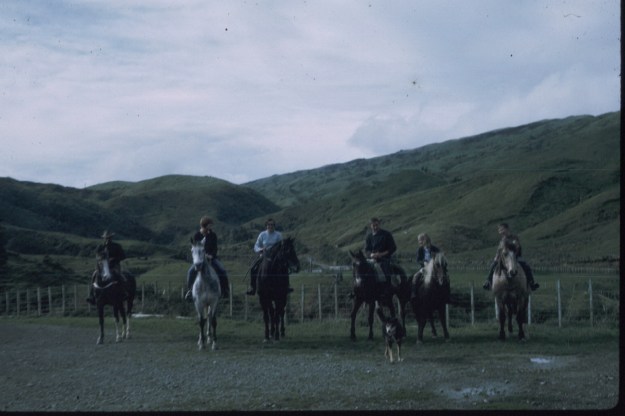
Marty Smith reads ‘Hat’ from Horse with a Hat, Victoria University Press, 2014


‘This is the kind of territory they were all locked together in. Here are the hills, and this is how they went to work.Left to right: Garth Smith (Dad) on Misty; Fiona Allpass on Poo: Marty Smith on Blackie: Bill Champion on Tiny: Chrissy Champion on Pet, and Paul Smith on Trixie.’ Marty on the photograph
Marty has given up teaching and administering literary events to work full time on writing a non-fiction book about what it takes to work in the racing industry and how and why people do. Her research involves regularly watching morning track work at the Hastings racecourse and betting at the TAB.


Poetry Shelf Classic Poem: Kate Camp picks Lauris Edmond’s ‘Camping’


Camping


Do you remember how we woke

to the first bird in that awkward pine

behind the ablution block, and leaned

across the knotted ground to lift

the canvas as though it was

the wall of the world

and ourselves at the heart of it

lying together

with the fresh grass against our faces

and the early air sweet beyond all telling –


do you sometimes look still

into that startled darkness

and hear the bird,

as I do?


When we drove away I looked back always

to the flattened yellow grass

to see the exact map of our imagining

our built universe

for a week

and saw that it was just earth

and faced the natural sky.


We took with us the dark pine

and the blackbird

and dew beside our foreheads

as we woke


and now we live apart

and I don’t know where they are.


Lauris Edmond  (from New & Selected Poems, Oxford University Press, 1991)

Posted with kind permission from the Lauris Edmond Estate.


From Kate Camp: It feels a bit odd that this is such a favourite poem of mine, because of the pun with my name. But the image of the flattened grass hit me with such power when I first read it, and does every time I revisit it. There is so much to love about the poem – its sensuality, its unashamed romanticism, and of course (being Lauris Edmond) its absolutely killer ending.

I remember Lauris saying to me once that she felt a poem should end like the shutting of a car door, from which I took a sense of satisfying and substantial closure, a rightness. I didn’t know Lauris well but she had a way of talking, and of reading her poems, as if she was slightly surprised by each individual word. I hear that cadence when I read the poem.

But of course the best thing about this poem is the ablution block. It’s such an ugly, unlikely thing to find in a poem, both the thing itself and the awkward “no one has ever said it” tone of the phrase. You know this is a found piece of language off some battered sign of the camp ground, and that lends the whole poem a down home, unpretentious feeling, that lets her get away with the romantic flourish of the “early air sweet beyond all telling.”

The other thing I love about this poem is how, like one of Shakespeare’s sonnets, it’s really a kind of sly testimony to the power of poetry – and of this particular poet – to capture and immortalise. It ends “I don’t know where they are” but of course we do know where they are, the bird and the pine and the dew are here in this poem. Wherever the poem’s protagonists and landscapes are, however lost to time and mortality, the poet has saved them here.

I think that’s why for me this melancholy poem is one that leaves me with a sense of exhilaration, even triumphalism – because when the car door of the poem closes, I sense the power of the poet in the driver’s seat.


Kate Camp is a Wellington-born essayist and poet, with six collections of poetry published by Victoria University Press. She has also written essays and memoir. Unfamiliar Legends of the Stars won the NZSA Jessie Mackay Best First Book of Poetry Award (1999), and The Mirror of Simple Annihilated Souls won the New Zealand Post Book Award for Poetry (2011). Snow White’s Coffin was shortlisted for the award in 2013, and The internet of things was longlisted in 2018. She has received the Creative New Zealand Berlin Writer’s Residency (2011) and the Katherine Mansfield Menton Fellowship (2017). Her essay ‘I wet my pants’ was a finalist in the Landfall essay competition in 2018.


Lauris Edmond wrote poetry, novels, short stories, stage plays, autobiography and edited several books, including ARD Fairburn letters. She published over fifteen volumes of poetry, including several anthologies, and a CD, The Poems of Lauris Edmond, was released in 2000. Her debut collection, In Middle Air, written in her early fifties, won the PEN NZ Best First Book of the Year (1975) while Selected Poems won the Commonwealth Poetry Prize (1985). She received numerous awards including the Katherine Mansfield Menton Fellowship (1981), an OBE for Services to Poetry and Literature (1986), an Honorary DLitt from Massey University (1988). Edmond was a founder of New Zealand Books. The Lauris Edmond Memorial Award was established in her name. Her daughter, Frances Edmond, and poet, Sue Fitchett, published, Night Burns with a White Fire: The Essential Lauris Edmond, a selection of her poems in 2017.


Poetry Shelf review: Poetry New Zealand Yearbook 2019


9780995102965.jpg

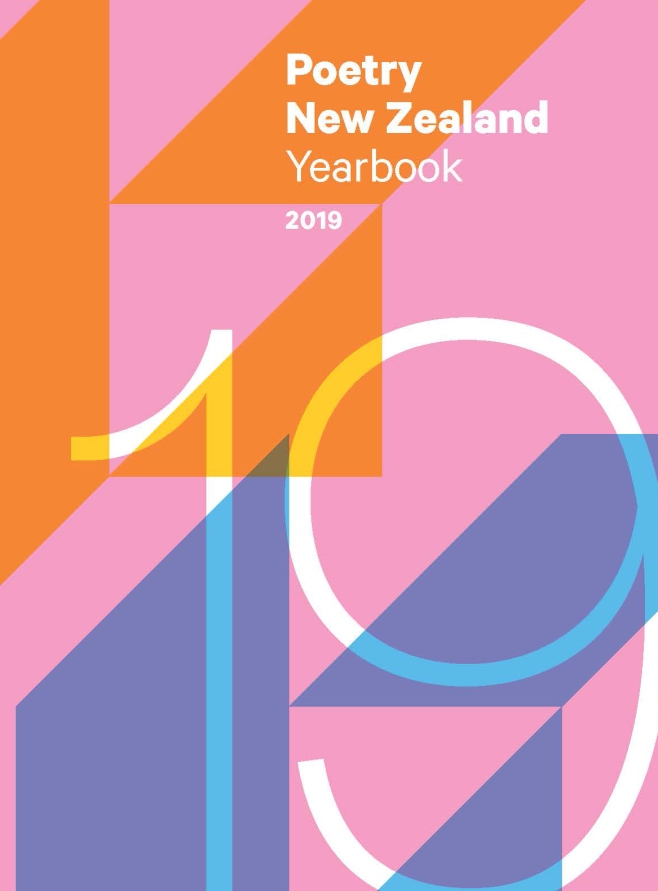
Poetry New Zealand Yearbook 2019 

editor Jack Ross, published by Massey University Press


Poetry New Zealand Yearbook always offers a substantial selection of poetry. This issue includes essays, reviews and the results of two poetry competitions, along with poems from new and established poets. I started reading the issue – I always dip and dive into literary journals – and made notes, gathering the poems that ‘spoke to me’. But then I hit the rest button and realised I was running on empty post big project. I have lain on a couch for a week and stared at the sky and after the horrendous terrorist event in Christchurch everything feels different. Because everything must be different. What happens when I pick up this journal again with a raucous bust-up of questions in my head: How to live? How to speak? How to connect? How to write a poem? How to run a blog? How to widen us and make room for past, present and future, to celebrate the good things and challenge the rest?

I picked up Poetry New Zealand again and started at the first page. No dipping and diving. Just tracking an alphabet of voices and letting poetry work its magic.

Certain poems set me musing. Marisa Cappetta‘s ‘Homeless like bones’ is both an anchor and a kite. This poem is worth the buying the book for, as a keepsake, a drifting catalyst.


My house is like a thing that flies

a warm bodied creature with wooden wings and moss

stuffed in the cracks to keep out

the draft at high altitudes.

Every night I burrow into its feathers.


Ria Masae’s magical ‘Children’s Eyes’ takes me back to a childhood looking, to stepping off from the knowable physical world to a world without limits or rules, a world bright with colour and possibilities. The poem is the thread that stitches child to adult.


In autumn

I would walk from school

under a canopy of different shades of Papatuanuku.

The flakes of her skin

drifted gently from her offspring trees

and whispered the earth’s secrets

into my childish ears

before playfully licking my cheeks

and falling to the ground

paving my golden-leaf road home.


Emma Neale’s poetry always catches hold me because its musical effects equal the craft of a silversmith – intricate, alluring, bright. However Emma’s ‘The TastiTM Taste Guarantee’ leads me in a different direction as the poem showcases her ability to write wit in all seriousness. She explains why, in the form of a letter, she has eaten the museli bar destined for her child’s lunchbox. The ending is a knockout – you get wit and seriousness with her characteristic deft musical touch.


All of which I guess

is just to say

(hey WCW, still got it!)

since you asked, I would like to know

how closed-grained and sweet-glazed

is the happiness of the future

assuming there is happiness in the future?

Because sometimes, when I do catch a glimpse

of time’s webbed, oil-black wings,

its tangerine-stained, crazed-bullet teeth,

I’m so stunned and dread-run

that even eating a candy bar

in Supergrain disguise

seems to be a legitimate opposite

to inaction.


Vaughan Rapatahana has poetry here in te reo along with a poem, ‘Rangiaowhia, 1864’, that takes us back to a massacre, an event we should become aware of in school, an event that returns us to the pronouns we and us. Again the questions compound. How to link the past to the future in order to understand the present?  How join hands and stand and listen. What to do with the breaking hearts?


who knows about the murders at Rangiaowhia?

not the majority in this country nowadays.

who remembers the burned children?

not the majority in this district.

who believes the word of the survivors?

only a minority outside that town.

alas

alas

alas.


I read Tracey Slaughter’s ‘archealogical’ and I just wanted to hear her read it aloud because it is such a sumptuous aural display of what words can do in a poem. The sound effects are as effective as the detail and the mood, and the surprising arrival of individual words; I am right back in the fumbling sexual awakenings of adolescence. I can’t wait to read Tracey’s debut collection out this year with VUP.


When the bell rings we are archealogical, cutting

through the harbour home, shins uprooting litres of slush

& levelling bubbles & barbs of creatures triggered back

into their chinks of flood. Their pinprick beds turn the sand

grid silver before your ranchslider shines up the low slope – beyond

your scalp the view’s not a bad excuse for stars. Inside we crumble

from the waded calves, the tight-knit glisten of mud scuffed

off by inches, the silhouette of grains slid of our sip.


Sue Wootton also draws me into the musicality of her writing, the luminous detail and the rendering of miniature stories and settings. ‘Anywhen’ is an electric read – taking me back to the 1960s and a foreign magazine sent to me by my French penfriend with Mary Quant products and miniskirts and velvet every way you looked.


Anywhere and anywhen

you unzip the hip-knock swing-along

to see what pops up

to hear what’s blowin’ in the wind.

You write past midnight on the blue machine

with your Mary Quant eyelashes a-droop

and the moon watches you and you watch

the moon. You’d like to land on the moon

but in colour. Page after page comes back to earth

with a crumpled thump


I have never read any poems by Sigred Yamit before and now I am keen to track down more because ‘Sweater’ blew the top off my head off (to borrow from Emily Dickinson) and really this skinny poem is sharp and sweet and utterly original and you have to read the whole thing to get the effect so I will just give you the start.


I’m supposed to write

something poignant

earth-shattering

eradicate cancer

but all I can think of

is my itchy red sweater

and how I fucking love it

and sad I get

when a boy is more

beautiful than me


I also loved Zuo You’s poem ‘I accepted His Apologies’ because it made me laugh out loud. Just two verses. Here is the second one.


The cold noodles I ordered

turned into hot ones

as if by magic.

After lunch

I posted a five-star review on the food.


Of all the finalists in the two poetry competitions I was hooked by Wes Lee‘s winning tour-de-force of a poem, The Things She Remembered #1’.   Phrases accumulate like a rollercoaster memory pulling you along in a blaze of sharpness and surprise. I was equally gripped by secondary school winner, Aigagalefili Fepulea’i-Tapua’i’s ‘275 Letters to Southside’. The poem, also sharp and rhythm rich, makes it clear that ‘Auckland is not the same place as South Auckland’.


Such is the strength of anthologies and literary journals: they can poke your skin and make you feel things – reading these poems I got sad, I laughed out loud and I got lost in trains of thought. Not everything hooked me but there is superlative poetry on offer. It was just what I needed. Now for the essays and reviews ….


Massey University Press page


Poetry Shelf Monday poem: from Amy Brown’s Neon Daze

Excerpt from Neon Daze


8th December 2016


A friend warned me months ago

that my baby would start to smell

of other people – perfumes, creams,

colognes, sweat – your baby’s head

will press against strangers’ throats

and décolletage, held close and warm.

Sure enough I recognised the musky,

woody scent of our family friend in his hair

and skin yesterday long after she’d left.

Babies are olfactory creatures, happiest

emanating their own or their parents’

odour. We squirt Johnson’s shampoo

under the running tap for the manuka

sweetness it leaves behind his ears.

Now, he is strapped against me and

I am afraid the sunscreen on my chest

will distract from the baked tussock,

sandy fragrance fresh and familiar

as a wave [1], blue and white as the baby’s

eyes. We walk along Ocean Beach towards

Cape Kidnappers, which is only ever a haze

of coast in the distance, past macrocarpas,

painted black in the Dick Frizzell print

on my parents’ bedroom wall. We walk and

the baby’s sleeping cheek sticks to my skin.


—————————————————


[1] To Wave

To move to and fro, from the Old Norse vagr meaning billowing water. Waves, Robin, look! I told him today, both of us squinting into the glare of the mid-morning horizon, paddling along the edge of the Bass Strait. His right hand lifted and twisted back and forth, to and fro at the breakers.

I am wavering between then and now. This is our third time at Skene’s Creek. The first was the first weekend away with my partner – my first conventional weekend away with any partner. He booked a cabin whose view from the bedroom window was dense and private with eucalypts and which was all sea and sky from the balcony, where I sat typing away at my thesis with a beer while he barbecued us fresh fish. I had about $36 in my bank account then and was both luxuriating in and anxious about the incongruity of this experience. In the spa bath we sucked each other’s toes and played lavishly with the jets. The photos I took were all of us – our feet the same size and sandy, only distinguishable by my red nail polish; him on the swing, a joyful blur of beard and beer.

The second time we came to this beach we stayed at the same cabin, but the weather was miserable. I photographed the food we made and the special bottle of wine we drank and my partner’s back as he walked away from me in his red jacket along the deserted beach. We brought our yoga mats and held postures together while rain hung white in the trees, obscuring the sea. I had just got my period for the twelfth time of hoping it wouldn’t come and was allowing myself to drink the wine, which tasted of nothing. We still didn’t know why I wasn’t getting pregnant, or how to fix it, or how lucky we would be when the weeks of injections started.

This time we are staying in a family’s beach house. I move the bowls of shells and driftwood ornaments to higher ground. My partner blocks the steps from the deck to the wild garden with three chairs. We coax our toddler to not use the length of timber dowel locking the sliding door in place to drum on the glass coffee table. We find empty snail shells, stones of all varieties and point at the sulphur-yellow underside of the wings of the cockatoos, which shriek en masse as they fly. I photograph the baby in the hammock, the baby in the sea, the baby scooping sand into his bucket; his face is always behind a broad-brimmed sunhat patterned with leaves. After seven, when Robin is asleep, we play quiet games of Scrabble and Monopoly at the outdoor table, drinking wine and eating chocolate to keep warm. On every visit I’ve forgotten how cold the beach gets at night and pack inadequately. This time I bring socks but no shoes, and many T-shirts but no heavy jersey. Like an eighteen-month-old I wear socks and sandals and eccentric layers. To warm up after swimming in the sea, we all shower together. I show Robin how I wash my face by closing my eyes and dipping my head under the stream. Nick demonstrates how he washes his face, carefully with a flannel. We both applaud when Robin’s wet eyelashes open and he smiles.


9th December 2016


There are creases in the back

of my father’s tanned neck, like

Hemingway’s old man. He spends

two hours longer than usual out

in his boat, trying to catch enough

kahawai for our dinner. It is filleted,

barbecued and served with a Persian

marinade from a cookbook I gave

my mother two Christmases ago.

The recipe calls for dried rose petals.

She laid them out in the sun (and

later microwave, to speed the process)

herself, picked from her own garden.

She lets the baby take handfuls

of petals off the aging bunch in

the dining room. He scatters them

romantically across the floorboards.

Later, I find one still clutched, bruised

perfumed and bright as blood in his fist.


Amy Brown


Amy Brown lives in Melbourne, where she teaches literature and philosophy. Her first poetry collection, The Propaganda Poster Girl (Victoria University Press, 2008), was shortlisted for a Montana New Zealand Book Award in 2009. Her next work of poetry, The Odour of Sanctity (Victoria University Press, 2013) was the creative component of a PhD on contemporary epic poetry. Her next book, Neon Daze, will be released by Victoria University Press in 2019.


Two poems from More of Us, launched by Landing Press today on World Race Relations Day


more-of-us-cover-1.jpg


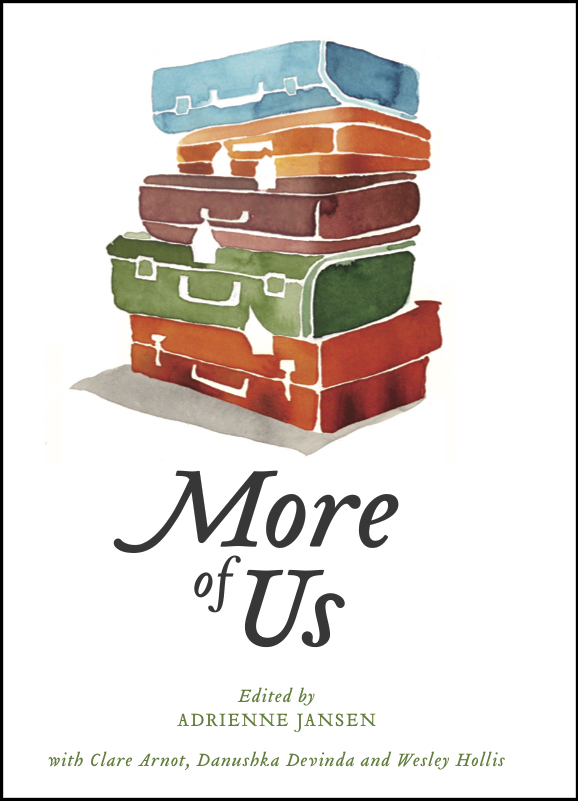
More of Us, edited by Adrienne Jansen with Clare Arnot, Danushka Devinda and Wesley Hollis, Landing Press 2019

46 writers from 29 countries, all now living in New Zealand, award-winning poets and high school students


The journey of football

Lebanon

In Lebanon my brother and I
used to play football on the street.
There were shops on the right
and houses on the left.
The shops were a dairy, Express (fast coffee),
a farouge that sold alive and dead chickens.
The houses were old, full of Syrian families.
We passed the ball between each other,
wasting time because the days were long.
The sun was shining with no cloud,
the birds were standing on the trees,
their heads were darting, but they were singing.
Then I joined them and started to sing,
‘I believe I can fly’.


New Zealand

I feel nervous, scared,
happy and strong.
I hear the whistle
and we are all running
to get the ball.
We are running like hedgehogs
to score a goal.
It starts to rain,
the wind bashes you back
if you try to run forward.
It is raining so hard
our clothes are all wet.
The grass is muddy and slippery.
I can see people falling.

It is cold, but it gives me a very good feeling.
It makes me forget everything hurting,
it makes me forget all the sad moments.
It makes me live here in this moment.

Mohammad El Fares


Mohammed: I’ve been in New Zealand for two years and I love playing
football. My high school teachers say I’m a very friendly
student who gets on well with everyone, and I’m happy
about that.


When we came here

I didn’t know how to sleep
in Aokautere’s silence,
the hush of darkness
was something I didn’t know
how to touch.

My childhood had been a field
of people. They didn’t feature
in our photo albums or come
round for tea. Instead they made
a clatter, rumble, shuttle, rush
just outside the window.

Kirsten le Harivel


Kirsten: I am a writer, programme manager and mother based on
the Kāpiti Coast. I was born in Scotland and am of Scottish,
English and French descent. I have an MA in Creative
Writing from Victoria University and run the annual
Kahini Kāpiti Writers’ Retreat and Kāpiti Workshop Series.


Landing Press page

Landing Press is a small cooperative press based in Wellington that focuses mainly on poetry.


Poetry Shelf Monday poem: 15.3.19


15.3.19


This poem can hold the sky for you to see

you will fall into the wide blue of hope

and the wide blue of the next day and the day before


and you will see beauty and you will pause

at the sight of the plunging kereru


but this poem is different because it struggles to hold


the surge of grief and the loss of words so so

so poetry feels helpless because


what good a poem in the face of massacre

what good a poem against the home made unsafe

what good a poem in my white skin

what good a poem when my skin is crying

what good a poem when we feel so bad

what good a poem for the bereft families

what good a poem when life’s fabric changes

what good a poem for intolerance

what good a poem against the racist taunt

what good a poem when mothers fathers

grandparents children friends are dead


or when the Muslim family is detained at the airport

or when the young girl in hijab is abused on her way to school

or when a detained Muslim poet shares his dream

or when you are told to go back where you came from


which is here

which is home

which is where

your children

are born


and so and so

this poem is holding out you     a fragile pronoun

not knowing who will fit and who will agree

you and you and you and we are in mourning


and so and then

when our children marched for the good of the planet

and when we will all march for the good of the planet

and when we will all march and we will all speak for the good

of the beating heart of the planet which is you and you and we


and I am writing heart and we will keep writing heart

because the heart of the planet depends on

kindness and respect and love and open arms


and in this surge of tears and voices speaking

as we stand and sit and bow and pray in solidarity

and I hear National Radio

and I cannot stop listening

to Mohamed Hassan’s podcasts


and a Sikh taxi driver speaks of human solidarity

and a Muslim looks at his neighbours laying flowers

and they are all lost for words and he speaks

and the white flowers are laid and the family gathers

and the families gather and a nation gathers

and candles are lit and vows are made to


make this place home to make this our home and to

stand against racism and this is yes you and you and your

and we are heart to heart and I am holding out words

yes these words after making salty bread and spreading butter

and trying to move through the day and writing words

like white flowers like a wreath of sadness

like human warmth like human peace like hope for we


Paula Green


Poetry Shelf conversation with Sugar Magnolia Wilson


Magnolia photo.jpg


The night sky is full of

stars but

we are more clever than

most – we know

they are just

      burned bones.


from ‘Spent’


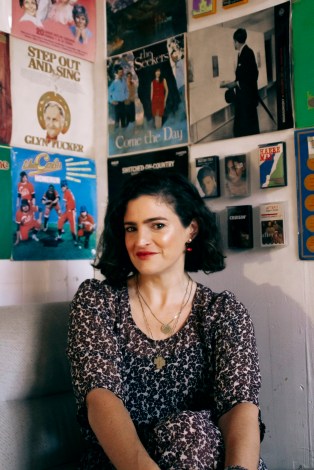
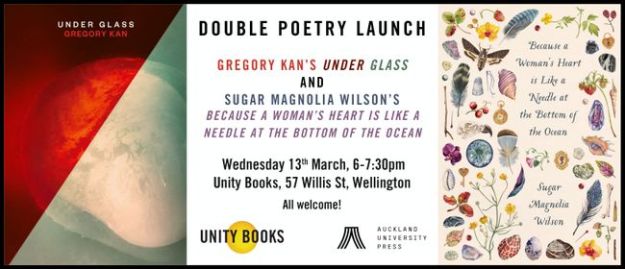
Sugar Magnolia Wilson is from Fern Flat, a valley in the far North. In 2012 she completed her MA in creative writing at the International Institute of Modern Letters at Victoria University of Wellington. Her work has appeared in a number of journals, both in New Zealand and overseas, and she co-founded the journal, Sweet Mammalian, with Morgan Bach and Hannah Mettner. Auckland University Press is launching Magnolia’s debut collection, Because a Woman’s Heart is Like a Needle at the Bottom of the Ocean on March 13th. The new collection is a reading treasure trove as it shifts form and musical key; there are letters, confessions, flights of fancy, time shifts, bright images, surprising arrivals and compelling gaps. Lines stand out, other lines lure you in to hunt for the missing pieces. There is grief, resolve, reflection and terrific movement.
 

Mags book.PNG


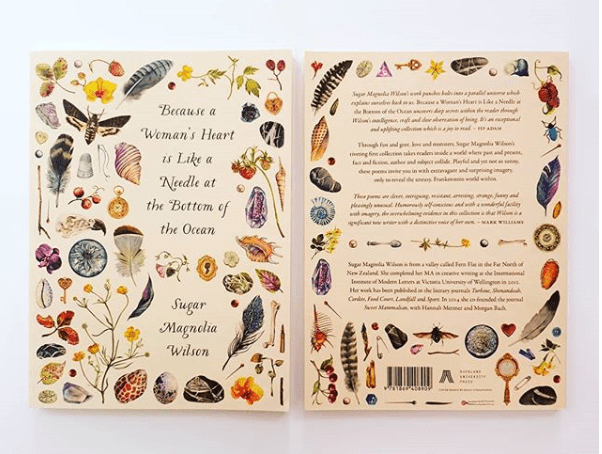
Paula: Tell me about the cover of your book. I just love it. I love the way it is rich in miniature things, a little like your poems are.

Magnolia: Isn’t it totally amazing? When I first received the email from Keely O’Shannessy with several cover design options, I was so blown away by it that I almost couldn’t see it. It was weird, like I was looking at running water in a stream or something and I felt like I might faint. I guess I’d never expected her to ‘get’ my work so completely or so quickly, I was prepared to have to go back and forth to fight for a cover I loved, but that never happened. My friend Kerry Donovan-Brown said it’s like someone took a blood sample from me, put it in a petri dish and looked at it under a microscope, and that the cover is what close up Magnolia Wilson blood looks like! Haha. I wish! Best compliment ever. It’s what my dream blood looks like. I wish my blood was jewellery.

And yes, rich in miniature things. One external review of my book mentioned that I seem to be obsessed with accumulation in my work, and it’s true. Lots of little collections of pins and clips, of food in bowls, jewellery, flowers. I grew up as an only child and I lived a rather sylvan kind of life. I loved to collect bits a pieces and when I was nine Mum, Dad and I travelled around the world (yes, lucky me), and I came home with a giant collection of buttons from different countries. I think it’s an innate desire to hang on to what is beautiful in life, to have proof that beautiful things happened, and is probably tied into grief somehow.


Paula: I first heard you read poems from this book at the National Library Poetry Day celebration and your ‘Dear Sister’ poems – they open the book – blew my socks off. The letter-writing voice drew me in, the sparkling detail, the mood and the mysteriousness. Where did this haunting sequence spring from?

Magnolia: I can kind of trace where they have come from, but like most creative stuff, the true meaning flutters off just before I can pin it down. So, ‘Pen Pal’ was written in 2012, and that’s a letter sequence, and I think that’s where I got the love for the freedom and mystery that epistolary poems allow, and in that same year I wrote a poem called Anne Boleyn, which is also in the book. I started writing the ‘Dear Sister’ sequence with the idea that is was Anne (pre-Henry) writing to her sister, Mary. But, I wasn’t trying to be factually correct I just sort of followed what the letter writer had to say. Slowly it morphed away from being Anne and simply became a woman from another time, struggling with a sense that she was immensely powerful but with no place to express that power. Hence the onset of a kind of ‘madness’ or, more accurately … going full Sybil / turning into a ‘witch’.


Paula: It is such a magnificent way of building a voice in a poem – fierce mixes with doubt, vulnerability, tenderness. This was poetry that I felt. Can you tell me a couple of poetry books that you have felt?

Magnolia: One of the first books of poetry ever gifted to me was Mary Oliver’s collection, American Primitive. My dad set off and travelled around the States after my mother passed away, and he must’ve come across it in his travels and sent it to me with the inscription, Magsie darling, I know you will love this. And I did! It makes me grieve for the majesty of the natural world. I love the way she honours the idea that beauty and love are inseparable from pain and the brutality of nature.

I also love that she is a Christian woman. Usually I would run a mile from a ‘Christian’ poet (probably because I am a bit basic in my thinking and have stereotyped Christians, as though there aren’t a billion different variations on what a Christian can be), but she was Christian in some kind of arcane, pagan way that I love – or that’s what I like to imagine, at least. Also, Mary Reufle’s poetry always makes me feel a lot of hard-to-put-words-to/liminal-space feelings. Her work is a kind of déjà vu. Also, Atsuro Riley’s collection, Romey’s Order, is completely beautiful and was a huge influence for my Pen Pal sequence – the tender, ever so delicate construction-work a child does to build their world.


Paula: Poetry may or may not be something you feel as either reader or writer; it might be a matter of music and mystery, story or ideas. Yet so often a poem knots a complex (scarcely visible) string of effects. Take your poem ‘Home Alone 2 (with you)’, for example. At the core of this poem are multiple loves (a movie, a lover, a mother) and a punch-gut moment. And the after effects last and the questions surface. This is the joy of poetry. You move in and out of self-exposure in the collection. Do you have limits? Is it a form of discovery?


Christmas time and we’ve been out all night.

You’ve been speaking mix of Korean and English,

the way you do when you’re drunk – and

because English is your second language

people can’t be sure if you’re

talking over their heads or if

you’re freestyling your own

kind of poetry.


from ‘Home Alone 2 (with you)’


Magnolia: Interesting. Yes, I definitely have limits. And not purposeful ones for creative constraint etc. They’re the limits of being the specific person that is me with my specific voice and set of issues, trying to write poetry. It’s 100 percent a form of discovery for me, a way of making sense of my world and of growing. I think going back to my interest in accumulation, of objects and imagery, I think maybe it’s a kind of armour.


The lake has a long memory a long

memory, a large imagination.


When my mother left the spring

on our land didn’t change. The water didn’t

stop didn’t stop bubbling up from below.

It didn’t cover itself in a shawl of blackbirds

to indicate grief.


Each litre of water that came up

was different from the next and the next

and each time and each time after that

when I took a drink a drink I became

a deep blue lantern teeming with invisible life.


from ‘The lake has a long memory’


In my poetry I definitely move between self-exposure/vulnerability and then away from it, and I tend to build my poems up and up with imagery like a larva building itself a protective pupa, in order to do its work within, safely. Lol. I think in my poems I build a space where I can work things through, maybe without confronting them directly. And I find that my poems keep on revealing things to me. ‘Muddy Heart’ is an old poem, but only two weeks ago I finally ‘got’ what it was saying. I read it out in an interview and suddenly I was like whoa! That’s what it means! It was so clear and I’d never seen it.

Maybe it’s totally obvious to the reader, I don’t know, but to me I only just got that it was about feeling abandoned by my father after my mum died. I think all creative work is like this, a process of many lives and many mini-deaths, which allow for new life and new understanding in turn.


Muddy heart


You’ll lie down one day on the field behind

your house and your heart will turn

to mud.


Dandelions will push up through the earth, your

blood mingling to a rich beet-coloured soil,

your bones some kind of ash like your father uses

around the strawberry plants.


Clover and pennyroyal will take seed on you.

You’ll call out in the fading light for your father,

who is, after all, just over the fence in the house – but you’ll

sound like the long grass, the frogs, the dogs herding cattle.

When eventually he comes looking for you,

how ever many years later


there will only be the green flush of land down toward

the road, the river and a patch of grass

where he will tend to st from now on.


Paula: It is such a layered sensual poem; I can feel the earth and smell a sharp kick of dandelions just as the image of the father in the fading light who ‘eventually comes looking for you’ is also a sharp heart-kick. And the potent last lines. I adore this poem. The main story might be missing but the feeling is acutely present.

What do you find hard when you write poetry? What gives you pleasure? Does doubt aid or hinder?

Magnolia: I think doubt is something I’m always struggling with in terms of writing. Before I did the IIML masters course, I never really thought much about writing, it was just something that happened to/for me from the age of nine! The IIML course was mostly a blessing and partially a curse. There’s a lot of shit poetry floating round in the world. Honing your editorial eye/ear is key if you want an audience for your work and want to grow as a writer, but, thinking critically about my work pushed me into a place where I felt like nothing was really good enough. I’m only now, seven years on, getting free from that thinking, I am no longer giving fucks.

I am a lyrical, image-laden, nostalgic, confessional poet and that’s totally fine. What I find hard when I write: getting started! I have so, so many failed starts at poems. For every one poem there are maybe 10 or 20 failures. What gives me pleasure: when the creative duende / spirit shows up, and writing just happens in a way that seems outside of my control. It doesn’t happen often but when it does it makes all of the failed attempts worth it.


Paula: Ah yes, I don’t think doubt ever leaves. But that mysterious hard-to-describe poem flow can be such a joy. Have you read any poetry books in the past few years that have given delight? Challenged you? Taken you outside your comfort zone. Given your pure reading uplift?

Magnolia: I’m more likely to love individual poems rather than have entire favourite collections. The poems that’ve struck me in some way or other recently (but aren’t necessarily ‘new’ works) have been: Kiki Petrosino – Witch Wife. Alice Te Punga Somerville – time to write (for Larry), Hannah Mettner, her whole book Fully Clothed and So Forgetful, Emma Barnes – all her poems but especially Ohio. Lynn Jenner – many poems, Rebecca Hawkes – the cave draws u in like a breath, Michael Steven – a sequence of poems he wrote about his son, August. Nina Powles – in the end we are humanlike. Jenny Bornholdt – Flight. Anna Jackson – her whole incredible chapbook, Dear Tombs, Dear Horizon. Faith Wilson – Lynette #1. Cynthia Arrieu-King – her whole book People are Tiny in Paintings of China. Alice Oswald – the whole collection Dart. Morgan Bach – her two new poems in Sport. SO MANY MORE.


Paula: Ok – books for me to track down there. I haven’t read that poem by Nina for a start. Where was it published? I love reading books outside my comfort zone, that are nothing like I will ever write in terms of style, form and content, but I also love those books that refresh my own writing preoccupations. What are key things when you write a poem? Could you narrow it down to three words?

Magnolia: The Nina one was published in The Shanghai Literary Review online.

Three words: really quite random! I don’t know how I write poems. It seems like a bizarre miracle every time it happens, and then I’m convinced I’ll never be able to write another one again.


Paula: I know that feeling – and the way you can pick up an old poem and it reveals new and surprising things to you (as you did with ‘Muddy Heart’). That feels like another miracle. Was there a poem in the collection that just arrived with ease and flow (almost in one sitting) and another that was much harder to form?

Magnolia: ‘The sleep of trees’ was a poem that was just ready and waiting to be written. There had been fragmented, short incarnations of it the year leading up to writing it, but they never worked, and then they all magnetically found their way into that poem, and it was written in about fifteen minutes. And then edited a bit over time.


this is the sleep of mothers – of

five thousand lit candles burning hot in the

dark hall of the body, eyes open

and flaming over the bars of a cot

the sleep of babies – restless turning

a sweet and angry clock

bending in space as it draws earthward, pushing

out and protesting against

                            the constraints

                                the boredoms

                                    the repetitions.

from ‘The sleep of trees’


‘Glamour’ also kind of wrote itself. Harder to write – Newton gully mixtape – trying to capture the feeling of growing up in the 80s and visiting fashionable Aucklanders, the party scene my parents were involved in, but the emptiness of the scene at the same time. Don’t think I nailed it – because of course, it was way more nuanced than that. Lots of love and happiness too.


Paula: Your collection offers poetic pleasure because it has music, space and heart and that makes it both open and fertile. I was flying home from Wellington musing on your book and was drawn to the two-part ‘Conversation with my boyfriend’ where you ‘translate’ your experience together from English into Korean, and from Korean into English, not as language translations but as experience translations. I was thinking then how every poem is a form of translation – so capturing the 80s scene is like a flickery translation. I guess if you think of poetry as translation it becomes something new and intriguing with fragile lines to the original experience-thought-feeling.


You are always full of rice because you eat rice and you love rice and

your skin feels like rice when we hug – our bodies mould together

and we are a bread yin and a rice yang and although traditionally

Korean people don’t eat bread you are more than hungry to have me.


from ‘English into 한글’ in ‘Conversations with my boyfriend’


We should always be filled with rice: cooking it and eating meals

together, and rice is important before we die, too. We hug and your

skin is learning to love rice, or, at least starting to star the healthy

map of rice. Traditionally, Korean people don’t eat bread, but there

are now many patisseries in larger cities, and many children long to

be pastry chefs, and I am not so sure about this.


from ‘한글 into English’ in ‘Conversations with my boyfriend’


I loved the way as I closed the book the two translations merged; yin overlaying yang, yang overlaying yin. Would you ever see a poem as translation or at times as performance/acting out or as walking into discovery (like some poets do) or as an opening of the writing valves into a mysterious process (as you indicated above) that is never the same and simply happens?

Magnolia: Love the fact that they close over one another! Hadn’t even noticed that. I think all of those things are true about poems – they are translation, performance, an act of discovery and totally mysterious. Art is a way to translate human experience and I think life is a constant act of translation, layer upon layer of meaning being filtered through our own specific set of circumstances, beliefs and experiences, that have been filtered through someone else’s before us, and will go through someone else’s after us. That’s why I am not really into black and white dichotomies – left vs right, Labour vs Nats, the right thing to say vs the wrong thing to say, male vs female. Life is way, way too nuanced and strange for such basic framing. Hannah Mettner passed on the most excellent quote about poetry to me, by the poet Robin Robertson and it sums up all my moods: I’ve always thought that writing poetry has very little to do with the intellect. It’s not something one can explain and chat about very easily: certainly not about the making of it. It’s very resistant to explanation. It comes from a place that is occult, in the sense of being hidden. It attends to some of our deepest anxieties and hopes in the same way that dreams do.


Auckland University Press page

Magnolia reads ‘Betty as a Boy’
 

1251989-557485-7.jpg