Category Archives: NZ poetry

Poetry Shelf Friday talk spot: Jeffrey Paparoa Holman and ‘Normal Service’


Normal Service

It feels like months since I’ve come near to anything like writing poetry. Sometimes it just happens like that: there’s a season, not that the well is dry, just that the bucket hasn’t been lowered. The first few months of this year have been taken up with getting myself ready to leave my position at the University of Canterbury, deciding not to re-apply for another three years as an adjunct. Time to go, after nine productive and stable years.

I tell people, “I’m not retiring, just moving offices”, which is true, but it is a major change. Every weekday morning, Jeanette and I have cycled out to the Ilam Campus, stopping off for a coffee most days near Hagley Park. Now, I don’t have to go anywhere, which is different from having nowhere to go, but it will take some getting used to.

What I won’t forget is that in the last two weeks of my tenure, all has been overtaken and devoured by what happened on the afternoon of the fifteenth of March when the whole campus was locked down as a result of what we were first told was, “ a firearms incident at the Al Noor Mosque”. It soon became obvious it was a fatal shooting, there had been many casualties, that some were dead, and as the afternoon wore on, the numbers climbed as the scale of the tragedy was revealed.

So much has happened in this city since that day, on a public stage and in private places, that don’t need any reminders here. The stories, the narratives of grief, shock, anger and even a kind of numbness are all being woven together, in a community that knows disaster, that must now confront terrorism and its aftermath at our very heart – a place of worship.

I had no intention, no inclination, to write anything resembling a poem. It was enough just to try and get my head around what was happening and as well, carry on clearing my desk, saving files, changing email addresses and saying goodbye to good friends on the staff of Canterbury.

Jeanette and I sometimes go for breakfast at Under The Red Verandah, a famous city eatery reborn after the poet and publisher Roger Hickin’s original establishment was wrecked in the earthquakes. While we were there on Thursday morning, my wife asked me if any poetry was there in the wake of what had happened, and I recall saying, no, I couldn’t even contemplate writing a poem.

But as I walked around afterwards, I heard a line, an insistent phrase, quite clearly: “Normal service will not be resumed”. It just sat there. Then another: “There has been a slaying”.  It isn’t often I feel I must obey an instinct as strong as this, but started to write what was really a form of litany, compressing the underlying horror I felt. The poem came in couplets that began with what sounds like a public service announcement, which the next line undermines. At least I hope that is the effect.

I worked on it during the day, and on Friday I took it out to Christchurch Mens’ Prison, Paparua, where every week, three Christchurch poets – Bernadette Hall, Jeni Curtis and I – run a book group in the library overseen by Susan, our wonderful librarian.

There was a security lockdown that day and we had no prisoners turn up. We all sat around and shared our lives, and the poem was read. Susan took a copy for the prison’s monthly library magazine. Whatever it is worth, a silence for me was broken and some of the men in that jail will get to read it, maybe even give a response at a later group.

W. B. Yeats once wrote, “…but all that is personal soon rots; it must be packed in ice or salt”. For Yeats, style, form – made new – was vital in preventing the poet from lapsing into subjective egotism. A disaster like this is not about me, but the victims.


Normal service


mō ngā mate Mahometa e rima tekau i hinga ki Ōtautahi 15 Māehe 2019

Normal service will not be resumed
There has been a slaying

Normal service is impossible
Children executed

Normal service disconnected
Mothers slaughtered

Normal service is terminated
Elders eliminated

Normal service makes no sense
Terror is walking

Normal service is banned for life
Blood on the welcome

Normal service is now shut down
Thank you for weeping


Jeffrey Paparoa Holman
4 April 2019


Jeffrey Paparoa Holman writes poetry, memoir and history. His most recent work is Now When It Rains: a writer’s memoir, published by Steele Roberts (Aotearoa) in 2018.


Rob Stowell, the videographer at Canterbury had recorded this reading of the poemW


Poetry Shelf audio spot: Hinemoana Baker reads ‘Aunties’


Hinemoana reads ‘Aunties’


Hinemoana Baker, of Ngāti Tahu, Ngāti Raukawa, Ngāti Toa and Te Āti Awa along with English and Bavarian heritage, currently lives in Berlin. A poet, musician and playwright, she graduated with an MA in creative writing from Victoria University of Wellington in 2002. She was the 2009 Arts Queensland Poet in Residence, a writer in residence at the University of Iowa International Writing Program (2010), Victoria University Writer in Residence (2014) and held the Creative New Zealand Berlin Writer’s Residency (2015–16). She has published three poetry collections and several CDs of sonic poems.


Poetry Shelf classic poem: Vana Manasiadis picks J. C. Sturm’s ‘The last night at Collingwood’


The last night at Collingwood


No moon and a black sea,

The daytime birds have flown

To their night time places,

The incoming tide creeps


Over Farewell Spit.

Soon waves will wash the rocks

Outside our windows,

Spraying the glass with salt.


Twenty-four hours from now

Birds, land and sea

Will repeat it all again

We’ll be gone by then


Back to that northern

Beach across the Strait

With far fewer sea birds

But Kapiti close at hand.


There we watch the sun go down

Where the Spit lies out of sight,

Believing love, like them

Returns again and again.


J C Sturm  from Postscripts, Steele Roberts, 2000

(posted with kind permission from J C Sturm estate)


From Vana Manasiadis:

Dear Jacquie

Postscripts was the first poetry collection I cared enough about to steal from my sister and stash in a ring-binder. It was the first poetry collection I read and reread until I could say aloud the lines that made me cry. Repeat it all again, Beach across the Strait: I pinned your ‘The last night at Collingwood’ over Arnold’s ‘Dover Beach’ once I got over men with rights and titles; once I was on the other side of the Entitled Man, the White Supremacist man, the Drunken Father-Husband man. Jacquie, there’s been a lot of pain. Jacquie, we really need the sea. Island Bay, Gouves-Crete, Piraeus, Collingwood followed all these peak-and-trough waves meeting; immigrating. So thank you for not bordering up the sea. Thank you for your black sea (our big fish tīpuna), your Farewell Spit-salt-glass sea (our headings off and back), your Kāpiti close at hand (where Alia lives, who healed our sudden schisms, and Nadine and Alex, their mana wāhine seeing).   I believe you Jacquie. I believe that there are shared ways and still ways and noticing ways.  I believe you Jacquie that there’s a clear and certain way to wash the rocks.


Vana Manasiadis has published two collections of poetry, with a third, The Grief Almanac: A Sequel, to be published by Seraph Press in 2019. She co-edited Tātai Whetū: Seven Māori Women Poets in Translation (2018) in the Seraph Press Translation Series, and edited and translated from Greek Ναυάγια/Καταφύγια: Shipwrecks/Shelters: Six Contemporary Greek Poets (Seraph Press, 2016).

J. C. Sturm (Jacqueline Cecilia) (1927–2009), of Taranaki iwi, Parihaka and Whakatōhea descent, was born in Opunake and is thought to be the first Māori woman to graduate with an MA from a New Zealand university (First Class Hons, Philosophy, Victoria University of Wellington). She initially wrote short fiction, and her work was the first by a Māori to appear in an anthology. Her debut poetry collection, Dedications (Steele Roberts, 1996), received an Honour Award at the 1997 Montana New Zealand Book Awards and she published further collections of poetry and short stories. Her poetry appeared in a number of anthologies and journals. Her collection, Postscripts (Steele Roberts, 2000), includes images by her son John Baxter. She received an honorary doctorate from Victoria University of Wellington, worked as a librarian, was married to James K Baxter and had two children.


Te Ara page on J. C. Sturm by Paul Millar

NZ Book Council page


Poetry Shelf Monday Poem: Vanessa Crofskey’s ‘The Capital of My Mother’


The Capital of My Mother


My mother is born in the capital of Malaysia

her own umbilical cord tied to a deflating sun


In her country, the heat is wet

the air is heady

the sweat on my back is hereditary


I know no kin except blood tied to bone

my water body leaks red and diaspora yellow

my eyes are globes


Karl, my brother, is turning seven.

We sit in the muggy backyard of our grandparents

house in Kuala Lumpur


Kuala Lumpur means muddy confluence

The city is born from the place two rivers

merge then flow


I am the point two paths cross just to separate

byproduct of my parents’ relations

divorce impeding

my mother’s birthplace


They say all rivers flow to sea

I cannot find home except the sense

of somewhere I can’t reach

I am a migrant’s remembrance

I am a welcome party.


The kettle is boiling and it is time in slow motion

It is the noise of my grandma learning English

off my five years old cousin


Her R’s are a dysfunctional lawnmower

explaining wet season, sticky rice, banana leaf


Across the phone

in my privileged NZ accent

I talk about burgers, flat whites, fries with aioli.


We don’t speak the same language

but we do share the same ocean

when I say noodles she knows exactly what I mean.


Potluck is God doing dishes

Migration is the earth stirring flavour

Clepsydra is a clock that runs from dripping liquid

Its name means water thief


Across boats, migrants tell time by the second

and we call them thieves for different reasons


The first house I live in is a transported container

stolen body, claimed land, white heartbeat


Decades are tides that rock us to sleep

except landlocked I cannot dream

except I’ve a fear of the open sea

accept that you are dry land

still amniotic

barren

bleeding


I’ve worn ships not shoes since the minute

I was aware of my own unbound feet


Only a daughter’s daughter’s body

arriving to this space every century


The harbour is a welcome mat

for a new placenta


I spit in it

and let the land claim my whole front teeth


Vanessa Crofskey


Vanessa Crofskey is a poet and artist based in Tāmaki Makaurau. She was the Auckland Regional Slam Champion for 2017 and won Best Spoken Word / Storytelling at Auckland Fringe Festival that same year. Vanessa has written for multiple publications including Turbine | Kapohau, The Pantograph Punch, Starling, Hamster Mag, Hainamana, East Lit, SCUM Mag and Dear Journal. She tends to write about water, intimacy and violence.


Poetry Shelf Friday talk: Lynn Davidson on the collectivity of writing poetry


I am excited right now about the collectivity of writing poetry; how poems draw from poems. In 2016, soon after arriving in Edinburgh, I was invited to join a collective of women writers who had come together at the request of the Cooper Gallery in Dundee to respond to their exhibition about a 70s collective art movement called the Feministo Postal Art Event. The Postal Art Event began with two artists – Sally Gollop and Kate Walker. When Sally moved away from South London where she and Kate were neighbours to another part of the UK, both women missed sharing their art so began posting small artworks to each other. Other women artists heard of and picked up this idea and in homes across cities, towns and villages in the UK women made, posted and received art and generated a community of artists. We echoed the Feministo Postal Art Event’s process in a 21st Century way, by writing and responding to each other’s work via a shared Google document.

Our collective is called 12. There are twelve of us, we are Edinburgh-based, and we have continued to write and respond to each other’s poems via a shared Google document for more than two years. We sometimes perform our work, and have been asked to respond to several art exhibitions, most recently to Emma Hart’s Banger at the Fruitmarket Gallery in Edinburgh. We are finding that the poems we write for 12 are a bit different to the poems we write outside of that particular circle of response. Why? I’m not sure, but there’s something about being honest about writing from community. About calling our lone selves in from the hills. The collectivity of making is front and centre; no one is pretending otherwise.

Lynn Davidson


Lynn Davidson is a New Zealand writer living in Edinburgh. Her latest poetry collection Islander is published by Shearsman Books and Victoria University Press (out this month). Lynn teaches creative writing, works in Edinburgh libraries and is a member of 12, a feminist poetry collective.


Poetry Shelf audio spot: Helen Rickerby reads ‘How to live through this’


IMG_20160820_161326.jpg


Helen Rickerby ‘How to live through this’ from How to Live (Auckland University Press, due August 2019)


Helen Rickerby has published four books of poetry, most recently Cinema (Mākaro 2014), and her next one, How to Live, will be published by Auckland University Press in August. She’s interested the elastic boundaries of what poetry can encompass, and has become especially obsessed with what happens when poetry and the essay meet and merge. She lives in Wellington, runs boutique publishing company Seraph Press, and works a day job as an editor.


Poetry Shelf Classic Poem: Bill Nelson picks Hinemoana Baker’s ‘Sound Check’


Sound Check


you sound just like that woman, what’s her name

she sings that one about the train

check one two one two check check

ka tangi te tītī tieke one two


she sings that one about the train

can I get another tui over here

ka tangi te tītī tieke one two

my secret love’s no secret any more


can I get another tui over here

at last my heart’s an open door

my secret love’s no secret any more

that sounds choice love what a voice


at last my heart’s an open door

you got a voice on you alright

that sounds choice love what a voice

you know the crowd’s gunna soak up the highs


you got a voice on you alright

had a bit of a band myself back in the day

you know the crowd’s gunna soak up the highs

i’d up the tops if I was you ay


had a bit of a band myself back in the day

check one two one two check check

i’d up the tops if I was you ay

you sound just like that woman, what’s her name


Hinemoana Baker from mātuhi / needle  (Victoria University Press, 2004)


From Bill Nelson: Sometime in 2009 I heard Hinemoana Baker read ‘Sound Check’ and it has stuck in my mind ever since. I think the reading might even have taken place on a mid-range PA system in a dingy carpeted room, some people laughing in the next room. Although I could be retrofitting that memory and it was in Unity Books or something. Anyway, at the time I noticed the outstanding music in the poem, and then wit and humour, and finally, the way the drama escalated as it continued.

Unusually, the poem is entirely in dialogue. A man is speaking to a woman who is trying to do a soundcheck and sings bits and pieces into a microphone. There’s no other description of the room, or the man, or the woman, or any other sounds. And yet through the poem’s pitch perfect choice of dialogue, the man is conjured up before us. A man we’ve probably all met. A pissed bloke in a pub, who likes to talk shit, knows a little bit about everything, probably from some other generation. He leans with his elbow propped on a tall felt-covered loudspeaker at one side of the stage, a beer in other hand, maybe a cigarette too. By contrast, the woman in the poem is a collection of song fragments and meaningless numbers, and it’s harder to picture her clearly. We know little about her, other than she seems like an incredibly professional musician, with a grasp of te reo Māori and a penchant for love songs.

You don’t have to try very hard to hear the music. It’s a pantoum, so there’s the repetition of course, but also the rhymes are particularly great and bang home like a drum, and there are bits of song lyrics that are italicized like they are meant to be sung. The complexity of the staccato sound check syllables juxtaposed with the rambley-bloke language of the man speaking is also really interesting and ramps up the conflict. Different people and different rhythms, looping in and out and over each other. It’s the kind of poem that is always going to be read out loud.

Pantoums are great at showing how context is important for language, how one line put against another can change it’s meaning entirely, or more accurately, provide two equally true meanings. The poem starts and ends on the same line said by the man, ‘you sound like that woman, what’s her name.’ And what seemed like an innocent enough question at the beginning, a bit idiotic perhaps but friendly enough, becomes patronising and infuriating by the time we get to the end. We cringe as he says it a final time, after a string of condescending comments and feeble compliments. He’s sounding more drunk, unable to remember what he already said two minutes ago, and I imagine him wandering off to the urinal, a poster of the gig that night right in front of his face. And he stands there with one hand propped against the wall, squinting his eyes, still unable to remember her name.


Bill Nelson’s first book of poetry, Memorandum of Understanding, was published by VUP. He is a co-editor at Up Country: A Journal for the NZ Outdoors and his work has appeared in journals, dance performances and on billboards. He is currently living in France. You can find more about him here at billmainlandnelson.com.


Hinemoana Baker  of Ngāti Tahu, Ngāti Raukawa, Ngāti Toa and Te Āti Awa along with English and Bavarian heritage, is a poet, musician and playwright currently living in Berlin. She was the 2009 Arts Queensland Poet in Residence, a writer in residence at the University of Iowa International Writing Programme (2010), Victoria University Writer in Residence (2014) and held the Creative New Zealand Berlin Writer’s Residency (2015–16). She has published three poetry collections and several CDs of sonic poems. Hinemoana’s website.


Poetry Shelf secondary school spot: Mo’ui Niupalavu’s ‘Camp’


Camp


Do you remember how birds

would wait until we woke up

 so they could be feed?

Do you remember

the time you saved me

from falling in the trap we built?


I wish I could carry that smell of burnt twigs

and the mixed smell of leaves and rice

with me forever.

Every night I would lay by the bright,

warm flame that accompanied

the smell of rice pudding.

I remember I would pick

the rough leaves as I daydreamed

about what would happen if we were lost.


If only life could give us another chance to go back.


Mo’ui Niupalavu


Mo’ui’s poem was inspired by Lauris Edmond’s poem ‘Camping‘, picked for the blog by Kate Camp a few weeks ago.


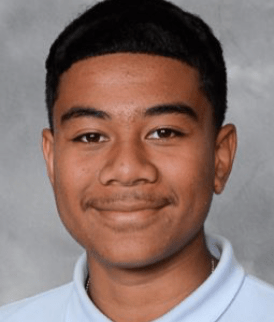
Hello, my name is Mo’ui. I am from St Bernard’s College in Lower Hutt and I am a proud Tongan. I have a brother who is 7 years and a father; my mother passed away when I was 13, I am now 14 years and in Year 10. I love music and English. I want to pursue music when I am older because I love to compose songs and write lyrics.


Screen Shot 2019-04-02 at 9.03.00 AM.png