Category Archives: NZ poetry

Poetry Shelf Monday Poem: Alison Glenny’s ‘Notes on The Nocturne Tradition’


Notes on The Nocturne Tradition

By the end of the decade the song is said to have lost most of its charm. This did not diminish the vogue for delicate compositions, likened to albums of fragrant leaves or to finger bowls in which reveries drifted among the reflections.

A preference for ornament over direction led to a confusion of jewellery boxes. The greatest treasures mingled with trinkets of lesser value, or were lost against the velvet lining.

The expressed aim of the cantilena was to drown the world in night.

The enigmatic nature of beauty is said to have inspired his phrasing of the portamento. At its most lucid moments a slight staccato, almost a stammer, conveyed the vague sensation of a serenade.

The belief that the action of the wrist was a form of respiration gave rise to experiments with breathlessness. Audiences likened the experience to diving into a deep lake, or being smothered in song.

Each charmed moment coaxed a new loop of melody from the shadows. Also her hair, which he compared to a curtain made of silk and embroidered with tiny stars.

Although the modulations were described as ‘tormenting’, this did not diminish the rapture that greeted the appearance of the sub-clause.

She compared the delicate figurations in the left hand to an attempt to conceive of a vaporous machine. Also a pattering of raindrops, or the sound of a bird tapping its beak against a shell.

By wandering into less dominant keys, he hoped to reveal a gender that slipped through minor modulations like water, and had no name.

Likened to a failure of the symbolic code due to an exhaustion of available resources. For example, the disappearance of the object, or the composer burying himself in a large white handkerchief.

Alison Glenny

Alison Glenny’s Antarctic-themed collection of prose poems and fragments, The Farewell Tourist, was published by Otago University Press in 2018. She lives on the Kāpiti Coast.

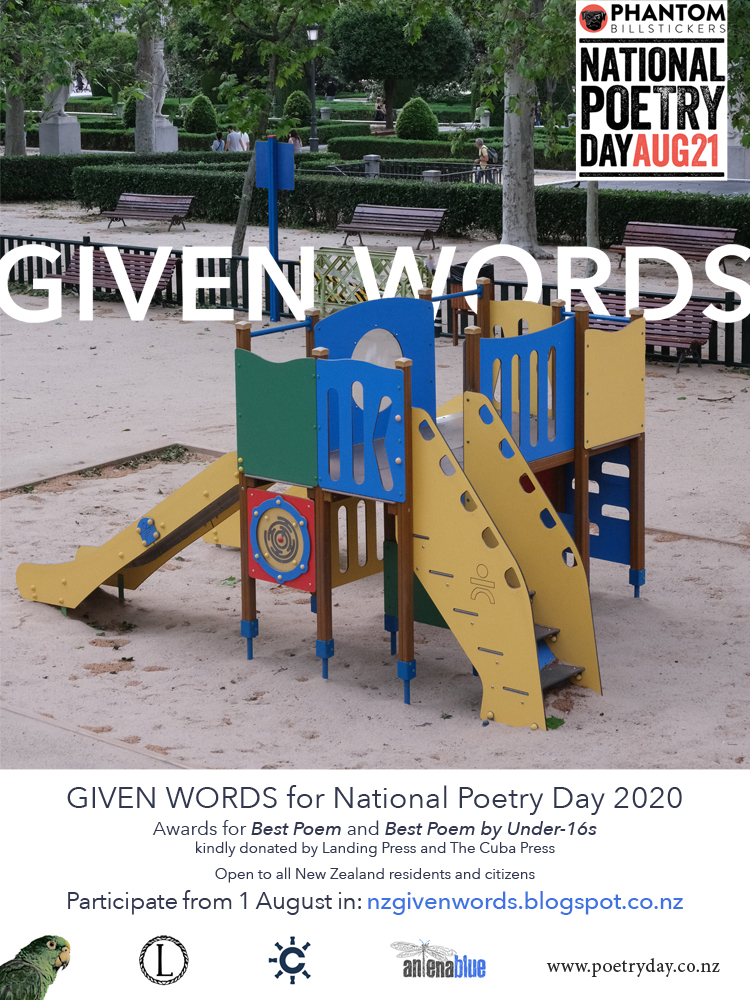
Poetry Shelf noticeboard: Given Poems for National Poetry Day 2020 – the winners

GIVEN WORDS thanks everyone who sent their poem with the five words chosen from Las Moscas (‘Flies’) by the Spanish poet Antonio Machado. They received 144 poems and have made a selection from these to publish here on Given Words. The winning poems have been selected by the poets Mikaela Nyman, Jordan Jace and Charles Olsen. (You can read about them here.)

You can read the judges’ comments here.

GIVEN WORDS is delighted to announce the winning poets. The winner of Best Poem is Stuart Airey for his poem I am a Blue Whale Heart, and the winner of the Under-16 category is Sarah-Kate Simons for her poem Attic. They will receive books courtesy of Landing Press and The Cuba Press respectively as well as being translated into Spanish and published on Palabras Prestadas. More details of the book prizes can be found here. Congratulations from Given Words, Landing Press and The Cuba Press.


Below are the winning poems. You can read the judges’ selection of the rest of the poems from adults here and from under-16s here. All the entries had to contain the words: letter, childhood, fly (the animal), greedy and dream.

I Am a Blue Whale Heart

In this current re-make of me I am becoming the heart of a blue whale
I dreamt myself an angel but this wasn’t enough
He was wondrous but stuck
like a fly in amber

You can hear a whale heartbeat from 2 miles away
which is the distance I want to be from unleavened nurse smiles
and the choice of ensure or tube

No tampering with the drip lines
Friends I am un-distending
I wonder as my zipper finds free air
whether Eve had to eat the whole apple

I liked my angel
counting calories and grams together
his feather vane minutiae

A whale heart aorta is as big as a dinner plate
Why does food have such gravity?

My angel’s face was an open letter
to each whispered treatment
our greedy midnight exercises

A whale heart – blue – is as heavy as a Lion (adult, male)
which is exactly what you need
for beautiful dying

I wish I could take my angel’s place
sleeve my childhood into the wall

When a whale dives deep its heartbeat slows
slows in the black to 2 beats per minute
just 2 beats left to still to marble


Stuart Airey, Hamilton

Attic

all the days of childhood collected in sepia
photographs in the crevices of
the boards watching the greedy dust
descend to settle on their faces

age has curled up their edges into love hearts
like the shape she used to replace the dots on
her i’s; tiny lopsided hearts that flood the pages
of the stack of letters resting in the bottom of
the rickety suitcase, its faded travel stickers

peeling off and flaking away like the nails on fingers
pressed to an anxious mouth and these funny little
dreams of things swirl up like moths from the piles
of outgrown clothing and fill the air with their wing powder
turning the musty scent of forgotten things into a phantom

of lily of the valley; the lid of the harpsichord crammed against
the broken dollhouse is propped open on a sewing box
and in the murk of memories there’s a song tiptoeing up the keys
— or is it just the bluebottle fly scratching its wings
against the windowpane and whining to be set free


Sarah-Kate Simons, age 15, Canterbury

Stuart Airey lives in Hamilton with his wonderful wife and has three children who have mostly left home. He writes poetry as therapy or possibly for more perplexing reasons. He has been a Sarah Broom finalist and was shortlisted for the Julia Darling Memorial Prize. Stuart has been published in the Molotov Cocktail Journal with a short story and third place in the Shadow Poetry Award. These successes have managed to pay for several cups of coffee. He has dabbled in multi-media performance poetry and dreams of being a jazz pianist. His poem entry for given words is an honest attempt to enter the thoughts of those suffering from anorexia as well as being more widely read.

Sarah-Kate Simons is a 15 year old home-schooled girl from rural Canterbury. Her day job consists of schoolwork and volunteering at her local wildlife park, where she gets to walk the llamas. She loves to go on biking and tramping holidays with her family, and tries her hand at all sorts of arts and crafts. She is also the proud owner of a very naughty puppy named Missy.
Sarah-Kate eats, breathes and sleeps writing in all its forms—poetry, flash fiction, short stories and novels. She can often be caught talking to thin air as she tries to figure out time travel for her latest novel or peeking into nooks and crannies in search of her next poem.

A Poetry Shelf gathering: AUP NEW Poets 7 read and talk poetry

AUP New Poets 7: Rhys Feeney, Ria Masae, Claudia Jardine, ed. Anna Jackson

Auckland University Press, 2020

Anna Jackson, editor of AUP New Poets 7, suggests the collection ‘presents three poets whose work is alert to contemporary anxieties, writing at a time when poetry is taking on an increasingly urgent as well as consolatory role role as it is shared on social media, read to friends and followers, and returned to again in print form’.

I agree. Poetry is an open house for us at the moment, a meeting ground, a comfort, a gift, an embrace. But poetry also holds fast to its ability to challenge, to provoke, to unsettle. In the past months I have read the spikiest of poems and have still found poetry solace.

It feels really important to maintain our poetry hubs – to listen to poets as well spend time with the book in hand. So many new books have missed launches. I haven’t been to a poetry reading since the Wellington Writers and Readers Festival. This is partly why I am compelled to create Friday gatherings so we can connect with poets across Aotearoa.

I am the lucky one. Each of these poets emailed me their readings and I felt I was at an intimate private preview. Just me and the poems, and the heart-moving discussions on poetry, poems and the book itself.

I will review this anthology at a later date, but in the meantime, settle back in a comfy spot and take a listen, and the support the poetry world and buy a copy! I love this gathering so much I am walking on air, boosted out of covid flatness into glorious activity.

Thank you so much Ria, Rhys and Claudia for the mahi, the poetry love. Thank you.

The Poets

Ria Masae talks poetry and the book:

Ria reads poems:

Claudia Jardine reads and talks poetry:

Rhys Feeney reads two poems and talks about the book:

The Poets

Rhys Feeney is a high school teacher, volunteer peer support worker and fledgeling doomsday prepper who lives in Te Whanganui-a-Tara. He writes with terrible grammar about things he is scared of. His work can be found in Starling, Sponge, Salty x Foodcourt, and forthcoming in The Spinoff. You can buy his debut chapbook ‘soyboy’ as part of AUP New Poets 7.

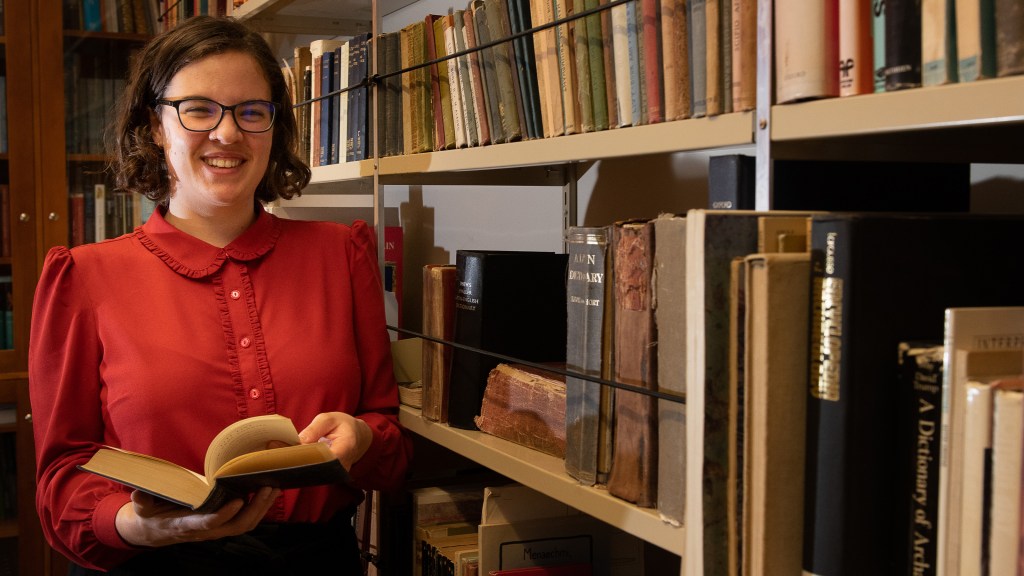
Claudia Jardine (she/her) is a poet and musician based in Te Whanganui-a-Tara. Her most recent publication is AUP New Poets 7 which also contains collections by Ria Masae and Rhys Feeney. In recent months she has completed an MA thesis on intertextuality in Anna Komnene’s Alexiad, and now she is learning to groom dogs. Jardine’s writing can be found in Sport 47, Starling, The Spinoff, Stasis and Landfall 237.

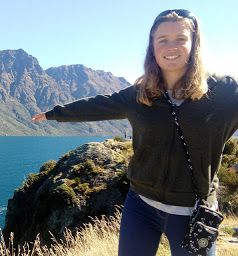
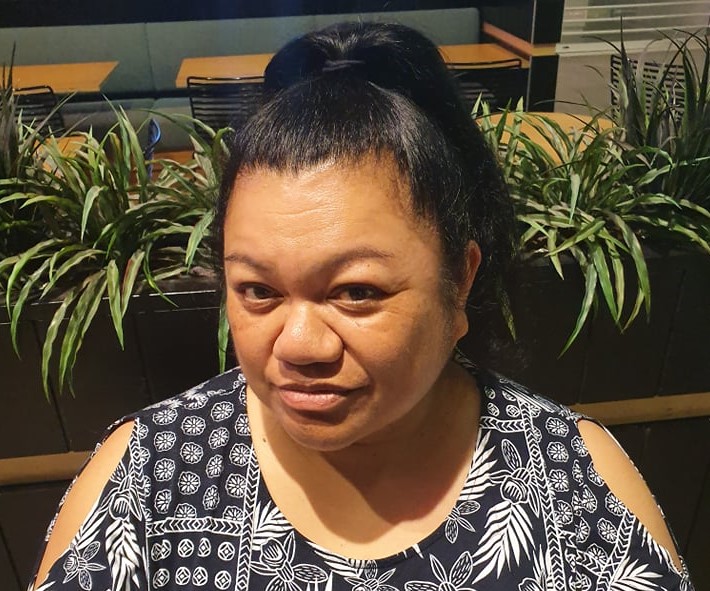
Ria Masae is of Samoan descent, born and raised in Tāmaki Makaurau. She is a writer, poet, and spoken word artist whose work has appeared in various literary publications, as well as a handful of theatre productions. Her family includes an exasperating, but adorable dog who looks like a cow and neighs like a horse. Since her acceptance into the AUP New Poets 7 anthology, Ria has been working on a poetry collection for her first sole anthology.

Auckland University page

Poetry Shelf noticeboard: Warm congratulations to the winner of The National Schools Poetry Award

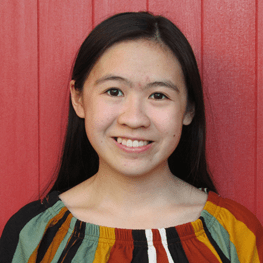
I am so delighted to see that E Wen Wong from Burnside High School in Christchurch has won the National Schools Poetry Award. I have had poetry communications with E Wen since she first began writing poetry as a child, so this is a very good news indeed. Warm congratulations E Wen – may your days continue to shine with poems and poetry.

You can read E Wen’s poem Catalyst in the Monday poem spot.

Aotearoa’s poets of the future feature in National Schools Poetry Awards


E Wen Wong, a Year 13 student from Burnside High School in Christchurch, has won the 2020 International Institute of Modern Letters (IIML) National Schools Poetry Award.

Her poem titled ‘The house that Saturn built,’ was described by judge Airini Beautrais, as “powerful and beautiful”, “full of surprising language and with a strong sense of place and the interaction between the human built environment and the natural environment”.

E Wen Wong receives a prize of $500 and her school library receives a book grant of $500. She also receives a package of literary prizes provided by Read NZ Te Pou Muramura, Victoria University Press, Sport, Landfall and the New Zealand Society of Authors. As part of the prize, Wong will attend an online poetry masterclass with Airini Beautrais, along with nine other poets shortlisted for their entries.

Director of the IIML at Te Herenga Waka—Victoria University of Wellington Professor Damien Wilkins, says, “Over the years this competition has featured many writers who have gone on to publish widely and have careers in the arts. We view it as one way of encouraging young writers and their teachers to see imaginative writing as legitimate, valued, and important.”

E Wen Wong says, “Receiving this award was unexpected, yet exciting and uplifting. ‘The house that Saturn built’ gave me a platform to channel my passion for the environment in a way that was distinctly positioned in Aotearoa. It allowed me to comment on climate change from a new perspective—to communicate what science cannot.”

There were more than 250 entries this year from senior high school students, with a wide range of styles and subjects represented, including personal events, politics, history, humour, and current events such as the COVID-19 pandemic. Ms Beautrais notes, “I’m impressed at anyone being able to write a poem (or anything at all) during the months of lockdown and accompanying stress. There are poems that give vent to big and terrifying feelings, and poems that take a comical slant.”

Nine students were finalists: Campbell Wilson, Abraham Hix, and Marijke Hinton (all from St Andrew’s College, Christchurch); Arwyn Cranston (Wakatipu High School, Queenstown), Isabella Lane (Rangitoto College, Auckland), Xavier Hayward (Marist College, Auckland), Allegra Wilson (Diocesan School for Girls, Auckland), Robin Kunwar (Burnside High, Christchurch), and Victoria Sun (Epsom Girls’ Grammar, Auckland). Each will receive prizes from Read NZ Te Pou Muramura and Sport, as well as $100 cash.

This was also the first year the Award was able to receive entries in te reo Māori. While there were fewer such entries than the IIML had hoped, Māori language judge Anahera Gildea (Ngāti Tokorehe) was excited about the potential of te reo Māori poetry.

The 2020 National Schools Poetry Award is organised by the IIML with the support of Creative New Zealand and advertising agency Ogilvy (formerly Ogilvy & Mather), with sponsorship and promotional support from Wonderlab.

The winning poem, the complete judges’ report and all the shortlisted poems are available on the National Schools Poetry Award website.

Poetry Shelf review: Elizabeth Brooke-Carr’s Wanting to tell you everything

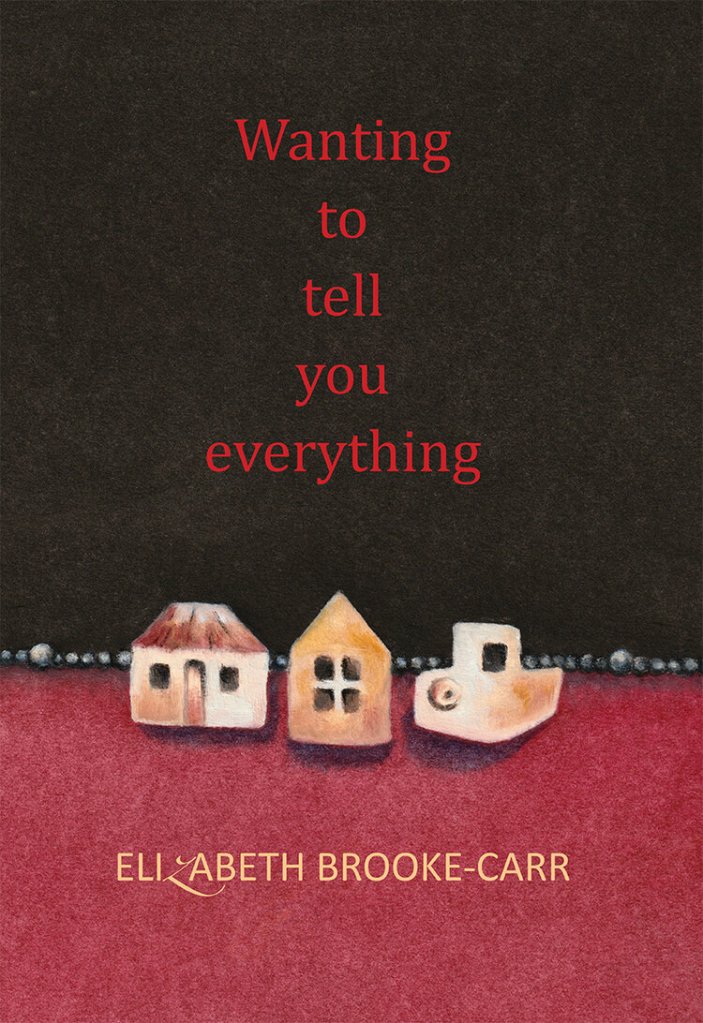
Wanting to tell you everything Elizabeth Brooke-Carr, Caselberg Press, 2020

Upright


Our kitchen table was perfect for a family of four with Protestant

leanings. Solid and square, legs sturdy as posts, set between window

and woodstove, it kept the faith, never moved, wore no adornments

except for a gingham cloth laid before a meal, on the diagonal,


triangles of polished wood showing bare at the corners like our

father’s elbows through the worn wool of his gardening jersey.

Afterwards the cloth was shaken out over the back lawn, and if

unspotted, folded away on the same crease lines for next time,


chairs slid in, chaste, ribs against the unyielding edge so they

scarcely dared breathe. But if you sat there alone at night with your

homework, undisciplined thoughts wandering through your verbs,

there might be a sudden creak, a sly shift in the air around the table,


a loosening of values as chair legs brushed against each other and

laughter scraped the linoleum. And if you shut your eyes you might

hear flakes of gossip peeling off the cracked cream paint, history

you thought forever sealed in grainy wood, being whispered low like


bedtime prayers destined to be heard in heaven; a pair of Edwardian

spindlebacks, gifted from a well-married aunt careful with vowels,

exchanging memories of refinement and silver service in a designated

dining room, a ladderback, in darker patois, telling tales of neglect


in the cellar of a second-hand shop, and the bentwood, rescued

from the tip, singing our father’s praises for the number eight wire

he’d twisted around its legs to keep them from growing crooked,

as sure as God’s grace and the metal brace on my teeth.


Elizabeth Brooke-Carr

Elizabeth Brooke-Carr (1940 – 2019) was a Dunedin poet, essayist, short story writer, teacher, counseller. Her writing appeared in newspapers, online journals and anthologies. She was awarded the New Zealand Society of Authors’ 75th Anniversary Cmpetition and the Dunedin Public Libraries competition Changing Minds: Memories Lost and Found. She received a PhD from the University of Otago.

Elizabeth’s posthumous debut collection has arrived in the world thanks to friends and her writing group,: Maxine Alterio, Claire Beynon, Martha Morseth, Carolyn McCurdie and Jenny Powell. The cover features Claire Beynon’s painting of Elizabeth’s favourite necklace. Mary McCallum provided editorial assistance, Paul McCallum production assistance. The book itself is published by the staunch supporter of poetry, Dunedin’s Caselberg Press. It is so heartwarming to see this group of poets and poetry fans bringing this book, and thus Elizabeth’s poetry, to our attention.

Last year, when I hosted my Wild Honey event in Dunedin, Elizabeth had just passed, and as much as the event was a celebration of women writing poetry in Aotearoa, it was the celebration of a particular woman. It felt both special and fitting. The more we shine the light on women writing, and the women who have written, the more we enrich our poetry communities, as both readers and writers.

The collection’s opening poem ‘Upright’ holds a kitchen table for our close attention. It is the place of family experience, a repository of history and anecdote, celebration and loss. The table is so present I want to reach out and stroke it. Maybe because the details are nostalgic; the gingham cloth set on the diagonal leaves wood patches reminiscent of ‘our / father’s elbows through the worn wool of his gardening jersey’. The table, like family history, is lacework in its prolific gaps. The speaker was once at the table with homework dreaming, and from that moment, I am carried across decades of secret musings that filled the writer holding the pen.

The joy in reading Elizabeth’s poetry is in part the way the poetry gifts you a joy in life: the joy you find in moments from the past, your kin, beloved places, friendship. More than anything her writing ink is fuelled with love. To read these poems, at this particular time, with such uncertainty and global loss, both global and local, is of the greatest comfort.

The poems are light-footed, with honey currents and patches of shade. I am reminded that close friends arranged the collection’s order. They have done a good job; we move from the kitchen-table hub through various scenes and connections to perhaps the last poems she wrote before she died. People and places are paramount: this is poetry that gathers together life, from the speckled past to the endangered present:

We arrived in the future, unpacked, folded the years

away into our own small histories. Now, my family

gone, I look back on the life-stained map


with the rusty pins that marked our meanderings,

my finger trails over mountaintop folds,

into valley creases, tracing the journey home


from ‘A spot on the map’

The movement that shapes the poems is so appealing; it builds mood, presence, absence, surprise. I find myself constantly moved as I read, drawn into the surprising notes that ring out in the endings. Moments are recovered and translated into poetry. I adore these. In ‘Out of the glare’, a couple go for a drive in the countryside and eat at the Wobbly Goat. The ending catches so exquisitely:

Dazzled by a low ray of sunshine on silver,

he slid the spoon sideways out of the glare,

laid it in the curve of hers.

Over the page a poem deposits me in the sensual shimmer of Bannockburn, and again it is the poem’s ending that grips:

At the base of the hill you leap from the stile

arms thrown wide like ropes tossed to my bollard.

Your mouth tastes of sunshine.

Your palms smell of bruised thyme.


from ‘Bannockburn sluicings’

Mood is such a potent ingredient – mood that is subtle and steady in growth. Poems reach towards beloved family and friends who have departed. Like a deep kernel, like an origami bud, this skillful handling of feeling is why I keep reading and why I will read this book again. The poem, ‘Gardening in the rain’, is a way of remembering, of recalling a goodbye kiss to a brow. In the opening lines the speaker is ‘digging deep / for the sound of your voice’, while in the last lines ‘My claggy spade / sticks to the soil’. So much unsaid. So much felt. The image of the claggy soil and the effort to dig so heart-breakingly sharp.

Love is equally significant in poetry that embraces both the economy and richness of everyday life, and why the personal can be so resonant. ‘Poolburn’ is written in old age (‘All the days of our youth are behind us / dust spiralling back along old roads traversed’) and again the couple is driving though beloved southern countryside. It is as though people don’t exist without place, and place is made vibrant and vital through the eyes of those in the scene. This is a love poem. A beautiful, slow pitched, breathtaking love poem. Again the layers, the scent, the texture is resonant. Like a piece of music, like a song perhaps by Nadia Reid or Reb Fountain you want on replay, this is a poem to read at intervals throughout the day. Here is the ending:

When the sun sinks and the light fades

purple shifts among the rocks, wild geese arc

in an amethyst sky, ruby veins line the face

of the lake. You come indoors, sit by the window.

Dusk has gathered you in.

The final section of poems were written from Elizabeth’s death bed. She is writing from terminal illness, nearby death, with her small revelations, her rage and her equilibrium. Perhaps writing is a way of living, of bearing treatment, a changing body, the changing future, a way of sharing what is difficult to decode. The final poem, ‘Wanting to tell you everything’, presents a phone call to a beloved, another moment, larger than life, urgent with feeling, subtle with the unsaid, using a moment of physical beauty (a rainbow stretching across the sky ’embracing everything that soars – light and sound and thistledown’) to summon so much more than the words on the page. The final lines – of the poem, of the book, of a life – unfold and refold, unfold and refold, and poetry is a way of breathing. Necessary. Exquisite. Blood boosting.

Your television in the background talks to itself.

While you turn the volume down, I wait.


Yes, I’m still here. I’m still here and wanting,

wanting to tell you everything.

Elizabeth’s poetry reminds me of the joy of reading Elizabeth Smither, Cilla McQueen, Ruth Dallas, Jenny Bornholdt, Bernadette Hall. I am drawing Elizabeth Brooke-Carr into the house of Wild Honey: she belongs there, with her honeyed currents, her uplifting translation of life into poetry, her wisdoms and her poetic finesse. Poetry can do so much. This book is a gift.

Caselberg page

Poetry Shelf Poets on their poetry: Frankie McMillan reads and discusses ‘Hunting my father’s voice, County Down’

Photo credit: Kenneth Rittener, Getty Images

Frankie McMillan reads ‘Hunting my father’s voice, County Down’

Frankie McMillan is the author of five books, the most recent of which, The Father of Octopus Wrestling and other small fictions was listed by Spinoff as one of the 10 best New Zealand fiction books of 2019. Her previous book, My Mother and the Hungarians and other small fictions was long listed for the NZ Ockham Book Awards, 2017. She was awarded the NZSA Peter and Dianne Beatson Fellowship in 2019. Frankie currently teaches at the Hagley Writers’ Institute in Christchurch.

Poetry Shelf Monday Poem: Michele Leggott’s ‘very fine lace knitting’


very fine lace knitting


this is a picture of my house

wallpaper silvery with birch trees

covering the workbook

the stories and the pictures

red and yellow blue and blue-green

the smiling suns

jack in the box on the window sill

see Sweetie run

the high shelf in the toyshop

I want to be a ship

the umbrella poem

the oak tree and its acorns

the blue eyes that wouldn’t

the bar of chocolate and our mother at a high window

angelic openings in the calendar

circus elephants on the road at Waitara

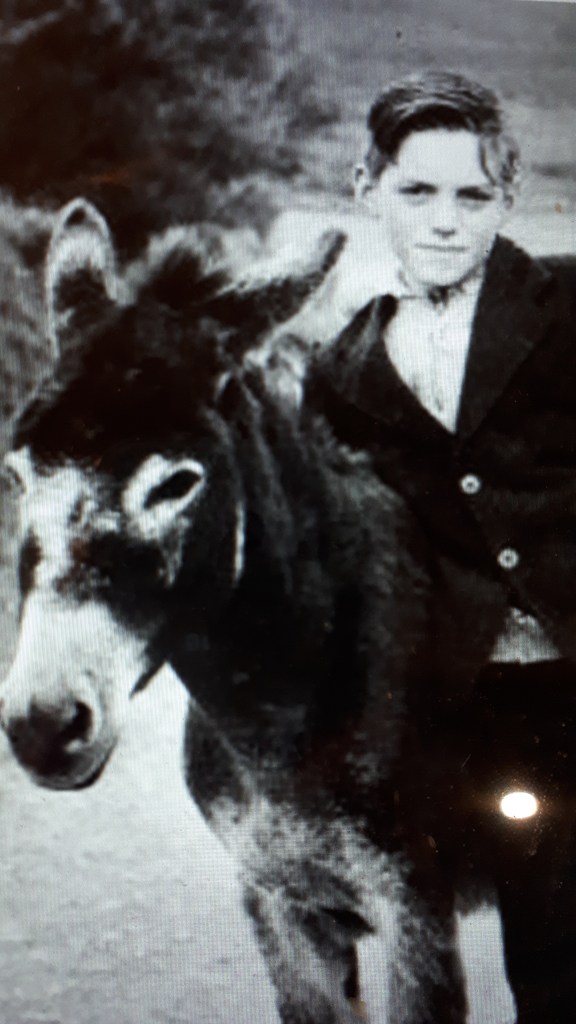
hot black sand and the donkey rides at Ngāmotu


but we came ashore after the others

Mama still pale and no baby sister

though we begged her to tell us

when we might see her again

hush darlings she said

look at the tents and the lovely black sand

we will camp out until there is a house for us

but that house burned down right away

and Papa had no watch

or any instruments to make drawings with

and all of us felt sad

because the ship had gone

perhaps with our baby sister hidden somewhere inside

crying to us but we couldn’t hear

now Papa must cut the Sugar Loaf line

now Mama must tell us a new story

and when the earth shakes and the rats run across our blankets

we will not think of her

our sister outside in the dark

beside the rivers and wells

that wait to drown children less wary than us


when my mother was a girl

she thought all grown men had to go to jail

and feared to find her father one day

among the figures working in the prison gardens across the river

under the watchful eye of Marsland Hill

how did she know

afternoon sun slanting through eucalypts

stream curving or carving the valley that divides

here from there, us from them

now from then

or not at all

how did she know

that her grandfather was locked up

for three months pending trial

for the attempted murder of his wife and child

on the farm at the top of Maude Road

and that she, our great grandmother

would drop the charges, needing him

at home and claiming he would often shoot at her

going down the road, for target practice

he was cautioned against excessive drinking and released

to lose the farm and start over

as a teacher in country schools

how did my mother know

that her father, a young man in a country town

was put in the lock-up for two weeks in the year before the war

for sending indecent literature to the girl who jilted him

two postcards and a photograph

he is named but she is not

in the police report that went to the local paper

he was in the second draft

leaving for Palmerston North

dark hair brown eyes five foot seven

oblique scar on left forearm

August 1914


We were too small to remember

the trouble that took Papa to prison

for losing all his money

were we there too we ask Mama

did you take us did we all live in prison for a while

she will tell us only

that it wasn’t so bad

that everyone helped out and soon

he was home again I cannot now recall

how long we were away

but I was glad enough to leave that place

though I was not in favour of the long voyage

to the other side of the world

and dreaded confinement at sea

Well that is another story

now your father ties off his lines

for the company and remembers Cornish hills

Somerset hills and Devon hills under his pencil

he sees the nature path in the valley of the Huatoki

and knows it will take him to slopes covered in red and white pine

rimu and kahikatea

where a house may be built or brought

on land bought with remittances from England


the small child in the big photo

dark hair dark eyes pixie face

is my mother’s sister

they share a middle name

the child in the photo could be a year old

she is holding onto a stool with baby fingers

her feet are bare and she wears a dress

of soft white wool knitted by my grandmother

in whose bedroom the photo hangs

above the treadle sewing machine we are pumping hard

for the noise it makes up and down up and down

up and down and we are never told to stop or be quiet

we know the child in the photo died long ago

before she had time to become my mother’s sister

but we never ask our grandmother

about the very fine lace knitting

of the photo that hangs in her room


when at last we go looking for

the child who would have been our aunt

the trail is cold the dates stones or tears

Date of death: 20 September 1923

Place of death: Stewart Karitane Home Wanganui

Cause or causes of death: Gastroenteritis 2 1/2 Months, Exhaustion

Age and date of birth: 19 Months, Not Recorded

Place of birth: Stratford

Date of burial or cremation: 21 September 1923

Place of burial or cremation: Kopuatama Cemetery


we see our grandfather thrashing the Dodge

between Stratford and Whanganui

and the journey home with the little daughter

he will bury next day at Kopuatama

was our grandmother there

in the car at the Karitane Home at the graveside

the two and a half months of sickness

the birth of a second child

our Uncle Jack

8 July 1923


up and down up and down up and down

noise to cover a heartbeat under soft white wool


I look upon these letters and do not like to destroy them

they are a house of memory and when I read

I am my mother on deck at last

searching for a ripple on the flat Pacific Ocean

I am my father making delicate waves

around each of the Sugar Loaves on the map going to London

I am my brother in a choir of breakers

that bring his body to the landing place

I am my sister in the boat

outside the orbit of the moon and the orbit of the sun

I am my sister a bell-shaped skirt

between ship and shore

I am my sister painting a rock arch

that became fill for the breakwater

I am my sister exhausted

by travelling and the house to clear

I am my sister writing poems

that lie between the thin pages of letters

I am my sister singing

ship to shore choir of breakers alpine meadow

I am myself on the other side of nowhere

waiting for a knock on the door


my mother is taking a photo

of herself and our baby sister

in the mirror on the wall of silvery grey birches

it’s summer and she has propped the baby

between pillows in the armchair

holds the Box Brownie still

leans over the back of the chair smiling

into the mirror

she and her baby by themselves

reflected in silvery light

not for a moment aware of the child

whose passing long ago

mirrors to the day

the arrival of our sister

whose middle name my mother took

from the light of Clair de Lune


and so the daughter library

remakes itself and is not lost

though great libraries burn and cities fall

always there is someone

making copies or packing boxes

writing on the back of a painting or a photo

always there is someone

awake in the frosty dark

hearing the trains roll through and imagining

lying under the stars at Whakaahurangi

face to the sky on the shoulder of the mountain

between worlds and mirror light


***


Michele Leggott

Michele Leggott was the first New Zealand Poet Laureate 2007–09 under the administration of the National Library. She received the Prime Minister’s Award for Literary Achievement in Poetry in 2013. Her collections include Mirabile Dictu (2009), Heartland (2014), and Vanishing Points (2017), all from Auckland University Press. She cofounded the New Zealand Electronic Poetry Centre (NZEPC) with Brian Flaherty at the University of Auckland where she is Professor of English.

Auckland University Press page

Poetry Shelf review of Mezzaluna

Poetry Shelf Lounge: A National Poetry Day gathering

Kia ora poets and poetry fans

Welcome to the Poetry Shelf gathering on National Poetry Day. One of my favourite Poetry Days was in Wellington when I jumped in a taxi and went from one event to the next: Vic Books, the National Library, Unity Books, the Book Hound, Miaow. Listening to others read, reading a snippet myself or mc-ing, it felt like the best thing in the world (well right up there with early morning beach walks, and cooking meals, writing secret things, reading books for hours on end).

These days it feels good to count blessings because there is so much toxic stuff out there. I feel utterly privileged to get sent loads of poetry books published in Aotearoa, and to celebrate some of them on the blog. So many times this year I have picked up a new book and felt goosebumps as I settled into the poem thickets and clearings. You know the feeling – when the music and the mystery and the freshness, the challenges and the sensualness and the connective currents – make you feel so darn good.

I invited a handful of poets to send me an audio or video to celebrate National Poetry Day – it was over to them what they did: read their own poems, read the poems of others, share a favourite book or poet, muse on poetry. Bernadette Hall drove 30 km to hook up with Doc Drumheller and Rangiora Library staff at the band rotunda to create her video. Amy Brown did two versions, one with interruptions and a wee poem from her son Robin. I posted both for you! Student E Wen Wong recorded a poem by Cilla McQueen.

I have been getting these files as Auckland is in level 3 – and everyone else level 2 – and what a treat to listen to them. Poetry can do so much! The past few months it has been of immense comfort, and the way so many of you say yes to my requests.

As some of you know I had a melt down yesterday as WordPress has put us onto a new system that I find hard to manage yet. My daughter helped me a bit, but I had to make a few compromises, and one poet will make a future appearance. Thank you for the boosts on social media.

Happy National Poetry Day everyone. Dip and delve into this glorious and utterly special poetry gathering.

IMG-8587.JPG

Amy Brown reads two poems of her own: ’16 August 2016′ and ‘Pacing Poem’ from Neon Daze Victoria University Press, 2019. She also reads Airini Beautrais’s ‘Flow’ from Victoria University Press, 2017. Amy sent me two versions, one with interruptions by her son Robin (he does a poem at the end) and one without Robin present. I couldn’t pick as I loved so both, so you get to choose which one to listen to. I think the Robin one is rather special.

Amy Brown reads two poems with the help of Robin

Amy Brown reads the two poems without help

David Eggleton reads ‘The Sound and the Fury’ filmed by Richard C. Wallis in Waikouaiti, North Otago, on Wednesday 19.08.20. Not his tokotoko but a walking stick. Still waiting for the tokotoko ceremony at Matahiwi marae.

Erik Kennedy reads ‘There Is a Man Dancing on the Rudder of an Enormous Cargo Ship’

Bernadette Hall reads two sonnets, one published in Aotearotica and the other in Landfall 239. Her guest Doc Drumheller reads his haiku in Landfall 239. Bernadette had travelled 30 kms to the band rotunda in Rangiora to film this reading with the help of Paula and Daniel from Rangiora Library.

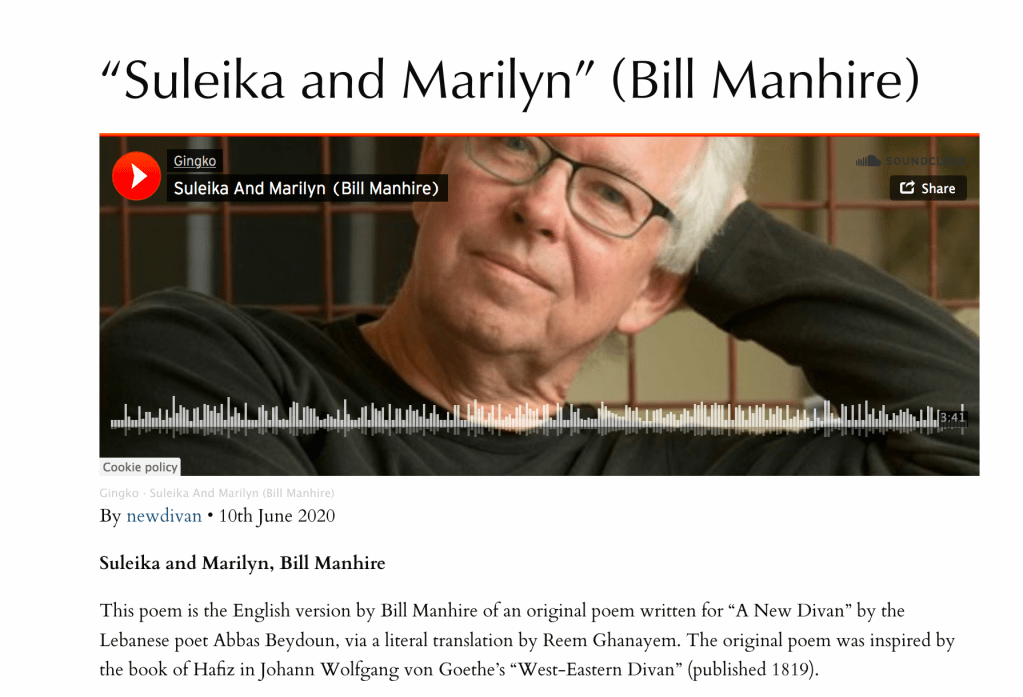
You can listen to Bill read here

You can find texts of the original poem and Bill’s translation here

Emma Neale reads ‘Polemic’ from Tender Machines Otago University Press, 2015

Cart+&+Horse.JPG

You can listen to Marty read here

Marty Smith reads ‘Agnus Dei’ from Horse with Hat, Victoria University Press, 2013

Ruby Solly reads two poems, a very early one and a very new one

Chris Tse reads ‘(Green-Nature)’

Louise Wallace 1.JPG

Louise Wallace reads three poems on a women/mother/daughter theme: by herself, (from Bad Things Victoria University Press, 2017), and by Naomii Seah and Modi Deng (from the latest issue of Starling).

E Wen Wong reads ‘Vegetable Garden Poem iv’ by Cilla McQueen from Axis: Poems and drawings Otago University Press 2001

The Poets

Amy Brown is a New Zealand poet, novelist and teacher, living in Melbourne. In 2012 she completed a PhD in creative writing at the University of Melbourne. She is the author of The Propaganda Poster Girl (VUP, 2008), which was shortlisted at the 2009 New Zealand Book Awards, The Odour of Sanctity (VUP, 2013), a contemporary epic poem, and Neon Daze (VUP, 2019), a verse journal of the first four months of motherhood. She is also the author of Pony Tales, a series of children’s novels.

Doc Drumheller was born in South Carolina and has lived in NZ for more than half his life. He has worked in award-winning groups for theatre and music and has published 10 collections of poetry. His poems have been translated into more than 20 languages. He lives in Oxford, where he edits and publishes the literary journal, Catalyst.

David Eggleton is a Dunedin-based poet and writer. He is the current Aotearoa New Zealand Poet Laureate. His Selected Poems is forthcoming.

Bernadette Hall is Otago born and bred. Following a long career as a high school teacher in Dunedin and Christchurch, she has now lived 17 years in a renovated bach at Amberley Beach in the Hurunui, North Canterbury where she has built up a beautiful garden. Her 12th collection of poetry, Fancy Dancing (VUP), will be launched at the WORD festival in Christchurch in November. ‘It’s as close as I’ll ever get to writing an autobiography,’ she says, laughing. And as for the wilful sonnets that explode in the final pages of this book, she wonders where on earth they came from. ‘It was such fun writing them,’ she says, ‘as if I‘d kicked down the stable doors and taken to the hills.’ In 2015 she collaborated with Robyn Webster on Matakaea, Shag Point, an art /text installation exhibited at the Ashburton ArGallery. In the same year she was awarded the Prime Minister’s Award for outstanding achievement in Poetry. In 2017 she was made a Member of the New Zealand Order of Merit for services to New Zealand literature.

Erik Kennedy is the author of There’s No Place Like the Internet in Springtime (Victoria University Press, 2018), and he is co-editing a book of climate change poetry from Aotearoa New Zealand and the Pacific forthcoming from Auckland University Press in 2021. His poems and criticism have recently been published in places like FENCE, Landfall, Poetry, Poetry Ireland Review, the TLS, and Western Humanities Review. Originally from New Jersey, he lives in Christchurch, New Zealand.

Bill Manhire Aside from publishing his own widely acclaimed poetry, Bill Manhire has edited a number of anthologies and written extensively on New Zealand literature. He was New Zealand’s first Poet Laureate. His most recent collections include Tell Me My Name and Things to Place in a Coffin.  Victoria University Press are publishing his new collection Wow November 2020.

Emma Neale is the author of six novels and six collections of poetry. Her most recent novel, Billy Bird (2016) was short-listed for the Acorn Prize at the Ockham NZ Book Awards and long-listed for the Dublin International Literary Award. Emma has received a number of literary fellowships, residencies and awards, the most recent of which is the Lauris Edmond Memorial Award for 2020. Her first collection of short stories, Party Games, is due out late 2020/early 2021. Emma lives and works in Ōtepoti/Dunedin, and she is the current editor of Landfall, New Zealand’s longest-running literary journal.

Marty Smith’s Horse with hat won the 2014 Jesse Mackay award for Best First Book of Poetry. Some of the book looks at the cost to her father of not talking about the war. ‘Agnus Dei’ is a poem that crosses religion over into war, although it looks like farming. She grew up riding beside her father, hence the horse strand in Horse with hat, hence the book she is writing about the obsession of people who risk their lives to ride racehorses. She would risk her life right now to ride a racehorse, if she were allowed.

Ruby Solly is a Kai Tahu / Waitaha writer and musician from Aotearoa, New Zealand. She has had poetry and creative non-fiction published in Landfall, Sport, Poetry NZ, Starling, Mimicry, Minarets, E-Tangata, The Spinoff, and Pantograph Punch amongst others. Victoria University Press will be publishing her debut book of poetry ‘Tōku Pāpā’ in 2021. Ruby is also a scriptwriter and her film ‘Super Special’ which aims to share knowledge around traditional Māori views and practices around menstruation has been featured in film festivals within New Zealand and the US. As a musician, she has played with artists such as Yo-yo Ma as part of his Bach Project, Trinity Roots, Whirimako Black, Rikki Gooch, and Ariana Tikao. Ruby is a taonga puoro (traditional Māori musical instruments) player and therapist with a first-class master’s in music therapy where she conducted kaupapa Māori research into the use of taonga puoro in acute mental health. As a taonga puoro player and therapist, she is privileged to work around Aotearoa with people from all walks of life sharing the taonga of her ancestors. She will be beginning a PhD to further her research this year. Her first album, ‘Pōneke’, which also features poetry, is available from rubysolly.bandcamp.cpm

Chris Tse is the author of How to be Dead in a Year of Snakes and HE’S SO MASC, both published by Auckland University Press. He is a regular book reviewer on Radio New Zealand and contributor to Capital’s Re-Verse column. He is currently co-editing an anthology of queer writers from Aotearoa.

Louise Wallace is the author of three collections of poetry published by Victoria University Press, most recently Bad Things. She is the founder and editor of Starling, and is currently working on a PhD in Creative Writing at the University of Otago on women, [domestic] paralysis and poetic form.

E Wen Wong is in her final year at Burnside High School, where she is Head Girl for 2020. Last year, her poem Boston Building Blockswon first prize in the Year 12 category of the Poetry New Zealand Student Yearbook Competition.

Poetry Shelf poets on their own poetry: Kiri Piahana-Wong reads and discusses ‘Night Swimming’


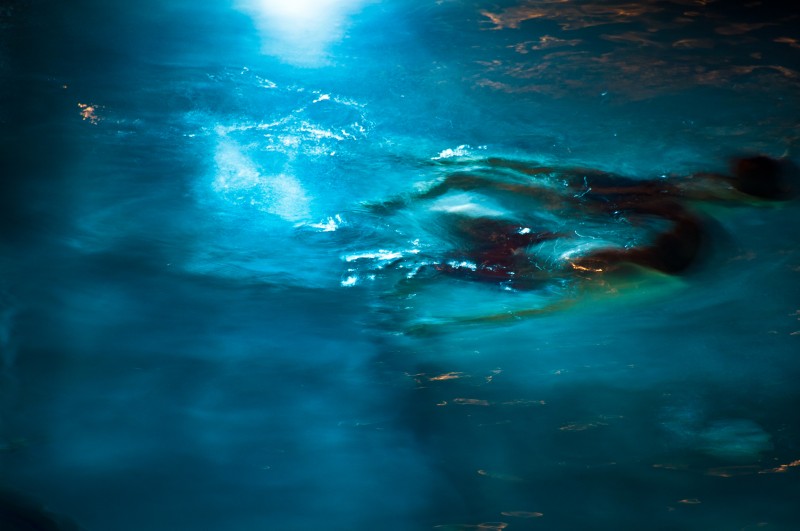
people-in-pool-at-night-802.jpg

Photo credit Cheryl Marland


Kiri Piahana-Wong reads and discusses her poem, ‘NIght Swimming’ from Night Swimming, Anahera Press, 2013


Kiri Piahana-Wong (Ngāti Ranginui) is a poet and editor, and she is the publisher at Anahera Press. Her poetry has appeared in over forty journals and anthologies, most recently in tātai whetū: seven Māori women poets in translation, Solid Air: Australian and New Zealand Spoken Word and Set Me on Fire: A Poem For Every Feeling (Doubleday, UK). Her first poetry collection, Night Swimming, was released in 2013; a second book, Give Me An Ordinary Day (formerly Tidelines), is forthcoming. Kiri lives in Auckland with her family.


Poetry Shelf review: Rata Gordon’s Second Person


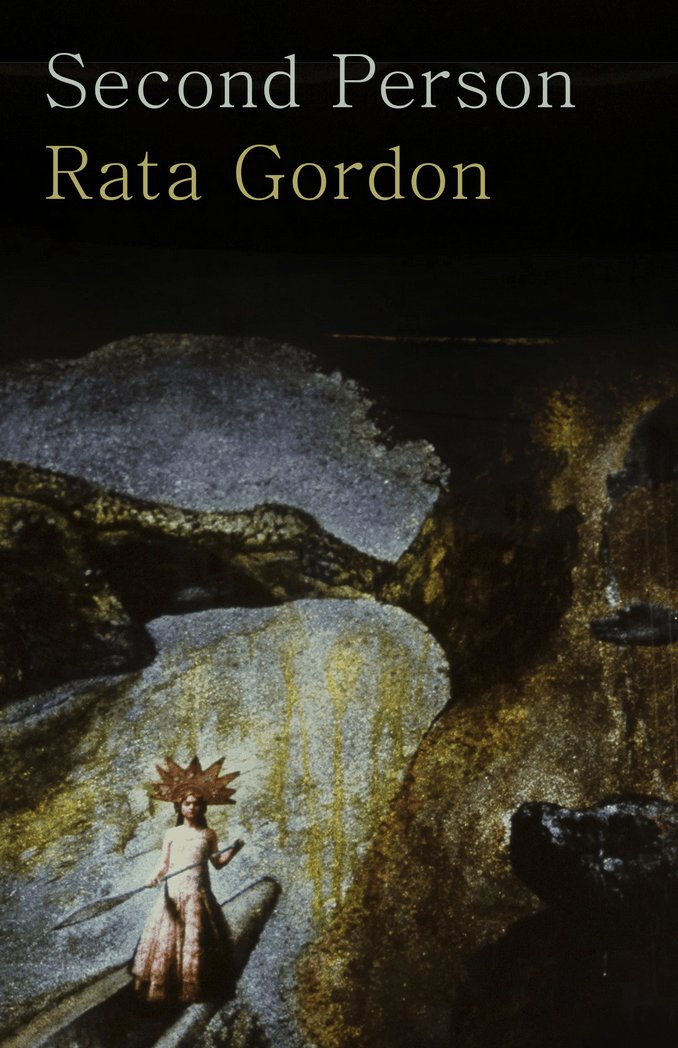
Screen Shot 2020-08-17 at 12.59.25 PM.png


Back in Level Three lockdown, but this time I can read, despite the wide awake nights. Rata Gordon’s debut poetry collection Second Person is mesmerising. It held me in the grip of poetry from first page until last. Yes! I devoured this collection in one sitting and then went back to dawdle on the poems that pulled me back in.

I have been musing on the way poetry can offer the reader a chain reaction of poem joy (among many other things of course). But joy seems like a good thing to imbibe at the moment.

Reading Second Person filled me with poetry joy.

This is a book of birth, babies, death, the universe, love, motherhood, water, sky, wildlife. It is a book that celebrates the present tense, the way we can inhabit the now of being. My first joy is visual as the poems are brocaded with hues and gleams. It is as though an artist has animated poems with their colour palette: ‘I painted sonnets on the wallpaper’. I adore the way a smattering of colour words spike the poems to gorgeous new levels. It fills me with joy.


I’m dressed in yellow leaking

gorse seeds out my pockets like

crumbs I am dressed in white skin

drinking from the spout of a

teapot (…)


from ‘The pregnant pioneer looks over her shoulder’


The second joy is the joy of sound. Many of the lines are short, the rhythm breathy with ample white space at the end of the line. These poems flow like a honey current. Again I am filled me with joy. At times it is the rhythm of walking. At time is is the rhythm of lying on the couch and looking out a wide window and breathing in and out, in and out. You inhale the poem.

As much as there is the physicality and a sensual present, there are also signposts to behind-the-scenes, to what is hinted at but not detailed. A taste from this poem for example:


In Delhi the dust

gets up your nose and into

your veins it swims

through the insides

of your bones


In April you want to hurt

yourself in the hotel room

but you don’t becuase a mango

will make it better


You walk through the streets

in the second person as if

watching yourself from behind

your backpack and your hands

are limp but your heart is

beating


This is all you have

to look forward to

your heartbeat and a

mango

everything else has dissolved:

your family

your intentions


from ‘Mango’


There is an unspoken story signposted here, and it may be real or fictional. It is the mood of the speaker, the state of mind, that holds as you read. The speaker becomes second person, alive, that beating heart, that mango luminous. I am musing on the way, as we write poems, as we insert ourselves above, between, behind and in the lines, we always become second person, whether past present future. I am filled with joy at this thought: the peering into the self inserted into the poem that is close at hand and walking away. Ah.

A third joy is the poetry stitching that shows through at times. Little windows open onto the writing of a poem, its making doesn’t just appear out of thin air, but is something altogether more mysterious, complicated, self-sustaining. I especially love ‘I find slaters’ with its surprising curves and bridges. Here is the middle bit:


I am rifling through this poem

trying to find

its hidden meaning.

If I rifle through fallen leaves

I find slaters.


The leaves are being digested.


How much twiddling do trees do?

Do they doodle on the sky?

Do they do a little spiral?


Second Person is fresh, layered and utterly captivating. Just the ticket  when you want to lie back on the couch and nestle into a welcome and very satisfying poetry retreat. I love this book.


Rata’s poetry has appeared in a number of Aotearoa journals. She works in the arts and mental health.

Her website.

Victoria University Press page.