Category Archives: NZ poetry

Starling goes live at Wellington’s Meow Cafe

Screen shot 2016-02-09 at 12.41.14 PM


STARLING: A new online literary journal publishing poetry and prose by New Zealand writers under 25 years old. Founded by Louise Wallace & co-edited with Francis Cooke.

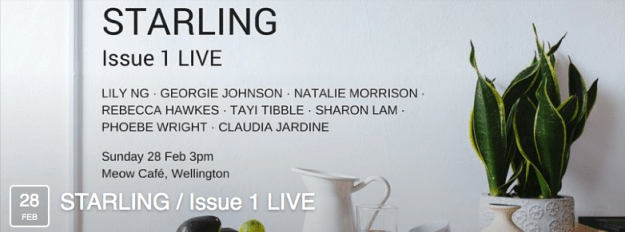
ISSUE 1 LIVE: Eight incredible young writers from our first issue will take to the stage to read their work:

Lily Ng / Georgie Johnson / Natalie Morrison / Rebecca Hawkes / Tayi Tibble / Sharon Lam / Phoebe Wright / Claudia Jardine

Come along to celebrate the arrival of Starling at this relaxed all-ages, free event. Bring your mates or bring your kids! Soak up some inspiration for the afternoon. Meow’s delicious coffee and food available for purchase, as well as beer and wine for those 18 and over if it happens to be one of those stellar sunny days Wellington is famous for.

Atlas is a new NZ medical journal seeking creative writing submissions

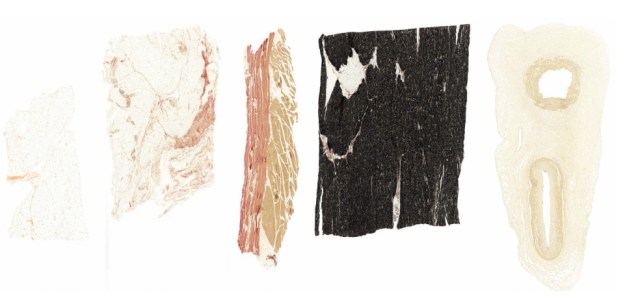
Atlas Journal - Connective Tissue, Verhoeff Stain


Atlas is a recently established medical literary journal, both online and in print, that hopes to encourage thought and open discussion on the ascientific and creative aspects of medicine and the human body.

The journal takes its name from the atlas, the first vertebra in the body. Supporting the skull, the atlas allows the head to nod yes.

We hope that Atlas will become a space to share questions, appreciation and respect for the body’s structure and complexity. We want to recognise that the body exists within a social and cultural context that differs for each individual. We believe that illness and suffering should be interpreted and treated within this context and it is through stories and metaphor that we can connect with these differences.

We hope to publish our first issue in print in mid 2016 and are currently open for submissions.
For our first issue, we are keeping contributions as open and wide-ranging as possible, accepting all forms of poetry, prose, short stories and non-fiction from writers, doctors, patients and artists.

We also want to provide a space for everyday New Zealanders to share their views on the current state of the health system, to provide a voice for those who feel their needs have fallen through the cracks and for those within the system to share their views.

Here are some topics that have been on our mind recently that we’d be interested in your thoughts on:

architecture, housing and health
the sociology of diagnosis
interactions between gender and the physical body
the emotional and philosophical aspects of surgical intervention
the healthcare needs of indigenous people
the meaning/meaninglessness of suffering and pain
Submissions close at 10pm on the 31st of May 2016. For more information please visit  here.

Poetry Shelf: Invitation Interviews – Mary McCallum interviews Jamie Trower

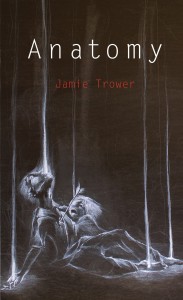
Trower Jamie WEB   Anatomy-front-cover-final-183x300

Mary McCallum of Mākaro Press interviews debut poet Jamie Trower about his collection Anatomy, which they published under their Submarine imprint in 2015.

(for my review of the book see here)


Mary McCallum: As a new poetry publisher we get a lot of emails from people wanting to submit their collections of poetry. Some of those emails are like explosive devices — as soon as you open them you know you’re in danger. All the tiny words on the screen shimmer with the excitement of being written by someone for whom words are not simply tools or exciting ways to evoke the world of experience or imagination, but tiny rockets that have changed or saved a life.

This was the case when I opened an email from Aucklander Jamie Trower – a young man in his early twenties who had only just discovered poetry, but who had nonetheless crafted a whole collection that he wanted me to read. A collection of poems that charted his recovery from a terrible childhood brain injury that could have killed him.

What a ride. It felt to me reading Anatomy for the first time – and I continue to feel this – that Jamie had given himself permission to write how he wanted to write, and discover what he wanted to discover using words in a way that he’d never thought possible. With obvious delight he raged on the page, and laughed at and interrogated it. Words came and he connected them and lit the fuse. Which is not to say Jamie wasn’t open to editing. He was. He loved the whole process … more of a chance to play with words, more connections to fire. We published it, dear reader, and this week I talked to Jamie about the book so close to his heart – how he wrote it and why, and where to now.


M: What made you start to write poetry?
J: In the months of rehab after I sustained a severe brain injury as a nine-year-old, I learned to use a typewriter. I wrote sporadic, jumbled notes of how I was feeling and the changes I noticed in my wheelchair-bound body. I really started writing poetry after taking a creative writing course at the University of Auckland two years ago. It was then that I went back to the notes that I wrote in rehab and found myself expanding and stretching the words into poetry.

M: What do you like about it?
J: The beauty and ease of poetry. How a single moment can be expanded on, heightened, strengthened, transformed, stretched, redefined and moulded in a couple of lines. How a writer can adapt a thought, a feeling or an event so easily through compressed, rhythmic language.

M: Who are your poetry heroes? Are there any poets you try and emulate?
J: I am in awe of Sam Hunt, Paul Muldoon, Ben Okri – the list goes on! I think their writings are compelling and eloquently formed. I draw on their poetry quite a bit – how they use simple thoughts and words to create a big impact.
M: Your poetry collection feels like one long narrative poem about what you went through when you had a brain injury as a child – rather than lots of separate poems – do you see it that way?
J: Anatomy is definitely narrative in its structure: a start, middle and end. I tried to separate the poetic canvas by titling the poems – making it feel like more of a collection rather than a narrative – and pairing it with a traditional form of storytelling. I decided in the editing process to parallel poetry with prose to guide the reader, and to allow the emotion I felt to show through more.
M: In Anatomy you indicate the typewriter was an important tool in your rehab – is poetry also important as a form of therapy in getting over what happened to you?
J: Poetry will always be my rehab, my therapy, my hospital, my home. This use of self-expression and self-examination helped me (and still does) realise that I needed to take control of my own body, my own disability. I hope to continue to use the lessons that poetry has taught me for many years to come.

M: What are you writing now?
J: I’m writing my next poetry collection, and I’m brainstorming a novel on the side. I’m excited to see what comes of it!

M: Who are you reading?
J: Right now I’m reading Michele Leggott’s Heartland (for the tenth time, it feels). She very kindly came to the launch of Anatomy, which was very, very cool.

Mākaro Press page

You are invited to the launch of Gregory Kan’s This Paper Boat

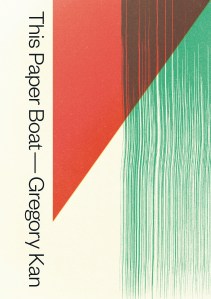
Kan_this-paper-boat   Kan_this-paper-boat

Auckland University Press and Gregory Kan warmly invite you to the launch of

This Paper Boat

6pm, Thursday 25 February
Time Out Bookstore
432 Mount Eden Road
Mount Eden Village
Auckland

My mother used to make up stories in the darkness that no one knew the endings to. It was a kind of permission to have imperfect and beautiful plans.

Please join us in celebrating the publication of Gregory Kan’s debut poetry collection, launched by award-winning poet Michele Leggott.

6pm, Thursday 25 February 2016
Time Out Bookstore
432 Mount Eden Road
Mount Eden Village
Auckland, 1024

RSVP not essential but helpful for catering
Phone 09-373-7528 or email pressmarketing@auckland.ac.nz

Poetry Shelf review: Jamie Trower’s Anatomy – it is poetry as reboot

Anatomy-front-cover-final-183x300   Anatomy-front-cover-final-183x300

Jamie Trower  Anatomy   Mākaro Press 2015


At the age of nine, Jamie Trower suffered a traumatic head injury when skiing on the slopes of Ruapehu. After months in a coma, he spent two years at the Wilson Centre in Auckland. Jamie is currently based in Auckland where he is studying English and Drama at the University of Auckland. Anatomy is his debut poetry collection.

Anatomy rebuilds anatomy. The word ‘disability’ (disabled, disable, disablement) is like a shadow protagonist that Jamie pitches against and from. It felt like a physical presence, an entity to interrogate as Jamie navigates his recovery paths. To read our way into and out of ‘disability’ is to thwart ‘unable’ and latch upon ‘enable.’ It is to follow Jamie from the accident and rocks to his cloud nine.

I felt a little nervous opening the book, as in the middle of my PhD, I smashed into a glass door and suffered the effects of post-concussion syndrome for about a year. Everything was thrown in the air as I struggled to make sense of the world let alone my academic research. My ability to speak and write and c0mprehend (and hang out the washing, cook dinner) was utterly compromised. Once I started reading Anatomy, the twitchiness at revisiting the memory of my vulnerable head faded.

This book is poetry as record, it is poetry as reboot and poetry as rehabilitation. Writing becomes a way of refurbishing self and moving through. You are carried along by the fluency of the line, so lyrically, yet there is the white space of hiccup. Some words are stretched out as though we say them slowly ( d i s a b i l i t y,   t h i n g). Some words drop down the page like a teetering step ladder to cloud nine or back down to earth. The poetic choices heighten the struggle to recover, and to face what recovery means.

This is a poetry collection that moves and elevates you, that records a devastating experience at the most personal of levels, and that plays with what words can do (from the first clacks and clatters on the old typewriter he was given by his teacher). Wonderful!


from ‘( m a y b e ,   t o m o r r o w )’


m i g h t

hybridize

from teenage boy

in

n a p p y      &      pacifier,


to a mighty sea bird –

to a juvenile juggernaut

– dancing

in the wild …


to whistle

in rainbows

of thistles,

(ocean spray) …


Mākaro Press page


Poetry Shelf review: Holly Painter’s Excerpts from a Natural History – This book is a tonic for me as a reader

front-cover     front-cover


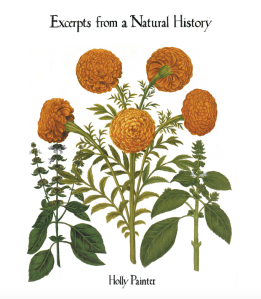
Excerpts from a Natural History Holly Painter  Titus Books  2015


This book is a tonic for me as a reader and a boost in the blood for poetry. I adore it.

John Newton’s endorsement on the back is perfect: ‘Holly Painter is a trickster poet, you never know where she is going next. Sometimes she wants to lick your ear. Over the page she might chew your ear off.’

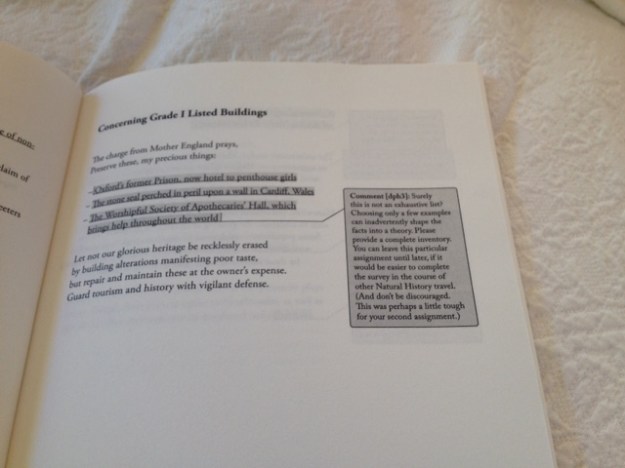
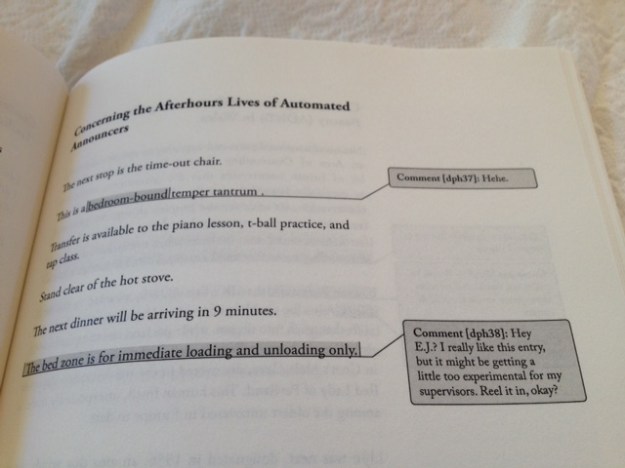
The launch pad for the collection: ‘When the British natural philosophers of the 17th century founded modern natural history, they proposed finding a poet to compile a poetic account of everything that existed in nature, very broadly defined. Four hundred years later, the work is ongoing, made modern and rigorous with rules and style-guides, managers and research-poets.’

The notion of a research-poet sidetracked me into other poet roles that have existed or might exist: speculative-poet, domestic-poet, Sunday-poet, global-village-poet, experience-poet, travel-poet, theory-poet, heart-poet.

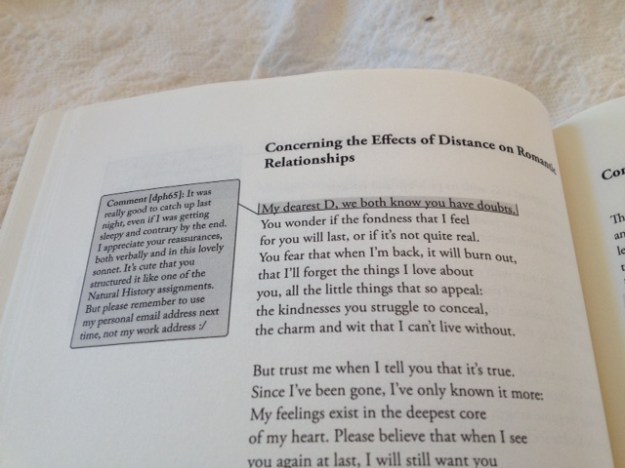
The collection is made up of the submissions of a researcher-poet but made infinitely more interesting by the tracked comments of her supervisor and the myriad ideas and relations that proliferate.

The poet-researcher is set assignments that demand inventories and lists of things that include the natural world (regenerating starfish, the kakapo) but veer wildly into a material world (buttons for sale, ‘Tubular Bells’) and curious things between (flower motifs for teenage courtship).

The supervisor demands the voice of reason, clarity, facts, comprehensive lists, specificity, neutrality and rebuffs anecdotes, adverbs, poetic licence, personal confession.

Sometimes the submissions are laugh out loud as in the light of the recovery work of ‘Tubular Bells’ or the counting of buttons (how long did it take?).

The tracking comments form editorial advice but also trace the relationship between supervisor and researcher-poet(this label keeps slipping in my hands!). The reaction of the supervisor to relations beyond editorial choices is explicit in the tracked comments; the reaction of the latter is buried in the poetry submissions. Love hijacks the cool calculation of inventories. The very guts of ‘natural history’ and what that might embody is reinvented.

Holly employs a range of styles, tones, rhymes, layouts, silences, musicalities as though the heart cannot be penned (excuse the pun!) within a style-guide. The collection is dexterous on its tip toes as it gets you thinking about categories and categorisations, hierarchies and dichotomies, and the way love cannot resist (avoid) anecdote, confession, adverbs.

The book is beautiful. The paper gorgeous to the hand, while the cover’s marigolds almost fill the room with a nostalgic scent.

I highly recommend this book.

Holly is an MFA graduate from the University of Canterbury. Her poetry has been included in Sport, Landfall, the NZ Listener and JAAM. She lives in Singapore with her wife and son.

Titus Books here

Holly Painter’s web site
IMG_3035


IMG_3033


IMG_3034


Poetry Highlights at Wellington’s Writer’s Week in March

For the full programme see here but this is the poetry on offer.


I would love to go to the Laureate Circle but can’t make it at this stage (might just fly down on a whim!). I would really like to post pieces on any of the poetry events at the festival. Any takers?


Friday March 11th 7pm  A Circle of Laureates

Screen shot 2016-01-30 at 9.48.49 AM


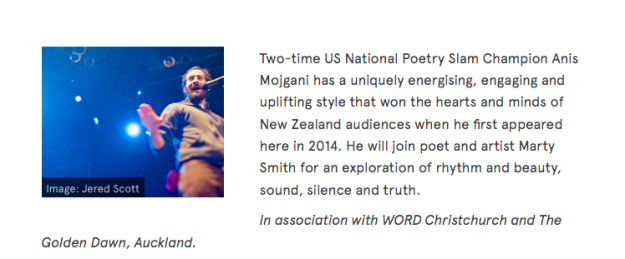
Friday March 11th 5pm   Anis Mojgani and Marty Smith

Screen shot 2016-01-30 at 9.55.17 AM


Thursday March 10th 1.45pm Anis Mojgani

Screen shot 2016-01-30 at 9.57.28 AM


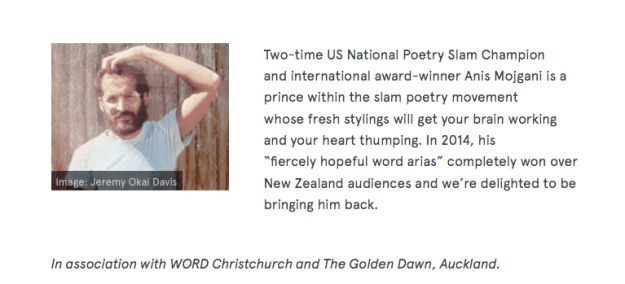
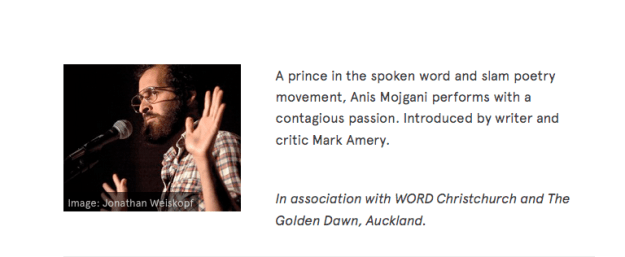
Sunday 13th March 2.30 pm  Anis Mojgani with Mark Amery

Screen shot 2016-01-30 at 9.59.20 AM


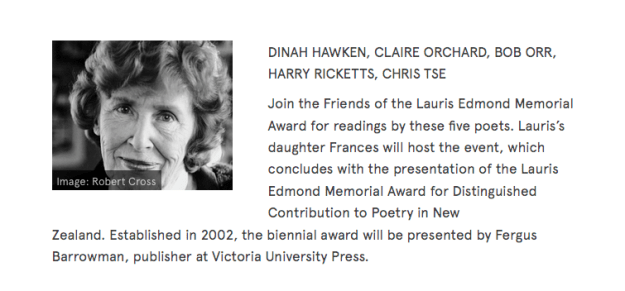
Saturday 12th March 3.30 pm Five Poets and a Prize


Screen shot 2016-01-30 at 10.00.52 AM

Tastes of Ika 3 – Ika 4, a few days left for submissions

IMG_3027


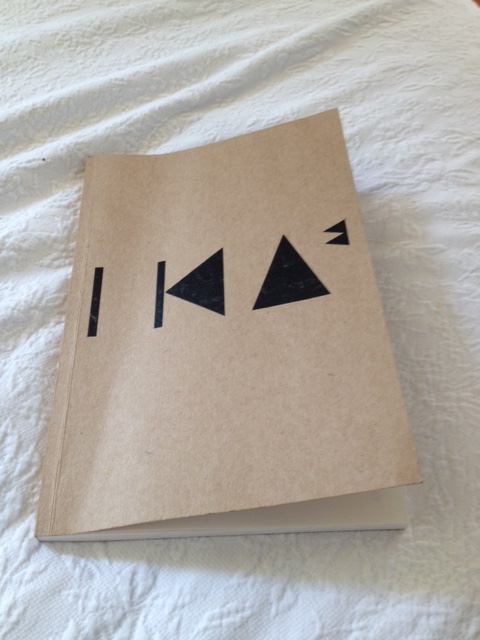
Ika 3 looks cool. It is the literature and arts journal from Manukau Institute of Technology and is edited by Anne Kennedy. Anne is a poet and novelist and she is about to head to Victoria University where she will be the 2016 Writer in Residence.

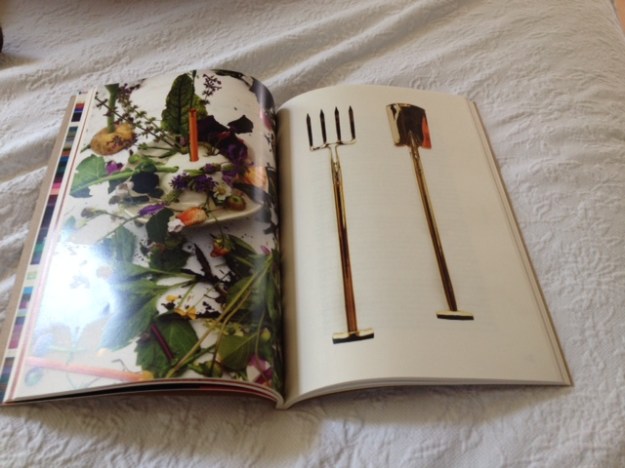
The internal design is fresh. The issue looks like it is wrapped in brown paper. It feels slightly rough to the hand. It features prose, poetry and art from students and staff, and stretches out to include work by well known writers from both here and overseas.

The mix is eclectic. There are appealing grades/gradients of lyricism and subject matter, but what makes this issue pop out from others is the political elbow that juts out, the raw angles, the Pacific Island presence. Compared with this journal, others seemed saturated in white. To have such diverse reading lines in to brown skinned voices makes this newish journal a vital presence within our writing/reading options.

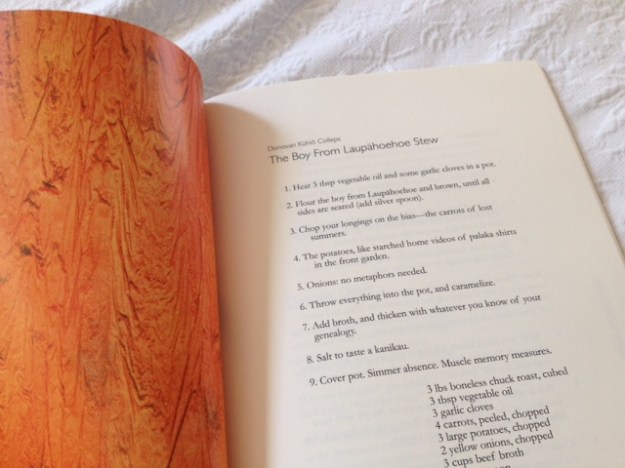
A bundle of poets made me snap to attention. I love the playfulness of Tusiata Avia’s ‘We are the diaspora of us all’ where play becomes play with a potent bite. I love the way Chris Tse’s ‘This house’ is inventive, detail rich, personal, kinetic and catches both heart and mind. Faith Wilson’s ‘Echo (bootleg remix)’ is a poem bisected in two and the interplay of dual voices is sharp, hard, heart hitting. You need to read again to find different paths. Donovan Kūhiō Colleps wraps place and moment so acutely in ‘Muscular Dreams,’ and I love the way lines coil and repeat. J A Vili’s ‘Mother’s Rope’ is spare, just a handful of words on the page, but it is the white hot core of the issue. Sophie Van Waarden’s ‘Water Girl’ confirms that this young poet writes with linguistic grace, verve and surprise and is an emerging poet to watch.

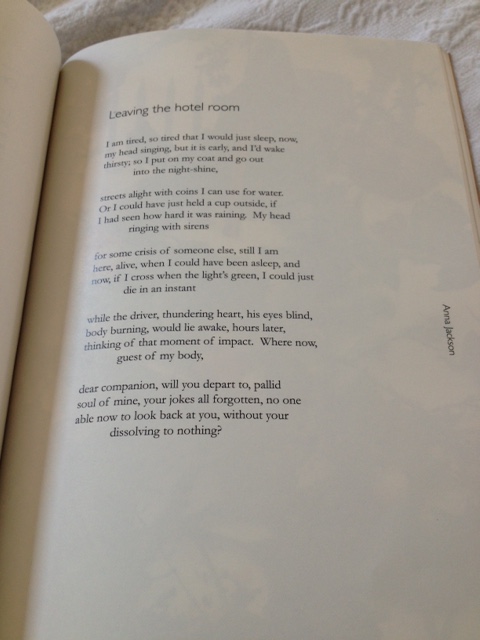
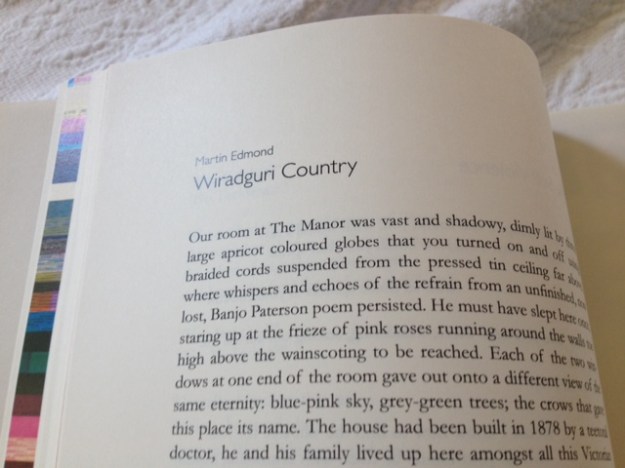
There is much more. See some treats below in the photos, including Anna Jackson’s surprising ‘Leaving the hotel room.’ This journal is worth a subscription! The art is mind catching as well as eye-catching. Again I come back to the words fresh and vital.


Work is about to start on the next issue. Submissions for Ika 4 are due by February 1st.

Submit here.

Submission details:

We invite submissions across Moananui for Ika 4 from emerging to established practitioners in the fields of writing (poetry, prose fiction, non-fiction), performance, and visual art.

Ika 4 will be published in print and accompanied by a website for moving image and performance, to be launched as part of the Auckland Writers Festival in May 2016.

Electronic documents are preferred, but printouts together with a self-addressed envelope may be mailed to: Ika Journal, Faculty of Creative Arts, Manukau Institute of Technology, Private Bag, 9400, South Auckland Mail Centre 224, New Zealand.

Video works must be in the form of mp4 files and can be submitted via private Vimeo / Youtube links.

The submission limits are: eight poems, eight images, three video/performances, 7,000 words of prose.

Inquiries to: ikajournal@gmail.com

Editor: Anne Kennedy
Arts Editor: Richard Orjis

IMG_3028

IMG_3029

IMG_3032

IMG_3030

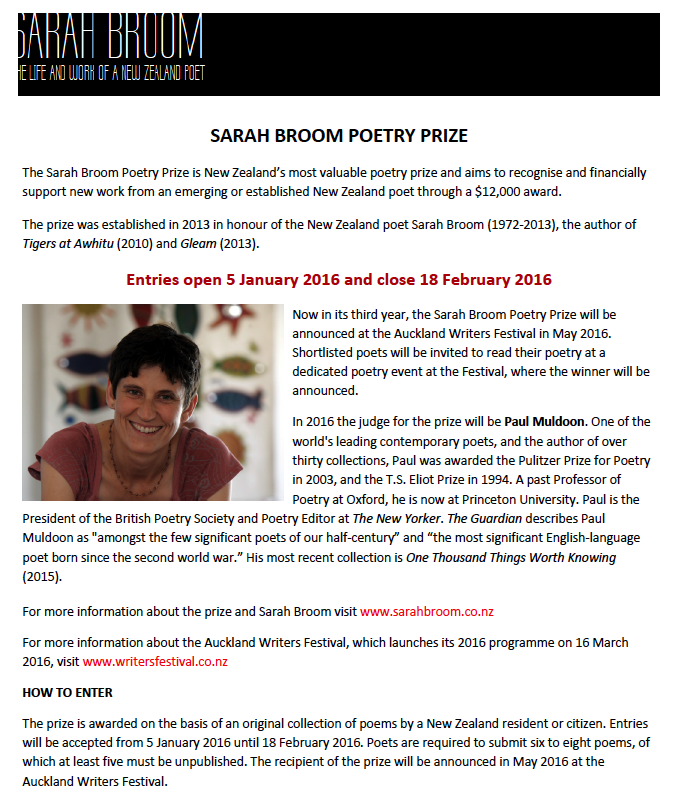
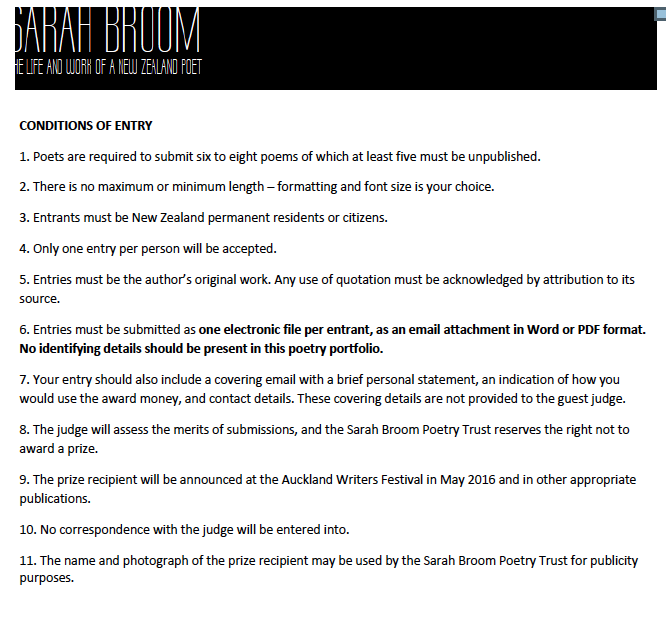
Sarah Broom Poetry Award now open for entries – and an announcement of exciting new judge!


This exciting news! Bravo for keeping this vital competition up and running. Let’s hope entries come from far and wide.


Screen shot 2016-01-05 at 2.36.54 PM

Entries should be emailed to poetryprize@sarahbroom.co.nz
Any queries should be emailed to enquiries@sarahbroom.co.nz


Screen shot 2016-01-05 at 2.38.50 PM