Category Archives: NZ poems

Poetry Shelf The Summer Season: Poets pick poems: Jeffrey Paparoa Holman picks James K Baxter


The Communist Speaks

Do not imagine I could not have lived

For wine, love or poetry,

Like the rich in their high houses

Walking on terraces above the sea.


But my heart was caught in a net

Woven out of strands of iron

By the bleak one, the thin one, the basket-ribbed

Coolie and rickshaw boy


Who has not learnt the songs that ladies like,

Whose drink is rusty water,

Whose cheek must rest on a dirty stone,

In whose hands lie the cities of the future.


©James K Baxter Runes Oxford University Press, 1973.

(Poem copyright the estate of James K. Baxter, used with permission.)


When Paula invited me to contribute my thoughts for her Summer Season: Poets on Poems, I knew pretty quickly it would be something from James K. Baxter. He was a huge influence on me in the early 70s and I leaned on what I learned from him for years. A year after he died, in 1973, Oxford University Press published his last collection Runes and I got to know my copy pretty well. Of course, I also had Jerusalem Sonnets, Autumn Testament, Jerusalem Daybook and Ode to Auckland, all read and re-read intensively – but somehow, the poems in Runes got under my skin.

Baxter could make personal vatic utterances in the middle of a poem that stuck with you, his philosophical bent dropping them into a flowing sequence about his father, or his daughter, or a night in some bush hut up the tops. These late poems were all pre-Jerusalem, before abandoning his family and suburbia, heading to Jerusalem; they were all South Island poems, too.

The one I thought I wanted to write about was the book’s last, ‘Letter From The Mountain’, closed off by the unforgettable line, “My door has forgotten how to shut”. It seems now a precursor poem to the Franciscan poverty verse of his Wanganui River sojourn amongst Ngā Mokai, The Fatherless. It still carried echoes; now curious, I went back and read the whole book. It was like visiting an old town where I’d grown up, or time travelling into a world that has disappeared, and my self, being long since changed, unable to quite belong.

Then I came to ‘The Communist Speaks’, a poem that also had haunted me, harking back to the time he spent in India with his family on a UNESCO Grant in 1959. Jacqui Sturm has since spoken on record about how this experience upended a man already on the margins; how the extreme poverty of those he saw unhinged his sense of who he was, and led ultimately to his rejection of the middle-class Kiwi lifestyle he’d always been wary of and critical towards.

It’s a simple, declarative poem of three short stanzas, more of a song, an incantation than any of the others in the collection, standing in bleak relief to the libidinous salvos that open the book: the love, lust and losing poems of Words To Lay A Strong Ghost. Who could forget the image of Egnatius (a nom de plume), “…the ugliest South Island con man…who cleans his teeth with AJAX” (The Party).

In ‘The Communist Speaks’, however, Baxter was laying out a road map for his own future, whether or not he quite knew it at the time – as well a laying down a wero, a challenge to us, his inheritors. This is a poem about inequality, about desperate poverty, of “the basket-ribbed/Coolie and the rickshaw boy/…/In whose hands lie the cities of the future”.

It is a poem that speaks to me afresh in a country where families sleep in cars and investors buy the houses beyond the reach of the poor who cannot afford them, then make a living off these less fortunate backs through charging high rents, taking money for food and other necessities off the table of the tenants – and their children. This is South Auckland today: Baxter may be dead but in a poem like this, he lives on.

Jeffery Paparoa Holman


Jeffrey Paparoa Holman has worked as a sheep shearer, psychiatric social worker, postman and bookseller. He is now a senior adjunct fellow in the University of Canterbury. He has published memoir, non-fiction and several collections of poetry. In 2014-15, he studied in Berlin on a Goethe-Institut scholarship, researching a family history project. His next collection, Blood Ties: New and Selected Poems 1963-2016 (Canterbury University Press) is due in February. Dylan Junkie, fanboy poems for His Bobness (Mākaro Press, Hoopla series) will appear in April.
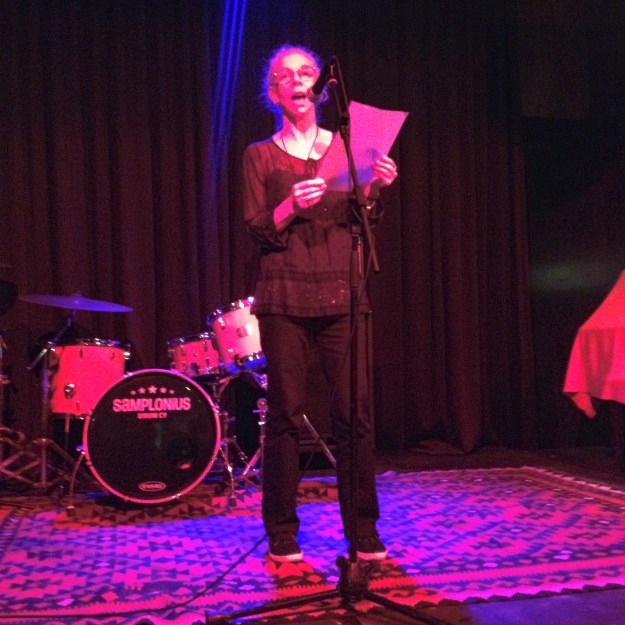
Poetry Live Kicks off 2017 with Anne Kennedy (report from Carolyn Cossey)

AnneKennedy.jpg

Photo credit: MW Sellwood


You know that the year is settling into its groove when Tuesday nights are again occupied with a trip to the Thirsty Dog for Poetry Live. The first session for the year was held on the 7th of February,  with Anne Kennedy as the featured poet.

Anne has recently returned to Auckland from her year as Writer in Residence at Victoria University, to resume her teaching position at Manukau Institute of Technology’s creative writing programme.

Anne’s poems through the night were in turn political, and personal, and always wrapped in her wry humour. Her stage presence was somehow ethereal, and compelling. (Okay, I know, I’m fan-girling, but it really was that good!) She began by dedicating her first poem to the group of Indian students currently facing deportation from New Zealand due to their association with immigration fraud. She touched on Trumpism and its seed stock from observations during her Hawaiian years, with her sonnets.


‘That thing
on the rim of the glass is the sun going down
on America.’


There were familiar favourites, such as ‘Island Bay has a new sea wall’, but we were also privileged  with new material; Anne read from a series ‘Transformations’, based on a poem by her late brother. Her final poem was by fellow MIT lecturer Tusiata Avia, published in Ika 3, ‘We are the diasporas of all of us’.

The scene was set for the evening by the raw blues of MW Sellwood. Finally, the Poetry Live team announced the appointment of Sophie Proctor, to fill the vacant MC spot.


Carolyn Cossey

Poetry Shelf The Summer Season: Selina Tusitala Marsh picks Tusiata Avia


This is a photo of my house


It has pink bricks and a big tree. This is the driveway, you can lie on it in the summer, it keeps you warm if you are wet. This is the screen door, swallow. Front green door, hold your chest. The carpet is dark grey and hurts your knees, it doesn’t show any blood. Here are the walls, be careful of the small girl in the corner. Here is the door into the hall, be careful of that too. Here is the line where the carpet stops and the kitchen starts, that is a different country—if you are in the kitchen you are safe, if you are in the lounge on your knees you are not. Watch out for the corners. She isn’t going anywhere. There is the piano. There is the ghost. Here is the hall, it is very dark. Here is the bedroom. Here is the other bedroom, babies come from there. Here is the last bedroom, it is very cold, there is a trapdoor in the wardrobe, it goes down under the floor and you can hide if there is a flood or a tornado. There is the bath. The aunty punched the uncle in the face till he bled, they lived in the small room, the cold one, that was before I was born. Here is the lounge again, here is the phone: ringthepoliceringthepolice. Here is the couch, it is brown, watch out for the man, he is dangerous. Here is the beginning of the lino in the kitchen again, here is the woman. Watch out for the girl in the corner, she is always here. There is the woman, she just watches and then she forgets.

I am cutting a big hole in the roof. Look down through the roof, there is the top of the man, you can’t see his face, but see his arm, see it moving fast.

I am removing the outside wall of the bedroom. Look inside, there are the Spirits, that’s where they live.

Stand outside in the dark and watch the rays come out through the holes—those are the people’s feelings.


©Tusiata Avia,  Fale Aitu | Spirit House, Victoria University Press, 2016.


This is not a favorite poem.  It is not kind or gentle on the ears, eyes or heart.  But it is unforgettable.  Its quiet violence, the way it creates in-breaths of silent horror through concrete objects, the materiality of the powerful against the powerless in domestic spaces, the neutrality of nothing, imbalances me.  The manner of this poem reflects the nature of domestic violence – that all is seemingly known and visible, like a normal brick house on a normal street, and yet, inside the walls thrive secret spirits inhabiting the dark corners of our lives.  The voice in the poem remembers and pries open these walls, as one would do with a doll’s house.  She stands back and notices the pinprick light escaping through the openings she’s made.  This is how she begins to exorcise secret pain.  This is how memory might work.

Selina Tusitala Marsh


Selina Tusitala Marsh is Associate Professor of English and Pacific Literature at the University of Auckland. She is of Samoan, Tuvaluan, English, Scottish and French descent. Her first collection of poems, Fast Talking PI (Auckland University Press, 2009) won the 2010 NZSA Jessie Mackay Best First Book Award for Poetry. Selina was the Commonwealth Poet for 2016 and performed her poem, ‘Unity,’ for the Queen at Westminster Abbey. She was made Honorary Literary Fellow in the New Zealand Society of Authors’ annual Waitangi Day Honours, 2017.

Tusiata’s collection is longlisted for The Ockham New Zealand Book Awards.


Poetry Shelf The Summer Season: Poets pick poems – Airini Beautrais picks Gregory O’Brien


The clod of earth speaks


2004


I have come to Waitangi,

Said the leader of the opposition.

But I have always been here,

Said a clod of earth scooped from the ground.


We are for the leader of the opposition,

Sang the enclave of suits.

So am I,

Intoned the clod, mid-air.


2005


Although you didn’t recognise it at the time

I was your best idea


a thought bubble hovering just west

of your changeable complexion.


That, between the two of us, we might arrive at

some natural relation


between man and land, I was a hearing aid

that you might hear,


a handful of clay rubbed into your eyes

that you might see.


A year has passed, I am often asked

where the flying clod


finally came to rest. Up north

we have a saying:


the mud outlives

the man.


You never stood easily inside

your body – you needed


earth to steady you. That I offered.

Every gardener’s dream:


A good manuring. Time did not

stand still for me:


I was raised up, remembered

as ‘the high flying one’,


but also that most stationary of things,

the everything-returning earth.


©Gregory O’Brien Afternoon of an Evening Train Victoria University Press,  2005.


In 2004, Don Brash, then leader of the opposition, delivered a now infamous inflammatory speech at the Orewa Rotary club. Amongst other things he claimed that Māori were the recipients of unfair privilege, and described the Waitangi tribunal process as the ‘now entrenched Treaty grievance industry.’ The full text of Brash’s speech is available online.

The speech sent ripples of hurt throughout Aotearoa: amongst Māori, amongst non-Māori, amongst people working for reconciliation.

In 2004 I was 21, living in a flat with six staunchly political women and genderqueer people. Some of us were directly involved in working with treaty issues, particularly aiming to educate our wider communities about the history of the treaty and its importance in the contemporary world.

When Brash attended Waitangi Day celebrations in 2004, he was showered with mud and hit in the face with a clod of earth. It felt like the clod of earth was speaking for a lot of people. It was speaking for us.

Later, when Greg O’Brien’s poem ‘The clod of earth speaks’ appeared, I remember reading it and thinking ‘Yes.’

Responses to reading poems vary, even when poetry is one’s ‘thing.’ Sometimes I am quietly impressed. Other times I’m delighted by a poet’s technical skill. At times I’m ambivalent, at times I feel ‘that doesn’t work,’ and so on. The poems that have really stayed with me over the years have been the ones that reached me on an emotional level. Somehow these poems have said something I needed or wanted to hear; something that stops me in my tracks. ‘The clod of earth speaks’ is one of my favourite New Zealand poems for this reason. I remember being excited that O’Brien was willing to tackle this subject, one which might quickly be put in the ‘too hard’ basket by many writers. Few subjects in New Zealand have the potential to touch on so raw a nerve. For Pākehā poets it might be easy to say ‘That has nothing to do with me, I have no place writing about it, I’ll leave it for someone else.’ But it has everything to do with us. We live on this piece of earth.

I like the way this poem is divided into two sections, the first the symmetrical, call-and-response exchanges of Brash and the clod. I like the shift in tone in the second half, where the clod is given the last words, stating ‘I was your best idea . . . a hearing aid / that you might hear. . . .’ Ventriloquising through the clod, the poet asks a politician, but in fact all of us, to listen. The final line ‘the everything-returning earth’ is a call to humility: a reminder of our fallibility and mortality, and our responsibility to the land and to each other.

In the collection Afternoon of an Evening Train, this poem is included in a short section entitled ‘Two handfuls of earth’, alongside another political poem, ‘Dominion’. A number of other poems in the collection feature the story of Parihaka. There are strongly thematic concerns in the collection, various approaches to place being the most evident. ‘The clod of earth speaks’ marks an important moment in New Zealand history; Afternoon of an Evening Train is a significant waypoint in New Zealand poetry.

Airini Beautrais


Airini Beautrais is the author of three poetry collections. A fourth collection about the Whanganui river region is forthcoming later this year.


The gift shop


The gift shop


When Josephine leaves Ellis Island she is not yet sure what she takes away with her, and what she leaves behind in the glass cabinets, and she wonders if the gift shop sells little blue bottles of hope, gathered as carefully as saffron, to keep in a coat pocket and season the next day, and then the day when it is most needed.


© Paula Green New York Pocket Book Seraph Press, 2016.


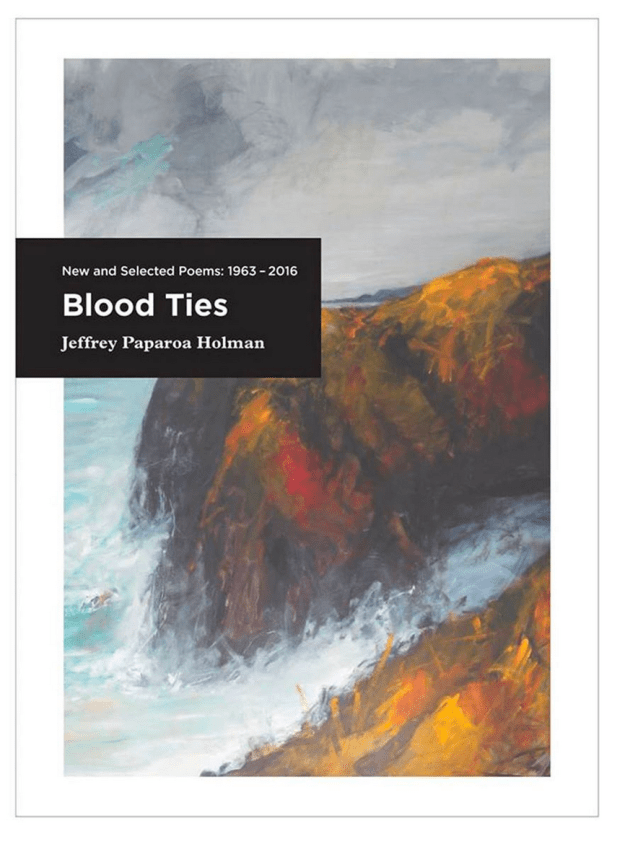
A Selected Poems from Jeffrey Paparoa Holman is out this month

BLOOD TIES: New and Selected Poems 1963-2016.
Jeffrey Paparoa Holman, Canterbury University Press,
978-1-927145-88-3, $25.00, due February 2017.

‘Blood Ties is a journey through a lifetime that is a parable of settlement, one man’s response to the challenge of living responsibly and with sensitivity to the question of where we are and what we must be. There are strong ancestors throughout, but, at the same time and very distinctively, the urgent sound of this river of poetry is all this fine poet’s own.’
Patrick Evans


Screen Shot 2017-02-01 at 7.10.52 PM.png

Poetry Live relaunches with Anne Kennedy and MW Sellwood

Screen Shot 2017-02-01 at 7.06.14 PM.png


Come one, come all, to our opening night of the year!

GUEST POET: ANNE KENNEDY
Anne Kennedy is a poet, novelist and screenwriter. Her awards include the NZ Post Book Award for Poetry for Sing-song and the Montana New Zealand Book Award for Poetry for The Darling North. Her novel, The Last Days of the National Costume, was shortlisted for the NZ Post Book Award for Fiction in 2014. In 2016 Anne was Writer in Residence at IIML, Victoria University of Wellington. She teaches fiction and screenwriting at Manukau Institute of Technology.

GUEST MUSICIAN: MW SELLWOOD
MW Sellwood is an up-and-coming Auckland blues artist from the city’s thriving underground music scene. Equally at home performing tunes on stage or a street corner, his groovy electric guitar riffs and playful vocals combine for a fresh take on Blues music in the new millennium!

POETRY OPEN MIC

KOHA ENTRY

MC: KIRI

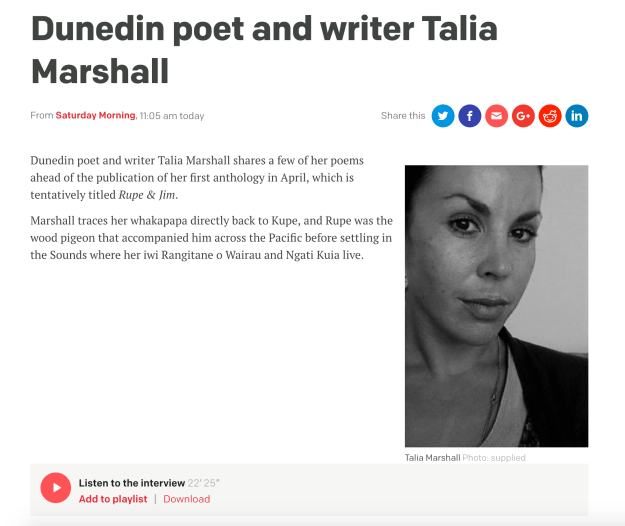
Fabulous poems from Talia Marshall on Radio NZ National

Screen Shot 2017-01-28 at 4.04.37 PM.png

Good to see Radio NZ National deleting excellent poetry.

Poems can be heard here.