Category Archives: NZ poems

Poetry Shelf The Summer Season: Poets pick poems – Anna Jackson picks Bob Orr


Swordfish . . . Far Hotel

That’s me up there cast in plaster

above the wide window

of a coastal pub’s vista bar.

I am the trophy of some forgotten fisherman.

Cigarette smoke fogs my vision

but I still see that day the trophy of my life was taken.

Again I feel. I feel the hook deep within me catch

I feel my anger whip

I feel the tackle tighten

I feel my guts explode

I feel the rainbow strength of colours in me leap

I feel the sky like a mirror smashing

I feel the sun across my dorsal fin get torn

I feel the waves beneath me again and again split open

I feel the blood in the protein church of my heart begin to chant

I feel the hook in my brain burning

I feel the trace against my jawbone cut

I feel time tight as a nylon line almost breaking

I feel the great poem of my life and I know that it is ending.

©Bob Orr Valparaiso Auckland University Press, 2002.


I found myself hesitating between two very different poems I could choose, Janet Charman’s “pin unpin pin unpin pin,” which so vividly recalls the intensity of new motherhood, or Bob Orr’s Hemingwayesque fishing poem, “Swordfish…Far Hotel,” told from the point of view of the fish, now caught and cast in plaster.  My reason for choosing the fishing poem is the experience I had of reading it out loud once at a National Poetry Day event at Te Papa, and feeling myself caught on the line of the poem just as it describes the fish caught on the fishing line.  It is an extraordinarily taut and powerful poem and reading it was one of the great poetry experiences of my life.  It can be found in Bob Orr’s 2002 collection Valparaiso, which is full of favourite poems of mine, including “Eternity” (“Eternity is the traffic lights at Huntly…”), “Remembering Akhmatova,” and “Friday Night…Alhambra Bar,” amongst others.

If we weren’t limited to New Zealand poems, I’d choose “Viewless Wings,” by Mark Ford, the poem which best captures the “lyric strangeness” that Alex Hollis and Simon Gennard have been talking about as what poetry is for, and what poetry needs.  It is the poem I would most wish to have written myself, and now am looking for some way to write past.

Anna Jackson


Anna Jackson lives in Island Bay, Wellington, lectures at Victoria University, and has published six collections of poetry, most recently I, Clodia (AUP, 2014).  With Helen Rickerby and Angelina Sbroma she quite often runs conferences and other events for talking and thinking about writing, this year a conference on Poetry and the Essay.

Poetry Shelf The Summer Season: Poets pick poems – Bernadette Hall picks Anne Kennedy


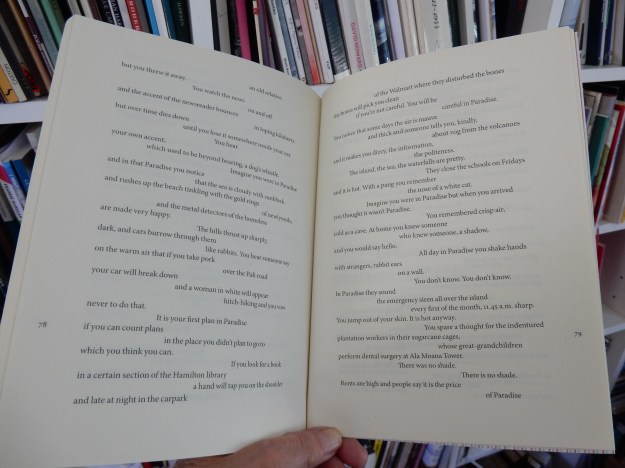
DSCN7352.jpg

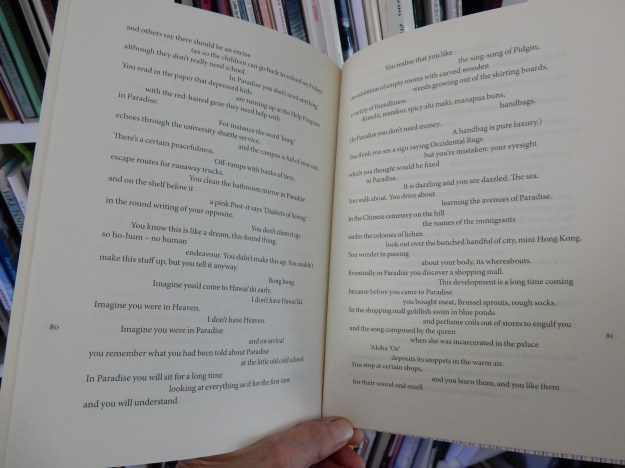
DSCN7353.jpg

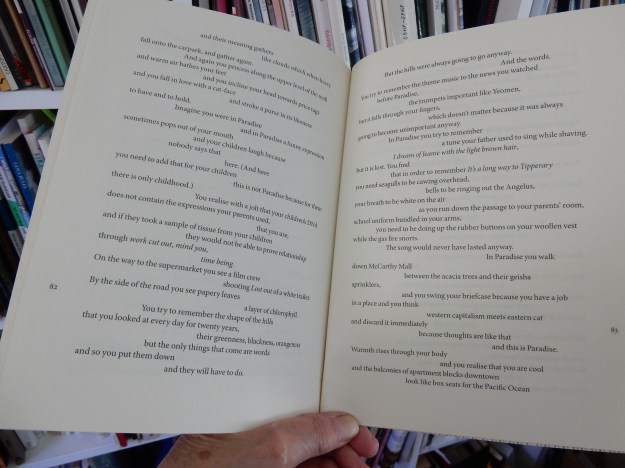
DSCN7354.jpg

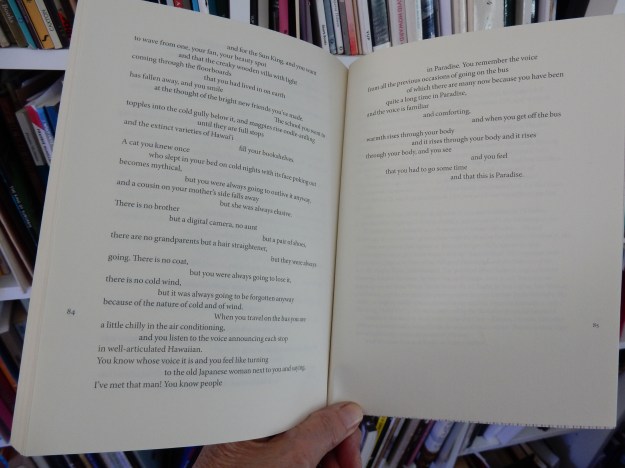
DSCN7355.jpg

DSCN7356.jpg


©Anne Kennedy, The Darling North, Anne Kennedy, Auckland University Press, 2012.


Bernadette Hall comments on the poem:


Screen Shot 2017-02-04 at 3.03.44 PM.png


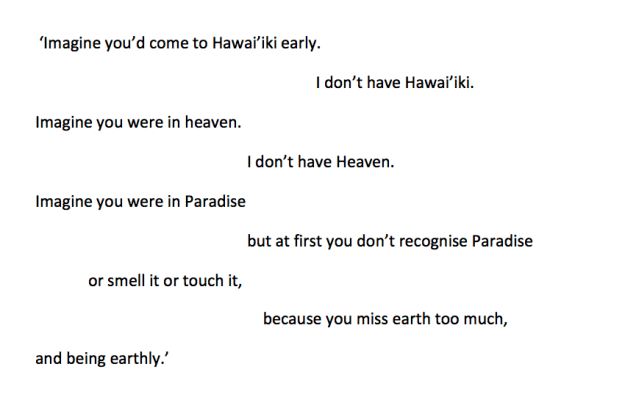
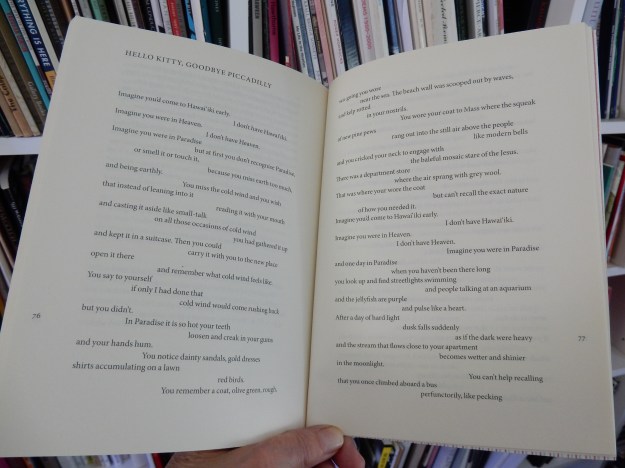
I first read these lines in 2012. Anne Kennedy’s book had just come out. I read the lines and I fell in love with them. I held onto the poem that held onto them as if it was a life-raft. Every time I read that poem, Hello Kitty, Goodbye Piccadilly, (and I read it often) I have the same feeling of home-coming. The thinking is within the same territory I’m fixated on: the tension between the dream places, the places of beginning, of origin, the places that arise from myth. And the materiality of here and now, the stuff that arises from star dust just as our world does and everything including us within it.

On the one hand there’s the ancient dreaming, the naming and the renaming of myth and ritual. Of religion and philosophy. The stuff of the mind, the soul and the imagination. The stuff of desire. And then there’s the solid ground beneath our feet. There’s a collision here surely. How are we to shape a language that it is capacious and mobile and courageous  enough to handle collision and complexity?

It’s an ancient curiosity, this, to ask the existential questions : unde? whence? quo? whither? cur? why? Philosophers and theologians are the professionals. But so often their thinking has been disembodied. Maybe it was up to poets to explore the connective tissue between concrete and abstract, to make new alliances between thought and matter. The body, the mind, the heart, the soul. How serviceable the old language was. But how are we to reveal ourselves to ourselves today?

The framework of Hello KittyGoodbye Picadilly  is the shift from New Zealand with its theatre of memories to Hawai’i. It’s a move north, away from the cold wind – ‘you wish you had gathered it up / and kept it in a suitcase’ – to a Pacific ‘Paradise’. The kind of place the French sailors with Marion du Fresne thought they’d found in Tahiti. But then they went on and found a Pacific ‘Hell’ when they landed in the Bay of Islands in 1772. (I’m fresh from reading Joanna Orwin’s marvellous novel ‘Collision’ that explores these things with spectacular success.)

What I love about the poem is that it arises out of uncertainty, out of questioning. Out of a sense of what’s missing.

There are those repeated lines, the repeated negatives : ‘I don’t have Hawai’iki’    ‘I don’t have Heaven’. Isn’t this the Socratic method, using negatives to slash away the debris and then see what’s left standing? ‘In Paradise you will sit for a long time / looking at everything as if for the first time / and you will understand.’ So we’re back to the very beginning, in need of language, in need of thinking. But then ‘You wonder in passing / about your body, its whereabouts’. And there’s the female body, the human body, the body, not as something corruptible but as an equal.

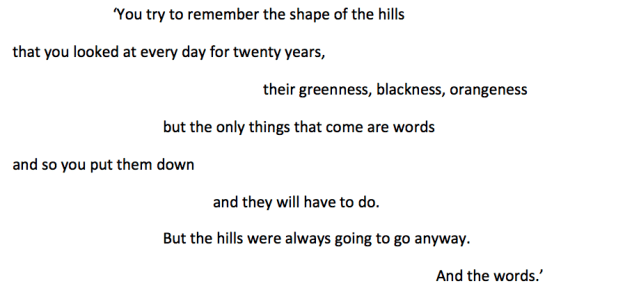
Maybe memory is the cache where everything holds together, where everything lasts:


Screen Shot 2017-02-04 at 3.10.11 PM.png


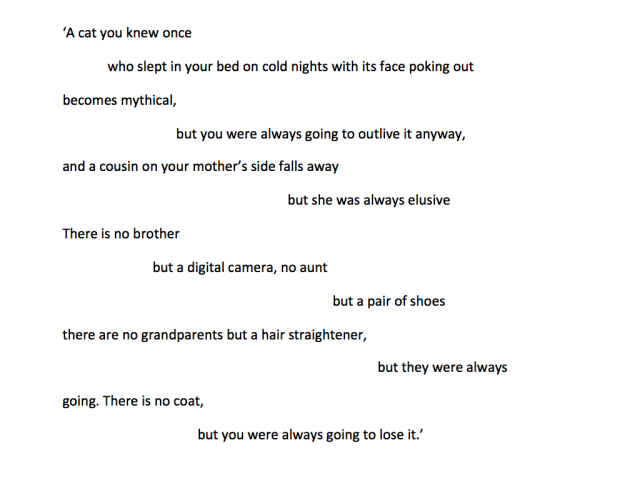
Almost at the very end of the poem there’s a recounting of losses:


Screen Shot 2017-02-04 at 3.11.53 PM.png


And my heart turns over. I guess these lines just get richer as I age. As the whole question of getting up and leaving the room becomes more present. How is this to be done?

There’s a scene in J. M Coetzee’s novel ‘ Elizabeth Costello’ where the aged academic finds herself at the gates of what we might call heaven.  She has to face judges there, she has to answer difficult questions. Her life as a writer, a life spent of making up things, is under scrutiny.

‘Is childhood on the Dulgannon another of your stories, Mrs Costello? Along with the frogs and the rain from heaven?’

‘The river exists. The frogs exist. I exist. What more do you want?’

Indeed, what?

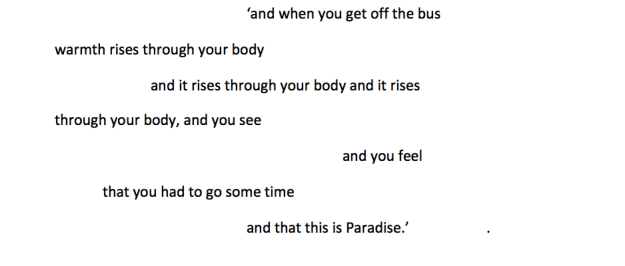
The final move in the poem is from loss to uplift.  Once again it’s repetition that’s the key turning in the lock, multiplying the ways to enter the text:


Screen Shot 2017-02-04 at 3.07.34 PM.png

.


I love this kind of thing. The depth and the nourishment I find here. The way Anne Kennedy’s writing, like that of Coetzee, opens up new rooms in my head and in my heart.

Bernadette Hall


Bernadette Hall lives at Amberley Beach in the Hurunui, North Canterbury. She has published 10 collections of poetry, the most recent being Life & Customs VUP 2013 and Maukatere, floating mountain, Seraph Press, 2016. The latter includes drawings by the Wellington artist, Rachel O’Neill. In 2015, Bernadette received the Prime Minister’s Award for Literary Achievement in Poetry. And in 2017, she was invested as a member of the New Zealand Order of Merit for her Services to Literature.

Poetry Shelf The Summer Season: Poets pick poems – Tim Upperton picks Bill Manhire


Kevin


I don’t know where the dead go, Kevin.

The one far place I know

is inside the heavy radio. If I listen late at night,

there’s that dark, celestial glow,

heaviness of the cave, the hive.


Music. Someone warms his hands at the fire,

breaking off the arms of chairs,

breaking the brute bodies of beds, burning his comfort

surely to keep alive. Soon he can hardly see,

and so, quietly, he listens: then someone lifts him

and it’s some terrible breakfast show.


There are mothers and fathers, Kevin, whom we barely know.

They lift us. Eventually we all shall go

into the dark furniture of the radio.


©Bill Manhire, Lifted  Victoria University Press, 2005.


The eldest of my children published a poem in a recent issue of Sport about the two of us. The poem ends, “We don’t like Kevin but we both like ‘Kevin.'” I forget who Kevin was, but of all the poems of Bill Manhire’s that I admire, this one, “Kevin,” this secular prayer, is the one I admire most. It reminds me of Matthew Arnold’s “Dover Beach,” another secular prayer: what is there, when we all must die, and we have lost religious faith? Arnold finds an answer, of sorts, in personal relations: “Ah, love, let us be true / To one another!” Manhire finds it in human continuity, perhaps the poetic tradition he has inherited, which includes Arnold: “There are mothers and fathers, Kevin, whom we barely know.” The man “breaking off the arms of chairs, / breaking the brute bodies of beds, burning his comfort / surely to keep alive” is no doubt a metaphor, but I think of the great Russian poet, Marina Tsvetaeva, in the winter famine of 1918-1919, who did exactly this. This poem conveys harsh truths, unironically, sympathetically, and in its hopelessness – as in Arnold’s hopelessness – there is a glint of hope, or consolation. Perhaps the only afterlife is in “the dark furniture of the radio” – one of those stained oak radios of my childhood, its transistors humming, a vehicle for the voices of the living and the dead. “They lift us” – “lift” being a particularly resonant word for Manhire – in the way that hymns lifted previous generations. This is such a sad, desolate poem, but every time I read it, it cheers me.

Tim Upperton


Tim Upperton’s poems have been anthologised in The Best of Best New Zealand Poems (VUP) and Essential New Zealand Poems (Random House). His second book, The Night We Ate The Baby (Haunui Press), was a finalist in the Ockham New Zealand Book Awards in 2016.

The Charles Causley International Poetry Competition: Liz Breslin’s winning poem

Screen Shot 2017-02-15 at 8.42.43 AM.png

extract from ‘Walk A Mile/ Stepping Out’


‘Liz Breslin is the 3rd prize winner for this year’s Charles Causley International Poetry Competition. Her winning poem is ‘Walk A Mile/ Stepping Out’ and was selected by our head judge Sir Andrew Motion.

As a child in the UK, Liz Breslin memorised Charles Causley’s poems, sitting in the bath. She now lives in Hawea Flat, New Zealand and writes poems, plays, stories, articles, and a fortnightly column for the Otago Daily Times. She also edits, parents, partners, skis badly, gardens sporadically, coordinates a school student volunteer programme, drinks too much coffee and loves getting her feet wet.’


For the full comments and complete poem see here. I loved the way the poem moves – and especially love the ending!

Hera Lindsay Bird reads a poem for Valentine’s Day @radionz @jessemulligan

ca5ff196-de28-4704-a12b-2d6a1292d767

On Radio National this afternoon, a little uplift:

Hera Lindsay Bird reads a poem for big fan, Jessie Mulligan, to celebrate Valentine’s Day.

Listen to ‘If you are an ancient Egyptian Pharoah’ here.

It is so very good!

Poetry Shelf The Summer Season: Poets pick poems – Simone Kaho picks Sarah Broom


Rain

She’s been lying
on the jetty for weeks,
cheek flat on the wet
wood, mouth an inch
from a fishgut stain
knife at her elbow.

The rain just keeps
coming down.

She’s as naked
as a shucked scallop,
raw and white
on the splintered planks.

Her breath is as slight
as the sea’s sway

Up there in the bush
all the trees lean down
and inwards, longing
for the creek
which longs
for the sea.

And the grey ocean
nuzzles the sand,
its waves as gentle
as tiny licks of kisses,
their small collapse
an everytime surrender.

Don’t touch her.
Let it rain.
Let it rain.


©Sarah Broom, Tigers at Awhitui  Auckland University Press, 2010.


I find this a terrifying poem, I feel it offers me hopelessness and acceptance intermingled.  There is spiritual movement away from a body before the body is dead, an exquisitely rendered vulnerability, a painfully sensual strength.

The poem opens on a woman who has been lying on a jetty ‘for weeks’; stopped in the middle of gutting fish, to drop her knife and be still, her mouth close to the fouled wood, which has not been cleansed by the continuous rain.

Some violence has been done on her, she is naked, shucked from her clothes, her position of power – she is as a scallop, an image both sensual and visceral. She has swapped places with the sealife – someone/thing else now holds the knife.

The image of the scallop caught me, an icon of fine dining. It’s tender vulnerability is its delectability; I see the taut white quiver of her on the splintered wood.

In the next line we learn she is still alive, breathing, aware. Unable, then, to move – or unwilling. Is she being punished – is she being defiant?

The likening of her breath to the sea’s slight sway is a dizzying; she is at once barely alive, and conversely, a goddess; inexorable and elemental.

We move up and away into the bush with the curved yearning trees, and the sustaining creek – all longing for the sea, which is far away, with this woman.

The sea in the sixth stanza is like an animal or a lover:

‘its waves as gentle
as tiny licks or kisses,
their small collapse
an everytime surrender.’

This verse holds all the tension of lovemaking.  The woman on the jetty is soothed by the sea, it surrounds her, supporting her breath – the elements are the only things that can reach her now.

This is confirmed for us in the next line where for the first time we are given instructions:

‘Don’t touch her.
Let it rain.
Let it rain.’

We are powerless like her. We must not touch her, we must allow nature.

I think of the rain. How we rush to be out of it because of its wetness and coldness. How I knew my cats were ready to die when they didn’t move out of the rain. Here, it replaces human touch, releasing, relentless.

This poem is spare; precisely descriptive and rhythmic. Small sways of lines like shallow breathing. It presents us injury, danger and paralysis – a helpless naked female, who has not lost her allure despite her diminishment, and her vulnerability – yet prevents us from helping or even empathising. Rather asks us to bear witness to her passage. Her transcendence into an elemental rhythm which we cannot take part in.

I feel this poem has helped me understand my father’s death from cancer more, and given me a glimpse into a pain beyond anything I have experienced or imagined.

Simone Kaho


Simone Kaho is an Auckland performance poet and a graduate of the International Institute of Modern Letters in Wellington. Lucky Punch, Simone’s first book, was launched November 2016. It bridges poetry and memoir as the narrator comes of age in New Zealand’s rich and confusing intersection of pacific and colonial culture. Simone has been interviewed on TV by Tagata Pasifika and will be featured in an upcoming Landfall.


The Sarah Broom Poetry Prize is now open for entries, closing March 2nd. Details here.


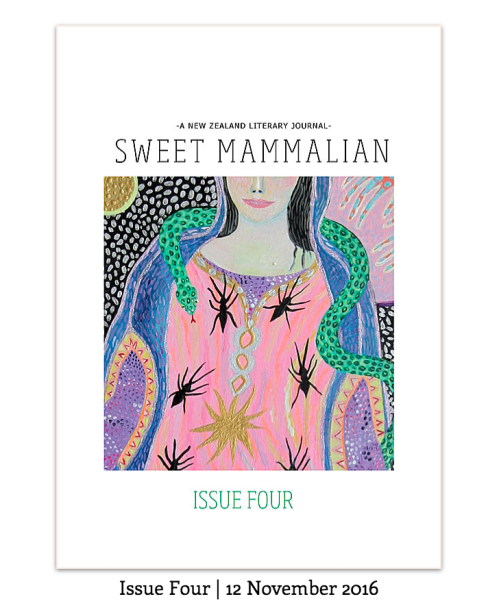
Blissful reading -Sweet Mammalian

Screen Shot 2017-02-14 at 9.10.09 AM.png


‘Teach me how to forget the colours of the city as we saw them, just as we left them, bright and full of drowning.’

Nina Powles, from ‘What it tastes like’


Sweet Mammalian Issue 4 is out now and it is a terrific read (almost finished!).


The magazine is edited by Hannah Mettner, Magnolia Wilson and Morgan Bach – three poets whose work I admire. Here is their goal:

‘We are all sweet mammalians.

This publication comes out of a wish to see more good, new writing out in the world. Our aim is to provide a fresh space for poetry that comes out of the complex, the absurd, the warm-blooded. Our aim is to provide a space for all kinds of writing.’


I got goosebumps reading these poems and I kept reading when I should have been doing other stuff. It felt like I entered a magical music palace where, whichever way I turned my ear, I would hear a different melody- heavenly or sharp. Plus there’s lots of colour!


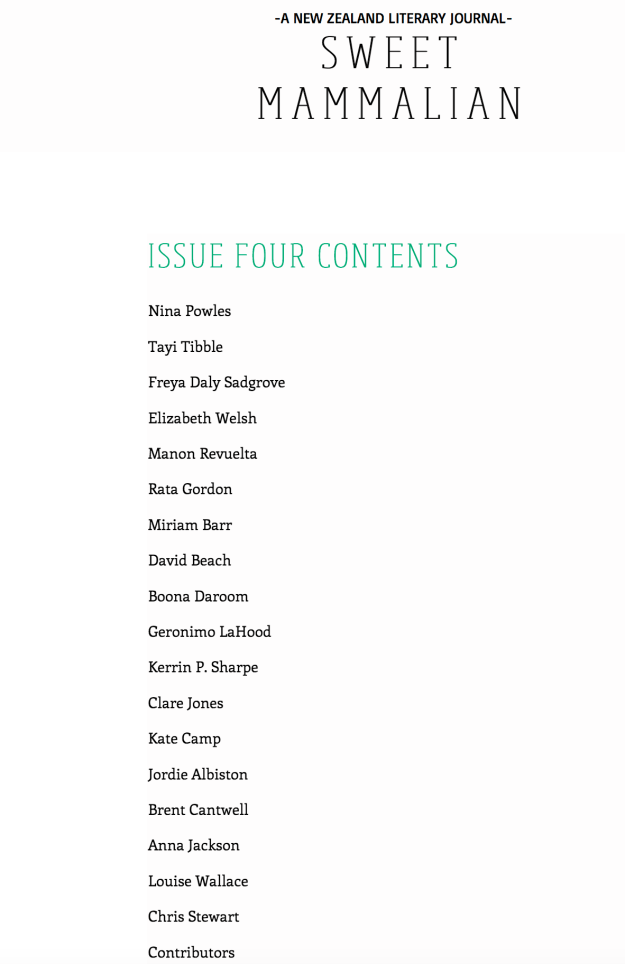
Clare Jones muses beneath the surface of exquisite detail.

Manon Revuelta, lyrically adroit, employs colour hinges and fertile juxtapositions.

Elizabeth Welsh delivers a lyrical echo chamber, again vibrant with colour, with intense realism giving way to strangeness.

Rata Gordon delivers a surprising narrative coil. I want to read her first collection!

There is the acidic bite of Freya Daly Sadgrove that moves you by surprise.

Tayi Tibble catches a nostalgic light to the point her poem glows.

Nina Powles‘ evocation of memory, in its tilts and slips, is infectious.

There is sheer beauty when you read Chris Stewart.

Louise Wallace dedicates her poem to Rachel Bush, and I am hooked on the way expectation tricks, the way you can hear a hydrangea voice and the way a duet might stumble at the bridge.

Anna Jackson produces sunlight and dark, the easily viewed and the hard to see, yet there is a melodic lift.


You can read the latest issue here.


Screen Shot 2017-02-13 at 8.59.27 AM.png


Poetry Shelf The Summer Season: Poets pick poems – David Eggleton picks Ian Wedde


Mahmoud Darwish

from ‘The Andalusian Epilogue’


Because it’s our last evening on this earth we extract our days

From their leafy camouflage and count the coasts we’ll encounter

And those we’ll leave. There. On this our last evening

There’s nothing left to farewell and no time for fanfares.

This is how everything’s governed. How our dreams are renewed,

Our visitors. Suddenly irony’s beyond us

Because the place is set up to accommodate nothing.

Here, on the last evening

We moisten our eyes with mountains encircled by clouds.

Conquest and reconquest

And an earlier time that relinquishes our door-keys to the present.

Come into our houses, conquerors, and drink our wine

To the music of our mouwachah. Because we are the night’s midnight.

And no courier-dawn gallops to us from the last call to prayer.

Our green tea is hot, drink it, our pistachios are fresh, eat them,

The beds are of green cedar wood, yield to sleep

After this long siege, sleep on the duvet of our dreams.

The sheets are spread, perfumes placed at the doors

And by the many mirrors.

Go in there so we can leave, finally. Soon enough we’ll seek out

The ways our history wraps around yours in distant regions.

And at the end we’ll ask: Was Andalusia there

Or over there? On the earth . . . or in the poem?


(after the French translation by Elias Sanbar of Darwish’s poem in Arabic)


©Ian Wedde The Lifeguard: Poems 2008 – 2013 Auckland University Press, 2013.


The poem I have chosen, ‘Mahmoud Darwish’, is taken from Ian Wedde’s collection The Lifeguard: Poems 2008 – 2013 (Auckland University Press, 2013). This is a book mostly made up of sequences of interlocking poems. One of the sequences is called ‘Three Elegies’, and consists of three poems, titled, respectively: ‘Harry Martens’, ‘Mahmoud Darwish’ and ‘Oum Kalsoum’. These are connected through the life and work of the Palestinian poet Mahmoud Darwish (1941 – 2008). The elegy for Harry Martens remembers an exuberant traveller, linguist and poet, one Harry Martens, who translated Darwish, while the elegy for Oum Kalsoum celebrates a famous Egyptian singer and media star — acclaimed generally as the single most prominent Arab woman in twentieth-century history — who died in 1975. In this latter elegy, Wedde recalls hearing her in the early 1970s ‘singing Darwish in Cairo, /reprise after reprise’, a performance he watched at the time on a TV set in Amman, Jordan.

Of the central poem ‘Mahmoud Darwish’, it could be said rarely has a poem seemed more pertinent than this one right now, when, preening himself like an orange budgerigar, President Trump is obsessively chirping anti-Muslim, anti-Arab tweets on Twitter, intent on scapegoating and marginalising Arab citizens as the dangerous Other. Mahmoud Darwish (1941- 2008) was one of the most accomplished modern poets, not just of the Arab world, but internationally. Furthermore, he is one of the emblematic poets of loss of homeland and exile, of ‘destroyed identity’ — and the central literary figure in Palestinian culture.

The Israelis razed Darwish’s home village to the ground in 1948, when he was seven. He grew up in occupied Palestine. Emerging as a significant young writer in the 1960s, he was imprisoned for reciting his poems, harassed, banned, and eventually sent into exile by the Israeli authorities: a permanent refugee.

Ian Wedde, working with the Arabic scholar Fawwaz Tuqan, translated a number of Darwish’s poems into English in the early 1970s, and Carcanet Press in the UK published these as a Selected Poems in 1973. A copy of this slim volume in its now-faded yellow dust-jacket resides on my bookshelves.

‘Mahmoud Darwish’, however, is not a poem directly about the poet; instead it is a translation from an original poem by Darwish, filtered through a translation into French by Darwish’s friend and fellow Palestinian writer Elias Sanbar. One affinity between Darwish and Wedde is that they are both philosophical poets, ontological poets, concerned with exploring being-in-the-world through language. Another affinity is that they are both cosmopolitan poets, restlessly alert to contexts and cultural allusions. Many of the poems in The Lifeguard emphasise a kind of stream-of-consciousness effect, or are, in their reverie, even occasionally teasing reminiscent of Walter Benjamin on hashish.

‘Mahmoud Darwish’ picks up on the same phenomenological pressure, but then artfully opens out into a sort of liminal dream space. Its verbal music, at first acquaintance, seems to have an air of yearning, as it evokes what might be a mirage, an oasis, a sequestered courtyard. But gradually, reread, the poem becomes increasingly haunting, subtly plaintive, and the tone you might at first take for lassitude, world-weariness, melancholy, begins to resonate in a more complex way. Beneath the incantatory language and luscious imagery, the air of fatalistic resignation, is a smouldering anger and underlying bitterness.

Wedde has actually only selected the first of eleven poems in Darwish’s original ode sequence, titled by one translator ‘Eleven Stars Over Andalusia’, or as Wedde calls it ‘The Andalusian Epilogue’. All the poems in the original sequence are variants of classic Arabic verse forms, pushing and pulling and prescribed rhyme schemes and standard imagery.

Andalusia in southern Spain is a mythical homeland for the dispossessed Palestinians. It’s a region of medieval artistic accomplishments, where Muslims, Jews and Christians lived together in harmony for centuries until Muslim Spain — al-Andalus — was conquered by Christians from northern Spain in 1492. Darwish wrote this poem on the anniversary of the Fall in 1992, in part in response to Yassir Arafat’s peace negotiations with Israel at that time, which Darwish regarded — rightly, as it turned out — pessimistically. ‘Mahmoud Darwish’, then, is a poem about harsh realpolitik, only cast in sensual cadences; it’s a poem of disillusionment, affirming a lost cause. The tribal bard calls on his people’s collective memory to mark the ongoing occupation of the homeland and the intransigence of the conqueror — that conqueror’s policies of eradication, subjugation, apartheid  — in language reminiscent of the Song of Solomon.

 David Eggleton


David Eggleton lives in Dunedin, where he is a poet, writer, reviewer and editor. His first collection of poems was co-winner of the PEN New Zealand Best First Book of Poems Award in 1987. He was the Burns Fellow at Otago University in 1990. His most recent collection of poems, The Conch Trumpet, won the 2016 Ockham New Zealand Book Award for Poetry. He is the current Editor of Landfall, published by Otago University Press.

Poetry Shelf The Summer Season: Poets pick poems – Sue Wootton picks Rhian Gallagher


The Wash House


The turning on was slower done — the firebox stoked,

the wooden lid the copper had, gilded shine of its deep pan.

And side by side two great stone sinks

for suds and rinse, could hold a muddy child.


The place became a store — chook mash,

pig grits — housed a mat and dust of wares,

played host to mouse. Cat found a hide for bed

and laid her kittens there.


One small window choked with web,

light gave way across the floor; each step

softening to listen hard

though you could never say what for.


Warped tracks of tallboy teased, opened to a world of finds.

A jar of pennies turned to bank. Rust crept

along the blades of knives. And each oilskin coat, from its nail,

stiffened like a corpse impaled. The kittens ended in a sack.


The shedding held small lost endeavour, walls with cracks

poached by the weather, dissolved the meanest acts of time

where garden slept in seed sachets, the mewing

ghosts, the lynching strength of binder twine.


©Rhian Gallagher, Shift Auckland University Press, 2011.


Rhian Gallagher publishes beautiful poems, each one of them burnished to a sheen. Her first volume, Salt Water Creek, was published in the UK and shortlisted for the 2003 Forward Prize for best first collection.  In 2012, her second collection, Shift (Auckland: AUP), won the NZ Book Award for Poetry.

How to choose a favourite poem from her oeuvre? I can’t, actually – there are many poems from her two collections that I love. So it’s been a deep pleasure these past few days to read both books again in search of one poem to talk about. At random, here are a few of the Gallagher lines that slay me: What did I ask of you, water of no-going…? (“Salt Water Creek”);  Reaching for you was to hear the light expand (“A Winter’s Room”); Give us this day, cobbles worn to shine like water (“In the Old Town”); To walk off the edge of the green world (“Under the Pines”); It’s always been a wired country (“Paddocks”); Heat radiated from the schist, the air felt migrated (“The High Country”). The spirit animating these poems is open and alert; the writing is sensual and intelligent.

“The Wash House” is one fine example among many possible fine examples.

It’s a poem I simply cannot tire of. It casts its enchantment early through lulling lyricism, assonance, consonance and internal rhyme. I’m hooked before I know I’m hooked. Into this sound-cradle, Gallagher embeds concrete visual details: the firebox, the wooden lid of the deep and shiny copper, the stone sinks, a muddy child. Ah, you might think, how nostalgic. You would be wrong. As the poem progresses, its lyrical charm builds and intensifies. By the middle stanza, we’re hypnotised. Quietly and slowly, we step with the poet behind the “window choked with web”. We “listen hard”. Our eyes and ears adjust, and suddenly we’re in the “world of finds”, and what we find there is both brutally real and threaded through with the uncanny. Gallagher’s exquisite, multi-dimensional craftwork is invisible, but everywhere, in this poem (take the selection and placing of the last word, for one example). I recommend reading “The Wash House” aloud – I recommend learning it by heart.

Sue Wootton


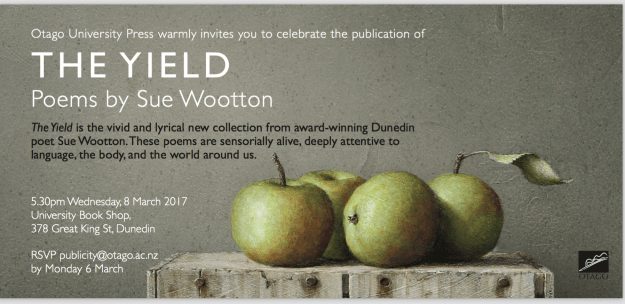
Sue Wootton lives in Dunedin where she is a PhD student researching the affinity between medicine and literature. She is the selecting editor for the Otago Daily Times Weekend Poem column, and co-editor of the Health Humanities blog Corpus: Conversations about Medicine and Life. Her novel Strip (Makaro Press) is longlisted in the 2017 Okham NZ Book Awards. Her fifth poetry collection, The Yield, will be published in March by Otago University Press.
website here

corpus.nz