Category Archives: NZ poems

In conversation with Selina Tusitala Marsh


1497493006148-1.jpg  1497493006148-1.jpg


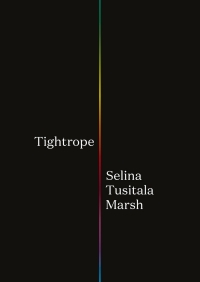
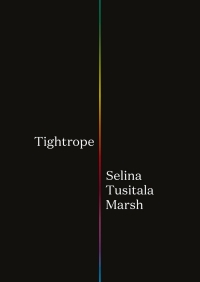
Tightrope, Selina Tusitala Marsh , Auckland University Press, 2017.


Let’s talk about unity

here in London’s Westminster Abbey


did you know there’s a London in Kiritimati?

Republic of Kiritibati, Pacific Sea.


We’re connected by currents of humanity

alliances, allegiances, histories


from ‘Unity’


To celebrate Selina’s new poetry collection, Tightrope, and her appointment as our current New Zealand Poet Laureate we email-conversed over several weeks. Selina is of Samoan, Tuvaluan, English and French descent. Her debut collection, Fast Talking PI, won the Jessie Mackay Award for Best First Book of Poetry. She was the first Pacific Islander to graduate with a PhD in English from the University of Auckland. Last year as Commonwealth Poet she performed ‘Unity’ for the Queen at Westminster Abbey.

I leapt for joy when I found out our new Laureate was Selina. Firstly because I am in awe of what she writes and she is a good friend. Her latest book catches you from first to last page on so many levels. Secondly I follow behind her at schools and I can see how she has utterly inspired teachers and students, whatever the level. This is poetry gold. Thirdly I leapt for joy because that now makes it 5 women poets  out of the 11. Did it matter to me that a woman was picked -yes it most certainly did. Selina has talked about the way she wants to have 1000 hands touch the tokotoko – how she wants to bring the poetry of brown faces to the spotlight. When I look about and see how whitewashed we are in so many ways – what gets published, what gets reviewed (check out the latest list of best poetry books 2017 in The Listener), what gets put stage centre at festivals, journal content etc – I leapt for joy that we have Selina. Hone Tuwhare and Sam Hunt are the two poets that are so beloved by our nation. I predict Selina is our third. I am currently writing a book on NZ women’s poetry and while my aim is to showcase the poetry that so often gets eclipsed by theory and dogma and bias, I also, at times, talk about the woman holding the pen. She has existed in the shadows. She has been maligned and misunderstood and devalued. I want to give women poets presence where it seems apt because their stories have so seldom been told. So while I think the poem is the first most paramount thing, I also think it is important to navigate the difficulties and triumphs women have faced as poets over the past century in New Zealand; how their poetry has been denigrated and erased due to gender or race. To have Selina given this golden opportunity to write further into our sightlines is heartwarming.

Paula Green 10 October 2017 on Facebook


Our conversation


Paula: I have spent a stormy Sunday morning lying in bed reading your new poetry collection, Tightrope, from cover to cover, and now I want to read it again slowly as an email conversation unfolds between us. The reading experience moved shook soothed challenged diverted me with the ooh and aah of recognition pain delight. In other words, the poems take you so many places in so many ways. I love it!


Gran’s jasmine

delicate pink


heavy and sweet

clings to the bone


from ‘Kiwitea Street in the ’80s’


The cover is striking with the tightrope moving from top to bottom rather than stretched taut across a horizontal line. I had held up my piece of red wool at your book launch, but it is only now, I am wondering why it holds a vertical line. It as though the rope stretches from the sky (heavens) to the earth (grounding), or from earth to sky. It is like an upturn, an overturn, and is infinitely resonant in its red to green glow. Why this placement?


Selina:  Instinctively insightful as always Paula.  In part, it references the living conditions of what I think of as the first poem of this land – the poetic parting of Papatuanuku, Earth mama and Ranginui, Sky dad, and the struggles of living before, during and after their separation. What does it mean to live in between such aroha, such passion, such angst?  Sometimes, like this morning, it means submitting to Tawhirimatea’s restlessness in the driving wind; other times, it means tuning into a mist-like longing in the light after-rain.  I’m often in between.  As a middle child I’m used to it and have finely honed skills of negotiation. Inbetweeners possess tightropish qualities:  a tender balance between joy and pain; the toe inching forward of a line that demands feeling before seeing.  That’s why the line is raised (much to Michele Leggott’s joy, who proclaimed at the Devonport Library launch recently that it was one of few books which she could hold up to an audience and know it was rightside up!)  Because I feel my lines.  Because that’s what brings me out of the abyss.  It’s also what gives depth to the abyss.

Unity is an underlying theme in the collection, as well as being the title of the poem for the Queen.  Unity is what’s needed in ‘the struggle’, however you define it in your life at that point (evoking the brothers’ struggle against the darkness imposed on them by their parents).  Unity is what my poetry seeks to create.  Unity of the multitudinous stories that constitute our memory, which in turn, form our history, ‘the remembered tightrope’, to quote Albert Wendt. The morphing colours of that beautiful vertical rainbow line (thanks Katrina Duncan and Spencer Levine) evokes the many hues of our lives that refuse to be forgotten.


Al,

I’ve taken a black vivid marker

pressed it against your page

and letter by space by word by phrase

inked across your lines

streaking pouliuli pathways

wending in and out of the Void


from ‘The Blacking Out of Pouliuli (1977)’


Paula You climb reverse-wise through Albert’s quote, so to speak, in your three sections: from the abyss to the tightrope to the trick. It seems the poetry pollinates the inbetween space between forgetting and remembering. He places this in view of history, but is it also personal?

‘We are what we remember, the self is a trick of memory … history is the remembered tightrope that stretches across the abyss of all that we have forgotten.’ Maualaivao Albert Wendt

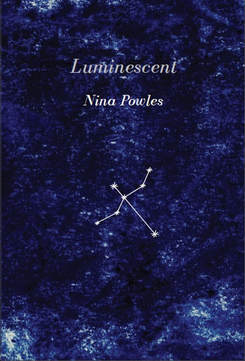
Selina:  History is deeply personal, after all, it’s ‘written by the winners’, as I first saw in my undergraduate years graffettied under Grafton Bridge as my bus was heading out to Avondale (and later attributed to Churchill).  I’m reading a delicate collection of poems titled ‘Luminescent’ by Nina Powles at the moment (PG: my review here). 5 chapbooks are stacked in a fold out box (Seraph Press does a beautiful job) and each of them speaks back to women figures – some famous (I especially like the poem ‘If Katherine Mansfield were my best friend’) and some lesser known (to me), like ‘The Glowing Space Between the Stars’ responding to the award-winning New Zealand cosmologist Beatrice Tinsley (1941-1981), who ended up at Yale University teaching on galaxy evolution.  Where was her history in school?  Nina’s personal, poetic connection with five (early) New Zealand women is helping to build this history.

I think that’s why I so love Al’s line ‘the self is a trick of memory’, because that’s the personal self (‘Queens I Have Met’, a way to memorise moments), the communal self (‘The Dogs of Talimatau’ – how did all those dogs really die?) and the national self  (from the New York poems, see for example ‘Inward Hill, New York’ – what happened to the indigenous people of Manahatta? – to Oceania’s ‘Atoll Haiku Chain’ – Tahiti’s stories fan the flames of its history of colonisation, nuclear testing, and protest.  That inbetween space between forgetting and remembering though, is probably most potent in the abyss of death, but ‘Essential Olis for the Dying’, the poem written for my beloved colleague and ‘shooting black star’ Teresia Teaiwa (1968-2017), to whom this collection is dedicated, appears in the ‘Tightrope’ section.   That’s because, to quote Al again, ‘we are what we remember’, and we choose to capture moments of relationship that are ephemeral by nature, that’s the act of tightrope walking.

We choose, inch by inch, what we will feel beneath our toes, how we will balance ourselves in the air and keep our centre of gravity so that we can keep moving forward.  Certain moments, particular memories, we will throw across the abyss of time in order to reach back while moving forward.  Other things will recede into the background – we think we’ll never forget, but then we do.  We lose shades of it, pieces of it, and even though the loss stays, even that, the depth of it, the pain of it begins to diminish over time.  Maybe it’s meant to.


Take this cardamon

to ease you into the next plane

not the one taking you back to Santa Cruz

or Honolulu or Suva

but the next plane.


from ‘Essential Oils for the Dying’


Paula: I also love Nina’s collection and the way she is casting light on these five diverse women. That you dedicate your collection to Teresia Teaiwa resonates deeply, on an individual level, but also because you are part of a weave of women writing, speaking, sharing. You don’t write out of a vacuum.

I was particularly moved by, ‘Apostles’ and the way it challenges on so many levels. Alice Walker lays down the first challenge:


Alice Walker said

before placing a red

cushion in the middle of the road

that poetry is revolutionary.


You recount events that speak to such a claim. I am musing on way you highlight the example you accidentally found when googling lime; a brown skin woman mob tortured for sorcery. Not famous; one woman suffering. Do you think poetry can make a difference?


A brown woman is sitting

her back to us

bare on a corrugated

iron dock

noose round her neck

wrists bound

machete bites

mar her back

one gash so deep

its creviced meat

blackens

in the smoking air.


from ‘Apostles’


Selina: ‘Apostles’ is my answer to that question, which is answered by a question back to Alice Walker, poet, writer and activist extraordinaire: ‘Alice, how can a poem possibly revolutionise?’  Then Kepari Lenara, the name of the young woman murdered by mob, appears and fades over the following lines. These visually echoing whispers evoke the power of orality at the heart of poetry.  Poems are meant to sit on the tongue, be spoken and sung, flung into someone’s ears.

One of my favourite lines of all time is by poet and lyricist Rangitunoa Black: ‘A fire burns on the tip of my tongue, I should cry to put it out.’ That’s the power of poetry, that it matters, that it creates fire and movement out into the world.  It’s why the Poet Laureate Matua Tokotoko (parent tokotoko) is so gorgeously poetic. The parents have three detachable sections to them (to enable easy travel!).  It comprises of a mama section (which has a hand written poem by Hone Tuwhare in its belly) and a papa section (which has a grooved tip).  When you rub them together – ahi!  Smoke! Isn’t that what poetry is about?  It’s why I’d love love love to have a flint embedded in my own tokotoko so in performance, I can strike it and create that spark.  A living metaphor.  A heightened engagement with the audience.  An interactive poetry.  That’s the difference poetry can make.   And poetry has made a tangible difference in my life.  Poetry enabled me to articulate my turangawaewae (standing place) at university as nothing else could. Poetry can make a difference.  That’s why I take it out to schools, community halls, corporate boardrooms.  For the difference it can make.


Paula:  And you take it to your sons in ‘Warrior Poetry’. It is like a letter coming from the gut, saying this is what I do, but it also feels like an energised song-chant-poem for teenagers, especially boys, who skirt books and poetry.

Putting together a poetry collection, boys

is like the NLR nines

Eden Park, 45,000 packed

you’ve got 90 pages of lines

to work the eclectic crowd

into some kinda synthesis – some kinda wonderful


from ‘Warrior Poetry’


Poetry does many things in your collection – even act as a little spot of revenge! Ah! the revenge poem.

Selina: Poetry for all occasions right?  You see, often in a difficult, embarrassing, confronting, uncomfortable situations, my first reaction is to smile (my kickboxing trainer used to call me the ‘Smiling Assassin’).  It’s only later when the brilliant retorts, the intellectual one-liners, the sardonic replies, come to the tongue. Or I should write, the pen.  And poems can carry the weight of my anger or angst; they can take the push-pull of my righteousness and ambivalence (at the same time); they can turn a moment of indecision about what just happened or shock at someone’s rudeness or felt gut-disempowerment and re-story it ways that return power to me.  Call it ‘the revenge poem’ or call it ‘the re-storying painful or uncomfortable events poem’, whatever you call it, its at all of our fingertips!


My moana blue Mena

My Plantation House shawl

My paua orb

My Niu Ziland drawl

My siva Samoa hands

My blood red lips

My va philosophising

My poetic brown hips


from ‘Pussy Cat’


Paula: Five poets were Te Mata Estate Poets Laureate, with Bill Manhire (1996) and Hone Tuwhare (1997), the first two. In 2007 the National Library took over the administration and appointment process and selected Michele Leggett as the first New Zealand Poet Laureate. You are the sixth Laureate appointed by the National Library with the change in title.

Looking back across the Laureate blogs and tenures, each Laureate seems to shape the role to fit him or herself, just as the tokotoko is carved by Hauamoana artist, Jacob Scott, to fit the individual. I love the idea that you will shape the role to fit – what matters to you as Poet Laureate?


Selina: In 2 weeks I leave for Samoa where I’m judging the Pan-Pacific Tusitala Short Story competition, giving the keynote for the Pacific Arts Association, running two writing workshops, and performing on opening night.  While this was arranged well before becoming Poet Laureate, I am taking the Matua Tokotoko with me and ‘they’ (the parents) will feature.  Usually behind lock and key in a glass case at the National Library in Wellington, I have instinctively known, as a person from the Pacific, the taonga, the national treasure, that I have in my possession.

Polynesians know the mana such taonga possess.  Material objects become taonga as they are passed on and down; as they pick up the stories, histories, and genealogies of those who possess them.  I will have reached my goal of a 1000 pairs of hands touching the Matua Tokotoko in Samoa (I’m currently at 977) since the Award was announced on August 25th.  Everywhere I go people are enthralled with the story of its making – but it’s not really common knowledge.  That’s what I want to do, at least among the diverse communities I engage with.  Most are not aware of what the Poet Laureate is, nor what the tokotoko represents.  Each Laureate has helped increase awareness in their own circles, in their own way.  That’s what I’m doing now.

After visiting Hawkes Bay and finally having a korero with carver Jacob Scott from Matahiwi Marae, we’re really excited about bringing my tokotoko into the world.  This trip to Samoa will also enable my Samoan treasures to be included in its making.  One idea was that I source (that means ‘cut’) some wood from my grandfather’s house in Elise Foe, the original ‘Tusitala’, to include in the carving.  Then when I visit Vailima, Robert Louis Stevenson’s plantation house, I do the same there (with permission from the owners) and source material from the other ‘Tusitala’ to somehow incorporate.  I’d like to bring home a stone from the river my mother used to bathe and play in. I’d like to include some other historical objects.   As poets are wont to do, I will wait for synchronous moments to come – I know these material stories will make themselves known to me.

This is part of a journey and Mike Hurst, along with his film-mate Andrew Chung, and Tim Page are the guerilla film / photo crew capturing formative moments in order to make a lovely documentary – more on that later!

I guess this is a round-about way of also addressing the question: ‘What does it mean to be a Pasifika Poet Laureate?’  It means doing this stuff.  Taking the Laureate-ship along in my Pacific-infused life (we are, after all, in the middle of the Pacific), not just in incidental ways, but in deliberate, epistemologically-informed ways that centre Pacific worldviews, at least, as far as I see and experience them in my life as a Pasifika poet-scholar.

So, as the Poet Laureate, people matter to me, stories matter to me, especially when those stories have existed on the margins of mainstream consumption.  Creativity and freedom matters to me, honoring my own unique poetic voice, and continuing to grow it matters to me.  I have two years to work on these things that matter to me: to continue taking poetry ‘to the people’ and to continue growing poems!


We are about to step

on stage at Aotea Centre

in front of a sold-out

crowd of two thousand

I ask

How would you like to walk on –

before me or after me?

You say

Let’s just do this

and take my hand.

We stroll on

side by side

to a standing ovation

your hands become doves


from ‘Alice Walker’ in ‘Queens I Have Met’


Auckland University Press page

Poet Laureate blog

NZ Book Council page

Watch Selina perform ‘Unity’ at Westminster Abbey here

Gina Cole picks ‘In Creative Writing Class’

‘The Dogs of Talimatau’ at The SpinOff

Selina picks Tusiata Avia’s ‘This is a photo of my house’


Carin Smeaton’s Tales of the Waihorotiu – a heart-crunching, mouth-watering, kaleidoscopic read

large_9781877441608.jpg


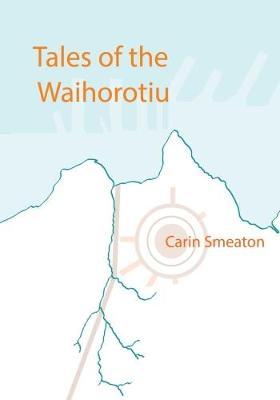
Tales of the Waihorotiu,Carin Smeaton, Titus Books, 2017

Carin Smeaton’s debut collection, Tales of the Waihorotiu, is all about voice. It is acutely textured: surprising, open, sharp, slang-rich, vernacular driven. It pulls you so close you can sense the speaker’s breath on the line. It grips you from the first page until the last.

The short lines, the shortened words, intensify the conversational flow – like there is an inward outward breath audible, like there is pause for thought, what to reveal and what to keep quiet. Conversational fluency in poems ought not be taken lightly, we are so easily seduced by an apparent ease, but this is exquisitely crafted. Talk is transposed into music and that music becomes poetry, layered, magnetic.

What I love in this collection is the way voice is a gateway to abundant life on the page, startling at times, moving at others. Place matters, people matter and experience is the pulse that steers the line. You might move from a meteor shower to kids spinning on a whirligig to eating eel to Fargo to bad relations to Woody Allen to Mary Poppins to a broken tooth to St Kevin’s Arcade to the Rugby World Cup to a crap world to a better world to headache and heartache.

The title refers to the Waihorotiu stream that used to run down Queen Street but after life as a canal, then sewer, now flows underground. The poetry’s roots soak deep into Auckland, especially into lives that flow counter to the bright lights and the privileged.  Voice now gives presence to the voiceless.

This a heart-crunching, mouth-watering, kaleidoscopic read and I love it. Here is a poem to whet your poetry taste buds:


Night Shower
last night
i wanted to catch
a meteor shower
but it was the wrong night
i saw 2 hedgehogs instead
under the cosmos sky
under the clothesline
that was pretty cool
wit uncle moon
naina says
he give us the light
to go anywhere
astro speed
to see the night
swallow aniseeds
whole
then throw em up
da brightest ones
weather dreadful
stellar blue
i think i’ll wake
my boys for u
if we don’t see u
we’d at least see
 the hedgies
i think that’d make
us happy
©Carin Smeaton

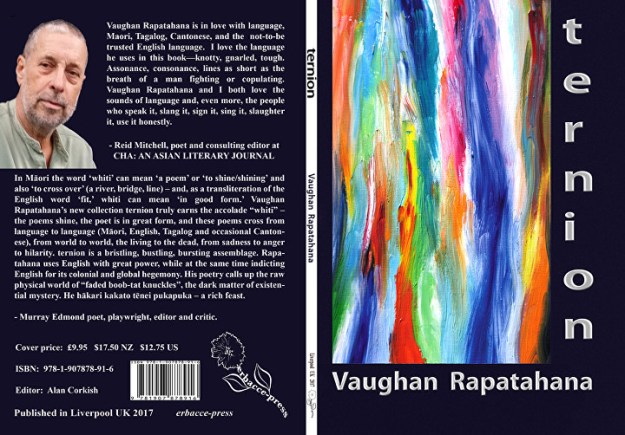
Vaughan Rapatahana’s Ternion: I love this generous embrace


4632673381_720x502.jpg


Ternion Vaughan Rapatahana (Liverpool: erbacce-press, 2017)


Vaughan Rapatahana travels and lives in three distinctive places:  Aotearoa, the Philipines and Hong Kong. His poetry reflects an impulse to travel because the linguistic movement, whether aural or visual, is paramount. Words dart, dash, stretch, stutter, link, break down, break apart. There is vertical uplift and downward slants. Such linguistic playfulness is not simply a matter of exercising the dimensions and possibilities of language; each poem travels with a movement of heart and mind.


There is the hiccup of letters and words in ‘my father’s death’, a poem that faces the hard-to-say in fits and starts. Physical detail anchors the experience:


only

the young oldest son

there to witness

his shrivelled size,

the estranged demise

-astray the slim single bed


The diverse subject matter embraces the movement of a global traveller, with several languages sharpening the line, hooking place and experience, opinion and identity. He rails against the weakness of English (‘railing against’). He rages against blinkered if not blind identity views: ‘why/ are  we/ mis interpreted/ all the time?’ (‘I carry a rage’).

The detail is pungent and thick on the line – especially when place is at the poem’s core:


hong kong, you old bastard;

your flabbergasted lips

basting the back alleys

in jisms of sputum,

disabling sophomore solons

garbled in yellow

under colourless sun.


from ‘hong kong town, 2015’


What I love about Vaughan’s poetry are the multiple jigs: the way death brushes against life, humour touches against sharp-as-axe political edges, confession corrupts reticence. Poetry is a way of cooking up a brew that resists boundaries, rules, decorum, models. I especially like the scene at the fence where poetry is the topic pf conversation:


‘Smells good,

you cookin’ up another one

of those bloody poems of your’s mate?;

offered my gap-toothed neighbour,

through the interrupted picket fence.


‘reckon,’ I said, stirring up

a bit of everything on the page,

so to speak.


from ‘boil up’


The neighbour hopes the poem hasn’t got any of ‘those clever-dick tricks’ when he wants ‘plenty of/ good old carrot & onion words’. I love this poem. On the one hand, Vaughan is responding to the age-old incomprehension at what a poet does, but it also gets right down to the guts of how he brews a poem. There are clever, tricky acrobatics on and off the line that signal intellectual engagements with the world, but there is also a Hone-Tuwhare-like cheek and an absorption of an everyday physical world. We might get ‘cacophonous condiments’ along with ‘a little watercress    on the side’ and a good stir of Te Reo.

Murray Edmond claims the collection as ‘a rich feast’ on the back cover and I agree. The poems spark in myriad directions that touch mind and heart, and I can think of few local examples that are so linguistically and creatively fluid.


Postscript: Vaughan’s must-read poem for Tusiata Avia and Fale Aitu / Spirit House resonated so deeply I felt like crying. A poem like this underlines the way we write within poetry communities, not in estranging isolation, but in arm-to-arm states of poetry and human connection. I love that. I love this generous embrace.


manuia Tusiata, manuia

this is the best body of poetry


I’ve hugged for years.


from ‘fa’afetai Tusiata’


Congratulations to Alice Glenny; winner of the Kathleen Grattan Poetry Award

otago667397.jpg


Kāpiti poet Alison Glenny has won the 2017 Kathleen Grattan Award with ‘The Farewell Tourist’, a poetry collection inspired by a visit to Antarctica.

She receives a $10,000 prize and a year’s subscription to Landfall, and Otago University Press will publish her collection in 2018.

Glenny says she wrote an initial draft while completing a postgraduate certificate in Antarctic Studies last summer at the University of Canterbury.

“One of the amazing things about the course is it includes a short residency in Antarctica, and the early parts of the book were written either in the library at Scott Base (the library with the best view in the world!), or in a tent on the Ross Ice Shelf.”

Other influences include the “endless light of the Antarctic summer”, and the writings of explorers from Antarctica’s so-called Heroic Age, and scientific writing about human-driven climate change.

“Are we really willing to resign ourselves to saying farewell to Antarctica’s unique ecosystems? I truly hope not.”

The judge of the 2017 Kathleen Grattan Poetry Award was prize-winning New Zealand poet and fiction writer Bill Manhire who says the collection “pushes against the boundaries of what poetry might be”.

“The Farewell Tourist was the manuscript I wanted to reread most often, each time getting refreshed pleasure from what was already familiar, and also finding new things to enjoy and admire.”

The biennial poetry award from Landfall and the Kathleen Grattan Trust is for an original collection of poems, or one long poem, by a New Zealand or Pacific permanent resident or citizen.

Landfall is published by Otago University Press.


About Alison Glenny

Glenny was born in Ōtautahi/Christchurch, and currently live in Paekākāriki, on the Kāpiti Coast. She holds an MA in Creative Writing from Victoria University Wellington, and a postgraduate certificate in Antarctic Studies from the University of Canterbury.

She has taught creative writing at Whitireia Polytechnic, and published short fiction and creative nonfiction. She currently works in the area of public housing.

Further details here.

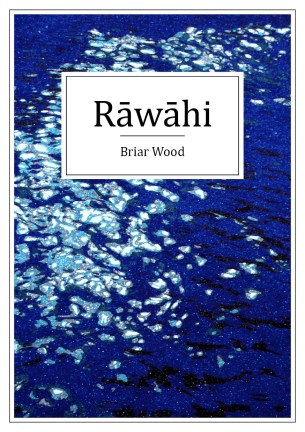
Two poems from Briar Wood’s Rāwāhi

Diptych


We walk the long sea shore to pick

scallop and cockle while she flicks

shells from her pocket

hinged like a locket

where poems appear, like tricks.


A child is quoting limericks

while I search the shore for lyrics.

We sort words—rocket,

pacific,  quick, stich.

Jamie loves tongue-twister music.


Paewai o Te Moana


The sea at night is blacklit,

kikorangi, kōura, topazerine, pango,

a haul of images pouring from nets,

darker than oil underground


at the edge of Parawhenuamea

rave streams, jostling yachts,

brown iris flags, meadowfoam, puka


Tai Timu, Tai Pari, arawhata ki


pocket beaches of pebble shell rock

meaning a joining of waka

across the slanted playing field


virtual beaches on imaginary roads

where poetry and geometry are almost

compatible, wai weld, creolerie,


ocean patter in ngā kupu,

tūātea, ngaru mata, rahopē


moana waiwai, karma moana,

beforeglow and sonar,


like finding


whakaea


©Briar Wood, Rāwāhi   Anahera Press, 2017


Briar Wood’s poetry collection gathers, with a wide embrace, details of travel and living, and as the lived-in world grows on the page, the poems set up all manner of conversations. This book draws upon whakapapa, love, relations, ecology, the past and the present. Its warmth and its empathy are infectious. I love the way you can take two poems, such as these, and listen to the talk across and beyond their bridges.

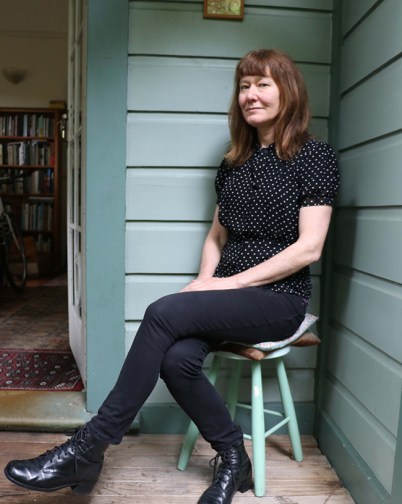
Briar grew up in South Auckland and has returned to Northland places where her Te Hikutū ki Hokianga, Ngāpuhi Nui whakapapa resonates with ecological concerns.


Rawahi-Front-Cover_high-res.jpg


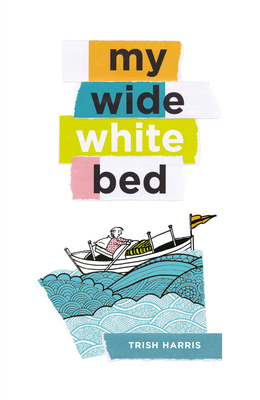
Trish Harris’s My Wide White Bed is an astonishing uplift


large_my-wide-white-bed-front-cover.jpg

The Wide White Bed Trish Harris  Landing Press 2017


Trish Harris spent eight weeks in the Orthopaedic Ward at Hutt Hospital as people – visitors and patients – came and went about her. Someone brought her a journal and that became both her private room and the subsequent resource for My Wide White Bed.

The poetry is airy, with acute observations, luminous things, and an awareness of community experience rather than a single perspective. It is immensely readable; I gobbled it in a flash, loving the sweetly crafted lines, the wit and the reflection.

The sequence comprises untitled poems that begin with the idea of a ship:


The hospital sails

like a tall ship

down the crease of the valley.

I am stabilised

mid-mast

laid out on a wide white bed

head facing east.


The book struck such a cord with me because it took me right back into the thick of hospital stays where intimacy thresholds dissolve, discomfort displaces comfort and walls and windows are unsteady.

This is not a bitter grim read but an essential read in the light of the current state of hospital care. The politics are subtle and various:


They arrive

as elderly women with

broken bones

strained muscles.

Back home

they are the strong ones

caring for senile husbands

sick sisters

dying mothers.

They come to this place

of illness

for a rest.


Trish pulls us into the lives of others as much as she exposes her own story, and that is what elevates the reading experience. Names are changed but the dialogue, the situations and the revelations sound out as vital human truths. This is poetry of connection, of empathetic relations in tough circumstances. Single lines glow:


Merle is doing crosswords.

That’s why she buys the newspaper.

At home her husband grows daisies and dementia.


The book should be in the drawers beside every hospital bed, and in the gift shop, because the book, like the boat with the wind in its sails, is an astonishing uplift. Plus I recommend placing a journal and pen in bedside drawers, so patients can open up their own privates rooms to write or doodle windows and doors and secret sails.


Then again pick up this book for a wet Sunday and savour the rewards. I love it.


All night long I ease

the white blanket over shoulder

across belly and over hip

dreaming of transformation.


In the morning the nurse says

You look like a cocoon.


I smile. The covers bulge

with antennae buds and

the scratching of wings.


©Trish Harris The Wide White Bed

Trish Harris has a BA of Applied Arts (Creative Writing) from Whitireia New Zealand. She has worked with words – editing, writing, creating and tutoring – for over thirty years. In 2016, Escalator Press publisher her memoir, The Walking Stick Tree. Her poetry has appeared in various journals.


Better off Read: Pip Adam talks with Nina Powles


nina-powles.jpg

Episode 51: Pip Adam talks to Nina Powles about her new work LUMINESCENT

Listen here.

‘In this episode I spoke with one of my favourite Wellington poets Nina Powles. I first spent time with Nina around Helen Rickerby’s table where a group of us were hand-binding copies of her first collection Girls of the Drift.

Nina is an outstanding poet, non-fiction writer and zinemaker. She is half Malaysian-Chinese, half Pākehā. Nina has an MA in creative writing from Victoria University of Wellington and won the 2015 Biggs Family Prize for Poetry for the first draft of Luminescent. She is the author of the chapbook Girls of the Drift (Seraph Press, 2014) and several poetry zines.

Nina’s new work Luminescent is an extraordinary work.’


Paula: I love this collection so much. Here is my review.


luminescent-cover-low-res.jpg

Courtney Sina Meredith airs new poems at a very good Ladies Litera-Tea – here are two for you


IMG_8173.JPG   IMG_8170.JPG

This year, The Women’s Bookshop hosted two Ladies Litera-Tea events. I didn’t make the first one, but the one on Sunday was perhaps the best one I have been to. The range of voices was inspired programming. I needed toothpicks to hold my eyes up when I left home, but Dame Fiona Kidman had me sitting up listening to the sonnets she wrote for her mother, Kirsten McDougall mesmerised with an extract from the must-read Tess, Heather Kidd showed the diverse creativity and ambitions of rural women (wow!), Michalia Arathimos spoke of the gut-wrenching origins of her debut also must-read novel Aukati, Fiona Farrell’s extract from Decline & Fall on Savage Street had me sitting on the edge of my seat, the sentences were so good (now have a copy!). Hearing how Eat My Lunch came into being from Lisa King underlined the difference one person can make (with help from friends!). 

The first half was a glorious rollercoasting brain-sparking heart-warming delight.

By this stage no vestiges of tiredness. I thought I might flag in the second half but the immune-system boost continued. Wow! Hearing Sue Wootton read poems was a bit like hearing Anne Kennedy read and I just wanted more (please can she come to AWF?), Annaleese Jochems had me gasping every time she read an extract (also now on my table), Diana Wichtel’s account of Driving to Treblinka and her missing Polish Jewish father was so moving I was in awe of her tenacity and ability to bring that story to life on the page, Tina Makereti made abundantly clear why Black Marks on the White Page matters and why this collection is compulsive reading. I actually loved the way – rather than read her own award-winning ‘Black Milk’  – she picked ‘Famished Eels’ by Mary Rokonadravu to read (it had won the 2015 Commonwealth Short Story Prize for the Pacific Region).

We tell stories and we write poems in so many different ways – and that matters.

I came home with four new novels and so much more! Thank you Carole Beu, her team and the authors. I so needed that pick-me-up. Seriously I felt like I had come back from a month at Sandy Bay after reading novels and swimming.

Somewhere in the glorious mix, Courtney Sina Meredith read some new poems – which is no easy thing. I loved hearing her half sing/half speak an early poem,  ‘Brown Girls in Bright Red Lipstick’, and I loved hearing the new poems. There is the same musical lift, the same political undercurrents, the same heart that beats along every line – yet there is also a stepping out, a tasking risks, a renewed self exposure with vital attachments to the world. Courtney kindly agreed to let me post two new poems that make a rather good pairing. Just so you can have a taste. I feel rather lucky as I an read them with her performance voice taking over.

I just adore the way these two poems make conversations with each other.


The poems


How about being a woman?

How about being a young woman?

How about being a young brown woman?

How about being a young brown queer woman?

How about being a young brown queer single woman?

How about being a young brown queer single educated woman?

How about being a young brown queer single educated professional woman?

How about being a young brown queer single educated professional creative woman?

How about being a young brown queer single educated professional woman?

How about being a young brown queer single educated woman?

How about being a young brown queer single woman?

How about being a young brown queer woman?

How about being a young brown woman?

How about being a young woman?

How about being a woman?


I have stolen away into the secret room

mothers build inside their daughters

I am feeding on a dowry centuries old

the bones sucked dry

a feast of bright quiet.


My mother’s dreams are here

beside the red gold river

born of shame and laughter

the shifting bank won’t hold.


Her mother’s wings are here

wild shimmered iridescent

girl to bird to prophet

an angel killing time.


And there is her mother

at the top of the sky ablaze

lighting the islands below

into a string of tears.


©Courtney Sina Meredith


Michele Leggott’s glorious new poetry collection: a launch speech and some poems


IMG_1043.jpeg  GetFileAttachment-1.jpg


2017 seems to be the year of enviable launch speeches. Gregory O’Brien did a cracking job launching James Brown’s new book; Greg had taken the poems up to Palmerston North to read before writing his speech.

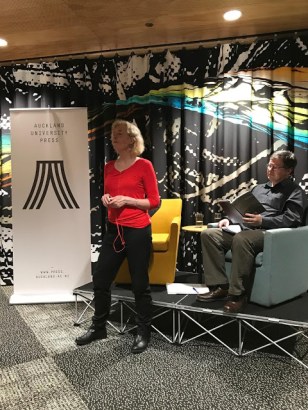
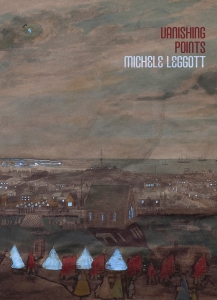
Jack Ross has launched Michele Leggott’s Vanishing Points (Auckland University Press) with similar incandescent word flare. I have read the book twice so far and he is right on point: this is one special poetry collection.


The Speech

Well, needless to say, I felt very flattered when Michele Leggott asked me to launch her latest book of poems, Vanishing Points. Flattered and somewhat terrified. It’s true that I’ve been reading and collecting her work for well over 20 years, and I’ve been teaching it at Massey University for almost a decade now, but I still felt quite a weight of responsibility pressing down on my shoulders!

One thing that Michele’s poetry is not, is simple. It’s hard to take anything in it precisely at face value: what seems like (and is) a beautiful lyrical phrase may be a borrowing from an unsung local poet – a tangle of Latin names can be a reference to an obsolete star-chart with pinpricks for the various constellations.

The first time I reviewed one of her books, as far as I can see, in 1999, I ended by saying “the reading has only begun.” At the time, I suspect I was just looking for a good line to finish on, but there was a truth there I didn’t yet suspect. Certainly, I’ve been reading in that book, and all her others, ever since.

But how should we read this particular book? “Read! Just keep reading. Understanding comes of itself,” was the answer German poet Paul Celan gave to critics who called his work obscure or difficult. With that in mind, I’ve chosen two touchstones from the volume I’m sure you’re all holding in your hands, or (if not) are planning to purchase presently.

The first is a phrase from the American poet Emily Dickinson, referred to in the notes at the back of the book: “If ever you need to say something … tell it slant.” [123] The second is a quote from the great, blind Argentinian writer Jorge Luis Borges: “I made a decision. I said to myself: since I have lost the beloved world of appearances, I must create something else.” [35]

With these two phrases in mind, I’d like you to look at the cover of Michele’s book. It’s a painting of the just-landed Imperial troops, camped near New Plymouth in August 1860. The wonderful thing about it is the way the light of the campfires shines through the painting: little holes cut in the canvas designed to give the illusion of life and movement.

“War feels to me an oblique place,” wrote the reclusive New England poet Emily Dickinson to Thomas Wentworth Higginson in February 1863, at one of the darkest points of the American Civil War. Higginson, a militant Abolitionist, was the Colonel of the 1st South Carolina Volunteers, the first officially authorized black regiment in American history. He was, in short, a very important and admirable man in his own right. Perhaps it’s unfair of posterity to have largely forgotten him except as the recipient of these letters from one of America’s greatest poets.

New Zealand’s Land Wars of the 1860s may have been on a much smaller scale, but they were just as terrifying and devastating for the people of Taranaki – both Māori and Pakeha – in the early 1860s. In her sequence “The Fascicles,” Michele transforms a real distant relative into a poet in the Dickinson tradition. Just as Emily Dickinson left nearly 1800 poems behind her when she died in 1886, many collected in tidy sewn-up booklets or fascicles, so Dorcas (or Dorrie) Carrell “in Lyttelton, daughter of a soldier, wife of a gardener” [75] provides a pretext for “imagining a nineteenth-century woman writing on the outskirts of empire as bitter racial conflict erupts around her.” [123]

There’s an amazing corollary to this attempt to “Tell all the truth but tell it slant” (in Dickinson’s words). Having repurposed one of her family as a war poet, Michele was fortunate enough to discover the traces of a real poet, Emily Harris, the daughter of the Edwin Harris who painted the picture of Taranaki at war on the wall over there, whose collected works so far consist of copious letters and diaries, but also two very interesting poems. “Emily and her Sisters,” the seventh of the sequences collected here, tells certain aspects of that story.

It’s nothing but the strictest truth to say, then (as Michele does at the back of the book), that one should:

walk away from the painting when it is lit up and see how light falls into the world on this side of the picture surface. Is this what the artist meant by his cut-outs? Is this the meaning of every magic lantern slide? [124]

I despair of doing justice to the richness of this new collection of Michele’s – to my mind, her most daring and ambitious work since the NZ Book Award-winning DIA in 1994. There are eight sequences here, with a strong collective focus on the life and love-giving activities which go on alongside what Shakespeare calls in Othello “the big wars”: children, family, eating, painting, swimming. One of my favourites among them is the final sequence, “Figures in the Distance,” which offers a series of insights into the world of Michele’s guide-dog Olive – take a bow, Olive – amongst other family members, many of whom, I’m glad to see, have been able to come along here tonight.

This is a radiant, complex, yet very approachable book. It is, in its own way, I’m quite convinced, a masterpiece. We have a great poet among us. You’d be quite crazy to leave here tonight without a copy of Vanishing Points.

Jack Ross


[Jack and Michele then had a discussion on how the book came into being. I am going to do an interview with Michele so Poetry Shelf readers can also get different entry points into the collection.]


1503612399072.jpg


The poems:


from ‘Figures in the Distance’


18

In he comes, bouncing and sweaty, to borrow a towel and go swimming at Duders. Voice out front, key in the lock, just passing through. A voice on the phone from an airport far away, saying early morning is the time to go and see the ruins outside the city when there’s no one else around. One heading for the beach each morning with a thermos of coffee and that same ragged towel. Breakfast. The other drinking something from a coconut on a beach in Mexico. One in this city, one in that city, two brothers crossing the sea. Camper vans gather down at the bay. Two people sit with their feet in the waves, looking out to sea and drinking wine from glasses they fill from the bottle hung off the side of their aluminium deckchairs. The house at the corner has been flying a tricolore since the Paris attacks. The house next to it is flying a flag that says Happy New Year. Here’s a man walking up the street dripping wet and asking if he can stick his nose into the buzzing magnolia flowers at the gate.


29

I saw the Maori Jesus walking on Wellington Harbour but his pool in the shadow of the museum was drained for repairs and the words were no longer lapped in fishscale light. I saw John Baxter in the pool ecstatic in arcs of water he was splashing over his father’s words on the day the writers’ walk opened. I heard the mihi that was sending Wellington Harbour over the father’s words. I heard the camera catch water light and send it to the eyes of beholders who were a great crowd on the waterfront that day. We took the train as far as Woburn, crossed the platform and came back along the side of the harbour. We took the ferry to Day’s Bay and back riding on the top deck and talking about other excursions. We had a dance at the mardi gras and kept walking along the waterfront to Roseneath. When we turned back there was the young woman walking towards us with bags full of produce from the market. Look, holes, she said.


30

We know what the dog of tears will do next, he who has been trailing the woman standing on the balcony looking up at the sky. She is the woman who wept, he is the dog who licked away her tears. They have gone on like this for some time, the only woman who can see and the dog who is now more human than he wants to be. His nails scratch the wooden floor. His belly is as empty as everyone else’s but he does not mind. He is walking towards the woman on the balcony. When he reaches her she will bring her eyes down to look at the ruined city and become blind. Everyone else will have their eyes back. She will have the dog of tears. The dog will bark holes in the last page of the book and lead her through one of them. There they are, the dog of tears and the woman who wept. His nails click on the rough stones. She who can no longer see begins to tell a story. They pass the street of crocodiles, the pool of tears, the hill of forty days and the hill of forty nights. They pass the little seahorse in its salty pool. They pass a white rose, a black swan, a blue biddy. The dog kills another hen and they roast it over a small fire. They can hear the sea, its fronding on smooth sand, its talking against rocks, its clapotis bouncing off stone walls. What might we not do with the hot bones dripping fat, she says. Two birds rise into the air on wings the colour of ash. Did you hear that she asks the dog licking away the salt on her cheeks.


32

The boy in his green turban the girl in her purple tunic dancing around each other under the old clock on the waterfront. Voices float in the morning air. One says, I had always imagined Paradise as a kind of library. The other replies, It is a bowl that one fills and fills.


©Michele Leggott, Vanishing Points Auckland University Press 2017


Auckland University Press page

Jack Ross’s blog The Imaginary Museum – his extended launch coverage


Poetry Shelf – Spring Season’s poetry fans: Catriona Ferguson picks Janet Frame


Wet Morning


Though earthworms are so cunningly contrived
without an opposing north and south wind
to blow the bones of Yes apart from the flesh of No,
yet in speech they are dumbly overturning,
in morning flood they are always drowned.

This morning they are trapped under the apple tree
by rain as wet as washing-day is wet and dry.
An abject way for the resilient anchorage of trees,
the official précis of woman and man,
the mobile pillbox of history, to die!


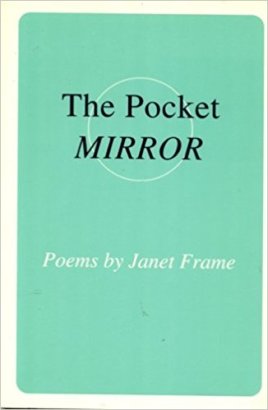
©Janet Frame, The Pocket Mirror (New York: George Braziller, 1967) posted with kind permission from Janet Frame Literary Trust.


Note from Catriona: Having been promised non-stop glorious weather in New Zealand I arrived from the chilly northern hemisphere to an unimpressive, soggy spring. I was taken aback by the Auckland rain; I grew up in Scotland and thought that I knew a thing or two about weather but apparently not. Happily, the first gift I received on arrival was a copy of The Pocket Mirror by Janet Frame. Frame’s ‘Wet Morning’ still reminds me of that time.


Catriona Ferguson is Director of the Publisher’s Association of New Zealand, which represents book, educational and digital publishers in New Zealand. She was formerly the Chief Executive of The New Zealand Book Council and has also worked for Creative New Zealand and the British Council.


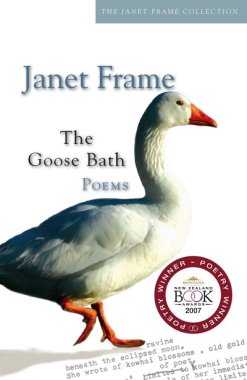
Janet Frame, one of New Zealand’s most beloved authors, both at home and abroad, wrote in various genres, but one of her chief loves was poetry. She published one collection The Pocket Mirror, but wrote copious poems across the course of  her lifetime. With the prior blessing of Janet, and the help of her literary estate, Bill Manhire edited the posthumous The Goose Bath. The collection went on to win the 2007 New Zealand Book Award for Poetry.


9781869790172.jpg                41ymMCH+owL._SX324_BO1,204,203,200_.jpg