Category Archives: NZ poems

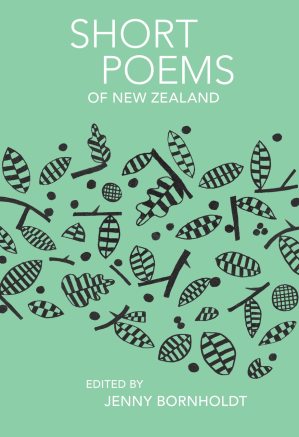
5 readings from VUP’s Short Poems of New Zealand

Short_Poems_of_New_ZealandRGB__74017.1533875435.jpg


Short Poems of New Zealand, edited by Jenny Bornholdt, Victoria University Press, 2018


Angela Andrews reads ‘Grandparents’


Tusiata Avia reads  ‘Waiting for my  brother’


Lynley Edmeades reads ‘The Order of Things’


Brian Turner reads ‘Sky’


Albert Wendt reads ‘Night’


VUP page


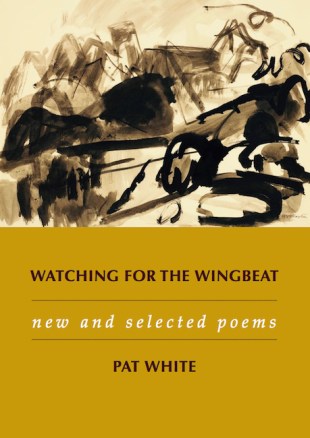
A poem from Pat White’s Watching for the Wingbeat: new and selected poems


There’s much more going on here

for Hone Tuwhare


From where we sat talking the hills take on a painter’s

tone, light and dark, valley and ridge, bush at night

with the small owl sounding far enough away. Both of us

a bit deaf, we shout observations across the back porch


two old gramophones not quite used to listening. Today

stumbling across that ridge, half-lit seen at dusk last night

it’s different, each step testing mud-slide sheep track

fallen trees, such subtle geomorphology, rough slopes facing


north, telling how little distant perspective gets to know

of that hare bursting from beside your foot, fooling

with your sharp-eyed observations about literature

of landscape borrowed from an unpaid library book.


Old Bess the bitch would have given chase once, but today

she thinks better of activities meant for puppied bounce

the silliness of charging off up hill when there’s perfectly

good bones back home rotting under the macrocarpa


it’s enough to be out there, reading the breeze. I watch

you stop, lay a flat hand against grass bruised and bent

by the hare’s body warmth, her form hid beside dead thistle

stalks, dry and buff coloured in winter, it is still warm.


This hare has learned to be elusive, still, till instinctive

urge to flight has her bursting away, past the skylark’s nest

through the rusting fence, pushing the heart’s capacity

to run. We romance the hills from our chairs, our beer


out of the sun’s heat, the rain’s beat, knowing

next to nothing. The risk of leaving our bones out there.


©Pat White  Watching for the Wing Beat: new and selected poems Cold Hub Press, 2018)


978-0-473-44420-4.jpg


Pat White is a writer and artist living near Fairlie. He has an MFA from Massey University, and an MA in Creative Writing from IIML Victoria University. In August 2018 Roger Hickin’s Cold Hub Press published Watching for the Wingbeat; new & selected poems. In 2017 his biography/memoir of the teacher, author, environmentalist, Notes from the margins, the West Coast’s Peter Hooper, was published. An exhibition Gallipoli; in search of family story has been shown in museums and art galleries a number of times in recent years.


Cold Hub Press page

2 poems and a conversation – All of Us by Adrienne Jansen and carina gallegos


homework


she waits

for her children

to fall asleep

before she opens

their schoolbags

and studies their homework.

they learn

so much faster

and she’s falling behind.

they speak her language

with an accent now

and she can’t

understand what they say

when they speak

among themselves

in their new

mother tongue.


carina gallegos


Lost in translation


Lev has learnt

the word in English.

Rabbit.

He points at the book

and says in his thick accent

‘Rabbit.’

It’s freezing cold,

frost on the window.

‘Rabbit’ comes out

in a rush of smoke.

‘No’ I say,

‘that’s not a rabbit.’

I point at the book.

‘It’s a pig.’

He breathes heavily,

clouds of white steam

rising around him.

He goes to the window.

A dog is running

on the white grass.

‘Rabbit!’ he shouts

‘Rabbit! Rabbit! Rabbit!’

and bursts into tears.


Adrienne Jansen


©Adrienne Jansen and carina gallegos All of Us, Landing Press, 2018

Watch a clip from the book launch


Adrienne and carina  gave me kind permission to post their conversation which forms the  introduction to the collection.


Where did these poems come from?

Adrienne: I wanted to write a series of poems from two perspectives: what does someone from Syria, for example, experience when they go to a railway station, compared to what I experience going to a railway station? What would happen if we each wrote about our experience of the railway station?

So I started to write a series of poems that were about ‘there’ and ‘here’. One of the reasons it appealed to me was because I didn’t want to take on the voice of the migrant or refugee. I might be recording the stories and experiences they’ve told me, but I’m not taking on their voice.

Now you can talk about where your poems came from.

carina: my poems aren’t imagined either, they’re just sharing the experiences that people have shared with me. they’re the observations of ‘here’ and ‘there’, when you work with people or communities from refugee backgrounds, you hear these stories over and over again. the stories go on for days and people experience them in their heads every day, and to tell them in a poetic context brings them alive in a more succinct way. but we don’t get to experience the ‘there’, we only experience the ‘here’.

coming from a migrant background it was easy for me to relate to some of their stories too.

Adrienne: Both of us are retelling the stories that we’ve heard and heard and which we think are very important to pass on, and in this case, we’re recording them in poetry.

carina: exactly. it’s storytelling poetry.

that was the other part of the vision – that we were going to write poetry that was accessible to a wide range of people. it wasn’t conceptual poetry, it wasn’t difficult, it was poetry that a lot of people could read and understand, even if there were other layers of meaning, even if there were stories between the lines. there was something there, regardless of whether you could read between the lines or not.

Adrienne: Tell me why you don’t use capital letters.

carina: because i don’t like capital letters.

Adrienne: Because … ?

carina: ever since i was a little girl i’ve had an issue with authority (that’s a longer conversation). i don’t mean for the lack of capital letters to be an obstacle for people. it’s quite common for poets to play with capital letters and punctuation and with the aesthetics of letters and words. i love full stops and commas and use them in a very traditional way. i just don’t like capital letters. i don’t even use them to spell my name.

Adrienne: So that was a challenge for us, how to combine two quite different styles. I use capitals and punctuation because I see them as a kind of small signpost to the reader and a kind of fine-tuning for the writer. That would be my approach.

But there are other differences in style too. Like yours – would you describe your style as Latin American style? It’s more discursive.

carina: we talk a lot. latin americans, i mean.

Adrienne: You talk a lot. Right. And of course, New Zealanders don’t talk so much. This could be very interesting!

carina: we’re long-winded people.

Adrienne: That’s why you’ve got longer poems than mine. We’re both being true to type.


carina: and there’s also the weather factor. we’ve been told that in the poems it rains a lot. the weather here is not tropical. if we lived in central america or south america, we’d be writing about mugginess or bad hair days. but in new zealand the challenge is the weather, even for people who were born here. it’s the cold weather that challenges people.

Adrienne: So that’s why it rains a lot.

carina: that’s why it rains a lot.

Adrienne: In the poems.

carina: because in new zealand it rains a lot.


From All of Us, published by Landing Press November 2018


Carina Gallegos has a background in journalism and development studies. She grew up in Costa Rica, moved to New Zealand thirteen years ago, and has worked with refugee-background communities since 2011. She lives in Wellington with her family.

Adrienne Jansen has published numerous books (poetry, novels, nonfiction). She teaches on the Creative Writing Programme at Whitireia Polytechnic. For ten years she was part of the writing team at Te Papa, New Zealand’s national museum. She lives in Wellington.

Poetry Shelf Monday Poem: Zarah Butcher-McGunnigle’s ‘From the discomfort of my own home’


I had a brief period last week where I didn’t hate everyone. But now I’m back to hating everyone. Someone from an online dating website asks me if I am going to this music festival because everyone he knows is going and he feels left out. I’ve never heard of it, I say, I don’t even know what that is. I say I don’t have any friends though so maybe that’s why I don’t hear about these things. He says, everyone loves to say they don’t have friends when they actually do. I say, Yeah, and everyone loves to say to people who say they don’t have any friends, that they actually do have friends because they’ve never been in a position where they haven’t had friends so they can’t actually imagine it. Well, your negative energy is probably putting off potential friends right now, he says.


Woke up to a message from someone I haven’t spoken to in a while that said “hey so if u could send me nudes that would be appreciated, I’m going to jail soon for 2-3 years.” The only thing I have going for me right now is that I have good nipples and good eyelashes. On the train on the way to a job interview I’m looking at my own nudes to build my confidence. The interviewer asked me what I was doing between 2013 and 2015 and I didn’t feel like I could say debilitating depression and poor physical health so I said I worked as an English tutor for an educational company, but then she asked for a reference from them.


Is the noise I can hear coming from the inside of the building or the outside, I can’t tell. No one is replying to any of my messages. Last week I was supposed to go on a date with someone who already cancelled on me twice. The first time he said he was too tired, the second time he said the weather was too warm. I said to him, look, if you have changed your mind about meeting, that’s ok, let me know, otherwise we could do Thursday. He didn’t acknowledge the part of the message about changing his mind or not, he just went ahead and made a third plan for Thursday. But when I woke up on Thursday, there was a message from him at 7.50am that said he couldn’t meet up. He said he’d gone to his therapist and realised he wasn’t in the right state to meet people at the moment. Well, I could have told you that for free, I wanted to say, but I didn’t reply.


©Zarah Butcher-McGunnigle


Zarah Butcher-McGunnigle is from Auckland, NZ and currently lives in Melbourne. She is the author of Autobiography of a Marguerite (Hue & Cry Press, 2014). Her chapbook, nostalgia has ruined my life, was recently a finalist for the Subbed In Chapbook Prize 2018. You can donate to their fundraising campaign here


A poem from Heather Bauchop’s new collection – Remembering a Place I’ve Never Been


Holes


On the fallen stone

the lead lettering of ‘died’

stands proud


the rest of the story

has dropped out

leaving only the peg holes of memory.


©Heather Bauchop

from Remembering a Place I’ve Never been: the past in three voices (Cold Hub Press, 2018)


Heather Bauchop was born in San Francisco to Scottish parents who migrated to New Zealand in 1972. She is a public historian living in Dunedin. Her poetry and fiction have appeared in a number of journals. She won Takahe‘s 2016 short story competition.


9780473453671 cover.jpg


Reading CK Stead’s That Derrida Whom I Derided Died: Poems 2013 – 2017

1536809900755.jpg  1536809900755.jpg  1536809900755.jpg

CK Stead, That Derrida Whom I Derided Died  Auckland University Press  2018


Frank and Allen, Robin, Ron and Rex

rode the North Shore ferries, while Rangitoto

pictured itself sunk in a stone composure.

Eeven the Golden Weather would have to end

where a small room with large windows disclosed

geraniums wild in the wet and a gannet impacting.


from ‘That summer cento sonnet, 1950s’


In September I listened uncomfortably as Steve Braunias questioned CK Stead and Charlotte Grimshaw about the truth of happy childhoods in the Stead family. Steve insisted but Karl and Charlotte sidestepped with tact and grace. I have since read and loved Charlotte’s novel Mazarine – I was caught up in both the momentum of a thriller and entranced by the interior struggles of the main character. I savoured the novel for the novel’s sake rather than muse upon autobiographical tracings. In this world on edge the novel felt vulnerable, driven, humane. It was writing I felt as much as I thought.

Here I am writing about the daughter when I have just read the father (his novel waits me).

When I first picked up Karl’s new poetry collection, That Derrida Whom I Derided Died, the title catapulted me back into the gated community of literary theory.  I wanted to open the book and travel lightly but I was carrying the Going West session into the collection; that tension between what you write and what you live. I can’t think of a New Zealand literary figure who has courted greater controversy, maintained lifelong enemies along with lifelong friendships, and who has irked so many writing peers. I scarcely know the details of these relations or want to but I have had a long history of reading and admiring Karl’s poetry and fiction. Really I wanted to banish all this external hubbub from my reading and engage with the poetry on its own terms.


In the dark

of the 15th floor

Bill Manhire woke

thinking the building

had turned over in sleep

and groaned

or ground its teeth


from ‘Apprehension’ in ‘Christchurch Word Festival, 2016’


Karl’s collection is deeply personal; the poetry is a meeting ground for dream, memory, retrieval, old age. It is a book of friendships with the living, with ghosts of the past and with writers that attract such as Catallus. He obliquely and briefly returns to arguments and enmities that persisted but for me it is the love of poetry that is the greatest fuel.

The poetry is deftly crafted – like honey at perfect consumption – with shifting forms, syllabics, subject matter. You move from the exquisite opening poem ‘An Horatian ode to Fleur Adcock at eighty’ to the challenge of writing war poems to the final poem written at ‘ten to midnight’.

The 80 plus poems almost match Karl’s age (86) – and maybe that changes things for me as a reader. I am brought closer to death as I am reading, not because death is a protagonist, but because the long-ago past is returned to the frame. And I have had close shaves. What do we want to bring close and find poetic ways to make present? I am asking myself this as I read. Mysterious, dreamlike, moving; yet there is an intensity about these replayed moments. Perhaps luminosity is a better word for these poems that make things utterly present.


She was, she tells me

the one without a partner

until I came

with a bottle of bubbly and two plastic cups

and a small box of rose petals.

‘You realise my age?’ I ask

(uncertain what it is).

‘Of course,’ she says.

‘This was half a century ago.’

So we danced and danced

until just before midnight

when I walked out

into the Bavarian dark.

‘I’ve never forgiven you,’she says.

‘Where did you go? Where have you been?’


from ‘Ten minutes to midnight’


In one poem, ‘By the back door’, Karl responds to Damien Wilkin’s review that suggests Karl’s writing suffers from a glut of lucidity and that his novels yearn to be poems. I can’t say I have ever felt that but Karl suggests in his endnote he wrote this as a semi farewell to fiction. Ah the way we get thrown off kilter. This is what I mean by deeply personal. We are being brought in close to the man writing, the man living, the man and his little and larger anxieties, the man and his little and larger fascinations. And how this might shift and resettle at ten to midnight. In a footnote Karl tells us that he ended up writing at least one novel (The Necessary Angel – it’s on my pile) but maybe two (Risk) after writing the poem.

As I move through the book, lingering over poems with admiration and feeling uncomfortable at others, the outside stories come clamouring. But I hold them at arm’s length. Even when Karl is doing the signposting. Instead I relish the dreamlike moment that the writer, on this occasion, in this instant of almost urgent return, renders lucid, gleaming. This is a book to be celebrated.


I was the one who believed in poetry –

that it could capture the gull in flight

and the opening flower

and in the blink of an eye

a knock on the door of death.

I believed with Shakespeare

there was a trick that unlocked

the mystery of

the named stars.


from ‘I was the one …’


Auckland University Press page

CK Stead is an award-winning poet, literary critic, novelist, essayist and Emeritus Professor at The University of Auckland. He was the New Zealand Poet Laureate (2015 -2017), has received the Prime Minster’s Award for Literary Achievement in Fiction and is a member of the Order of New Zealand, the highest possible honour in New Zealand.



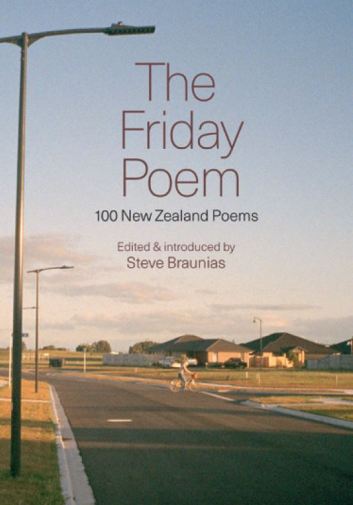
Reading The Friday Poems in a book


cover-1.jpg

Luncheon Sausage Books, 2018


A new poem. Wow just wow

A new poem that no one will forget any time soon.

A new poem. I think it’s important.

I wrote a new poem. You’ll be amazed at what happened next.


Bill Manhire from ‘Thread’


Steve Braunias kickstarted his Friday poem at the Spinoff four years ago – which prompted me to shift my Friday poems to Mondays! Decided to begin the week  with a poem in the ear and have since started an ongoing season of Thursday readings (I really like hearing other poets read, especially those I have never met). More importantly I also like the fact we have more than one online space dedicated to local poems. Steve tends to pick from new books which is great publicity for the poet. I tend to pick poems that have not yet been published in book form and find other ways to feature the new arrivals (interviews, reviews, popup poems on other days).

Steve’s anthology of picks from the Friday-Poem posts underlines our current passion for poetry. I don’t see him belonging to any one club (like a hub around a particular press or city) – unless he is inventing his own: Steve’s poetry club. And there is a big welcome mat out. You will find mainstream presses and boutique presses, established poets and hot-off-the-press brand new poets, a strong showing of Pasifika voices, outsiders, insiders. He is fired up by the charismatic lines of Hera Lindsay Bird and Tayi Tibble but he is equally swayed by the tones of Brian Turner, CK Stead, Elizabeth Smither, Fiona Kidman.


She cried wolf but she was the wolf

so she slit sad’s bellyskin

and stones of want rolled out.


Emma Neale from ‘Big Bad’


Who would he feature at a festival reading? At Unity Books on November 12th in Wellington he has picked: Dame Fiona Kidman, Bill Manhire, James Brown, Joy Holley, Tayi Tibble.

The anthology is worth buying for the introduction alone – expect someone writing over hot coals with an astute eye for what is happening now but also what has happened in the past (especially to women poets). And by hot coals I mean a mix of passionate and polemical. This person loves poetry and that is hot.


Where there’s a gate there’s a gatekeeper, I suppose, but I think of the past few years as an exercise in welcoming rather than turning away. Publishing works of art every week these past four years has been one of the most intoxicating pastimes of my writing life. But I came to a decision while I was writing the Introduction, and commenting on the work of women writers, and adding up the number of women writers: it’s time to step aside. An ageing white male just doesn’t seem the ideal person right now to act as the bouncer at this particular doorway to New Zealand poetry. Women are where the action is: the poetry editor at the Spinoff in 2019 will be Ashleigh Young.

Steve Braunias, from ‘Introduction’


I felt kind of sad reading that. I will miss Steve as our idiosyncratic poetry gate keeper.  Of course this book and the posts are unashamedly Steve’s taste, and there are a truckload of other excellent poets out there with new books, but his taste keeps you reading in multiple directions.

That said it’s a warm welcome to the exciting prospect of Ashleigh Young!


On most drives I like quiet because my mother

had a habit of appraising every passing scene, calling ordinary

things, especially any animal standing in a field, lovely


and this instilled in me a strong dislike for the world lovely

and for associated words of praise like wonderful and superb

but on our drive home tonight the sky is categorically lovely


Ashleigh Young from ‘Words of praise’


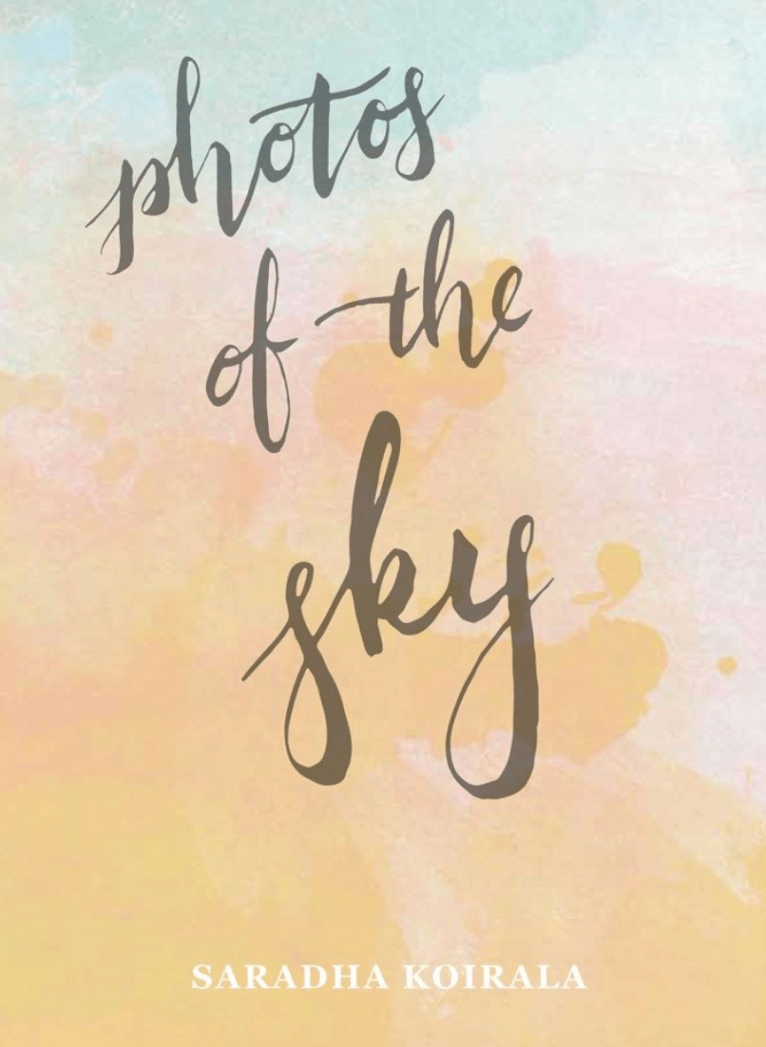
A book launch, a reading and a new poem: Saradha Koirala’s ‘Confession, confessed’


Confession, confessed


I’ve been the secret and the secret-keeper

the one from whom the secret is kept.


I’ve been a curiosity of connections that don’t concern me

the cause and effect of all that is curious.


I’ve been right and I’ve been wronged

I’ve been righteously wrong.


I’ve been a cut-out shape where I used to be seen

and I too have cut fleshy shapes from my life.


I’ve been the problem and the solution

the floating object of insomnia, rage


a presence off limits

that has in turn been there for me.


I’ve been the reason and I’ve been the excuse.

I’ve been falsely accused, rightly refused.


I’ve been the obsession

the obsessed.


I had an alibi.

I am the reason you needed an alibi.


©Saradha Koirala, from Photos from the Sky (Cuba Press, 2018)


November 5th Saradha is launching this new collection tonight at The Thistle Inn in Wellington at 5.30 pm (3 Mulgrave St, Thorndon, Wellington). Launched by the wonderful Tim Jones. Come early to the marquee area at Thistle Inn for a glass of bubbly and some vegetarian snacks, stay for the poetry.

Then on Wednesday 7th Nicola Easthope will join Saradha at Unity Books in Wellington at noon until 12.45 to celebrate their two new books with Cuba Press, Photos of the Sky and Working the Tang.

Saradha Koirala is a writer and teacher living in Melbourne. Her book Lonesome When You Go won a Storylines Notable Book Award. She has Published two previous pietry collections.


Cuba Press page


Screen Shot 2018-11-05 at 3.56.08 PM.png


Poetry Shelf Monday Poem: Vincent O’Sullivan’s ‘In defence of the adjectival’


In defence of the adjectival


An epithet you cannot get rid of

becomes, shall we say, a little house you abide in,

so when the clock dings, or the bird gargles,

the world knows he’ll attend here any second,

the man who lives in the Swiss-chalet-house.


Or you may think, ‘What kind of mantis,

I ask you, if I don’t say “praying”?’

A disappointed mantis I can tell you that.


Stripped of adjectives I’ve sometimes thought,

and you’re Adam & Eve sauntering the Garden,

no one else in sight, as yet quite undecided

as to grasping at fig-leaves.


I know there are writing instructors

who’ll tell you, ‘Shy clear of the adjectival,’

as though they’re telling hikers to avoid

tracks buzzed with wild honey.


What sort of instructor would tell you that?


One who fears the approaching drone.

Who hears the wing-chirrs of intent.

The little hive arriving for him to crouch to.


©Vincent O’Sullivan


Vincent O’Sullivan, who lives in Dunedin, is a fiction writer and poet. His recent works are the poetry collection, And so it is, the oratorio Face, with composer Ross Harris, performed by the BBC Symphony and Choir in London in April, and the novel All This by Chance.


The Meow Gurrrls online

Screen Shot 2018-11-04 at 5.53.59 PM.png


The Meow Gurrrls are a group of women from Wellington, the Kapiti Coast and the Wairarapa who meet regularly to write, read and discuss poetry, often at Meow café/bar in Wellington (hence the name). They’ve kicked off with half a dozen poetry videos and will be adding new content soon, such as the occasional poetry-related interview. There are a couple more Meow Gurrrls yet to record, but so far there are poems by Janis Freegard, Mary Macpherson, Mary-Jane Duffy, Sudha Rao and Abra Sandi King.

Watch here


Screen Shot 2018-11-04 at 5.53.47 PM.png