Category Archives: NZ poems

Poetry Shelf Monday Poem: Maringikura Mary Campbell’s ‘How we loved’


How we loved

for Meg and Te Ariki Campbell


i always wondered why
the dogs never pissed inside the house
How the house gripped onto the hill
the wind
and how we never fell
How you lived even though
you wanted to die, my mother
How we loved and hated
but mostly loved
How we doubted the sincerity
of those whose lives seemed easier
How we hated the Nats
because they hated the poor
How we tolerated those who voted for National
because they thought their wealth would rub off on
them
How our family, our mokopuna, surpassed all others
and how every time we looked at each other we saw
out Tupuna
staring right back at us
How we loved our parents right to the end
of their lives and ours
My beloved parents
How we loved.


Maringikura Mary Campbell


Maringikura Mary Campbell lives in the family home in Pukerua Bay. She is a mother of three and has one mokopuna whom she adores. She published Maringi in 2017. She also published Smells like Sugar – poems by rangatahi young people in psychiatric care and What it takes to fly – poems by mental health consumers from around New Zealand.

You can listen to Maringikura Mary Campbell read another poem (for her grandmother), ‘Ethell Mary’, here


Poetry Shelf Classic Poem: Johanna Emeney picks Michael Jackson’s ‘Green Turtle’


Green Turtle


Sam smashes its head in

with the same sledgehammer

I used this afternoon

to ram our tent pegs home.


A hemisphere turns

turtle; Sonny hacks

its mildewed, sea-marbled

breastplate free.


It recoils from the sky.

Head lolls.

A flipper feebly pushes

Sonny’s knife away.


They empty

the long gray rope of its life

onto the sand by the thudding boat

that holds two more


And its carapace is a vessel

filled with a wine lake

in which clouds

float, birds fly, leaves fall.


Michael Jackson

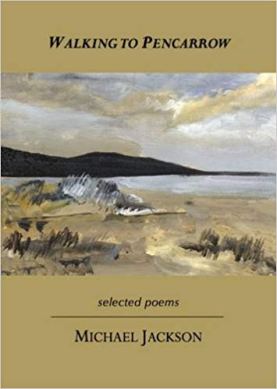
From Walking to Pencarrow: selected poems Cold Hub Press (2016)


This poem was occasioned during Jackson’s one-year stay with a Kuku-Yalanji family in the Bloomfield rainforest. The butchering of the turtle was carried out by his host’s brother and brother-in-law, and it was an incident that clearly raised conflicts within Jackson, both cultural and emotional. It is described in his nonfiction books The Accidental Anthropologist (Longacre, 2013) and As Wide as the World Is Wise: Reinventing Philosophical Anthropology (Columbia University Press, 2016). Jackson includes the poem in the memoir and the textbook.

The speaker’s complete vulnerability to the experience (not openness, vulnerability) is one of the main things that makes the poem so powerful for me. The narrative position of the speaker is that of an outsider endeavouring to be respectfully uninvolved in the spectacle. The reader can feel his reluctance to place judgement on this cultural encounter. However, it impossible not to intuit the initial shock of the first lines and the reverence of metaphor describing the turtle—I see him almost like an old general being denuded of his armour when “Sonny hacks/its mildewed, sea-marbled/breastplate free”. The diction and imagery create a perfectly credible awkwardness and humility to the speaker in the face of the turtle’s brutal death.

The other aspect of “Green Turtle” that I find very powerful is the transcendence of the final image. The last stanza is a distillation of everything that has gone before, and, as an ending to the poem, is exquisite, raising the narrative recollection of the killing of the turtle to a lyric contemplation of this event in the scheme of things, especially within a Western, Christian model. Here, in the final lines, is the shell of the turtle, a vessel containing a blood-wine, literally reflecting the things of the world that go on as normal despite the creature’s violent death just moments before. With this ultimate image, the poet invites his readers to undertake their own reflection on humankind and nature, on life and death, on religion and culture. The poem ends with such opening out, and such unexpected beauty.

Johanna Emeney


Jo Emeney holds a PhD in Creative Writing, and has taught at Massey, Albany, for the past nine years. She also runs the Michael King Young Writers Programme with Ros Ali.
Jo read English Literature at Pembroke College, Cambridge, and then taught senior school English Literature for twelve years. She has written two books of poetry (Apple & Tree, 2011; Family History, 2017), and one nonfiction book on the topic of lyric poetry and the medical humanities (2018). She has just finished drafting a chapter for Routledge on Disability and Poetry.

Michael Jackson is internationally renowned for his work in the field of existential anthropology and has been widely praised for his innovations in ethnographic writing. Jackson has done extensive fieldwork in Sierra Leone since 1969, and also carried out anthropological research in Aboriginal Australia, Europe, and New Zealand. He has taught in universities in New Zealand, Australia, the United States and is currently Distinguished Professor of World Religions at Harvard Divinity School. His most recent books include The Varieties of Temporal Experience (2018), Selected Poems (2017), and The Paper Nautilus: A Trilogy (2019). Cold Hub Press author page.


41cl-rF2JDL._SX353_BO1,204,203,200_.jpg


Poetry Shelf Monday Poem: Kim Meredith’s ‘Summer’


Summer


I have eyes for the cake

rising slowly in the oven.

The sweet smell of vanilla

escaping, but there is talk

about the pond teeming

with Goldfish. Go see the fish.

Every visit goes like this.


Now my mother joins my

aunt, looking back and forth

to her sister and the gaggle

of us, her head nodding toward

the kitchen door that leads out

to the lush garden and pond.


On the steps I hear the kettle

whistling over my aunt laughing

as the two relax, swapping secrets

of forbidden love. Our ears deaf to

their native tongue.


Outside amongst the hedges we

reach between branches of Camellias

searching for treasure. The winner –

the first to hold up a fist with a cicada

singing for release.


The clouds move at great pace

animals drift in and out of view.

In the distance the wind carries

the sound of intermittent sobbing.

I cock my head to the left and

hear only the cicadas singing

freely on the wind.


Kim Meredith


Kim Meredith was raised in Glen Innes, Auckland; her works have appeared in journals and collections. She has collaborated with artists in New Zealand and overseas. A multi-media artist she is part of Auckland duo Marvellous with Kingsley Melhuish performing poetry and music, their compositions narrate urban sketches of New Zealand life. She is a businesswoman and also teaches at a Music Tertiary School.


Poetry Shelf Monday Poem: Anna Livesey’s ‘Little words’


Little words


Dear heart, a word —

which word? Shall we choose something

secret and unexpected?


Don’t say ‘moon’, everyone knows

that code of longing. Don’t say ‘talk’, the running sound

of every banal conversation.


Don’t say ‘bread’ or ‘wine’ or ‘salt’ —

those easy gestures towards

humanity and history.


Don’t say ‘love’ — that hollow ‘o’ so easy to look through.

One might say ‘bird’ or ‘house’ or ‘hand’ —

nearer sounds to the one we are looking for.


There is always ‘silence’

or ‘question’ — don’t say these words,

too large to qualify.


Let us sit quietly.


Let us shape a small word that holds us.

Let that little word

be ‘name’.


Anna Livesey


Anna Livesey is a poet, corporate strategist, stand-up comic, policy analyst, literary curator-at-large, podcaster, shouting yogi and early morning raver. Born and raised in Wellington, Anna studied at Victoria University where she completed a BA in English and an MA in Creative Writing. Anna also holds Masters degrees in Public Policy and Business Administration.

Anna has published three poetry collections to date: Good Luck (2003), The Moonmen (2010), and Ordinary Time (2017). She currently lives in Auckland with her husband and two children.


Poetry Shelf audio spot: Jane Arthur reads ‘Snowglobe’


The poem, ‘Snowglobe’, was published in Mimicry 5 and will appear in Jane’s first collection CRAVEN to be published by Victoria University Press in September 2019.


Jane Arthur was the recipient of the Sarah Broom Poetry Prize in 2018, judged by Eileen Myles. She has worked in the book industry for over fifteen years as a bookseller and editor, and has a Master of Arts in Creative Writing from the IIML at Victoria University of Wellington. Born in New Plymouth, she lives in Wellington with her family. Her first poetry collection will be published in September 2019 by Victoria University Press.


Poetry Shelf Classic Poem: Elizabeth Morton picks Janet Frame’s ‘I Visited’


I Visited


I visited
the angels and stars and stones;
also, adjectival poets, preferably original.
There was an air of restlessness
an inability to subside, a state of being at attention,
at worst, at war with the immediately beating heart and breathing lung.
I looked then in the word-chambers, the packed warehouses by the sea,
the decently kept but always decaying places where nouns and their
representative images lay together on high shelves
among abbreviations and longlost quotations. I listened.
Water lapped at the crumbling walls; it was a place
for murder, piracy; salt hunger seeped between the shelves;
it was time to write. Now or never. The now unbearable,
the never a complete denial of memory:
I was not, I never have been.


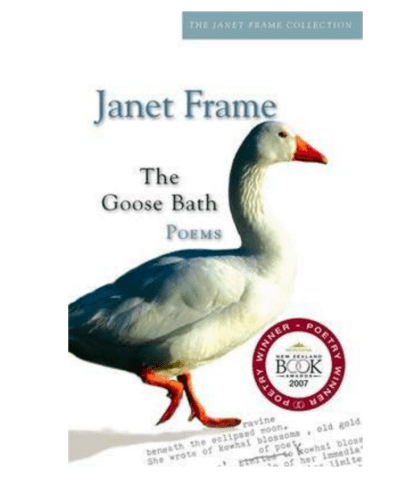
Janet Frame from The Goose Bath: Poems, Vintage, 2006


published with kind permission from The Janet Frame Estate (note in The Goose Bath states that this appeared as a section in a long untitled sequence)


Notes from Elizabeth Morton:

Veni Vedi Veci is a T-shirt-perfect slogan, gloating in its victory of ancient history, and its facility with Latin grammar. As an undergraduate I likely sported such an item of casual alliteration. I may have stood at the fence of Albert Park, smoking a Wee Willem cigarillo, mispronouncing the words to passing first-years and telling a bastardised yarn about Julius Caesar. Janet Frame’s poem, ‘I Visited’ relates a quieter, more tentative conquest – that ends in brute self-nihilation – ‘I was not, I never have been’. This is no Caesar. Here is a concession that our words are things to be borrowed, not usurped. There is a sense of things in flux, things that spill through the gaps in your fingers – ‘decaying places’ and ‘crumbling walls’. There is no pillaging of intangibles. The world of words is a lending library with ‘word chambers’ and ‘high shelves’.

Frame’s poem is gently playful. Through it, I recognise this impossibility of ownership. Words are slippery; words alter to their context; words are shared but never spent. I have supermarket bags full of words – words for ‘angels and stars and stones’, earthly and metaphysical – words like ‘turophile’ and ‘oleaginous’ and ‘eosophobia’ and ‘absquatulate’. They can never be conquests. I visit them. Visito. And I try to shake the dust off the words that have been left for dead. Words are people too, you know – ‘with beating heart and breathing lung’. Frame’s poem captures an excitement, a vitality, and also an humility. Also, ‘salt hunger’ makes me shiver.


Auckland writer, Auckland writer, Elizabeth Morton, is published in New Zealand, Australia, Ireland, the UK, Canada and the USA. She was feature poet in the Poetry New Zealand Yearbook 2017, and is included in Best Small Fictions 2016. Her first poetry collection, Wolf, was published with Mākaro Press in 2017. She is completing a MLitt at the University of Glasgow, usually in her pyjamas.

Janet Frame (1924-2004) published eleven novels, five story collections, a previous volume of poetry (The Pocket Mirror, 1967), a children’s book and a three-volume autobiography. She won numerous awards and honours, including New Zealand’s highest civil honour when she was made a Member of the Order of New Zealand in 1990. In 2003 she received the Prime Minister’s Award for Literary Achievement and was named an Arts Foundation Icon Artist. Pamela Gordon, Denis Harold and Bill Manhire edited The Goose Bath, Janet’s posthumous collection of poems in 2006.


Screen Shot 2019-06-05 at 9.08.19 AM.png


Poetry Shelf review: Murray Edmond’s Back Before You Know

ME_BBYK_StoreCover.png


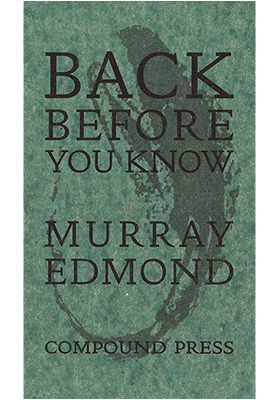
Murray Edmond, Back Before You Know, Compound Press, 2019

Jonas Bones, Jonas Bones esquire,

whale-stabber, seal-clubber,

great hands held like tongs in the fire,

road-digger, gold-grubber—

JONAS: Never did have no blasted luck,

every plan came unstuck—

Always up to his ears in muck

couldn’t make two ends meet.

So one last chance to call a stop

one last throw on a crumbling life,

on the King Country line he set up shop,

with one lone child and one sharp wife.

from ‘The Ballad of Jonas Bones’


Murray Edmond is a playwright, poet and fiction writer; he has worked as an editor, critic and dramaturge. Several of his poetry collections have been finalists in the New Zealand Book Awards:   Letters and Paragraphs, Fool Moon and Shaggy Magpie Songs. He has worked extensively in theatre including twenty years with Indian Ink on the creation of all the company’s scripts.

Murray’s new collection comprises two long poems that play with other sources; with fable, allegory, history, theatre, poetics, the ballad form. The first poem, ‘The Ballad of Jonas Bones’ steps off from Robert Penn Warren’s ‘The Ballad of Billie Potts’ (1943), from Kentucky to the Waikato / King Country. Murray claims his version as a palimpsest or adaptation, leaving traces of the original version, ghost-like and haunting. We may find vestiges of place, the story that gets passed down the line from ear to mouth, the innkeepers who rob their well-off guests, a character’s return to origins, the cutting shards of history, the kaleidoscopic turns of humanity. I haven’t read Warren’s poem but I sense its eerie presence.

Murray’s fluctuating rhythm and rhymes are like shifting river currents, his poem a river poem carrying the debris of story, hand-me-down anecdote. There’s gold and there’s mud, there’s error and there’s incident, there’s greed and there’s survival. Dialogue gives it life as a theatre piece, staged to the point I invent the presence of audience and a live version runs through my head. I am watching as the past is made present and the future present is gestured at in the revised story along with the original skelton. A wider context is superimposed and hides in the seams: ‘frontier’ stories that mutate in the telling, the more significant misrepresentations that shaped our histories, the way individual stories are muffled within the dominant narratives.

Ah but alongside these fertile underground veins is the fact this is a cracking good story with its blinding twists and wounding heart. For some reason I kept thinking of Blanche Baughan’s affecting long ballad, ‘Shingle Short’.

The second poem, ‘The Fancier Pigeon’, is equally arresting with Murray characteristically playful. I am reading with a wry smile, every sense provoked, my reading momentum both fluid and addictive.  We meet the fancier pigeon and the pigeon fancier (she with her hair aglint) when they meet perched on stools at a bar:


She had hair the colour of apricot

she smelt like a cake just taken

from the oven and her father played

drums in a band in the only night club

in town


I am always reluctant to spoil the unfolding of a poem, long or short, in ways that ruin the reading experience, that spotlight the darkened nooks and crannies, the poem’s pauses or digressions. That dampens the joy of reading. But I will say when the two characters kiss a pigeon drops a ring at their feet – they decide they will each keep the ring for a week and then only met when they exchange the ring. Such an emblematic hook.

The poem feels cinematic (visually sharp, moody hued), theatrical (with both dialogue and action body gripping) and fable-like (overlaying universal themes of love, betrayal, mishap and destiny). The poem also feels cinematic with its smudged lighting as though we can’t quite be sure what happens between this scene and the next, with the cue to fable never far off, the characters, a quartet, shifting and sliding in and out of view.


and it was there

the girl had stopped her

as she walked

“Has he come asking for me”

of course he had so she said “No”

and as if she were granting wishes

she asked

“You wanna come out on the lake

with me in the canoe?”

and she had lead her down

among the bulrushes


What I love about the poem – beyond the supple language play and the sensual images, the addictive and offbeat characters, and the narrative tug – is the way the world adheres. As reader you can’t just stick to the poet’s diverting fable – because the real world intrudes, the hurt and broken world if you hold the bigger picture, and the miniature daily stories if you hold the way humanity is formed by individuals. Both things matter at the level of the humane.

The book’s punning title, like a cypher, a tease, is also a ‘dropped ring’. It is re-sited as the last line: ‘BACK AGAIN BEFORE YOU KNOW’.  And I am looping back on the unknown and the achingly familiar, the beginning that is ending that is beginning and so on, the switch back roads and the clifftop vantage points, the downright miraculous and the daily mundane. Ah setting sail on this poetic loop, with its blurs and its epiphanies, is sheer bliss. Poetry bliss.


Compound Press author page

Poetry Shelf Monday poem: Liz Breslin’s ‘getting away from it all with the feminists’


getting away from it all with the feminists


she is self sufficient, thank you very much

she has packed tea bags, brandy, chocolate, honey, wine, scroggin, olives, crackers, cheese, 30 second oats, a jar of ready espresso-ed coffee, double-wrapped, a home-made mix of potato mash, French onion soup power, salt, pepper, hand-chopped spring onion and bacon flakes, toilet paper, sanitiser, matches, candles, firelighter, New Yorker, cook pot, gas canister, three-prong burner, spork, mug, a whole, firm salami and

she is carrying a sleeping bag for all seasons, a midweight puffer jacket, a water-resistant shell. she wouldn’t be conned into buying something tagged waterproof for twice the price. very few things are truly impermeable, this she knows. she has her beanie, her sunnies, her sun hat, her thermals, the nagging start of a blister and a throb in the nub of her back. a deep breath. keeping it light. they are on a ridge, just emerged from the bush, and he turns back and offers his hand and

she is distracted by a twitch in his southwest forearm and a hint of tannin sweat and the glint of the sun refracting on his teeth and that little chinlip tuft he hasn’t quite shaved and

she hasn’t even stumbled when he says if you feel yourself falling remember there’s time to decide which way you’re going to jump


Liz Breslin writes plays, poems, stories and a fortnightly column, ‘Thinking Allowed’, for the Otago Daily Times. Her poetry collection, Alzheimer’s and a spoon (OUP), was listed as one of The Listener’s Top 100 Books of 2017. At home on the page and on the stage, Liz’s recent performances include ‘Love in a time of netball’ at the sold-out Wanaka season of Tall Tales and True, and a stint as the back end of Jill the Cow for her 2018 pantomime, Jac and the Beansprouts. In 2019 she’s heading to Dunedin, Vancouver and Krakow to read, write and perform. Her website


Poetry Shelf Friday talk spot:Rebecca Hawkes on the poem as a snowglobe to contain the Anthropocene


_20190506_135411.JPG


At the moment it feels like pretty much every bright future I’d hoped for is at stake. On a grand scale the triple threats of economic precarity, bigoted populist political bullshit, and environmental degradation aren’t, uhhhh, great. And given human carelessness with our pollution, poisons, and climate apocalypse, basking in the glory of nature isn’t really cutting it anymore as a source of solace. Even David Attenborough is freaking out.

And still, to not be helpless, I turn to poetry. How else to process a planet-sized grief?

Ecopoetry as political activism and/or aesthetic impulse isn’t a new idea. But right now I’m interested in how others write about the effects humans have on nature, and how that affects us.

A poem that floats to the surface of my mind regularly, naming the current epoch, is ‘The Anthropocene‘ from Helen Heath’s Ockham winning (!!!!!!!!!) Are Friends Electric? The poem stars a tui and lyrebird mimicking the technological music of the species that destroys their native forests – cellphone trill, car alarm, camera shutter, chainsaw. Chainsaws in birdsong! I think of this too often.

Speaking of mimics, the new issue of Mimicry I just received contains two back-to-back poems on the drift of plastics through the furthest reaches of the ‘natural’ environment. Rhys Feeney’s ‘current mood’ and Erik Kennedy’s ‘Microplastics in Antarctica’ work to process the sheer scale of human junk, and model ways to respond to the guilt and arrogance of that phenomenon.

From Feeney:

“you thought you
were a god / but this sushi container
will outlive you /”

From Kennedy:

“Scratch the scalp of civilisation
and bits of it go all over the place.
Concerned about those embarrassing flakes?
You should be.”

Feeney’s poem is inspired by Pip Adam’s The New Animals which is great because I’d wanted to shoehorn that novel (with its hypnotic trajectory towards a widening gyre of sea-garbage) into this discussion somehow. Having dipped a toe in prose, it’s worth noting that my own poetry on nature (and the work of local poets like Gregory Kan and essa may ranapiri) has been influenced by Jeff Vandermeer’s novels too – testing out new ways to live in a changed world.

Poems about what people do to the environment, and what that means for us, help me work out how to rage and cope as well. When I’m overwhelmed, picking up a poem can help. Poems can help us look at the impact we have on our planet – but in a container compact as a snowglobe, enough to hold in two hands. A poem asks you to sit mesmerised by something and turn it over to see how it shifts. Shake the poem and watch what happens to the tiny landscape in the swirling glitter.

Showing off the capacity of a poem to be both moving and scientifically informative is a knack shared by Heath and Kennedy – their poems often incorporate research, like the press release that kicks off ‘Microplastics in Antarctica’. And ecopoetry is not always straightforwardly scientific – take Lucie Brock-Broido’s dreamy elegy ‘For a Snow Leopard in October‘. But each poem is also a way to pick up something about what’s happening to our world and ourselves. To write like this is a way to stake out what’s real and important. What vision of the world we should hold on to, what kind of mark we want to leave – from the Great Pacific Garbage Patch to the snow leopard vanishing.


Rebecca Hawkes is a poet, painter, and reluctant corporate ladder ascender. She’s from a high country farm near Methven and is now making it biggish in the small-medium city of Wellington. Find Rebecca’s poems scattered through journals like Starling, Sport, and Sweet Mammalian – or on her website. A collection of her writing will be published in August 2019 in the revival issue of the AUP New Poets series, alongside the work of Carolyn DeCarlo and Sophie van Waardenberg.

Poetry Shelf classic poem: Tracey Slaughter picks Fleur Adcock’s ‘Composition for Words and Paint’


Composition for Words and Paint


This darkness has a quality

that poses us in shapes and textures,

one plane behind another,

flatness in depth.


Your face; a fur of hair; a striped

curtain behind, and to one side cushions;

nothing recedes, all lies extended.

I sink upon your image.


I see a soft metallic glint,

a tinsel weave behind the canvas,

aluminium and bronze beneath the ochre.

There is more in this than we know.


I can imagine drawn around you

a white line, in delicate brush-strokes:

emphasis; but you do not need it.

You have completeness.


I am not measuring your gestures;

(I have seen you measure those of others,

know a mind by a hand’s trajectory,

the curve of a lip).


But you move, and I move towards you,

draw back your head, and I advance.

I am fixed to the focus of your eyes.

I share your orbit.


Now I discover things about you:

your thin wrists, a tooth missing;

and how I melt and burn before you.

I have known you always.


The greyness from the long windows

reduces visual depth; but tactile

reality defies half-darkness.

My hands prove you solid.


You draw me down upon your body,

hard arms behind my head.

Darkness and soft colours blur.

We have swallowed the light.


Now I dissolve you in my mouth,

catch in the corners of my throat

the sly taste of your love, sliding

into me, singing;


just as the birds have started singing.

Let them come flying through the windows

with chains of opals around their necks.

We are expecting them.


Fleur Adcock


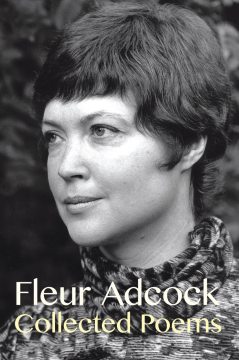
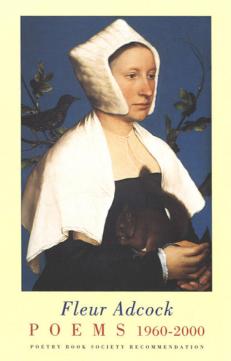
From Poems 1960-2000 (Bloodaxe Books, 2000). Subsequently published in Collected Poems (Victoria University Press); originally published in Tigers (Oxford University Press, 1967). Posted with kind permission from Bloodaxe Books and Victoria University Press.


Note from Tracey Slaughter:


When I read Fleur Adcock’s ‘Composition for Words and Paint’ I get a feeling like I’ve just stepped from glaring sunlight into a dim cool room, a blinking transition where objects shift their edges, textures and sensations blur. Things cross the retina that shouldn’t coexist – heat and cool, shade and sheen, disorientation and sharp awareness – as the dazzled eye tries to pull focus on outlines, shadows, glints. I’ve read it so many times now I could start to break down how its sheer mastery does this to me – but first I’d rather just surrender, step over that threshold, and let it return me to that liminal space it evokes, that experience of sensory eclipse.

Charted in a present tense aquiver with nowness, it’s a poem that wants to keep you in that state of dissolve, that hazy receptivity. Stanza through stanza as it tracks the movements of lovers drawing close in an intimate room, it guides the senses through concrete details that both cloud and illuminate, define and veil, observing the couple’s actions through sustained brushstrokes of metaphorical paint. It’s a poem that watches the act of love with an eye for its composition on the canvas, using the artist’s gaze to render the encounter in visual strokes and shapes, bringing bodies to slow light through questions of perspective, surface, angle, plane. As if conducting an ekphrastic exercise, analysing imagery already framed, it envisages the elements of this love scene in terms of its visual field, lining up the lovers in a studied play of light, curve, pose, dark, parallel, emphasis, depth. But if it employs the methodical and intricate tone of the artist approaching the canvas at the same time it applies the motif of paint to evoke the flooded senses of the lover lost in the work-at-hand’s erotic experience. Issues of surface, extension, colour, focus are at once used to underline the artist’s trained gaze and to wash the scene with a sensuous physical impression of the lovers’ work in progress. ‘I sink upon your image’ the speaker says – the borders of the canvas collapse. It pivots on a repeated play on ‘drawing,’ a practice which moves both brush and body – from a white line sketched around a figure, a head is drawn back, another tantalisingly down – using the term to figure both the tactile capture of the painted line and the gestural seduction of bodies, the pull and call of the lovers pacing and exploring each other in the shaded room. In that elided term, the hand that draws cannot sustain its ‘measured’ distance, it’s too coated in the palette of touch, too absorbed in lust for each line it envisages. Each brushstroke shivers on the painter’s own skin as it orders and colours objective space. It’s part of the mystery I love in Adcock’s language throughout the piece, that it can be at once controlled and lush, clinical and intoxicating – when I read it over I’m always searching for how it extracts such pulse from precision, such glistening intensity from poised restraint. Heat and chill, dark and gleam, it always keeps me blinking for how she keeps that threshold so skilfully blurred.

From an eye scrutinizing the shades and planes of love, the perspective slips to a place where the deeply implicated speaker can only ‘melt and burn’; I imagine that Adcock must have known the work of other women trying to depict female desire around this era: I always hear a tinge of Plath and Sexton in that phrasing. Perhaps there’s an echo of those poets present in the voice of this piece too, its commanding first-person, an ‘I’ intent on fixing and tracing the interaction with ‘you’ in a potent, honed, hypnotic tone. The slow processional sound of each line moves like brush or fingertip savouring the detail, like an entranced hand lingering on the contours of all it draws to light, tasting and positioning each syllable that ‘discovers’ the body with its palpable paint. It is unconventional glints of the lover that are touched upon too, the odd raw details an ordinary love-poem would read as flaws lifted into luminosity – flashes like ‘thin wrists, a tooth missing’ stand in contrast to the points of perfection a love ode would usually pick out, but the ‘tactile reality’ of this encounter sets them alight with ache and lustre. The final blur is ultimately the blur of fusion, of bodies merged and dissolved in such a close-up all sense of scale is lost from the visual field: ‘We have swallowed the light.’ The paint of the scene now spills into the speaker’s throat as she drinks in the lover: it’s a slyly rapturous depiction of orality which could have been a terrible paean to pleasure, but which Adcock’s lyric language manages to sculpt to a sultry and mutual release. Could any other poet pull off the miracle of birdsong ‘flying through the windows’ at climax? Sometimes I wonder if there’s a tint of darkness caught in the opal chains around the necks of those birds – but if there is, it is set against the tender domination of the voice, its soft imperative immediacy: ‘Now I dissolve you.’ It’s been said that a love poem always appeals as much to the reader as it does to the lover, using its language to pull and lure their senses too into a sweet-talking thrall. Consider me dissolved. ‘Composition for Words and Paint’ always has me at ‘This darkness…’


Bloodaxe Books page

Victoria University Press page


Tracey Slaughter‘s latest work is the poetry collection Conventional Weapons (VUP, 2019). She is the author of the acclaimed short story collection deleted scenes for lovers (VUP, 2016), and her work has received numerous awards, including the 2015 Landfall Essay Competition and the 2014 Bridport Prize. She works at the University of Waikato, where she edits the journal Mayhem.

Fleur Adcock, a New Zealand poet, editor and translator, resides in Britain. She has published numerous poetry collections, her most recent being The Land Ballot (2014) and Hoard (2017). This year Victoria University Press published her Collected Poems. She has won many book awards and has received notable honours including an OBE (1986), the Queen’s Gold Medal for Poetry (2006) and a CNZM for services to literature (2008).


Adcock_Collected__47517.1544061847.jpg     5582f5dd597e7.jpg