Category Archives: NZ poems

Poetry Shelf classic poem: Medb Charleton picks Janet Frame’s ‘I Take into My Arms More Than I Can Bear To Hold’


I Take Into My Arms More Than I Can Bear To Hold


I take into my arms more than I can bear to hold

I am toppled by the world

a creation of ladders, pianos, stairs cut into the rock

a devouring world of teeth where even the common snail

eats the heart out of a forest

as you and I do, who are human, at night


yet still I take into my arms more than I can bear to hold


 Janet Frame

from The Goose Bath, Vintage, 2006

(posted with kind permission from the Janet Frame Literary Trust)


Note from Medb Charleton:

The first time I read this poem it gave me that feeling only poetry can give, my nervous system was instantly held captive by the emotions generated and then freed as those emotions connected with my own lived experiences and ability to dream of life inside this mysterious art form.

Each line, in its weighted simplicity, its juxtaposed images, deciphers that moving and syntactically wonderful title. When I read it in more and more detail, I can see Frame’s musicality of diction with the effortless onomatopoeia, assonance, the line breaks, the repetition with which she somehow manages to weave the philosophical and moral themes that interested her.

A softness and beauty prevails even though adversity and disillusionment are present. The poet is willing to risk all, must in fact if she is to live, and with that very burden, one that she can barely carry, there is something of a pleasure and wonder in everyday things and the destructive capacity of the beautiful. Even she herself is accountable as you and I are. The world threatens to become too much. Not just the suffering, endurance and hardship in the world and in nature, but also its incredible creations, its mysteries – she feels it all intensely and it’s this unbearable weight that she holds.

The repetition of the title in the closing line, its gentle insistence, is both a plea and an acceptance of unattainable goodness with the hope that through this art of making, the poem itself, that she may find truth enough to absolve life’s cruelties, the weight of responsibility and bewildering unknowns and perhaps even be able to bear the pain or emotional intensity of beauty when found.


Medb Charleton grew up in Sligo, Ireland. She did an MA in Creative writing at the IIML in Wellington and since has published poems in Landfall, Sport, JAAM and online.

Janet Frame (1924-2004) published eleven novels, five story collections, a previous volume of poetry (The PocketMirror, 1967), a children’s book and a three-volume autobiography. She won numerous awards and honours, including New Zealand’s highest civil honour when she was made a Member of the Order of New Zealand in 1990. In 2003 she received the Prime Minister’s Award for Literary Achievement and was named an Arts Foundation Icon Artist. Pamela Gordon, Denis Harold and Bill Manhire edited The Goose Bath, Janet’s posthumous collection of poems in 2006.


Poetry Shelf interviews Fleur Adcock

3c58eb2e-2c98-4359-a439-504f7467e974.jpg

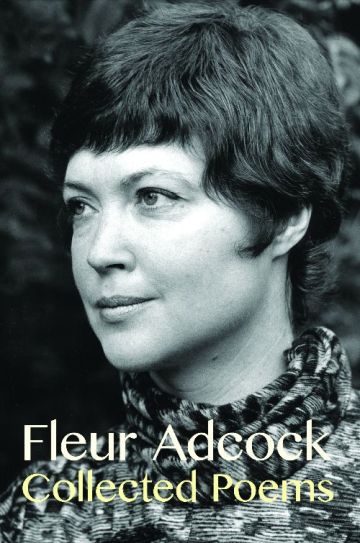
Fleur Adcock, Collected Poems, Victoria University Press, 2019


No; I can’t get it to knit. Scrunch!

Somewhere on the timeline between

the historical Eva whose

disappointments and retreating

daydreams I so tenderly probe

and our childhood’s ‘Grandma Adcock’

comes a fracture: Sam’s young lady,

eager emigrant, pioneer,

snaps into the dumpy figure

telling me off, when I was three,

for proving, at the tea-table,

I could put my toes in my mouth.


from ‘Reconstituting  Eva’ (originally published in The Land Ballot, 2014)


One of the many joys in researching and writing Wild Honey was reading Fleur Adcock’s poetry books – from The Eye of the Hurricane (1964) to Hoard (2017). Since then Victoria University Press has published Fleur’s Collected Poems. It is a sumptuous, substantial tribute to a much loved poet: the hardback book is beautifully designed, keenly edited and a perfect way to enjoy the scope of her poetry.

Born in New Zealand in 1934, Fleur has spent most of her writing life in Britain; she is an editor, a translator and above all a poet. She has published 18 collections of poems including the latest book along with several other Selected Poems. She edited The Oxford Book of Contemporary New Zealand Poetry (1982); The Faber Book of Twentieth-Century Women’s Poetry (1987); The Oxford Book of Creatures, with Jacqueline Simms (1995).  Her multiple awards include the Jessie Mackay Prize in 1968 and 1972, the Buckland Award in 1968 and 1979, and a New Zealand Book Award in 1984. She received an OBE in 1986, the Queen’s Gold Medal for Poetry in 2006 and was made a CNZM for services to literature in 2008.

The effects of Fleur’s poetry are wide ranging; she writes from a sustained history of reading and inquiry, from personal experience and sharp observation, from measured craft to conversational tones. Her poetry can be poignant, witty, serious, physical, abstract, humane. She assembles family and she looks back at New Zealand as she widens the definition of home.

To celebrate the arrival of Collected Poems we embarked on a slow email conversation.


At school I used to read, mostly,

and hide in the shed at dinnertime,

writing poems in my notebook.

‘Little fairies dancing,’ I wrote,

and ‘Peter and I, we watch the birds fly,

high in the sky, in the evening’.


from ‘Outwood’ (originally published in The Incident Book, Oxford University Press, 1986)


Paula: Can you paint a small snapshot of yourself as a young girl? Did books and writing feature?

Fleur:  From the age of six I was always a passionate reader, somewhat to the annoyance of my mother as the years went by. One of my favourite childhood photographs of myself (there were very few, because photographic films were almost unobtainable during the war) is of me lying on my stomach on the grass in our garden when I was eight or nine, reading a book. When I was nearly seven I was given a book called Jerry of St Winifred’s, about a girl who wanted to be a vet and who when trying to rescue a puppy from a rabbit hole accidentally discovered an ancient manuscript. This was when Marilyn and I were living in the country, as unofficial evacuees on the farm of our father’s cousins George and Eva Carter. Auntie Eva told me reading was bad for the eyesight, and restricted me to one chapter a day. If she had wanted to encourage me this would have been the best thing she could have done – in these days of reluctant readers, parents are told that if reading were forbidden more children would want to do it. In my case there was absolutely no need.

At that time we were away from our parents, and therefore writing letters and little stories for them, or at least I was – Marilyn was still at the stage of sending pictures, but it was all useful practice in communication.

The following year, 1940, we were living in Salfords, Surrey, with our mother, just across the road from the small tin-roofed public library. I used to go and browse in it alone, to borrow books. Titles I remember are Fairies and Chimneys, by Rose Fyleman, and Tales of Sir Benjamin Bulbous, Bart, which involved naiads, water sprites, etc. You will observe a fairy theme.

In what seems no time at all we were settled in a house of our own and I was reading whatever I could lay my hands on: library books, books from school, occasional books I was given as presents. Because of the wartime paper shortage these were in rather short supply. I liked adventure stories: Dr Doolittle, books by Arthur Ransome, Robert Louis Stevenson, and inevitably Enid Blyton. When I was 10 my mother lent me her copy of Gone with the Wind, and the following year gave me a rather beautiful ex-library copy of  Pride and Prejudice, which I read over and over again and still treasure. 

I was also writing poems. When I was seven, at Outwood School in the Surrey countryside, I had a little notebook in which I wrote my compositions at lunchtimes. I was there for only three months, from early June to early September 1941, and had no friends. Marilyn was away for the first few weeks, with whooping cough. Poetry was my refuge.


(…) I was impatient

for Jerry of St Winifred’s

my Sunday School prize, my first real book

that wasn’t babyish with pictures –


to curl up with it in the armchair

beside the range, for my evening ration:

‘Only a chapter a day,’ said Auntie.

‘Too much reading’s bad for your eyes.’


I stuck my tongue out (not at her –

in a trance of concentration), tasting

the thrilling syllables: ‘veterinary

surgeon’, ‘papyrus’, ‘manuscript’.


from ‘Tongue Sandwiches’ (originally published in Looking Back, Oxford University Press, 1997)


At my next school, St John’s, I won a gold star (see my poem ‘The Pilgrim Fathers’, and also the previous one, ‘Tongue Sandwiches’, re the earlier experience). I graduated to a slightly larger notebook and my subject matter expanded slightly, although one of my principal influences was still Enid Blyton – our mother thought her little magazine “Sunny Stories” was suitable reading matter for children, rather than the comics we swapped with our friends from school. I also liked ballads and melodrama. There were three more schools before the end of the war. At one we studied ‘The Lady of Shalott’: just my cup of tea, with its Tennysonian sound-effects and melancholy ending.

When I was 13 we went back to New Zealand, and I began writing nostalgic poems about such topics as “Spring in a Surrey wood”. The poems were rather fewer in my teens; some of them were carefully made, with rhymes and proper scansion, suitable for the school magazine, in which I won prizes for ‘The Bay’ and a poem about a seagull. My more private poems came under the influence of TS Eliot, whose work we studied when I was 15. World-weary disillusionment set in, together with free verse; I’ve just found one that ends with the two lines: “But what the hell does it matter? / Let’s go out and shoot ourselves.” The Waste Land has a lot to answer for.

But I’m afraid this is not a small snapshot but a sprawling album! I’ll stop.


Paula: I got goose bumps picturing the power of words and books for the young child making her way from girlhood to adolescence. Has poetry writing always been a refuge for you? Or has it developed other functions?

Fleur: Writing poetry has many functions for me; more than I can identify. It’s art, it’s therapy, companionship, a challenge, an indicator of health – I’ve always been aware that when I’m healthy I’m writing, and when I’m writing I’m healthy. It’s that much despised thing self-expression, as resorted to by generations of teenagers. It’s also, to some extent, my bread and butter. When I had a proper job, as a librarian in the civil service, time to write poetry was the unattainable ideal. Now that I’m retired I have a small pension from that ‘proper job’, but for a long time while I was freelance most of the work I did, in the form of poetry readings, broadcasting, book reviewing, translating, teaching on writing courses, going to festivals, writing libretti, etc, arose out of the fact that I wrote poetry. There’s less of that now – you don’t get quite so many commissions in your 80s – but still a certain amount. And I’m still writing the poems.

Poetry also has a social function. Some 18th century poets used to call their books ‘Poems upon Several Occasions’. I’ve written a number of those, too: poems for other people, for specific occasions or on topics that I hope they will be able to identify with. My poem ‘The Chiffonier’ about a particular habit of my mother’s (marking out special items for her children to inherit, long before she died) turned out to be common to a whole troop of mothers, I was pleased to learn from fan letters. I write a number of family poems: for birthdays, for Greg’s wedding to Angie, for the birth of my great-grandson Seth (a rare male among my hosts of female descendants), also elegies – for my parents and various ancestors, and one for Alistair that I managed to produce in time for Marilyn to read it at his funeral. There are elegies for friends, too, and increasing numbers of laments for doomed or extinct inhabitants of the natural world: birds, butterflies, insects of all kinds (my book Glass Wings contains examples), bats… It would be depressing to go on.


But now I see you in your Indian skirt

and casual cornflower-blue linen shirt

in the garden, under your feijoa tree,

looking about as old or as young as me.

Dear little Mother! Naturally I’m glad

you found a piece of furniture that had

happy associations with your youth;

and yes, I do admire it – that’s the truth:

its polished wood and touch of Art Nouveau

appeal to me. But surely you must know

I value this or any other treasure

of yours chiefly because it gives you pleasure.

I have to write this now, while you’re still here:

I want my mother, not her chiffonier.


from ‘The Chiffonier’ (originally published in The Incident Book, Oxford University Press, 1986)


Art: one of the enormous satisfactions of writing is constructing a beautiful or at least memorable and satisfying artefact. I believe that one of the essential elements of being human is wanting to create some kind of art. I remember having an argument with a friend about this, or perhaps just a misunderstanding – when I say “art” I include large areas of human creative endeavour such as gardening, growing plants, making clothes, furniture, jewellery, or anything that gives satisfaction to its creator. Some people (I’m not among them) find artistic pleasure in cooking. When my grandchildren Cait and Ella were small they spent hours of ingenuity constructing miniature items of furniture for their Sylvanian toys out of scraps of cardboard, Sellotape, fabric or whatever was around; that was art. So, I suppose, were the elaborate cakes their mother made for their birthdays; I remember one in the form of a swimming pool with blue jelly for water. For me the primary art-form is poetry. Very few things make me happier than finishing a poem I’ve been struggling with.


Paula: I love the way poetry emerges from the nooks and crannies of your life and thinking, the way it feeds and spurs. Your Collected Poems demonstrates this so clearly. Rereading the first two collections – The Eye of the Hurricane (1964) and Tigers (1967) – I am reminded how these early poems have travelled so well across the decades. Take the much-loved and anthologised ‘For a Five-Year-Old’ for example.  What were your early preoccupations as a poet in view of both style and subject matter?


I see, then, that a kind of faith prevails:

your gentleness is moulded still by words

from me, who have trapped mice and shot wild birds,

from me, who drowned your kittens, who betrayed

your closest relatives, and who purveyed

the harshest kind of truth to many another.

But that is how things are: I am your mother,

and we are kind to snails.


from ‘For a Five-Year-old’ (originally published in The Eye of the Hurricane, AW Reed, 1964 and then in  Tigers, Oxford University Press, 1967)


Fleur: I don’t think I can answer this in any meaningful way. I could look back through the early collections to see what I was writing about, but so could anyone; it’s not the same as being inside my feelings at the time, which I find it impossible to recall. I wasn’t setting out with any aim or objective; I just wrote about whatever topics suggested themselves, and my chief emotion was “Oh, good, I’m writing a poem!”

One of my first preoccupations, even as an adolescent, was my ‘exile’ from England. I wrote about this in my early teens, and also in the poem I called ‘The Lover’, in which I imagined a male persona trying to adapt to living in a new country. This ridiculous enterprise naturally misfired: everybody thought I was writing about Alistair. Serves me right, for not having had the confidence to write as a female.

Looking at The Eye of the Hurricane, I see that a number of the poems were about relationships with various men, one in particular – a natural preoccupation of a person in her 20s. One person they were definitely not about is Alistair. I was very surprised, in later years, to find that some people imagined he was the character represented in such poems as ‘Knifeplay’, when he was not at all like that.  Most of those poems were written in the nearly five years between my divorce from him and my marriage to Barry Crump in 1962. I never wrote about Alistair while I was married to him. Most of my very few poems about him were written while he was dying or after his death in 2009 – my elegy for him was modelled stylistically on his famous Elegy in Mine eyes dazzle.  My own early “battle of the sexes” poems (to use a Baxter phrase) were about my then current preoccupations. By 1959, Alistair was history.

As for the style, in those days I wrote in traditional verse forms, often rhymed, because it was easier to be convinced that I’d got a poem right if the rhymes and metre were correct. Free verse is far more difficult to judge (I don’t mean blank verse – unrhymed iambic pentameter, as in Shakespeare’s plays – which is another kettle of fish. I certainly used that from time to time.)

When it came to my next collection, Tigers, a new subject presented itself: culture shock. I was suddenly living in a wider society, in England, exposed to the harsh realities outside insular little cosy New Zealand. ‘Regression’ is a reflection of my new political anxieties, although I had also written about the nuclear threat earlier, in NZ. We were all convinced the world could end at any time, as seemed quite likely. But on the whole I rather cringe to open these two earliest collections. I think of what Katherine Mansfield wrote to JMM when he urged her to allow In a German Pension to be reissued: “It is far too immature, and I don’t even acknowledge it today. I mean I don’t ‘hold’ by it. I can’t go foisting that kind of stuff on the public” (quoted in his introduction to the Penguin Modern Classics edition).


All the flowers have gone back into the ground.

We fell on them, and they did not lie

crushed and crumpled, waiting to die

on the earth’s surface. (..)


from ‘Regression’ (originally published in Tigers, Oxford University Press, 1967)


Paula: You touch upon the way autobiography can both corrupt and enhance a reader’s pathways through a poem and the danger of making assumptions about both the speaker and subject of a poem. Some things in a poem stay secret and some are exquisitely open.  As I read my way through your collections I relish the shifting tones, sharpness, admissions, contemplations. The way poems are both oblique and transparent. Two collections have particularly affected me, but before sharing these, are there one or two books that have been especially important in the making and published result?

Fleur: Once again, impossible to answer. For quite some time The Incident Book gave me particular pleasure to look back on, but inevitably it was overtaken by others.  Every published collection that appears between covers and looks like a complete and separate entity is in fact just a bundle of individual poems. When my youngest granddaughter saw the size of my Collected Poems in New Zealand, she said to her father, “Wow! How could she write so many poems?” The answer is, one at a time. Each new poem is a world in itself, something to plunge into and be absorbed by for as long as the writing of it lasts. Only much later does it become part of a published book, if I decide to include it in one. Not every poem is chosen.


21

The fountain in her heart informs her

she needn’t try to sleep tonight –

rush, gush: the sleep-extinguisher

frothing in her chest like a dishwasher.


She sits at the window with a blanket

to track the turning stars. A comet

might add some point. The moon ignores her;

but dawn may come. She’d settle for that.


from ‘Meeting the Comet’ (originally published in Time-Zones, Oxford University Press, 1991)


My feelings about the various collections tend to be influenced by my memories of the circumstances and places in which they were written. For example, Time-Zones received its title from the travelling I was doing during that time I was working on it. It contains poems from my three months in Australia as writer in residence at the University of Adelaide in 1984, including the two long sequences at the end, ‘Mrs Fraser’s Frenzy’ (written for music, originally for Gillian Whitehead, but she decided it didn’t suit the commission she had in mind and it was subsequently set by the English composer George Newson instead), and ‘Meeting the Comet’, which I wrote in bits and pieces during my journey to and from the southern hemisphere, as a way of staying sane and having something to work on while I was in transition from one place to another. (The girl in the poem is fictional, but was originally inspired by the child of friends in Newcastle, who had the same disability although not the same history as the one in the poem.) The collection also includes poems about Adelaide, where I was living for a time, and Romania, which I had visited and where I had made good friends and had my eyes opened to a new political landscape. Altogether a bit of a ragbag – I was crossing time zones as the poems came to me.

How complicated these things are to explain.

Then there was Looking Back, which was short-listed for the T.S. Eliot prize in 1997. It gave me great pleasure to write, or at least the poems about my ancestors did, because of my obsession with genealogy, but shortly afterwards, oddly enough, I lost interest in writing poems for some years, and devoted myself to the ancestors in a big way.

Dragon Talk was important, by virtue of the fact that it marked my return to writing poetry after a gap of several years. However, I certainly wouldn’t call it my best collection; it was a necessary one, to get the wheels turning again, but afterwards I moved on in different directions.

The only book I actually conceived and embarked on as a single entity, in the way you might embark on a novel, was The Land Ballot. I wrote three or four poems about my father’s childhood, and then it dawned on me that  I might be able to produce enough for a book. I did enormous amounts of research for this, over a period of two years, 2012-2013, building up a picture of this remote community and its inhabitants, and was totally immersed in it. Two of the happiest years of my life as a writer. On the other hand, one of the happiest years of my life as a person was 1977-8 (September-June), living in the Lake District as writer in residence at Charlotte Mason College in Ambleside, surrounded by amazing scenery, with time to walk and explore and make discoveries, as well as making a quantity of new friends and spending more time than usual with many of the old ones: if you live in a famously beautiful place and have a spare bedroom you suddenly become very popular. But the poems that emerged from this time are scattered between more than one published collection.


As there was only one lamp

they had to spend the winter evenings

at the table, close enough to share

its kerosene – perfumed radiance –


his mother sewing, and he

reading aloud to her the books

he borrowed from Mr Honoré

or the Daysh boys on the next farm


from ‘Evenings with Mother’ (originally published in The Land Ballot, Bloodaxe Books and VUP, 2014)


Paula: I love the way a poem becomes a miniature absorbing world for both reader and writer, and the way the context of its making is important for the poet. Reading a book is akin to listening to a symphony; you absorb the composition as a whole with certain notes and melodies standing out. I also loved The Incident Book with its fertile movement, physical beacons and emotional underlay. I keep going back to ‘The Chiffonier’, both a conversation with and portrait of your mother. The ending never fails to move me.

But I also loved Looking Back and The Land Ballot, two collections that consider ancestors, the past and the present, an attachment (and detachment) to two places, the UK and New Zealand. I guess it gets personal; the fact I am drawn to the gaping hole of my ancestors with insistent curiosity and the fact your exquisite writing satisfies my interest as a poet. Heart and mind are both engaged. Questions might arise, I feel and think multiple things, the music holds me, the intimacy is breathtaking.

What attracts you in poetry you admire?

Fleur: Another impossible question. The simple answer is simply expressed in the last line of my poem ‘The Prize-Winning Poem’: “it’s got to be good.”  Of course you will ask what is the nature of that ‘goodness’, or excellence? I could talk about the tone, the rhythms, the emotional resonances, the sense of mystery or wonder that poems sometimes induce, but what I always want a poem to do is surprise me. The only full answer would be a list of poems I have admired over the years, which would be impractical.

This afternoon I was listening to a performance of Britten’s Serenade for tenor, horn and strings, which includes the setting of Blake’s little gem ‘O rose thou art sick’, which I’ve known and admired since childhood, but because the musical setting (also familiar to me) slows the words down I was listening to them more carefully than usual, and particularly struck by them. A perfect poem. But then yesterday I picked up the latest copy of the TLS and found a poem by Helen Farish that was totally new to me, and found it striking in a different way, possibly because of its strangeness: it makes you want to know more about the situation she describes, although on the other hand knowing too much might spoil it.

Poems serve different functions in our lives, and how we respond to them is affected by the circumstances in which we read or hear them.


Paula: Indeed. Can you name three poetry collections you have admired in the last few years?

Fleur: The answer is that no, I can’t make any such choices. I don’t do “favourite poets” or “favourite books”. To do so would not constitute a considered judgement. Enthusiasms come and go; they are things of the moment. It takes me a long time to make up my mind about the value of any particular writer. For example, many of my friends have published books that were important to me, but that would be a judgement about friendship, not necessarily about literary worth. I’d rather pass on this question.


Paula: What activities complement your love of poetry?

Fleur: Walking (in our local woods or wherever I happen to be), watching plants grow, watching birds and other living creatures in my garden or elsewhere. The greater the destruction of our natural environment, the more important these things become. When I first bought my house in London, in 1967, huge crowds of birds came to the neighbours’ bird table; miniature froglets hopped around the grass verges when I tried to mow the lawn; the buddleia tree was smothered in butterflies; we used to hear owls in the night. Now that I have my own birdfeeders, and more time to watch and observe the population, I’m more and more aware of the sad losses. On the other hand, I’m grateful for my health and continued ability to look after my garden and get out and about.

Now that my eyesight is so much worse I find myself reading less and listening to music a lot more, but that doesn’t really belong in this interview – music is a completely different medium from literature.


Paula: Thank you Fleur, especially as I posed such difficult questions. I have loved this slowly unfolding conversation that has kept me returning to the joy and richness of your poetry. Thank you for your generous and engaging responses – it is now time for you to get back to what you love – writing poems!


Paths


I am the dotted lines on the map:

footpaths exist only when they are walked on.

I am gravel tracks through woodland; I am

field paths, the muddy ledge by the stream,

the stepping-stones. I am the grassy lane

open between waist-high bracken where sheeep

fidget. I am the track to the top

skirting and scaling ricks. I am the cairn.


Here on the brow of the world I stop,

set my stone face to the wind, and turn

to each wide quarter. I am that I am.


(originally published in Below Loughrigg, Bloodaxe Books, 1979)


Victoria University Press page


Poetry Shelf Monday poem: Louise Wallace’s ‘it’s winter’


it’s winter


sit facing the toilet which look

it’s fine it’s fact it’s winter according

to the new seasonal fruit so shock

your life before it shocks you change

your partner change your wardrobe

your secret your small revelation

nurturing doubt hear the room hear

the strange thin levels that sound

a bit full in your mouth your vocals

their once serene chords like stone tight

like a budget ripe as the bulky

citrus fruit sharp and untrue


Louise Wallace  from… ‘Like a heart’


Louise Wallace is the author of three collections of poetry published by Victoria University Press, most recently Bad Things. She was the 2015 Robert Burns Fellow at the University of Otago, and is the founder and editor of Starling. Louise lives in Dunedin with her husband and their young son.


Poetry Shelf audio spot: Charles Olsen reads ‘Inland’ – ‘Tierra adentro’


nzpoetryshelf-DSCF3056.jpg


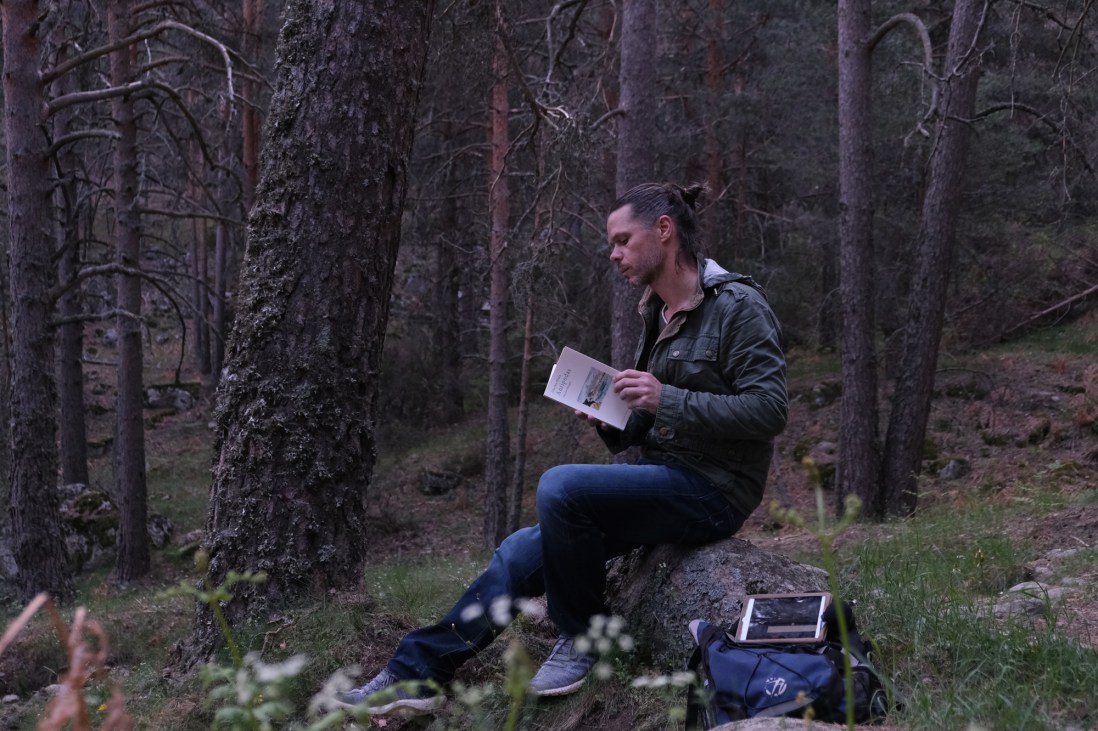
Charles Olsen reads ‘Inland’ – ‘Tierra adentro’ in Spanish – from his bilingual collection Antípodas published in Spain by Huerga & Fierro, 2016.


Charles Olsen moved to Spain drawn by his interest in Spanish artists such as Velázquez and Goya and to study flamenco guitar. Artist, filmmaker and poet, his paintings have been exhibited in the UK, France, New Zealand and Spain, and he has two bilingual collections of poetry published in Spain, Sr Citizen (Amargord, 2011) and Antípodas (Huerga & Fierro, 2016). His short film The dance of the brushes was awarded second prize in the I Flamenco Short Film Festival in Spain and his poetry films have been shown at international festivals and featured online in Moving Poems, Poetry Film Live and Atticus Review. In 2018 he was awarded the III Antonio Machado Poetry Residency in Segovia and Soria and he has received the XIII distinction Poetas de Otros Mundos.


Poetry Shelf classic poem: Siobhan Harvey picks Bob Orr’s ‘Remembering Akhmatova’


Remembering Akhmatova


Of course they are not

spacecraft. The seed packet

described them as ‘Giant Russians’.

Nevertheless they are looking down

as if to find a place to land.

They are not Van Gogh’s sick hospital flowers

neither are they William Blake’s eternal time machines

nor even Allen Ginsberg’s gold Harlem recognition of self.

These are the sunflowers

that looked over my shoulder

at Frankton Railway Station

as I sat in brown shadows

awaiting a train out of Hamilton.

In the heat the tracks trembled like mercury.

In the pages of a book of poems

I was abducted by a Russian –

her black and yellow words

her giant symmetry.


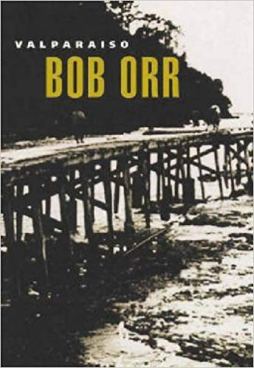
Bob Orr   from Valparaiso Auckland University Press 2002


From Siobhan Harvey:

I’ve always admired Bob Orr’s poetry for his rare ability to entwine narrative, atmosphere and intimation. So much in ‘Remembering Akhmatova’ is said, and so much inferred. Of the spoken, Orr manages to use few words for maximum activity. Within six early lines, for instance, we are transported from a humble seed packet of sunflowers to a stretch of iconic artistic representations of the Helianthus. Van Gogh, Blake, Ginsberg – the diaspora of their artistry, history, geography, inspiration and output is collected and counterpoised seamlessly. There’s weight there too, of course: the burden inferred by the work and legacy of these great artists which carries through the remaining lines of the poem, as the narrator – located in humble Hamilton – waits to leave; but for what? For a life of writing, assuredly, as Akhmatova – directly referred to in the title, but not in the poem – anchors the end of Orr’s work and its story. It’s her poetry which has stolen the narrator’s imagination, something tellingly revealed to us only at the point of his escape. Yet, in its covert concluding reference, it speaks to – and connects – everything which has gone before.

This is said without mention of form or lyric in this poem, both of which deserve discussion of course. Where Orr’s verse stretches to include mention and inference of the work of significant creatives (painters, poets), it also extends its lines; and the musicality of the work expands too. So the first eight lines steadily lengthen, guiding the eye and ear into the rhythmically exquisite, “nor even Allen Ginsberg’s gold Harlem recognition of self.” Cleverly, such extension occurs at the point when the narrative is built upon dissent and negation, ergo “they are not spacecraft” and “are not Van Gogh’s sick hospital flowers”. Then the poem – its tale, form and lyric – tips into ten short lines, all of which are affirmative in tone (“They are the sunflowers …”), tight in form and symphony sharp.

So much is packed into these eighteen lines. As a reader and an artist, I return to this poem so often, listening to it, looking and deconstructing it, searching to make sense of its deep craft.


Siobhan Harvey is an emigre author of five books, including the poetry collection, Cloudboy (Otago University Press, 2014), which won the Landfall Kathleen Grattan Award. She’s also co-editor of the New Zealand bestseller, Essential New Zealand Poems (Penguin Random House, 2014). Her work has appeared in multiple journals both in New Zealand and Internationally. She was long-listed for 2019 Australian Book Review Peter Porter Poetry Prize (Aus) and won 2016 Write Well Award (Fiction, US). The Poetry Archive (UK) holds a ‘Poet’s Page’ devoted to her work. She lectures in Creative Writing at The Centre for Creative Writing, Auckland University of Technology where she’s completing a PhD in Creative Writing.

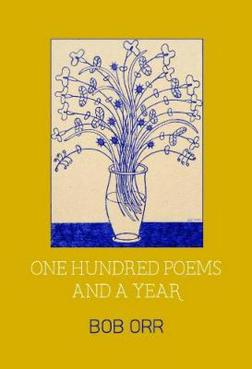
Bob Orr grew up in the Waikato, and has subsequently lived most of his adult life in Auckland. He has published nine collections of poetry and won the Lauris Edmond Memorial Award for Poetry in 2016. His writing has appeared in a number of collections, journals and anthologies and he has recently published the new collection One Hundred Poems and a Year (Steele Roberts, 2018).


51HoExGnmsL._SX342_BO1,204,203,200_.jpg          9780947493837.jpg Continue reading

Poetry Shelf review: Ashleigh Young’s How I Get Ready

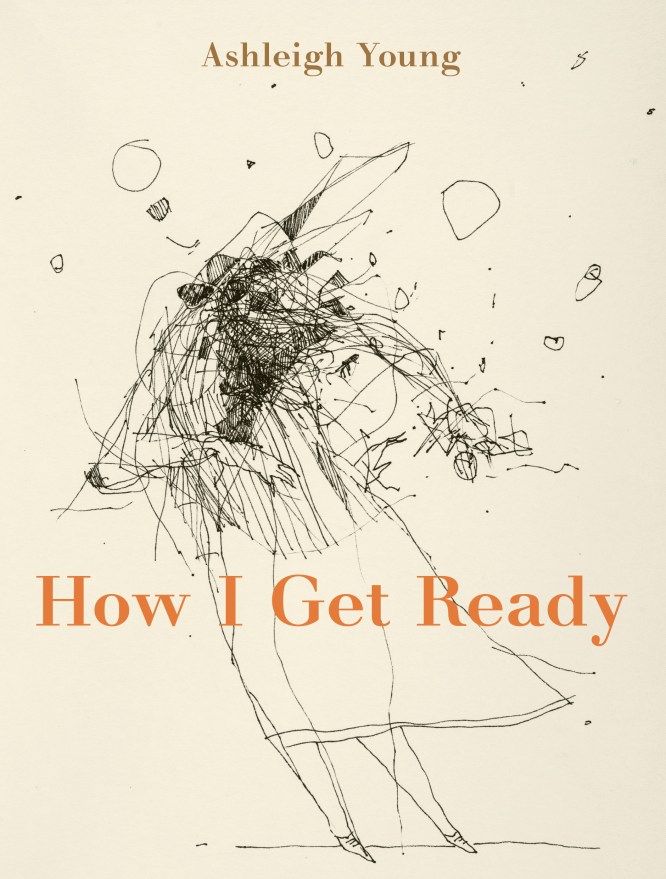
How I Get Ready.jpg


Ashleigh Young, How I Get Ready, Victoria University Press, 2019


A woman smiles out of a plastic coat

its yellow turning rain to torches.


Light rests on a man waiting to cross,

coats his dog.


Light crosses a man

waiting to rest.


The hills pull fog around themselves

and trudge to the sea,

carrying all our houses.


from ‘Lifted’


I like the shape of this book – this matters with poetry – because when a poetry book is good to hold it makes you want to linger even more, to stall upon a page. The book looks good, the paper feels good, and the cover drawing by Sam Duckor-Jones is a perfect fit. His idiosyncratic artwork moves in and out of reality, a person tilted by anxiety, the wind, both exposed and screened. A little like the poems inside the book. This is a collection of waiting, breathing, of curious things, anxieties, anecdotes, lists, found things, recycled words; little starts in your head as you read. It is extremely satisfying.

The Notes acknowledge the jump-off points of a number of poems – a line in a letter from Andrew Johnston turns into ‘Turn Out to Be Something’. Poems spring from epigraphs, a contents page, Margery Kempe, psychiatric cases, other poems. Where the poems shift to is perhaps a blend of the fictional and the personal. The speaker is always on the move.

One of the joys of reading these poems is the way connective tissue or an invisible thread holds the poems together; it might be the way you stay with one character or situation or mood. Yet the doubled reading joy is in the glorious little leaps: from an idea, admission, description or trope to another idea, admission, description or trope. Surprising, startling, fascinating and always feeding the invisible thread. Take ‘Ghost Bear’ for example. Eliot pulls me through the poem. He is the mystery and the guide. You will move from a ritual where someone tests themselves against a ghost bear with a skull head to a boy who gets electrocuted but survives then scores a try (‘He’s just showing off  / because he got electrocuted’)  to an inappropriate kiss. Before the strange, goosebump ending, I got stuck on this verse which feels like an intrusion from the poet herself:


When there are two frail old women together, there is always one

who is visibly stronger.

I have an old friend and I think about whether we will be old together

and which of us will be stronger, holding up the other

which of us the wind will push over first

for a good joke


The opening poem, ‘Spring’, begins with an eye-catching image : ‘I saw a horse lying on the street / and people were trying to help it up.’  It is a poem of little fascinations (forgive me if I keep using that word!) but it is also a poem of breath, of holding and releasing breath, of waiting. The words form little exhalations on the page. I am standing with the person (the ‘I’) standing in the street thinking random things as they wait to see that the horse will stand. I am fascinated by the little admissions (they have waited so long it is too late to go to work). I am fascinated by the personal truisms (‘When I am satisfied with one thing / I want something else’).  I am fascinated by the biography of the speaker.


My mother   assured me

that when I feel     that I am not wel-

come at home and everybody has

hatred towards me that it is       only

my imagination. This statement

made me feel very good;

I went to bed    and

slept sound


The poem arrives in surprising increments – in bursts of unsettling strangeness. Who is this speaker who must keep revealing things? I look at the Notes, only after musing on the poem awhile, and discover it is a found poem, with the words borrowed from the study of a young man with compulsion neurosis who transforms his life into bizarre distortions. (published in 1918).

‘Turn Out to Be Something’ is also a poem that involves waiting;  the speaker waits for things and then modifies the admissions; waiting is fine as long as waiting is not in vain and something is at the end, although not necessarily what is first expected.


I can wait for a layer of sandstone to form over me

and freeze and thaw and freeze and be shattered

and be piped into the sea            as long

as that turns out to be something.


Many of the poems play with lists, repeating the beginnings of stanzas before swerving or drifting in myriad directions. Take ‘Guide’ for example. A poem written for an exhibition of Colin McCahon’s Walk (Series C) at Te Papa. I love this poem; I love the way it builds upon ‘what if’ and gathers heart,  wisdom and downright surprise. Ashleigh steps off from Colin’s ‘walk’ along Muriwai Beach and walks through meditations on water (the sea, fresh water, a river mouth, waterfalls). Her poem walks us into the physical and then catapults us elsewhere. It makes my heart ache.


If a girl is lost, someone will walk a long way to get her.

If her hand is held all the way back, it will be a short walk.


I have to share the ending with you because it gets right to the heart of what makes an Ashleigh Young poem so darn good.


If a waterfall no longer has water, it is a groove

that suggests a falling motion, just as this trail

suggests a walking motion


but if a person keeps walking until there is no more walk to take

they will no longer look forward to it, so will turn back.


Pretty much every poem is a poem I want to talk about. I want to talk about ‘Driving’ because it feels like a miniature autobiography that goes deep into experience. It gets personal but it’s prismatic in image and ideas. Somehow in this mix of riding a bicycle, learning to drive and imaginative leaps, the poem feels acutely human. Like it is breathing life back into me. When I stop on this double page I am thinking you could swap ‘driving’ and ‘riding’ for any number of things. The way the things we do conjure anxious thinking and random thoughts. I read the poem and replace all the driving/ riding words for ‘writing’. For example:  I write along the street outside your house / with my heart floating loose and getting chain grease on it.

Yes this poem is a gem – it builds and ducks and freewheels. Here is the start:


They tell me any idiot can do it and I tell them

I’m not just any idiot, I’m specific. Even when my lungs

are bursting – properly bursting

like things dragged up by a deep-sea fisherman

I keep riding.                  I get tired.                      I just keep riding!


I have written about this book in Wild Honey so have tried not to repeat myself or even refer to the poems I picked to talk about in the book! But Ashleigh became one of my sky poets for all kinds of reasons.

Every poem catches me! Some books you pick up, scan a few pages and then put down because you just can’t traverse the bridge into the poems. Not this one. It is as exhilarating as riding a bicycle into terrain that is both intensely familiar and breathtaking not. The speaker is both screened and exposed. The writing feels like it comes out of slow gestation and astutely measured craft. I say this because I have read this andante, at a snail’s pace. Glorious!


What song will they play if I don’t come home tonight?

I wished  someone would write a song for me, then someone did

but it was a song berating me; it was called ‘Actually, Ashleigh’


and I think of the cruelty of songwriters as I get ready

how their music makes their words sound better than they really are

how our feelings make music seem better than it really is


and how the difficulty of getting ready is a pure, bitter difficulty

like calculus. In the back row a once-promising student cries.

What will my face become? Strings of demi-semi quavers.


from ‘How I Get Ready’


Victoria University Press page

Read ‘If So How’ from How I Get Ready


Ashleigh Young is the author of the poetry collection Magnificent Moon (VUP, 2012), and the essay collection Can You Tolerate This? (VUP, 2016) which won a Windham-Campbell Prize from Yale University and the Royal Society Te Apārangi Award for General Non-Fiction in 2017. She works as an editor and lives in Wellington.


Poetry Shelf review – From the Henderson House: eight poems by Jenny Bornholdt and Gregory O’Brien


dscn9671-1.jpg


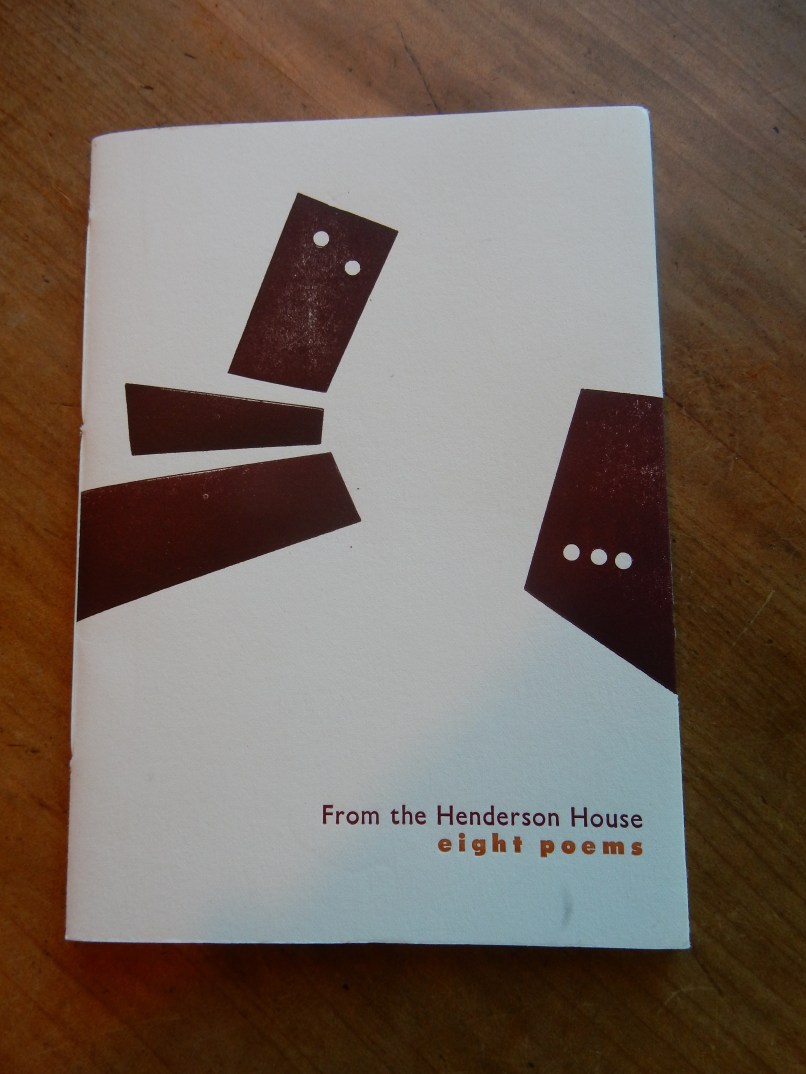
From the Henderson House: eight poems is an exquisite chapbook penned by Jenny Bornholdt and Gregory O’Brien. The first 18 copies feature a cover design lovingly handprinted by Brendan O’Brien on an Merlarue etching press at the Henderson House in Alexandria. The remaining 40 copies feature covers designed and printed by Brendan at Fernbank Studios in Wellington.

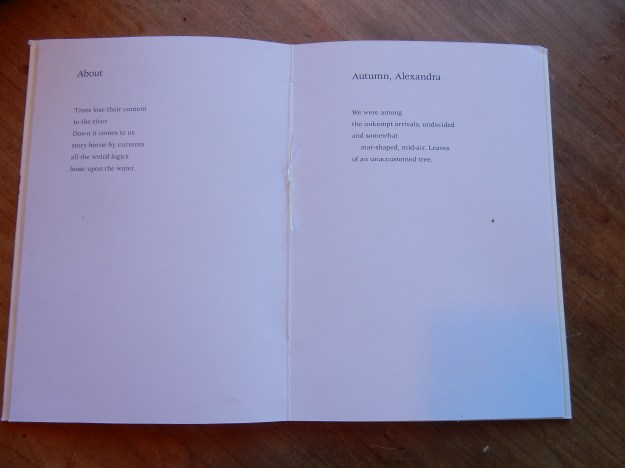
The eight poems were written while Jenny and Gregory enjoyed a year-long artists’ residency thanks to the Henderson House Trust. Each double page is like a set of open palms – with Jenny’s poem on one side and Gregory’s poem on the other. A loving couple. Here are the titles:


Old Prayer

On drinking water

About

Autumn, Alexandria

Fog

Styx Crossing, Upper Taieri

En plein air

Two burning cars, one afternoon


The poems rise from contemplation, from lengthy time in a place of beauty, from the small but fascinating detail. To read the poems is to absorb place; to delight in the ability of poetry to transport you physically to the uplift of elsewhere. Yet the poems also transport you along rebounding ideas, particularly along the verb ‘to be’. These are poems that speak of existence.

As I read I am thinking of a slow poetry movement (in keeping with the slow food movement) and that slowness extends to reader as well as writer. I travel from hawk to water to trees to autumn to fog to river to horse to burning car. I am taking my time and it is so very nourishing.


About


Trees lose their content

to the river.

Down it comes to us

story borne by currents

all the weird logics

loose upon the water.


Jenny Bornholdt


Autumn, Alexandria


We were among

the unkempt arrivals, undecided

and somewhat

star-shaped, mid-air. Leaves

of an unaccustomed tree.


Gregory O’Brien


DSCN9672.jpg


Poetry Shelf Monday Poem: Marcus Sellwood’s ‘Aotea Square’


Aotea Square


Finally just us two

reclining on the shores of Aotea square

The absolute epicentre

of any bonafide

Auckland urban romance


I’m convincing you the pavers

could almost be sand

If you squint hard enough anyway

But I’ll say any old guff

just to make you smile


The sun’s evaluating the skyline

It’s making me drowsy

or you’ve doped me with the pretzels

I swear the odd gradient of these steps

is identical to a beach on the tip of the Coromandel

I can’t quite remember the name of

or perhaps I never knew to begin with


Your polygamy story soon jolts me out of my reverie

En masse the city dwellers

are lying around sun-drunk

sprawled all over my fake foreshore

in their suitably fake sunglasses

half watching the Chinese cultural festival

cryptically splash at our feet


We’ve got gigs across town from one another

so we’re play-acting

sulky besotted teenagers being torn asunder

by unspecified forces

much larger than our-tragic-selves


The IMAX sign looks down frowning, unconvinced

and for heaven’s sake, it would know!


Marcus Sellwood


Marcus Sellwood is a musician and occasional poet. He was born in central Auckland and has lived his whole life there. He likes to write about his experiences of the fast-changing city.


Poetry Shelf audio spot: Vaughan Rapatahana reads ‘mō ōtautahi’ [for Christchurch]


Vaughan Rapatahana commutes between Hong Kong, Philippines and Aotearoa New Zealand. He is widely published across several genre in both his main languages, te reo Māori and English. He earned a Ph. D from the University of Auckland with a thesis about Colin Wilson and writes extensively about him. Rapatahana is a critic of the agencies of English language proliferation, inaugurating and co-editing English language as Hydra and Why English? Confronting the Hydra (2012 and 2016.)

He is a poet, with collections published in Hong Kong; Macau; Philippines; USA; England; France; India and New Zealand. Atonement was nominated for a National Book Award in Philippines (2016); he won the inaugural Proverse Poetry Prize the same year; and was included in Best New Zealand Poems (2017.)

He writes commentaries for Jacket2 (University of Pennsylvania): a 2015–2016 series and again during 2018-2019.  In 2019 he edited an anthology of Waikato poets: Ngā Kupu Waikato.

His New Zealand Book Council Writers File


Poetry Shelf review: Landfall 237

otago708667.jpg

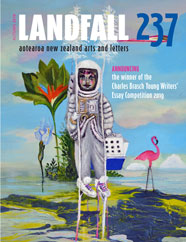
Landfall 237 edited by Emma Neale


Landfall 237 offers rich pickings for the poetry fans: familiar names (Peter Bland, David Eggleton, Elizabeth Smither, Ria Masae, Lynley Edmeades and Cilla McQueen) to emerging poets (Rebecca Hawkes, Claudia Jardine, essa may ranapiri) and those I am reading for the first time (Robynanne Milford, Jeremy Roberts, Catherine Trundle to name a few). The reading experience is kaleidoscopic, pulling you in different directions, towards both lightness and darkness, risk and comfort. And that is exactly what a literary journal can do. I was tempted to say should, but literary journals can do anything.

Landfall has a history of showcasing quirky artwork – and this issue is no exception. Sharon Singer’s sequence, “Everyday Calamities’ with its potent colour, surreal juxtapositions, strange and estranging narratives, and thematic bridges, is an addictive puzzle for heart and mind. I am circling humanity, the power of connection, the individual both tenacious and frail, the state of the planet. Paintings whirling and tipping you into moments that soothe, bewilder and provoke. I adore these.

I turned from these to Rachel O’Neill’s prose poem ‘The Supernatural Frame’ and get goosebumps:

You may look upon the painting through these special

foiled binoculars. We are at a safe distance. Afterwards you

may feel a chill or a fever linger for two days and a night,

accompanied by an infernal cough.


On the centennial of the birth of Ruth Dallas in Invercargill, I am also delighted to see John Geraets spotlight her poetry. Certain Dallas poems have always had a place in NZ literary anthologies (think ‘Milking Before Dawn’) but as readers we may less familiar with the wider expanse of her work. Like so many women poets of the twentieth century she is in the shadows. In his intro John suggests it is not clear how to include her ‘within more recent nexus based on gender, ethnicity, ecology, avant-gardism, faith or political affiliation’. He responds by assembling her words – culled from Landfall editor-contributor responses and her autobiography Curved Horizon – on the left-hand pages and his words on the right. He first sees in her poetry – compared with contemporary writing choices – predictability, regularity, un-excitement, regionalism; and then, by paying attention and refreshing his routes, he opens up poems to different movements. He moves in close to the poem. I love that. Much I could say on how we approach the women from the past! Expect 568 pages soon.


I absolutely love the poetry in this issue; it is both fresh and vital! I see neither formula nor dominating style but shifting stories, musicality, feeling, political bite, muted shades, bright tones.


Here are some highlights:


Joanna Preston’s poem ‘Allegrophobia’ carries you from birth to tardiness to spring in a layered on punctuality – a perfect little package.

Jasmine Gallagher’s ‘Be Still’ sent me to her bio because I want to read more by her. She is a doctoral student at the University of Otago and has previously been published in brief. Her poem is poetry as brocade – glinting for the eye and chiming for the ear.


Slattern: a

hoar frost:

a rime

Cold seed bed

Rot and slime


Another poet, Catherine Trundle, also sent me scavenging for more. She writes poetry, flash fiction and experimental ethnography. Her poem ‘The Caravan behind the Plum Tree’ is also an exquisite brocade.


This lush cusp of spring rides

pinkish, amoebic, wilding

the inside, every flesh ’n’ cranny

while the sunlight lunges in

through winter tidelines

of curtain rot


Tam Vosper’s ‘Ailurophilia’ was an equal hook for me. He is working on a PhD at Canterbury University that considers Allen Curnow and the poetics of place. Again this is brocade poetry: so rich in effect.


All Gallic pluck

and casual loft

you claim a suntrap,

slump sidewise down,

and unhinge your barbed yawn:

           a shark to shoaling mice.


And I want to add Medb Charleton’s ‘I think I Saw You Dreaming’, Rebecca Hawkes’s ‘If I could breed your cultivar / I’d have you in my garden’ and Gail Ingram’s ‘The Kitchen’ to my list of brocade poetry. Glorious.

In contrast you have the spare deliciousness of Ariha Latham’s ‘Waitangi’. Another poet whose work I want to track down.


When I read Ria Masae’s “Jack Didn’t Build Here’ I can hear her performing its sharp mix of personal and politics  – and it cuts into my skin. Six houses built. She carries us from the father’s house full of stories to David Lange’s Mangere home open to the locals: he ‘understood the pressures of fa’alavelave,/ cos he brown on the inside like that’. She bears us from the house her mum built with its’ celebration tables’ to the house Key built with its ‘security code gate’. She ends with a question (the house to be built?):


What house will Jacinda build?

Will it enable my daughters to build their own homes

of tangata whenua foundations and fa’a Samoa roofs

in this palagified City of Sales?


You can move from political bite to the glorious wit you often find in an Erik Kennedy poem. His ‘All Holidays Are Made-Up Holidays’ is no exception. Meet Cabinet Day – ‘we went along/ from house to house hanging little doors / around each other’s necks to hide our secrets’. Or the Feast of Holy Indifference. Genius!

Claire Orchard’s poem, ‘Breakages’, swivels on a set of shelves, on the objects that they hold, and in that satisfying movement speaks of so much more; the poem resembles a shelf of family history with peaks and troughs.


I enjoyed the way it had begun to display time

in the style of tottering, elderly people


I heard Joan Fleming talk about new poetry she was writing at the Poetry & Essay conference at Victoria University in 2017. The poems came out of her experience of camp life in Nyrripi and surrounding areas in Australia’s Central Desert. I was moved by her discussions of collaboration and consent, her attentiveness to the local. Two poems here – ‘Alterations’ and ‘Papunya is Gorgeous Dirty and I Second-guess my Purposes’ – come out of this experience. I can’t wait to see this in book form.


Finally a treat from Cilla McQueen. She has written ‘Poem for my Tokotoko’; it is personal, physical and abundant with the possibilities of poetry. Pure pleasure.


Sometimes I see you as an enchanter’s staff,

scattering poems like leaves to the west wind;

at others you’re practical, a trusty pole

by means of which, through quarrelling

undercurrents, I can ford turbulent water.

By means of which I put myself across.


This is such good issue – there are reviews and fiction I haven’t read yet, and the announcement of the Charles Brasch Young Writers’ Essay Competition 2019 – but on the poems only, it warrants a subscription. Yep – Landfall has its finger on the pulse of NZ poetry.


Landfall 237 page