Category Archives: NZ poems

Poetry Shelf Monday Poem: Helen Rickerby’s ‘Mr Anderson, you heartbreaker you’


Mr Anderson, you heartbreaker you


Oh Hans Christian Andersen, you tormentor

of children, creator of nightmares

The Little Mermaid always did me in

with her big love and her

enormous silence and giving up

her fishy tail for two legs

maybe to part them for

her sweet prince, but

relegated to the friend-zone

each shard of glass she stepped on

pricked a tiny hole into my

squishy little heart

And, really, if she’d just held on to her tongue

she could have sung him to her

reeled him in, drunk him down

One prince, on the rocks, coming up


*


And at the same time as the prince married the princess and the Little Mermaid turned into not even sea foam, but air, Andersen wrote to his friend Edvard Collin, who was also about to marry: ‘I languish for you as for a pretty Calabrian wench … my sentiments for you are those of a woman.’ Collin later wrote in his memoir, ‘I found myself unable to respond to this love, and this caused the author much suffering.’ Gosh, I can barely move for the shards of broken hearts beneath my feet.


Helen Rickerby, How to Live, Auckland University Press, 2019


Helen Rickerby is the author of four collections of poetry, most recently How to Live (Auckland University Press, 2019). She likes questions even more than answers. Since 2004 she has single-handedly run boutique publishing company Seraph Press, an increasingly important publisher of New Zealand literature, focusing on poetry. Helen lives in a cliff-top tower in Aro Valley, and works as an editor.


1565824292476

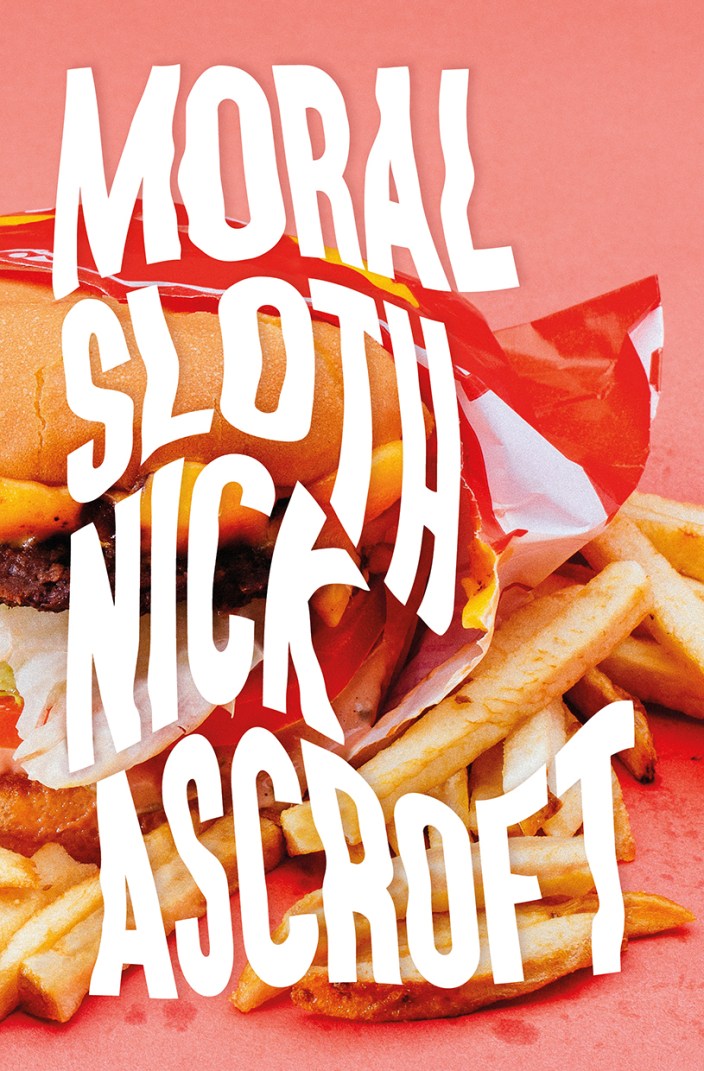
Poetry Shelf noticeboard: Nick Ascroft’s launching Moral Sloth

531745d5-a272-4bec-9a02-9ed67cce6044.jpg


You are warmly invited to the launch of

Moral Sloth
a new collection of poetry by Nick Ascroft
to be launched by Ashleigh Young

Tuesday 12 November, 5.30pm–7pm
Hudson Bar, Chews Lane, Wellington.

All welcome!
$25


Poetry Shelf fascinations: Frankie McMillan’s The Father of Octopus Wrestling and other small fictions

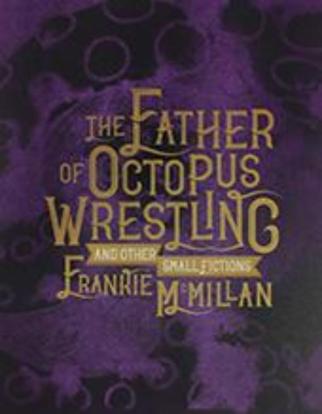
1563145604097_The-Father-of-Octopus-Wrestling_Cover-low.jpg


The Father of Octopus Wrestling and other small fictions, Frankie McMillan, Canterbury University Press

Canterbury University Press page


What a gorgeously produced book! A purple marbled cover with gold lettering and dark marbled section dividers inside. The book was designed and printed at Ilam Press, Ilam School and published by Canterbury University Press. I do hope more books emerge from this genius partnership.

Not far into reading I began to muse on the idea of original writing because the book is so invigoratingly original – I am fascinated by the origins of these short fictions that are shaped by an aeronautic imagination and (perhaps) specks of real experience. The realness is luminous – the sharp compounding detail does its work beautifully – yet each fiction offers tilts and kinks and little spikes of strangeness.


The opening piece, ‘Seven starts to the man who loved trees’, is like a test pot of beginnings that overlap with scene and foreboding  to the point of fluidity and connection. The book’s dark swirly cover with its murky possibilities seems a perfect match because this fiction, like all the fictions we read here, arrives in tantalising pieces. We will never get the full story but we do get sensual and emotional impact. I love that.

The water-presence in the first section is a thematic link. There is a father who gets put in an aquarium, a sister who holds tight to her sinister secret by a river, there’s too much plastic in the ocean, an Amsterdam canal. There are multiple movements ( I am thinking of the movement of water that is both predictable and unpredictable). Movement is a way of going forwards; elsewhere someone is moving through Ireland’s eerie rock-clad Burren.

Frankie’s writing flows like honey and is so sweetly crafted with its shifting rhythms. In ‘The honking of ducks’ the first long sentence is like a breath held (a secret held) and we all come up gasping for air:


The thing to do with a secret is to swallow it, and just as you’re not bothered by thoughts of a plum’s progress through your intestinal tract, neither will you think of your sister running hand in hand with a strange man to the river bank and when your sister goes missing you will have to borrow words to explain why you never told and when the police say who put those words into your mouth you will think only of the loveliness of weeping willows, the sshhh sweep of fronds over the sandy bank, all the fun you will have when your sister sets up house under water and you have to swim through the clefts in rocks holding your breath against the squeeze.


The collection is a reading banquet: I am feasting on scenes, situations, relationships, human challenges, desires, loves, losses.

Situations – In ‘How we occupy ourselves’, after parental bickering, the family home gets physically split in half, and the father lives by the river and the mother lives on the flat, and the grandmother makes roly poly pudding and says ‘how lucky we are, all of us alive with roofs over our heads and telling each other stories’.

Situations – In ‘A good match’ a husband wants to know if his shirt looks good with his green jeans (third one tested). The wife looks at the clothes strewn on the bed after he has gone out and stares and muses: ‘Wonder again about what goes best, this or that, blue with green, him with me or her.’ I get a whole whoosh of feeling when I read the this final sentence.

Frankie’s short fictions (you could also say prose poems) have poetry’s ability to screen most of the detail but with a few deft strokes and admissions reach a poignant kernel of human experience.

Situations: In ‘Reading the signs’ a miniature but dynamic biography of a hospitalised father emerges. To his visiting offspring he admits regret over a chimp he had raised like a human child in a zoo. The visitor sees him at the window as they leave:


I waved, knowing that it was probably the last time I’d be seeing him but wanting the wave to convey all the love I had inside me, all the things I was wanting to do and all the things I was wanting to say but couldn’t.


Ah such a whoosh of feeling as I read these lines. The way a story, a situation, a scene twists your heart until it hurts.


Here I am breaking my rules and telling you the endings. The beginnings are equally good. Here is the the start to ‘Salt’, a piece that pivots on salt and a woman who is forbidden to eat it on the hospital ward:


Sometimes you can ask for something as small as salt only to be refused, the rules won’t allow it. Then salt becomes a big thing in your mind and all you can think of is salt; how it’s responsible for the salinity of the ocean, and then you imagine all the seas in the world, all the whales, then all the camel trains across deserts to bring salt to people like the big woman in the bed opposite. It puts it all into perspective when the nurse says, sorry no salt allowed on this ward.

You forgot to add salt is also good for mistakes.


And here is another favourite beginning (‘Jesus and the ostriches’): ‘Soon after Roland began sleeping in the caravan I saw Jesus.’


The Father of Octopus Wrestling offers many satisfactions. Yes it is a book in pieces but it is also a book of echoes, hinges, connections. Fathers are every which way you look, along with birds, Jesus, fish, mothers. The strangenesses will jolt you – like when you think you saw a wild cat but it’s the bending tree – and the human experience will make your skin prickle. Within the surprising anecdotes (think bizarre surreal unexpected) wisdom takes seed. This is a book that maps human existence, past present future, and I am all the better for having read it. I recommend you do too! I just love it to bits if you will forgive the pun.


The mothers of the mothers of the mothers


She tells the child that if all the great grandmothers were

to climb out of the ground to drift though the cemetery,

it wouldn’t be long before they came across each other,

laughing to see each other’s old faces and say they were to

hold hands, the long line of them would reach the other

island, but they couldn’t complain that their feet were in

the cold salty ocean, in fact the mothers of the mothers of

the mothers were used to much worse, some having only a

potato to eat at night or soldiers burning down their whares

and others having to wear corsets of whale bones that go all

the way to their knees but the child says that’s going too far

and she likes the part best where the mothers of the mothers

of the mothers wonder about the little girl who rides to

school in a car that does not eat hay but only drinks lakes

and lakes of petrol.


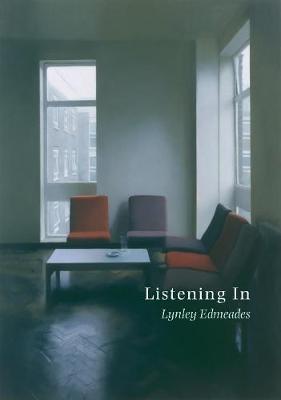
Poetry Shelf Monday Poem: Lynley Edmeades ‘Nodding is Soft’


Nodding is Soft


I can only tell you. What I saw.

And all I can. Say is that you.

Wouldn’t have wanted. To see it

yourself no. Sir it was not.

For public. Consumption it was

very hard and very. Bad probably

the hardest and. Baddest thing

to see but yes. I saw. It I saw

it hard and it was. Bad but even

when I. Saw it I didn’t say. Wow

that is the hardest. Thing I’ve ever

seen I just. Said when. Are we

leaving and you. Said well we

can leave when. You’ve finished

looking at the. Thing you’re looking

at. And so I turned. Away but

already I. Knew it was. Not

worth telling you. About this

most hardest and. Baddest thing

it is not. Soft not like your. Nodding

is soft. But why are. You nodding

don’t you know. That this is. The

hardest and baddest. Thing. No you.

Don’t understand it is. The worst.

I can only. Tell you what.


Lynley Edmeades, Listening In, Otago University Press, 2019


Lynley Edmeades completed an MA at the Seamus Heaney Centre for Poetry at Queen’s University in Belfast, Northern Ireland, in 2012. Her first collection of poetry, As the Verb Tenses (Otago University Press, 2016) was longlisted for the Ockham NZ Book Awards for Poetry, and shortlisted for the UNESCO Bridges of Struga Best First Book Award. She has a PhD in avant-garde poetics and teaches literature and creative writing at the University of Otago.


Otago University Press page

Lynley in conversation with Lynn Freeman (it’s terrific) Standing Room Only

218285831.jpeg

Poetry Shelf noticeboard: Madeleine Slavick reviews Hinemoana Baker’s Live at Aratoi


Screen Shot 2019-10-17 at 9.22.36 AM.png

Photo by Nicola Easthope


Madeleine Slavick is a poet, photographer and communications manager at Aratoi Wairarapa Museum of Art and History, Masterton. She has reviewed Hinemoana Baker’s recent performance there – a thoughtful review that is as much poetry as it is critique. Brava!


Read Madeleine’s full piece here but here is the beginning:


Funkhaus

Funkhaus – the working title of Hinemoana Baker’s upcoming collection.  ‘Funk’ as in funk, and also ‘broadcast’ in German, as the ‘haus’ in Berlin where the poet-singer-songwriter once lived, or squatted, had been a GDR radio station.  A saxophonist was also there, and Hinemoana would be sleepless in her tiny cubicle.  Born in 1968, Hinemoana says she’s too old to live like that, but I don’t see her living any other way. She lives and dives at once. Follows the river out to sea. Hinemoana. Woman of the Ocean.


Poetry Shelf Monday Poem: Meg Doughty’s ‘Under the Moon as it Rises’


Under the Moon as it Rises

I love the thought of running
out under the moon as it rises
on warm sand, still warm
from the day Like me
like my skin hot
like when I was just born
My black hair the night
flanking the moon, impending
(to run toward it as it rises too)…

But I don’t live near beaches
near dunes Just a city
that runs to the water and ceases
runs down and over hills
that keep me as a fish
in a bowl a cat in a bowl
hemmed in and antsy
scratching for the sun to leave
and let me run over sand to sea

Carving valleys with my claws
a prayer to bring rain
to bring the hills down
or turn them to dunes
to waves to let me away
across the wild Soft and hot
sand black white and red
on my paw pads and unending
Running and running and running…


Meg Doughty


Meg Doughty: I am a reactionary writer who is fascinated by the everyday mystic. I completed my English Honours degree in June from Vic, where I was lucky to be taught by Anna Jackson. I grew up with a black cat and we read Meg and Mog books together, convincing me I was a witch. I am now living in the big smoke, Auckland.

Meg’s poem ‘Potion’ at Starling


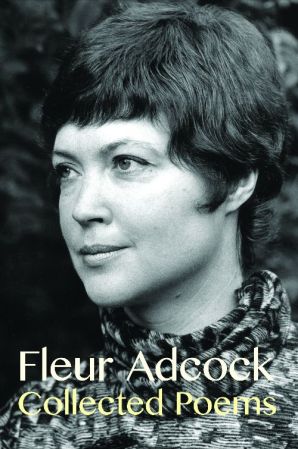
Poetry Shelf noticeboard: my giveaway copy of Fleur Adcock’s magnificent Collected Poems

3c58eb2e-2c98-4359-a439-504f7467e974

          Victoria University Press, 2019


Thanks everyone who named one of their favourite Fleur Adcock poems and wrote a sentence saying why.

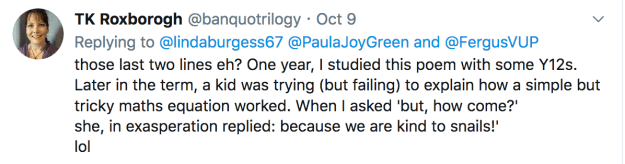
I put all the names in the hat and pulled out Tania Roxborogh! She picked ‘Advice to a Discarded Lover’ but also had a cool anecdote on the most widely picked poem, ‘For a Five year Old’

Congratulations to Fleur – who will be receiving the Prime Minister’s Award for Literary Achievement in Poetry tomorrow.


Screen Shot 2019-10-13 at 2.19.33 PM.png


Screen Shot 2019-10-13 at 2.19.42 PM.png


Poetry Shelf fascinations: MIMICRY 5

Screen Shot 2019-10-03 at 11.47.52 AM.png


I have been musing on the variety of journals we have, both in print and on line, that are publishing poetry, various fictions, essays, images. Each issue feels like a one-off gathering that provokes, surprises, consoles and delights. I sometimes feel I have wandered into someone’s front lounge and am eavesdropping on the conversation currents of a mix of house guests. Sometimes it feels like family – kindred poets – other times it is altogether different. Nobody is afraid to say what they feel. Or get political. I like that.

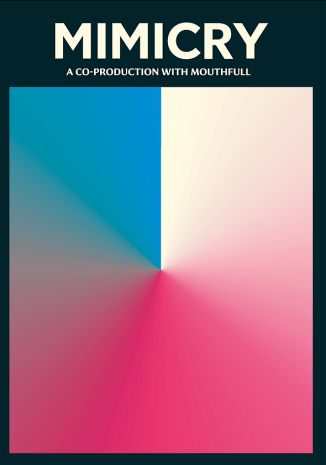
MIMICRY 5 is edited by Holly Hunter and Ollie Hutton (Mouthfull Productions); the contributors epitomise a cool new wave of writers – some barely published, some gaining recognition in the performance / slam / spoken word scenes. The images are excellent plus you get a Mimicry mixtape.

Eliana Gray‘s terrific debut collection Eager to Break is recently published – so how very fitting to have their poem ‘Sometimes I wonder if my salt water mouth / should be allowed to speak at all’ open the gathering. The first line sets up the poem: Sometimes I wonder if my poems should have been tweets’. Each line shimmies as both poetry and as potential tweet and the effect is glorious – I am swung and I slide and the effect is mood and it is dark and it is burning.

Alisdair Armstrong is studying at Victoria University and loves rock climbing which makes sense when you read ‘Sitting in a blast crater’. This is his first published piece of writing and it is wry and deft and I am loving the image of the speaker sitting ‘at the bottom of a blast crater in a puddle’. This is the line I love: ‘I introspect for awhile.’  The scene would be enough to delight but other people turn up and then it is just exquisitely funny.

We’re lying down in this crater, we tell him.

He asks why we haven’t got out.

We tell him we’re introspecting.


Molly Robson‘s three photographs are eye-popping (‘Tongariro’ is B & W but the others use a palette of surreal orange-reds with distancing and estranging grey /blacks. The empty rooftop chair is unbearably uncanny. I want to sit in it. I want to sit in it and read a novel until the sun comes up. The tilts will be numerous.

Rhys Feeney‘s ‘current mood’ is genius in the way it catches the overwhelming anxiety we feel as we face climate change and the loathsome mountain of products that will outlast us.


there’s a feeling in your chest

& it’s not going anywhere

it has the permanence

of a pile of used plastic

floating around

on the oil-slick surface


Erik Kennedy follows suit with ‘Microplastics in Antarctica’. This is poetry at its most vital – making connections with a groundswell of global protest; poetry is linking ideas and anxious voices and I applaud it.


The snow contains a finer snow.

That’s how it gets there, this plastic

that maybe one kept a lettuce green

or packaged another plastic package.


Scratch the scalp of civilisation

and bits of it go all over the place.

Concerned about those embarrassing flakes?

You should be.


Enter this lounge and you will find the miniature scenes of Rebecca Hawkes, rich in physical detail, feeling and sonic surprises along with Jordan Hamel‘s genius found mash-up that evokes a ‘Regular Kiwi Bloke’.

What I love about these literary lounge gatherings is meeting new voices. Sometimes it is like an electric shock upon skin – like how good can poetry get? Michaela Keeble is an Australian writer living with her family just north of Wellington. She writes climate-change press releases and has published fiction and poetry in various places. Her poem ‘Bob Marley was a poet’ had me listening hard because it feels so fresh and surprising and full of invigorating movement. The poem sets your attention in myriad directions, leaves gaps for you to traverse, gathering together politics, intimate thoughts, the beauty of the moon and the river, the joy of contemplation.


a few days after Waitangi Day

Bob Marley’s birthday

a Thursday


I sit down at the side of the river


the river is an estuary

is homemade paper


Rose Peoples brings an equally satisfying moment of attentiveness to ‘Hoots’. But here the poet/storyteller pivots and leaps off from the hooting ruru; and poetry becomes a form of storytelling that is to be savoured. Slowly. Sweetly. You need to read the whole poem but here is the opening stanza:


The ruru hoots each night

with a regularity which rivals the

tinny beeps of the digital watch.

The sound is directionless

it simply sits in the air,

surrounding us.

In this version of the story,

it s the glow of the streetlights

that makes its way through

the gaps in the blinds.


The final charismatic poem, Jane Arthur’s ‘Snowglobe’, showcases the addictive mix of verve and imagination that you find in her poetry. Watch this space for my musings on her new collection Craven.


I have just realised

I have just now realised


I am in a snowglobe! and that is why

leaves blow around and around but never away


and that is why I feel shook up

amazingly shook up so often.


MIMICRY probably features more artwork than any other local literary journal – and again features excellent lounge guests. For me MIMICRY 5 was like a well-needed retreat from routine and requests. I loved it. Such invigoration. I look forward to the next one!


MIMICRY page


Poetry Shelf noticeboard: Te Rito o te Harakeke – A collection of writing for Ihumātao


Screen Shot 2019-10-02 at 9.16.14 AM.png


Cover art: ‘Pono’ by Maioha Kara (Waikato, Ngāti Kahungunu, Te Arawa and Ngāti Porou)


The contributors: Hana Pera Aoake, Hinemoana Baker, Cassandra Barnett, Tyson Campbell, Jacqueline Carter, Anahera Gildea, K-t Harrison, Rangimarie Jolley, Maioha Kara, Johanna Knox, Rāhiri Mākuini Edwards-Hammond, Anna McCallister, Donna McLeod, Kōtuku Titihuia Nuttall, Sinead Overbye, Tru Paraha, Michelle Rahurahu Scott and Lyssa Rogers-Rahurahu, essa may ranapiri, Serena Ngaio Simmons, Carin Smeaton, Stacey Teague, Ruby Mae Hinepunui Solly, Alice Te Punga Somerville, Tayi Tibble and George Watson


Note from the organisers (Rangatahi o te Pene, Hana Pera Aoake, Sinead Overbye, Michelle Rahurahu Scott and essa may ranapiri):


The book was produced in five weeks, and almost all of these pieces were written within a two week period.

Our aim was to bring together a wide range of Māori authors to respond to the events at Ihumātao, to show that Māori all have different voices and different perspectives, even though there are commonalities among us (i.e. ancestral trauma, the pain of which still runs through the core of the book). We brought together more established Māori authors to sit beside newer Māori voices, including poets who have never been published before.
The title Te Rito o te Harakeke comes from a well known whakatauki ‘Hutia te rito o te harakeke, kei whea te kōmako e kō? Kī mai ki ahau; He aha te mea nui o te Ao? Māku e kī atu, he tāngata, he tāngata, he tāngata’. This translates as ‘If the heart of the harakeke was removed, where would the bellbird sing? If I was asked; What is the most important thing in the world? I would reply, it is people, it is people, it is people.’
At the core of the book is people. At the core of the movement at Ihumātao is people. We need to come together in times of struggle, in order to support each other to go on. That is what this book was about. The ‘rito’ of the harakeke refers not only to the ‘heart’ or ‘core’ of the harakeke, but also metaphorically to the younger generations in a whānau. The whakatauki, and the title of the book, therefore also implies that if we do not foster and support the younger generations, we will not progress as a people.
The organisers of this project- Hana Pera Aoake, Sinead Overbye, Michelle Rahurahu Scott and essa may ranapiri- did not edit or alter any of the kupu in the book. Each piece is published exactly as the artist intended. Each piece is perfect just as it is. As you read the physical copy, you will notice the hand-stitching, experimental formatting, and even a fold-out poem in the centre (as one of our poets desired the book to fold out from the book like a map). We wanted to maintain the integrity and mana of each piece of work. We wanted to create a space where every artist could express themselves exactly as they wanted.
There is grief at the heart of this book, and there is pain, but there is also hope. Out of this project, new friendships and connections have flourished. We are creating a space for ourselves, and we are creating new communities and opportunities. We hope that the book continues to be shared amongst friends and whānau. We hope that it sparks kōrero about our history, and that it helps to guide Māori who might otherwise feel alone.

No reira, we are very proud to have this book out in the world. He taonga ia.
Ehara taku toa i te toa takitahi, ēngari he toa takimano e – My strength is not mine alone, but the strength of many.


You may find more information about the pukapuka and how to get a copy here

essa may ranapiri’s poem here


IMG_5122.JPG


Poetry Shelf fascinations: Helen Rickerby’s How to Live

1565824292476.jpg

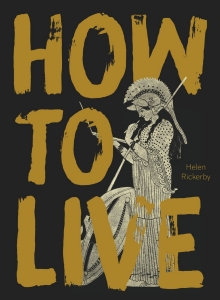
How to Live, Helen Rickerby, Auckland University Press, 2019


When that philosopher said life must be lived forwards

but can only be understood backwards

he was not thinking of me

I have lived all kinds of lives


from ‘A pillow book’


Helen Rickerby’s latest poetry collection How to Live is a joy to read. She brings her title question to the lives of women, in shifting forms and across diverse lengths, with both wit and acumen. Like many contemporary poets she is cracking open poetic forms – widening what a poem can do – as though taking a cue from art and its ability both to make art from anything and in any way imaginable.

Reading this book invigorates me. Two longer poems are particularly magnetic: ‘Notes on the unsilent woman’ and ‘George Eliot: a life’. Both function as fascination assemblages. They allow the reader to absorb lyrical phrases, humour, biography, autobiography, insistent questions. Biography is enlivened by such an approach, as is poetry.


6.   It seems to me that poetry usually begins with the self

and works its way outwards; and the essay, perhaps, starts

outwards and works its way in towards the self.


from ‘Notes on the unsilent woman’


Thinking of the silent woman I am reminded of Aristotle’s crown of silence that he placed upon she. I then move across centuries to Leilani Tamu’s poem ‘Mouths Wide Shut’ where she sits on a bus with her mouth taped shut silent. The skin-spiking poem (and the protest) considers silence in the face of racism. Even now, even after the women’s movements of the 1970s and the explosion of feminism and feminisms over ensuing decades, men still talk over women, still dismiss the women speaking (take women in power for example, or a young woman at the UN challenging climate-change inertia).

What Helen does is remind us is that silence is like snow – it is multi-hued and deserves multiple names and nuances: ‘Silence isn’t always not speaking. Silence is sometimes / an erasure.’

Ah the stab in my skin when I read these lines. In ‘Notes on the unsilent woman’ Helen draws me in close, closer and then even closer to Hipparchia of Maroneia (c 350 – c 280 BC).


5.    But I do have something to say. I want to say that she

lived. I want to say that she lived, and she spoke and she

was not silent.


Helen gathers 58 distinctive points in this poem to shatter the silence. Sometimes we arrive at a list of women who have been both audible and visible in history, but who may have equally  been misheard, misread and dampened down. At other times the poet steps into view so we are aware of her writing presence as she records and edits and makes audible. In one breath the poet is philosopher: ‘Silence might not be speaking. It might be / listening. It can be hard to tell the difference.’ In another breath she apologies for taking so long to bring Hipparchia into the picture.

Elsewhere there is an ancient warning: ‘”If a woman speaks out of turn her teeth will be / smashed with a burnt brick.” Sumerian law, c. 2400 BC.’

A single line resonates with possibilities and the ‘we’ is a fertile gape/gap/breathing space: a collective of women, the poet and her friends, the women from the past, the poet and I: ‘There are things we didn’t think we could tell.’ Yes there are things we didn’t think we could tell but then, but then, we changed the pattern and the how was as important as the what.

Another single line again resonates with possibilities for me; it could be personal, it could equally be found poetry: ‘I would like to be able to say that  it was patriarchy that stopped me talking on social media, but it wasn’t, not / directly.’

I read ‘Notes on the unsilent woman’ as a poem. I read this as an essay. I am tempted to carry on with my own set of bullet points as though Helen has issued an open invitation for the ‘we’ to speak. Me. You. They. She quotes Susan Sontag: ‘The most potent elements in a work of art are, often, its silences.’


The other poem I dearly love, ‘George Eliot: a life’, is also long form. Like the previous poem this appears as a sequence of numbered sections that are in turn numbered in smaller pieces. It is like I am reading a poem and then an essay and then a set of footnotes. An assemblage of fascinations. Biography as fascination allows room for anything to arrive, in which gaps are curious hooks, reflective breathing spaces and in which the personal is as compelling as the archives. Helen names her poem ‘A deconstructed biography’ and I am reminded of  fine-dining plates that offer deconstructed classics. You get a platter of tastes that your tongue then collates on the tongue.

To taste ‘George Eliot: a life’ in pieces is to allow room for reading taste buds to pop and salivate and move. This is the kind of poem you linger over because the morsels are as piquant as the breathing spaces. It delivers a prismatic portrait of George Eliot but it also refreshes how we assemble a biography and how we shape a poem. Helen brings her acerbic wit into play.


10.7.1.  But the fact is, and I don’t want to give you spoilers, that for such an

extraordinary woman she sure did create some disappointing female

characters. Even the heroines don’t strike out – they give up, they stop,

they enclose themselves in family, they stand behind, they cease, they  die.

They found nothing.


10.7.2.   Did she think she was too exceptional to be used as a model for her

characters? Did she think that while she was good enough to be involved

in intellectual life, and she could probably even be trusted to vote, the same

could not be said for her inferior sisters?


A number of smaller poems sit alongside the two longer ones including the moving ‘How to live though this’, a poem that reacts to an unstated ‘this’. ‘This’ could be anything but for me the poem reads like a morning mantra that you might whisper in the thick of tough times or alongside illness or the possibility of death.

‘How to live’ is a question equally open to interpretation as it ripples through the poems; and it makes poetry a significant part of the myriad answers. I haven’t read a book quite like this and I love that. The writing is lucid, uplifting, provocative, revealing, acidic, groundbreaking. The subject matter offers breadth and depth, illuminations, little anchors, liberations, shadows. I am all the better for having read this book. I just love it.


I slept my way into silence

through the afternoon, after days

of too many words and not enough words

to make the map she needs

to find her way from here

I wake, too late, with a headache

and she, in the garden wakes up shivering


from ‘Navigating by the stars’


Auckland University Press author page

Helen reads ‘How to live through this’

Helen on Standing Room Only