Category Archives: NZ author

Poetry Shelf audio spot: Helen Rickerby reads ‘How to live through this’


IMG_20160820_161326.jpg


Helen Rickerby ‘How to live through this’ from How to Live (Auckland University Press, due August 2019)


Helen Rickerby has published four books of poetry, most recently Cinema (Mākaro 2014), and her next one, How to Live, will be published by Auckland University Press in August. She’s interested the elastic boundaries of what poetry can encompass, and has become especially obsessed with what happens when poetry and the essay meet and merge. She lives in Wellington, runs boutique publishing company Seraph Press, and works a day job as an editor.


Poetry Shelf Classic Poem: Bill Nelson picks Hinemoana Baker’s ‘Sound Check’


Sound Check


you sound just like that woman, what’s her name

she sings that one about the train

check one two one two check check

ka tangi te tītī tieke one two


she sings that one about the train

can I get another tui over here

ka tangi te tītī tieke one two

my secret love’s no secret any more


can I get another tui over here

at last my heart’s an open door

my secret love’s no secret any more

that sounds choice love what a voice


at last my heart’s an open door

you got a voice on you alright

that sounds choice love what a voice

you know the crowd’s gunna soak up the highs


you got a voice on you alright

had a bit of a band myself back in the day

you know the crowd’s gunna soak up the highs

i’d up the tops if I was you ay


had a bit of a band myself back in the day

check one two one two check check

i’d up the tops if I was you ay

you sound just like that woman, what’s her name


Hinemoana Baker from mātuhi / needle  (Victoria University Press, 2004)


From Bill Nelson: Sometime in 2009 I heard Hinemoana Baker read ‘Sound Check’ and it has stuck in my mind ever since. I think the reading might even have taken place on a mid-range PA system in a dingy carpeted room, some people laughing in the next room. Although I could be retrofitting that memory and it was in Unity Books or something. Anyway, at the time I noticed the outstanding music in the poem, and then wit and humour, and finally, the way the drama escalated as it continued.

Unusually, the poem is entirely in dialogue. A man is speaking to a woman who is trying to do a soundcheck and sings bits and pieces into a microphone. There’s no other description of the room, or the man, or the woman, or any other sounds. And yet through the poem’s pitch perfect choice of dialogue, the man is conjured up before us. A man we’ve probably all met. A pissed bloke in a pub, who likes to talk shit, knows a little bit about everything, probably from some other generation. He leans with his elbow propped on a tall felt-covered loudspeaker at one side of the stage, a beer in other hand, maybe a cigarette too. By contrast, the woman in the poem is a collection of song fragments and meaningless numbers, and it’s harder to picture her clearly. We know little about her, other than she seems like an incredibly professional musician, with a grasp of te reo Māori and a penchant for love songs.

You don’t have to try very hard to hear the music. It’s a pantoum, so there’s the repetition of course, but also the rhymes are particularly great and bang home like a drum, and there are bits of song lyrics that are italicized like they are meant to be sung. The complexity of the staccato sound check syllables juxtaposed with the rambley-bloke language of the man speaking is also really interesting and ramps up the conflict. Different people and different rhythms, looping in and out and over each other. It’s the kind of poem that is always going to be read out loud.

Pantoums are great at showing how context is important for language, how one line put against another can change it’s meaning entirely, or more accurately, provide two equally true meanings. The poem starts and ends on the same line said by the man, ‘you sound like that woman, what’s her name.’ And what seemed like an innocent enough question at the beginning, a bit idiotic perhaps but friendly enough, becomes patronising and infuriating by the time we get to the end. We cringe as he says it a final time, after a string of condescending comments and feeble compliments. He’s sounding more drunk, unable to remember what he already said two minutes ago, and I imagine him wandering off to the urinal, a poster of the gig that night right in front of his face. And he stands there with one hand propped against the wall, squinting his eyes, still unable to remember her name.


Bill Nelson’s first book of poetry, Memorandum of Understanding, was published by VUP. He is a co-editor at Up Country: A Journal for the NZ Outdoors and his work has appeared in journals, dance performances and on billboards. He is currently living in France. You can find more about him here at billmainlandnelson.com.


Hinemoana Baker  of Ngāti Tahu, Ngāti Raukawa, Ngāti Toa and Te Āti Awa along with English and Bavarian heritage, is a poet, musician and playwright currently living in Berlin. She was the 2009 Arts Queensland Poet in Residence, a writer in residence at the University of Iowa International Writing Programme (2010), Victoria University Writer in Residence (2014) and held the Creative New Zealand Berlin Writer’s Residency (2015–16). She has published three poetry collections and several CDs of sonic poems. Hinemoana’s website.


Poetry Shelf secondary school spot: Mo’ui Niupalavu’s ‘Camp’


Camp


Do you remember how birds

would wait until we woke up

 so they could be feed?

Do you remember

the time you saved me

from falling in the trap we built?


I wish I could carry that smell of burnt twigs

and the mixed smell of leaves and rice

with me forever.

Every night I would lay by the bright,

warm flame that accompanied

the smell of rice pudding.

I remember I would pick

the rough leaves as I daydreamed

about what would happen if we were lost.


If only life could give us another chance to go back.


Mo’ui Niupalavu


Mo’ui’s poem was inspired by Lauris Edmond’s poem ‘Camping‘, picked for the blog by Kate Camp a few weeks ago.


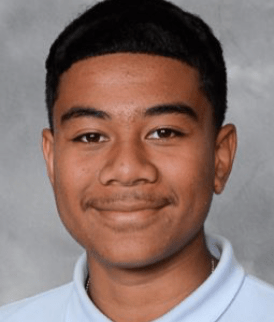
Hello, my name is Mo’ui. I am from St Bernard’s College in Lower Hutt and I am a proud Tongan. I have a brother who is 7 years and a father; my mother passed away when I was 13, I am now 14 years and in Year 10. I love music and English. I want to pursue music when I am older because I love to compose songs and write lyrics.


Screen Shot 2019-04-02 at 9.03.00 AM.png


Poetry Shelf review: Here we are read us: Women, disability and writing

DSCN9594.jpg

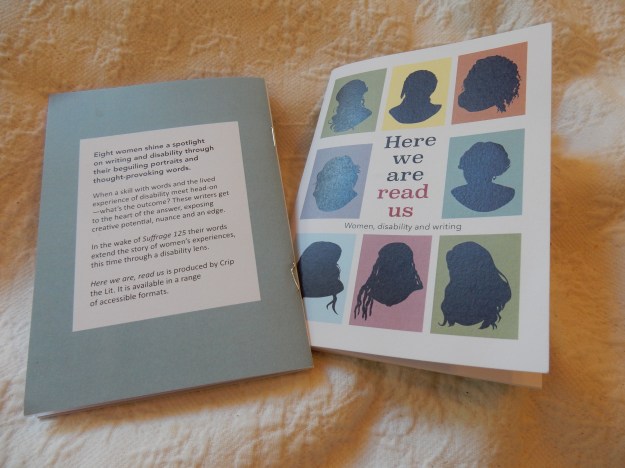
Here we are read us Women, disability and writing ed Trish Harris (Wellington: Crip the Lit, 2019) 


In 2016 Robyn Hunt and Trish Harris established Crip the Lit ‘to celebrate and foster the work of Deaf and disabled writers’. Trish explained further in an email to me:

We chose ‘There is no such thing as a disabled writer. We are all just writers’ for our debate topic at LitCrawl (2018) because we wanted a moot that could be argued–in an entertaining and feisty way–either way. And that’s what we got! We want to open up those kinds of conversations but Crip the Lit also makes a stand saying there’s an important voice under represented in mainstream New Zealand writing and that is the voice of writers who have an impairment/disability–people who can write about this topic from the inside of the experience.

Crip the Lit has produced a slender pocket book, Here we are read us, that showcases eight writers who all live with disability. The writers include memoirists, novelists, poets, essayists, playwrights and bloggers from across New Zealand/ Aotearoa. Most of them seem to do poetry in some form or another!

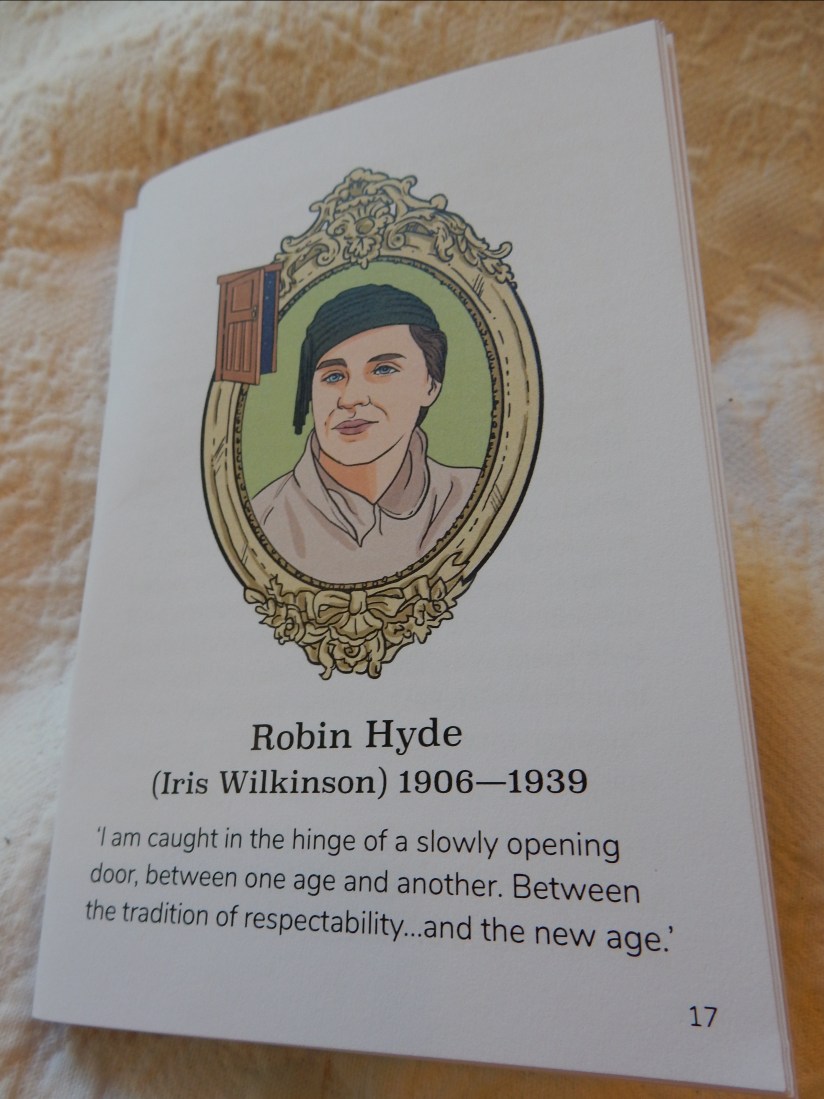
Illustrator, Adele Jackson has done a portrait of each writer housed within personalised frames that include a writer-selected symbol. The writers are: Tusiata Avia, Steff Green, Michele Leggott, Helen Vivienne Fletcher, Charlotte Simmonds, Trish Harris, Te Awhina Arahanga and Robin Hyde. The disabilities include blindness, autism and epilepsy.

Each writer has written about their chosen symbol, living with the experience of disability and their writing choices.

There is a section where each writer responds to the question: Why do you write?

This is how Tusiata answers the question:

I write because there’s an itch or a spangle and when I give it attention and space it expands to something full blown. It teaches me something. I write because sometimes the spirits are whispering and if I put pen to paper they will speak.

The pocket book is also available as large print format, an audio book, an e-book, individual social media files on each writer, in Braille and DAISY audio.

I love this pocket book because it brings disability out into the open – it took Tusiata awhile, for example, to expose her epilepsy in poetry beyond hints and traces. The pocket-book writings not only open out the daily challenges that each writer faces but confirm the notion that the ways and hows and whys of writing are utterly diverse.

Huge admiration to the editors for bringing this uplifting project to realisation. It is a gift.


Order copies and get downloadable files here.


dscn9595.jpg


Poetry Shelf Monday poem: Harry Ricketts’s ‘Ginny’s Garden’


 Ginny’s Garden

(for Ginny Sullivan, 1950-2017)


Magpies quardle-oodle in the high firs.

Down here, under the overhang, it’s hot,


looking out over the lawn Karen says she cut

two weeks ago, and already thick, clumpy,


to the paddock where Friendly, the seven-year-old ewe

that you couldn’t bear to send to the butcher,


baas by the fence for kale and attention.

The veggies you planted have gone mad:


tomatoes big as butternuts; huge, shiny aubergines;

giant marrows; cabbage whites all over the basil.


In the Pears’ Soap poster in the bathroom,

two small girls still stare at large bubbles.


Harry Ricketts


Harry Ricketts teaches English literature and creative writing at Victoria University of Wellington. His latest collection, Winter Eyes, has been longlisted for this year’s Ockham New Zealand Book Awards.


Poetry Shelf noticeboard: an evening with Vivienne Plumb


Screen Shot 2019-03-31 at 2.45.15 PM.png

Award Winning Writer of Poetry, Drama and Fiction. 2018 Creative New Zealand Berlin Writing Resident.

Vivienne Plumb recently held the 2018 Creative New Zealand Berlin Writing Residency, and lived in Berlin for almost a year while researching and working on her new creative nonfiction book.

She is based in Wellington and writes poetry, drama and fiction. She has published twenty books in these three fields of writing.

She has held many writing residences, including the 2016 University of Auckland/Michael King Writing Residency and a University of Iowa residency; and has been the recipient of many awards including the Bruce Mason Playwrighting Award, the Hubert Church First Best Book Award, the Sargeson Fellowship, and an Australian post-graduate scholarship. She has acted as a judge for numerous poetry competitions and for the Ockham New Zealand Book Awards.

Her plays have been produced all over New Zealand and translated and published in Poland and Italy.

She is a member of the Academy of New Zealand Literature.

Her most recent book, a compilation of her past-published readers’ favourites, As Much Gold as an Ass Could Carry, has been translated into Italian and published in Italy.

Vivienne’s North Island reading tour is supported by the New Zealand Book Council.


Poetry Shelf audio: Marty Smith reads ‘Hat’

004_4-009540913200 copy.jpg


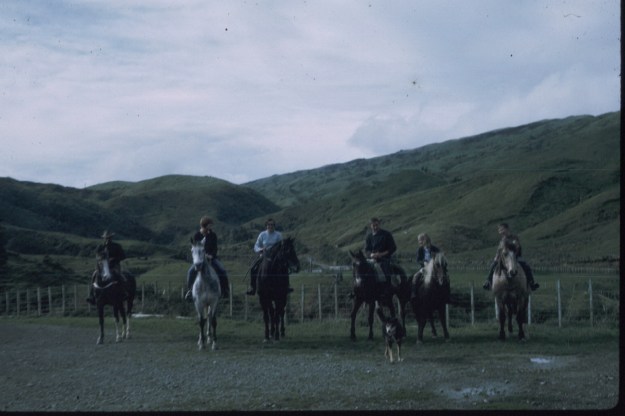
Marty Smith reads ‘Hat’ from Horse with a Hat, Victoria University Press, 2014


‘This is the kind of territory they were all locked together in. Here are the hills, and this is how they went to work.Left to right: Garth Smith (Dad) on Misty; Fiona Allpass on Poo: Marty Smith on Blackie: Bill Champion on Tiny: Chrissy Champion on Pet, and Paul Smith on Trixie.’ Marty on the photograph
Marty has given up teaching and administering literary events to work full time on writing a non-fiction book about what it takes to work in the racing industry and how and why people do. Her research involves regularly watching morning track work at the Hastings racecourse and betting at the TAB.


Poetry Shelf Classic Poem: Kate Camp picks Lauris Edmond’s ‘Camping’


Camping


Do you remember how we woke

to the first bird in that awkward pine

behind the ablution block, and leaned

across the knotted ground to lift

the canvas as though it was

the wall of the world

and ourselves at the heart of it

lying together

with the fresh grass against our faces

and the early air sweet beyond all telling –


do you sometimes look still

into that startled darkness

and hear the bird,

as I do?


When we drove away I looked back always

to the flattened yellow grass

to see the exact map of our imagining

our built universe

for a week

and saw that it was just earth

and faced the natural sky.


We took with us the dark pine

and the blackbird

and dew beside our foreheads

as we woke


and now we live apart

and I don’t know where they are.


Lauris Edmond  (from New & Selected Poems, Oxford University Press, 1991)

Posted with kind permission from the Lauris Edmond Estate.


From Kate Camp: It feels a bit odd that this is such a favourite poem of mine, because of the pun with my name. But the image of the flattened grass hit me with such power when I first read it, and does every time I revisit it. There is so much to love about the poem – its sensuality, its unashamed romanticism, and of course (being Lauris Edmond) its absolutely killer ending.

I remember Lauris saying to me once that she felt a poem should end like the shutting of a car door, from which I took a sense of satisfying and substantial closure, a rightness. I didn’t know Lauris well but she had a way of talking, and of reading her poems, as if she was slightly surprised by each individual word. I hear that cadence when I read the poem.

But of course the best thing about this poem is the ablution block. It’s such an ugly, unlikely thing to find in a poem, both the thing itself and the awkward “no one has ever said it” tone of the phrase. You know this is a found piece of language off some battered sign of the camp ground, and that lends the whole poem a down home, unpretentious feeling, that lets her get away with the romantic flourish of the “early air sweet beyond all telling.”

The other thing I love about this poem is how, like one of Shakespeare’s sonnets, it’s really a kind of sly testimony to the power of poetry – and of this particular poet – to capture and immortalise. It ends “I don’t know where they are” but of course we do know where they are, the bird and the pine and the dew are here in this poem. Wherever the poem’s protagonists and landscapes are, however lost to time and mortality, the poet has saved them here.

I think that’s why for me this melancholy poem is one that leaves me with a sense of exhilaration, even triumphalism – because when the car door of the poem closes, I sense the power of the poet in the driver’s seat.


Kate Camp is a Wellington-born essayist and poet, with six collections of poetry published by Victoria University Press. She has also written essays and memoir. Unfamiliar Legends of the Stars won the NZSA Jessie Mackay Best First Book of Poetry Award (1999), and The Mirror of Simple Annihilated Souls won the New Zealand Post Book Award for Poetry (2011). Snow White’s Coffin was shortlisted for the award in 2013, and The internet of things was longlisted in 2018. She has received the Creative New Zealand Berlin Writer’s Residency (2011) and the Katherine Mansfield Menton Fellowship (2017). Her essay ‘I wet my pants’ was a finalist in the Landfall essay competition in 2018.


Lauris Edmond wrote poetry, novels, short stories, stage plays, autobiography and edited several books, including ARD Fairburn letters. She published over fifteen volumes of poetry, including several anthologies, and a CD, The Poems of Lauris Edmond, was released in 2000. Her debut collection, In Middle Air, written in her early fifties, won the PEN NZ Best First Book of the Year (1975) while Selected Poems won the Commonwealth Poetry Prize (1985). She received numerous awards including the Katherine Mansfield Menton Fellowship (1981), an OBE for Services to Poetry and Literature (1986), an Honorary DLitt from Massey University (1988). Edmond was a founder of New Zealand Books. The Lauris Edmond Memorial Award was established in her name. Her daughter, Frances Edmond, and poet, Sue Fitchett, published, Night Burns with a White Fire: The Essential Lauris Edmond, a selection of her poems in 2017.


Poetry Shelf Monday poem: from Amy Brown’s Neon Daze

Excerpt from Neon Daze


8th December 2016


A friend warned me months ago

that my baby would start to smell

of other people – perfumes, creams,

colognes, sweat – your baby’s head

will press against strangers’ throats

and décolletage, held close and warm.

Sure enough I recognised the musky,

woody scent of our family friend in his hair

and skin yesterday long after she’d left.

Babies are olfactory creatures, happiest

emanating their own or their parents’

odour. We squirt Johnson’s shampoo

under the running tap for the manuka

sweetness it leaves behind his ears.

Now, he is strapped against me and

I am afraid the sunscreen on my chest

will distract from the baked tussock,

sandy fragrance fresh and familiar

as a wave [1], blue and white as the baby’s

eyes. We walk along Ocean Beach towards

Cape Kidnappers, which is only ever a haze

of coast in the distance, past macrocarpas,

painted black in the Dick Frizzell print

on my parents’ bedroom wall. We walk and

the baby’s sleeping cheek sticks to my skin.


—————————————————


[1] To Wave

To move to and fro, from the Old Norse vagr meaning billowing water. Waves, Robin, look! I told him today, both of us squinting into the glare of the mid-morning horizon, paddling along the edge of the Bass Strait. His right hand lifted and twisted back and forth, to and fro at the breakers.

I am wavering between then and now. This is our third time at Skene’s Creek. The first was the first weekend away with my partner – my first conventional weekend away with any partner. He booked a cabin whose view from the bedroom window was dense and private with eucalypts and which was all sea and sky from the balcony, where I sat typing away at my thesis with a beer while he barbecued us fresh fish. I had about $36 in my bank account then and was both luxuriating in and anxious about the incongruity of this experience. In the spa bath we sucked each other’s toes and played lavishly with the jets. The photos I took were all of us – our feet the same size and sandy, only distinguishable by my red nail polish; him on the swing, a joyful blur of beard and beer.

The second time we came to this beach we stayed at the same cabin, but the weather was miserable. I photographed the food we made and the special bottle of wine we drank and my partner’s back as he walked away from me in his red jacket along the deserted beach. We brought our yoga mats and held postures together while rain hung white in the trees, obscuring the sea. I had just got my period for the twelfth time of hoping it wouldn’t come and was allowing myself to drink the wine, which tasted of nothing. We still didn’t know why I wasn’t getting pregnant, or how to fix it, or how lucky we would be when the weeks of injections started.

This time we are staying in a family’s beach house. I move the bowls of shells and driftwood ornaments to higher ground. My partner blocks the steps from the deck to the wild garden with three chairs. We coax our toddler to not use the length of timber dowel locking the sliding door in place to drum on the glass coffee table. We find empty snail shells, stones of all varieties and point at the sulphur-yellow underside of the wings of the cockatoos, which shriek en masse as they fly. I photograph the baby in the hammock, the baby in the sea, the baby scooping sand into his bucket; his face is always behind a broad-brimmed sunhat patterned with leaves. After seven, when Robin is asleep, we play quiet games of Scrabble and Monopoly at the outdoor table, drinking wine and eating chocolate to keep warm. On every visit I’ve forgotten how cold the beach gets at night and pack inadequately. This time I bring socks but no shoes, and many T-shirts but no heavy jersey. Like an eighteen-month-old I wear socks and sandals and eccentric layers. To warm up after swimming in the sea, we all shower together. I show Robin how I wash my face by closing my eyes and dipping my head under the stream. Nick demonstrates how he washes his face, carefully with a flannel. We both applaud when Robin’s wet eyelashes open and he smiles.


9th December 2016


There are creases in the back

of my father’s tanned neck, like

Hemingway’s old man. He spends

two hours longer than usual out

in his boat, trying to catch enough

kahawai for our dinner. It is filleted,

barbecued and served with a Persian

marinade from a cookbook I gave

my mother two Christmases ago.

The recipe calls for dried rose petals.

She laid them out in the sun (and

later microwave, to speed the process)

herself, picked from her own garden.

She lets the baby take handfuls

of petals off the aging bunch in

the dining room. He scatters them

romantically across the floorboards.

Later, I find one still clutched, bruised

perfumed and bright as blood in his fist.


Amy Brown


Amy Brown lives in Melbourne, where she teaches literature and philosophy. Her first poetry collection, The Propaganda Poster Girl (Victoria University Press, 2008), was shortlisted for a Montana New Zealand Book Award in 2009. Her next work of poetry, The Odour of Sanctity (Victoria University Press, 2013) was the creative component of a PhD on contemporary epic poetry. Her next book, Neon Daze, will be released by Victoria University Press in 2019.