Category Archives: NZ author

Poetry Shelf noticeboard: Gregory O’Brien’s launch speech for Richard von Sturmer’s Postcard Stories

9781877441622.jpg


POSTCARD STORIES…a launching speech, VicBooks, Wellington, 12 April 2019


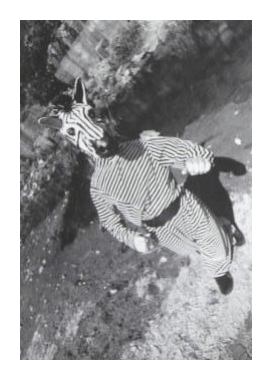
It’s over thirty years ago since Richard von Sturmer appeared on the cover of Robert Cross’s and my book about New Zealand writers Moments of Invention. Back in 1987 I remember Richard suggesting that Robert photograph him in his ‘most natural habitat’. So we went to Smales Quarry, near Lake Pupuke—a flooded, desolate, you could almost say post-apocalyptic zone—a lunar landscape with the occasional sprig of kowhai. After spending quality time in a trench-coat and mask (as the ‘Neanderthal businessman’ character, Mr Chipden), Richard donned striped overalls and a papier mache zebra-head.
Screen Shot 2019-04-17 at 7.43.56 AM.png

Was the zebra outfit a uniform or a disguise—an act of self-expression of concealment? Either way, the photo on the book’s cover raised the question, for me, of how it might be that writers, more generally, fit into this world. Richard was, and still is, proposing we should all look, listen and think beyond the obvious. Maybe the lesson of Smales Quarry is that we should look for answers in the direction of archaeology or possibly the analysis of dreams, rather than in the realms of sociology, cultural history or literary theory. The cover photo of Richard, zebra-headed and humanimal (in the adjectival sense), begged the question whether the life of the writer is ultimately an absurdity, a theatrical production or maybe even an inexplicable folly. More than anything else, the image reminds me of one characteristic of all good writers: they are up to something. They ask that we follow them somewhere new and surprising. ‘I think we should go into the jungle,’ as Barbara Anderson would have put it. Their jungle.

The cover photo was taken shortly after the appearance of Richard’s We Xerox Your Zebras appeared—a book which has long been something of a cult classic and which, infamously, upon publication prompted threats of legal action from Rank Xerox Corporation, on account of copyright infringement. Still in his twenties, Richard’s creative trajectory as a genre-bending, world-expanding writer was set, as was his now longstanding allegiance with, and commitment to, the unexpected, the odd and the illuminating. He struck me then, as he strikes me now, as an improving influence not only on the world of letters but on the world itself.

Over the three decades since then, there have been collections of poems from Richard and –to much-deserved acclaim upon its publication three years ago–a memoir about his father and grandfather, This Explains Everything. Yet, as the new book reiterates, nothing is ever really explained. Explanation is too often simply a misreading, simplification or a reduction of the matter at hand. Reality is full of live circuitry and ongoingness and expansiveness. We reach conclusions at our peril.

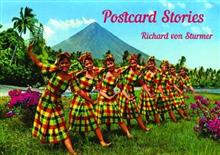
Richard’s books are working documents of a life-in-progress, a sensibility in the making and constant remaking. Reality is put, much of the time, through a Zen Buddhist filter, yet his writing can be as rowdy and colourful as the line-dancing Filipino women on the cover of Postcard Stories. Such a paradoxical, contrary state remains at the heart of his creative project. Also worth noting is a curious propensity for the transmutation or transubstantiation of the mundane or the misguided into a state of meaningful joyfulness.

What sort of narratives are on offer in Postcard Stories? Are these stories about postcards or inspired by postcards—or are these the stories the postcards themselves might have told, if they could speak. Through the first half of the book, Richard performs a visual/verbal two-step, offering short sequences of text—a hybrid of short story and  haiku—to enhance, elaborate upon, subvert and embrace the images which they accompany.


Quickly enough, the book gets one thinking about the nature of postcards. It becomes a protracted meditation on that endangered if not dying species. In the era of the jpeg and digital file, postcard stands are becoming fewer and further between. Postcard Stories offers the gentlest of interrogations, a backward glance at these printed images, their industry and their format. It asks questions, but without, of course, requiring any kind of answer.

Most of the time, postcards relate to a specific location yet, as this book manifests, they often reflect a certain lostness, aimlessness, waywardness. You would not want to use them to get your bearings in the physical world. I remember, years ago when Jen and I were spending six months in the South of France courtesy of the Katherine Mansfield fellowship, Richard sent us—in Menton—an antique Greetings from Menton postcard which he had procured from a South Auckland second hand shop.  As Richard’s new book attests, postcards, like the rest of us, lead paradoxical, complex and unreliable lives. In his bright and user-friendly introduction, he goes so far as to describe postcards as ‘cells in a giant, universal brain’ then adds, instructively: ’I like to dream with postcards’.

Traversing such inner and outer realities, the texts in Postcard Stories feature a surprising number of flowers. Ditto monuments, towers, clocks and water features. In deep amidst the imagistic ebb and flow, we are asked to consider how flowers flower differently in words than they do in pictures. We are back in the quarry. We are back at the beginning of the world, and the beginning of the word. We are once again keeping company with a zebra-headed youth in his wasteland-quarry. Yet we are also in the world of a film-maker, one half of the Humanimals who is now one half of a group called the Floral Clocks (greetings to the other half, Gabriel White, here with us tonight)… We are in the world of a man- or person-of-letters, an exemplary citizen of Aotearoa, a Buddhist, activist, free radical and traveller in the universe of postcards; a surveyor also of the lives contained in these most wistful of images and of the lives that continue to swirl around them long after they have been posted, received and put to one side.


Gregory O’Brien


.


Poetry Shelf noticeboard: David Howard awarded UNESCO Ulyanovsk residency

Writers from Slovenia and New Zealand to be the first participants of the Ulyanovsk UNESCO City of Literature Residency Programme

D4OrruYVUAEUk6M.png

In September, David Howard from Dunedin (New Zealand) will visit Ulyanovsk. The author is going to develop a poetic sequence set in Ulyanovsk, as well as to collaborate with a local composer on a musical setting for his texts. Howard is the author of six books, a participant of several international residencies, was awarded several literary awards, was a participant of exhibitions and performances, an editor of several books, including the book, devoted to Russian authors. His works were translated into European languages; the book «The Ones Who Keep Quiet» (Otago University Press, 2017) featured in the New Zealand Listener’s Books of the Year. David received the New Zealand Society of Authors Mid-Career Writers’ Award (2009), the University of South Pacific Poetry Prize (2011), and the University of Otago Robert Burns Fellowship (2013).

Full details here

Poetry Shelf Monday Poem: Jack Ross’s ‘What do you want?’


What do you want?


said the librarian

in Friendly Feilding

to come in from the cold

was my reply


we’re closing an hour early

for a function

the function I’d driven down for

I walked away


he’s crying

but he doesn’t know

why he’s crying

said my sister


to the primer one teacher

who wanted to know why

I guess I do too

I guess I do


I was small and afraid

of a brand-new place

so many people

but what remains


is kindness

my sister

trying to help

unavailingly


Jack Ross


Jack Ross’s novel The Annotated Tree Worship was highly commended in the 2018 NZ Heritage Book Awards. He has written five poetry collections and six other volumes of fiction. He works at Massey University, and is the managing editor of Poetry New Zealand. His blogs here.


Poetry Shelf noticeboard: Gail Ingram launches new collection

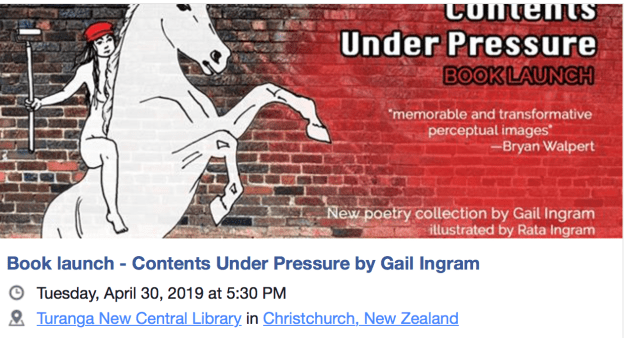
Contents Under Pressure a new poetry collection by Gail Ingram illustrated by Rata Ingram published by Pūkeko Publications 5.30-7.00pm Spark Room, Ground Floor at Tūranga New Central Library, Christchurch.


Screen Shot 2019-04-13 at 3.17.20 PM.png


Poetry Shelf Friday talk spot: Jeffrey Paparoa Holman and ‘Normal Service’


Normal Service

It feels like months since I’ve come near to anything like writing poetry. Sometimes it just happens like that: there’s a season, not that the well is dry, just that the bucket hasn’t been lowered. The first few months of this year have been taken up with getting myself ready to leave my position at the University of Canterbury, deciding not to re-apply for another three years as an adjunct. Time to go, after nine productive and stable years.

I tell people, “I’m not retiring, just moving offices”, which is true, but it is a major change. Every weekday morning, Jeanette and I have cycled out to the Ilam Campus, stopping off for a coffee most days near Hagley Park. Now, I don’t have to go anywhere, which is different from having nowhere to go, but it will take some getting used to.

What I won’t forget is that in the last two weeks of my tenure, all has been overtaken and devoured by what happened on the afternoon of the fifteenth of March when the whole campus was locked down as a result of what we were first told was, “ a firearms incident at the Al Noor Mosque”. It soon became obvious it was a fatal shooting, there had been many casualties, that some were dead, and as the afternoon wore on, the numbers climbed as the scale of the tragedy was revealed.

So much has happened in this city since that day, on a public stage and in private places, that don’t need any reminders here. The stories, the narratives of grief, shock, anger and even a kind of numbness are all being woven together, in a community that knows disaster, that must now confront terrorism and its aftermath at our very heart – a place of worship.

I had no intention, no inclination, to write anything resembling a poem. It was enough just to try and get my head around what was happening and as well, carry on clearing my desk, saving files, changing email addresses and saying goodbye to good friends on the staff of Canterbury.

Jeanette and I sometimes go for breakfast at Under The Red Verandah, a famous city eatery reborn after the poet and publisher Roger Hickin’s original establishment was wrecked in the earthquakes. While we were there on Thursday morning, my wife asked me if any poetry was there in the wake of what had happened, and I recall saying, no, I couldn’t even contemplate writing a poem.

But as I walked around afterwards, I heard a line, an insistent phrase, quite clearly: “Normal service will not be resumed”. It just sat there. Then another: “There has been a slaying”.  It isn’t often I feel I must obey an instinct as strong as this, but started to write what was really a form of litany, compressing the underlying horror I felt. The poem came in couplets that began with what sounds like a public service announcement, which the next line undermines. At least I hope that is the effect.

I worked on it during the day, and on Friday I took it out to Christchurch Mens’ Prison, Paparua, where every week, three Christchurch poets – Bernadette Hall, Jeni Curtis and I – run a book group in the library overseen by Susan, our wonderful librarian.

There was a security lockdown that day and we had no prisoners turn up. We all sat around and shared our lives, and the poem was read. Susan took a copy for the prison’s monthly library magazine. Whatever it is worth, a silence for me was broken and some of the men in that jail will get to read it, maybe even give a response at a later group.

W. B. Yeats once wrote, “…but all that is personal soon rots; it must be packed in ice or salt”. For Yeats, style, form – made new – was vital in preventing the poet from lapsing into subjective egotism. A disaster like this is not about me, but the victims.


Normal service


mō ngā mate Mahometa e rima tekau i hinga ki Ōtautahi 15 Māehe 2019

Normal service will not be resumed
There has been a slaying

Normal service is impossible
Children executed

Normal service disconnected
Mothers slaughtered

Normal service is terminated
Elders eliminated

Normal service makes no sense
Terror is walking

Normal service is banned for life
Blood on the welcome

Normal service is now shut down
Thank you for weeping


Jeffrey Paparoa Holman
4 April 2019


Jeffrey Paparoa Holman writes poetry, memoir and history. His most recent work is Now When It Rains: a writer’s memoir, published by Steele Roberts (Aotearoa) in 2018.


Rob Stowell, the videographer at Canterbury had recorded this reading of the poemW


Poetry Shelf audio spot: Hinemoana Baker reads ‘Aunties’


Hinemoana reads ‘Aunties’


Hinemoana Baker, of Ngāti Tahu, Ngāti Raukawa, Ngāti Toa and Te Āti Awa along with English and Bavarian heritage, currently lives in Berlin. A poet, musician and playwright, she graduated with an MA in creative writing from Victoria University of Wellington in 2002. She was the 2009 Arts Queensland Poet in Residence, a writer in residence at the University of Iowa International Writing Program (2010), Victoria University Writer in Residence (2014) and held the Creative New Zealand Berlin Writer’s Residency (2015–16). She has published three poetry collections and several CDs of sonic poems.


Poetry Shelf review: John-Paul Powley’s Kaitiaki o te Pō: Essays


kaitiaki-cover-front-web.jpg


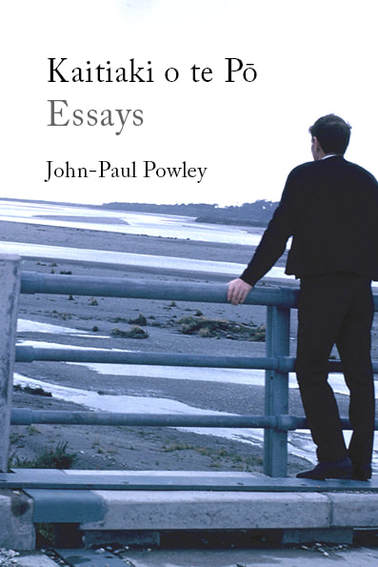
John-Paul Powley,  Kaitiaki o te Pō: Essays,  Seraph Press, 2018


John-Paul Powley writes with ease and grace in essays that present entwined threads. Simplicity and richness coexist as he reaches down into the truth (his truth) of his experience. This is what draws me into his collection: the need to explore the personal truth of both past and present. It feels utterly explorative, vulnerable, testing, mobile. It feels humble.

The opening essay resembles a reflective walk, a sequence of interconnected musings, particularly on grief. John-Paul is watching Brideshead Revisited, he is walking through the grounds of Victoria University on his way to a History Conference that starts off tediously with an Education Minister who speaks of herself rather than from an accumulation of listening and then, when Justice Joe Williams suggests the role of the historian is as kaitiaki o te pō (caretaker of the night), includes moments of epiphany. John-Paul is walking through the past as he walks to the conference, retrieving his younger self and more importantly a university friend who had recently died in London. The essay is a deft weave of experience, ideas and feelings: of moving with the past into the future, of processing loss and carrying that loss forward, of shifting the way he carries the dead within him. Reading the essay is akin to taking a walk. I stop by certain vistas and objects and let the embedded ideas reverberate. A plaque, for example, unnoticed by the young John-Paul, now resonates. An old oak tree had been axed by bureaucracy to make room for a single car park.

The second essay also drew me in to close attention as John-Paul navigated his masculinity, his femininity, his gender identity – however we might define such concepts and ways of being. The fact others thought he was gay when he was not gay challenged him as both child and adult. We travel through his school-boy choices that threaten to put him at the bottom of the social ladder. He loathed the misogynistic lyrics of Guns N Roses, he picked leg warmers as his favourite item of clothing and pictured a leg-warmer dance scene when the class sniggered at him, he fell in love with Marlon Brando and cried when Marlon died. He got to shave before his Y8 peers did and it felt like a badge of masculinity. He wondered when he would ever be at the arrival point of himself. When as an adult he became Dean, at the high school where he taught, he wanted to protect the bullied and ended up being called a ‘faggot’. The layerings of confession and experience are deeply affecting. John-Paul asserts this is not a coming-out essay – I see the essay as an opening up of gender experience that resists location within either/or.

If the essays are deeply personal they are also political. One essay considers why Anzac Day irks him: he pinpoints our blind spots (indifference? ignorance? need to ignore? to privilege white narratives?): the New Zealand wars and the Boer war in the claim ‘we’ lost our innocence in Gallipoli. The notion of noble sacrifice. The whole business of remembering ‘them’ when who exactly was ‘them’. The way remembering begins at WWI.

John-Paul teaches (or has taught) history and social studies and that occupation strongly influences the weave of writing. When he visits a beach and the adjacent town with his children, he reflects upon the grave of Parnell but he also reflects upon the graves of Te Puni and his family. The dampened down stories, in the master narratives, are drawn to the light. It feels so important to be reading these essays, to be acknowledging the unspeakable violence and theft and wrongs done to Māori, to be widening our view of history. It feels so right that his students will not be limited to a Pākehā-centric view of the past.

This book feels like part of our coming together; of the contemporary call to reconsider who and how we are at both a personal level and within our communities, both past and present. It is essential reading.


Seraph Press author page


Poetry Shelf Monday Poem: Vanessa Crofskey’s ‘The Capital of My Mother’


The Capital of My Mother


My mother is born in the capital of Malaysia

her own umbilical cord tied to a deflating sun


In her country, the heat is wet

the air is heady

the sweat on my back is hereditary


I know no kin except blood tied to bone

my water body leaks red and diaspora yellow

my eyes are globes


Karl, my brother, is turning seven.

We sit in the muggy backyard of our grandparents

house in Kuala Lumpur


Kuala Lumpur means muddy confluence

The city is born from the place two rivers

merge then flow


I am the point two paths cross just to separate

byproduct of my parents’ relations

divorce impeding

my mother’s birthplace


They say all rivers flow to sea

I cannot find home except the sense

of somewhere I can’t reach

I am a migrant’s remembrance

I am a welcome party.


The kettle is boiling and it is time in slow motion

It is the noise of my grandma learning English

off my five years old cousin


Her R’s are a dysfunctional lawnmower

explaining wet season, sticky rice, banana leaf


Across the phone

in my privileged NZ accent

I talk about burgers, flat whites, fries with aioli.


We don’t speak the same language

but we do share the same ocean

when I say noodles she knows exactly what I mean.


Potluck is God doing dishes

Migration is the earth stirring flavour

Clepsydra is a clock that runs from dripping liquid

Its name means water thief


Across boats, migrants tell time by the second

and we call them thieves for different reasons


The first house I live in is a transported container

stolen body, claimed land, white heartbeat


Decades are tides that rock us to sleep

except landlocked I cannot dream

except I’ve a fear of the open sea

accept that you are dry land

still amniotic

barren

bleeding


I’ve worn ships not shoes since the minute

I was aware of my own unbound feet


Only a daughter’s daughter’s body

arriving to this space every century


The harbour is a welcome mat

for a new placenta


I spit in it

and let the land claim my whole front teeth


Vanessa Crofskey


Vanessa Crofskey is a poet and artist based in Tāmaki Makaurau. She was the Auckland Regional Slam Champion for 2017 and won Best Spoken Word / Storytelling at Auckland Fringe Festival that same year. Vanessa has written for multiple publications including Turbine | Kapohau, The Pantograph Punch, Starling, Hamster Mag, Hainamana, East Lit, SCUM Mag and Dear Journal. She tends to write about water, intimacy and violence.


Poetry Shelf Friday talk: Lynn Davidson on the collectivity of writing poetry


I am excited right now about the collectivity of writing poetry; how poems draw from poems. In 2016, soon after arriving in Edinburgh, I was invited to join a collective of women writers who had come together at the request of the Cooper Gallery in Dundee to respond to their exhibition about a 70s collective art movement called the Feministo Postal Art Event. The Postal Art Event began with two artists – Sally Gollop and Kate Walker. When Sally moved away from South London where she and Kate were neighbours to another part of the UK, both women missed sharing their art so began posting small artworks to each other. Other women artists heard of and picked up this idea and in homes across cities, towns and villages in the UK women made, posted and received art and generated a community of artists. We echoed the Feministo Postal Art Event’s process in a 21st Century way, by writing and responding to each other’s work via a shared Google document.

Our collective is called 12. There are twelve of us, we are Edinburgh-based, and we have continued to write and respond to each other’s poems via a shared Google document for more than two years. We sometimes perform our work, and have been asked to respond to several art exhibitions, most recently to Emma Hart’s Banger at the Fruitmarket Gallery in Edinburgh. We are finding that the poems we write for 12 are a bit different to the poems we write outside of that particular circle of response. Why? I’m not sure, but there’s something about being honest about writing from community. About calling our lone selves in from the hills. The collectivity of making is front and centre; no one is pretending otherwise.

Lynn Davidson


Lynn Davidson is a New Zealand writer living in Edinburgh. Her latest poetry collection Islander is published by Shearsman Books and Victoria University Press (out this month). Lynn teaches creative writing, works in Edinburgh libraries and is a member of 12, a feminist poetry collective.