Category Archives: NZ author

Poetry Shelf classic poem: Tate Fountain picks Emma Barnes’s ‘White Tuxedo’


White Tuxedo


I dream of you in a white tuxedo. It is a wedding. It is not our wedding.

But the face that you affix to yourself when you look into me is the face

of the man viewing the woman. Hello this is love. Your square jaw. Your

soft, capable, all knowing mouth. Hello even your bluest and greenest

eyes. Everyone is wearing white. I look down at myself and I am lace over

pearlescent white water wings and I am shaking with adrenaline. We walk

holding hands and you’re a helium balloon I tug to earth with my

unexpected weight. Your hands slip over me. You in a white fitted shirt

with your head thrown back. We lie in bed together wrapped tightly in disbelief.

Some of our best moments were sleeping. Some of our best

moments were only in our eyes. You tilt your head to turn to me and the

whole world follows behind you.


Emma Barnes


The poem was originally published in the journal, Sweet Mammalian 3


Note from Tate Fountain:

I rarely pass specific poems on to friends, despite the amount I read and my general penchant for sharing. ‘White Tuxedo’, however, was immediately dispatched to the other side of the globe: this is a very good poem, I told my best friend, the link attached in a Twitter DM. And it is, of course, precisely that. A very good poem. A bittersweet one, which accomplishes so much in something so seemingly simple.

‘White Tuxedo’ balances the delightful with the devastating, and both elements are augmented for the presence of the other. There is an ease to Barnes’ language, unadorned yet undoubtedly calculated, which lends both to fine poignancy—‘Your/ soft, capable, all knowing mouth’—and to forward propulsion—‘lace over/ pearlescent white water wings […]’. The fourth ‘sentence’, if you will—‘But the face that you affix to yourself when you look at me is the face/ of the man viewing the woman’—pierces. It verbalises a distinct discomfort, and the inescapable air of objectification, that I’ve so often found in ‘heterosexual’ experiences. (This is perhaps furthered by the wedding in the poem, and how pointedly it is not that of the narrator and the subject.) Of course, this line might just as well signal romance to someone else (‘Hello this is love’): perhaps an ode to the archetypes of affection by which they have seen themselves represented. This may be the loving look of literature, of cinema, of song—which is a valid interpretation, and a testament to the multitudes Barnes’ phrasing can contain (though it may also be the kind of feminine subjecthood that Barnes, in penning this particular poem, has explicitly reversed).

What I love most about ‘White Tuxedo’, though, is entrenched in each and every phrase: say it with me, gang—the intimacy of it all. This intimacy is a condition that I’m always looking for in poetry; in art, in life. The knowing of somebody, and an existence shared with them, that cannot be erased by the conclusion of it. The enormity of that understanding; making macro of the minute. Really, I have always had to share this poem just for its final statement, in which Barnes handles the depth of these ideas with sparing, rapturous clarity: ‘You tilt your head to turn to me and the/ whole world follows behind you.’ It’s delicious. It’s immediate, and it’s immense. It says everything it needs to. It’s very, very good.


Tate Fountain is an Auckland-based writer, actor, and academic, whose recent work can be found in Starling, Perception, Gold Hand and MIM. In 2018, she self-published the chapbook Letters, which found readers around the world, and she has just begun a literary newsletter, which she hopes might be read by five people.


Emma Barnes lives and writes Te Whanganui-ā-Tara. She’s working on an anthology of Takatāpui and LGBTQIA+ writing with co-conspirator Chris Tse. It’s to be published by AUP in 2021. In her spare time she lifts heavy things up and puts them back down again.


Poetry Shelf Monday Poem: Jordan Hamel’s ‘Wednesday’


Wednesday


It used to be on your forehead.

a blackened smudge

filtering through punctured skin,

entering the blood stream

until your cuts and scrapes became

Communion for forgotten sins

and you dripped the sermons

delivered in the precipices

of your childhood.


            Give us today our daily bread

                Forgive us our gluten intolerance


Like a bartender

who only serves

true crime podcast theories

or a stamp collector

who collects other stamp collectors,

habits reimagined

still ask you to bear the same weight.


Deliver us from temptation

Like a reverse Uber Eats


The smudge is still there,

bystanders can’t see it

nesting, in the coil of your

skull, calcified, waiting

to be exhumed and finally

rest behind glass or

stay dormant in the cave

surrendering to the moss,

never to be resurrected.


Jordan Hamel


Jordan Hamel is a Pōneke-based poet and performer. He was raised in Timaru on a diet of Catholicism and masculine emotional repression. He is the current New Zealand Poetry Slam champion and has words published or forthcoming in Takahē, Poetry NZ, Mimicry, Sweet Mammalian, Glass Poetry, Queen Mob’s Teahouse and elsewhere.


A tribute to Dunedin poet: Elizabeth Brooke-Carr (1940 – 2019)

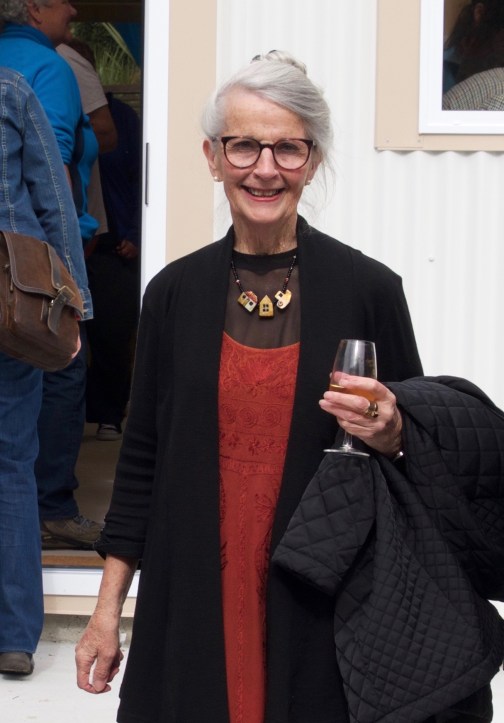
Elizabeth B-C in the Caselberg cottage.jpg


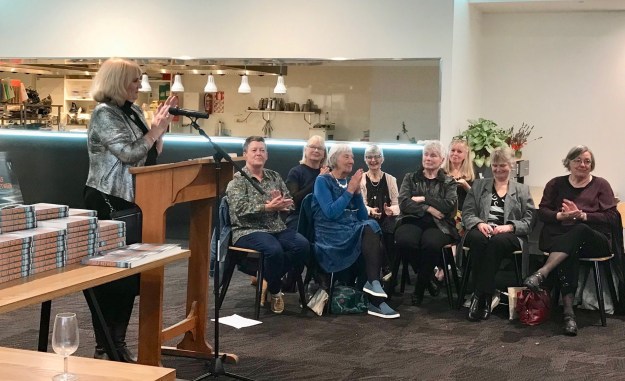
On Friday 6th September I was in Dunedin to celebrate Wild Honey with local poets. The occasion was moving in its connections and warmth, but made even more so by the sadness many felt at the death of much loved Dunedin poet, Elizabeth Brooke-Carr that afternoon.


Elizabeth Brooke-Carr was a poet and writer. She taught English in secondary schools for twenty years and has tutored creative writing evening classes. Her work includes The Soldier and the Poet, a collaborative piece with Clair Beynon. Her poems, and her short story ‘Jimmy the Needle’, have been published in the Otago Daily Times. Her articles on social justice and environmental issues have appeared on the web, in Touchstone, the National Methodist Newspaper, as an exemplar in NZ Secondary Schools Scholarship Examination, and in Connections a collection by Philip Garside Publishing. Her 2005 essay won the open section in the Dunedin City Council’s competition about the built environment. She was awarded an NZSA mentorship in 2007, and in 2009 was winner of the NZSA 75th anniversary National Competition. Elizabeth was the inaugural writer-in-residence, Down the Bay, at the Caselberg Trust cottage in 2010.

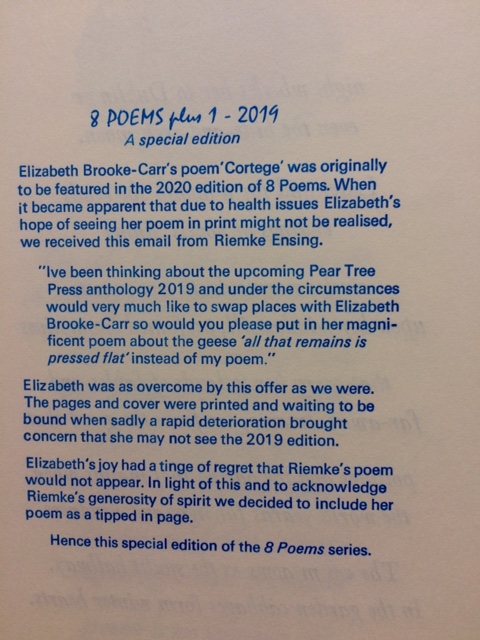
I have invited some Dunedin poets to pay tribute to Elizabeth. Jenny Powell shares the poem of Elizabeth’s that she read at the Wild Honey event. I have also included the introduction to the new 8 Poems plus one which became a wee letter-press-printed anthology of 9 poems in order to publish Elizabeth’s this year rather than next. The anthology was released in time for her to see it and depended upon an act of kindness from Riemke Ensing. Thanks to The Pear Tree Press I have also included Elizabeth’s poem.

Elizabeth’s page at Otago Writers network


Jenny Powell:

I chose Elizabeth’s poem to read partly because it’s about a Clydesdale horse and partly because there are a series of coincidences attached to the poem.

Kay McKenzie Cooke and I, otherwise known as touring poets J & K Rolling, posed with Clydesdales for the photo we use on our posters. Elizabeth loved the photo. It reminded her of childhood days, and so she went on to write her poem.

J & K Rolling have a shared trait of getting lost. It’s not a great quality when you’re on tour. Last year, inland from Owaka, we were driving down a country road looking for the farmhouse where we were staying the night. After a while we came to an old dairy factory and Kay decided we weren’t on the right road, so we turned around and drove back. Coincidentally, directly across the road from the dairy factory was the setting for Elizabeth’s poem. It was the site of the farm where she lived as a child.

But I wasn’t prepared for the final coincidence.

Elizabeth died this afternoon.


Nobby and Joseph

He hauled the bulky leather collar from a peg
at the back of the high walled barn,
heaved it up in a crane-swing arc

to fasten around Nobby’s burnished shoulders,
a soft word or two blurted into his neck
with awkward country affection,

a rub of his jaw, a nudge, and down to the garden
they trudged, Joseph close behind
the old Clydesdale, silky leg feathers

flaring wide in a lumbering dance, through the gate
harnessed to a single-furrow plough
nosed firm into the earth.

Joseph held the reins lightly, the hand grips hard
turned the sod slice by slice,
like strips of blubber flensed from

the sides of a dark-fleshed whale, rolling them
over onto the back of the last neat row
until the whole field was an ocean

of green fringed waves. His turf is kept by another
now, who sits astride a ride-on mower,
smoke wafting, incense-blue,

from the exhaust-pipe thurible, rumbling deepthroated
down swathes of sombre lawn
flanked by granite headstones,

one, with Joseph’s name and a few shy words
of love, tethered in gold letters,
blinks in the sinking sun.

Elizabeth Brooke-Carr
Dunedin, New Zealand


Sue Wootton

I selected several of Elizabeth’s poems for the ODT when I was editing the poetry column, and also had the privilege of publishing a couple of pieces by her, recently, for Corpus. “All hitched up” is about receiving her first dose of chemotherapy and contains her poem “The Vein Whisperer”.


20181024_183154.jpg


With kind permission from The Pear Tree Press, here is the  ‘Introduction’ and Elizabeth’s poem; from 8 Poems plus 1 by New Zealand Poets 2019,designed by Tara McLeod (Auckland: The Pear Tree Press, 2019):


IMG_9539.jpg


‘All that remains is pressed flat’ Elizabeth Brooke-Carr, 8 Poems plus 1:

IMG_9551.jpeg


IMG_3020.jpg


Claire Beynon shares one of Elizabeth’s poems that recently came to light after quite a search. ‘I took it to our writing meeting yesterday and read it out to the group – it’s a poem that Paddy Richardson especially loved. She said it had stayed with her long after first being published in the ODT’s Monday Poem series (several years ago, when Diane Brown was editor).’


When bright red was eclipsed by silver shoon


You see your teacher perched on a spare desk

at the front of the classroom. A dusty blackboard

behind, frames her there, skirt tucked tight around

her calves. She stares across the top of your head,

draws a long, deep breath, Silver, she says, pausing

to open the book on her lap. She begins to read.


You are captivated by her bright red lipstick,

it goes right to the corners of her mouth.

You hear your mother say scarlet is for show-offs

and only clowns take lipstick out to the corners.


Your teacher knows none of this.

She is enchanted by Silver. Her lips, full and lucent,

send tiny stars wheeling off into the round,

as she aspirates each soft, silvered sound.

You forget bright red and what your mother said.

Everything is silver.


Your teacher is swaying a little, peering this way

and that as she reads. You know she’s walking

with the moon, and soon you catch up.

You’ve never heard of shoon, or casements,

but now you see them, glistening. You reach out,

touch silver fruit on silver trees, step around

the sleeping dog, look up to doves. Startle

when a mouse darts by. You’re moveless near the

edge of a silver stream when you become aware


your teacher has stopped reading. She has

closed the book, a far-away look in her eyes.

Ah, girls, she sighs, Walter de la Mare!

She speaks his name in a spangle of stars,

clasps him close to her chest as she swoons

and steps down to the floor. You’re still thinking

of the moon, leaving the sky to come and walk

with you at bright red noon, slowly, silently

to the end of your days, in her silver shoon.


Elizabeth Brooke-Carr


From Jane Woodham:


Listen to Elizabeth read an extract from her novel Greywacke


P1060100.jpeg


All that remains is pressed flat,


a strip of bare earth up on the hillside

and, between the leaves of a book

she was reading that morning, four stiff stalks

bearing sunrise petals. A softly coiled feather

brats the air when she turns the page.


from ‘All that remains is pressed flat’,  8 Poems plus 1


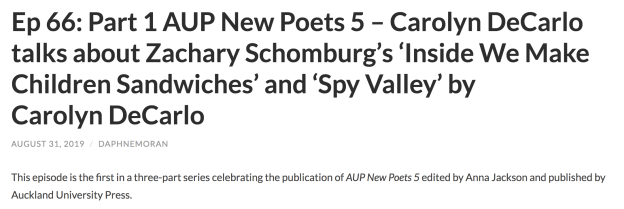
Poetry Shelf noticeboard: Better Off Read in conversation with Carolyn DeCarlo (AUP New Poets)

Screen Shot 2019-09-12 at 9.18.54 AM.png

(Image of Carolyn DeCarlo by Tabitha Arthur)


Screen Shot 2019-09-12 at 9.19.15 AM.png


Launched in 1999, AUP New Poets first introduced readers to Anna Jackson, Sonja Yelich, Janis Freegard, Chris Tse and many other significant New Zealand voices. Relaunching this year under the editorship of Anna Jackson and with a bold new look, AUP New Poets 5 includes substantial selections from the poetry of Carolyn DeCarlo, Sophie van Waardenberg and Rebecca Hawkes.

Go here to listen


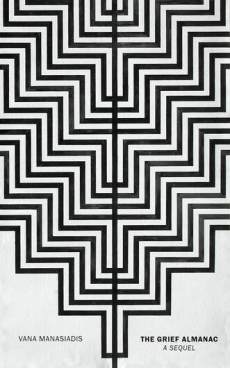
Poetry Shelf audio spot: Vana Manasiadis reads ”Hieroglyph 3 (or Colin McCahon’s Gate III in 1993)’


the-grief-almanac-cover-front-web.jpg


Vana Mansiadis reads ‘Hieroglyph 3 (or Colin McCahon’s Gate III in 1993)’

Published in The Grief Almanac: A Sequel  Seraph Press, 2019


Vana Manasiadis is a Greek-New Zealand poet, translator and creative writing teacher who has been moving between Aotearoa and Greece, and is now living in Tāmaki Makaurau/Auckland. Her first collection, Ithaca Island Bay Leaves: A Mythistorima, was published by Seraph Press in 2009. She is the co-editor of the Seraph Press Translation Series, and was the editor and translator of Ναυάγια/Καταφύγια: Shipwrecks/Shelters: Six Contemporary Greek Poets (2016) and co-editor, with Maraea Rakuraku, of Tātai Whetū: Seven Māori Women Poets in Translation.


Seraph Press author page


Poetry Shelf classic poem: Wen-Juenn Lee picks Joan Fleming’s ‘Husband and Wife Talk Without Talking At A Difficult Dinner Party’


Screen Shot 2019-06-05 at 10.18.31 AM.png


Note from Wen-Juenn Lee:

I first read Joan Fleming’s ‘Husband and Wife Talk Without Talking At A Difficult Dinner Party’ at university, when something about the simple domesticity yet the ‘intolerable solitude’ of love (‘Translations VI’, Failed Love Poems) struck me – at a time when I was just beginning to read tragic, suburban love stories by Raymond Carver. (I liked the line, ‘He drinks more and she stops drinking. It is for the same reason’ and I did not know why, until later I realised that it reminded me of the wife in ‘The Student’s Wife’, who wakes up in the middle of the night and calls her husband’s name, but he does not answer.)

Love is different in ‘Husband and Wife Talk Without Talking At A Difficult Dinner Party’, different because it is not marked by suffocating drabness, but sleepy attentiveness, knowing the patterns of someone else with the instinctiveness you know it’s going to rain when storm clouds appear. (Simone Weil: ‘Attentiveness is the rarest form of generosity.’) It is with this attentiveness that the poem breathes: there is the hard brittleness of a wine glass, the clattering of forks, underpinned by the softness of silent communion. A couple sits, one drinks and one doesn’t, and they suffer quietly, and maybe they’ll leave and go to bed, alone with their griefs and little traumas. Maybe they will talk without saying anything important at all.

Here, we have the external actions of people, yang, and the inarticulate feelings they have, yin. This heartbeat of yin and yang underpins the very heartbeat of the poem. Yang, the boundaries in self between you and me, yang, the face I present to the wider world: of husband shredding his napkin, of wife touching her earlobes. In this, I am reminded of my parents who interact with the formality of Chinese tradition. My parents do not say, ‘I love you’, but ask ‘have you eaten?’ Yet. They know I talk loudly when I’m tired and they know when I’m irritated and trying to disguise it with forced cheer; they would just never tell me they know. To the outsider, someone walking past the window, a plus one at the party, anyone that isn’t the husband or wife, maybe they would notice the shredded napkin, the unnecessary earlobe-touching, but they can only guess; they can observe but never decode. This is a poem of extended people-watching, in the sense that we too, are outsiders with the privilege of understanding a couple’s private state, if only fleetingly.

When we are lucky enough to know people that know us intimately, that know us well, they will know the difference between your laugh and your forced laugh, and this is where the duality of yin and yang can occur. Husband and wife are having a conversation without using their words at all. She says, I have a headache. He says, I’m worried about my father. The dinner party is Difficult because maintaining your yang is Difficult in the face of your worries, because expressing your yin is near impossible. I found the last line in the poem so devastating, not because it ends with silence, but something of the frail and incomplete yin, ‘a soft space where speech can grow’. This tender, fragile possibility of communion (in whatever form that takes) is part of the larger love letter I see in Joan Fleming’s The Same As Yes. It struck me then, as it strikes me now, how ordinary intimacy and its limits can feel to me more concrete, more sorts of tragic, than anything else.


Wen-Juenn Lee works in Melbourne, and writes when she can. She writes about Wellington, her family, and her feelings. Her work has appeared in Landfall, Southerly, and other publications.

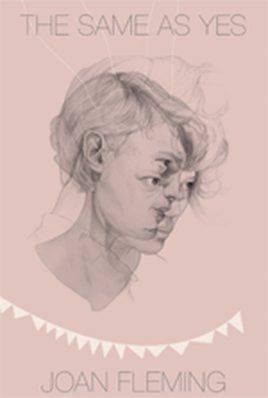
Joan Fleming is the author of two collections of poetry, The Same as Yes and Failed Love Poems, both from Victoria University Press, and the chapbook Two Dreams in Which Things Are Taken (Duets). Her new collection Dirt is forthcoming with Cordite Books. She holds a PhD in ethnopoetics from Monash University, Melbourne, and is the New Zealand/Aotearoa Commissioning Editor for Cordite Poetry Review. She currently lives in Madrid, and in 2020 she will travel to Honduras for the Our Little Roses Poetry Teaching Fellowship.

Victoria University Press author page


sameyes.9780864736987__33157.1347922933.jpg


Poetry Shelf noticeboard: celebrating Helen Heath

Helen Heath won the 2019 Ockham New Zealand Book Awards with her poetry collection, Are Friends Electric? National Poetry Day sat down and talked to her about ‘that moment,’ the themes that recur in her work and why poetry is so hot in Aotearoa.


Helen reads two poems for Poetry Shelf

Poetry Shelf in conversation with Helen

Victoria University Press author  page


Poetry Shelf Monday poem: Kate Camp’s ‘The law of expressed emotion’


The law of expressed emotion

The law is, that those who love you
will not help you get better.

Yes, they will sit next to you in a car
and take you through space

both moving forward at exactly the same speed
showing your profiles to each other

which are ageing rather more cruelly
than the fronts of you.

They will do things like park their car on the footpath for you
leaving only a card on the dashboard as a plea for clemency

and they will do explaining for you
when people do not understand your language

because you appear absolutely fluent while in fact
you are somewhat on fire.

They might take you to the monastery
with its not very important frescoes of Jesus

faintly visible and let you look down into valleys
that literally never see the sun.

They hope you will find this soothing
but perhaps it will be terrifying, the train of marvels

with its gorges and viaducts
and the medieval villages it passes though

on its way to the coast.
Maybe better to take you to the wardrobe

the armoire, where all the sheets and towels are
and where there used to be stickers of the Incredible Hulk

which glowed in the dark.
Except we gave the wardrobe away

left it out on the street with a sign saying
FREE

and when we woke up
or when we looked around

it was gone.


Kate Camp


Kate Camp is a Wellington-born essayist and poet, with six collections of poetry published by Victoria University Press. She has also written essays and memoir. Unfamiliar Legends of the Stars won the NZSA Jessie Mackay Best First Book of Poetry Award (1999), and The Mirror of Simple Annihilated Souls won the New Zealand Post Book Award for Poetry (2011). Snow White’s Coffin was shortlisted for the award in 2013, and The internet of things was longlisted in 2018. She has received the Creative New Zealand Berlin Writer’s Residency (2011) and the Katherine Mansfield Menton Fellowship (2017). Her essay ‘I wet my pants’ was a finalist in the Landfall essay competition in 2018.


Poetry Shelf Friday talk spot: Nithya Narayanan on getting into poems through Sylvia Plath


It was Sylvia Plath’s poems that really got me into poems.

I managed to get through most of high school without much contact with poetry. Not many people I knew wrote poetry, or read it. While I was fortunate enough to grow up in a home filled with books, poetry wasn’t really something that featured. The only poets I could name were the dead British ones: Keats, Byron, Coleridge, Southey. My grandmother—who was educated in freshly post-colonial India—would often bring them up, and remains shocked that I have gotten three years into an English major without encountering the canon.

In my final year of high school, I sat the Scholarship English exam and decided it would be more interesting (true) and easier (not true) to study poetry for one of the essay questions. I didn’t really have a clue who Sylvia Plath was. I knew only that she was American, and that she had written a novel called The Bell Jar. It’s funny how far you can get into a writer’s work without knowing the first thing about them. I got through about four of Plath’s poems—and meticulously annotated them—before I found out their author had gassed herself in an oven at the age of thirty.

There is a lot of commentary out there that will discuss Plath’s suicide alongside her body of work, as if her death is what makes her legendary. While I find this deeply problematic, I also think that it is difficult to read Plath’s work without an awareness of how she lived and died. She battled clinical depression for most of her life, a condition acutely worsened by the discovery that her husband (poet Ted Hughes) was in love with another woman. In 2003, a film was released on Plath’s life. Quite apart from its terrible casting (with Daniel Craig horribly miscast as Hughes), it reduced the problem of Plath’s life to a love triangle, and chose largely to skirt over the allegations of physical violence that Plath made against Hughes. Plath did not lead an easy life by any standard—a reality that is endlessly reflected in her poems.

I was initially drawn to Plath’s poetry because I thought she was God’s gift to feminism. There’s this wonderful line at the end of ‘Lady Lazarus’: “Out of the ash/I rise with my red hair/And I eat men like air”. I remember reading that at seventeen and trying to interpret the entire poem as some sort of tirade against men. In retrospect I think this was a rather reductive interpretation although, in my defence, the average seventeen-year-old girl will concoct a feminist reading out of almost anything. When I read ‘Lady Lazarus’ today, I read it more as a poem about survival. One of the things I admire most about Plath’s poetry is that it expresses the feeling of not being okay without being dramatic, sentimental, syrupy or self-indulgent. In ‘Tulips’ she contrasts—almost clinically—her body’s determination to live with her mind’s desire to leave: “I am aware of my heart: it opens and closes/Its bowl of red blooms out of sheer love of me”. The poem isn’t about moving on. It’s about endurance; about sitting with your not okay-ness until you are ready to move on.

If I had a dollar for every time someone told me they “don’t get” poetry, I wouldn’t have a crippling student loan. The way we’re taught to read in school puts an inordinate amount of emphasis on extrapolation: what something means as opposed to how it makes you feel. While this is helpful in terms of learning how to express an argument, it can be really counterintuitive when it comes to poetry. So much of what makes a poem worth reading is the sensation of it—its texture; its shape; the way it feels on the tongue. I think it’s possible to love a poem without ever really figuring out what it means. I struggled—and still do struggle—with a lot of Plath’s poems. I have never quite managed to figure out ‘Daddy’. I can’t reconcile its various parts, but I still love the way it sounds. Poetry isn’t algebra; you’ll never be able to solve it. Most of the time, the unknowability of the ‘x’ just hits you repeatedly in the face.

The last time I told someone I liked Sylvia Plath, they asked if I was into confessional poetry generally. The term “confessional” is defined as “the poetry of the personal”, and could include anyone from Plath to Anne Sexton to (arguably) Hera Lindsay Bird—yet Plath is a different animal to Sexton who is a completely different animal to Bird. My love for Plath is specific; I struggle to label, generalise, or explain it. I feel a little fraudulent even writing this because, while I love a good poem, poetry doesn’t make up the bulk of my reading material. My passion for Plath is the exception rather than the norm, the way some people claim to avoid dairy but have a special affinity for cheese.

I’m not sure why Plath isn’t taught more widely in New Zealand schools, but I really wish she was. I think we’re perhaps a little scared of poetry that addresses mental health so explicitly. I don’t really have anything to say to this, except to point out that we have the highest youth suicide rate in the OECD. Poetry isn’t a substitute for conversation or treatment—but it might well be a beginning.


Nithya Narayanan was born and bred in Auckland, and is currently studying a BA/LLB conjoint at the University of Auckland. She works on the editorial team for Interesting (the Faculty of Arts’ undergraduate journal) and her essay on Don Mee Choi’s ‘Shitty Kitty’ will be published in this year’s edition. Her poetry has previously appeared in Starling.