Category Archives: NZ author

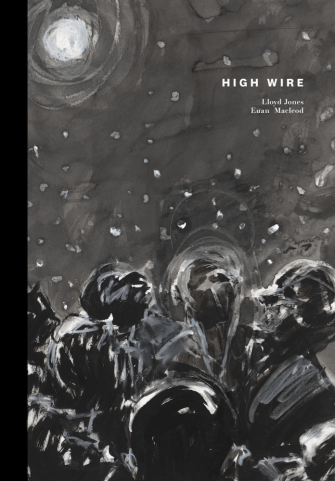
Poetry Shelf review: Lloyd Jones and Euan Macleod’s High Wire


Screen Shot 2020-05-21 at 10.41.23 AM


High Wire Lloyd Jones and Euan Macleod Massey University Press 2020


Massey University has launched the kōrero series of picture books for adults – a series of collaborations where ‘two different kinds of artistic intelligence’ work on a shared topic.

The first collaboration links author Lloyd Jones and artist Euan Macleod.

After Lloyd invited Euan to the bridge project, Euan drew and sketched profusely. Lloyd mused upon the crisscrossing bridges that constitute a life, and the way such structures lift you above the mundane. But then his musings changed:

But soon the heady ideas I had about bridges began to collapse. Where I had been, others had. The commonality of experience breathed its deflating air. As exhilarating as it had been to walk across Golden Gate Bridge or to soar above Sydney Harbour or to flit across the modest rainbow from child hood, my footsteps fitted neatly into others’: my beating heart fell in with theirs.


Bridges became high wire.

With High Wire you enter a collaboration that is glorious at every level: the words, the images, the ideas, the feelings. It is a book that saturates you in wonder and, as reader, I contemplate, observe, sidetrack. I had thought about interviewing both Lloyd and Euan, but the book is so powerful, so haunting, I want to celebrate that. Keep room for the unsaid, the enigma, the openings.


To begin with I am mindful of the beauty, the vistas and heights that bridges might deliver but then, as Lloyd abandons his first musings and settles on the high wire, I am lodged in the terrain of vertigo, fear, death, exhilaration, memory, wobbliness.

Euan’s initial drawings resemble subconscious scrawls steered by predetermined subject matter (an oxymoron?).  I can’t stop looking at them. I can’t stop turning the pages as the opening light and airiness hit the dark. The thicker wedges of ink and line draw me in and then switch back to an enigmatic wash of light, a sudden and surprising flash of colour. Euan’s kinetic sketches are as much about the maker as they are the subject. I read them as a piece of music. Again an oxymoron, as all senses are lit. More than anything, I relish the musical flow. Art as music as feeling as idea in a tempo-ed move between light and dark, thin and thick, space and density. The high-wire figures – scrawled and ink washed – are a catalogue of human emotion. Think intimacy, think vulnerability, think daring. Think astonishing!

This is gut wrenching stuff. It is a book you feel before you move on and speculate. I find myself thinking about art, heights, tightrope walkers, childhood, people leaping from the flaming Twin Towers, struts and balancing acts. I get to the drawing ‘hold your nerve’ and it seems prescient.


Adjacent to each image is the writing – tightrope writing – where the author opens himself up, testing where he places the next foot so to speak. At one point he writes:

In the subconscious everything is up for grabs – there is no enforced geographical isolation. There are no trespass notices.

Again I am pondering the degree to which the subconscious steers the predetermined subject matter – to the way a sense of risk and challenge is heightened in the state of writing. I could have asked Lloyd this if I had interviewed him, but I remember he once told me his novels are guided by the unknown and discovery.

I don’t need to know how this book came into being – I want to navigate its existence in as many ways as possible. That makes it a book of returns.


On a pragmatic level you could stick with the simple premise that this is a book about a narrator walking to Australia on a high wire! Or the story of Philippe Petit who walked a high wire between the Twin Towers in 1974. Ah but this is a book of so many crossings, crisscrossings and possibilities, both physical and ethereal. At one point we meet the saddest bridge in the world. It is a bridge that is as much about disconnection as it is connection.

Lloyd muses on the bridges between random things as Bill Gates had imagined. So now, having stalled on this opening on the page, the bridges between me reading and my own random things are spiked into view by the book. How do I dare? How do I dare? How do I dare? How do I cross the vertigo-inducing gap between here and there? As reader? As writer? As human being?

What would the world be like without bridges? Lloyd asks. I carry that question as I follow the drawings again.


Lloyd weaves together the mysterious and the physical: to the point a sentence becomes luminous. Haunting.


A dark wriggle in the lunar surface of the sea turns yellow as the cloud passes and the moon reappears. To the west, the steady light of an aeroplane on its direct and patient course.


I love this book for so many reasons: because of its fertility for both heart and mind, because images and words speak to each other without taking a privileged position, because human experience is made complex and absorbing.

I don’t see this as a graphic novel – I see it as a book of connections born out of collaboration. An adult picture book. Massey University Press has created an exquisite book – the paper a perfect hue and texture. A gorgeous object to hold. High Wire is bookmaking at its very best. I recommend it highly and I can’t wait to read the next one.


Massey University Press page

Launch video (an excellent lockdown launch)


Poetry Shelf Monday Poem: Fleur Adcock’s ‘Island Bay’


Island Bay


Bright specks of neverlastingness

float at me out of the blue air,

perhaps constructed by my retina


which these days constructs so much else,

or by the air itself, the limpid sky,

the sea drenched in its turquoise liquors


like the paua shells we used to pick up

seventy years ago, two bays

along from here, under the whale’s great jaw.


Fleur Adcock


Fleur Adcock was born in New Zealand but has lived in England since 1963, with regular visits to NZ. She lives in London, and has dual British and New Zealand citizenship. She was awarded an OBE in 1996, a CNZM in 2008 and the Queen’s Gold Medal for Poetry in 2006. Her poetry is published in Britain by Bloodaxe Books and in New Zealand by Victoria University Press. In 2019 her Collected Poems appeared from Victoria University Press, and later that year she received the Prime Minister’s award for Literary Achievement in Poetry.

Fleur: I wrote this poem when I was in New Zealand late last year. It feels unbelievable that I should have been able to walk freely along the coast of Island Bay basking in the sunshine and the wind, just because I felt like it; things are not like that here, and may never be again for someone of my age. But at least it’s spring, and I have my garden, and am allowed to go for walks in the local woods as long as I don’t travel on a bus to get there, or risk doing anything so audacious as my own shopping.


Poetry Shelf noticeboard: Emma Neale awarded 2020 Lauris Edmond Memorial Award

Screen Shot 2020-05-17 at 9.11.09 AM

Warm congratulations to award winner, Emma Neale.


Verb Wellington is proudly supporting the Friends of Lauris Edmond. Below is a Press Release announcing the 2020 Lauris Edmond Memorial Award for Poetry. Read on to discover three new poems by the 2020 winner, Emma Neale.


A Birthday Celebration: Dunedin poet honoured in biennial poetry award

Dunedin poet Emma Neale is the 2020 recipient of the Lauris Edmond Memorial Award for Poetry, a prize given biennially in recognition of a distinguished contribution to New Zealand poetry.


Emma Neale is the author of six novels and six collections of poetry. Her most recent novel, Billy Bird (2016) was short-listed for the Acorn Prize at the Ockham NZ Book Awards and long-listed for the Dublin International Literary Award. Her new book of poems is To the Occupant which was published in 2019 by Otago University Press. Emma is currently editor of the iconic Aotearoa literary journal, Landfall.


On receiving the award, Emma says:

“I’m incredulous, happy and stunned in my tracks, as if someone has thrown a surprise party – the way friends did when I was nine, and they waited to jump out at me until I was standing near the host’s swimming pool. All the other nine-year-olds were hoping I’d fall into the water with shock. I didn’t. So here I am, dry, a bit disoriented and also delighted again, and remembering that Lauris Edmond was the first poet I ever heard give a public reading. When I was 16, I caught the bus alone to a Book Council lunchtime lecture during school holidays in Wellington, and went to hear her talk about her writing career. I have a feeling I’d sneaked out of the house to do it – as if my interest in poetry and my aspirations to write it were somehow going to get me into trouble, and my parents and friends shouldn’t know. I sat and listened on the edge of my seat, as the poems and the talk opened a portal that meant I could glimpse the green and shifting light of hidden things. The portal was still a long way off, but I was convinced that poetry and literature were going to carry me into an understanding of intimacy, identity, time, ethics, deeper metaphysical questions.

I still think of Lauris Edmond as a kind of poet laureate of family relationships; her work was immensely important to me as the work of a local woman poet I could not only read on the page but also hear in person. I am just sorry that I can’t thank her face to face for what her work has meant to me, and I’m enormously grateful to the Friends for reading my own poetry and giving me this generous award. I’ve pinched myself sore. I actually feel like leaping into a pool.”


Established in 2002, the Award is named after New Zealand writer Lauris Edmond who published many volumes of poetry, a novel, a number of plays and an autobiography. Her Selected Poems (1984) won the Commonwealth Poetry Prize.

The 2020 award was announced on 2 April the date of Lauris Edmond’s birthday. A ceremony and birthday celebration was due to take place at National Library of New Zealand in Wellington on 3 April to honour Emma, however due to COVID-19 the event is postponed and will take place in collaboration with Verb Wellington later in the year.


Piece in ODT


Poetry Shelf connections: Elizabeth Welsh’s ‘steady’


steady


day i

i am trying to imagine a body of water from the confines of our green space.

my neighbour reads an excessive number of library books on hydrotherapy,

and i become accustomed to skimming these surreptitiously before returning

them for her. there is a composure to the watery diagrams that i pore over,

searching for instructions beyond mere bodily mechanics, some sort of cure

for aloneness in one’s body. we must stay safe at home, i repeat, but it means

very little to you beyond a sibilant silkiness on your tongue. and sometimes,

although you don’t know it yet, harm can come from within too. these days,

our neighbour calls out to us from her bedroom window each morning

when we are once again wandering undirected in the early flinching bush

and your face breaks, like a wave at its apex, about to crash. to distract,

we lean in to green. you choose the seaweed stick of chalk, and we draw

pulsing trees together. later, finding a grove of wild ginger, you insist

it’s a treasure, protecting this weed with its pervasive rhizomatous roots,

shielding it with your splayed hands and then draping it over your shoulder

along with your foraged Hormosira banksii, claimed at mid-tide on our last

evening swim. everything equal in your mind, you stroke the leaves

and shrivelled olive beads sleepily, lulled by a saturated silence from

the deserted road above; watching you, i think of habits and how they form,

and hope we keep some or all of these we are forming. my pelagic fish,

the silt in your river of isolation came when you realised the sea was lost

to you, and you struggled to use those branching chains of water-filled veins

to withstand the ebbing tide


day ii

morning light hits shivering rimu fingers in a way i didn’t notice before,

like it’s plunging, trying to pick something up that’s lost at the bottom

of a council leisure centre pool; abandoned goggles, cap, stick, stone.

i want to find that thing we’ve forgotten, or maybe all the owners

of these churning lost things that help us stay buoyant or otherwise.

my maternal grandfather was a daily wild swimmer and treated it with

a reverence bordering on panic. it’s the alteration of body temperature

that releases, relieves. it made him feel sound of mind, but maybe not safe

of body, given the lacey shape of the fractured greywacke rocks he dove from

at the inlet they called home. i can visualise a breathlessness, and then

a bruised flying. and I wonder, is that how he felt? did the propulsion

into water, coupled with that numbing, knotty coldness, shake him wildly loose?

like him, you exercise an immersive love that demands return to one salty,

thrown-about body, tangling us up in green scribbles, circles and untraceable

starfish scratches. how deep you want to measure, to fill up every space

between us, the air we share. at breakfast, while slicing apple suns,

we discuss the air quality index and the Clean Air Act and what this means

for cities and transport and adverse health effects. afterwards, floating in

the bathwater on your back, eyes closed to me, i watch the soft depression

of your chest cavity and talk to you about the humming bee breath,

closing one ear to all surrounding sound


day iii

we bend and collect fallen kauri and tanekaha leaves to dry downstairs

for making into sheets of paper, and i feel like calming, wake-like

into the warmness of the leaf litter underneath peeled-bare branches,

sighing into all the worries of the basalt, granite and rock crust

that should be frustrated with us for failing to care. we do not

have kauri rot, and our ritual to ensure this has something of prayer to it.

understanding, you chastise any who visit, pointing to which boots

are allowed to be worn on your indecipherable map filled with rising

lines, eddies, swells. you are rooted deep to your watery west coast clay.

today, we read of the cormorants that have returned to Venice,

as the seaweed-thick fragile lagoon ecosystem is visible again, shorn

of tourism and motor transport disturbance. and while you flick through

photographs, I worry that we will forget too soon. you replay the narrative

again and again, hopping and spinning about and hot-headedly insisting

on mimicry. my body still baffles me after birth; refusing, uncooperative,

not at all one with my clamorous mind, it carries me along through

this time of confinement but feels weightless in a frightening way,

as though i am an alluvial river, and not at all certain how to halt

the erosion of these shores


day iv

stories are one thing we agree upon, resting flock-like on steaming

beds of compost mulch, chopping up rotting weeds and long, prickling

stalks from harvested Jerusalem artichokes. we argue over a pair

of turquoise-handled scissors like siblings until i take your

little finger and link it through mine, pleading silence while i weave

another marshy history. the blue hue of the ocean is largely constructed

from chlorophyll and disintegrating organic bodies, and this seems

to be the only likely truth i can hear. there are more snarled news reports

that i mute furtively, my fingers washing away a wider belly of current,

holding it back for just a little longer. i am selfish in this skimming

of possible narratives, but i want you to be a water-skating insect,

legs as flotation devices, ridged with grooves marked on tiny hairs

that trap air. please slide across this surface without pause; you will learn

to scull or drift through swampy nodes and puckers soon enough.

for now, all you have is the woven ribs of trees, and the light running deep,

keeping us very nearly afloat. sometimes, if i rise early and walk into

the aqueous-lit yawn of bush before you wake, i can hear our neighbour

singing, just ever so faintly


Elizabeth Welsh is a poet, papermaker and academic editor. She is the author of Over There a Mountain, published by Mākaro Press in 2018. Her poetry and short fiction has been published in New Zealand and the United Kingdom. She lives in Titirangi with her husband and daughter.


Poetry Shelf connections: two poems from Kay McKenzie Cooke


cricket during lockdown


The ragged monotone

of a cricket’s refrain

is childhood’s waist-high grass

and boredom. It is last chances,


eternity, the beige of neglected summer lawns.

Through an open window

I hear its shrill register

competing

with the sporadic wash

of reduced traffic noise

and my granddaughter’s tearful protests

against an afternoon nap.


This cricket’s front-leg click, rub, whirr,

is an irksome useless key

turning a music box

with a loose spring

that cannot be wound any tighter.

I find myself counting on it to be


today’s measure of time. Even when

everything turns, re-turns,

the cricket will keep

on. For now though, it is

my stop watch.


above the line


Above, a black-backed gull

grifts the high way

only gulls trawl,

a sky- valley current

that streams between

beach and harbour.


I look up, see its chest

feathers ironed white by light,

its black wings

rowing west

towards today’s catch:


fish entrails, road kill,

mud crab. I note

how it hauls its cargo

of intent, watch

until it disappears

behind the tips

of trees, envision


the movement, the trail

it leaves

behind, that caught

rude disturbance

of time’s dead air.


Kay McKenzie Cooke


Kay McKenzie Cooke is a Dunedin writer. The Cuba Press are publishing her fourth poetry collection which is scheduled for release in June 2020.


Poetry Shelf Lounge: MUP’s online launch of Lloyd Jones and artist Euan Macleod’s High Wire


High Wire brings together Booker finalist writer Lloyd Jones and artist Euan Macleod. It is the first in the new kōrero series of a series of ‘picture books written and made for grown-ups’ and designed to showcase leading New Zealand writers and artists working together in a collaborative and dynamic way.

In High Wire the narrators playfully set out across the Tasman, literally on a high wire. Macleod’s striking drawings explore notions of home, and depict homeward thoughts and dreams. High Wire also enters a metaphysical place where art is made, a place where any ambitious art-making enterprise requires its participants to hold their nerve and not look down.

It’s a beautifully considered small book which richly rewards the reader and stretches the notion of what the book can do.

It’s a hardback and $45.


Nicola Legat


Unity Books Wellington are currently taking pre-orders for the book, simply fill out the inquiry form here
Alternatively, the book is available for purchase from the Massey University Press website here


Poetry Shelf connections: two poems from Eliana Gray


Regent’s Canal


We push a trolley

Into the canal

Just to watch it sink

Slowly, then all at once

Like they talk about love:

Swallowed, completely

Clear toxic liquid

Opaque


Both the nature of desires

And love, yes, love is viscous

Festooned with trash

Bumping up by the locks

In the waterway

Single use plastics

Brushing hands with

Twist ties, bloated crusts and


Isn’t it interesting?

How we’ll steal something

Just to break its purpose

Hoarding mentality

But sideways, emotional


The thrill of a sharpened crayon

The compulsion for bluntness

For rubbing, hard

On a perfect ending


Are we trying to make ourselves soft?

Trying to fit

The world to our curvature?

Action’s nothing more than a

Mechanism of coping


And what does that say about Romance, hmmm?


Supermarket nightwork:

Pigeons looking fat and sensuous

Moonlit tension

Pilfered fizz and roses

Stolen, from a discarded bench

In Victoria Park


Push me dangerously

Close to the water

Make me believe

You’ll tip me in


We’ll laugh a little too

Tight, too high, too fast

Like, of course we know

You don’t mean to hurt me

But the back wheel

Has always been faulty

(as stolen trolleys tend to be)

Seems like it’s locking

Skidding, sideways, again


What if it flies out of your hands?

What if it just . . .  keeps skidding

And my feet, stuck under

Crossed legs, my scarf, my

Jacket too bulky for sudden moves


What if I try to jump

And it just . . . .  tips?

Crack my head against the metal

Concrete, what if the wheels

Are already over the edge?

My centre of gravity not heavy enough


What if it teeters, expectantly

On the edge of the canal

And you’ve finally decided

To reach your hand to steady

But your balance is off and

You push


How long would you stand?

Watching. My head, my

Hands, beneath the water

Viscous fill my lungs

Swallow me like the trolley


All I want is to be absolutely perfect forever


I want to live like an ornamental apple

Protected from consumption

Slick plastic blush red perfect

Looking so delicious

Resting, in a crystal bowl


Beautiful and

An irresponsible use of plastic

Something that could be art but isn’t

And not in the sense that ‘everything is art’

Because it isn’t


A perfectly useless representation

of something so cliche

It feels almost overwhelming


A stand in for temptation

with no intention or ability

To be so desirous


No perfumed smell

no golden hanging from the garden

no pollination no rotting no flies


Is it still stasis

if you’ve reached your final destination?

And how long exactly

Is a sense of finality satisfying?


Anticipation and anxiety are a Venn diagram

with approximately one circle

The only way to soothe them

is to complete the task


I want to live like an ornamental apple

Slick red plastic constant state of blush perfect

The promise of forever

A lifetime sabbatical

Researching absolutely nothing


Eliana Gray


Eliana Gray is a poet from Ōtepoti, Aotearoa. They like queer subtext in teen comedies and not much else. They have had words in: SPORT, Mimicry, Minarets, Mayhem and others. Their debut collection, Eager to Break, was published by Girls On Key Press (2019) and in 2020 they will be both a writer in residence at Villa Sarkia, Finland and Artist in Residence at St Hilda’s Collegiate, Ōtepoti.


Poetry Shelf congratulates the Ockham NZ Book Award winners – and showcases the poetry

d590ea43-fe25-4bb4-a1b5-a785e5cb0b66.jpg


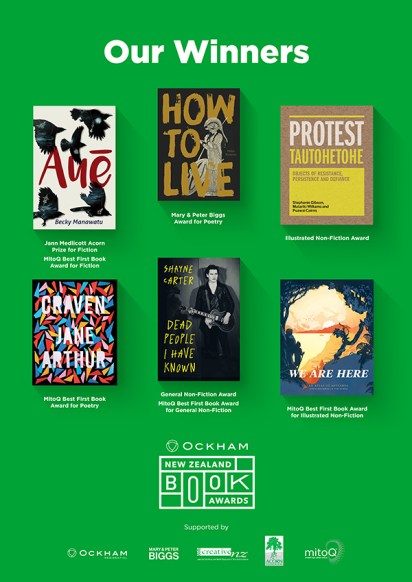
Warm congratulations to all winners! This is a year where well-deserving and much-loved books have taken the winning spots – each book is worthy of a place on our book shelves.

I look at this list (and indeed the shortlists) and it reminds me that NZ literature is in good heart. These are heart books. These are books born from love and labour, by both inspired and inspiring authors and publishers.

The Award’s poetry section  was a drawcard for me. I loved each shortlisted finalist so much, but I leapt for joy at the kitchen table to see Jane Arthur win Best First Book and Helen Rickerby win Best Book.

Yes, some extraordinary books did not make the longlists let alone the shortlists – but this is time to celebrate our winners.

I toast you all with bubbles and bouquets and can’t wait to see what you write next.

Right now we need to support our NZ book communities, so I strongly advocate putting an Ockham winner in our pile, the next time we visit our local booksellers.

In these strange Covid times my email box has has never been so full of poems – we’re making sour dough and we’re writing poetry, and it has been such a connecting comfort.

Long may we cherish poetry in Aotearoa.


My toast to the Poetry Winners:
 

screen-shot-2020-02-11-at-8.45.03-am.png


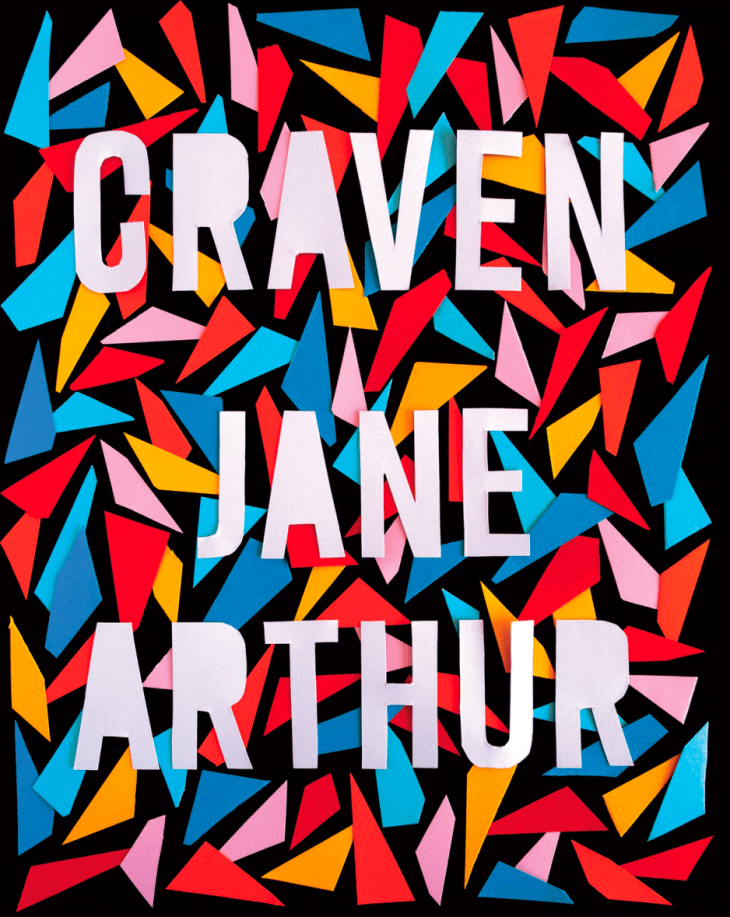
Craven, Jane Arthur, Victoria University Press, 2019 Best First Poetry Book


I have a broth at a simmer on the stove.

Salty water like I’ve scooped up some ocean

and am cooking it in my home. Here,

gulp it back like a whale sieving plankton.

Anything can be a weapon if you

swallow hard enough:

nail scissors, a butter knife, dental floss,

a kindergarten guillotine, hot soup,

waves, whales.

from ‘Circles of Lassitude’


Jane Arthur’s debut collection Craven inhabits moments until they shine – brilliantly, surprisingly, refractingly, bitingly. Present-tense poetry is somewhat addictive. With her free floating pronouns (I, you, we) poetry becomes a way of being, of inhabiting the moment, as you either reader or poet, from shifting points of view.

It is not surprising it has won Best First Book at 2020 the Ockham New Zealand Book Awards.

The collection title references lack of courage, but it is as though Jane’s debut collection steps across a line into poetic forms of grit. This is a book of unabashed feeling; of showing the underseam, the awkward stitching, the rips and tears. Of daring to expose. The poems are always travelling and I delight in every surprising step. You move from taxidermy to piano lessons to heart checks and heart beats, but there is always a core of exposed self. And that moves me. You shift from a thing such as a plastic rose to Brad Pitt to parental quarrels. One poem speaks from the point of view of a ship’s figurehead, another from that of Constance. There is anxiety – there are dilemmas and epiphanies. The poetic movement is honeyed, fluid, divinely crafted – no matter where the subject travels, no matter the anxious veins, the tough knots.

An early poem, ‘Idiots’, is like an ode to life, to ways of being. I keep crossing between the title and the poem, the spare arrival of words punctuated by ample white space, elongated silent beats that fill with the links between brokenness, strength and pressing on.


Idiots

I’ve known people who decided

to carry their brokenness like strength

idiots

I’m a tree

I mean I’m tall, I sway

I don’t say, treat me gently

No¾I say, cool cool cool cool

I say, that really sucks but I guess I’ll survive it

or, that wind’s really strong

but so are my roots, so are my thighs

my branches my lungs my leaves my capacity to wait things out

I can get up in the morning

I do things


I heard Jane read for the first time at the Sarah Broom Poetry Prize session at the Auckland Writers Festival in 2018. Her reading blew my socks off, just as her poems had delighted American judge, Eileen Myles, and it was with great pleasure I announced her as the winner. Eileen described Jane’s poetry: ‘poetry’s a connection to everything which I felt in all these [shortlisted] poets but in this final winning one the most. There’s an unperturbed confident “real” here.’ In her report, Eileen wrote:

The poet shocked me. I was thrust into their work right away and it evoked the very situation of the poem and the cold suddenness of the clinical encounter, the matter of fact weirdness of being female though so many in the world are us. And still we are a ‘peculiarity’ here and this poet manages to instantly say that in poetry. They more than caught me. I like exactly how they do this – shifting from body to macro, celestial, clinical, and maybe even speaking a little out of an official history. She seems to me a poet of scale and embodiment. Her moves are clean and well-choreographed & delivers each poem’s end & abruptly and deeply I think. There’s a from the hip authority that inhabits each and all of these poems.

I am revisiting these words in view of Craven’s multiple poetry thrills. So often we talk about the way a poem steps off from the ordinary and blasts your heart and senses, if not your mind, with such a gust of freshness everything becomes out of the ordinary. This is what happens with Craven. A sense of verve and outspokenness is both intoxicating and necessary:


I’m entertaining the idea of never being silent again,

of walking into a room and shouting, You Fuckers Better Toe the Line

like a prophylactic.

from ‘Sit Down’


A sense of brittleness, vulnerability and self-testing is equally present:

I’ve been preoccupied with what others think again.

I’ve been trying not to let people down.

Nights are not long enough.

Lately there’s been more sun than I would’ve expected.

I keep the weather report open in its own tab and check it often.


From ‘Situation’

The movement between edge and smooth sailing, between light and dark, puzzle and resolution, and all shades within any dichotomy you might spot – enhances the reading experience. This is a book to treasure – its complexities and its economies, its confession and its reserve. It never fails to surprise. I am delighted Jane read as part of my Poetry Shelf Live session at Wellington’s Writers Festival in March. It was a divine reading.


Victoria University Press page

Poetry Shelf Monday poem: ‘Situation’ by Jane Arthur

Poetry Shelf audio spot: Jane Arthur reads ‘Snowglobe’

Poetry Shelf: Conversation with Sarah Broom Prize finalist, Jane Arthur
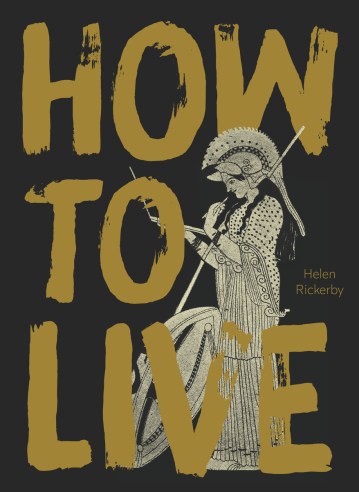


Rickerby_How_to_Live__14837.1564361874.jpg


How to Live, Helen Rickerby, Auckland University Press, 2019 Best Poetry Book


Helen reads ‘How to live through this’


When that philosopher said life must be lived forwards

but can only be understood backwards

he was not thinking of me

I have lived all kinds of lives

from ‘A pillow book’

Helen Rickerby’s latest poetry collection How to Live is a joy to read. She brings her title question to the lives of women, in shifting forms and across diverse lengths, with both wit and acumen. Like many contemporary poets she is cracking open poetic forms – widening what a poem can do – as though taking a cue from art and its ability both to make art from anything and in any way imaginable.

Reading this book invigorates me. Two longer poems are particularly magnetic: ‘Notes on the unsilent woman’ and ‘George Eliot: a life’. Both function as fascination assemblages. They allow the reader to absorb lyrical phrases, humour, biography, autobiography, insistent questions. Biography is enlivened by such an approach, as is poetry.


6.   It seems to me that poetry usually begins with the self

and works its way outwards; and the essay, perhaps, starts

outwards and works its way in towards the self.

from ‘Notes on the unsilent woman’


Thinking of the silent woman I am reminded of Aristotle’s crown of silence that he placed upon she. I then move across centuries to Leilani Tamu’s poem ‘Mouths Wide Shut’ where she sits on a bus with her mouth taped shut silent. The skin-spiking poem (and the protest) considers silence in the face of racism. Even now, even after the women’s movements of the 1970s and the explosion of feminism and feminisms over ensuing decades, men still talk over women, still dismiss the women speaking (take women in power for example, or a young woman at the UN challenging climate-change inertia).

What Helen does is remind us is that silence is like snow – it is multi-hued and deserves multiple names and nuances: ‘Silence isn’t always not speaking. Silence is sometimes / an erasure.’

Ah the stab in my skin when I read these lines. In ‘Notes on the unsilent woman’ Helen draws me in close, closer and then even closer to Hipparchia of Maroneia (c 350 – c 280 BC).

5.    But I do have something to say. I want to say that she

lived. I want to say that she lived, and she spoke and she

was not silent.


Helen gathers 58 distinctive points in this poem to shatter the silence. Sometimes we arrive at a list of women who have been both audible and visible in history, but who may have equally  been misheard, misread and dampened down. At other times the poet steps into view so we are aware of her writing presence as she records and edits and makes audible. In one breath the poet is philosopher: ‘Silence might not be speaking. It might be / listening. It can be hard to tell the difference.’ In another breath she apologies for taking so long to bring Hipparchia into the picture.

Elsewhere there is an ancient warning: ‘”If a woman speaks out of turn her teeth will be / smashed with a burnt brick.” Sumerian law, c. 2400 BC.’

A single line resonates with possibilities and the ‘we’ is a fertile gape/gap/breathing space: a collective of women, the poet and her friends, the women from the past, the poet and I: ‘There are things we didn’t think we could tell.’ Yes there are things we didn’t think we could tell but then, but then, we changed the pattern and the how was as important as the what.

Another single line again resonates with possibilities for me; it could be personal, it could equally be found poetry: ‘I would like to be able to say that  it was patriarchy that stopped me talking on social media, but it wasn’t, not / directly.’

I read ‘Notes on the unsilent woman’ as a poem. I read this as an essay. I am tempted to carry on with my own set of bullet points as though Helen has issued an open invitation for the ‘we’ to speak. Me. You. They. She quotes Susan Sontag: ‘The most potent elements in a work of art are, often, its silences.’


The other poem I dearly love, ‘George Eliot: a life’, is also long form. Like the previous poem this appears as a sequence of numbered sections that are in turn numbered in smaller pieces. It is like I am reading a poem and then an essay and then a set of footnotes. An assemblage of fascinations. Biography as fascination allows room for anything to arrive, in which gaps are curious hooks, reflective breathing spaces and in which the personal is as compelling as the archives. Helen names her poem ‘A deconstructed biography’ and I am reminded of  fine-dining plates that offer deconstructed classics. You get a platter of tastes that your tongue then collates on the tongue.

To taste ‘George Eliot: a life’ in pieces is to allow room for reading taste buds to pop and salivate and move. This is the kind of poem you linger over because the morsels are as piquant as the breathing spaces. It delivers a prismatic portrait of George Eliot but it also refreshes how we assemble a biography and how we shape a poem. Helen brings her acerbic wit into play.


10.7.1.  But the fact is, and I don’t want to give you spoilers, that for such an

extraordinary woman she sure did create some disappointing female

characters. Even the heroines don’t strike out – they give up, they stop,

they enclose themselves in family, they stand behind, they cease, they  die.

They found nothing.

10.7.2.   Did she think she was too exceptional to be used as a model for her

characters? Did she think that while she was good enough to be involved

in intellectual life, and she could probably even be trusted to vote, the same

could not be said for her inferior sisters?


A number of smaller poems sit alongside the two longer ones including the moving ‘How to live though this’, a poem that reacts to an unstated ‘this’. ‘This’ could be anything but for me the poem reads like a morning mantra that you might whisper in the thick of tough times or alongside illness or the possibility of death.

‘How to live’ is a question equally open to interpretation as it ripples through the poems; and it makes poetry a significant part of the myriad answers. I haven’t read a book quite like this and I love that. The writing is lucid, uplifting, provocative, revealing, acidic, groundbreaking. The subject matter offers breadth and depth, illuminations, little anchors, liberations, shadows. I am all the better for having read this book. I just love it.


I slept my way into silence

through the afternoon, after days

of too many words and not enough words

to make the map she needs

to find her way from here

I wake, too late, with a headache

and she, in the garden wakes up shivering

from ‘Navigating by the stars’


Auckland University Press author page

Helen‘s ‘Mr Anderson, you heartbreaker you’

Helen on Standing Room Only


Poetry Shelf connections: 2 poems by Joan Fleming


Meditation on relative suffering

            5 April, Madrid


Many terrible things in life happen quietly and without spectacle.

The times I am penned inside my own skin are a one that feels like a seven

and it makes me loud.


I pull down a book and find a strand of hair that cannot be mine.

I stroke it the wrong way to make it squeak

like an animal.


Now the windows are open and I smell a fire I want to be next to.


They say that after great pain, you find you can speak well,

but I have been speaking badly and feel about it all

as helpless as childhood.


Everything is flowering and the wild boars run in the street,

expecting someone.


Via Negativa

1 April, Madrid


In the day book, several nothings have made a space as slow as the city.

I toe the bottle to the table’s far side, this stops me reaching for it.

Mornings are good, don’t you find? And evenings sometimes terrible.


We ought to be flooded with green, turned out onto a slope

held down with roots and crowns, zesty with rot, the seasons

breaking into food, the air mad with bees and matter.


Instead, there are streaks on the glass

only where the left-side body was responsible.

We meet in bed, stroke each other’s skin as if we possessed it.


Joan Fleming


Joan Fleming is the author of two collections of poetry, The Same as Yes and Failed Love Poems, both from Victoria University Press, and the chapbook Two Dreams in Which Things Are Taken (Duets). Her new collection Dirt is forthcoming with Cordite Books. She holds a PhD in ethnopoetics from Monash University, Melbourne, and is the New Zealand/Aotearoa Commissioning Editor for Cordite Poetry Review. She currently lives in Madrid, and in 2020 she will travel to Honduras for the Our Little Roses Poetry Teaching Fellowship.


Poetry Shelf connections: two poems from Nicola Easthope


Unessential kiss


I thought we’d meet in Island Bay

on a park bench facing the sea.

Well, you two on it, in your safe bubble

with us three standing, two metres away.


There’d be coffee poured from the flask

steaming against the strait’s new ice

and muffins with feijoa’s soap-sweet grit.

We’d inhale the aroma, lift our masks.


In lock down, I can’t mistakenly slip

on the mussel-kelp-anemone rock

and the soft creased surface of your cheeks

cannot be surprised by my bursting lips.


Numb and Absurd have morning

love children

and there is small relief.


Boris has gone to hospital.

Donald is lost, will lose.

Scotland’s chief medical officer,


Catherine and our Health Minister, David

have apologised for breaking

their own rules. The Queen, Elizabeth


calls for stoicism and self-discipline.

The iwi from Uawa are dancing

on the checkpoint line, in rainbow chiffon


wings, totally winning.

Craig from Solly’s lorries says all loos

are closed on his route from Mataura


to Ashburton but he makes it in time

yet the journo presses him – just take us

through this – what did this feel like?


I am looking in the mirror at the small

purulent pimple on my chin

wondering why on earth at my age?


I am thinking of people with nothing

in the fridge and no safe haven.

I am loading the dishwasher too unlovingly


and chip the willow-green bowl my mother

made at a pottery nightclass way back

when all we ever caught off each other


were colds, mumps, chickenpox, headlice

and it was wickedly easy

to make ourselves burp, or cry.


Nicola Easthope


Nicola Easthope (Pākehā, tangata Tiriti) is a teacher, poet and cheerleader for teen activism, from the Kāpiti Coast. Her two collections are leaving my arms free to fly around you (Steele Roberts, 2011) and Working the tang (The Cuba Press, 2018), and individual poems have been published in Aotearoa, Australia, Scotland and the U.S. She was a guest of the Queensland Poetry Festival in 2012, the Tasmanian Poetry Festival in 2018, and a couple of very cool LitCrawl seasons in Pōneke. You can find more of her work on gannet ink