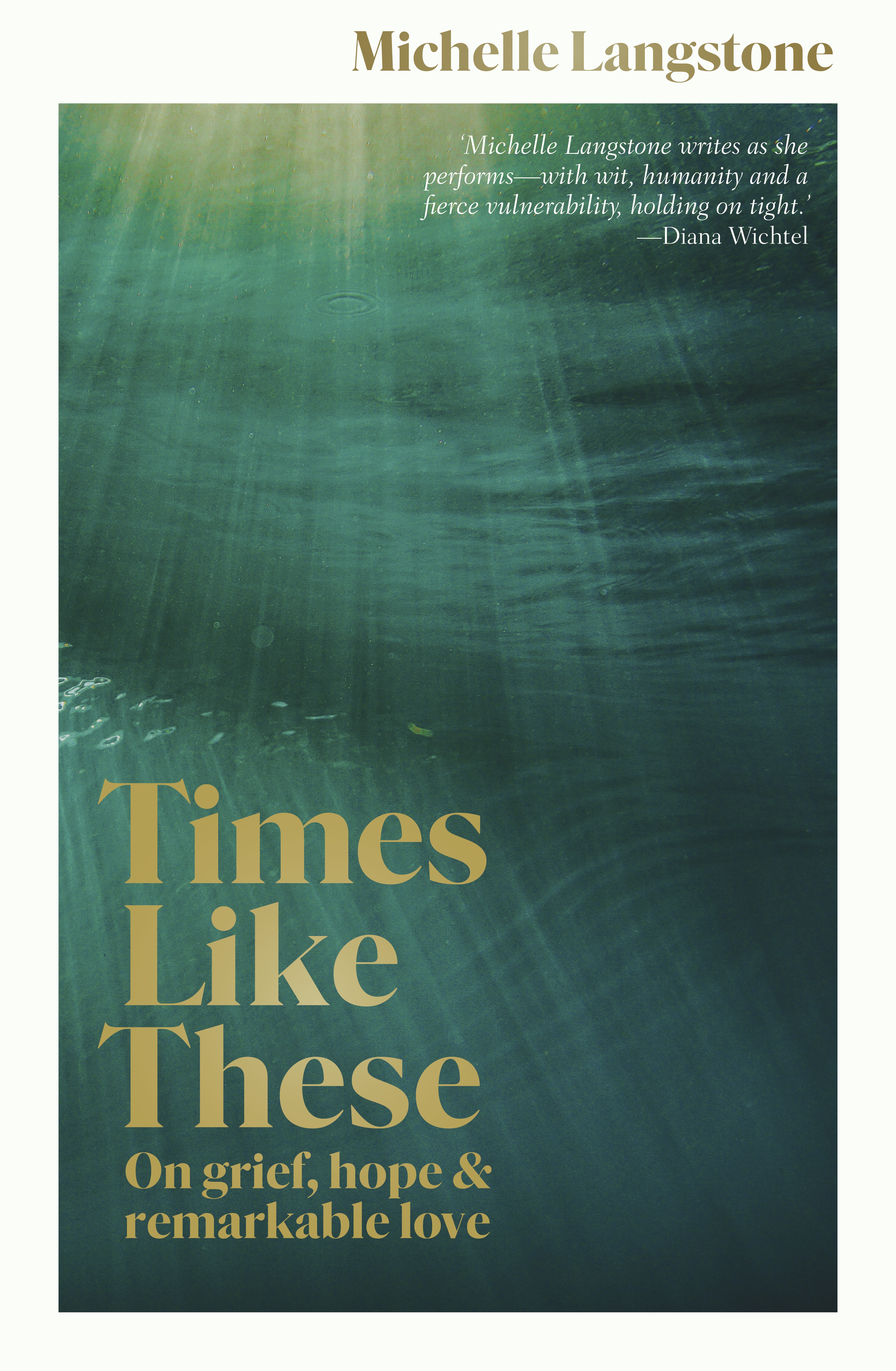
Times like These, Michelle Langstone, Allen & Unwin, 2021
I wonder how long it will take for us all to snap back into old ways of being, like rubber bands set free. I hope I will remember the way these days slowed down to show me things, to allow time to sit with the spaces inside me. I want to keep the quiet of these days close, and look for myself imprinted on the landscape where I walk.
from ‘Where I Walk’
Poet and bookseller, Jane Arthur, enthused about Michelle’s memoir to me in Good Books, so I came home to Tāmaki Makaurau with a copy. I now picture you standing next to me in my kitchen as I write this, as I too share my enthusiasms, my unadulterated love of this memoir, with its personal avenues and wisdom boulevards, its aches and its solace. I want to find readers who will love it as much as I do.
The sentences, ah, so sweetly crafted: jewels on the page, neither laboured nor akward. Michelle writes with the ink of a poet. Similes enrich. The rhythms flow like music. I stop and admire single sentences, phrases, word choices, but equally important is the content. The way grief, hope and love infuse the wider story and the smaller detail. Each scene gleams with life and at times death; Michelle’s father is dying, and the details are precious. I am in the scene, an interloper, feeling my own life and my own death with such intensity, such verve, such love, I know this is a rare reading experience.
An essay takes me back to lockdown, to the five weeks when everything changed, when we were out walking and breathing in the quiet, baking and making different plans, out walking walking walking. Michelle returns me to the way some of us had anxiety overload, not just for self and family, but also for the world, especially for the global loss of loved ones, for stories that resonate and matter behind every statistic.
Yes this memoir takes you into hard terrain. The death of a father is not just feeling it is also physicality, a changing body, the shared life recalled in piercing flashes. It is the rollercoaster experience of trying to conceive a baby, fertility treatment, maternal yearnings. But it also takes you to the everyday life that carries on, as partner, sibling, daughter, friend, actor, writer. The need to nourish and be nourished sits alongside the restorative power of the natural world: walking up the local maunga, the sky, the stars, trees, weather, falling leaves. It is the series of family boats where bags get packed and the harbour calls, mother ashore, father at the helm, the swimming, the near-drownings. It is life in all its kaleidoscopic range: the plainness, the sharpness, the joy.
I love this book because it draws me close to how experience, both good and bad and everything in between, can help view things in new lights, whether people or places or values. Whether ideas, the past, the present. For Michelle, her mother is re-seen:
I have seen my mother almost every day of my life, but it took my dad’s death to bring her into a focus that is hers alone. After his death we have more time. What she wants to do is see things grow, and with her I revert back to childhood, looking at plants with her, inspecting the old wooden troughs that she has given to me, making sure they’re in one piece and ready for new plants. I grow a salad and herb garden in the troughs she’s had for several decades, and when the new growth comes through I am euphoric, because it grows in my history and in the history of my mother’s hands. She comes to dinner and I make salads from from what I gather in the garden and I watch her eat and feel just like her.
from ‘Mother/Earth’
Thank you Michelle Langstone, thank you for this glorious gift of a book. I do hope one of the readers looking over my shoulder in my kitchen feels compelled to get a copy and start reading.
Michelle Langstone is a well-known actor in both New Zealand and Australia, and has featured in multiple film and television roles, including recurring roles in One Lane Bridge, 800 Words and McLeod’s Daughters. Michelle won the award for Best First Person Essay at the Voyager Media Awards in 2019 and the award for Best Interview or Profile at the Voyager Media Awards in 2020. She is a regular contributor to North & South, The New Zealand Herald and The Spinoff website.
When I look again, now closer to that line of debris
fluorescent seaweed are strands of thin balloons
blues and yellows simply twisted and segmented
overlapping scuttlers
a carrier crab with an urchin settled on its carapace
an offering or mardi-gras hat
People have written cryptograms with sticks
just under the surface of the water
tic-tac-toe and boxes made of scallop shell
preserved in the stillness of it all
The sand path around the cliffside grows thin
and I walk like there’s less gravity
in a jacket that rustles and clinks
pockets full of the clarity I’m bootlegging
Lily Holloway
Lily Holloway (she/they) has been published in Starling, Scum, The Pantograph Punch, Landfall and other various nooks and crannies (see a full list at lilyholloway.co.nz/cv). She is an executive editor of Interesting Journal and has a chapbook forthcoming in AUPNew Poets 8. Lily is based in Tāmaki Makaurau, is a hopeless romantic and probably wants to be your penpal! You can follow her on Twitter @milfs4minecraft.
Home is a state of mind, it’s where you lay your roots down, where you trace your roots, feed yourself, friends and family, bake your bread and make kombucha, where you stand and sleep and dream, it’s a physical place, a small house with wooden floors and comfortable couches, a garden with kūmara almost ready to harvest, shelves overflowing with books, my family tree, my family treasures, my thoughts of life and my thoughts of death, a series of relationships, myself as mother, partner, writer, home is my reluctance to drive beyond the rural letterbox, it’s contentment as I write the next blog, the next poem, sort the kitchen cupboards, light the fire, conserve the water, feel the preciousness of each day.
The poems I have selected are not so much about home but have a home presence that leads in multiple directions. Once again I am grateful to publishers and poets who are supporting my season of themes.
The poems
all of us
once upon a time
all of us here
were one of them there.
maybe
in another skin
in a life before.
maybe
only a few weeks ago.
land of the long white cloud,
land of no borders,
floating
adrift
near the end of the world,
near the end of the sea.
we came
and stayed
and with our accents
call
this place
home.
carina gallegos
from All of Us, Landing Press, 2018
there’s always things to come back to the kitchen for
a bowl of plain steamed rice
a piece of bitter dark chocolate
a slice of crisp peeled pear
a mother or father who understands
the kitchen is the centre of the universe
children who sail out on long elliptical orbits
and always come back, sometimes like comets, sometimes like moons
Alison Wong
from Cup, Steele Roberts, 2005, picked by Frankie McMillan
What’s the pH balance of yin + yang?
lake / river / liquid / beverage / additional charges or income / (of clothes) classifier for number of washes / hai bian / shang hai / shui guo / zhong guo / Sway by Bic Runga / three drop radicals on my guitar / liquid cement / tai chi at Buckland’s Beach / put your facemask on and listen to the rain on a UE speaker /
It’s not outlandish to say I was raised by the water. Aotearoa is a land mapped in blue pen, each land mass a riverbed. Originally swampland, the water gurgles from kitchen taps and runs silent cartographies underneath cities of concrete.
I was raised by my mama, raised with the treasures of every good cross-pollinated pantry. We have rice porridge for breakfast and mee hoon kueh when I plead. My siblings and I vie for iced jewel biscuits kept out of our reach, packed tightly into red-lidded jars on the highest shelf of our pantry. We stretch torso to tiptoe to reach them, knocking the jars off their perch with our fingertips. The dried goods we ignore on the levels below are the real jewels in the cabinet. From behind the creaky door comes the festivities of Lunar Celebrations: dried mushrooms, dried shrimp, vermicelli noodles, black fungus, herbal remedies, that good luck moss you eat on New Year’s.
Chinese cooking is a testament to soaking. Benches overflow with an array of colanders, damp towels cover small white bowls of noodles, rehydrating. We wash rice in liquid choreography: Pour. Swirl. Measure by the pinky. Drain.
My mum is from Ma Lai Xi Ya, her mum’s mum from Fujian, China. I google map the curve of a bordering coast, trace a line through the wet season pavements of Kuala Lumpur and end up with fingerprints all the way to Oceania. From my house you can see the windmills of Makara, jutting out like acupuncture needles. The sea rushes the wind like nature’s boxing lessons.
We fly back to Malaysia every couple years, past the sea-lapsed boundaries of other countries. In Singapore I am offered moist towelettes on the plane. In KL, where two rivers meet by the oil of Petronas, I shower in buckets of cold water and reunite with faulty flushing.
The first ethnic Chinese came to New Zealand during the 1850’s, following flakes of fortune. They came for the gold rush, fishing for luck on the unturned beds of rivers. Wisps of fortune lay in thousand year old rocks worn down to alluvial alchemy. Chinese last names carried through the cold water creeks. They died in sea-burials.
Tones and tombs. You made your river, now lie in it. Yǐn shuǐ sī yuán. To think of water and remember its source; to remember where one’s happiness comes from; to not forget one’s roots or heritage.
Oriental Bay is the closest beach to us in Wellington City. On weekends, we drive out for picnics, happy to migrate our schedules. The beach was named by George Dupper in the late 1840’s after the boat he arrived on. Fresh off the Bay. Oriental Parade is famous for 22,000 tonnes of imported sand. In my house we are displaced soil in torrential rain. I search ancestry on Wikipedia, then look for my own last name.
Think of water and remember its source. Where do our pipelines go? When do our bodies enter the main frame? Oriental, noun. Characteristic of Asia, particularly the East. Rugs, countries, bamboo leaves. A person of East Asian descent (offensive). A beach with fake grains. Imported goods and exported gooseberries. The fruits of our labour, measured and drained.
I think tourists find the green unsettling. It never stops pouring.
Year of the money. Year of the pig. Year of the scapegoat, the migrants, the rats on the ship. Labour. Lei. Qi Guai. Guai Lo. I google the wind howls around a shipwreck. I google microtraumas until my eyes bleed transparent. I google:
why do chinese people love hot water
can chinese people swim
why are there so many chinese in auckland
chinese people population
chinese people opinion
Ink blue motions stencil sight lines into the harbour of my eyes. I rub at ink sticks until the ocean turns to soot. The rising shadows of New World Power loom from water’s depths. We float currency back to motherlands in a trickle down economy. What’s the pH balance of yin + yang?
I was raised with the dawn promise of an unpolluted skyline, pools in cyan-printed eyes, long white dreams of the colony. My body the cycle of a washing machine, bleached into safety. I was raised in a world full of oysters, one lofty pearl held between the whiskered snout of a dragon. But you can’t feng shui the comments on Stuff articles.
Feng shui just means wind water. It’s not scary. Duān wǔ jié is the annual dragon boat festival. I throw zongzi in the river to protect Qu Yuan’s body. Remember how you moved across the world to know you had been here already? My mum says she caught sight of the harbour and it’s why she will never leave. I watch her from the doorway, her frame hunched across the sink. She belongs here. The soft light of morning streams through the window, catching glints on small rice bowls. I can hear a pot of water boiling. She soaks bones for breakfast, then asks if I’m hungry.
Vanessa Mei Crofskey
from A Clear Dawn: New Asian Voices from Aotearoa New Zealand, eds Paula Morris and Alison Wong, Auckland University Press, 2021
blue beat
Every morning he milked the cow.
It was the chime that woke me and my sister,
metal against metal,
the fall of the empty milk-bucket’s handle
as he put it down to open the gate
right beside our sleep-out.
At the end of the day, in socks,
the cold, clear smell of fresh air
still on him, was his way
of arriving back;
the glass of water he gulped,
the hanky dragged from his pocket,
how he leaned back with a grunt
against the nearest doorpost
to rub and scratch the itch,
or ache, between his shoulders. Once,
seeing me poring over a map of the world
trying to find Luxemburg,
he teased, saying something
about how I couldn’t wait to leave.
None of us knowing then
that he would be the first to go,
leaving us
long before we could ever leave him.
Kay McKenzie Cooke
from Born to a Red-Headed Woman, published by Otago University Press, 2014
We used some
concrete blocks
the hollow kind
that let the grass
grow through
to make a carport
then took a few
out back to
plant a herb garden
parsley thyme
used to step out
mid-dish to snip off
fronds till
it all went to seed
now my mother’s not
been out the
back door in
more than a year
they’ve grown into
massive aberrant
plants to match
the trampolines
around the flats
on either side
Jack Ross
Bliss
If I were to describe this moment
I may write
bliss
If bliss meant quiet, companionship
you in the garden, me hanging washing
the fresh scent of rain on the air
the murmur of voices inside
You and me
not far away
bliss
Rose Peoples
Reasons you should retire to the
small town the poet grew up in
Because you have a Grahame Sydney book on your coffee table. Because you are public figure reinventing yourself as a public figure – in Central Otago. Because you can buy advertising space cheap and write a column about local issues. Because you know how moorpark apricots ripen from the inside and look deceptively green. Because it’s a gold rush a boomer boom town. Because you are a big fan of Muldoon flooding the gorge for the generation of electricity – when the river rose it formed little islands possums, skinks and insects clung to power poles to escape drowning. Because you fell in love when you were sixteen with the dusty curtains in the high school hall – immense as the horizon holding the town in.
Ella Borrie
from Stasis 2020, picked by Aimee-Jane Anderson-O’Connnor
In my mother’s house
Everything is always evening:
curios in candlelight, blowpipes,
riding crops, cabinets of Caligari.
Children used to giggle in the rhododendrons;
dragons wander up to the door.
There were nightingales.
The ghosts hunch, passing the port,
rehash old scandals, broken trysts,
all those garden parties long ago.
Harry Ricketts
from Just Then, Victoria University Press, 2012
Hunting my father’s voice, County Down
It begins with the medieval
throat clearing of crows
high over Scrabo tower. You
were the boy your mother
forgot to drown and still
you holler for help
So here’s a bloody conundrum
shot to blazes and back
and your brother Jimmy
in a slow swim to save you
Dad, the land is full of boulders
an apron of stones
to feed a nanny goat
chalk a plenty to soften your voice
All those stories, enough
to hang a man, come Easter
All that dreaming
the time it took
to dig breath for the fire
the knot and bog
of the back parlour where Jimmy
washed roosters
and sister Maureen, her hair
lovely enough to stop your throat
Frankie McMillan
appeared on a Phantom Poetry Billsticker 2015
SH5
From Bluff Hill we can see the ships come in. Past the buoys stitched crooked like Orion’s belt. My school is art deco seashell and lavender climb. Girls press their hands to the frames and breathe on the glass. There’s this one boy who got peach fuzz before the rest of them. His voice cracks seismic and we all swarm. I practice my California accent down the landline and my mother laughs behind the door. We pass him around like chapstick. Hickies like blossoms on his neck, like rose-purple flags planted behind pine trees and beach grass. There are socials. Socials with glow sticks and apple juice in cardboard cartons. We all look at him. We look at him, through him, to see each other. A postcard is no place to be a teenager. The sea air is too thick. Rusts my bicycle in the garage. Rusts the door hinges. Stings in the back of my eyes.
Our town’s like honey. You get knee deep. Arataki. Manuka. Clover. Sweet. Council flat, Sky TV, pyramid scheme, boxed wine, sun-freckled early twenties. Ultra-scan, veganism, Mum’s club with the girls who went to your kindy. His sisters, their perfume vanilla and daisies, their babies fat and milky. We could have built a vege garden. I could have kept a shotgun under the mattress.
Most of us. Most of us leave. We carve the initials of our high school sweethearts into lumps of driftwood and throw them out to sea. To big cities where no one knows us, where the cops drive with their windows up and their sleeves rolled down. We learn to sleep through the traffic. We keep on leaving till we find a way to go. We leave so one day we can maybe come back.
Aimee-Jane Anderson-O’Connor
from Starling 6
The Shed
It was a shed before it was home to Tongan relatives. The inside smelled like Dad’s work gloves, musk and dirt. Dust caught in cobwebs draped over muddy tools. Overgrown insects nested between the spades and hoes. Wonky stacks of building stuff lay against the walls,window frames, doors, planks with flaking paint and nails poking out. Dad would be busy in the humming dark behind the shed, shovelling smelly things in the compost.
He’d reach the bottom of the pit in one spadeful, burying green- oaty food waste and feathering rich crumbly compost over the top with delicate shakes. I liked the slicing sound of the spade when he dug deep. The mouldy compost frame kept everything together for so many years. To Dad’s left there was the chicken coop, with a motley crew of chickens and a duck. He’d built a pirate-rigging treehouse in the trees above. To his right the long brown garden where everything he planted thrived, giant broccoli and gleaming silverbeet. Runner beans grew up a chicken-wire frame separating the veggie plot from the pet cemetery at the back where flowers grew amongst wooden crosses with cats’ names scrawled on them.
There was a flurry of bush between us and neighbours. One bush grew glowing green seed-capsules we wore as earrings, there was a sticky bamboo hedge and the rotten log sat solidly in a gap. The bush was thick enough for birds to nest in, dark patches in the twigs that cried in spring. Sometimes we’d hear strangled shrieks and sprint to retrieve dying bodies from cats’ mouths; saving lives for a few moments. Dad said we’re allowed to pick flowers to put on graves but otherwise it’s a waste.
Aimee-Jane Anderson-O’Connor was awarded the 2018 Charles Brasch Young Writers’ Essay Competition, and the 2017 Monash Prize for Emerging Writers. Her work has appeared in Starling, Mayhem, Brief, Poetry New Zealand, Landfall, Turbine, Flash Frontier, Mimicry, Min-a-rets, Sweet Mammalian, Sport and Verge. She is Poetry New Zealand‘s 2021 Featured Poet. She writes thanks to the support of some of the best people on this great watery rock.
Ella Borrie is a Te Whanganui-a-Tara based poet from Otago. She co-edited Antics 2015 and her work appears in Mimicry, Starling and Turbine | Kapohau. The title of this poem is inspired by Louise Wallace’s poem ‘How to leave the small town you were born in’.
Kay McKenzie Cooke’s fourth poetry collection was published by The Cuba Press in June 2020 and is titled Upturned. She lives and writes in Ootepoti / Dunedin.
Vanessa Crofskey is an artist and writer currently based in Pōneke Wellington. She was a staff writer for online arts and culture journal The Pantograph Punch and has a collection of poems out in AUP New Poets Volume 6.
carina gallegos, originally from Costa Rica, has worked in journalism and development studies, and with refugee communities since 2011. She published poems in All of Us (Landing Press, 2018) with Adrienne Jansen. She lives in Wellington with her family and refers to New Zealand as ‘home’.
Simone Kaho is a digital strategist, author, performance poet and director. Her debut poetry collection Lucky Punch was published in 2016. She has a master’s degree in poetry from Victoria University’s International Institute of Modern Letters (IIML). She’s the Director of the E-Tangata web series ‘Conversations’ and a journalist for Tagata Pasifika. In 2021 Simone was awarded the Emerging Pasifika Writer residency at the IIML.
Vana Manasiadis is Greek-New Zealand poet and translator born in Te Whanganui-a-Tara and based in Tāmaki Makaurau after many years living in Kirihi Greece. She is 2021 Ursula Bethell Writer-in-Residence at Te Whare Wanaga o Waitaha Canterbury University. Her most recent book was The Grief Almanac: A Sequel.
Frankie McMillan is a poet and short story writer who spends her time between Ōtautahi/ Christchurch and Golden Bay. Her poetry collection, There are no horses in heaven was published by Canterbury University Press. Recent work appears in Best Microfictions 2021 (Pelekinesis) Best Small Fictions 2021 ( Sonder Press), the New Zealand Year Book of Poetry ( Massey University) New World Writing and Atticus Review.
Emma Neale is a writer and editor. Her most recent collection is To the Occupant. In 2020 she received the Lauris Edmond Memorial Award for a Distinguished Contribution to New Zealand Poetry.
Rose Peoples is from Te Awakairangi/Lower Hutt. She is a student at Victoria University and, having finished her law degree last year, decided that the logical next step was to embark upon a Masters in Literature. She is a bookseller at Good Books. Her work has previously appeared in Cordite, Mimicry and Starling.
Harry Ricketts teaches English Literature and creative writing at Victoria University of Wellington Te Herenga Waka. His latest collection Selected Poems was published by Victoria University Press, 2021.
Jack Ross‘s most recent poetry collection, The Oceanic Feeling, was published by Salt & Greyboy Press in early 2021. He blogs on the imaginary museum, here[http://mairangibay.blogspot.com/].
Alison Wong is the coeditor of A Clear Dawn: New Asian Voices from Aotearoa New Zealand (AUP, 2021), the first anthology of creative writing by Asian New Zealanders. Alison’s novel, As the Earth Turns Silver (Penguin/Picador, 2009) won the NZ Post Book Award for fiction and her poetry collection Cup (Steele Roberts, 2006) was shortlisted for the Jessie Mackay Award for best first book of poetry. She was a poetry judge at the 2018 Ockham New Zealand Book Awards.
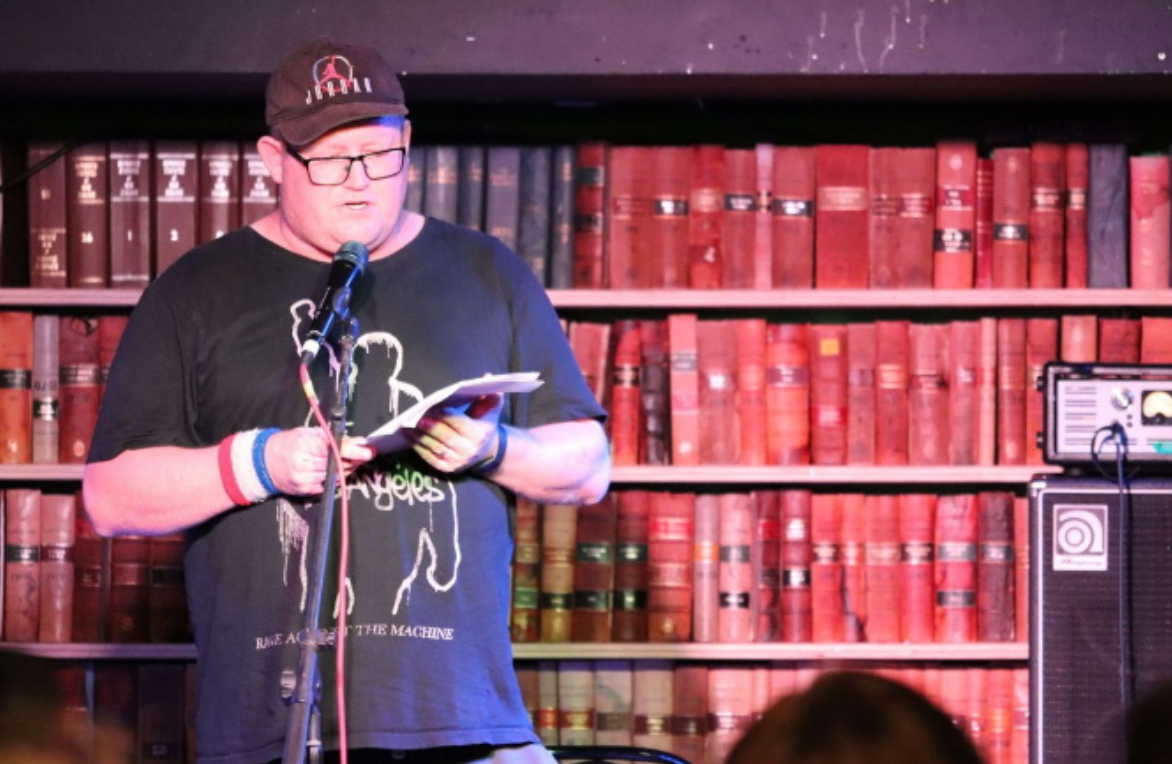
The fantastic Poetry in Motion hosts an event on the first Thursday of every month at Wellington’s Fringe Bar. I’ve been attending as often as I can across the last couple of years. The structure is always the same – open mic starting at 7.30, and after an intermission there’s a feature poet; a guest spot.
The format might always be the same but the content is different. This is the best open-mic going in Wellington that I know about. And the guests are wonderful.
I’m honoured to be the July guest poet. (No pressure!) I’ll be reading poems from my book and newer work too.
It’s $3-$5 on the door. It starts at 7.30. Get there a few minutes earlier to register if you want to read. Bring money to buy copies of my book if you’re keen.
Melinda Szymanik is an award-winning writer of picture books, short stories and novels for children and young adults. She was the 2014 University of Otago, College of Education, Creative New Zealand Children’s Writer in Residence, held the University of Otago Wallace Residency at the Pah Homestead in 2015, and was a judge for the 2016 NZCYA Book Awards. Her most recent book is My Elephant is Blue (Penguin, 2021).
20 May 2021: Winners in the 2021 Hippocrates Prize for Poetry and Medicine were announced by live webcast on Wednesday 19th May to an international audience from North America, Europe, Asia and Australia.
First Prize in the FPM-Hippocrates Open Awards went to Fran Castan, former magazine editor, freelance writer and teacher of writing and literature from New York City, USA for Voice Mail. About her poem she said: “When my friend, the poet Siv Cedering, was suffering from pancreatic cancer, I would visit frequently. I wrote Voice Mail as witness to our experiences during her heroic struggle.”
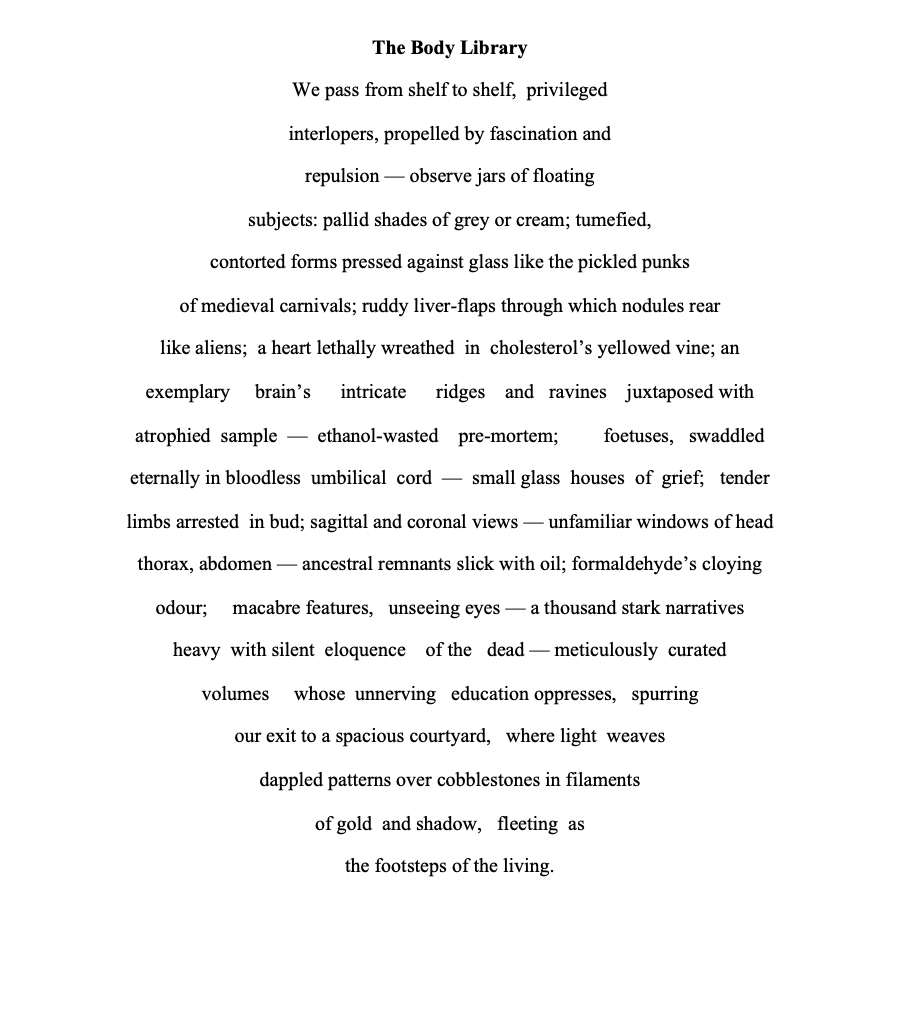
First Prize in the FPM-Hippocrates Health Professional Awards went to Sophia Wilson from Dunedin in New Zealand for The Body Library. Sophia has a background in arts, medicine and psychiatry.
She said: “The Body Library is a mélange of memories of the anatomy and pathology museums at Sydney University. I recall in particular the enormous sense of privilege, the bizarreness of human body parts being presented and objectified in this way, and the relief of exiting the hallowed rooms into daylight.”
‘The Body Library’ first published in Hippocrates Prize Anthology 2021, hippocrates-poetry.org
Sophia Wilson has recent writing in Mayhem, Blackmail Press, Intima, Australian Poetry Anthology, Shot Glass Journal, The Poetry Archive, Landfall, A Fine Line, Not Very Quiet, Ars Medica, Hektoen International, Poetry New Zealand, Flash Frontier, Best Microfiction 2021 and elsewhere.She was runner-up in the 2020 Kathleen Grattan Prize for a Sequence of Poems and her poem ‘The Captive’s Song’ won the 2020 Robert Burns Poetry Competition. Sophia has a background in arts and medicine and is based in Aotearoa New Zealand.
Paula Green, from Cookhouse, Auckland University Press, 1997
My theme-season introductions seem like miniature self confessions on life and poetry. Crikey! I always have much to say about food and poetry because I love cooking and I love writing. My first book Cookhouse got scathing reviews either for being too domestic or forbeing too experimental. I walked around the supermarket on a Sunday morning reading the first review of my first book saying OMG OMG OMG. It was my first lesson as a writer: leave reviews with the person who wrote them. Just get on with what you love. A few weeks later I opened the Listener and there was a photograph of Cookhouse on the recipe page with a Marcella Hazan cookbook ( I loved her recipes!). Plus one of my poems, sitting on the page like a recipe. That was my second lesson as a writer. Your books and poetry find their way into surprising places and you will never know how your poetry touches people. Although sometimes you get an inkling: a stranger might walk up to you, or send an email or a card, and surprise you (in a good way!).
I can’t keep food out of my poetry and I am equally drawn to writers with similar intent. It is one reason I am such a fan of Nina Mingya Powle’s poetry. Her poems lead in multiple directions but the sensual hooks are often sparked by food. Ian Wedde is the same. I adore The Commonplace Odes. It has always mattered what food I put in my body, and it is a bit the same with with poetry. I want to cook a meal that tastes good and I want poetry that satisfies my reading tastebuds whether I am writing or reviewing. In fact don’t call me a reviewer please. And I am not actually very kind. I simply love reading poetry and sharing my engagements. Just as I love cooking a meal every night for my family.
The poems selected are not so much about food but revel in a presence of food to varying degrees. Grateful thanks to the publishers and poets who continue to support my season of themes.
The Poems
De-stringing beans
A mountain of runner beans
to top and tail and de-string.
She decides to do it for them: her sons
so they will be eaten this evening
sliced into green splinters
with pink seeds showing through.
Easier to sit than stand. Her best profile
towards the door when her son appears.
She wants to disguise how content she is.
The stringy edges, tops and tails, in a dish
the beans growing, like a mountain of shoes
later to be wrapped in tinfoil
roughly divided into two.
No one else in the family will eat them.
In an article it says they are underrated
almost despised as a vegetable
underestimated on two counts
or three: first the vigorous way
they climb, clamber to the sun
second they are rich in iron
and last and best: this contentment
so rarely found, except in
a painting of a woman pouring from a jug
someone bathing someone in a tub
this mountainous-seeming task
calming with each stroke of the knife.
Elizabeth Smither
little walnuts
served from across the seas
in a tin or a jar, fished from suitcases
presented
with grandmotherly dimples
little walnuts – xiao he tao
proudly, good for brain.
except neurons are firing
in staccato, half-
forgotten Mandarin.
they manage xie xie and dutifully
I eat them.
I forget why I ask for these –
the carnage of shells
scraps of brown meat
and a strange invasion staged
on my tongue – slow
and clumsy muscle.
I am quick to rise – you do not get to comment on what’s in my lunch box –
but just as quick to pick
the yolks of my too-dry lotus mooncakes –
discarded suns
of a world in hieroglyphs.
and when I have counted
waves of sleep – yi, er, san –
I don’t dream in the same vowels.
what can I bring back for you?
her smile like furls of steaming jasmine tea
amidst clamouring children
hawking their wants like roadside wares
or suitcase wheels clicking on concrete
destined for smog and skyscrapers.
I always ask for my little walnuts.
*Little walnut or xiao he tao is a particular kind of Chinese walnut with a distinct sweet-salty flavour.
Joy Tong
from A Clear Dawn: New Asian Voices from Aotearoa New Zealand, eds Paula Morris and Alison Wong, Auckland University Press, 2021
from A Clear Dawn: New Asian Voices from Aotearoa New Zealand, eds Paula Morris and Alison Wong, Auckland University Press, 2021
With Nectarines
to Claire Beynon
A cob loaf rests on a surface,
perhaps a table, an altar, a jetty,
that reaches over a shoreline toward dark water
and the approaching edge of night.
Out there an indigo quiet where the sky lowers to sea,
clouds shouldering weight of storm to come;
a hint of beach, airborne flicks of white,
where seabirds swoop for fish and scraps.
On this side of a sill,
the bread, and a bowl of tawny nectarines
occupy foreground that’s human with light,
with hearth-glow in the corner,
tended against incoming cold.
The bread is warm from the oven,
the fruit ripe, and the room that extends
from the canvas edge into my lived space
where the painting hangs, included as offering
to the sombre air,
to anyone who comes to this threshold, empty.
Carolyn McCurdie
Super Wine
The news is early or his clock is slow,
so he grabs his mug of tea and pops
a biscuit in his pocket,
the top pocket of a faded old coat.
It’s a wreck of a thing, this coat of his.
a shamefully limp and grubby article,
but he wears it through the news and Campbell Live
and on into the night,
and he wears it when he leaves his little flat
and slips up the lane and out into the park
and lights a cigarette
(his skinny nine-o’clocker
and the last of the day).
And he smells the smells of mown grass and woodsmoke,
and he walks across the park towards the lights,
the lights of the houses on the hill,
secular stars of silver and orange,
and he walks beneath the frosty stars themselves,
this unmarried, unmended man,
this unmarried, not-unhappy Earthling,
A Super Wine forgotten in his pocket.
Geoff Cochrane
from Pocket Edition, Victoria University Press, 2009
If you love me you’ll buy Bluff oysters and cook asparagus. Even though I don’t like either.
for Kirsten Holst, for feeding me many good things
and for Alison and Peter, for their Bluff oysters and asparagus
When I am no longer who I was
I can only hope that I will be loved by someone
so much that every day during Bluff oyster season
they will buy me a dozen Bluff oysters.
Even though they don’t like Bluff oysters
they will buy them for me
and every day I will exclaim
“I can’t even remember the last time I had Bluff oysters!”;
they will nod at the extreme length of time it has been.
When I am no longer who I was
and when Bluff oyster season is over
I can only hope that I will be loved by someone so much
they will cook me freshly picked asparagus every day.
Even though they don’t like asparagus
they will grow it for me and pick it for me
and lightly steam it
so that I can relish it served with hollandaise sauce
(although some days more lazily served with butter and lemon).
I will eat it with my fingers
and let the sauce (or butter) dribble down my chin;
no one will mind or tell me to be less messy
it will just be moments of edible joy.
In reality I don’t like Bluff oysters (or any oysters)
and I can’t stand asparagus (the taste and texture are disturbing);
I can only hope that maybe someone will love me enough
to buy and cook me the things that I love
even though they hate them, even though I won’t remember.
Paula Harris
the great pumpkin war
standing in the kitchen crying
beaten by a vegetable
thought by now it would be easier
people have suggested this (people i trust)
the myth of progress
you do something every day it gets easier
in reality each day the dirt accrues
it multiplies between cupboard doors
i am running out of resources
i am getting further & further into
the ten-year warranty on the fridge compressor
one day soon i will have to pick up the knife
& address the pumpkin in the room
bought so cheaply from the farmers’ market
now growing larger by the day
taking up all the bench space
i fear for the fruit bowl
my mother says to drop it from a height
she throws hers down the stone garden steps
my previous attempt resulted in
20 minutes lost to searching for an unscathed pumpkin
trying to break open a pumpkin at night
is like starting a winter war in russia
i am letting everything get out of control
i sleep knowing it is getting worse
i do not think i can win at this
i do not think i can carry on in any capacity
Rhys Feeney
from AUP New Poets 7, ed Anna Jackson, Auckland University Press, 2020
The Cheese Scone Recipe as Promised
What’s the secret, people ask,
why do your students return
year after year to your class?
Cheese scones, I say, crisp
on the outside, soft inside
like all good characters. First,
turn up the heat, 200 degrees
should do it. Next, sift two cups
of self-rising flour, holding the sieve
high, letting the flour fall like snow
in the air, then add a heaped half
teaspoon each of salt, mustard powder
and a good pinch of cayenne for a lick
of fire. Stir and rub in 30 grams
of butter. If in a hurry, as I usually am,
you can grate the butter or cheat
with the food processor,
but do not go all the way, stop
at the crumbly stage, add 75 grams
of grated cheese, then beat a large egg,
with about 75 mils of buttermilk,
(if you have none, add lemon juice to milk,
rest it for ten minutes). Breaking
the drought pour into the dry ingredients,
mixing first with a knife, then lightly
with your hands to bring the soft dough
together. If it seems too dry
add more buttermilk, but like
it’s a newborn and precious, go easy
with your handling, remembering
scones and poems need a light touch.
Cool hands, my mother said,
though mine have always been hot.
Roll the dough out in a rough circle,
not too thin, about 2.5 cm thick.
With students due any minute,
I usually take the lazy way, divide
it roughly into 8 triangles but you might
be wanting to impress your mother
or daughter-in-law, and have the time
and the aesthetic sense for fluted cutters.
Appearance improves the taste
so brush the tops with milk, sprinkle
on a little grated cheese, and a dusting
of cayenne. Bake on a high shelf
for about 15 minutes till golden
and irresistible. Making scones
is not dissimilar to crafting a poem,
you need to pay attention to detail,
measuring, mixing, letting in air,
but there the recipe ends.
What I haven’t talked of can not
like metaphor, be quantified, the secret is
to bring to the process, a little of you.
Diane Brown
the children open their
lunch boxes to each other
a ham sandwich
for a Fijian fried egg and three cassava sticks
a mini feta quiche
for a South Indian roti parcel stuffed
with cumin and okra
a tub of yogurt
for a Middle Eastern pouch of semolina
sautéed in ghee and cardomens
a celery stick
for a Tongan plantation ladyfinger banana
a juice box for
fresh Kiribati island toddy
the wooden decks approve
their slats on standby to suck evidence
of sharing and spit them into the crawl space
beneath the salivating joists
it’s the allergies
the adults
the food policies
and
the way fear feeds us all
Mere Taito
P r o p e r t i e s
You’ll need oil – For your forehead on Ash Wednesday, for the insides and outsides of your palms. For sore inner ears and lifeless hair. For removing the evil eye – that’s the most important. Though not one in the family knows the ritual, better to be with, than without.
Grapes and leaves – For your rice and pinenuts, for your grape jelly.
And ash – For the grape jelly – vine cinders to be precise. For holy crosses over the front doors of your houses or workplaces. For the bottoms of incense holders – hubris to clear it out.
Rose petals – For gravestones, but mostly for the preserve that fits into a spoon followed by icy water.
Water – From the priest, for drinking in the first month of the year and sprinkling in every room. For keeping in the fridge thereafter. For putting chamomile into – tea or warm compresses.
Garlic – For everything. For mashing up and applying with honey to sores. For rubbing on styes. For wrapping in bread and swallowing whole when feverish. For shooing away evil by saying the word alone – along with a spitting sound.
Vana Mansiadis
from Ithaca Island Bay Leaves: A Mythistorima, Seraph Press, 2009
1.2 To the cookbook
Turning east, I drove towards blue grey
Mountains down which cloud crawled
From summits which were already sky. High in it
A glare like grubby porcelain told me that morning
Was advanced. The nibbled winter paddocks were over-
Written in a language no one had ever taught me:
Glottal, almost choking, wet. Lines
Of leafless shelter-belt enwrapped the shorter
Rows of berryfruit trellises in need
Of pruning. My destination: an art gallery.
My mission: to speak about art and poetry.
It was going to be all over before I got there.
Quintus Horatius Flaccus, help me
In my hour of need, help me turn my back
on landscape that wants to be art, on poetry with feet
Of clay. The lovely world has everything I need,
It has my kids, my sweetheart, my friends, it has a new book
With mouth-watering risotto recipes in it,
The kind of plump rice you might have relished,
Horace, in the Sabine noon, yellowed with saffron.
‘The zen poet’ is another of you, he wrote a poem
About making stew in the desert which changed my life.
A good cookbook is as good as a book of poems
Any day, because it can’t be more pretentious
Than the produce you savour with friends as night falls.
Ian Wedde
from The Common Place Odes, Auckland University Press, 2001
Custard
When I was smaller than the family dog,
Dad would tell Mum
that he was taking me to kōhanga.
Then we’d go to the bakery
and get as many custard pies
as we could handle.
Park up by the river,
talk,
eat,
listen to the radio a while.
He’d light one up
as fat as the mighty brown trout,
captured and killed
and lull me to sleep
with a puku full of custard
in his red van
with all his windows up.
Now I am grown
and you ask me to explain something you said.
My eyes glaze
and all I can see is that
red van,
pastry flakes resting
in the corners of my sleeping mouth.
Ruby Solly
from Tōku Pāpā, Victoria University Press, 2021
The Poets
Diane Brown is a novelist, memoirist, and poet who runs Creative Writing Dunedin, teaching fiction, memoir and poetry. She is the Poetry Editor for ‘The Mix’ in the Otago Daily Times. Her latest book is a poetic novella, Every Now and Then I Have Another Child, Otago University Press 2020.
Geoff Cochrane is the author of 19 collections of poetry, mostly recently Chosen (2020), two novels, and Astonished Dice: Collected Short Stories (2014). In 2009 he was awarded the Janet Frame Prize for Poetry, in 2010 the inaugural Nigel Cox Unity Books Award, and in 2014 an Arts Foundation of New Zealand Laureate Award.
Rhys Feeney is a high school teacher in Te Whanganui-a-Tara. You can buy Rhys’ debut collection, “soyboy,” as part of AUP New Poets 7
Paula Harris lives in Palmerston North, where she writes and sleeps in a lot, because that’s what depression makes you do. She won the 2018 Janet B. McCabe Poetry Prize and the 2017 Lilian Ida Smith Award. Her writing has been published in various journals, including The Sun, Hobart, Passages North, New Ohio Review and Aotearotica. She is extremely fond of dark chocolate, shoes and hoarding fabric. website: www.paulaharris.co.nz | Twitter: @paulaoffkilter | Instagram: @paulaharris_poet | Facebook: @paulaharrispoet]
Vana Manasiadis is Greek-New Zealand poet and translator born in Te Whanganui-a-Tara and based in Tāmaki Makaurau after many years living in Kirihi Greece. She is 2021 Ursula Bethell Writer-in-Residence at Te Whare Wanaga o Waitaha Canterbury University. Her most recent book was The Grief Almanac: A Sequel.
Carolyn McCurdie is a Dunedin writer, mostly of poetry and fiction. Her poetry collection ‘Bones in the Octagon’ was published by Makaro Press in 2015.
Neema Singh is a poet from Christchurch of Gujarati Indian descent. Her work appears in Ko Aotearoa Tātou: We Are New Zealand(2020) and A Clear Dawn: New Asian Voices from Aotearoa New Zealand (2021) and she is currently working on her first collection of poetry, a series of poems unfolding the layers of culture, identity and history contained within ordinary moments. Neema is an experienced secondary school English teacher and holds a Master of Creative Writing from The University of Auckland.
Elizabeth Smither ‘s new collection of stories: ‘The Piano Girls’ will be published in May by Quentin Wilson Publishing.
Ruby Solly (Kāi Tahu, Waitaha, Kāti Māmoe) is a writer, musician and taonga pūoro practitioner living in Pōneke. She has been published in journals such as Landfall, Starling and Sport, among others. In 2020 she released her debut album, Pōneke, which looks at the soundscapes of Wellington’s past, present and future through the use of taonga pūoro, cello, and environmental sounds. She is currently completing a PhD in public health, focusing on the use of taonga pūoro in hauora Māori. Tōku Pāpā, published in Februrary 2021, is her first book.
Mere Taito is a poet living and working in Kirikiriroa.She is interested in the way poetry can be used to revitalise minority Indigenous languages like Fäeag Rotuạm ta.
Joy Tong picks wildflowers from neighbours’ fences, pets strangers’ dogs and chases stories in the streets. She’s a student, musician and writer from Tāmaki Makaurau and her other works can be found in Landfall, Mayhem and Starling, as well as A Clear Dawn, an anthology for NZ-Asian voices.
Ian Wedde was born in Blenheim, New Zealand, in 1946. He lives with his wife Donna Malane in Auckland. ‘To the cookbook’ is from a sequence called The Commonplace Odes, published as a book by Auckland University Press in 2001. He was New Zealand Poet Laureate in 2011.
Their feelings are like a mosquito sliding its proboscis into a freckle. Their feelings are like light through blinds in an 80s music video. Their feelings are like techno under aurora in Norway. Their feelings are like swimming in sunlit sea and seeing a shadow. Their feelings are like when they’ve taken bath salts that turn out to be bath salts, and they end up in A&E and their mothers have flown in from Hamilton and are holding their hands and crying, but all they can think about is how their lives have become a TV hospital soap which they could have been written out of or out of which they could have been written. Their feelings are like a Mindful Self Compassion course when someone asks where the hyphen goes in the title and the convenor says ‘Anywhere’ and the person says ‘I don’t think this is what I am looking for.’
James Brown
James Brown’sSelected Poems was published by VUP in 2020. He is working on a new book.
So many poets have written walking poems. So many poets have commented on the relationship between walking and a poem gathering momentum in the pedestrian’s head. Just for a start, I am thinking of Jenny Bornholdt’s magnificent poem ‘Confessional’, Michele Leggott’s walking blind, a vital thread, with different insight and senses on alert in her poems, and of course Blanche Baughan’s love of hill walking. A poem itself is a form of walking with its various rhythms and absorptions. The poet becomes walker, bricoleur, observer, mind-drifter.
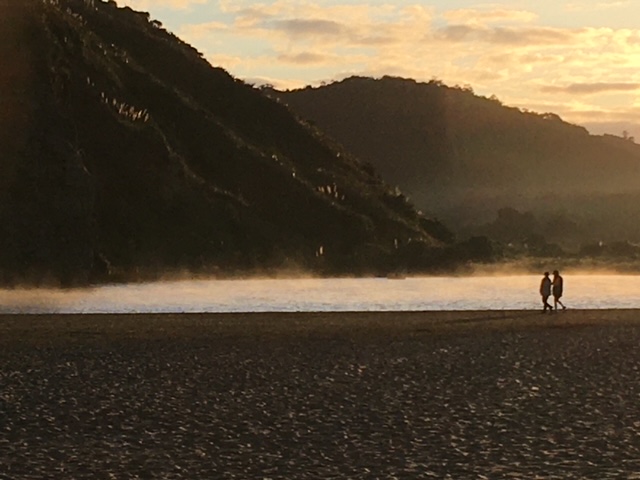
My most recent collection The Track (Seraph Press) was written as I walked the third day of the Queen Charlotte Track with a broken foot in a wild storm. To keep walking I used the alphabet to compose poems and returned home with a book-length sequence. Whenever I have read from it, I am right back in the storm diverting pain with words. A strange feeling indeed. But I also have the early mornings at Te Henga Bethells. Walking on the near empty beach in the early morning light is an opening for poetry. Glorious.
I am currently reading Foxtrot and Other Collisons, Shari Kocher’s sublime second collection. In her endnote she says the poems were written over a five-year period. She wrote:
No poem in this collection was written before it was walked: arbitrary or otherwise, the rule I applied to the book’s organic growth was that each poem was to be ‘discovered’ on foot, and many continued to be composed peripatetically across many drafts while out walking in ways dedicated to that terrain.
The poems I have selected are not so much about walking but have a walking presence that leads in multiple directions. Many of the poems are longer rather shorter and take you on glorious excursions. Once again I am grateful to publishers and poets who are supporting my season of themes.
The Poems
Travelling light
She is walking at the edge of the sea
on the wet shining sand.
The bright sky is behind her.
She is travelling
on a sheet of grey light.
We pass, and I wave.
She laughs. Of course.
A woman who walks at the edge,
on light, would laugh.
Adrienne Jansen
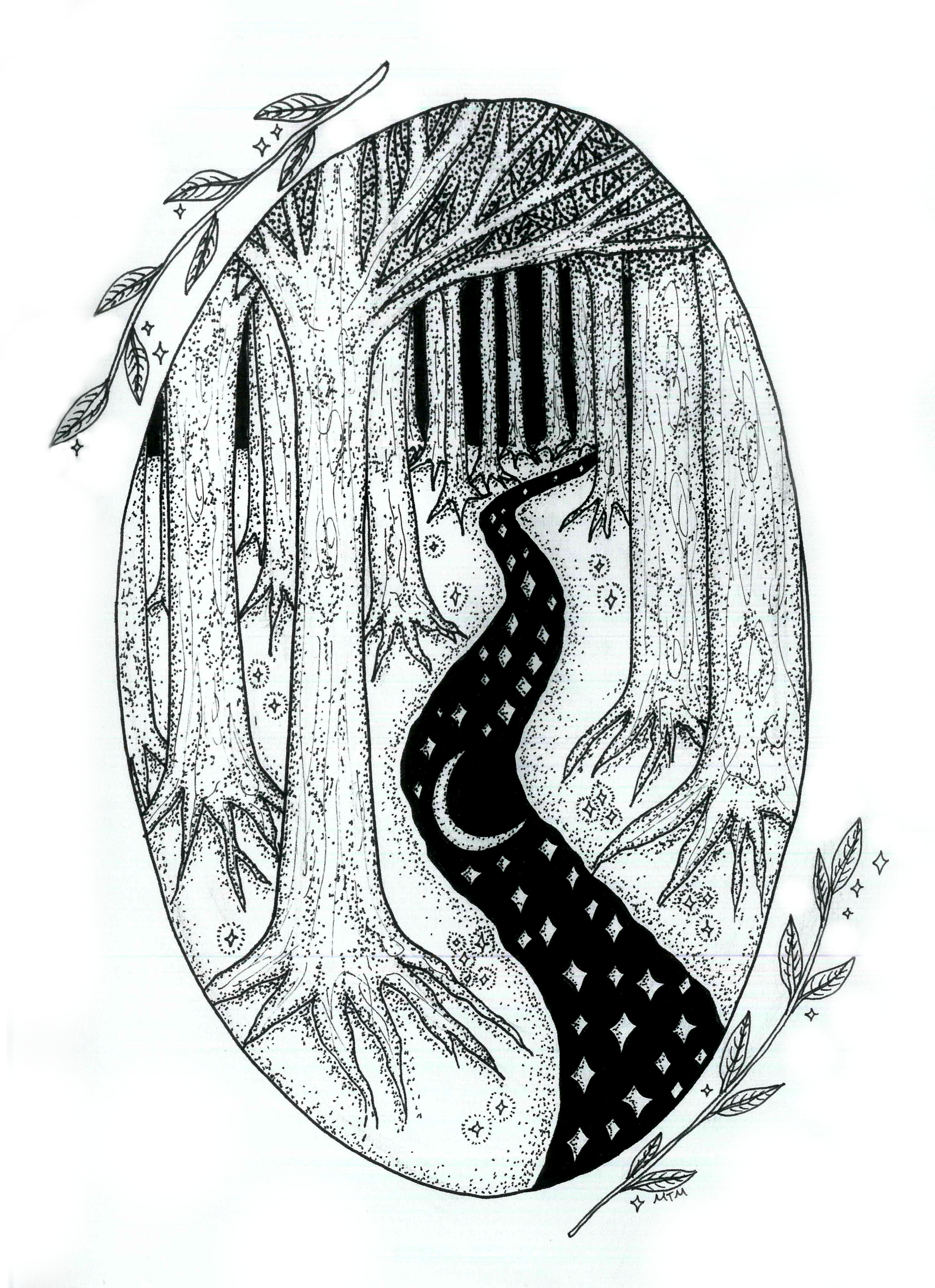
Madeline McGovern’s ‘Enchanted forest’, source of Rose People’s poem
A path of stars
There are many things
I would like to tell you,
my darling
My darling,
I would like to tell you
in this life
everything will be okay
I would like to tell you
that you will walk upon a path of stars
that you will travel through the forest
and never lose your way
I would like to tell you
to look only at the stars
and not the gaps between them
to look at the sun
and not the clouds.
My darling, I would like to tell you all these things
for the same reason we read fairy stories to children
and weave their years with mythologies
because there is comfort is such lies
because I want the world you live in
to carry more magic
and less sharp edges.
But, on this dark night
I have run out of comforting lies.
My darling,
I cannot promise you a path of stars.
some days you will walk upon
unforgiving concrete or sharp-edged gravel
some days you will wade through quicksand.
Tonight, I cannot conjure stars
without the black between them.
My darling, I can only wish
when you walk through the dark and tangled forest
and lose your way a thousand times
that one day
you come across a clearing
where you can sit
and where the sun will find you
and warm your face
and where you can rest.
My darling
you can rest.
Rose Peoples
My Maunga
we’re monitoring pests at the Maungatautari reserve
gluing bait to ink slick cardboard with peanut butter
extracted from a single hole in the finger of a latex
glove bulging with the breakfast spread
our hands were all sticky fingers and dirt
made it to the first true slope
gorse brushing our knees the angle necessitating
a fuck-this what-are we doing crawl upwards
the trees move back and forth
poles caught in a tide
swinging long ways
between sickly white clouds
and glare-blue sky
a miromiro sitting plump on a ponga
squeaking like a mouse
then fluttering caught blurry on a camera
there are no edgerleyi in sight
Māhinaarangi’s perfume a ghost in the clouds
replaced by sweat-stink
the trip back down is a chorus of snaps
and low groans from wood and soil
giving way under our weight grown careless
with exhaustion
then we’re back through the mechanical gate
one shuts and locks for the other to unlock and open
pull it back on its squealing hinge
to leave the reserve behind
it’s a short trek down the hill back to the car
the air made pungent by cowpats
essa may ranapiri
from Ngā Kupu Waikato: an anthology of Waikato poetry, ed Vaughan Rapatahana, Waikato Press, 2019, selected by Aimee-Jane Anderson-O’Connor
A Walk with Your Father
Before you do anything else, check your lungs.
Are they the right size for you, are you the right size for them?
Are they nice and snug against your ribs and spine?
Don’t worry if they’re a bit big for you, you’ll grow into them.
They must be full, however; you don’t want them empty.
You have a long way to go.
Put your hand inside your mouth and make sure
everything’s in it’s place, check that all the pipes and hoses
leading from your lungs into your mouth are in position and in good nick.
You don’t want any leaks or sudden explosions
this is your air we’re talking about.
Close your mouth securely around this apparatus.
Next check your weight. If you are too heavy
or too light you won’t get anywhere. By the way
there’s no need to take a whole lot of extras with you.
Some people strap expensive knives to their legs and wear protective gloves.
There’s no real need for any of this – an ordinary old sharp knife
from the kitchen drawer will do. And just your bare hands.
You may need to signal to each other.
Now pay some attention to your skin.
It should feel secure and warm
but also allow plenty of room to move freely.
There are any number of colours available nowadays –
they all do pretty much the same job.
Your feet, are they the right size?
If they’re too large you will tire quickly,
too small and you’ll be left behind.
You’re probably looking at feet
about the same size as his.
Your eyes – spit in them.
It keeps everything clear.
That step you’re about to take
will have to be wider than you’re used to.
Don’t forget to move forwards, not backwards.
Keep your hand on your mouth so everything stays in place
when you break the surface.
Mihi to Tangaroa. Mihi to Hinemoana.
Now get yourself in under there,
immerse yourself.
Do it now, go.
He’ll be right behind you.
Hinemoana Baker
from mātuhi / needle, Victoria University Press, 2004
When I Head Home I Like To Be On The Left Side Of The Road SoAs To Be Closer ToWhere I Am Heading
I walk home with a bouquet of flowers held up
like an explorer holding up a torch,
in the early days of these days.
The flowers do not emanate
light, but they do catch the eyes of the people
I might like. The flowers will sit by my bed
waiting for when I open my nose from sleep.
Maeve Hughes
from horse power, printed by Fernbank Studio, 2019
The verb ‘to be’
It is foggy.
There is a mountain.
I am climbing the mountain.
She is climbing the mountain.
The path is slippery.
She says, ‘It is all right.
It will all be all right.’
She is right.
There are people behind us.
They are climbing the mountain.
They are in the fog.
Their voices are broken.
There is a shout.
There is laughter.
We are all climbing the mountain.
She is climbing ahead of me.
There is fog in her hair.
Her hair is glittering.
The wind is cold.
There is a man with a walking stick.
There are names scratched on the stick.
He carries the names as if they were eggs.
They could fall and smash.
We are carrying names too.
They are carved on bone.
They are scratched on skin.
We are all carrying names up the mountain.
There is a chapel at the top.
It is locked.
Its walls are damp.
There is broken timber.
There are fallen stones.
It is cold here.
Now we are turning.
We are going down.
She is running.
She is sliding down the mountain.
I am following her.
She is running ahead in the fog.
That is how it is now.
That is how it will be.
That is how it will be
till she is and I am not.
She will be.
I will not be.
The verbs slip under our boots,
like small changeable stones.
Fiona Farrell
from The Pop-Up Book of Invasions, Auckland University Press, 2007
A note about ‘The verb ‘to be’’
This poem was written when I had a writing fellowship in Ireland. My younger daughter took leave from her job working with kakapo recovery on Codfish Island and came to stay for a month. We climbed the high hills.
We climbed Croagh Patrick, up the slippery path from the enormous carpark and visitor centre to the crest where the fog was thick and the chapel was closed and a chill wind tore at the flimsy remnants of shelters built to give some protection to the thousands who come here each year. Toward the top we met a man who was climbing using a camán (the stick used in hurling or the women’s version of the game, camogie) as a support on the stony ground. He showed us some names written on the flat head of the camán. ‘You’ll recognise these’ he said. We didn’t, and felt awkward for not knowing. It was an All-Irish champion camogie team he had coached, his daughter’s name among them. Some time after their victory she had become ill and was now in hospital, and he had made a vow to climb Croagh Patrick 30 times, if only she could be made well. He carried the camán each time. This was his 29th pilgrimage.
We climbed Errigal, a steep-sided hill in Donegal. Irish is still spoken around here and the man who ran the hostel was passionate for the language. It is subtle, he said. There are, for instance, two verbs meaning ‘to be’: one suggests permanence (‘this is the floor’). The other suggests transience and is used, for example, when speaking of the weather (‘it is sunny’).
I walked up the tracks behind my daughter with her strong legs, her dreadlocked hair. Not that long ago, I led her. I can still feel the weight of her in my arms, carrying her when she didn’t want to walk any more between banks of tussocks and flowering hebes on the track at Tongariro, or through the bearded bush at Dawson Falls, or on some sunny Sunday walk near Pohangina. The feel of her little duffel coat and her red tights and her feathery hair, usually chopped into a jagged fringe by herself using the toenail scissors. Now she takes the lead and I’m following, and behind us, there’s that long queue of people, living and dead, stretching back down into the fog.
Fiona Farrell
Pacing Poem
Past the green flowers
past the red stool
past the drying towels
past the letter from school
past the newspapers
past the glass fruit bowl
past the decanter
past the ‘Hoptimist’ doll
and into the kitchen.
Past the oven
past the breadbin
past the broken dishwasher
past the empty tomato tin
and towards the table.
Around the red chair
over the floorboards
past the stairs
and onto the rug.
Past the lamp
past the outside world
past the radio
past the Argentinian print
and around the bassinet.
Past the novels
past the poetry
past the proteas
past the pottery
and into the sun.
Past the breeze
past the ottoman
past the unwrapped cheese
past the pestle
past the wine rack
and nestled
under my armpit:
two deep eyes
still shining wide,
so we keep circling
until sleep arrives.
Amy Brown
from neon daze, Victoria University Press, 2019
Travelling
How normal it feels to get around new places— how basely, physically normal it is for our feet to touch the ground and propel us forward, step after step exactly as they do anywhere.
And if these roads home one day become the rivers they once were— though we might have to pedal the currents or steady our soles on pebbles— we’ll soon get used to it.
A flavour’s only new at first taste; and common sights become invisible; and love dulls into something necessary; and in grief we think this new lack is impossible to live with but we do.
Jane Arthur
from Craven, Victoria University Press, 2019
By the Bosphorous Strait I sat down and wept
Breathe in
when Istanbulites woke to find the water a bright turquois they thought
the worst, a curse had taken over the city or toxins seeped from textile
factories but scientists agreed it was just an explosion of plankton migrating
from the Black Sea, a milky blessing heralding the summer calm, I am told
it’s serene.
breathe out
I did not find out I was colour blind until they tested our class at the library
in Form 2, it explained so much, why I always coloured grass in brown and
tree bark green, why I’d clash my outfits and no one is impolite enough
to tell me, my parents must have thought I was stupid or acting out, the
scientists agreed it was neither
breathe in
my manager told me that things can be difficult here, but when you walk
along the Bosphorous it makes it all worth it, sometimes I think this
city is magical, other times I’m sure it is cursed, a dark pact signed in its
catacombs centuries ago threatening to explode, most of the time it is sad,
mourning a lover lost or a friend it couldn’t save
breathe out
everyday at 12.30pm I walk out of the office and stand at its mouth waiting
for a sign, for the air to return, the explosions in my lungs to subside, the
panic attacks are a daily occurrence, a striking in the middle of a meeting, a
hungry mall, a dolmus packed with strangers and I tense my abdomen and
squeeze my shirt with my hands and try not to remember
for the life of me all I can see is blue, even the scientists are at a loss on this
one, they tell me to relax my shoulders and focus on my breathing, not
worry about time I can’t unwind
it’s amazing how something can be right in front of you and you just can’t see it
Mohamed Hassan
from National Anthem, Dead Bird Books, 2020, selected by Alison Wong
Locus
as you walk you become the vanishing
as you walk you lose the point
as you walk you snow
though autumn
the ranges hold the storm
the ranges bite the neck
and night and day unfix
and night and day turn stone
snow monkeys sit with ice on lashes
coast monkeys pick snails from pools
shop monkeys flip fish in milk and flour
as you walk through autumn, the ranges
unfix snow, and pool you lose
ice-pick, milk-lash, snail-bite—
turn your neck to the day—
Nicola Easthope
from Working the tang (The Cuba Press, 2018).
Duet
I became an old woman
age eleven
Doctor and physio
circling my fingers
around a stick
bone on wood
Swinging my legs
to a new rhythm
wood on bone
bone on wood
Instructing me
in the art
of walking a duet
heel toe
bone wood
stick stick
Trish Harris
published NZ Listener, 1999
Crunch
(i)
She collected broken things: fragments of a delicate speckled eggshell she found on the gravel driveway, a starfish arm from the beach. She kept them in a leadlight box, along with her imaginings.
(ii)
He was the one who knew the way back: just to the left of the forked piece of driftwood standing upright on the shore. Over the bed of African daisies and ice plants. Past the clump of marram and close to the flat patch of sand where they’d lain together that time. That time he hardly thought about any more.
(iii)
She walked briskly, in a way that made you think the act of walking was the purpose of the walk. Not the view of the island, nor the chirrup of pipits camouflaged in the dunes. Not the way a shoe sinks into the sand, nor the sight of a collie hurtling after a stick. No, her walk was for the sake of walking and she’d dressed accordingly: the sneakers, the sun visor, the sensible orange windbreaker.
(iv)
The sheets were so bright against the dull sky, he almost couldn’t bear it. He wanted to take a pot of red paint and throw it against them. He wanted to tell her, you bring out the red in me.
(v)
She lay on top of the duvet being a starfish, each of her hands touching an edge of the bed. She thought how nice it would be, not to have to share.
(vi)
He found himself walking up and down the gravel driveway, just to hear it crunch underfoot as the stones scraped against each other. When he noticed her watching him from the bedroom window, he just kept crunching.
(vii)
She lifted the speckled egg from its cotton wool cradle in the leadlight box and fitted the pieces together to make it whole again. There was one piece missing. She turned the shell so she couldn’t see the gap.
(viii)
Pounding the driveway. Grinding the stones. He supposed he could do it all day. His heavy tread. His trample. He didn’t see her leave the house.
(ix)
The beach was a beacon, making her way clear. She could feel the island’s solid presence, even when she couldn’t quite see it.
(x)
He recognised her footsteps, getting louder. There she was at his shoulder, joining her crunching pace to his. His foot, her foot. Stamping together on a firm earth. Her foot, his foot. Two in step. A two-step. She smelt like biscuits. He reached for her hand.
Janis Freegard
from Kingdom Animalia: the Escapades of Linnaeus Auckland University Press, 2011
Hill walk
We often wonder what moves us in a day – was it words in a sequence that surprised us
or notes played by someone who kept their mouth closed & let the sound leave their broken body
or maybe after years it was the sight of your brother nursing his leg down the hill catching up with you
so you could walk on together to discuss what bird that was in the bush making the sound
neither of you were certain of.
Richard Langston
from Five O’Clock Shadows The Cuba Press, 2020
walking with Dorothy
a dog bothers the scraps
of food around the compost bin
it howls at the murmur of the village stream
ignoring the voice calling from the hill
the trees gleam with overnight rain
each tree, taken singly, was beautiful
the bees emerging
from their wooden house
mistake me for
a flower and for
a moment I am one
hopelessly lacking in pollen
swaying in the breeze
and taking up space
standing still in the mud
unmaking myself amid
leaves I’ve seen a thousand times
and never wondered the names of
some trees putting out red shoots
query: what trees are they?
a fantail flits from branch to branch
something bigger than language
in its movements
which lose
their sheen when captured
and later the sky between
apartments and streetlamps
empties but for the full moon
and Venus striving to be seen
as brightly
all the heavens seemed in one perpetual motion
grit on the footpath like glitter
the roads very dirty
a morepork somewhere in the dark
oblivious to me and better for it
Ash Davida Jane
from How to Live with Mammals, Victoria University Press, 2021
The Poets
Jane Arthur lives in Wellington, where she is the co-owner and manager of a small independent bookshop. Her debut poetry collection, Craven, won the Jessie Mackay Award (Best First Book) at the 2020 Ockham NZ Book Awards.
Hinemoana Baker is a poet, musician and creative writing teacher. She traces her ancestry from Ngāti Raukawa, Ngāti Toa Rangatira, Te Āti Awa and Ngāi Tahu, as well as from England and Germany (Oberammergau in Bayern). Hinemoana’s latest poetry collection Funkhaus (VUP, 2020), was shortlisted for The Ockham NZ Book Awards 2021. She has edited several online and print anthologies and released several albums of original music and more experimental sound art. She works in English, Māori and more recently German, the latter in collaboration with German poet and sound performer Ulrike Almut Sandig. She is currently living in Berlin, where she was 2016 Creative New Zealand Berlin Writer in Residence, and is completing a PhD at Potsdam University. Hinemoana’s website
Amy Brown is a writer and teacher from Hawkes Bay. She has taught Creative Writing at the University of Melbourne (where she gained her PhD), and Literature and Philosophy at the Mac.Robertson Girls’ High School. She has also published a series of four children’s novels, and three poetry collections. Her latest book, Neon Daze, a verse journal of early motherhood, was included in The Saturday Paper‘s Best Books of 2019. She is currently taking leave from teaching to write a novel.
Nicola Easthope (Pākehā, with roots in Orkney, Scotland, England and Wales) is a high school English and psychology teacher, and mentor of young activists and writers. Her two books of poetry are: leaving my arms free to fly around you (Steele Roberts, 2011) and Working the tang (The Cuba Press, 2018). She has appeared at the Queensland, Tasmanian and Manawatū poetry festivals, as well as LitCrawl in Pōneke. Nicola’s very occasional blog is gannet ink.
Fiona Farrell publishes poetry, fiction, drama and non-fiction. In 2007 she received the Prime Minister’s Award for Fiction, and in 2012 she was appointed an Officer of the New Zealand Order of Merit for Services to Literature. Her most recent publication, Nouns, verbs, etc.Selected Poems (OUP 2020) has been warmly reviewed as ‘a Poetry Treasure House…a glorious book’ (Paula Green, Poetry Shelf), and ‘an excellent retrospective… remarkable for drawing small personal realities together with the broad sweep of history.” (Nicholas Reid, The Listener). After many years in remote Otanerito bay on Banks Peninsula, she now lives in Dunedin.
Wellington-based Janis Freegard is the author of several poetry collections, most recently Reading the Signs (The Cuba Press), as well a novel, The Year of Falling (Mākaro Press). She was the inaugural Ema Saikō Poetry Fellow at New Zealand Pacific Studio and has previously won the Katherine Mansfield Short Story Prize and the Geometry/Open Book Poetry Prize. She grew up in the UK, South Africa and Australia before her family settled in Aotearoa when she was twelve. ‘Crunch’ was placed third in the Manawatu Festival of New Arts Poetry for Performance competition and performed in Palmerston North.
Trish Harris has written two books – a poetry collection (My wide white bed) and a memoir (The Walking Stick Tree). She teaches non-fiction on the Whitireia Creative Writing Programme, is co-founder of Crip the Lit and edited their 2019 pocketbook, ‘Here we are, read us: Women, disability and writing’. She says she’s a part-time crane operator…but maybe she’s dreaming?
Mohamed Hassan is an award-winning journalist and writer who has lived in Egypt, Aotearoa and Turkey. He was the winner of the 2015 NZ National Poetry Slam, a TEDx fellow and recipient of the Gold Trophy at the 2017 New York Radio Awards. His poetry has been watched and shared widely online and taught in schools internationally. His collection, National Anthem, was shortlisted for the Ockham New Zealand Book Awards, poetry category.
Maeve Hughes is a recent graduate of English literature with a minor in creative writing. She lives in Wellington where she loves to walk home.
Ash Davida Jane’s poetry has appeared in Mimicry, Sweet Mammalian, Starling, The Spinoff and elsewhere. Her second book, How to Live with Mammals, was published by Victoria University Press in April 2021. She lives and works in Wellington.
Adrienne Jansen writes fiction and non-fiction for both adults and children, but for her, poetry is where the magic is. Her fourth collection of poetry, All of Us, published in 2018, is a series of poems, with carina gallegos, around the themes of migration and refugees. She is the co-founder of Landing Press, a small Wellington poetry publisher. She lives at Titahi Bay, north of Wellington. Website
Richard Langston is a poet, television director, and writer. Five O’Clock Shadows is his sixth book of poems. His previous books are Things Lay in Pieces (2012), The Trouble Lamp (2009), The Newspaper Poems (2007), Henry, Come See the Blue (2005), and Boy (2003). He also writes about NZ music and posts interviews with musicians on the Phantom Billstickers website.
Rose Peoples is from Te Awakairangi/Lower Hutt. She is a student at Victoria University and, having finished her law degree last year, decided that the logical next step was to embark upon a Masters in Literature. She is a bookseller at Good Books. Her work has previously appeared in Cordite, Mimicry and Starling.
essa may ranapiri (Na Guinnich, Ngaati Wehi Wehi, Highgate, Ngaati Raukawa) is a Tainui poet from Kirikiriroa living on Ngaati Wairere land / they want everyone to know that the Echidna they write about isn’t a spikey mammal but a lady with two long snake tails instead of legs / go figure / tino takatāpuitanga 4eva
Jordan Hamel is a Pōneke-based writer, poet and performer. He was the 2018 New Zealand Poetry Slam champion and represented NZ at the World Poetry Slam Champs in the US in 2019. He is the co-editor of Stasis Journal and co-editor of a forthcoming NZ Climate Change Poetry Anthology from Auckland University Press. He is a 2021 Michael King Writer-in-Residence and has words published in The Spinoff, Newsroom, Poetry New Zealand, Sport, Turbine, Landfall, and elsewhere.

 NZ Poetry Shelf