Author Archives: Paula Green

Poetry Shelf noticeboard: the 2019 National Flash Fiction Day Competition Short Lists


Screen Shot 2019-06-04 at 10.35.41 AM.png


2019 NFFD ADULT SHORT LIST


Breadcrumbs by Tom Adams, Wellington

Moving To Town by Tim Saunders, Palmerston North

Not a Vegetarian by Elena de Roo, Auckland

Over the Fields from Ballyturin House, 1921 by Rose Collins, Canterbury

Separated from That Which Cannot Be Separated by Craig Foltz, Auckland

T Is For Tiger by Tim Saunders, Palmerston North

The Beautiful Thing by Anna Granger, Whanganui

The Boat People by Jeff Taylor, Hamilton

The Museum of Curiosities and Natural History by Heather McQuillan, Christchurch

The sound a horse makes when it comes to drink at night by Wanda Barker, Hamilton

The Visitors by Anna Granger, Whanganui

Washing-up by Leeanne O’Brien, Auckland


2019 NFFD YOUTH SHORT LIST

Art is Dead by Lily Deuchars, Hagley College, Christchurch

Cleaning Clouds by Zoe Congalton, Year 9, Havelock North High School, Hawkes Bay

Five rules for liking girls when you are young and prone to heartbreak by Cybella Maffitt, Year 13, St. Cuthbert’s College, Auckland

Funeral hymn for a lost toy by Cybella Maffitt, by Cybella Maffitt, Year 13, St. Cuthbert’s College, Auckland

Gummy Bears by Hannah Daniell, Year 11, Cashmere High School, Christchurch

I Hope the Others Sang by Derrin Smith, Year 11, Ao Tawhiti Unlimited Discovery, Christchurch

Il faut laisser aller le monde comme il va by Cybella Maffitt, Year 13, St. Cuthbert’s College, Auckland

No Need by Hannah Daniell, Year 11, Cashmere High School, Christchurch

Noisy Silence by Maia Ingoe, Gisborne, Year 13, Gisborne Girls’ High School, Gisborne

Psycho Steve by Simon Brown, Victoria University, Wellington

Taking Shape by Alice Hoerara-Hunt, St Peter Paul School, Lower Hutt

The Last Voyage by Sarah-Kate Simons, Year 10, home school, Southbridge, Canterbury,

Youth by Phoebe Robertson, Whangarei Girls’ High, Whangarei


Winning stories will be announced June 22 at the NFFD events around the country (find an event near you, here!), and the winners will be listed on this page.

Poetry Shelf Monday poem: Liz Breslin’s ‘getting away from it all with the feminists’


getting away from it all with the feminists


she is self sufficient, thank you very much

she has packed tea bags, brandy, chocolate, honey, wine, scroggin, olives, crackers, cheese, 30 second oats, a jar of ready espresso-ed coffee, double-wrapped, a home-made mix of potato mash, French onion soup power, salt, pepper, hand-chopped spring onion and bacon flakes, toilet paper, sanitiser, matches, candles, firelighter, New Yorker, cook pot, gas canister, three-prong burner, spork, mug, a whole, firm salami and

she is carrying a sleeping bag for all seasons, a midweight puffer jacket, a water-resistant shell. she wouldn’t be conned into buying something tagged waterproof for twice the price. very few things are truly impermeable, this she knows. she has her beanie, her sunnies, her sun hat, her thermals, the nagging start of a blister and a throb in the nub of her back. a deep breath. keeping it light. they are on a ridge, just emerged from the bush, and he turns back and offers his hand and

she is distracted by a twitch in his southwest forearm and a hint of tannin sweat and the glint of the sun refracting on his teeth and that little chinlip tuft he hasn’t quite shaved and

she hasn’t even stumbled when he says if you feel yourself falling remember there’s time to decide which way you’re going to jump


Liz Breslin writes plays, poems, stories and a fortnightly column, ‘Thinking Allowed’, for the Otago Daily Times. Her poetry collection, Alzheimer’s and a spoon (OUP), was listed as one of The Listener’s Top 100 Books of 2017. At home on the page and on the stage, Liz’s recent performances include ‘Love in a time of netball’ at the sold-out Wanaka season of Tall Tales and True, and a stint as the back end of Jill the Cow for her 2018 pantomime, Jac and the Beansprouts. In 2019 she’s heading to Dunedin, Vancouver and Krakow to read, write and perform. Her website


Poetry Shelf noticeboard: National Flash Fiction Day 2019 Long Lists

Screen Shot 2019-06-01 at 7.44.18 AM.png


The competition LONG LISTS for adults and youth are here!
Please feel free to share – and congratulations to those writers who are on the Long List; please share the news that your work has made it to this stage. However, we ask that you please refrain from sharing your specific story title, as the judges are still deliberating to arrive at the winners. Thank you.
National Flash Fiction Day takes place June 22,
with events in Auckland, Christchurch, Dunedin, Northland, Wellington and Waikato.
See the events page for more information as it is updated in the coming weeks.

*
Micro Madness
The 2019 Micro Madness Long List is here! Thank you to everyone who entered — we had a record number of entries this year.

The Short List will be announced on a daily basis, as new micros are posted to the Micro Madness page each day, with the top three winners shared June 20, 21 and 22.

Watch that space and enjoy these 22 days of micros as we head towards National Flash Fiction Day!


Poetry Shelf Friday talk spot:Rebecca Hawkes on the poem as a snowglobe to contain the Anthropocene


_20190506_135411.JPG


At the moment it feels like pretty much every bright future I’d hoped for is at stake. On a grand scale the triple threats of economic precarity, bigoted populist political bullshit, and environmental degradation aren’t, uhhhh, great. And given human carelessness with our pollution, poisons, and climate apocalypse, basking in the glory of nature isn’t really cutting it anymore as a source of solace. Even David Attenborough is freaking out.

And still, to not be helpless, I turn to poetry. How else to process a planet-sized grief?

Ecopoetry as political activism and/or aesthetic impulse isn’t a new idea. But right now I’m interested in how others write about the effects humans have on nature, and how that affects us.

A poem that floats to the surface of my mind regularly, naming the current epoch, is ‘The Anthropocene‘ from Helen Heath’s Ockham winning (!!!!!!!!!) Are Friends Electric? The poem stars a tui and lyrebird mimicking the technological music of the species that destroys their native forests – cellphone trill, car alarm, camera shutter, chainsaw. Chainsaws in birdsong! I think of this too often.

Speaking of mimics, the new issue of Mimicry I just received contains two back-to-back poems on the drift of plastics through the furthest reaches of the ‘natural’ environment. Rhys Feeney’s ‘current mood’ and Erik Kennedy’s ‘Microplastics in Antarctica’ work to process the sheer scale of human junk, and model ways to respond to the guilt and arrogance of that phenomenon.

From Feeney:

“you thought you
were a god / but this sushi container
will outlive you /”

From Kennedy:

“Scratch the scalp of civilisation
and bits of it go all over the place.
Concerned about those embarrassing flakes?
You should be.”

Feeney’s poem is inspired by Pip Adam’s The New Animals which is great because I’d wanted to shoehorn that novel (with its hypnotic trajectory towards a widening gyre of sea-garbage) into this discussion somehow. Having dipped a toe in prose, it’s worth noting that my own poetry on nature (and the work of local poets like Gregory Kan and essa may ranapiri) has been influenced by Jeff Vandermeer’s novels too – testing out new ways to live in a changed world.

Poems about what people do to the environment, and what that means for us, help me work out how to rage and cope as well. When I’m overwhelmed, picking up a poem can help. Poems can help us look at the impact we have on our planet – but in a container compact as a snowglobe, enough to hold in two hands. A poem asks you to sit mesmerised by something and turn it over to see how it shifts. Shake the poem and watch what happens to the tiny landscape in the swirling glitter.

Showing off the capacity of a poem to be both moving and scientifically informative is a knack shared by Heath and Kennedy – their poems often incorporate research, like the press release that kicks off ‘Microplastics in Antarctica’. And ecopoetry is not always straightforwardly scientific – take Lucie Brock-Broido’s dreamy elegy ‘For a Snow Leopard in October‘. But each poem is also a way to pick up something about what’s happening to our world and ourselves. To write like this is a way to stake out what’s real and important. What vision of the world we should hold on to, what kind of mark we want to leave – from the Great Pacific Garbage Patch to the snow leopard vanishing.


Rebecca Hawkes is a poet, painter, and reluctant corporate ladder ascender. She’s from a high country farm near Methven and is now making it biggish in the small-medium city of Wellington. Find Rebecca’s poems scattered through journals like Starling, Sport, and Sweet Mammalian – or on her website. A collection of her writing will be published in August 2019 in the revival issue of the AUP New Poets series, alongside the work of Carolyn DeCarlo and Sophie van Waardenberg.

Poetry Shelf noticeboard: 2019 AWF podcasts now available

Here you go: catch up on some 2019 AWF sessions via podcasts and videos – I can’t wait!

Thanks AWF for sharing the book love.

Here are some now on offer (there are more) and they will keep adding more!

Screen Shot 2019-05-31 at 9.09.16 AM.png


Poetry Shelf classic poem: Tracey Slaughter picks Fleur Adcock’s ‘Composition for Words and Paint’


Composition for Words and Paint


This darkness has a quality

that poses us in shapes and textures,

one plane behind another,

flatness in depth.


Your face; a fur of hair; a striped

curtain behind, and to one side cushions;

nothing recedes, all lies extended.

I sink upon your image.


I see a soft metallic glint,

a tinsel weave behind the canvas,

aluminium and bronze beneath the ochre.

There is more in this than we know.


I can imagine drawn around you

a white line, in delicate brush-strokes:

emphasis; but you do not need it.

You have completeness.


I am not measuring your gestures;

(I have seen you measure those of others,

know a mind by a hand’s trajectory,

the curve of a lip).


But you move, and I move towards you,

draw back your head, and I advance.

I am fixed to the focus of your eyes.

I share your orbit.


Now I discover things about you:

your thin wrists, a tooth missing;

and how I melt and burn before you.

I have known you always.


The greyness from the long windows

reduces visual depth; but tactile

reality defies half-darkness.

My hands prove you solid.


You draw me down upon your body,

hard arms behind my head.

Darkness and soft colours blur.

We have swallowed the light.


Now I dissolve you in my mouth,

catch in the corners of my throat

the sly taste of your love, sliding

into me, singing;


just as the birds have started singing.

Let them come flying through the windows

with chains of opals around their necks.

We are expecting them.


Fleur Adcock


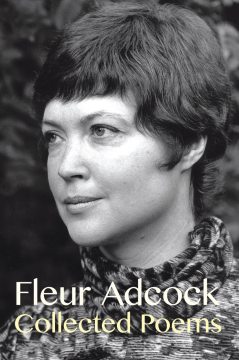
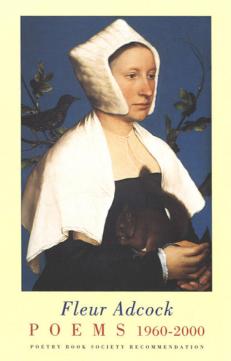
From Poems 1960-2000 (Bloodaxe Books, 2000). Subsequently published in Collected Poems (Victoria University Press); originally published in Tigers (Oxford University Press, 1967). Posted with kind permission from Bloodaxe Books and Victoria University Press.


Note from Tracey Slaughter:


When I read Fleur Adcock’s ‘Composition for Words and Paint’ I get a feeling like I’ve just stepped from glaring sunlight into a dim cool room, a blinking transition where objects shift their edges, textures and sensations blur. Things cross the retina that shouldn’t coexist – heat and cool, shade and sheen, disorientation and sharp awareness – as the dazzled eye tries to pull focus on outlines, shadows, glints. I’ve read it so many times now I could start to break down how its sheer mastery does this to me – but first I’d rather just surrender, step over that threshold, and let it return me to that liminal space it evokes, that experience of sensory eclipse.

Charted in a present tense aquiver with nowness, it’s a poem that wants to keep you in that state of dissolve, that hazy receptivity. Stanza through stanza as it tracks the movements of lovers drawing close in an intimate room, it guides the senses through concrete details that both cloud and illuminate, define and veil, observing the couple’s actions through sustained brushstrokes of metaphorical paint. It’s a poem that watches the act of love with an eye for its composition on the canvas, using the artist’s gaze to render the encounter in visual strokes and shapes, bringing bodies to slow light through questions of perspective, surface, angle, plane. As if conducting an ekphrastic exercise, analysing imagery already framed, it envisages the elements of this love scene in terms of its visual field, lining up the lovers in a studied play of light, curve, pose, dark, parallel, emphasis, depth. But if it employs the methodical and intricate tone of the artist approaching the canvas at the same time it applies the motif of paint to evoke the flooded senses of the lover lost in the work-at-hand’s erotic experience. Issues of surface, extension, colour, focus are at once used to underline the artist’s trained gaze and to wash the scene with a sensuous physical impression of the lovers’ work in progress. ‘I sink upon your image’ the speaker says – the borders of the canvas collapse. It pivots on a repeated play on ‘drawing,’ a practice which moves both brush and body – from a white line sketched around a figure, a head is drawn back, another tantalisingly down – using the term to figure both the tactile capture of the painted line and the gestural seduction of bodies, the pull and call of the lovers pacing and exploring each other in the shaded room. In that elided term, the hand that draws cannot sustain its ‘measured’ distance, it’s too coated in the palette of touch, too absorbed in lust for each line it envisages. Each brushstroke shivers on the painter’s own skin as it orders and colours objective space. It’s part of the mystery I love in Adcock’s language throughout the piece, that it can be at once controlled and lush, clinical and intoxicating – when I read it over I’m always searching for how it extracts such pulse from precision, such glistening intensity from poised restraint. Heat and chill, dark and gleam, it always keeps me blinking for how she keeps that threshold so skilfully blurred.

From an eye scrutinizing the shades and planes of love, the perspective slips to a place where the deeply implicated speaker can only ‘melt and burn’; I imagine that Adcock must have known the work of other women trying to depict female desire around this era: I always hear a tinge of Plath and Sexton in that phrasing. Perhaps there’s an echo of those poets present in the voice of this piece too, its commanding first-person, an ‘I’ intent on fixing and tracing the interaction with ‘you’ in a potent, honed, hypnotic tone. The slow processional sound of each line moves like brush or fingertip savouring the detail, like an entranced hand lingering on the contours of all it draws to light, tasting and positioning each syllable that ‘discovers’ the body with its palpable paint. It is unconventional glints of the lover that are touched upon too, the odd raw details an ordinary love-poem would read as flaws lifted into luminosity – flashes like ‘thin wrists, a tooth missing’ stand in contrast to the points of perfection a love ode would usually pick out, but the ‘tactile reality’ of this encounter sets them alight with ache and lustre. The final blur is ultimately the blur of fusion, of bodies merged and dissolved in such a close-up all sense of scale is lost from the visual field: ‘We have swallowed the light.’ The paint of the scene now spills into the speaker’s throat as she drinks in the lover: it’s a slyly rapturous depiction of orality which could have been a terrible paean to pleasure, but which Adcock’s lyric language manages to sculpt to a sultry and mutual release. Could any other poet pull off the miracle of birdsong ‘flying through the windows’ at climax? Sometimes I wonder if there’s a tint of darkness caught in the opal chains around the necks of those birds – but if there is, it is set against the tender domination of the voice, its soft imperative immediacy: ‘Now I dissolve you.’ It’s been said that a love poem always appeals as much to the reader as it does to the lover, using its language to pull and lure their senses too into a sweet-talking thrall. Consider me dissolved. ‘Composition for Words and Paint’ always has me at ‘This darkness…’


Bloodaxe Books page

Victoria University Press page


Tracey Slaughter‘s latest work is the poetry collection Conventional Weapons (VUP, 2019). She is the author of the acclaimed short story collection deleted scenes for lovers (VUP, 2016), and her work has received numerous awards, including the 2015 Landfall Essay Competition and the 2014 Bridport Prize. She works at the University of Waikato, where she edits the journal Mayhem.

Fleur Adcock, a New Zealand poet, editor and translator, resides in Britain. She has published numerous poetry collections, her most recent being The Land Ballot (2014) and Hoard (2017). This year Victoria University Press published her Collected Poems. She has won many book awards and has received notable honours including an OBE (1986), the Queen’s Gold Medal for Poetry (2006) and a CNZM for services to literature (2008).


Adcock_Collected__47517.1544061847.jpg     5582f5dd597e7.jpg

Poetry Shelf noticeboard: Poet Laureate Award call for nominations

Kia hiwa ra!
Kia hiwa ra!


The National Library of New Zealand Te Puna Mātauranga o Aotearoa is seeking nominations for the New Zealand Poet Laureate Award.

Poetry is a quintessential part of New Zealand art and culture, and through the New Zealand Poet Laureate Award the government acknowledges the value that New Zealanders place on poetry.

The Chief Librarian of the Alexander Turnbull Library will appoint the New Zealand Poet Laureate after reviewing nominations and seeking advice from the New Zealand Poet Laureate Advisory Group.

Nominees must have made an outstanding contribution to New Zealand poetry, and be an accomplished and highly regarded poet who continues to publish new work. They must also be a strong advocate for poetry and be able to fulfil the public role required of a Poet Laureate. The role includes engaging with a wide range of people and inspiring New Zealanders to read and write poetry.

Candidates are expected to reside in New Zealand during their tenure as Laureate.

The term of appointment for the next Poet Laureate will run until August 2021.

Nominations close on Wednesday, 24 July 2019 at 5pm.
Please email your nomination to Ruby.Yee@dia.govt.nz

Email is preferred, but you can also mail your nomination to:

Alexander Turnbull Library
Attention New Zealand Poet Laureate Award
PO Box 12349
Wellington.

Send any enquiries about the New Zealand Poet Laureate Award can be directed to Peter.Ireland@dia.govt.nz