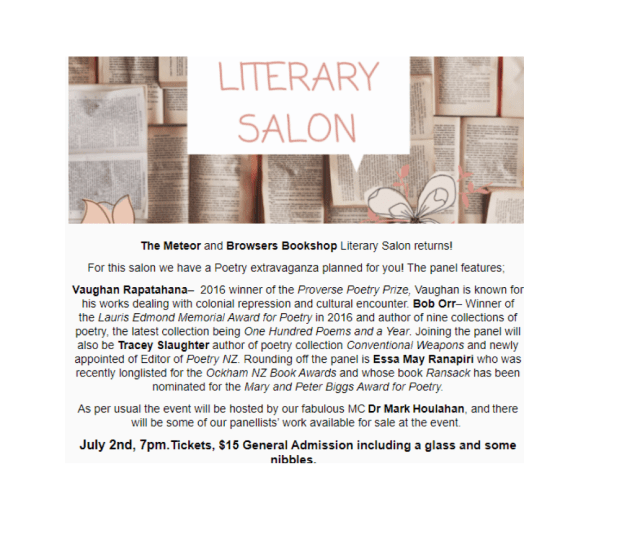
 At the Meteor Theatre, Kirikiriroa (formerly known as Hamilton.)

At the Meteor Theatre, Kirikiriroa (formerly known as Hamilton.)
Last days
In the last days of the supermarket
I walked through the fresh section,
wet-stained bins where there used to be fruit.
In the bakery my son said ‘Can we have meringues?’
They looked dubious but I said OK.
The coffee was long gone, the only tea was herbal.
I had better leaves at home.
‘Can we have Fanta?’ the kids asked,
‘Yeah ok,’ I replied, no use worrying about teeth.
There weren’t many shoppers, and no one re-stacked shelves.
In the frozen aisle all I could hear
was the low growl of the freezer motors
and my son saying ‘Ice cream!’
Whaddya know, they still had his favourite.
We could eat it before it melted.
No such luck in the wine and beer.
I knew I had a bit of whiskey in the cupboard.
‘Can I have a Turkish?’ my son said
in the confectionery section, ‘Yeah, you can
have a Turkish,’ I said, and his eyes lit up.
It was still so good to see that.
When the internet went down there was half an hour
of screaming, and I said maybe we’ll try again later,
although I knew that was bullshit. Then the phone
network dissolved and we lost touch
with the grandparents.
When the power blackout came I said let’s pretend
we’re camping and we got out the gas stove
and made a fort out of blankets.
I made them each a milo.
No bath so we went straight to bed
and read Harry Potter seven with a candle
up to where Harry sees the silver doe in the forest.
Every time they said one more chapter I said OK.
When the candle burnt out I said snuggle up.
One head on each of my shoulders.
‘Tomorrow can we go to the pond?’ asked the eldest.
‘Sure,’ I said. I’d told him fantastical things
in the past, like that there really are fairies
inside trees, that willow is a magic wood,
and that crystals can calm us.
The sky seemed thicker than I’d ever seen it,
and I didn’t like the noise, or lack of noise maybe,
that hovered behind the car alarms and occasional dog.
I knew the streets were lined with rubbish,
I heard the wind breathing in the last leaves.
‘Sleepytime,’ I said, and the boys slowly went quiet.
I missed the cats, the way their feet would press into my back
as I lay in bed. My arms were going dead
from the weight of my children’s minds.
I lay there and breathed.
Airini Beautrais
Airini Beautrais is a writer and teacher based in Whanganui. She writes poetry, short fiction, essays and criticism. Her work has appeared in a range of journals and anthologies in NZ and elsewhere. Her first book Secret Heart was named Best First Book of Poetry in the Montana New Zealand Book Awards 2007; it was followed by Western Line (2001), Dear Neil Roberts (2013) and Flow: Whanganui River Poems (2017).
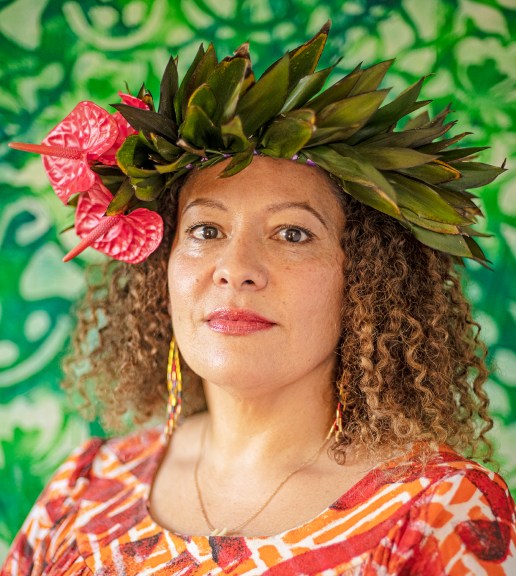
Karlo Mila reads and responds to her poem: ‘For Tamir Rice with Love from Aotearoa’
Dr Karlo Mila (Tongan / Pākehā) is an award-winning poet, mother, writer, activist and researcher. She is the Programme Director of the Mana Moana Experience at Leadership New Zealand. The kaupapa of this programme is to vitalise and prioritise Pasifika ancestral knowledge in contemporary contexts. Karlo lives in Tāmaki Makaurau with her three sons. Her third poetry book, “Goddess Muscle” will be launched this year by Huia Publishers.
Today I am launching a new feature on Poetry Shelf that will usually appear on Wednesdays. I have invited Aotearoa poets to read and talk about a poem of their own that matters to them. First up is a breathtaking and utterly necessary poem by Karlo Mila.
Monday features Monday poems – previously unpublished and by invitation from me. I wouldn’t be able to keep the blog going if I opened up to unsolicited material.
Tuesday I post reviews, poems, interviews linked to new Aotearoa poetry books (by me).
Wednesday poets on their own poems (audio or video)
Thursday I post reviews, poems, audios of poems from new books, interviews linked to new Aotearoa poetry books (by me or others).
Friday pieces on poetry, reviews of international poetry books, poetry podcasts by me and others, themed festivals, poetry questions among other things.
Poetry noticeboard daily.
You are welcome to propose reviews of local and international books, interviews with local poets, poetry podcasts, written pieces on poetry. I can give you a slot on my schedule.
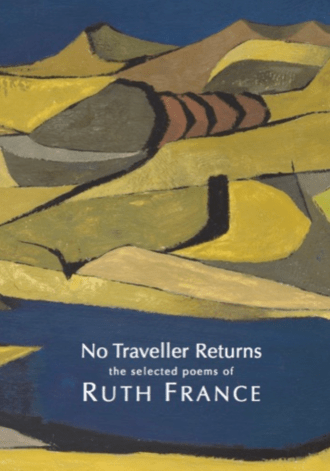
No Traveller Returns: the selected poems of Ruth France, Cold Hub Press, 2020
While Trying to Study Phonetics on a Spring Morning
This immense arch of sky
Is a palate, on which ring
Day’s consonantal sounds
Voicing the clarity of bell air
Which breaks about and above us
Like tumbled, exploding plosives
Tripping on the teeth; these
Rear up, far off; sharp sounding-board
Or white, guardian mountains.
Here all is implicit; perhaps we have
No need of such conceits;
Yet without them words remain dumb
Where we, tiny on the tongue
Of the plains, consider how sweet
How sweet is the taste of morning.
Ruth France
Ruth France was one of a number of women poets who didn’t make it into Wild Honey; not because I wasn’t fascinated by her poetry or ideas. I made it clear I was offering a provisional home that needed more rooms, more poets, and more versions written by others writers, especially Māori and Pasifika. When Ruth was writing, most women poets were not lauded to the degree men were, and too often praise was offered on the judgement scale of men. Anthologies only ever included a handful of women and ‘women’s writing’ was often disparaged, undervalued, silenced. I am sitting at the kitchen table where I wrote Wild Honey and I am feeling an overwhelming sadness at the historic invisibility of twentieth-century women poets that is still in effect today. I spent four years writing Wild Honey and didn’t have room for everyone. This has to be an ongoing project.
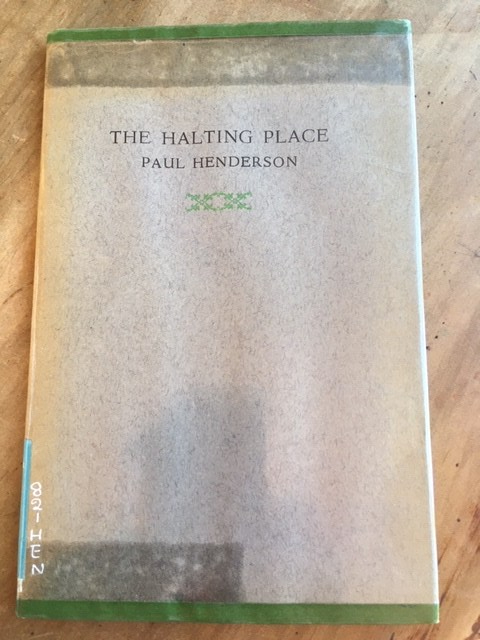
Ruth France (1913 – 1968) was a poet and novelist. She wrote two novels, with her debut The Race (1958) winning NZ Literary Fund’s Award for Achievement. She published two collections of poetry under the name Paul Henderson, a handful of which made it into two anthologies (not all women of her era were selected). Editor Robert McLean (himself a poet with a new collection out) has selected poems from Ruth’s published books (Unwilling Pilgrim 1955 and The Halting Place 1961) along with poems from an unpublished manuscript, ‘No Traveller Returns’. To have this lovingly edited collection of her poetry underlines what readers have missed with her work not readily available.
Robert’s introduction considers the poetry and states that as the poems do not offer explicit biographical details neither will his introduction. Yet her biography (not that we have easy access to much) is as intriguing as the poetry. Yes, we can let poems stand on their own feet and we can find our own invigorating pathways through, but autobiography can make poems glint in unexpected ways. In fact, as is my habit, I read the poetry first, wrote most of this, then read Robert’s introduction and hunted out her appearances in New Zealand anthologies. She is largely invisible.
Te Ara / The Encyclopedia of New Zealand has a biographical entry. She was born in Canterbury, her mother wrote poems and short stories and was published in the Christchurch Press while her father was a shopkeeper. Ruth attended secondary school and then worked as a librarian before marriage at 21. For over three years, she and her husband lived on a yacht at Lyttelton; she rowed her husband to work and her son to kindergarten. After the second son was born they settled at Sumner. Her father had been a devout Catholic and was incensed his daughter had married a non-Catholic.
Ruth published her first collection of poetry at the age of 42 as Paul Henderson. According to Te Ara she wrote letters to the press under her own name and had a strong social conscience and her poems were published in various newspapers and journals. Te Ara also suggests her contemporaries claimed she wrote under a male pseudonym as it freed her from ‘poetess mannerisms’. Crikey! I am so infuriated by these two words. Ruth is said to have held herself at arm’s length from the Christchurch writing community as she didn’t like the way women were treated as inferior. I am thinking of the Caxton Press and all the power it exerted but also of the gatekeepers at a national level (there were notable exceptions). This is what it says in Te Ara:
Already well known for her poetry written under her own name, it is unclear why she felt a need for a male pseudonym. Contemporary male critics suggested it freed her from ‘poetess mannerisms’ and contributed to her success. Today, the best features of her poetry are judged to be the plain, serviceable language and syntax in, for instance, ‘After flood’ or ‘New Year bonfire’.
I am so infuriated by this dismissiveness, I want to write another book. Ruth’s poetry is so much more than ‘plain, serviceable language and syntax’. Where do I begin? For a start plain serviceable language can offer a thicket of copious reading delights. Secondly her beautifully crafted lines offer all manner of musical rewards. Economy and richness coexist.
I am sitting at my kitchen table with a thousand questions mounting. Why wasn’t her last ms published? Her poetry had a vital political edge to it yet, for whatever reason, her poems did not raise questions about the status of women, whether as wife, mother, poet or woman. Ruth refers to ‘men’ to denote all people encompassed in her narrating ‘I’: ‘All men I, and I, living, all men’. It was the convention of the time to subsume women within ‘men’, but some women poets were resisting this tradition. I am reminded of Mary Stanley’s ‘I’ in Starveling Year (1953) as she navigated what it was to be a woman writing (see ‘The Wife Speaks’). Yes I am a little disconcerted that women (and ‘she’) do not make an appearance in Ruth’s poems but we see the world through Ruth’s eyes. It in no way detracts from the myriad rewards her work offers. But it makes me curious about her views on the status of women.
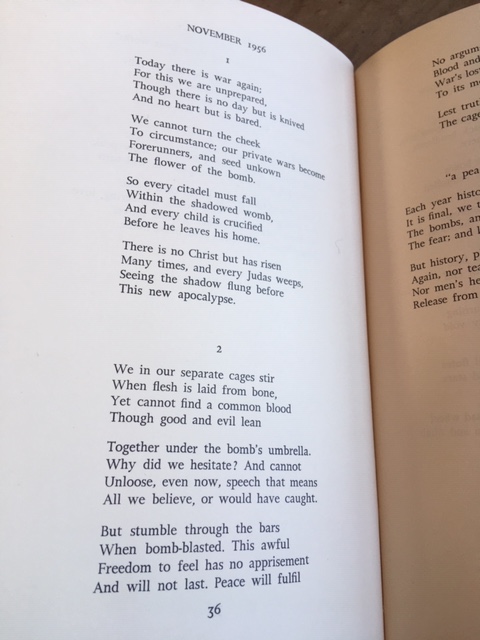
As with many women poets, global issues mattered to Ruth – war, the bomb, atomic energy, equality of men, invasions. You will find clear evidence of her political acumen, along with heart-moving love poems and an attraction to the seas, hills, mountains, shifting tides, seasons. Her poetry is a sumptuous feast of ideas and physical layers. I think she needs a book devoted to her writings, her opinions, her life.
While you are there I am nested among leaves;
As sparrows come each morning for breadcrumbs
So I look for your still face beside me;
Without your calm in the face of what wild storm
I am no longer nested, but desolate among these leaves.
from ‘Always, on Waking’
No Traveller Returns: The Poetry of Ruth France
‘Living’, an early poem from Unwilling Pilgrim intrigues me. Here is the first verse:
What shall I sing?
It has all been sung before
But time did not begin
Till child my mother bore.
The poem faces the haunting and perhaps persistent nag that however we write our experience it has all been written before. Yet when I read this potent line – ‘Tears bit me in the brief / Salt stream for the first time’ – I am on reading edge. Shortly later I read this: ‘So for each one was new / The shattering love and war’. The poem was written around the year of my birth and I am spinning on its axis. Grief, love, war, pain – poetry has never abandoned these topics, poets have never lost the ability to affect us, to present unique versions of experience that challenge or soothe or inspire.
Ruth concludes the poem with this:
So let me sing for all
And sing old songs again.
I am filled with curiosity about this poem. Ruth is galvanised into song, and I am wondering if the reclaimed subject matter is also a reclaimed how. How we sing matters as much as what we sing. And in this context how we make poems. Is she singing the songs of men? Is she singing her own cerebral activity into poetry?
In ‘Object Lesson’, also from the first collection, the idea that human experience is individually unique is key (although connected by countless universals such as our need to eat and love and grieve). In this poem a hill is a hill but when a particular hill is filtered through a man’s knowing, it is ‘a hill through the eyes of one human’. I see the seeds of subsequent theory here on the role of the reader, the spectator, the creator.
I am finding Ruth’s poetry utterly unique – she is a poet both thinking and feeling, hiding and exposing. Her poems are intricate considerations on what it is to love, write, exist. Never fully in the open. This from ‘How Shall I?’:
Then how shall I do this?
Confine the mind to a reasonable process
Beguiling thought by beguiling thought through a tight
Web to a firm conviction? No moonlight
Must persuade, nor smile chance
To alter the grave march of circumstance.
There is song and there is not song. There is love and there is not love. There is also and always uncertainty, a mind open to movement and a resistance to absolutes. Time and time again I divert the overground ideas to the making of a poem; the way poetry is uncertain, open to multiple interpretations, steered by gut and daring as opposed to rigid maps and regulations. I love the way the landscape is a constant presence – think of it as an anchor, homeplace and a series of travel routes. The poem ‘Road Map’ reiterates the inability of a map to catch everything. The traveller’s aid may guide us across physical terrain, but equally it references the terrain of the mind. It is the blank page of the poet writing.
For all was unexpected that we found;
Rivers were marked, but what map could foretell
The scouring of spring floods, the changed ford,
How the great boulders fell?
There is no absolute of place to be drawn
In neat precision with a mapping pen:
Lakes are hemmed in by thought as well as hills,
That has branched through many men.
Ruth keeps returning to the idea that we are in the land and the land is in us, and how the relationships will be marked by memory, experience, uncertainty, hesitancy, predilection. Here are the final two verses:
Place will be integrate, but not on paper;
The mind’s net flung and hauled, it is a silver catch;
Here was the limestone bluff, the sharp bend,
There was iced snow to watch.
But later, in what deep valley of hesitation
We consider time, and place, and thought
As tiny scratches on what surface, an ultimate
No map, or mind, has caught.
The poetry of Ruth France is a treasure house of gold-nugget poems. Like any good treasury, it reveals its physical and abstract luminosity across the course of many readings. I am utterly fascinated by this writer, by her inquiring mind and her poetic deftness. Go hunt this glorious book down. Bravo Robert McLean and Cold Hub Press.
The island belonged to my father,
Or rather it belonged to nobody.
It wasn’t even real considered against
Men and Material, War and Atomic Energy.
Reality rejected too the hut I built, now ruined,
But then, so did the island. Its own core
Was a reality immune even from wind the eroding stranger.
from ‘The Island’
Cold Hub Press author page
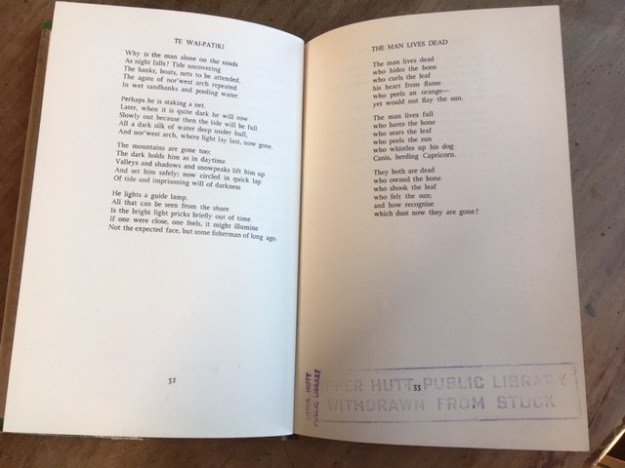
My first edition copy of the second collection
undergrowth
at dusk the birds by the road
are loud as a fire so much noise
from such small lungs
we say
it seems impossible but what’s worse is
we should be able to hear this anywhere
the branches
always ripe with nests
in spring
birdsong so big
we could almost dance to it
but the next day
we’re overheating in the park
& everyone’s too busy worrying
to notice our spot under the trees
I’m imagining a giant ballroom with
this leafy canopy for a roof
the floor a pool of cool green light
nobody’s been here for centuries &
most of the birds are gone too
but an ant crawls
across the cracked marble
& somewhere in the silence our buried
forms turning
back into earth are still
in love
& the flowers pick themselves
up & carry on
Ash Davida Jane
Ash Davida Jane is a poet and bookseller from Te Whanganui-a-Tara. She has a Master of Arts from the International Institute of Modern Letters. Some of her recent work can be found in Peach Mag, Turbine | Kapohau, Best New Zealand Poems, and Scum. How to Live with Mammals is due to be published by Victoria University Press in 2021.

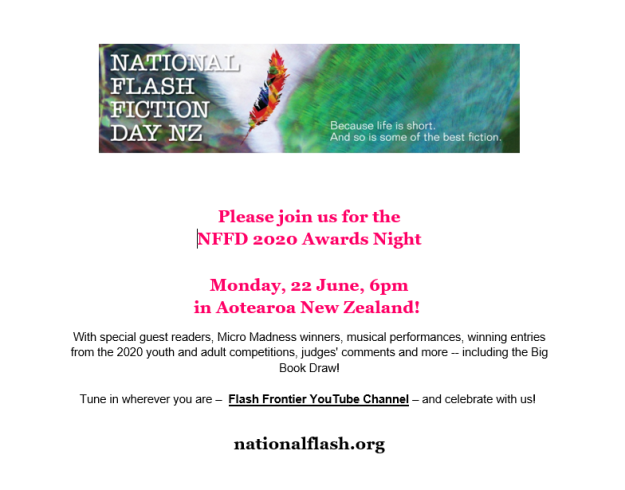
Poets@ONEONESIX Thursday 18 June, 5pm in the backroom
At around 7pm there will be a performance of poetry and dance by Naomi Sioux in the main hall. Its a real treat, please come and support her (koha).
International Writers’ Workshop NZ Inc (IWW) is delighted to announce that renowned New Zealand poet Siobhan Harvey, who lectures at AUT in Auckland, will judge The Kathleen Grattan Prize for a Sequence of Poems later this year.
Harvey was the winner of the award in 2019 for her sequence of poems titled Ghosts.
The prize of $1000 – which is made possible due to an ongoing bequest from the Jocelyn Grattan Charitable Trust – is for a cycle or sequence of unpublished poems that has a common link or theme. This is the twelfth year IWW has had the honour of organising the Prize.
The Kathleen Grattan Prize for a Sequence of Poems is sometimes referred to as the ‘Little Grattan’ as the Jocelyn Grattan Charitable Trust also funds the biennial Kathleen Grattan Award, run by Landfall / Otago University Press. Harvey won the Kathleen Grattan Award in 2013.
The competition is free for IWW members to enter. It is very easy for aspiring poets and writers to join IWW to be eligible to enter their poetry in the competition.
Previous winners over the past six years include: Harvey (2019) Heather Bauchop (2018), Janet Newman (2017), Michael Giacon (2016) Maris O’Rourke (2015) and Julie Ryan (2014.)
Harvey said: “I’m honoured to be asked to judge the 2020 IWW Kathleen Grattan Award for a Sequence of Poems. IWW does such important and integral work to foster and support writing talent within Aotearoa, and it’s humbling to think I have the task of judging this significant poetry competition. As a previous winner and runner up of the competition, I know the high standard of submissions I am already looking forward to receiving. In these challenging times, poetry continues to offers us the power of story, song and vision; all of which are needed now as much as ever.”
About the Judge
Siobhan Harvey is an award-winning author of six poetry books.
She is a Lecturer at The Centre for Creative Writing, Auckland University of Technology and has taught creative writing across New Zealand and the UK.
In 2019, Harvey judged the National Flash Fiction Competition and as well as winning the Kathleen Grattan Prize, she won the Robert Burns Poetry prize.
Preparatory Workshop
As well as judging the competition, Harvey will conduct a workshop on Writing Poetry at IWW’s meeting venue, the Lindisfarne Room at St Aidans Church, 97 Onewa Road, Northcote, Auckland on Tuesday June 16. Doors open at 10 am and the workshop runs from 10.30 am to 12.30 pm.
Visitors are welcome to attend the workshop for a $10 visitor fee. Any visitor who attends the workshop and joins IWW by the third Tuesday in July will be eligible to enter The Kathleen Grattan Prize for a Sequence of Poems and will have the visitor fee deducted from their joining fee.
About the Competition and about IWW
The rules for the competition, details of how to join IWW, meeting times and other activities of the workshop, which meets on the first and third Tuesdays of the month from February to November and runs several competitions a year, are available from the IWW website
Key Dates for The Kathleen Grattan Prize for a Sequence of Poems in 2020
16 June: Workshop with Siobhan Harvey on writing poetry.
21 July: Last day for new members to join IWW to be eligible to enter this year’s Prize.
6 October: Closing date for entries.
17 November: Announcement of the 2020 winner of The Kathleen Grattan Prize for a Sequence of Poems.
Contact
For further information about the Prize or about IWW, or if you would like photographs, please contact IWW President, Duncan Perkinson (email iww-writers@outlook.com) or check out the website

Welcome to 2020 National Flash Fiction Day!
NFFD 2020 ONLINE – all programme events are free – all welcome!
Forthcoming events livestreamed at the Flash Frontier YouTube channel Saturday in NZ/ Friday in other parts of the world — check your time zone and don’t miss it!
Friday, June 12 in NZ / Saturday, June 13 elsewhere
Language and Writing Small: A Roundtable with Journal Editors Around the World (Saturday, June 13, 9am NZ time / GMT + 12)
Featuring:
Sunday, June 13 in NZ / Saturday, June 14
Imagination Unbound: Five Women on the Poetic Narrative Form (Sunday, June 14, 4pm NZ time – GMT +12) – including:

