
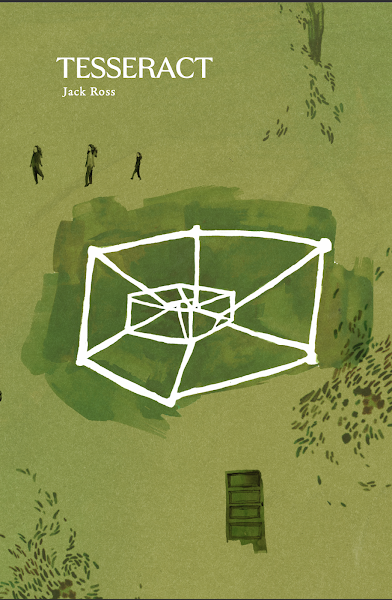
Tesseract, Jack Ross, illustrated by Scarlet Robinson-Kean
paper table, 2026
“We’re only conscious for a small / part of the time allotted to us: there’ll never be any more of it, / so let’s dance.”
Jack Ross, from ‘No time but the present’
I love the title of Jack Ross’s new collection Tesseract. I love how Jack connects the tesseract / hypercube to the idea that we are all made up of stories as Jack say on the blurb:
“Each of us is made up of stories – family stories, work stories, relationship stories – even stories about trying to buy a revolving bookcase in Paeroa . . . Stories, too, about the country and the world we live in.
If you put them all together, the lines begin to connect up into the shape of a life: not a simple geometric figure but the outline of a particular location in spacetime – a line, then a square, then a cube, then finally a four dimensional hypercube, a tesseract.”
I found myself stepping sideways and picturing Jack’s sublime collection as a tesseract on poetry, on writing poetry, on living breathing sharing poetry. It got me thinking about writing and reading poems, and how my lines of thinking have been prompted by Jack’s lines of writing. I have found myself gathering questions for him on the glorious stretch and tenacity of poetry, whether perceptions, measurements, constructions, experiences, memories, attachments. How poetry can step out of an overcoat of rules into a pair of socks or shoes we pick from the shelves of living. How poetry might ease the aches and pains we bear, shift the lens on the worlds we inhabit.
Scarlett Robinson-Kean’s mesmerising artwork offers the allure of space and presence, a textured divinely smudged colour palette that enhances the various slats of scenes and the people and children that inhabit them. The kind of artwork I want to linger with in a gallery.
Rear Window
A friend of mine
set up a camera
in the back of her car
and drove down hill
to the beach and back
art film
scoffed her boyfriend
and yet
there was something
so strange in the way
it bucked and leapt
as it recorded
the unchanging mountains
behind
with no hint of the wild sea in front
Walter Benjamin’s angel of history
does that
sweeps on
looking back
unable to help
as the rubble and graves pile up
they used to project it at rock concerts
Jack Ross
A reading

‘Soft’
‘The Ballad of the Great Storm’
‘Coming in from the Cold’
A conversation
that’s how I used to think of myself
until I switched off the
critic-o-meter
one weekend
when I read
an old collected poems
arranged by date
you just have to give them time
stop looking for obvious beauties
and open your heart instead
from ‘Bronwyn asked me’
Paula: One poem is titled, ‘Why do you write?’ It references the question a fellow guest once asked you . . . so yes, why do you write?
Jack: I started when I was at school. I’d get a kind of lofty feeling, and found that I needed to express it somehow. Eventually I graduated to having some ideas behind all the turgid words I poured out. Now that feeling comes less often, but I do more thinking about what I’m up to. Any self-importance that attached to it is long gone, though. I do it because it’s makes me feel better – getting painful stuff out on paper makes it easier to bear, and may even be of help to other people in similar situations.
Paula: Can you choose five (or so) words that signal what is important to you when you write a poem?
Jack: I don’t really have preset rules about how to write a poem, but I seem to have developed certain practices over time. I don’t use punctuation, but I allow myself line breaks and gaps for ease of understanding. Actually I don’t really mind if people misread sentences or don’t understand where a phrase fits in – it forces them to slow down and have to go back. I don’t like poeticisms – I try to make everything as vernacular as possible (within my own idiolect). I like poems that tell stories, so I do as much as possible of that– particularly in this book. I find it makes them far easier to read aloud, too.
Paula: Or when you read a poem by someone else? Oh and what poetry books have travelled with you, vitally, essentially?
Jack: I have a pretty high tolerance for artifice in other people’s poetry – though not in my own – but I do like there to be a sense of impetus (narrative or otherwise) behind it. I’m very fond of Robert Lowell’s poetry – Life Studies, For the Union Dead – I love those mid-career book of his. I like bold experimentalists like Anne Carson (NOX), Susan Howe (The Nonconformist’s Memorial), or Peter Reading (Perduta gente). Among local poets I’m a big fan of Fiona Farrell as a poet – Cutting Out is a fine book. Michele Leggott’s Mezzaluna collection is great; so is Albert Wendt’s The Black Star. The Star-Apple Kingdom by Derek Walcott is another book I like a lot. There are so many!
Paula: Your collection is steeped in both the personal and the domestic. I can remember when Cookhouse, my first poetry collection came out in 1998, the first reviews attacked it for its domestic bias. It felt sexist. I was walking around a supermarket with the Sunday newspaper in shock! Now all these years later, the domestic in poetry has held firm and necessary ground. I love being welcomed into the domestic and personal spaces of your poems. Tell me about opening up these spaces / places.
Jack: Yes, I remember that criticism of Cookhouse; also of Jenny Bornholdt when she wrote about buying herself a pair of pants in a vintage shop – I think the phrase used on the latter occasion was “exercises in the higher blogging.” As a blogger myself, I thought that was a bit insulting. Sneaking in meanings in disguise, rather than trumpeting them from the rooftops is what modern poetry does best, I think – and Bornholdt had disguised herself so well that her critic didn’t even appear to understand that her poems really were about something. The personal and domestic is where we all live, so (by definition) it’s the best place to reach people. You don’t have to put on stilts to talk about important things, as Chekhov once remarked.
Paula: Oh that image sent me trawling . . . stilts, flippers, skateboards, sneakers, hiking boots. Time is an alluring current in the collection, from time travel to memory travel. Two section titles reference time (‘No time but the present’ and ‘Time in poetry’) I love your Proustian reference – when you suggest poetry might be a way of recovering lost time (will quote). Tell me more about this.
Jack: Do you think it might be because I’m getting a bit older? I don’t know – I find myself savouring the sense of distance between the me who is now and that foolish and impulsive younger me who did something-or-other then. I’d like to be able to forgive that person for his flagrant misdeeds and crass stupidity. I can’t always manage it, but that sense of time in the abstract certainly helps. Maybe that’s what Proust was trying to do, too, but he seems to me to be much more comfortable with his earlier self than I am with mine.
Paula: At one point you confess you have a lack of imagination. Does this bother you?
Jack: It did use to bother me. When I started to try to write fiction, it was a shock to me just how hard it is to come up with plots and scenes out of your own head, the way any good storyteller does. But then I realised just how much action and detail careful observation of the reality around you can supply you with, ready-made. So now I’m okay with it. I try to cultivate the camera eye (like Christopher Isherwood) rather than those fanciful vistas I used to think of as being more “creative.”
Paula: Politics is there in the crevices – from seeing the Vietnam war on black & white tv to being out on the streets to being out on the streets with a placard with Bronwyn protesting our endangered and war-ravaged world. And there’s the idea that one person can make a difference. What are your thoughts on politics on poetry? Does it make a difference? Such a repeated question in these times.
Jack: I think there’s politics in everything. I have no objections to poems which are political manifestoes, but I do feel that the advantage of writing a poem rather than a manifesto is that you can personalise and humanise and expand your viewpoint till you pull in your reader whether they like it or not. I think of that ragged child in W. H. Auden’s “The Shield of Achilles”:
… That girls are raped, that two boys knife a third,
Were axioms to him, who’d never heard
Of any world where promises were kept,
Or one could weep because another wept.
That’s certainly where we live today. Those words are as true now as when he wrote them, just after the Second World War.
Paula: More than anything I am reminded that poetry has myriad ways of being and myriad ways of mattering. I am hearing that from you here. We don’t need to be constrained by rules and regulations. I read your collection and touch base with love and grief and fear. Tenderness and philosophy and weirdness.
Choose a poem from the collection for the reader of our conversation to linger on. Why this poem? But first is there a question you would like me to have asked you?
Jack: Your questions are great – “interesting, but tough,” as Huck Finn said of The Pilgrim’s Progress. I guess I might have liked a chance to talk about my collaboration with Scarlett Robinson-Kean, who designed and illustrated the book. I met her because she was working at Objectspace while Bronwyn was there, and we soon discovered a mutual love of comics and graphic novels. I really like it when I get to see my work through somebody else’s eyes – and the ways in which she responded to the poems were very interesting to me. I think she has a great future as an illustrator and a graphic novelist, though at present it’s her zines which have attracted most attention. Thanks for your beautiful pictures, Scarlett!
As for my choice of poem, I suppose one disadvantage of being on social media is that you tend to run into a lot of complaints from other writers. This was what I woke up to one fine morning:
The Killing Floor
A woman was whinging
about how only two people
turned up to her book-signing
though forty said they were coming
on the online invite
this sparked off a chorus of
you think that’s bad?
what about this?
from the likes of Neil Gaiman
Jodi Picoult
Margaret Atwood
and other celebs
Atwood said that not only
did nobody come
but the one person
who did approach her
wanted to buy scotch tape
it got me to thinking
about my own slew
of embarrassing events
readings where the readers
outnumbered the audience
launches where nobody bought the book
and the person giving the launch speech
admitted to not having read it
but still recommended we get it
‘because it’s an important book’
so why do you do it?
asked Bronwyn
some useful theories
I said
but at least the writing must be fun?
not really I replied
the agony of getting it down
then working through it all
again and again
the fear of falling short
of being laughed at
then why?
to be honest I don’t really know
I’m just glad that some people do
where would I be without the books they write
Jack Ross
Jack Ross is the author of four novels, five books of short fiction, and six previous poetry collections. He was managing editor of Poetry New Zealand (now Poetry Aotearoa) from 2014-2020, and has edited numerous other books, anthologies, and literary journals. He lives with his wife, crafter and art-writer Bronwyn Lloyd, in Mairangi Bay, on Auckland’s North Shore.
 NZ Poetry Shelf
Loved this! Great work each of you. Loved the poems from the quotitidian where we all live but which lift us out of it into language – just as the, sometimes, as Jack rightly says, pain of getting them down relieves us to live on more lightly.
Danke, danke!
Jan Kemp
LikeLike