Monthly Archives: March 2023

Poetry Shelf review: Helen Lehndorf’s A Forager’s Life

A Forager’s Life: Finding my heart and home in nature, Helen Lehndorf,
HarperCollins, 2023

I read Helen Lehndorf’s new book, A Forager’s Life: Finding my heart and home in nature, in two sittings. The first sitting was both short and long. I read the opening pages, that focus on a childhood blackberry memory, and then stalled because Helen’s recounted memory affected me so much. I returned to the book the next day and devoured the remainder. It was an all encompassing reading experience.

The book begins with the arrival of a baby brother when Helen is aged four. She goes for a ride on her dad’s motorbike. He wants to head to more rugged terrain with his mates so leaves her on a log momentarily. She is wearing her beloved magnifying glass around her neck and scrutinises the world about her: “The magnifying glass has given me a new way of looking.” She is unsettled by the beady glare of a squawking magpie. She finds comfort in a nearby blackberry bush, gathering and eating the fruit, collecting some for her dad in her handkerchief. The event, both scary and illuminating, feels like a turning point for the adult reflecting back: “I’m not the same kid who rode into the valley that morning.” The perfect steeping stone into a memoir of foraging, of self care, and of challenges.

I muse on the blackberry episode and consider about how we become stitched into books that affect us, and how books that affect us are stitched into us. On the one hand, our own experiences chime and rattle the surface of reading. On the other hand, Helen’s incident reverberates keenly in the context of a foraging life, and how life might offer us new and invigorating ways of looking, existing.

In her author’s note at the start of the book, Helen underlines the need to be careful eating foraged plants, and to eat what you are sure of. She also acknowledges her ancestry and that ancestral connections and knowledge “is utterly different for tangata whenua, the first people of Aotearoa”. She offers “respect and gratitude to all tangata whenua, who suffer many fractures to their intergenerational cultural transmission due to the actions of Aotearoa’s early ‘invasive species’: the European ancestors of Pākehā New Zealanders, like my own, and Pākehā today.”

Take the blackberry bush for example. This may feature in nostalgic memories for many of us who went foraging with families as children, made apple and blackberry pies, and devoured the sweet juicy fruit by bucket loads. But along with the benefits, the introduced plant is an invasive species, “a rampant coloniser”, not kind to locals.

A Forager’s Life includes recipes at the end of each chapter, featuring foraged plants, often with healing properties. There is an excellent guide to the art of foraging, to the principles of permaculture, and a useful bibliography. But aside from being a handbook on foraging, the book is a riveting memoir. It is a memoir in which foraging plays a key role, almost as a key to survival. We move from the awkward schoolgirl whose haven is the school library (book foraging) to the lessons learnt from her butcher dad who took her hunting, to her move into punk music, her meeting of kindred spirits at university and to becoming a community activist. There is the early marriage, the time in the UK and Europe with her husband, the birth of her first son back home, and the second son who was eventually diagnosed as autistic. There is a constant pull to both write and forage.

I adored reading this book. It’s one of those books that arrived at just the right time, when life is corrugated but certain things are anchoring. I found the idea of foraging such an uplift, a vital anchor for Helen in the midst of grief, challenge, the unexpected. In the blurb, Wendyl Nissen writes that the book will get you “looking at your neighbourhood with new intent”. Yes indeed, but it will also get you looking at your own life with new intent.

Beautifully written and carefully structured, this handbook to life and living is one to hold close. I loved it.

Helen Lehndorf is a life-long forager and Taranaki writer who lives in the Manawatu. She co-founded the Manawatau Urban Foraging group. Her first book, The Comforter, was published by Seraph Press in 2012, and her second book, Write to the Centre, a nonfiction book about the process of keeping a journal, was published by Haunui Press in 2016. Her work has also appeared in anthologies and journals such as Sport, Landfall and JAAM.

HarperCollins page
Poetry Shelf favourites: Lynn Jenner’s ‘ZL4BY’

ZL4BY

‘This is ZL4BY . . . ZL4BY on the air . . . ’ my father would say

Then there might be squeals
rising and falling in pitch
a long patch of silence
maybe a low animal noise like a cow
giving birth, or static so bad
I could hardly bear it

My father would turn the dial towards
the very centre of the pain, trawl
through it over and over and inside
there might be a man’s voice
clear as a bell

The man
might be the only person awake
in a town in Northern Saskatchewan

My father and the man
would exchange first names
report on each other’s signal strength
and say something about the weather
in each country. That seemed
to be enough

Sometimes
responding to a different urge
my father would just turn on his receiver
and listen

According to my father,
unacknowledged signals circled the earth
until someone received them properly

If my father heard one of these signals,
and he often used to – often – at the new moon,
and when low in spirits – all he had to do
was say the person’s call sign
and then say,

            ‘ZL4BY, receiving.’

That was enough.

Lynn Jenner
from Dear Sweet Harry (Auckland University Press, 2010)

In the 1960’s my father was what was called a ‘ham radio operator’, and ZL4BY was his callsign. From his shed in the garden he used to talk to people in other parts of the world about very ordinary things. You just talked to whoever was ‘on air’ when you turned on your receiver. This poem was written in 2008 and forms part of my first book Dear Sweet Harry.

Lynn Jenner is based in Te Tai Tokerau, just west of Kerikeri. She writes poetry and non-fiction and has a particular interest in hybrid genres Lynn also mentors other writers.  Lynn has published three hybrid genre books. More about her books and other poems can be seen on her website.

Poetry Shelf Favourite Poems is an occasional series where I have invited poets to pick a poem from their own backlist.

Poetry Shelf Monday Poem: Alice Te Punga Somerville’s ‘Written yesterday’

Written yesterday

It’s Valentine’s Day at this far edge of the Pacific
Clouds hang heavy, obscuring the shape of the land

Cook never made it here
But, according to Wikipedia, he made all of this possible:

I now live in the most livable city in the world
Named after a man who, they say, died in obscurity 

One Of Those White Men whose names are all most of us know
about places they barely touched

              Vancouver
              Vancouver
              Vancouver

Whose names have become lines we are forced to repeat to repent of our sins

Vancouver who was born in Norfolk
           (Pauline soaks aute on an Armidale afternoon –
           her work and her veins tying her family via Norfolk Island
           via Pitkern
           to Tahiti)
Vancouver who forty years later died in Petersham
           (my Sydneysider Ngāpuhi friend Carleen
           lived near Petersham
           on Gadigal country)
which is in Surrey
           there’s a Surrey here too –
           home of the fourth largest Indo-Fijian community in the world)

Vancouver mapped this Eastern edge of Oceania,
Becoming one of those white men who will never be obscure or forgotten

From here, when I look back towards home,
Hawai’i is in the middle distance –

Those complex supple islands where I repaired my waka
the other time I fled from home

Those staunch expansive islands
where love put Cook where he belonged  

It’s already the fifteenth of February in Aotearoa
And the annual jokes about Cookery and love for Hawaiians
are day-old tweets

While here, today, it’s still the fourteenth –
The day to march downtown for lives and deaths of Indigenous women

But we’ve moved too recently with a daughter
too young to be kept safe in a pandemic
            (As if this colony has ever been safe for Indigenous girls)

So I sit, scrolling, in a hired car and read
that New Zealand’s sixth highest mountain
           is also called Vancouver.

I am trying to guess which maunga his name has smothered
and for how long,

I am undone, again –

By how much I have yet to learn about the place I am from

And how much I have yet to learn about this lovely drizzly place

With all these names that hang heavy,
                                               obscuring the shape of the land.

Alice Te Punga Somerville

Alice Te Punga Somerville (Te Āti Awa, Taranaki) is a scholar, poet and irredentist. She researches and teaches Māori, Pacific and Indigenous texts in order to centre Indigenous expansiveness and de-centre colonialism. Alice is a professor in the Department of English Language and Literatures and the Institute for Critical Indigenous Studies at the University of British Columbia. She studied at the University of Auckland, earned a PhD at Cornell University, is a Fulbright scholar and Marsden recipient and has held academic appointments in New Zealand, Canada, Hawai‘i and Australia. Her first book Once Were Pacific: Māori Connections to Oceania (University of Minnesota Press, 2012) won Best First Book from the Native American & Indigenous Studies Association. A recent book is Two Hundred and Fifty Ways to Start an Essay about Captain Cook (BWB, 2020). Alice’s debut poetry collection, Always Italicise: How to Write While Colonised (Auckland University Press), is shortlisted for the 2023 Ockham NZ Book Awards.

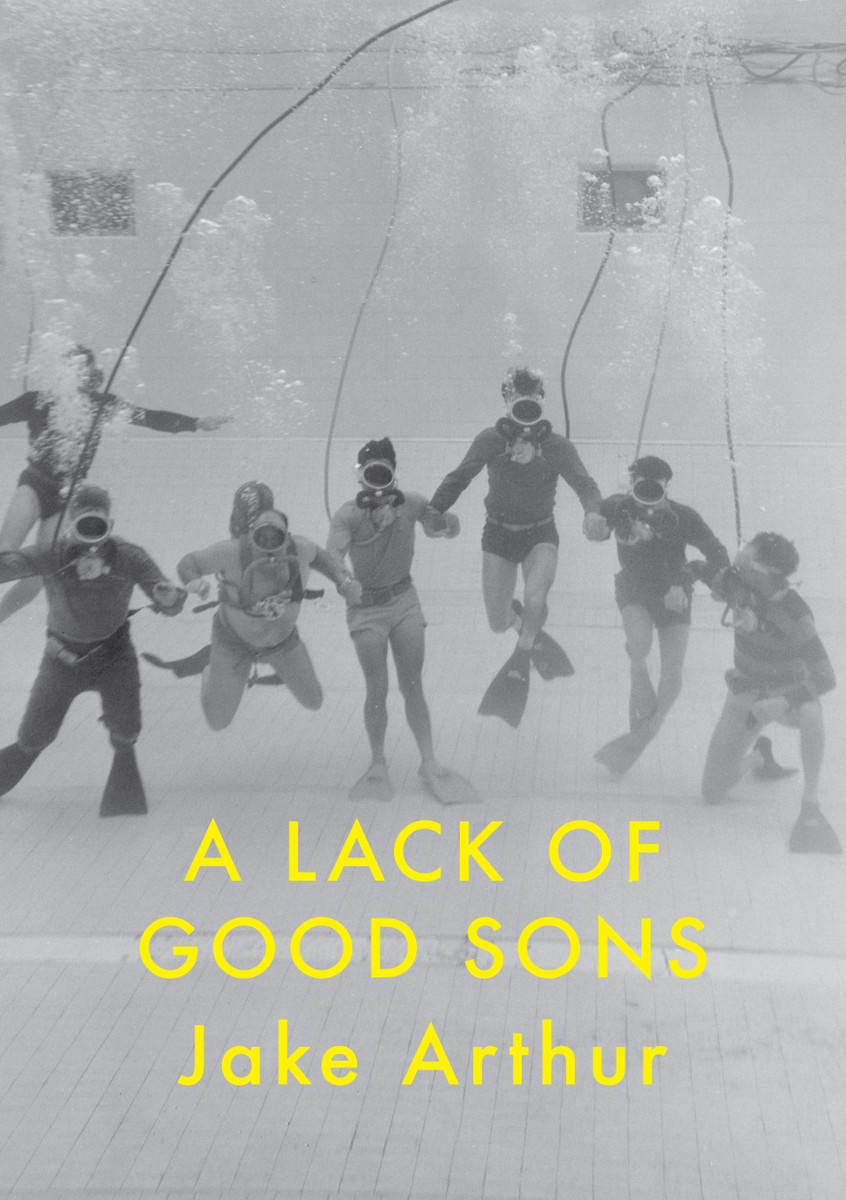
Poetry Shelf review: Jake Arthur’s A Lack of Good Sons

A Lack of Good Sons, Jake Arthur, Te Herenga Waka University Press, 2023

I cavorted through the Gobi Desert
I fell in love with a camel in Saudi
I poured pints in Kraków.

If anecdotes are a life, I have lived.
Otherwise, I’ve urgently wasted my time.

from “Peregrination”

The opening poem of Jake Arthur’s debut poetry collection, A Lack of Good Sons, is wow! A young boy witnesses a bizarre and startling sight through his bedroom window: the farmer who lives next door, stands naked in his gumboots, back to the window. Even more surprising is the mother who says the boy did that when he was younger. The poem is a perfect threshold into a collection that startles and twists, that is honey fluent, detail sharp, physically grounded and metaphysically sailing.

For me this is a travel collection – poetry as a means of travel through time, space, location, voice, perhaps memory. I could say “prismatic” which would make Nick Ascroft squirm with his abhorrence of the word “luminous” in reviews. But this is the collection’s effect on me. It is poetry that glints and hues variously, from dark to edge to light to edge to dark to softness to searing colour and more light. There is a fluidity of voice and representation, epitomised in an “I” that is on the move, third person pronouns that skate and shuffle, a symposium of characters that Luigi Pirandello might fall in love with, or Italo Calvino.

This is the kind of book you need to immerse yourself in without being dampened down by the expectations and limits a review might offer. I offer you a mini tasting platter of poem extracts. Some stanzas are so sticky you keep hold of them for ages. I love the weave and startle turns. In the multilayered “Confessional”, the poem navigates both an external world and internal consumption. The last verse is sublime:

On a pew I rest my head and look up,
the colonnade a forest to a stone ceiling;
in me, too, an awful lot of rock.

The speaking voice might be man woman son or daughter, but at other times it is object. I particularly loved the shifting perspective (a trademark of the book as a whole) of the tree that becomes boat mast in “Bare choirs”. Again I loved the final stanza:

The flap and licking
thrump of the sail is a beat,
the slapping waves an uneven melody,
but it is more dirge than music
and not a tune to sing too.

I ask myself whether I will locate a connective tissue across the collection as a whole, a link beyond recurring motifs and devices. I wondered, for example, if there is “sameness” embedded in all the difference, then I read this in “1588”:

Everything was animated.
It spun on a dime. It was umami.

Now I  know better.
There is a sameness in everything.

Physicality is a lure. It is there in the earth and soil that appear and reappear. In a deft subject sidestep in the poem “Encounter”, a gardener becomes springboard to a sci-fi anecdote, and is abducted by aliens.

                                                      (…) I’m used to getting soil out
of my clothes, being green-fingered, but first I looked up
in the hope of spotting their craft and
I did see a little black shape but
probably it was just a bird
oh well, I thought,
from a distance
everything’s
unidentified.

Reading this sublime book, I am reminded of the wit and humour, the economy and richness of a James Brown collection – and heck, there is James Brown, endorsing Jake’s book on the back cover. Jake takes us on a multi-dimensional, electrifying tour that holds human to the light and then keeps twisting and turning so can we absorb human from different vantage points. So satisfying as reader. I have barely scratched the surface of Jake’s fabulously haunting poetry. Read it!

Jake Arthur’s poetry has appeared in journals including Sport, Mimicry, Food Court, Turbine, Return Flight and Sweet Mammalian. He has a PhD in Renaissance literature and translation from Oxford University.

Te Herenga Waka University Press page

Poetry Shelf Favourites: Chris Tse’s ‘Midnight, somewhere’

Midnight, somewhere

The night remembers how I made myself smaller
every time I left a mess trailing behind me—
running from the obsessive thoughts I couldn’t evade
even at midnight when I donned my counterfeit
mask to dodge my ghosts and monsters. I folded,
shrunk and compressed to fit into those slow hours
hoping it would allow me to step into joy without
being throttled by a cold open—the Previously on…
that prefaces all my terrors. I should’ve introduced
this poem with a disclaimer: Based on true events.
Any resemblance to real persons, living or dead, is purely
intentional. Then maybe I’d forgive myself for making
a montage with all the memories I’ve deliberately
dissected and over-analysed so I can’t return them
while they’re still warm and lit by a blood moon
while I have the time and space to worry myself sick
while I stare at my reflection and see only the past.
Sometimes the past is us watching the ‘Blank Space’
music video and me telling him I want to be that horse.
(Now I see this fantasy meant I wanted to be an accessory
to someone else’s power.) Other times the past is playing
‘Treacherous’ on loop for a week straight because he
wouldn’t return my calls. I wanted so badly to ask
the million-dollar question knowing all too well
any answer would leave me broken. It’s always
close enough or not enough when you’re constantly
running late for a rehearsal for the worst night
of your life. I like to eat alone, or go to the movies
on my own and not have to fret about having opinions
or critical thoughts to share while the credits roll.
I imagine this is the kind of thing my popular twin
would be very good at—knowing what insightful
things to say to make everyone in the world fall in love
with them. Instead I’m the sad song you only listen to
when you need a good cry in the colourless dark.
Night won’t always let me let go, but it also reminds me
of other brighter fevers: karaoke in Portland, hands
clasped under the table at Vegie Bar, the waves crashing
outside our window in Mataikona. He tried to wake me
to watch the sunset from our bed but my head was
in knots, counting down the days we had left.
Not everything gets clearer with the lights on or when
the sun comes up. It’s always midnight, somewhere.

Chris Tse

Written for Around Midnights, a seminar featuring responses to Taylor Swift’s Midnights. The seminar was organised by Victoria University of Wellington Senior Lecturer Dougal McNeill (School of English, Film, Theatre, Media and Communication, and Art History).

Chris Tse is New Zealand’s Poet Laureate for 2022-24. He is the author of three collections of poetry published by Auckland University Press: How to be Dead in a Year of Snakes (winner of the 2016 Jessie Mackay Award for Best First Book of Poetry), HE’S SO MASC, and Super Model Minority. He and Emma Barnes edited Out Here: An Anthology of Takatāpui and LGBTQIA+ Writers from Aotearoa (AUP, 2021).

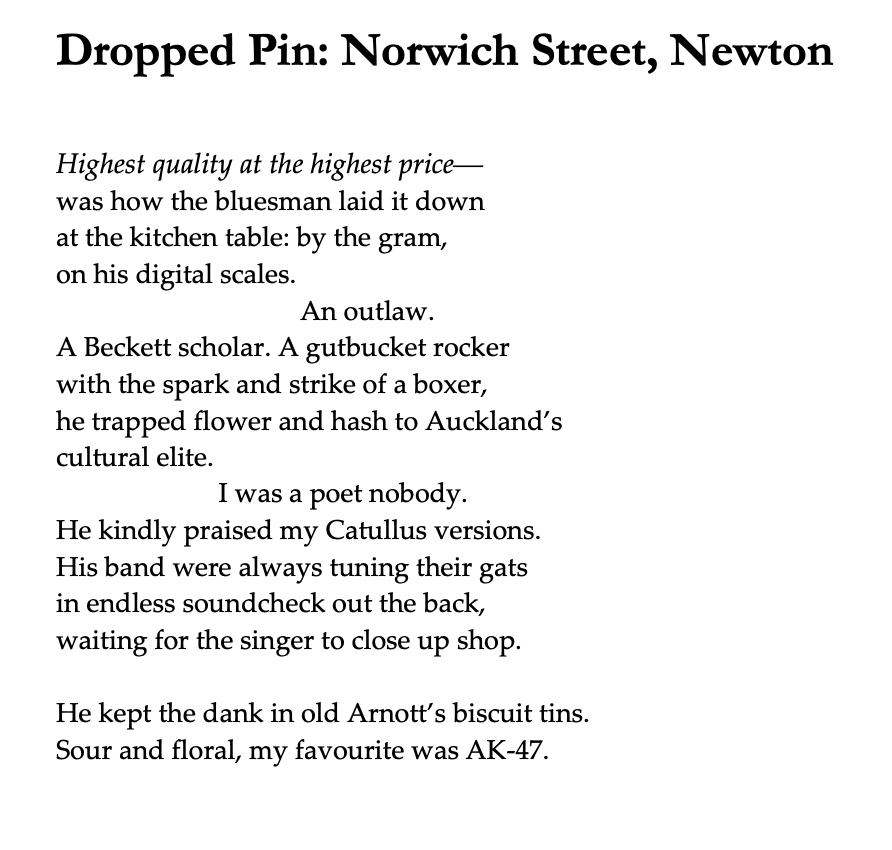
Poetry Shelf Monday poem: Michael Steven’s ‘Dropped Pin: Norwich Street, Newton’


                             — in memory of Rick Bryant

Michael Steven

Michael Steven lives and writes in the Waitākere region of Tāmaki Makaurau. 

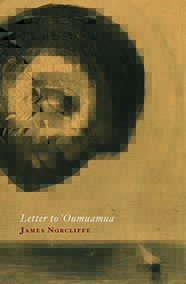
Poetry Shelf review: James Norcliffe’s Letter to ‘Oumuamua

Letter to ‘Oumuamua, James Norcliffe, Otago University Press, 2023

In these uncertain times I gravitate towards quiet poetry. It may sound corny but it is like sitting on the edge of a mountain embracing silence as a form of retreat, and then savouring the way the world is alive with sound. I find myself retreating into poetry collections as a form of balm, relishing the solitude, the complications, the edges.

James Norcliffe, recently awarded the 2023 Margaret Mahy Medal, writes with a pen fuelled by the physical world, and a sense of interiority that allows both confession and piquant ideas. His writing is witty, thoughtful, fluid and rich in movement. The opening poem, ‘Letter to ‘Oumuamua’ nails it. Dedicated to “the first known interstellar object to pass through the solar system”, the letter is as much about where it is written from, as where it is written towards. The rural scene is balm – with its hint of spring and new leaves. Yet the layers prickle as I hold onto the embedded notion that the scene is both beloved and under threat.

Poetry can be the heightened awareness of a moment, of a particular place or experience. James offers many such poems and it is impossible to hold them at arm’s length. This is a form of poetry as retreat. Take ‘The Coal Range’ for example. The poem ventures back in time to pay tribute to an aunt and a location. James slowly builds the scene with acute detail, and I am breathing in the smells, tasting the baking, and back in the embrace of my grandmothers.

The burning coal and smoke smell of Auld Reekie,
of far-away home. Pinned on the Pinex walls are
calendars: Scottie dogs, pipers and Greyfriars Bobby.

Sentiment sweetens distance, as drop scones, ANZAC
biscuits and peanut brownies sweeten the sour
pervading presence of damp coal, smoke and tea-tree.

I love the way the collection offers drift and movement, resistance to fixture. Nothing is as it seems. Everything is as it seems. “Knowing What We Are” is a gloriously haunting rendition of movement, of oscillation. The birds gather on the “shining mudflats”. I’ll share a couple of stanzas with you – then you can track down the book and read the whole poem.

Any day soon, the birds will fly
far beyond the red-rimmed horizon.

Much later they will return. Neither
here nor there is home, yet both are.

Knowing what you are, I take your hand.
Neither here nor there, I try to count the days.

‘Insomnia’ navigates the knottiness of a sleepless night; a restless mind grappling with big questions and small diversions as it fixes upon turning points in life. The what-ifs and T intersections. I muse upon the way the collection offers myriad movements from loop to overlap, from twist to slide, from spiral to scatter.

That path is no more real now than the trees on the bed. The pigeon
recovered and flew away. The child was found and lost and found again.
The woman died. The man makes you laugh and makes you weep and
makes you laugh.

He makes you weep and makes you laugh and makes your weep, but
nothing can make you sleep.

Ah, so many poems I want to share with you in this slender tasting platter. There is a sequence dedicated to Vivaldi’s Four Seasons. There is a return to childhood by way of Granity Museum. There is love and tenderness such as in the exquisite “Sauerkraut”:

(…) One pace at a time:
take care of the steps so that the miles take care
of themselves; conserving ourselves, preserving, avoiding
pretty prickles, but still pressing the white cabbage
that will be sauerkraut into a bright green crock.

There are multiple pathways through Letter to ‘Oumaumau. Numerous nooks and crannies for extended sojourn. Reading this was both solace and restoration. I picked up my pen and wrote a poem. I opened the book and returned to poetry that haunts and sticks. It’s James’s best book yet. Glorious.

James Norcliffe is a poet, children’s writer and editor. He has published 11 collections of poetry and 14 novels for young people. His first adult novel, The Frog Prince (RHNZ Vintage), was published in 2022 and his most recent poetry collection, Deadpan (Otago University Press), was published in 2019. He has co-edited major collections of poetry and short fiction, including Essential New Zealand Poems: Facing the Empty Page (RHNZ Vintage, 2014), Leaving the Red Zone (Clerestory Press, 2016), Bonsai: Best small stories from Aotearoa New Zealand (Canterbury University Press, 2018) and Ko Aotearo Tatou: We Are New Zealand (Otago University Press, 2020). He has had a long association with the Canterbury Poets’ Collective, takahē, the ReDraft annual anthologies of writing by young New Zealanders and, more recently, Flash Frontier.

Otago University Press page

Poetry Shelf poem: ‘Maghrib’ by Khadro Mohamed and Ronia Ibrahim

Maghrib

//

cotton tassels, soft in between the space of my toes
i’m carrying rosewater pearls in my belly.

            inhale,
                        exhale,

unravelling like lilac tissue
cheeks the colour of scorched chilli

inhale,                        
                       exhale,

the thin veil of night
spreads like butter over the hills

surah Al-fatiha, like a whisper

                                     it floats on an eyelash,         
                                     skims past my fingers

            inhale, exhale,

ٱلْحَمْدُ                                            


Khadro Mohamed and Ronia Ibrahim

This poem attempts to highlight the strong presence that Islamplays in our  personal lives, but also in the lives of Muslims in Aotearoa. While our families were not directly affected by the attacks on the 15th of March, 2019, the aftermath was felt by all of us across the motu. We hope that Muslims everywhere continue to use their relationships with Islam as a source of inspiration, strength and something to always be  proud of. 

Poetry Shelf Monday poem: Michaela Keeble’s ‘all the eels’

all the eels

*

we took the chook fat
to the creek
spooned the gloopy food
into the shallow wash

soon you came out to us

twenty or fifty of you
showed your teeth
and snapped at wooden spoons

fifty or more of you
thrusting up the creek
to claim the fat

with your single
perfect muscles
like dancers’ thighs
you never hurt us

*

does it help
to be specific?

*

to build the road
they have to leash the river

drain the swamps
stop the banks
build the bunds

they redirect the water

in come the ecologists
to fish the tuna
trapped in sediment

jet black skins
eyes blue like humans

tuna tall as me
tall as you

*

all the amphibians
and all the birds
who travel beneath
and all the eels
unite

certain kinds of water snake
gannets and shags
and all the eels
unite

from all the hidden places
at the margins of everything
everywhere

and all the eels

Michaela Keeble

Michaela Keeble is a white Australian writer living in Aotearoa with her partner and kids. Michaela’s first full-length collection of poetry, surrender, was published by Taraheke | BushLawyer in May 2022. She has a children’s book, co-authored with her son Kerehi Grace and illustrated by Tokerau Brown, forthcoming from Gecko Press in 2023. Watch out for Paku Manu Ariki Whakatakapōkai

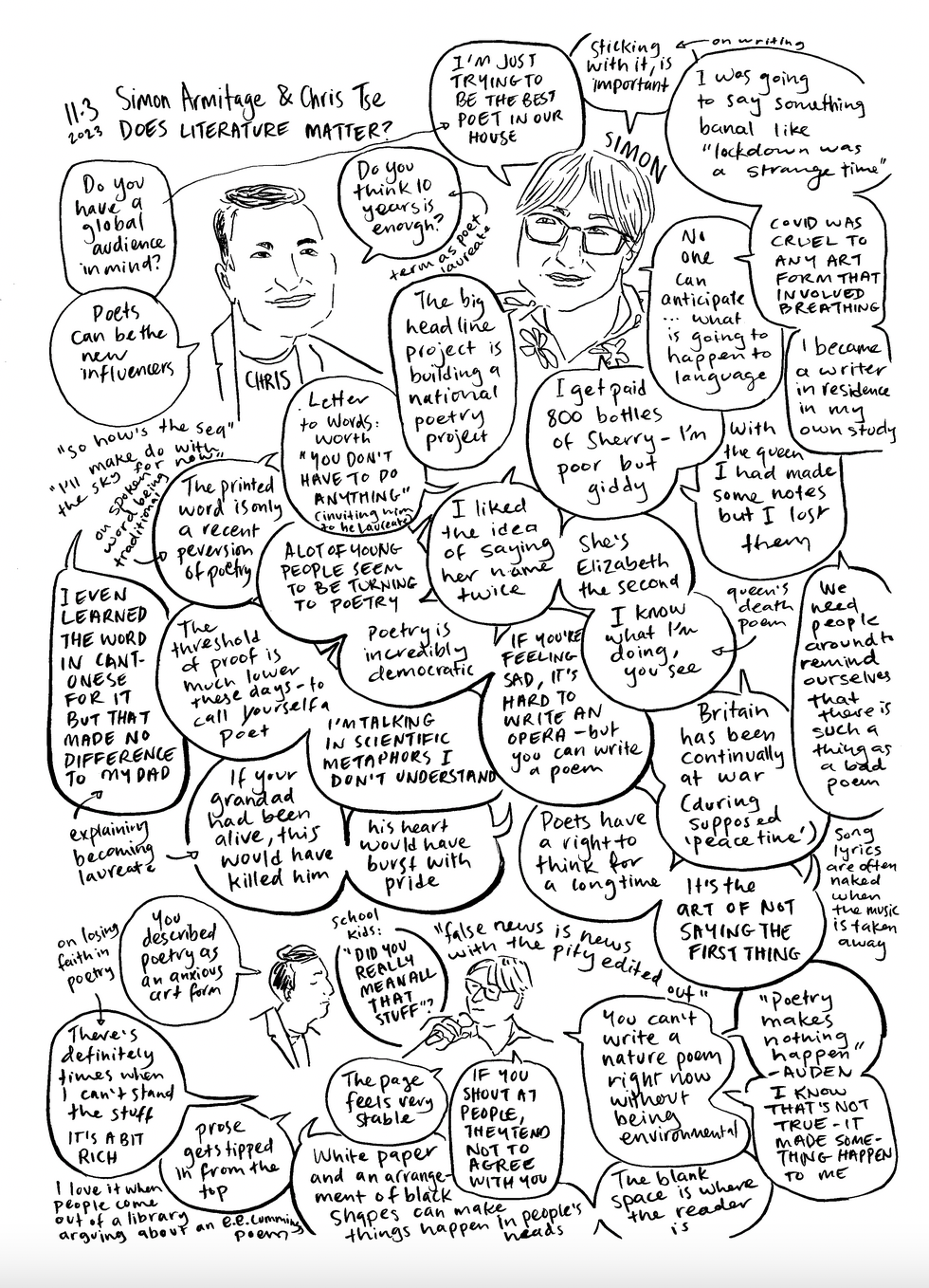
Poetry Shelf events Tara Black draws Simon Armitage with Chris Tse

UK Poet Laureate Simon Armitage has done a number of excellent events in Aotearoa (with VERB), in a conversation with our Poet Laureate Chris Tse. Here is a taste thanks to artist extraordinaire, Tara Black. You can visit her Substack site here.