
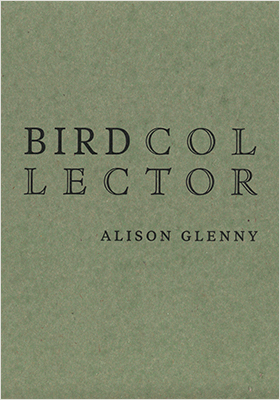
Bird Collector, Alison Glenny, Compound Press, 2021
This collection reads as if a Victorian composer, carrying her valise of new operetta libretti, collided in the street with a watchmaker, his briefcase of sketches for a new time-keeping device, and a genderfluid astronomer toting the patent forms for a mechanised solar model made of blown egg shells and bird skulls. Their papers, shuffled together by misdirected desires, unspoken and even unconscious intentions, lead to an entirely new work — a sheaf of pages where the negative space of silence speaks as pressingly as the shape of song.
Emma Neale
Alison Glenny’s new poetry book, Bird Collector, is a perfect sequel to the shining lights of her debut, The Farewell Tourist. What stood out out for me in the first collection is exquisitely revisited in the second: white space, silence, musicality, plenitude, word awareness, the footnotes. Bill Manhire, Airini Beautrais, Erik Kennedy and Emma Neale have endorsed the book. Brilliantly. To the point they almost make future reviews redundant. If you need signposts and pathways into the book, these four contributions are gold. Words that reoccur: awe, song, fragmentary, curiosities, silence, imagination, the unconscious, the gaps.
Chris Holdaway, through his Compound Press, has lovingly produced the book, using recycled materials, printing and binding it in Auckland. It includes sublime illustrations by Carrie Tiffany and by Alison herself. I am talking mesmerising. Wow! Alison’s collage-like images are gorgeous, visual overlays!
Bird Collector is in two parts: ‘Bird Organ’ and ‘Nights with the Collector’. Two halves of a beating heart. There is the off-real and the intensely real. Little caches for the hidden, little nooks for the startles. The opening poem holds out the possibility of narrative, character, the potency of things. I am picturing the poetry as paper art unfolding in water, and upon each occasion, the appearance and disappearance unexpected, as the poem comes into being. This is the joy of poetry. The way we read a poem to some surprising form of life. These are the opening lines of the opening poem, ‘Key’:
‘But we do not know in advance which key will unlock the hidden melody. Discovering it is a matter of chance—like opening a drawer at random and finding snow, or the ghost of a bird fluttering among the cogs and feathers.’
You enter the strange but it is not estranging. You come across gaslight and candles as the shade and light flicker. You enter the beautiful but not the beautifying. Sentences sing for the sake of song, and then sing along a thousand flight paths: ‘The notebooks chronicle her internal weather.’ This sentence is from ‘Bird’ where all manner of things and experiences, feeling and reactions, hide or hover over body or clothing. What is this poetry like? I keep losing words to tell you. I keep feeling I am standing in an image-rich, disorienting space, reminiscent of a steam-punk room, that stencils intricate maps on my eyes.
And perhaps each poem becomes the chest of drawers you slowly pull open. Ever so slowly you open the poem. Breathing in scent and melody, fascinations and intriguing juxtapositions. Little actions. Minute epiphanies. Individual words that are shivers, glints, clouds, seepage, dissolution: ‘The difference between use and exchange lay in an abstraction. When she opened the instrument, a cloud of butterflies flew out of the ghostly remains of a forest.’
At times there is a single sentence on the page or even simply a poem title which is expanded upon in a series of footnotes, on the facing page and is always always embraced by the white space, the generous silent beat (for example, ‘Footnotes to a History of Mourning’, Footnotes to a History of Birdsong’).
At times the poems feel like a series of hauntings to me.
At times it feels like scatter and rustle and perfume.
Why do I keep making comparisons to the making of a poem as I read this? The second section is set in a planetarium. The narrative foregrounds catalogues, collecting, cataloguing the collections. Keeping, discarding, keeping discarding. Caring for the souvenir, the ‘tiny shards’. Managing the challenge of falling snow. The sequence of paragraphs/poems offers endings that speak of ash and fracture, then move into poetry skeletons. A handful of words falling like snow down the page. And then the skeleton becomes footnotes, an intriguing aside that catapults you in fresh directions of contemplation, reverie. And what remains? Shadow and light? Ash? The weather? A love story. A lost story? The key is missing we read, and yet every time we travel through the book, we assemble our own key.
‘Some fragments of paper always remained from the burning of the
catalogues. She likened them to telescopes, pointing to a part of the
sky where everything is centred upon vacancy.’
from ‘Footnotes to a History of the Fragment’
The sources cited in the acknowledgements would enhance our reading pathways. I am wondering how we collect as we read. I want to check out: the poetry of Stéphane Mallarmé (again), Susannah B Mintz’s essay ‘Forms of Self-Disclosure in the Lyric Essay’ and Jasmine Gallagher and Kristina Marie Darling on specific found forms.
Alison is one of our most original poets: lyrical, heart-sustaining, mind-altering, hallucinogenic, attentive. Bird Collector demands the very best superlatives you can summon. For me this this is poetry standing on its tip-of-the-toes best, it’s sublime.
Alison Glenny lives on the Kapiti coast. Her Antarctic-themed collection of prose poems and fragments, The Farewell Tourist, was published by Otago University Press in 2018.
Compound Press author page
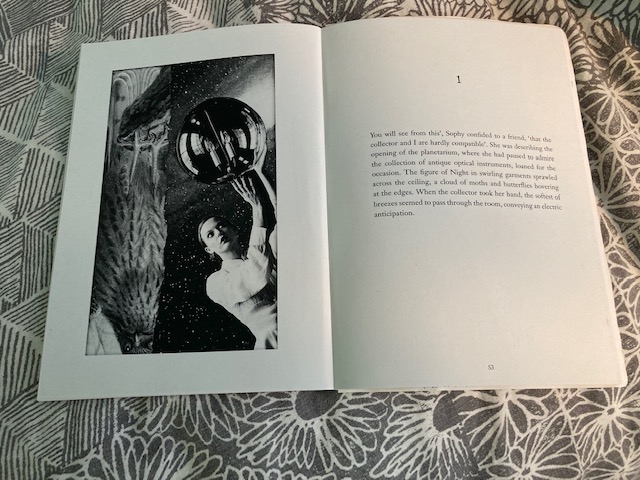
Image by Alison Glenny
 NZ Poetry Shelf