
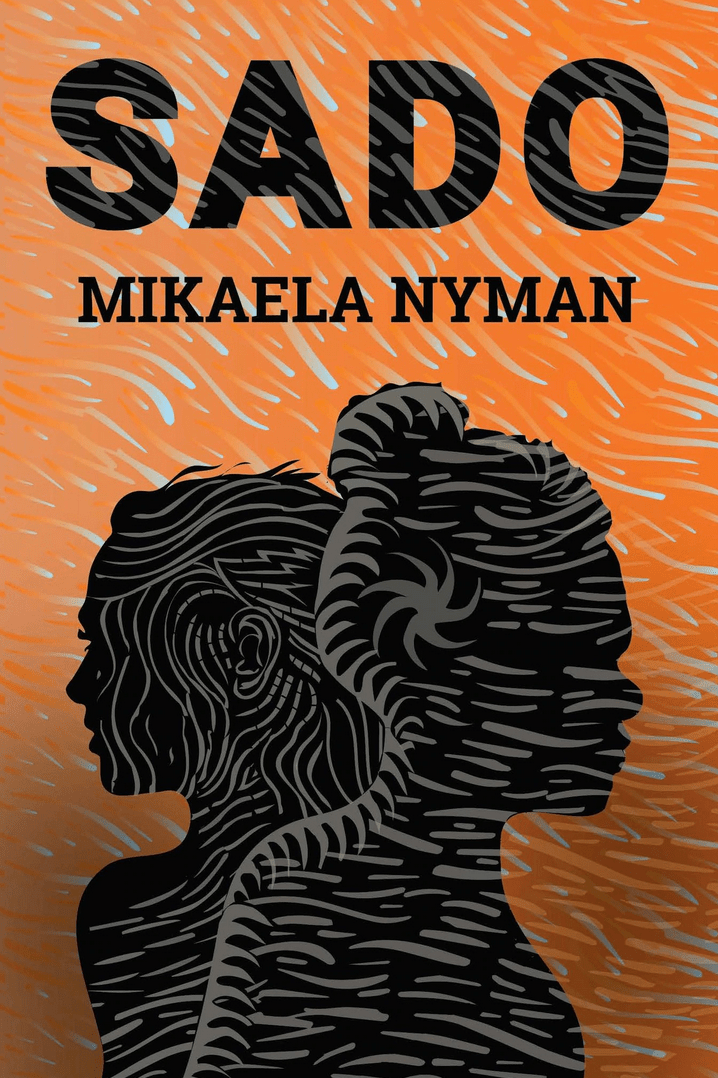
Sado Mikaela Nyman, Victoria University Press, 2020
At the end of the day, poetry and fiction are just different languages in which to express what matters most to me.
Mikaela Nyman, VUP Q & A
During lockdown Poetry Shelf hosted a virtual launch for Mikaela Nyman’s debut novel Sado. To miss out on the celebration of your first novel with friends and family, with people buying your books and you signing them is a big thing, and it seems so many of the books that were due during lockdown have missed out in other ways. Bookshops were shut, print media was on life-raft rations. And we were all struggling with subterranean anxiety, surreal connections with a surreal world. What mattered became a key question. I was delighted to see Mikaela has recently celebrated the book at a launch event with Elizabeth Smither.
Books are getting less attention in print media at the moment, but thank heavens for the commitment of some editors (Canvas is still doing its utmost best to include NZ reviews). And thank heavens for online review activity. But I do hear authors saying their recent books have disappeared into the ether.
I recently read a wonderful Q & A that Mikaela did for Victoria University Press; it has prompted me to post the link here and include a few personal reactions to the novel.
She doesn’t trust her memory to retain the sharp edges. One day this will appear no worse than a regular spring storm. People will try to convince her it wasn’t half as terrifying, that she’s made it up, that they watched movies and drank wine or cups of spice tea while the storm blew itself out. It would be unfair to anyone who was caught in this cyclone and in the storms to come. Because there are going to be more of them, increasing in frequency and intensity as the earth and the oceans warm up and create this atmospheric oscillation, this unpredictable lashing and swirling.
from Sado
Reading Sado during a time of world catastrophe – when some people are struggling to cope with the effect of Covid on their lives, when some people have greater access to what they need – is timely. Mikaela’s novel is set in 2015 in Vanuata at the time Tropical Cyclone Pam hit. The devastation is widespread – physical yes, but it also impacts on lives in myriad ways. Cathryn is an NGO worker from Aotearoa, with a local boyfriend and a teenage son. Faia is a radio journalist, a community organiser who works hard for women. There are various tensions between contemporary life and tradition. However the blazing-hot kernel of the story is a car accident where a young baby is killed, and kastom (custom) declares a child must be offered in compensation.
It grew out of the realisation that Vanuatu didn’t seem to feature on people’s radar in New Zealand – despite the fact that it is only a three-hour direct flight away, and we have thousands of Ni-Vanuatu come every year to work in our vineyards and orchards.
Mikaela, VUP Q & A
Patriarchy is a dominant force – women’s lives are regulated with scant access to power, individual choices, work opportunities. Justice is called into question by different actions of the Supreme Court and the Council of Chiefs. Yet Sado showcases the power of women to connect, to support, to communicate.
My nagging question: how did Mikaela get to write a novel outside her own culture and negotiate ideas of trespass? Mikaela was born in Finland, spent four years in Vanuatu and now lives in New Plymouth with her family. She writes poetry, fiction and nonfiction in both English and Swedish, and has published a collection of poetry in the latter. Her PhD in Creative Writing (IIML) involved a collaboration with Ni-Vanuatu writers. In her endnotes Mikaela describes Sado as a work of fiction shaped by her own experience of the cyclone, and her enduring friendships with writers and former colleagues in Vanuatu. Her expressed hope, having found only a few slender volumes by Ni-Vanuatu women, is that her novel will encourage ‘women writers from Vanuatu to tell their own stories’.
The questions mounted as I read – but have in fact been addressed by the Victoria University Press interview:
And so I chose to become an ally and supporter, and perhaps a conduit for New Zealanders to glean a different perspective of their Pacific neighbour. To help explain what it feels like to be at the receiving end of such a natural disaster in our Pacific neighbourhood and to have to deal with an unprecedented influx of responders and well-intended, but perhaps misplaced, relief efforts. In parallel, I’ve shared my writing, my knowledge and skills with emerging Ni-Vanuatu women writers, facilitating creative writing workshops and collaborative poetry events, in order to find my place in the world and enable Ni-Vanuatu writers to grow as writers and see their work published. ‘Nothing about us without us,’ one of my Māori colleagues said to me when we discussed the ethos informing my research and novel writing. It reinforced my decision that working in alliance and collaboration would be the best ethical choice. Taking heart from the fact that these Ni-Vanuatu women writers were among my first readers and encouraged me to keep writing this world that they recognised, while at the same time ensuring I left space for Ni-Vanuatu writers to tell their own stories. The kind of insider stories I couldn’t possibly tell.
Mikaela, VUP Q & A
So for me the novel has two vital impacts. The way I muse on the context in which the book was written. The slow surfacing of women’s voices, women writers, in Vanuatu. Poet and academic, Selina Tusitala Marsh has spent a number of years researching women writers across Pacific regions, working hard at finding ways to make their voices visible, and importantly, to find an apt expression of her own reading engagements. Selina’s book is still in the making but will be a significant arrival. If Vanuatu women’s books can springboard from Mikaela’s projects and engagements, along with the efforts of local women, then that is a blessing.
The second impact is the narrative itself: gripping, character driven, building complexity in its representation of place, people, culture. That Mikaela is a poet is made clear in the sentences and rhythmical fluency, at times lyrical, at times economical. I have no difficulty with the interplay of different registers. In a sense it mirrors the entanglement of culture, relationships and experience that is paramount. At the moment, in a world struggling with clashing perspectives, needs and outcomes, everything is complicated, so many challenges.
The novel’s complexity is also placed in sharp relief by the focus on various characters. Even in the aftermath of catastrophe, life carries on. Relationships might change, circumstances are affected, and what is normal shifts. So many entangled threads: Carolyn’s teenage son, her Ni-Vanuatu boyfriend, her mother, her attachment to Aotearoa, her friendships, her reaction to cultural difference, and of course the impact of climate change. All manner of storms – minor and major – that affect individuals, partnerships, families in all manner of ways.
As a reader I need multiple views and multiple engagements. Sado does open Vanuatu for me, I feel like I have visited somewhere I have never been before, and encountered versions of it through the eyes and thoughts and feelings of a visitor, a visitor who has lived there. I am grateful for this book that has moved me on many levels, but like Mikaela, I hunger for space to make as many voices and stories and concerns visible and viable.
Listen to Mikaela read an extract at her Poetry Shelf online launch
 NZ Poetry Shelf