Monthly Archives: October 2019

Poetry Shelf noticeboard: Sue Wootton announced as 2020 Katherine Mansfield Menton Fellow


sue_wootton-300dpibw-546x600.jpg


Dunedin author Sue Wootton has been selected as the next Katherine Mansfield Menton Fellow and plans to use her time in Menton to write new poetry.

“I still remember reading Katherine Mansfield’s Bliss when I was a teenager, and being knocked sideways by what she could do with a sentence. Forty years on, and I am deeply honoured to have the opportunity to live and write for three months in Menton, France, as the 2020 Katherine Mansfield Menton Fellow. My main project while I’m there will be writing poetry towards a new collection whose working title is Systems of Light. I have the wonderful feeling that the chance to immerse myself in a completely different place and language will generate, to use Katherine Mansfield’s phrase, a whole new “shower of sparks”, says Sue Wootton.

Sue Wootton’s most recent publications are her novel, Strip, which was longlisted in the 2017 Ockham NZ Book Awards, and her fifth poetry collection, The Yield, which was a finalist in these awards in 2018. Sue grew up in Whanganui and Wellington and now lives in Dunedin. A physiotherapist-turned-writer, she is a PhD candidate at the University of Otago, researching the importance of imagination and language in recovery and wellbeing. She co-edits Corpus: Conversations about Medicine and Life, found at https://corpus.nz/ and teaches creative writing in schools, universities and community settings. She is currently writing a novel about a group of friends caught up in the 1948 polio epidemic.

Sue was the successful recipient of the Katherine Mansfield Fellowship in a very strong field of New Zealand writers spanning all genres of literary endeavour. The selection panel was impressed by the breadth of her work to date and the well-developed project put forward for her time in Menton, when she will be working on her sixth poetry collection. This body of work will continue her substantial and acclaimed body of work which includes 5 poetry collections, a children’s book and a novel. In recent years she has shown her eminence in her chosen literary fields thorough winning several international and national poetry competitions, as well as receiving awards for her short stories.


Previous recipients include Paula Morris (2019 fellow), Carl Nixon, Kate Camp, Anna Jackson, Mandy Hager, Greg McGee, Justin Paton, Chris Price, Ken Duncum, Damien Wilkins, Jenny Pattrick, Stuart Hoar, Dame Fiona Kidman, Ian Wedde and other prestigious writers such as Bill Manhire, Janet Frame, Witi Ihimaera, Elizabeth Knox, Lloyd Jones, Roger Hall, Marilyn Duckworth, Michael King and Allen Curnow.


Warm congratulations from Poetry Shelf!

Poetry Shelf noticeboard: Te Rito o te Harakeke – A collection of writing for Ihumātao


Screen Shot 2019-10-02 at 9.16.14 AM.png


Cover art: ‘Pono’ by Maioha Kara (Waikato, Ngāti Kahungunu, Te Arawa and Ngāti Porou)


The contributors: Hana Pera Aoake, Hinemoana Baker, Cassandra Barnett, Tyson Campbell, Jacqueline Carter, Anahera Gildea, K-t Harrison, Rangimarie Jolley, Maioha Kara, Johanna Knox, Rāhiri Mākuini Edwards-Hammond, Anna McCallister, Donna McLeod, Kōtuku Titihuia Nuttall, Sinead Overbye, Tru Paraha, Michelle Rahurahu Scott and Lyssa Rogers-Rahurahu, essa may ranapiri, Serena Ngaio Simmons, Carin Smeaton, Stacey Teague, Ruby Mae Hinepunui Solly, Alice Te Punga Somerville, Tayi Tibble and George Watson


Note from the organisers (Rangatahi o te Pene, Hana Pera Aoake, Sinead Overbye, Michelle Rahurahu Scott and essa may ranapiri):


The book was produced in five weeks, and almost all of these pieces were written within a two week period.

Our aim was to bring together a wide range of Māori authors to respond to the events at Ihumātao, to show that Māori all have different voices and different perspectives, even though there are commonalities among us (i.e. ancestral trauma, the pain of which still runs through the core of the book). We brought together more established Māori authors to sit beside newer Māori voices, including poets who have never been published before.
The title Te Rito o te Harakeke comes from a well known whakatauki ‘Hutia te rito o te harakeke, kei whea te kōmako e kō? Kī mai ki ahau; He aha te mea nui o te Ao? Māku e kī atu, he tāngata, he tāngata, he tāngata’. This translates as ‘If the heart of the harakeke was removed, where would the bellbird sing? If I was asked; What is the most important thing in the world? I would reply, it is people, it is people, it is people.’
At the core of the book is people. At the core of the movement at Ihumātao is people. We need to come together in times of struggle, in order to support each other to go on. That is what this book was about. The ‘rito’ of the harakeke refers not only to the ‘heart’ or ‘core’ of the harakeke, but also metaphorically to the younger generations in a whānau. The whakatauki, and the title of the book, therefore also implies that if we do not foster and support the younger generations, we will not progress as a people.
The organisers of this project- Hana Pera Aoake, Sinead Overbye, Michelle Rahurahu Scott and essa may ranapiri- did not edit or alter any of the kupu in the book. Each piece is published exactly as the artist intended. Each piece is perfect just as it is. As you read the physical copy, you will notice the hand-stitching, experimental formatting, and even a fold-out poem in the centre (as one of our poets desired the book to fold out from the book like a map). We wanted to maintain the integrity and mana of each piece of work. We wanted to create a space where every artist could express themselves exactly as they wanted.
There is grief at the heart of this book, and there is pain, but there is also hope. Out of this project, new friendships and connections have flourished. We are creating a space for ourselves, and we are creating new communities and opportunities. We hope that the book continues to be shared amongst friends and whānau. We hope that it sparks kōrero about our history, and that it helps to guide Māori who might otherwise feel alone.

No reira, we are very proud to have this book out in the world. He taonga ia.
Ehara taku toa i te toa takitahi, ēngari he toa takimano e – My strength is not mine alone, but the strength of many.


You may find more information about the pukapuka and how to get a copy here

essa may ranapiri’s poem here


IMG_5122.JPG


Poetry Shelf noticeboard: Landfall essay competition joint winners

Landfall essay competition joint winners profound and persuasive

Wellington writer Tobias Buck and London based New Zealand writer Nina Mingya Powles are the joint winners of the 2019 Landfall Essay Prize.

Tobias Buck’s winning entry, ‘Exit. Stage Left.’, deals with issues of prejudice and bias from the perspective of a man who ‘is the colour of cotton candy or pink marshmallows’, whose hair is ‘definitely platinum’.

His essay is full of persuasive visual detail, and an ear for the unpleasant reverberations of everyday speech, says competition judge and Landfall editor Emma Neale. Ms Neale says she admires the way the essay effortlessly displays touches of history, pop culture and general knowledge in its discussion of identity.

Nina Mingya Powles’ essay, ‘Tender Gardens’, combines both profound, even urgent subject matter with an agility of style, says Ms Neale. The essay allows for pleasure and beauty, yet also tightens the screws on recognition of various humanitarian or philosophical issues such as racial prejudice, cultural identity and how to make a home in a foreign land.

In third place is Sarah Harpur’s essay ‘Dead Dads Club’. Placed fourth equal are Joan Fleming’s ‘Write First, Apologise Later’ and ‘The Art and Adventure of Subsistence’ by Jillian Sullivan.

Highly Commended essayists are Ingrid Horrocks (‘Where We Swim’); Himali McInnes (‘The Place’) and Derek Schulz (‘Kiwi Made’). Commended essayists are Justine Jungersen-Smith (‘Half Sugar Half Sand’) and Amy Brown (‘To Hold in the Palm of the Hand’).

Tobias Buck and Nina Powles each receive $1500 and a year’s subscription to Landfall. The winning entries will be published in Landfall 238, available in November. Landfall is published by Otago University Press. Some 64 anonymous entries were received in this year’s competition, down on last year’s 91.

For more information about the Landfall Essay Prize and past winners

The winners

Born in 1978 and currently living in Hawke’s Bay, Tobias Buck studied art history and creative writing, under Gregory O’Brien, and completed post-graduate degrees in the US and in Scotland at the University of Edinburgh.
He worked in digital media and publishing in London and, alongside owner Tilly Lloyd recently helped project-manage the redesign of Unity Books in Wellington. He was the last recipient of the BNZ Katherine Mansfield Award for his story ‘Islands in the Stream’ and in 2018 was Highly Commended for his essay ‘Aquae Populus’.

Nina Mingya Powles is a poet and writer of mixed Malaysian-Chinese heritage, born in Wellington and currently living in London. Her recent publications include Luminescent (Seraph Press, 2017) and field notes on a downpour (If A Leaf Falls, 2018). She is a co-editor of Tupuranga journal, poetry editor of The Shanghai Literary Review, and founder of Bitter Melon

Poetry Shelf fascinations: Helen Rickerby’s How to Live

1565824292476.jpg

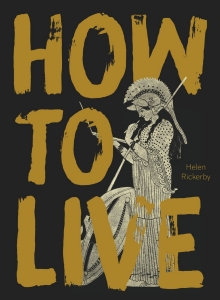
How to Live, Helen Rickerby, Auckland University Press, 2019


When that philosopher said life must be lived forwards

but can only be understood backwards

he was not thinking of me

I have lived all kinds of lives


from ‘A pillow book’


Helen Rickerby’s latest poetry collection How to Live is a joy to read. She brings her title question to the lives of women, in shifting forms and across diverse lengths, with both wit and acumen. Like many contemporary poets she is cracking open poetic forms – widening what a poem can do – as though taking a cue from art and its ability both to make art from anything and in any way imaginable.

Reading this book invigorates me. Two longer poems are particularly magnetic: ‘Notes on the unsilent woman’ and ‘George Eliot: a life’. Both function as fascination assemblages. They allow the reader to absorb lyrical phrases, humour, biography, autobiography, insistent questions. Biography is enlivened by such an approach, as is poetry.


6.   It seems to me that poetry usually begins with the self

and works its way outwards; and the essay, perhaps, starts

outwards and works its way in towards the self.


from ‘Notes on the unsilent woman’


Thinking of the silent woman I am reminded of Aristotle’s crown of silence that he placed upon she. I then move across centuries to Leilani Tamu’s poem ‘Mouths Wide Shut’ where she sits on a bus with her mouth taped shut silent. The skin-spiking poem (and the protest) considers silence in the face of racism. Even now, even after the women’s movements of the 1970s and the explosion of feminism and feminisms over ensuing decades, men still talk over women, still dismiss the women speaking (take women in power for example, or a young woman at the UN challenging climate-change inertia).

What Helen does is remind us is that silence is like snow – it is multi-hued and deserves multiple names and nuances: ‘Silence isn’t always not speaking. Silence is sometimes / an erasure.’

Ah the stab in my skin when I read these lines. In ‘Notes on the unsilent woman’ Helen draws me in close, closer and then even closer to Hipparchia of Maroneia (c 350 – c 280 BC).


5.    But I do have something to say. I want to say that she

lived. I want to say that she lived, and she spoke and she

was not silent.


Helen gathers 58 distinctive points in this poem to shatter the silence. Sometimes we arrive at a list of women who have been both audible and visible in history, but who may have equally  been misheard, misread and dampened down. At other times the poet steps into view so we are aware of her writing presence as she records and edits and makes audible. In one breath the poet is philosopher: ‘Silence might not be speaking. It might be / listening. It can be hard to tell the difference.’ In another breath she apologies for taking so long to bring Hipparchia into the picture.

Elsewhere there is an ancient warning: ‘”If a woman speaks out of turn her teeth will be / smashed with a burnt brick.” Sumerian law, c. 2400 BC.’

A single line resonates with possibilities and the ‘we’ is a fertile gape/gap/breathing space: a collective of women, the poet and her friends, the women from the past, the poet and I: ‘There are things we didn’t think we could tell.’ Yes there are things we didn’t think we could tell but then, but then, we changed the pattern and the how was as important as the what.

Another single line again resonates with possibilities for me; it could be personal, it could equally be found poetry: ‘I would like to be able to say that  it was patriarchy that stopped me talking on social media, but it wasn’t, not / directly.’

I read ‘Notes on the unsilent woman’ as a poem. I read this as an essay. I am tempted to carry on with my own set of bullet points as though Helen has issued an open invitation for the ‘we’ to speak. Me. You. They. She quotes Susan Sontag: ‘The most potent elements in a work of art are, often, its silences.’


The other poem I dearly love, ‘George Eliot: a life’, is also long form. Like the previous poem this appears as a sequence of numbered sections that are in turn numbered in smaller pieces. It is like I am reading a poem and then an essay and then a set of footnotes. An assemblage of fascinations. Biography as fascination allows room for anything to arrive, in which gaps are curious hooks, reflective breathing spaces and in which the personal is as compelling as the archives. Helen names her poem ‘A deconstructed biography’ and I am reminded of  fine-dining plates that offer deconstructed classics. You get a platter of tastes that your tongue then collates on the tongue.

To taste ‘George Eliot: a life’ in pieces is to allow room for reading taste buds to pop and salivate and move. This is the kind of poem you linger over because the morsels are as piquant as the breathing spaces. It delivers a prismatic portrait of George Eliot but it also refreshes how we assemble a biography and how we shape a poem. Helen brings her acerbic wit into play.


10.7.1.  But the fact is, and I don’t want to give you spoilers, that for such an

extraordinary woman she sure did create some disappointing female

characters. Even the heroines don’t strike out – they give up, they stop,

they enclose themselves in family, they stand behind, they cease, they  die.

They found nothing.


10.7.2.   Did she think she was too exceptional to be used as a model for her

characters? Did she think that while she was good enough to be involved

in intellectual life, and she could probably even be trusted to vote, the same

could not be said for her inferior sisters?


A number of smaller poems sit alongside the two longer ones including the moving ‘How to live though this’, a poem that reacts to an unstated ‘this’. ‘This’ could be anything but for me the poem reads like a morning mantra that you might whisper in the thick of tough times or alongside illness or the possibility of death.

‘How to live’ is a question equally open to interpretation as it ripples through the poems; and it makes poetry a significant part of the myriad answers. I haven’t read a book quite like this and I love that. The writing is lucid, uplifting, provocative, revealing, acidic, groundbreaking. The subject matter offers breadth and depth, illuminations, little anchors, liberations, shadows. I am all the better for having read this book. I just love it.


I slept my way into silence

through the afternoon, after days

of too many words and not enough words

to make the map she needs

to find her way from here

I wake, too late, with a headache

and she, in the garden wakes up shivering


from ‘Navigating by the stars’


Auckland University Press author page

Helen reads ‘How to live through this’

Helen on Standing Room Only